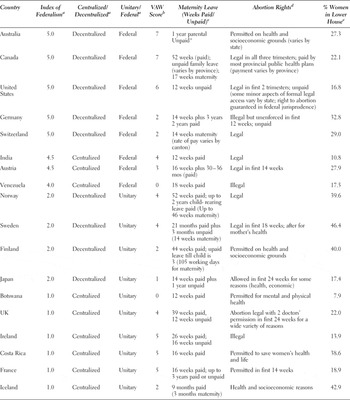
Federalism seems to play a widely varying role in maintaining or undermining gender hierarchies around the world. In 1869, for example, federalism allowed Wyoming—a new state in the United States—to enfranchise women before this happened at the national level. But in Switzerland, federalism let a recalcitrant canton disenfranchise women until the 1990s—20 years after women achieved the vote on the national level (Banaszak Reference Banaszak1996). More generally, federal institutions are associated with widely varying policies on women's rights. Table 1 groups countries according to Lijphart's (1999, Chapter 10) three measures of federalism: a numerical summary measure (column 2), whether the country is centralized or decentralized (column 3), and a dichotomous measure of federal or unitary based on the country's constitution (column 4). No matter which measure is used, gender equality policies vary greatly within each type of system. The wide variation within each category suggests that standard approaches to federalism give us little purchase on gender politics.
Measures of federal character and four areas of women's status

* Australia recently adopted a law permitting 18 weeks paid leave for families earning less than $150,000.
Notes: aLijphart Reference Lijphart1999; bWeldon Reference Weldon2002; cClearinghouse 2000 /International Labour Organization 2010; dCenter for Reproductive Rights 2008; eInterparliamentary Union 2010.
Moreover, the same country may have widely differing levels of gender equality across issue areas, so that focusing on a relatively static feature of the whole country provides only limited insight (Htun and Weldon Reference Htun and Weldon2010). For example, the United States has responded more extensively to violence against women than many other countries, but has no paid maternity leave; women also have relatively strong legal rights to abortion, although it is less available in practice. By contrast, Finland has more generous maternity leave but fewer policies responding to violence, and abortion is legally restricted (but widely available). So, the impact of federal institutions on gender relations must be contingent on other factors. Indeed, many scholars of federalism acknowledge the contingent impact of institutional design (Beramendi Reference Beramendi, Boix and Stokes2007; Chappell Reference Chappell, Krook and Mackay2010; McRoberts Reference McRoberts and Atkinson1993). But the theoretical challenge remains to specify the conditions on which the effects of federalism depend: Why does federalism have the different effects it does on gender relations around the world?
In analyzing how federalism influences gender policy, most scholars—both feminist and mainstream—examine formal institutional constructions. Although they note that different norms and practices exist, their major explanatory variables are different aspects of formal institutions. Some focus on vertical divisions of power, such as the power relations among different levels of government (Irving Reference Irving2008, 65–66; Jackson and Jackson Reference Jackson and Jackson2006; Wheare Reference Wheare1964), while others add horizontal divisions of power, that is divisions among different branches of government (judiciary, executive, and legislative functions), such as whether a parliamentary system exists (see Vickers's essay or Lijphart Reference Lijphart1999). Still others see federalism affecting gender policy mainly through the creation of multiple points of entry for women's movements (Bashevkin Reference Bashevkin1998; Chappell Reference Chappell2002; Elman Reference Elman1996) and their opponents (Banaszak Reference Banaszak, Banaszak, Beckwith and Rucht2003). Formal structures of federalism may also create inequality among women because some groups of women have less access to policymaking (Vickers Reference Vickers, Brown and Hiebert1994) or larger collective-action problems, particularly when they lack resources (Miller Reference Miller2008).
For all of these analyses, the formal institutions of federalism are the primary causal variables. We argue that attending also to informal institutions increases our analytic leverage, providing systematic explanations of the causal mechanisms by which formal institutions shape gender inequality and better explaining why federal systems have such different effects.Footnote 1
Given that studies of federalism may not be discussing the same formal institutions, the same gender issues, or the same groups of women, it is unsurprising that analyses of federalism's effect on gender arrive at very different conclusions (Gray Reference Gray, Haussman and Sawer2010; Vickers 2010). But we argue that even if one group of women or one area of women's status were examined, formal institutions of federalism do not determine national policy outcomes. Even for the same gender issue within one country, the impact of something like the vertical division of power can vary over time.
Importantly, much of the variation in impact occurs without concurrent changes in the formal institutions. In the case of U.S. family law, for example, the shift in the way that the division of powers was interpreted with respect to gender equality occurred not because of change in formal institutions but because of changes in the meaning of those provisions, which mirrored normative, social changes that resulted from women's mobilization. Hence, Reed v. Reed (1971) was the first time that the U.S. Supreme Court voided a state statute because of the equal protection clause in relation to sex, though the Fourteenth Amendment had been adopted in 1868. By the mid-1980s, state laws no longer survived challenges on equal protection grounds (Hoff Reference Hoff1991). In Orr v. Orr, the Supreme Court held that “[n]o longer is the female destined solely for the home and the rearing of the family.” While family law still varies across states (American Bar Association 2010), certain types of variation are no longer constitutionally permitted.Footnote 2 This example shows that changes in informal institutions, such as gender norms, provide additional leverage in explaining why the same formal institutions have different effects at different times.Footnote 3
Informal norms and institutions, defined here—following Helmke and Levitsky (Reference Helmke and Levitsky2004, 727)—as “socially shared rules, usually unwritten, that are created, communicated, and enforced outside of officially sanctioned channels,” mediate the impact of formal rules about division of powers. Studies of informal institutions within comparative politics have generally revolved around corruption or larger cultural practices, with little if any focus on the informal institutions of gender (Helmke and Levitsky Reference Helmke and Levitsky2004; Mershon Reference Mershon1994). We focus, however, on the informal institutions that constitute gender relations and examine their influence on formal institutions. We chose to concentrate on informal institutions, rather than the larger concept of norms and practices, because we believe it important to recognize the use of enforcement by both the state and societal actors in creating these informal institutions. For example, in many countries, informal institutions relegate women to the homemaker role, enforce normative heterosexuality, and/or privilege men in the family and leadership positions. These are not just patterns of behavior but, rather, informal institutions that are communicated, enforced, and sanctioned through nonofficial channels. These informal institutions are communicated through the media, educational materials, and informal interactions within communities: They are sanctioned by ridicule and social disapprobation, by religious communities' practices, and through violence against women and men who violate gender scripts. Indeed, even state actors informally sanction such institutions when police refuse to take violence against women by spouses as seriously as they do bar brawls.
In recognizing the role played by informal institutions, we are not saying that formal rules are irrelevant. Any account of federalism that relies entirely on formal rules, however, will be incomplete because it slights the powerful role that informal institutions play in mediating the effects of formal institutions.
Any political institution—formal or informal—can be categorized by whether it embodies egalitarian or male-biased approaches to gender relations. For example, formal institutions, such as those constitutional provisions that interpret the division of power by making explicit the importance of protecting the traditional family, may reinforce gender hierarchy by preserving male privilege.Footnote 4 Formal institutions can also be male biased when gender equality is explicitly defined as less important than other goals, such as ethnic harmony or local autonomy. Alternatively, formal institutions (e.g., quota laws) may explicitly reference gender equality and women's rights.Footnote 5 Informal institutions may vary similarly along this dimension, alternately promoting or undermining gender equality or privileging masculinity.
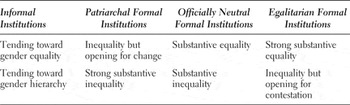
As Table 2 suggests, the egalitarian or male-biased nature of formal and informal institutions need not be in harmony. Gender quotas, for example, may counter social practices that disadvantage women seeking leadership positions. In some cases, both formal and informal institutions are patriarchal. Even formal provisions that appear to be gender neutral, however, can be interpreted in ways that produce inequality. In Nigeria, for instance, the constitution is currently interpreted as stating that federal laws pertaining to women and children must be readopted by every state, though this is not written in the constitution. Thus, although the Nigerian national legislature adopted the Child Rights Act in 2003, the law must also be adopted in individual states to be enacted outside of the Federal Capital Territory of Abuja (Toyo Reference Toyo2006; Weldon, Htun, and O'Brien Reference Weldon, Htun and O'Brien2009). Among other provisions, this law states that girls must be 18 years of age before they marry. In general, informal practices permitting variation in core aspects of women's citizenship and personhood across subnational units—such as Nigeria's multiple ages of consent—reflect a distinctly gendered position that sees women's citizenship and personhood as optional. Permitting women to be treated as chattel or noncitizens in some jurisdictions but not others is something prohibited by international conventions on human rights, for example.
How formal and informal institutions shape gender equality outcomes

Note: Whether a formal institution like federalism is equality promoting or not varies across social group and issue area.
Thus, informal norms about gender relations may reinforce, conflict with, or be accommodated by formal institutions. Even in new institutions, informal norms can be very powerful. New institutions are not blank slates, where institutional operations are determined by formal rules (Mackay Reference Mackay2009). Importantly, gender equality outcomes cannot be read off as either informal or formal institutions examined alone. As Table 2 suggests, when we hold the level of gender equality in informal institutions constant, we see variation in outcomes across different types of formal institutions. Similarly, when we hold the level of gender equality in formal institutions constant, we also see variation in outcomes across different levels of informal institutions. Therefore, the interaction between formal and informal institutions must be examined in order to explain institutional effects.
The relationship between formal and informal institutions also explains the opportunities for changing these institutions. The greatest opportunity to alter existing institutions occurs when formal and informal institutions conflict (see Table 2). Helmke and Levitsky (and other institutionalists) overlook the power of social movements as mechanisms of change in informal and formal institutions. Women's movements are important agents of change to gender hierarchies since they seek to alter not just policies and formal institutions but also gender norms. This multiple focus increases their opportunities to effect change. Informal gender institutions, even those tending toward gender hierarchy, may be altered by creating more gender equality in formal institutions. For example, where quota laws have been adopted, changes in women's representation have altered norms about women's leadership abilities to some degree, even where these were initially highly patriarchal. Similarly, where formal rules are patriarchal but informal institutions are more egalitarian, there have been greater opportunities for women's movements to alter formal institutions (see McCammon et al. Reference McCammon, Campbell, Granberg and Mowery2001).
Distinguishing between formal and informal institutions helps us understand the seemingly inconsistent impacts of the same federal structures on gender hierarchies: Only rarely do constitutional divisions of power explicitly relegate the concerns of women to a particular level. Most modern constitutions also do not explicitly disempower women. Rather, federalism is often characterized by a formal gender neutrality that accommodates informal norms of gender inequality (see column of neutral formal institutions in Table 2). When constitutions formally guarantee women's equality, feminists have more opportunities to transform federalism (Bashevkin Reference Bashevkin1998). Yet change usually occurs by empowering or sparking women's mobilization to bring political practice in line with the guarantees in formal institutions (Chappell Reference Chappell, Krook and Mackay2010). As such, formal institutions supporting gender equality reshape the informal norms and formal structure of federalism. An unfavorable division of power can also be altered, thereby affecting the informal norms that govern the interpretation of the constitution.
In sum, any analysis of the impact of formal institutions on gender needs to take into account informal institutions as well. Here, we only begin to chart the relationship between formal and informal institutions of federalism and their impact on gender policies. Our discussion of informal institutions takes us far from most studies' focus on the organization of shared rule or fiscal federalism. Changes in both formal (e.g., Canada's Charter of Rights and Freedoms) and informal institutions (e.g., norms about citizenship) that are not core dimensions of federalism nonetheless shape federalism's operation. To understand how formal institutions of federalism are gendered, and how gender shapes federalism, we must attend to the broader institutional context in which federalism is embedded. Such a broader analytic approach reveals that a key mechanism of change, even change in federal institutions, is social mobilization by women to advance gender equality.