Nam Kading National Protected Area, located in central Laos, is one of the most globally significant natural ecosystems of the Lao People's Democratic Republic (Hallam & Hedemark, Reference Hallam, Hedemark, Sunderland, Sayer and Hoang2013). The national park covers an area of c.169,000 ha, with an altitudinal gradient from 138 m in the lowlands to 1514 m at the summit of Mount Phou Pa (Hallam & Hedemark, Reference Hallam, Hedemark, Sunderland, Sayer and Hoang2013). The vegetation is diverse along this gradient, containing lowland evergreen forest, mixed deciduous forest, grasslands, wetlands and limestone karst (Strindberg et al., Reference Strindberg, Johnson, Hallam, Rasphone, Helm, Xiongyiadang and Sisayah2007; Hallam & Hedemark, Reference Hallam, Hedemark, Sunderland, Sayer and Hoang2013). Whereas the vertebrate fauna, including at least 43 species of mammals, 234 species of birds and 21 species of reptiles, has been well documented in the area (IEWMP, 2006; WCS, no date), very limited studies of the flora (Electrowatt, 1995; Hwang et al., Reference Hwang, Moon, Bounphanmy, Yoon and Sun2015; Souladeth et al., Reference Souladeth, Tagane, Zhang, Okabe and Yahara2017) have been made as in the other areas in Laos (Rundel, Reference Rundel1999; Newman et al., Reference Newman, Thomas, Lanorsavanh, Ketphanh, Svengsuka and Lamxay2007a).
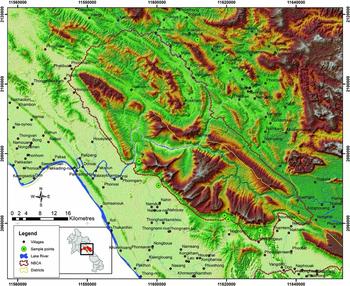
To elucidate the flora of Nam Kading National Protected Area, we carried out botanical inventories from 22 to 26 December 2016, and from 26 to 30 June 2017 (Fig. 1) under an agreement between the National University of Laos and Kyushu University, Japan, and collected 724 voucher specimens. The first period was in the dry season, and the second in the rainy season. Two field surveys were carried out to sample the maximum number of herbaceous species; in their sterile condition, such species might have been overlooked if a single survey had been carried out in one season. The identification of our collections resulted in the discovery of a new species of Strobilanthes Blume (Acanthaceae): S. namkadingensis Soulad. & Tagane (Souladeth et al., Reference Souladeth, Tagane, Zhang, Okabe and Yahara2017). Following the discovery of this new species, we here report 30 angiosperm species as new records in the flora of Laos.
Sites surveyed in the Nam Kading National Protected Area, Laos.

Species records in Laos are based on the Flore du Cambodge, du Laos et du Viêtnam (Aubréville et al., Reference Aubréville, Tardieu-Blot and Morat1960 to present) and Flore Générale de l'Indochine (Lecomte, Reference Lecomte1907–Reference Lecomte1950), Newman et al. (Reference Newman, Thomas, Lanorsavanh, Ketphanh, Svengsuka and Lamxay2007a,Reference Newman, Ketphanh, Svengsuka, Thomas, Lamxay and Armstrongb), Staples et al. (Reference Staples, Phoutthavong, Traiperm and Pornpongrungrueng2014), Hwang et al. (Reference Hwang, Moon, Bounphanmy, Yoon and Sun2015), Souvannakhoummane & Suksathan (Reference Souvannakhoummane and Suksathan2015), Lim et al. (Reference Lim, Kim, Saysavanh and Won2016) and Zhu (Reference Zhu2017), as well as the taxonomic literature on neighbouring countries, including the Flora of Thailand (Smitinand et al., Reference Smitinand and Larsen1970 to present) and Flora of China (Wu et al., Reference Wu, Raven and Hong1989–Reference Wu, Raven and Hong2013).
Voucher specimens are deposited in the herbarium of the Faculty of Forest Science, National University of Laos (FOF), and the herbarium of the Museum of Kyushu University (FU). Partial sets of voucher specimens may be found in the Forest Herbarium, Thailand (BKF), the National Herbarium of Laos (HNL), Kyoto University Museum (KYO) and the National University of Taiwan (TAI).
Species Newly Recorded for Laos
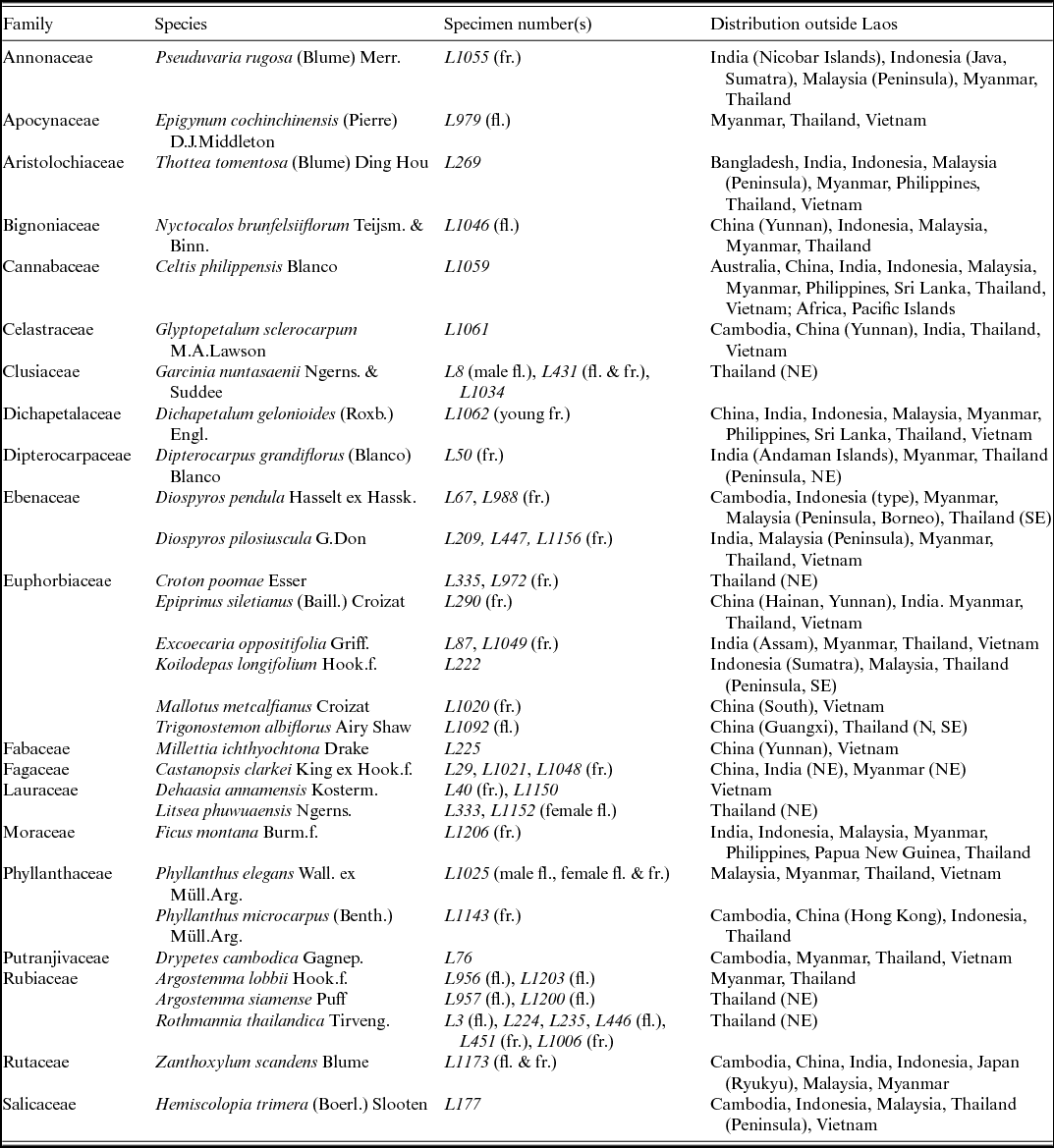
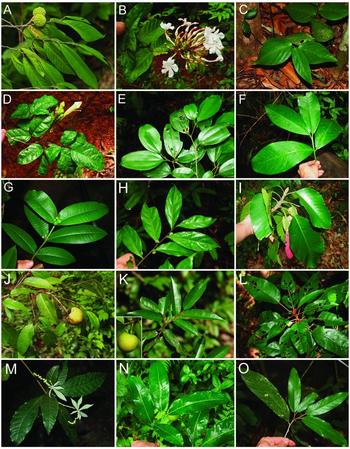
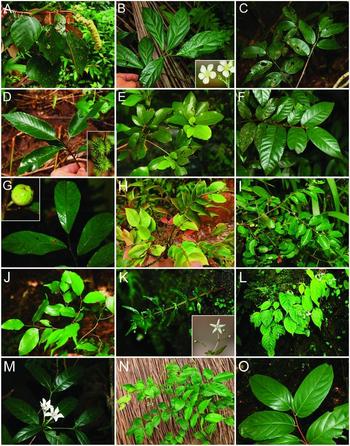
Thirty vascular plant species in 27 genera and 20 families are newly recorded in the flora of Laos (Table 1 and Figs 2, 3), among which six genera, Pseuduvaria Miq., Thottea Rottb., Nyctocalos Teijsm. & Binn., Epiprinus Griff., Koilodepas Hassk. and Hemiscolopia Slooten are new at genus level.
Species newly recorded in the flora of LaosFootnote a

a Editor's note: Prosperi et al. (the preceding article in this issue of the Edinburgh Journal of Botany) independently report the occurrence in Khammouane Province of four species in this table, namely, Pseuduvaria rugosa (Blume) Merr., Celtis philippensis Blanco, Dichapetalum gelonioides (Roxb.) Engl. and Diospyros pilosiuscula G.Don.
A, Pseuduvaria rugosa (Blume) Merr.; B, Epigynum cochinchinensis (Pierre) D.J.Middleton; C, Thottea tomentosa (Blume) Ding Hou; D, Nyctocalos brunfelsiiflorum Teijsm. & Binn.; E, Celtis philippensis Blanco; F, Glyptopetalum sclerocarpum M.A.Lawson; G, Garcinia nuntasaenii Ngerns. & Suddee; H, Dichapetalum gelonioides (Roxb.) Engl.; I, Dipterocarpus grandiflorus (Blanco) Blanco; J, Diospyros pendula Hasselt ex Hassk.; K, Diospyros pilosiuscula G.Don; L, Croton poomae Esser; M, Epiprinus siletianus (Baill.) Croizat; N, Excoecaria oppositifolia Griff.; O, Koilodepas longifolium Hook.f.

A, Mallotus metcalfianus Croizat.; B, Trigonostemon albiflorus Airy Shaw.; C, Millettia ichthyochtona Drake; D, Castanopsis clarkei King ex Hook.f.; E, Dehaasia annamensis Kosterm.; F, Litsea phuwuaensis Ngerns.; G, Ficus montana Burm.f.; H, Phyllanthus elegans Wall. ex Müll.Arg.; I, Phyllanthus microcarpus (Benth.) Müll.Arg.; J, Drypetes cambodica Gagnep.; K, Argostemma lobbii Hook.f.; L, Argostemma siamense Puff; M, Rothmannia thailandica Tirveng.; N, Zanthoxylum scandens Blume; O, Hemiscolopia trimera (Boerl.) Slooten.

Recently, Zhu (Reference Zhu2017) assessed the floristic similarities of Laos and the surrounding countries, and concluded that the flora of Laos showed the highest similarity to the flora of Vietnam (92.13% at genus level and 61.19% at species level), followed by the flora of Myanmar (86.01% and 40.07%, respectively) and Thailand (77.84% and 42.47%, respectively). However, the similarity in our collection shows the reverse trend: only 14 species (47%) share their distribution range with Vietnam, 18 species (60%) with Myanmar and 25 species (83%) with Thailand, indicating that the plant diversity of Laos is a more intricate topic that needs to be examined very carefully.
The following five species have been known only from north-east Thailand: Garcinia nuntasaenii Ngerns. & Suddee (Clusiaceae), Croton poomae Esser (Euphorbiaceae), Litsea phuwuaensis Ngerns. (Lauraceae), Argostemma siamense Puff and Rothmannia thailandica Tirveng. (both Rubiaceae). Although these species show limited distribution in Thailand and are all threatened (Forest Herbarium, 2015; Ngernsaengsaruay & Suddee, Reference Ngernsaengsaruay and Suddee2017), they are abundant in the lowland evergreen forests of Nam Kading National Protected Area; the previously known localities in Thailand are considered to be at the edges of their distribution range.
Two species, Celtis philippensis Blanco (Cannabaceae) and Argostemma lobbii Hook.f. (Rubiaceae), were known to prefer limestone areas. In addition, a wild type of Citrus hystrix DC. (synonym, Citrus macroptera Montrouz.) (Rutaceae, specimen no. L1081), Drypetes harmandii Pierre ex Gagnep. (Putranjivaceae, L1064) and some species of Begoniaceae (Begonia spp., L961, L1091 and L1202) and Gesneriaceae (Middletonia sp., L973, and Didymocarpus sp., L1198) were collected from the limestone karst, among which an unidentified species of Didymocarpus may be an undescribed species (D. J. Middleton, Singapore Botanic Gardens, personal communication). Considering that we visited the edge of karsts only for a few hours, more species related to limestone habitat would be expected to be included in further intensive inventories.
Two species, Pseuduvaria rugosa (Blume) Merr. (Annonaceae) and Dipterocarpus grandiflorus (Blanco) Blanco (Dipterocarpaceae), are remotely isolated from the main distribution areas: India (Nicobar Islands), Indonesia (Java, Sumatra), Malaysia (Peninsula), Myanmar (S), Thailand (N, Peninsula, SE, SW) for the former (Su & Saunders, Reference Su and Saunders2006), and Peninsular Thailand to Myanmar, extending to the Andaman Islands, for the latter (Smitinand et al., Reference Smitinand, Santisuk and Phengklai1980; Pooma et al., Reference Pooma, Poopath, Newman, Santisuk and Balslev2017). We also collected an unidentified species of Neo-uvaria Airy Shaw (Annonaceae), which consists of 9–15 species (formally 7 species are accepted) (Chaowasku et al., Reference Chaowasku, Keßler, Punnadee and van der Ham2011), all known from the Malesian region (southern Thailand, Peninsular Malaysia, Borneo, Sumatra and the Philippines). It is notable that the flora of Nam Kading contains some Malesian elements.
The remaining 21 taxa either just extend to Laos or fill gaps in their distribution ranges. For example, Epigynum cochinchinensis (Pierre) D.J.Middleton (Apocynaceae), known from Myanmar, Thailand and Vietnam, and Nyctocalos brunfelsiiflorum Teijsm. & Binn. (Bignoniaceae), known from southern China (Yunnan), Thailand, Myanmar, Malaysia and Indonesia, were previously expected to occur in Laos and Cambodia by Middleton (Reference Middleton2014) and Santisuk & Vidal (Reference Santisuk and Vidal1985), respectively. Therefore, the distribution in Laos can be very valid. Recently, Dang et al. (Reference Dang, Tran, Vu and Nguyen2016) also reported Nyctocalos brunfelsiiflorum from northern Vietnam.
The flora of Nam Kading National Protected Area remains poorly known. More than half of our collections are still unidentified, mainly owing to the lack of flowers or fruits, and some of them seem to be new species. Further inventories, especially of higher elevation and limestone karst areas, are needed to document the total flora of the Nam Kading National Protected Area.
The forest in the lowland area has been recently cleared or partially logged for timber or firewood and often converted to plantations of cassava, pineapple and upland rice, even within the protected area. Also, a hydropower dam along the Nam Theun River is under construction. Further studies on the plant diversity of this area should be urged to develop better conservation planning of this protected area.
Acknowledgements
The authors are grateful to the managers and staff of Nam Kading National Protected Area for permitting and supporting our botanical inventory in the protected area. Sawai Mattapha (Udon Thani Rajabhat University, Thailand), Do Van Truong (Vietnam National Museum of Nature) and David J. Middleton (Singapore Botanic Gardens) are acknowledged for their helpful comments on species identification. We also thank the curators of BKF, FOF, FU, HNL, KYO, TAI and TNS for granting access to their specimens. This study was supported by the Environment Research and Technology Development Fund (4-1601) of the Ministry of the Environment, Japan, and MEXT/JSPS KAKENHI (grant no. JP15H02640).