Bullying has progressively received growing interest in the scientific community since the pioneering studies conducted in northern Europe in the 1970s. In Spain, the suicide of a schoolboy named Jokin in 2004, marked a major change in the study of bullying. It stimulated the social debate on the issue and the proliferation of a broad range of local, regional and national studies. However, this recent interest should not lead to the false impression that bullying is a recent phenomenon. On the contrary, bullying is as old as traditional school itself (Díaz-Aguado, Reference Díaz-Aguado2006).
This article highlights the main internationally agreed criteria on the definition of bullying and the prevalence rates identified in national and international studies. It concludes with a brief analysis from the gender perspective that contributes to a more comprehensive understanding of the phenomenon.
Conceptualization and prevalence
Bullying has traditionally been described as a subtype of violent behavior that implies negative actions targeted to the physical, psychological, or social dimension. These actions occur repetitively and intentionally with the aim of hurting the victim, who is at a physical and/or psychological disadvantage. Although bullying is usually perpetrated by one or several individuals upon a peer without provocation, it may sometimes be targeted at a group (Díaz-Aguado, Reference Díaz-Aguado2005; Olweus, Reference Olweus1993, Reference Olweus, Smith, Morita, Junger-Tas, Olweus, Catalano and Slee1999; Smith & Brain, Reference Smith and Brain2000).
There is relative international consensus on the above mentioned defining traits. Yet, this conceptualization has certain limitations that should be considered in order to achieve a more comprehensive understanding of the phenomenon. Its main limitations are related to the intentionality and repetitive or systematic nature of bullying. As regards intentionality, the fact that bullying is an essentially relational phenomenon makes it difficult to identify to what extent the bully is aware of the damage caused to the victim and to what extent the damage perceived by the victim is deliberately caused by the bully (Ortega, Del Rey, & Mora-Merchán, Reference Ortega, Del Rey and Mora-Merchán2001).
As regards the repetitive nature of bullying, Olweus himself (1993) admitted that a single serious episode of abuse could be considered as bullying. The criterion according to which bullying is a repetitive phenomenon disregards the fact that experiences of abuse that are not necessarily extended over time but cause pain to victims are of the same nature as those that are considered bullying; the only difference between both is quantitative, not qualitative. Hence, the seriousness of a bullying situation is not exclusively or necessarily marked by the chronic nature of abuse but rather by its impact on the victim’s physical and/or psychosocial health. This statement highlights the need to use the term ‘seriousness’ with caution when referring to bullying situations (Defensor del Pueblo-UNICEF, 2000, 2007). Although it is tempting to identify more serious consequences of experiencing chronic abuse, the impact of peer abuse should not be minimized in any of its manifestations. In fact, most self-report studies present different behaviors that could be classified as bullying with a Likert response scale and eventually organize their results based on a more or less restrictive concept of the problem. The repetition criterion may be useful to avoid overestimating the scope of the problem; however, it may not be so useful or may even be counterproductive for understanding and preventing this phenomenon (for more detailed information on the limitations of the concept, see Carrera, DePalma, & Lameiras, Reference Carrera, DePalma and Lameiras2011).
As regards the prevalence of bullying, there has been a trend towards consolidation of studies on the phenomenon since research began in northern Europe in the 1970s. This trend is characterized by the international expansion of the study of bullying, which has shown that it is a generalized phenomenon that all children and adolescents seem to have contact with throughout the school experience as victims, bullies, or witnesses – the most frequent situation (Smith & Brain, Reference Smith and Brain2000). Stephenson and Smith (Reference Stephenson, Smith, Tattum and Lane1988) established an additional category: ‘bully-victims,’ that is, children who are bullied but also bully other children (Solberg, Olweus, & Endresen, Reference Solberg, Olweus and Endresen2007). This category has gradually acquired an entity of its own, as shown by the proliferation of studies devoted to its analysis (Ma, Reference Ma2001; Salmivalli & Nieminen, Reference Salmivalli and Nieminen2002; Schwartz, Proctor, & Chien, Reference Schwartz, Proctor, Chien, Juvonen and Graham2001; Solberg et al., Reference Solberg, Olweus and Endresen2007; Solberg & Olweus, Reference Solberg and Olweus2003; Wolke, Goods, Schulz, & Staford, Reference Wolke, Woods, Schulz and Stanford2001). Measuring bullying is not an easy task. However, it is even more difficult to estimate the prevalence of bully-victims and characterize this group compared to the other two, mainly because it is more heterogeneous and has additional methodological difficulties (Solberg et al., Reference Solberg, Olweus and Endresen2007; Sutton & Smith, Reference Sutton and Smith1999).
Research on bullying mostly began in Europe and was followed by a later development in North America. Studies have usually followed a descriptive approach aimed at determining the prevalence of bullying and the characteristics of individuals involved (Díaz-Aguado, Reference Díaz-Aguado2005). Results have been very heterogeneous, perhaps due to the different concepts of bullying they were based on or the instruments used to collect information.
In Europe, according to representative national studies, prevalence rates of students involved in bullying incidents range from 6% to 16%. The pioneering study conducted by Olweus in Norway identified a prevalence of 16% (Olweus, Reference Olweus, Smith, Morita, Junger-Tas, Olweus, Catalano and Slee1999); the national Irish study found a prevalence of 10.4% (Byrne, Reference Byrne, Smith, Morita, Junger-Tas, Olweus, Catalano and Slee1999), while the recent study carried out in Spain by the National Observatory on School Climate (Observatorio Estatal de la Convivencia Escolar, 2010) found a prevalence of 6.2%. According to these studies, more students are involved in bullying incidents as victims than as bullies. In fact, the percentage of victims ranges from 9% in the study by Olweus to 3.8% in the Spanish study; the percentage of bullies is lower – 7% in the Norwegian study and 2.4% in the recent Spanish study.
In Spain, the first studies on bullying, conducted by Vieira, Fernández, and Quevedo (Reference Vieira, Fernández, Quevedo, Roland and Munthe1989) and Ortega and Mora-Merchán (Reference Ortega, Mora-Merchán, Smith, Morita, Junger-Tas, Olweus, Catalano and Slee1999) found an overall percentage of 34.5% and 18% of students involved in bullying incidents, respectively. With the exception of the abovementioned study by the Spanish National Observatory on School Climate, recent studies do not provide an estimate of the prevalence of bullying. Instead, they analyze the phenomenon through the various types of bullying from the perspective of victims, bullies, and witnesses.
The first study of the Spanish Ombudsman’s Office-UNICEF (2000), conducted on a representative Spanish sample of secondary education students, showed the following results: according to victims, the most frequent behaviors involved verbal abuse (for example, 37.2% reported being called derogatory names at some point) and the least frequent were threatening behaviors (0.7% reported having been threatened with weapons at some point) and sexual harassment (2% reported having experienced it at some point). This order of prevalence remains considerably stable when it is assessed from the perspective of bullies and witnesses. The study was conducted again in 2006 and showed a slight improvement in the situation, with a lower prevalence of bullying behaviors, particularly the most frequent ones (Del Barrio et al., Reference Del Barrio, Martín, Montero, Gutiérrez, Barrios and de Dios2008). In these studies, the highest prevalence was reported by witnesses, followed by bullies, and finally victims; this is contrary to the trend identified by studies providing an overall bullying score.
However, the study conducted by the Spanish National Observatory on School Climate (2010) not only provided an overall bullying score but also analyzed specific victimization situations. Interestingly, it found the opposite trend: a lower percentage of students admitted their involvement as bullies; this percentage was even lower in the most explicit and hostile bullying behaviors except social exclusion behaviors, where a higher percentage of students admitting being bullies. This study was the first to observe this trend, which, according to its authors, is due to the greater social rejection elicited by the role of the bully. This research was conducted two years after that of the Spanish Ombudsman’s Office-UNICEF. A comparison between both studies provides the following information: in the most recent study, victims reported an increase in practically all situations except insults, which were less reported. This applied to overall and systematic bullying. The same trend was reported by bullies regarding systematic bullying; a comparison between overall percentages showed an increase in some of the most severe situations of violence such as breaking, stealing, hitting, forcing with threats, threatening with weapons, or sexually harassing.
From a regional viewpoint, it is worth highlighting the study by Díaz-Aguado, Martínez, and Martín (Reference Díaz-Aguado, Martínez and Martín2004) with adolescents attending compulsory and post-compulsory secondary education in the south of the region of Madrid, as well as the study by the regional authorities of Andalusia (Consejo Escolar de Andalucía, Reference Consejo Escolar2006) and the report by the Basque Ombudman’s Office (Ararteko, 2006), both with compulsory secondary education students. These studies used a very similar questionnaire to that of the Spanish Ombudsman’s Office-UNICEF and obtained similar results, identifying verbal abuse and social exclusion as the most frequent types of bullying.
Gender as a factor for analysis
Studies on bullying have devoted much attention to the sex of the bully and the victim, an individual factor, instead of conducting a more comprehensive analysis from the gender perspective. The first studies on bullying in the 1970s argued that bullying was a problem that mainly affected boys (Byrne, Reference Byrne, Smith, Morita, Junger-Tas, Olweus, Catalano and Slee1999; Olweus, Reference Olweus, Smith, Morita, Junger-Tas, Olweus, Catalano and Slee1999; Ortega & Mora-Merchán, Reference Ortega, Mora-Merchán, Smith, Morita, Junger-Tas, Olweus, Catalano and Slee1999); the internalized and less disruptive behavior of girls was interpreted as not being problematic at school, spreading the idea that girls did not experience situations of oppression and abuse (Keddie, Reference Keddie2009). This perspective of analysis has metaphorically been called gender blindness (Carrera et al., Reference Carrera, DePalma and Lameiras2011) because it ‘masculinizes’ the problem, paying little attention to the involvement of girls in bullying situations.
About two decades later, studies started to pay attention to relational aggression. This highlighted the existence of qualitative sex-related differences besides quantitative ones. Research has shown that boys are more involved in situations of direct aggression through verbal or physical bullying, whereas girls are significantly more involved in situations of indirect or relational aggression (Björkqvist & Österman, Reference Björkqvist, Österman, Smith, Morita, Junger-Tas, Olweus, Catalano and Slee1999; Giles & Heyman, Reference Giles and Heyman2005; Lösel & Blieneser, Reference Lösel, Bliesener, Smith, Morita, Junger-Tas, Olweus, Catalano and Slee1999; Smith, Reference Smith2004). This perspective of analysis had an advantage compared to the previous one: it highlighted the quantitative and qualitative differences between boys and girls in their participation in the phenomenon; however, it was still insufficient because it did not explain such differences or analyze the mechanisms through which they are shaped by the broader patriarchal and heterosexist social context. It was based on an essentialist and non-analytical study approach that ‘anchored’ such differences in sex, a biological category, disregarding gender and failing to analyze the causes of this differential participation. This approach still prevails, although it is gradually being replaced by a new constructivist approach that analyzes the differential involvement of boys and girls. This new approach searches for the causes of such differences beyond biology, in the patriarchal social context that modulates and shapes such expressions (for a more detailed analysis, see Carrera et al., Reference Carrera, DePalma and Lameiras2011).
The constructivist approach transcends the biological interpretation of the gender variable, highlighting the influence of sexist roles and stereotypes, according to which masculinity is associated with dominance, control, and violence. From this approach, it is worth noting the pioneering research carried out by Young and Sweeting (Reference Young and Sweeting2004) in Scotland and Gini and Pozzoli (Reference Gini and Pozzoli2006) in Italy. These studies found that, regardless of sex, instrumentality (personality traits traditionally associated with masculinity) is positively correlated with being a bully, whereas expressiveness (personality traits traditionally associated with femininity) is negatively correlated with being a bully. The Scottish study found that ‘atypical’ boys (boys who do not conform to the stereotype of masculinity) are significantly more vulnerable to victimization; this was not found in girls, perhaps due to asymmetric social desirability, which favors ‘masculine’ traits, values, and behaviors. In fact, studies have shown that adolescent girls tend to attribute themselves ‘masculine’ traits and are less socially punished than adolescent boys who attribute themselves ‘feminine’ traits (Meyer, Reference Meyer2008).
Consistent with these results, the abovementioned study by the Spanish National Observatory on School Climate (2010) obtained the following findings: among the causal attributions for bullying, the ones most identified by both victims and bullies were ‘being a boy who does not behave like most boys’ (selected by 16.43% of victims and 18.60% of bullies, and ‘being a girl who does not behave like most girls’ (selected by 16.30% of victims and 15.93% of bullies). Combined, these items obtained significantly higher scores than the other causal attributions provided (‘being a Gypsy,’ ‘skin color,’ ‘being fat,’ or ‘being new to the school’).
Most studies on bullying have analyzed the phenomenon from a biological, essentialist, or non-analytical perspective. However, it should be noted that a constructivist analysis of gender in the study of bullying must begin with a study of the sex variable. Therefore, the limitation is not the the fact of analyzing the sex category but rather the fact of interpreting it from an essentialist perspective that explains results with biological sex, an innate and fixed trait. The first step required to transcend this analysis is not only to highlight sex-related differences but also to interpret them from a gender perspective in the broader patriarchal and heterosexist framework that shapes them through a differential socialization process. This is the only way to make progress towards a more comprehensive understanding of school bullying. The present study followed this approach.
The aim of this representative national study was to determine the prevalence of school bullying in its various forms from the perspective of all of the individuals involved (victims, bullies, and witnesses) and to explore its distribution as a function of sex.
Method
Participants
A representative Spanish national sample was analyzed. It was composed of 1500 students attending any of the four years of compulsory secondary education (Educación Secundaria Obligatoria – ESO) in the academic year 2007–2008. The sample included 49.3% of girls and 50.7 % of boys, with a mean age of 14.19 years (SD, 1.4). Age ranged from 12 to 18 years. Among participants, 27.1% were in the first year of ESO, 25.5% were in the second year, 26.1% were in the third year and 21.3% were in the fourth year. As regards the type of school, 66.3% of participants attended public schools and 33.7% attended private or state-subsidized schools. Of the 44 secondary education schools that participated in the study, 20 were privately owned and 24 were public. The schools were located in the regions of Andalusia, Asturias, Valencia, Catalonia, Aragon, Madrid, Castile and Leon, and Galicia. Privately owned schools were included in the sample as a single group, without distinguishing those that were state-subsidized from those that were not.
Instruments
An ad-hoc self-report questionnaire was administered. Participants were asked about the occurrence of the various types of bullying from the perspective of victims, bullies, and witnesses. The questionnaire included 15 items for each perspective:
-
- Social exclusion: it included forms of abuse such as ‘ignoring,’ ‘rejecting,’ and ‘not letting participate.’
-
- Verbal abuse: it included types of abuse such as ‘insulting,’ ‘calling offensive or derogatory names,’ and ‘talking about someone behind their back.’
-
- Indirect physical abuse: it included behaviors such as ‘stealing,’ ‘breaking,’ and ‘hiding’ things.
-
- Direct physical abuse: it included ‘hitting’ as a type of abuse.
-
- Threats: it included behaviors such as ‘threatening to scare,’ ‘threatening with weapons,’ and ‘using threats to force someone to do something.’
-
- Sexual harassment: it included ‘intimidating with sexual comments or insults’ and ‘using threats to force someone to participate in sexual situations.’
Items in the categories social exclusion and sexual harassment were taken from the study conducted by Díaz-Aguado et al. (Reference Díaz-Aguado, Martínez and Martín2004); the remaining items, included in the categories verbal abuse, direct physical abuse, indirect physical abuse, and threats, were taken from the study by the Spanish Ombudsman’s Office-UNICEF (2007).
The situations described above were presented with the following introduction: ‘Next you will find several questions describing situations experienced sometimes by certain boys and girls in high schools in their relationships with their schoolmates.’ Participants were asked whether they had experienced any of these situations since the beginning of the school year (victim’s perspective), participated in them bullying schoolmates (bully’s perspective), or witnessed it or been aware of it happening to a schoolmate without doing anything to prevent it or provoke it (witness’ perspective); adolescents who explicitly cooperated with bullies or defended the victim were excluded from this perspective, as in the study by Díaz-Aguado et al. (Reference Díaz-Aguado, Martínez and Martín2004).
All participants responded to the questionnaire from the three perspectives of analysis. Each scale was responded on a Likert scale from 1 (never) to 4 (always).
The psychometric properties of the instruments are not included in this article because the interpretation of the results was based on specific items instead of the various categories of abuse.
Considering the abovementioned limitations related to the concept of bullying and to avoid biases in participants’ responses, the questionnaire did not include a definition of abuse. At the beginning of the questionnaire, the text stated that ‘... the aim of the present research is to learn about relationships established between boys and girls your age.’
Design and procedure
The study was correlational or ex post facto and was designed as a cross-sectional sampling survey. The sample was distributed proportionally to the structure of the universe, with cross stratification based on the following strata: large areas (conventional geographic aggregates of several Autonomous Communities or regions), population size of towns/cities (50000 or less or more than 50000), level of compulsory second education (1st-2nd or 3rd-4th year), public or private ownership of schools, and sex. A multistage procedure was applied, with successive random sampling of units in the series: regions (one per area), towns/cities, schools, and classes. This was based on conventional ratios of units that should be selected in each stage within each previously selected unit. A final adjustment was made to the quotas in the last selections of schools and participants to avoid an excessive concentration of schools in certain towns/cities, classes in certain schools, and students in certain classes.
Correspondence was almost total between the theoretical sample designed and the actual sample obtained. There was practically no need to make any changes in the distribution of schools, classes, or participants. The internal structure of the sample matched that of global data for Spain and its final distribution was proportional to that of the universe according to the stratification variables considered. This further guaranteed the accuracy of the estimates. In addition, considering the sample size (n = 1,500) and an infinite universe (N = 1,844,953) and applying the stratified sampling formula, the maximum hypothetical statistical error in the overall data was 2.6% (e = ± 2.6%) with variable proportions, assuming maximum variability in all the strata (p = q = 50%) and a 95.5% (2σ) confidence interval.
Once the schools had been selected, letters were sent to the principals explaining the study and asking for their cooperation. Schools were later contacted by telephone to confirm their participation. The questionnaire was administered during class hours in April and May 2008. It was individual, anonymous and self-administered, with the possibility of individually consulting the examiners. It was completed in a classroom selected for that purpose and in the absence of teachers. Participants were given approximately one hour to complete it.
Results
Results are presented according to the perspective of victims, bullies, and witnesses as well as the specific bullying behaviors shown in percentages and expressed with three response categories (‘never,’ ‘sometimes,’ and ‘very often;’ ‘very often’ included the categories ‘pretty often’ and ‘always’) as in other studies, such as that of the Spanish Ombudsman’s Office-UNICEF (2007) or that of Solberg and Olweus (Reference Solberg and Olweus2003). Results also include the overall prevalence for each profile, calculated from the various relative variables. This information reflects the percentage of students who admitted having participated systematically at least in one of the types of abuse analyzed.
Results are presented overall and according to sex. They were analyzed using contingency tables and Pearson’s Chi-square test; a more thorough analysis was conducted using the two-proportion Z test and adjusted standardized residuals, which provided a more accurate picture of differences according to sex and type of abuse. A 95% confidence interval was established in all the analyses.
Prevalence estimate according to victims, bullies, and witnesses
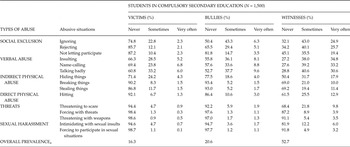
Based on responses of participants who identified themselves as victims (see Table 1), the most frequent victimization behaviors were those involving verbal abuse, followed by ‘hiding things’ – a form of indirect physical abuse or abuse of the victim’s belongings – and two forms of social exclusion: ‘ignoring’ and ‘rejecting.’ They were followed by ‘stealing belongings,’ another form of indirect physical abuse. The least identified abusive behaviors were those in the threat and sexual harassment categories.
Prevalence from the perspective of victims, bullies, and witnesses.

Note:
(a) Reflects the prevalence of respondents systematically involved (category ‘Very often’) as victims, bullies, or witnesses.
Bullies (see Table 1) reported higher percentages than did victims in all the types of abuse analyzed except ‘intimidating with sexual comments or insults’ –with an almost identical prevalence from both perspectives – and in the three forms of indirect physical abuse, which were reported by victims as being more prevalent.
Witnesses, that is, participants who admitted witnessing bullying incidents at school without participating (see Table 1), reported a higher prevalence than victims or bullies in all categories of abuse. Interestingly, they reported a similar order of prevalence to that reported by victims: according to them, the most frequent types of abuse were those related to verbal abuse.
As regards the overall prevalence of students systematically involved in bullying incidents (considering the response category ‘very often’) the study found a prevalence of 16.3% of victims, 20.6% of bullies, and 52.7% of witnesses (see Table 1). This refers to participants who claimed to have systematically experienced, perpetrated, or witnessed at least one of the types of abuse presented.
Sex-related differences based on the perspective of victims, bullies, and witnesses
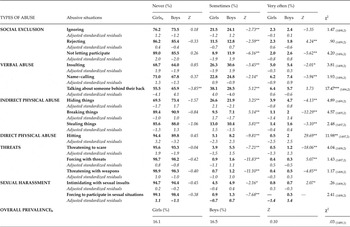
From the perspective of victims and according to sex (see Table 2), a significantly higher percentage of girls than boys reported that they ‘sometimes’ ‘talk about other girls behind their back;’ conversely, a significantly lower percentage of girls than boys reported ‘never’ doing so. Boys reported being significantly more involved as victims in the ‘hitting’ form of abuse; in fact, a significantly higher percentage of boys than girls claimed to have been physically abused by their schoolmates ‘sometimes’ or ‘very often.’
Prevalence according to sex from the perspective of victims

Note:
(a) GIRLS (n = 740); BOYS (n = 760). (b) Reflects the prevalence of participants systematically involved as victims (category ‘Very often’) according to sex. p < .05*; p < .01**; p < .001***.
Boys were also found to be significantly more involved as victims in most behaviors analyzed in the categories ‘sometimes’ and ‘very often.’
As for global overall prevalence, 16.1% of girls and 16.5% of boys reported being systematically involved as victims.
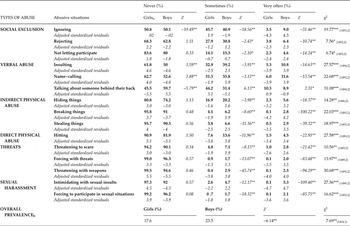
From the perspective of bullies (see Table 3), girls reported being significantly more involved as bullies in the form of abuse ‘talking about someone behind their back.’ By contrast, boys were significantly more involved in the remaining forms of abuse analyzed; more specifically, boys reached significantly higher percentages in the categories ‘sometimes’ and ‘very often.’ As regards overall prevalence, statistically significant differences were found between girls (17.6%) and boys (23.5%) involved as bullies.
Prevalence according to sex from the perspective of bullies

Note:
(a) GIRLS (n = 740); BOYS (n = 760). (b) Reflects the prevalence of participants systematically involved as bullies (category ‘Very often’) according to sex. p < .05*; p < .01**; p < .001***.
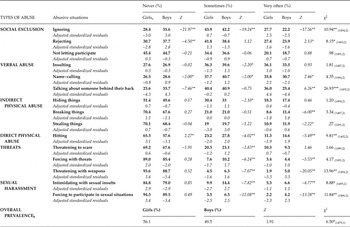
From the perspective of witnesses (see Table 4), a significantly higher percentage of girls than boys reported witnessing situations of abuse that involved ‘ignoring,’ ‘rejecting,’ and ‘talking about someone behind their back.’ By contrast, a significantly higher percentage of boys than girls claimed to have witnessed abuse involving ‘hitting’ ‘threatening with weapons,’ ‘intimidating with sexual comments or insults,’ and ‘using threats to force someone to participate in sexual situations.’ Findings on overall prevalence showed statistically significant differences between girls (56.1%) and boys (49.5%) who claimed to have systematically witnessed at least one of the forms of abuse presented.
Prevalence according to sex from the perspective of witnesses

Note:
(a) GIRLS (n = 740); BOYS (n = 760). (b) Reflects the prevalence of participants systematically involved as withnesses (category ‘Very often’) according to sex. p < .05*; p < .01**; p < .001***.
Discussion
This study found that all the categories of abuse analyzed occur in Spanish secondary education schools. It identified very different levels of prevalence depending on the type of abuse. More specifically, an inverse relationship was found between the types of bullying considered most ‘serious’ and their prevalence, as observed in other studies conducted in Spain at a national level (Defensor del Pueblo-UNICEF, 2000, 2007; Observatorio Estatal de la Convivencia Escolar, 2010; Serrano & Iborra, Reference Serrano and Iborra2005) or at a local or regional level (Ararteko, 2006; Martín, Pérez, Marchesi, Pérez, & Álvarez, Reference Martín, Pérez, Marchesi, Pérez and Álvarez2006). In addition, the order of prevalence of the various categories of abuse was similar to that found by other national studies (Defensor del Pueblo-UNICEF, 2000, 2007): verbal abuse was the type of abuse most frequently reported (Almeida, Reference Almeida, Smith, Morita, Junger-Tas, Olweus, Catalano and Slee1999; Ararteko, 2006; Defensor del Pueblo-UNICEF, 2000, 2007; Gómez-Bahíllo, Puyal, Sanz, Elboj, & Sanagustín, Reference Gómez-Bahíllo, Puyal, Sanz, Elboj and Sanagustín2006; Lösel & Blieneser, Reference Lösel, Bliesener, Smith, Morita, Junger-Tas, Olweus, Catalano and Slee1999; Observatorio Estatal de la Convivencia Escolar, 2010; Olweus, Reference Olweus, Smith, Morita, Junger-Tas, Olweus, Catalano and Slee1999; Ortega & Mora-Merchán, Reference Ortega, Mora-Merchán, Smith, Morita, Junger-Tas, Olweus, Catalano and Slee1999; Serrano & Iborra, Reference Serrano and Iborra2005).
As regards the contribution of each of profiles involved, witnesses reported the highest prevalence of all the bullying behaviors analyzed (Defensor del Pueblo-UNICEF, 2000, 2007; Serrano & Iborra, Reference Serrano and Iborra2005). This is not surprising considering – as explained in the two reports of the Spanish Ombudsman’s Office-UNICEF (2000, 2007) – that the number of adolescents who witness bullying incidents at school is necessarily higher than that of victims or bullies. This is because witnesses report the various bullying incidents that they have witnessed around them, not their specific individual experiences. In addition, the prevalence reported by participants who identified themselves as bullies was considerably higher than that reported by victims (16.3% of victims and 20.6% of bullies). These percentages are higher than those found by other studies. Studies have found a prevalence of bullies ranging from 2.4% in the study by the National Spanish Observatory (2010) to 7% in the Norwegian study (Olweus, Reference Olweus, Smith, Morita, Junger-Tas, Olweus, Catalano and Slee1999). The prevalence reported by victims in these studies ranged from 3.8% to 9%, respectively. According to the various types of abuse, a higher prevalence of bullies than victims was reported in all the subtypes of abuse presented, except those related to abuse of belongings (i.e. ‘hiding,’ ‘stealing,’ or ‘breaking’) and sexual harassment using sexual comments or insults (‘intimidating with sexual comments or insults’), which were more reported by victims.
The higher overall prevalence of bullies than victims found and the fact that the opposite trend was observed in some of the most explicit situations of abuse may be explained with the bias hypothesis. Most nationwide studies such as the recent one conducted by the Spanish National Observatory on School Climate (2010) have found the opposite trend, that is, more students reporting involvement in bullying as victims than as bullies. These studies provided a definition of bullying at the beginning of the questionnaire so that students could identify the kind of situations they were being asked about; the fact that they found a lower prevalence of bullies is not surprising, as there may be some bias in the responses. In other words, despite the anonymous nature of most questionnaires, if respondents are aware that the study is assessing their involvement as bullies, they are likely to deny participating in such incidents. By contrast, when no definition of abuse is provided and respondents are asked about their participation in various situations that occur among schoolmates, as in the present study and that of the Spanish Ombudsman’s Office-UNICEF (2000, 2007), students do not necessarily realize the seriousness of such actions. In fact, unlike being a victim of bullying, being involved in situations that imply flaunting one’s power can even be perceived as status symbol and used to climb in the hierarchy of the class. This is particularly true in boys, in line with the traditional stereotype of masculinity (Giles & Heyneman, Reference Giles and Heyman2005; LaFontana & Cillesen, Reference LaFontana and Cillessen2002; Stoudt, Reference Stoudt2006); by contrast, being labeled as a bully is likely to have the opposite effect (Connell & Messerchmidt, Reference Connell and Messerschmidt2005).
Response bias may also explain why differences between victims and bullies were inverted in some particularly explicit situations of bullying such as abuse of belongings or intimidation with sexual comments or insults. This is because such situations are visible and explicit and easily perceived as being serious, in line with the traditional discourse on bullying, which initially paid greater attention to explicit and visible situations of abuse (Hawker & Boulton, Reference Hawker and Boulton2000). In this context, bullies are likely to minimize their participation in this type of behaviors, whereas victims cannot easily deny their own victimization.
Another possible explanation for the higher overall prevalence of victims and bullies identified in this study is the frequency criterion established. Overall prevalence was estimated from relative variables considering the category very often, which previously included the response categories pretty often and always without specifying a frequency criterion to guide respondents. For example, the study carried out by the Spanish National Observatory on School Climate specified the number of times the abuse was experienced or perpetrated for each response category (Sometimes: once or twice a month; Often: about once a week; Very often: several times a week). The significant differences found between both studies may be a consequence of this and of the fact that, unlike the present study, the abovementioned one used two specific questions to identify the overall prevalence of abuse.
As regards the evolution of prevalence, from the perspective of victims and according to the various types of abuse, the results of this study are similar to those of the Spanish National Observatory on School Climate (2010). Combining the categories sometimes, pretty often, and very often, the frequencies reported were slightly higher in situations of verbal abuse, social exclusion, and physical abuse and slightly lower in the most ‘serious’ and explicit abusive situations such as threats or sexual harassment. However, when comparing systematic abuse, that is, abuse that takes place pretty often and very often, this study identified slightly lower frequencies. The differences found ranged from 0.5 to 1, except for direct physical abuse, which showed similar results. The comparison between the present study and the most recent report of the Spanish Ombudsman’s Office-UNICEF (2007) showed the following: in both overall and systematic abuse, victims reported an increase in almost all the behaviors analyzed, with a trend towards similar percentages in behaviors that could be considered most ‘serious’ (acknowledging all the limitations of assessing seriousness in bullying situations). The findings of the present study were more similar to those reported by the first nationwide study on bullying (Defensor del Pueblo-UNICEF, 2000) –although with a slightly higher prevalence – and to those reported by the abovementioned studies by Díaz-Aguado et al. (Reference Díaz-Aguado, Martínez and Martín2004) and Martín et al. (Reference Martín, Pérez, Marchesi, Pérez and Álvarez2006).
This study found a higher percentage of participants admitting involvement as bullies than the studies conducted by the Spanish National Observatory on School Climate (2010) and the Spanish Ombudsman’s Office-UNICEF (2007). Again, the findings were similar to those obtained by Díaz-Aguado et al. (Reference Díaz-Aguado, Martínez and Martín2004) and Martín et al. (Reference Martín, Pérez, Marchesi, Pérez and Álvarez2006).
Finally, responses of witnesses were compared to the most recent representative national study in which this perspective was considered (Defensor del Pueblo-UNICEF, 2007). Unlike the responses of victims and bullies, those of witnesses reflected a decrease in all the behaviors related to verbal abuse, social exclusion, direct and indirect physical abuse, and the behavior ‘threatening to scare,’ included in the category of threats. By contrast, a slight increase was identified in the remaining situations involving threats and sexual harassment. Yet, no direct comparison was possible between the findings of both studies, as the present study distinguished between verbal and physical sexual harassment, whereas the study of the Spanish Ombudsman’s Office-UNICEF (2007) did not. However, this decrease was not identified in systematic abuse. In fact, the present study found slightly higher percentages in some of the behaviors analyzed (i.e., ‘ignoring,’ ‘not letting participate,’ ‘stealing,’ ‘threatening with weapons,’ and ‘sexually harassing’). In addition, the similarities found in responses of victims and bullies between this study and those of Díaz-Aguado et al. (Reference Díaz-Aguado, Martínez and Martín2004) in Madrid and Martín et al. (Reference Martín, Pérez, Marchesi, Pérez and Álvarez2006) in Valencia were not reflected in the prevalence reported by witnesses: the percentages reported in the present study were higher than those identified in the region of Madrid and lower than those found in the region of Valencia.
As a function of sex, considering victims’ responses, a significantly higher percentage of girls than boys reported ‘talking about other girls behind their back.’ By contrast, a significantly higher percentage of boys than girls reported experiencing situations of direct physical abuse (‘hitting’), as found in the studies conducted by the Spanish Ombudsman’s Office-UNICEF (2000, 2007), Díaz-Aguado et al. (Reference Díaz-Aguado, Martínez and Martín2004), and Serrano and Iborra (Reference Serrano and Iborra2005). However, the study by the National Observatory on School Climate did not identify this qualitatively different behavior between boys and girls. That study reported that boys were significantly more involved as victims in all situations of abuse except that of ‘talking about someone behind their back,’ with no significant differences. From the perspective of bullies, the present study and others found that a higher percentage of boys than girls admitted abusing their schoolmates more frequently in all the behaviors analyzed, except ‘talking about someone behind their back,’ in which a higher percentage of girls admitted being involved (Defensor del Pueblo-UNICEF, 2000, 2007; Díaz-Aguado et al., Reference Díaz-Aguado, Martínez and Martín2004; Serrano & Iborra, Reference Serrano and Iborra2005). Finally, from the perspective of witnesses, a significantly higher percentage of girls than boys reported witnessing or being aware of situations of abuse at school involving ‘ignoring,’ ‘rejecting,’ and ‘talking about someone behind their back.’ By contrast, a significantly higher percentage of boys than girls reported witnessing situations involving ‘direct physical abuse,’ ‘threatening with weapons,’ ‘intimidating with sexual comments or insults,’ and ‘using threats to force someone to participate in sexual situations’ (Defensor del Pueblo-UNICEF, 2000; 2007; Díaz-Aguado et al., Reference Díaz-Aguado, Martínez and Martín2004).
In general terms, the findings of this study are consistent with most studies on bullying that have identified not only quantitative differences (Byrne, Reference Byrne, Smith, Morita, Junger-Tas, Olweus, Catalano and Slee1999; Olweus, Reference Olweus, Smith, Morita, Junger-Tas, Olweus, Catalano and Slee1999; Ortega & Mora-Merchán, Reference Ortega, Mora-Merchán, Smith, Morita, Junger-Tas, Olweus, Catalano and Slee1999; Smith, Reference Smith, Smith, Morita, Junger-Tas, Olweus, Catalano and Slee1999; Whitney & Smith, Reference Whitney and Smith1993) but also qualitative differences (Björkqvist, Österman, & Kaukiainen, Reference Björkqvist, Österman and Kaukiainen2000; Lösel & Blieneser, Reference Lösel, Bliesener, Smith, Morita, Junger-Tas, Olweus, Catalano and Slee1999; Olweus, Reference Olweus, Smith, Morita, Junger-Tas, Olweus, Catalano and Slee1999) between boys and girls in their participation in bullying situations as victims, bullies, or witnesses.
However, just stating that boys and girls participate differently in the bullying phenomenon without analyzing this finding would essentialize this difference, that is, anchor it in biology. Hence, making progress in a constructivist approach requires taking a further step beyond highlighting such differences. More specifically, it is essential to analyze the influence of the differential socialization promoted for girls and boys through traditional gender roles and stereotypes. In these stereotypes and roles, masculinity is associated with instrumentality and includes traits such as dominance, assertiveness, and aggressiveness, whereas femininity is associated with expressiveness and includes traits such as dependence, passivity, and affectivity. The different participation of boys and girls in bullying situations may be the result of the differential gender socialization promoted in the patriarchal and heterosexist social context. This would support the strong influence of gender socialization on bullying that has been highlighted by other studies (Gini & Pozzoli, Reference Gini and Pozzoli2006; Young & Sweeting, Reference Young and Sweeting2004).
Along these lines, the greater involvement of boys in the role of bullies may be explained, among other factors, by their greater endorsement of masculine gender roles and stereotypes (Gini & Pozzoli, Reference Gini and Pozzoli2006; Young & Sweeting, Reference Young and Sweeting2004). This is likely to allow them not only to conform to the stereotype but also to gain higher status in the peer group (Giles & Heyneman, Reference Giles and Heyman2005). Similarly, the greater victimization of boys, particularly in situations of direct physical abuse, may also be due – among other factors – to the greater gender-related control exerted on boys, which leads to severe punishment of those who transgress the stereotype (Young & Sweeting, Reference Young and Sweeting2004). Girls’ lesser involvement in bullying and greater participation in relational or indirect abuse is consistent with traditional stereotypes of femininity. According to these stereotypes, manipulation of group relations is a more appropriate strategy to climb in the hierarchy of the peer group (Kehily, Reference Kehily and Harris2004; Ringrose, Reference Ringrose2008). In girls, transgressing ‘feminine’ gender boundaries by perpetrating abuse in non-relational ways is likely to be punished as well, although not in the same way as in boys. This may be due to the greater gender control experienced by males, as pointed out above, as well as asymmetric social desirability, which favors ‘masculine’ traits, values, and behaviors. From this perspective, girls who adopt masculine traits and roles will be less socially punished than boys who adopt feminine traits and roles (Valcárcel, Reference Valcárcel1992).
These hypotheses, which obviously cannot be demonstrated with the data provided in this study, evoke a famous phrase by Butler (Reference Butler1990), who stated that ‘sex is gender all along.’
One of the main limitations of this study is related to the fact that the three perspectives of analysis studied (victims, bullies, and witnesses) were not mutually exclusive. This was useful to make comparisons with the findings of other representative Spanish studies but hampered the comparison between the three perspectives of analysis. Second, the study did not consider the emerging category of bully-victims, which would have been useful to obtain a more comprehensive understanding of the phenomenon. Third, differences between boys and girls were interpreted from the gender perspective but gender variables were not explicitly assessed.
Finally, it is worth highlighting a few implications for research on bullying that contribute to a more comprehensive understanding of the phenomenon. As a first and basic step for a constructivist analysis, it is key not only to underline but also to analyze the differential participation of boys and girls in bullying and transcend the biological interpretation of the data. To make progress in this area of research, studies should include instruments aimed at measuring gender that can be used to analyze the influence of differential socialization on the different expressions of boys and girls in bullying.
Moreover, analyzing bullying from different perspectives, considering victims, bullies, bully-victims, and witnesses as exclusive categories would contribute to a better understanding of the issue, determining which types of abuse show differences depending on the perspective. Consensus is also needed on the design of instruments used in studies on bullying. It is important to assess the appropriateness or not of including a definition of bullying in questionnaires, considering the possible bias in participants’ responses and analyzing the various types of abuse without neglecting its overall prevalence. Another matter of interest is the frequency criterion, which should be specified in questionnaires to guide respondents and thus contribute to a uniform study design. This would make results easier to compare. The consideration of the systematic nature of bullying should be an indicator aimed at not overestimating the scope of the phenomenon instead of a limitation that excludes from the analysis situations that are not repetitive or chronic but also cause damage and exclusion to victims.