INTRODUCTION
Fruit is considered as a high-quality food because it is an excellent source of carbohydrates (Danish et al. Reference DANISH, CHAPMAN, HALL, RODE, WORMAN, Hohmann, Robbins and Boesch2006). Among the carbohydrates, the monosaccharides glucose and fructose and the disaccharide sucrose are the most common nutrients present in fruits (Karasov & Martinez del Rio Reference KARASOV and MARTINEZ DEL RIO2007, Widdowson & McCance Reference WIDDOWSON and MCCANCE1935). These nutrients are quickly absorbed and readily digested and therefore sugar content is likely to be a factor influencing the selection of fruit (Coleman & Downs Reference COLEMAN and DOWNS2012).
Many primates feed on a large variety of plant species (Richard Reference RICHARD and Richard1985), suggesting that the choice of food depends on the nutritional content and/or degree of toxicity (Barton & Whiten Reference BARTON and WHITEN1994, Chapman et al. Reference CHAPMAN, ROTHMAN, LAMBERT, Mitani, Call, Kappeler, Palombit and Silk2012). They therefore need to assess the nutritional content through sensory cues that provide information on fruit quality such as colour, size, hardness, smell and taste (Dominy Reference DOMINY2004). Whereas colour is often a long-range cue used to recruit animals from a distance (Murray et al. Reference MURRAY, WINNETT-MURRAY, CROMIE, MINOR and MEYERS1993, Voigt et al. Reference VOIGT, BLEHER, FIETZ, GANZHORN, SCHWAB and BÖHNING-GAESE2004), once animals are foraging on fruits other sensory cues may provide more useful information about the palatability and quality of the fruit.
Spider monkey species are considered ripe-fruit specialists (Di Fiore et al. Reference DI FIORE, LINK, DEW and Campbell2008, Gonzalez-Zamora et al. Reference GONZALEZ-ZAMORA, ARROYO-RODRIGUEZ, CHAVES, SANCHEZ-LOPEZ, STONER and RIBA-HERNANDEZ2009), and energy content is considered a major factor in their food selection (Felton et al. Reference FELTON, FELTON, WOOD, FOLEY, RAUBENHEIMER, WALLIS and LINDENMAYER2009). Therefore, the detection of sugar may directly influence fruit consumption and is likely to be a criterion for the selection of food in spider monkeys (Laska et al. Reference LASKA, CARRERA-SANCHEZ, RODRIGUEZ-RIVERA and RODRIGUEZ-LUNA1996). Geoffroy's spider monkeys have a remarkable sensitivity to sucrose (Laska et al. Reference LASKA, CARRERA-SANCHEZ, RODRIGUEZ-RIVERA and RODRIGUEZ-LUNA1996) and are able to discriminate sucrose at lower concentrations than glucose and fructose (Laska et al. Reference LASKA, SANCHEZ and RODRÍGUEZ-LUNA1998). However, it could be argued that sucrose does not play an important role in fruit selection by spider monkeys, as it has a lower concentration than either fructose or glucose in most tested fruits (Riba-Hernández et al. Reference RIBA-HERNÁNDEZ, STONER and LUCAS2003). Using published sugar concentrations in the fruits of 27 species consumed by the spider monkey (Riba-Hernández et al. Reference RIBA-HERNÁNDEZ, STONER and LUCAS2003), we found a positive correlation between glucose and fructose concentrations (r = 0.763), but no correlation between sucrose and glucose concentrations (r = −0.096) or sucrose and fructose concentrations (r = −0.14), suggesting sucrose may have an independent influence on fruit selection in spider monkeys.
The aim of our study was to evaluate whether sucrose plays a role in the feeding decisions of Geoffroy's spider monkey in the wild and to assess the use of senses (touch, taste and smell) in food selection. First, we tested whether sucrose concentrations were higher in ripe than unripe fruits. Second, given their remarkable sensitivity to sucrose we hypothesized that spider monkeys would select and consume ripe fruits with a higher sucrose concentration. Third, we hypothesized that the spider monkey would use different sensory cues depending on the ripeness of fruits. We predicted that smell would be used more often when fruits are unripe than ripe, as it is usually used to inspect fruit when visual cues do not give a reliable indication of ripeness (Hiramatsu et al. Reference HIRAMATSU, MELIN, AURELI, SCHAFFNER, VOROBYEV and KAWAMURA2009). We also predicted that touch would be used to assess fruit hardness that changes during the course of ripening, as the spider monkey prefers softer fruits (Kinzey & Norconck Reference KINZEY and NORCONCK1990). Finally, as sweet perception is associated with an energy source (Hladik & Simmen Reference HLADIK and SIMMEN1996), we predicted the spider monkey would use taste more often in the selection of fruits with a higher sucrose concentration.
METHODS
Study site and subjects
Our study was carried out in the Otoch Ma’ax Yetel Kooh Reserve (20°38’N, 87°38’W, 14 m asl) located next to the village of Punta Laguna, Yucatan, Mexico. The protected area consists of 5367 ha and includes different degrees of regenerating forest. Approximately 700 ha are occupied by old-growth semi-deciduous forest and 2700 ha consist of 30–50-y-old successional forest. The dry season spans from December to April and the rainy season spans from May to November (Ramos-Fernández & Ayala-Orozco Reference RAMOS-FERNÁNDEZ, AYALA-OROZCO and Marsh2003).
We studied one community of the Geoffroy's spider monkey (Ateles geoffroyi) that has been the focus of continuous research since January 1997. Thus, all individuals were well habituated to the presence of observers and were individually identified. In the present study adult individuals of the community served as subjects (see Vick Reference VICK and Campbell2008 for age classification).
Data collection
We observed the fruit-selection behaviour for a total of 9 mo from January 2012 to January 2013 distributing the observations roughly evenly between the dry and wet seasons. We collected data 4 d wk−1 during 4- or 8-h blocks between 06h00–18h00. We collected data using 5-min focal animal observations (Martin & Bateson Reference MARTIN and BATESON1993) and scored all fruit inspections by the focal animal, which included touching, smelling and tasting the fruit (Hiramatsu et al. Reference HIRAMATSU, MELIN, AURELI, SCHAFFNER, VOROBYEV and KAWAMURA2009). We scored a fruit inspection when a focal animal performed a sensory investigation of a fruit without necessarily consuming it. We scored touch when the subject took the food in its hands or placed it against its lips with its hand. Smell was recorded each time the subject inspected a fruit by putting it within 2 cm of the front of its nose. We scored taste whenever the subject took small bites or just touched the fruit with its tongue. Only subjects with more than nine fruit inspections per species contributed to the analyses: six males and eight females.
Fruits were considered rejected when the monkey smelled, manipulated or tasted a fruit, but then it did not consume it. We considered fruits accepted by the monkeys when they consumed at least 75% of the fruit. Observations were made from a maximum distance of 20 m and we used Bushnell binoculars (8 × 42) to view the details of each fruit inspection because the tree canopy was relatively low (i.e. the vast majority of the trees did not reach more than 25 m in height).
We recorded at least 200 inspections on fruits of each of six tree species that changed colour over the course of ripening. The species were identified following Peña et al. (Reference PEÑA, KNAPP, TUN GARRIDO, ORTIZ DIAZ, MCVEAN, PÖLL, BONILLA and BROKAW2011). Three species (Sideroxylon capiri, Brosimum alicastrum, Spondias mombin) changed colour from green to yellow. One species (Croton fragilis) changed colour from green to red. Two species changed colour twice: Ficus ovalis changed colour from green to yellow to red and Dalbergia glabra changed colour from green to yellow to orange.
To determine the concentration of sucrose we collected five ripe and five unripe fruits from each species. In the case of Ficus ovalis and Dalbergia glabra five fruits were collected for each of the colour phases of the fruits. We manually extracted the pulp and homogenized it with a mortar and pestle. We then measured the concentration of sucrose with a Master-T Refractometer (Atago®) using a Brix scale (Kitamura et al. Reference KITAMURA, YUMOTO, POONSWAD, CHUAILUA, PLONGMAI, MARUHASHI and NOMA2002).
Statistical analysis
To determine whether there were differences in the sucrose concentration between ripe and unripe fruits of the same species we used parametric tests as the distributions of each dataset did not violate the assumption of normality (Kolmogorov–Smirnov test: all P ≥ 0.492). We used paired t-tests when fruit changed colour only once and performed within-subject analysis of variance (ANOVA) for the two species where fruit changed colour twice. We used Tukey's HSD post hoc tests to determine differences among the three colour conditions.
We performed two general linear models (GLMs) to examine the association between sucrose concentration and fruit selection and consumption. Data points were entered at the level of the individual monkey for each tree species whose fruit was selected and consumed. In both GLMs we used the difference in sucrose concentration between ripe fruits (yellow, orange or red colour depending on the species) and unripe fruits (green colour) as the independent variable. In the species where fruits changed colour more than once during ripening the values for ripe fruits were those of the yellow fruit, which had the lowest sucrose concentration between the two ripe colours. In the first GLM the dependent variable was the proportion of inspections of ripe fruits (i.e. number of inspections of ripe fruits/number of inspections of ripe and unripe fruits). In the second GLM the dependent variable was the difference between the proportion of consumed ripe and unripe fruits (i.e. the proportion of consumed fruits out of all inspections of ripe fruits – the proportion of consumed fruits out of all inspections of unripe fruits).
To examine the role of the senses of touch, smell and taste in fruit inspection we performed three further GLMs. For each GLM the dependent variable was the proportion of inspected fruits in which the monkeys used a sensory modality (i.e. touch, smell or taste). The independent variable was the ripeness of the fruit (i.e. ripe or unripe). We included fruit species as an additional independent variable to control for the effect of this variable on the relationship between fruit ripeness and the role of each sense in fruit inspection. In all GLMs the monkey identity was included as an additional fixed factor to control for between-subject variance and non-independence of data (i.e. the same monkey selecting/consuming/inspecting multiple fruits) (Tabachnick & Fidell Reference TABACHNICK and FIDELL2007).
RESULTS
We observed 2346 inspections of fruits by the 14 subjects in which 2036 fruits were consumed. We scored 1919 inspections of ripe fruits (MEAN ± SE % of consumed fruits out of total inspections per individual: 90.2% ± 9.6%) and 427 attempts on unripe fruits (43.5% ± 39.7%).
In species in which the fruit colour changed from green to either yellow or red, ripe fruit had a significantly higher sucrose concentration than unripe fruits (Table 1). In the two species in which fruits change colour more than once sucrose concentrations differed across the three stages of ripeness (Table 1). Tukey's HSD post hoc tests revealed significant differences between green and yellow, yellow and red, and red and green in Ficus ovalis, and between green and yellow, yellow and orange, and orange and green in Dalbergia glabra (all P < 0.01 for all pairwise comparisons).
Comparisons of sucrose concentrations (g L−1) (mean ± SD) in six species consumed by spider monkeys according to the fruit colour based on paired t-tests or within-subjects one-way ANOVAs. Tree species were determined following Peña et al. (Reference PEÑA, KNAPP, TUN GARRIDO, ORTIZ DIAZ, MCVEAN, PÖLL, BONILLA and BROKAW2011).

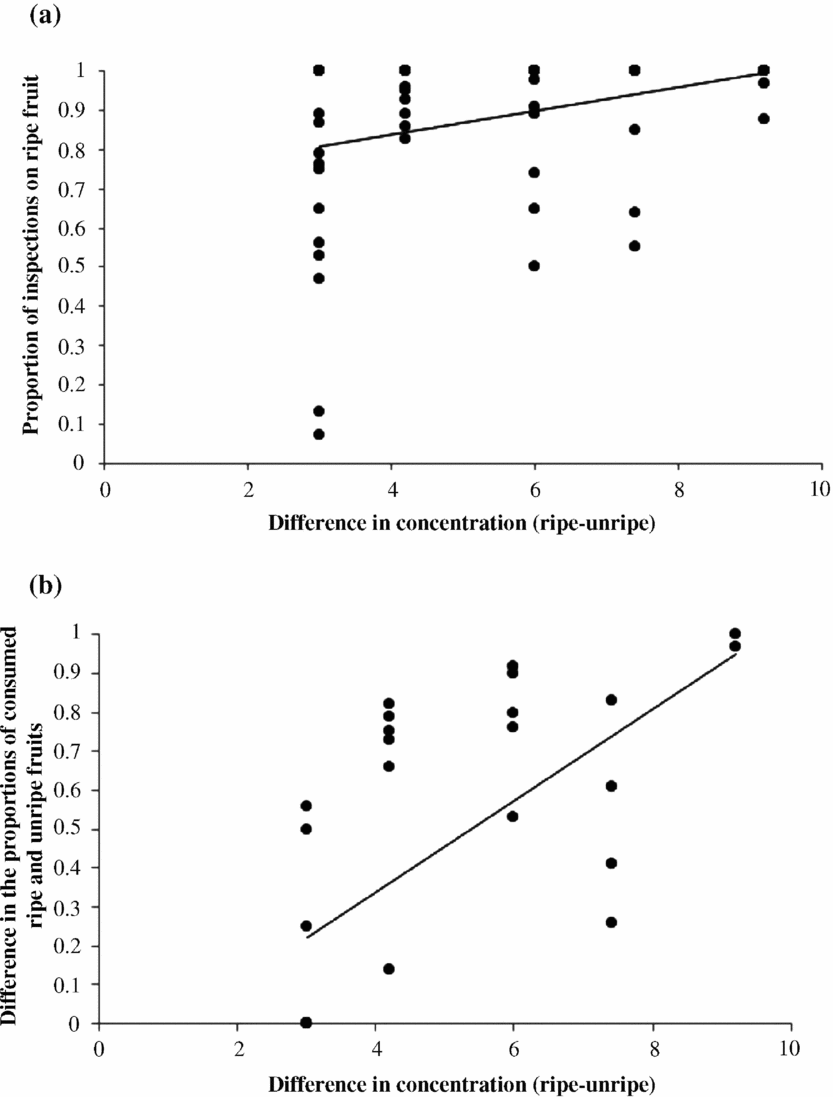
The first GLM revealed that the proportion of fruit inspections on ripe fruits was positively associated with the difference in sucrose concentration between ripe and unripe fruits (F1,51 = 8.02, P = 0.006; Figure 1a). In the second GLM we found that the difference between the proportions of consumed ripe and unripe fruits was positively associated with the difference in sucrose concentration between ripe and unripe fruits (F1,17 = 8.97, P = 0.008; Figure 1b).
Illustration of the relationship between the difference in sucrose concentration (g L−1) between ripe and unripe fruits consumed by spider monkeys and the proportion of fruit inspections on ripe fruits (a), and the difference in the proportions of consumed ripe and unripe fruits (b). Data points represent individual monkeys from Otoch Ma’ax Yetel Kooh Reserve, Yucatan, Mexico. The best-fitting lines representing the relationship between the variables are shown.

We also evaluated how the monkeys used their senses during fruit inspection. The GLMs revealed associations of fruit ripeness with the sensory modalities (Figure 2). Touch (F1,79 = 10.1, P = 0.002) and taste (F1,79 = 53.1, P < 0.001) were used more often when fruit was ripe, whereas smell was used more often when fruit was unripe (F1,79 = 17.0, P < 0.001).
Mean (± SE) proportions of inspected fruits in which touch, taste and smell were used depending on fruit ripeness by spider monkeys at the Otoch Ma’ax Yetel Kooh Reserve, Yucatan, Mexico. ** indicates a significant difference of P < 0.01 and *** indicates a significant difference of P < 0.001.
DISCUSSION
We established that sucrose concentration was significantly higher in ripe than unripe fruits of the six species under consideration. As hypothesized, we found that the larger the difference in the sucrose concentration between ripe and unripe fruits the higher the proportion of inspections the monkeys made on ripe fruits. The difference in sucrose concentration between ripe and unripe fruits was also positively associated with the difference between the proportion of consumed ripe and unripe fruits. These results indicate that sucrose plays a role in both fruit selection and consumption.
We found that in the fruits of each examined species there was an increase in sucrose concentration across the different colour phases during ripening. Although our findings are not surprising as fruits undergo physical and chemical changes across stages of maturity, including sucrose concentration (Irsan Reference IRSAN1998, Kader Reference KADER1999, Moriguchi et al. Reference MORIGUCHI, SANADA and YAMAKI1990, Sabir et al. Reference SABIR, KAFKAS and TANGOLAR2010), an increase in sucrose concentration likely leads to more frequent and successful selection of fruit (e.g. chimpanzee, Pan troglodytes, Reynolds et al. Reference REYNOLDS, PLUMPTRE and GREENHAM1998). We found support for such a relationship given that the difference in sucrose concentration between ripe and unripe fruits was positively associated with the selection and consumption in six species. This finding is in line with earlier experimental work in which the spider monkey appeared to specialize in sweetness as a criterion of fruit selection (Laska et al. Reference LASKA, CARRERA-SANCHEZ, RODRIGUEZ-RIVERA and RODRIGUEZ-LUNA1996) and prefer sucrose over other sugar solutions of equal molarity (Laska et al. Reference LASKA, SANCHEZ and RODRÍGUEZ-LUNA1998). Our results confirm that the detection of sweet substances in fruits is a key factor in their selection (Laska et al. Reference LASKA, CARRERA-SANCHEZ, RODRIGUEZ-RIVERA and RODRIGUEZ-LUNA1996), and that sucrose is likely to be an important factor in fruit selection in the spider monkey, despite not being a predominant sugar in many of the fruits it consumes (Riba-Hernández et al. Reference RIBA-HERNÁNDEZ, STONER and LUCAS2003). Collectively, this evidence points to the proximate mechanisms for fruit selection, whereas the function is the acquisition of nutrients with high-energy impact. However, future work is needed in which sucrose, fructose and glucose concentration are all measured during different fruit ripening phases to evaluate the relationship of each sugar with the selection and consumption of fruits by the spider monkey before this issue can be fully resolved.
As hypothesized, we also found relationships between the use of the senses of touch, smell and taste during fruit selection depending on ripeness, which support the view that different sensory cues are useful to spider monkeys in inspecting and selecting foods as has been reported for other primates (capuchin monkey, Sapajus apella, Visalberghi & Neel Reference VISALBERGHI and NEEL2010; squirrel monkey, S. sciureus, Dominy et al. Reference DOMINY, LUCAS, OSORIO and YAMASHITA2001; spider monkey, A. geoffroyi, Hiramatsu et al. Reference HIRAMATSU, MELIN, AURELI, SCHAFFNER, VOROBYEV and KAWAMURA2009, Laska et al. Reference LASKA, FREIST and KRAUSE2007). Our finding that spider monkeys sniff unripe fruits more often than ripe fruits supports recent work showing that spider monkeys use olfaction to inspect a fruit when visual cues do not give a reliable indication of ripeness (Hiramatsu et al. Reference HIRAMATSU, MELIN, AURELI, SCHAFFNER, VOROBYEV and KAWAMURA2009). As previous research in captive animals has shown that spider monkeys have a high olfactory sensitivity to food odours (Hernández-Salazar et al. Reference HERNÁNDEZ-SALAZAR, LASKA and RODRÍGUEZ- LUNA2003, Laska et al. Reference LASKA, HERNÁNDEZ-SALAZAR and RODRÍGUEZ-LUNA2003, Reference LASKA, RIVAS-BAUTISTA and HERNANDEZ-SALAZAR2006), sniffing may be particularly important to verify the status of fruit ripeness.
Little research has examined the use of the sense of touch in the inspection of fruits by spider monkeys. Our finding of an increase in the use of touch when the fruit was ripe supports earlier assertions that touch is an important mechanism to inspect fruit before consumption (Dominy et al. Reference DOMINY, LUCAS, OSORIO and YAMASHITA2001, Hoffmann et al. Reference HOFFMANN, MONTAG and DOMINY2004). The sense of touch can be used to distinguish the size, shape and hardness of a fruit (Dominy et al. Reference DOMINY, LUCAS, OSORIO and YAMASHITA2001), which change in most fruits during ripeness. Spider monkeys appear to prefer ripe fruits, as they are softer than unripe fruits (Kinzey & Norconck Reference KINZEY and NORCONCK1990) and the soft texture may be an indicator of ripeness (Dominy Reference DOMINY2004). Thus, the sense of touch may be important in food selection for spider monkeys by assessing the texture that changes during fruit ripening.
The sense of taste is crucial for the selection of food as the last step in its acceptance (Garcia-Bailo et al. Reference GARCIA-BAILO, TOGURI, ENY and EL-SOHEMY2009) and is essential to ensure that food is safe (Dominy et al. Reference DOMINY, LUCAS, OSORIO and YAMASHITA2001, Laska et al. Reference LASKA, FREIST and KRAUSE2007). We found that spider monkeys tasted fruit more frequently when it was ripe. Sweet perception resulting from simple sugars is generally elicited by ripe fruit and is associated with an energy source (Hladik & Simmen Reference HLADIK and SIMMEN1996). Our findings support earlier studies on captive animals of the same species, which demonstrate that taste is important in fruit selection (Hladik et al. Reference HLADIK, SIMMEN and PASQUET2003, Glaser Reference GLASER1989, Laska Reference LASKA1996, Laska et al. Reference LASKA, CARRERA-SANCHEZ, RODRIGUEZ-RIVERA and RODRIGUEZ-LUNA1996, Reference LASKA, SCHEUBER, CARRERA-SANCHEZ and RODRIGUEZ-LUNA1999, Reference LASKA, HERNÁNDEZ-SALAZAR and RODRÍGUEZ-LUNA2000, Reference LASKA, FREIST and KRAUSE2007). Thus, overall our findings on the role of sensory cues highlight the importance of smell, touch and taste in fruit selection depending on ripeness.
Although in our study we did not measure the concentrations of monosaccharide sugars present in fruits, such as glucose and fructose, we did find evidence that points to an important role of sucrose in fruit selection and consumption by spider monkeys. In addition, our findings add to the body of literature supporting that sucrose concentration is associated with conspicuous colour changes during fruit ripening. It is well understood that fruit colour is an important sensory cue that various species rely on to recognize fruit ripeness, particularly from a distance (Dominy & Lucas Reference DOMINY and LUCAS2001, Regan et al. Reference REGAN, JULLIOT, SIMMEN, VIÉNOT, CHARLES-DOMINIQUE and MOLLON2001). Our results provide evidence that other sensory cues are important for selecting fruits at close range in spider monkeys.
ACKNOWLEDGEMENTS
We would like to thank Eulogio Canul, Macedonio Canul, Juan Canul and Augusto Canul for valuable assistance in the field. We are grateful to the Punta Laguna community, CONANP and SEMARNAT (SGPA/DGVS/01241/12; SGPA/DGVS/00910/13) for permission to carry out the research. We would like to thank Braulio Pinacho for providing information for the study. We would like to thank Matthias Laska for his comments on an early version of the paper. We also thank an anonymous reviewer for suggestions that improved the quality and clarity of our manuscript. MPR is grateful for the support of CONACyT (No. CVU 272328) for her scholarship and to the Universidad Veracruzana, I010/152/2014 C-133/2014 provided by CONACYT for funding and equipment for the project.