I. INTRODUCTION
Epoxy resins are one of the most developed high-temperature thermoset materials and they are used extensively as a structural adhesive, functional coating, mechanical and electronic material, molding compound, and advanced composite matrix.Reference Azeez, Rhee, Park and Hui1 These extensive application prospects result from their versatile properties, such as high strength, stiffness and modulus, creep resistance, good thermal stability, electrical properties, adhesive strength, and excellent chemical and corrosion resistance.Reference Zaioncz, Silva, Sirqueira and Soares2 However, a well-known drawback of epoxy resins is their brittleness, which results from their high crosslinking character. This leads to a poor resistance to crack formation and crack growth, which restricts their application significantly.Reference DeCarli, Kozielski, Tian and Varley3
Several methods have been proposed to improve the toughness of epoxy resins.Reference Domun, Hadavinia, Zhang, Sainsbury, Liaghat and Vahid4 Reactive liquid rubbers are well-known as effective fillers to improve toughness.Reference Kar and Banthia5 The phase separation of rubber particles after curing results in matrix shear yielding and plastic deformation.Reference Tang, Wang, Wan, Wu, Jiang and Lai6 However, major defects of this method include decreases in material thermal and elastic properties.Reference Hazot, Pichot and Maazouz7 Silica nanoparticles have been used to enhance the epoxy resin toughness,Reference Sprenger, Kothmann and Altstaedt8,Reference Dorigato, Pegoretti and Quaresimin9 because these nanoparticles can increase the toughness without sacrificing the thermo-mechanical properties and the glass transition temperature (T g).Reference Crespo, González and Pozuelo10,Reference Kinloch, Masania, Taylor, Sprenger and Egan11 Bray et al. suggests that the epoxy toughness increases steadily with increasing silica nanoparticle content.Reference Bray, Dittanet, Guild, Kinloch, Masania, Pearson and Taylor12 Blackman et al. demonstrated that the introduction of silica nanoparticles into an epoxy polymer increased the fracture toughness and cyclic-fatigue behavior.Reference Blackman, Kinloch, Lee, Taylor, Agarwal, Schueneman and Sprenger13 However, the relatively high specific surface area of nanoparticles also increases the resin viscosity significantly, which reduces the ease of processing.Reference Ilyin, Brantseva, Gorbunova, Antonov, Korolev and Kerber14 An organic/inorganic hybrid route has been considered for the preparation of silica-based hybrid particles. These hybrids can combine advantages of silica particles and organic polymers. Hence, it is tempting to modify silica nanoparticles with rubbers. Pan and He provided a novel approach to prepare core–shell pentablock copolymer/silica hybrids by growing silica on pentablock copolymer precursors.Reference Pan and He15 Zeng et al. suggested an approach to fabricate epoxy-functionalized polystyrene/silica core–shell hybrid nanoparticles via emulsion polymerization.Reference Zeng, Yu and Guo16 The strength and modulus of epoxy thermosets with silica/rubber hybrids were higher than those of the thermoset that was modified only with rubber.Reference Kinloch, Mohammed, Taylor, Eger, Sprenger and Egan17 Gao et al. proposed that SiO2 nanoparticles grafted by rubbery block copolymer enhanced the ductility, fracture toughness, and fatigue crack growth resistance of the epoxy matrix substantially.Reference Gao, Li, Zhao, Benicewicz, Hillborg and Schadler18 Multiscale hybrid composites were fabricated using carbon nanotubesReference Sharma and Lakkad19 and graphene was grown on carbon nanotubeReference Im and Kim20 with an epoxy matrix. Jiang et al. introduced silica nanoparticles that attached to graphene oxide into epoxy to enhance the mechanical properties of the composites.Reference Jiang, Kuila, Kim, Ku and Lee21 The effects of silica nanoparticle/multiwalled carbon nanotubes,Reference Jia, Liu, Huang, Hui and Yang22 carbon nanotubes/microparticles,Reference Li, He and Bai23 and silica sand nanoparticle/glass fiber hybrids on epoxy-based composites have been reported.Reference Ahmad, Ahmad, Kamran, Wahjoedi, Shakoor, Hussain, Riaz, Jamil, Isaac and Ashraf24
Recently, the addition of core–shell particles (CSPs) has proven to be a good solution to solve toughness problems in epoxy resins.Reference Quan and Ivankovic25 Chen and co-workers showed that pre-formed polysiloxane rubber CSPs were well-dispersed into epoxy resins and did not affect the T g.Reference Chen, Kinloch, Sprenger and Taylor26 Naguib et al. showed that the presence of CSPs did not affect the curing process but improved the impact resistance.Reference Naguib, Grassini and Sangermano27 Meng et al. introduced spherical core–shell nanodomains with average diameters of 29 or 32 nm into epoxy thermosets.Reference Meng, Zhang, Du, Zhou, Zhou and Qi28 Quan and Ivankovic confirmed that the interaction between matrix and particles increased the T g, ductility, and Poisson's ratio, but reduced the Young's modulus and tensile strength.Reference Quan and Ivankovic29 However, the introduction of traditional CSPs that consist of pure polymers as core and shell parts has resulted in the decrease of other mechanical properties, such as tensile and flexural strength.Reference Quan and Ivankovic25 An important strategy to fabricate CSPs with high mechanical properties is to prepare hybrid core–shell composites composed of functional organic polymers and inorganic nanoparticles.Reference Su, Yu, Jiang and Yin30 An advantage of this approach is that these hybrid CSPs can combine the versatile characteristics and properties of organic polymers and the excellent physical properties of inorganic nanoparticles. The addition of CSPs, that consist of silica nanoparticles as core and poly(methyl methacrylate) as shell, improved the toughness of epoxy-based composites without any significant deterioration in their thermal properties.Reference Yang, Zhu, Xia, Wang, Du and Zhong31
Hyperbranched polymers (HBPs), which have a low viscosity and melting point, unique three-dimensional architecture, and compatibility with other polymers,Reference Thakur and Karak32 are used to improve the impact resistance of epoxy resins.Reference Pan, Lu, Xiao, He, Zeng, Gao and Yu33 An exceptional characteristic of HBPs is their high density of terminal functional groups, which can enhance the compatibility between HBPs and epoxy matrices. Tomuta et al. demonstrated that the introduction of HBPs toughened epoxy.Reference Tomuta, Ferrando, Serra and Ramis34 Allauddin et al. observed an improvement in the thermal stability, T g, storage modulus, tensile strength, and toughness of epoxy/HBP thermosets.Reference Allauddin, Akhil Chandran, Jena, Narayan and Raju35
Many investigations have been conducted on the improvement in the mechanical properties of epoxy resins. However, increased attention should be given to their extensive application. In this paper, the goal was to focus on improving the mechanical performance of epoxy resins by using newly designed CSPs and hydroxyl-terminated HBPs (HBPHs). The novelty of this work is the synergistic reinforcement of epoxy resins with CSPs and HBPH. The effect of CSP content on the mechanical properties of epoxy/HBPH thermosets was studied. Results from tensile, flexural, and impact tests are discussed. The impact fracture surface microstructure was observed using field emission-scanning electron microscopy (FESEM).
II. EXPERIMENTAL
A. Materials
Diglycidyl ether of bisphenol A epoxy resin E51 with an epoxide equivalent value of 185–208 g/eq. was obtained from Hangzhou (Wuhuigang Adhesive Co., Ltd., China). Polyamide 650 with an amine value of 220 ± 20 mg KOH/g, which was synthesized by the polymerization of eleostearic acid monomers and diethylenetriamine, was purchased from Wuxi (WuxiResin Factory, China). Silica nanoparticles of an average 50-nm diameter were obtained from Yixing (Xinxing Co., Ltd, China). Aqueous solutions of hydrogen peroxide (H2O2, 30 wt%), toluene (98%), γ-aminopropyl triethoxysilane (98%), N,N-dimethylacetamide (98%, DMA), epichlorohydrin (98%, ECH), succinic anhydride (98%), and diethanolamine (98%) were purchased from Chengdu (Kelong Chemical Reagent Company, China).
B. HBPH synthesis
HBPH synthesis followed the method in former reports.Reference Li, Cui, Hou, Wu and Zhang36–Reference Li, Lin, Zhu, Hou, Li, Wu and Cui38 Succinic anhydride (1.57 g) was blended with diethanolamine (1.50 g) at 70 °C for 6 h in a 50-mL round-bottomed flask provided with a thermometer, nitrogen inlet, and magnetic stirring. The mixture was heated to 120 °C and kept for 6 h with stirring in nitrogen. The HBPH product was dried at 80 °C for 12 h under vacuum to eliminate the water formed.
C. Preparation of CSPs
Typically, silica nanoparticles (0.5 g) were blended with 5-mL H2O2 solution and sonicated for 30 min in a 50-mL three-neck round-bottomed flask, followed by refluxing at 105 °C for 4 h with magnetic stirring. After drying at 80 °C under vacuum overnight, particles were added into 5-mL toluene and sonicated for 30 min. γ-Aminopropyl triethoxysilane (0.25 g) was added and the mixture was heated to 80 °C for 24 h with magnetic stirring under nitrogen. The silanized particles were also dried at 80 °C under vacuum overnight. The modified particles were blended homogeneously with diethanolamine (0.5 g) with magnetic stirring at 300 rpm for 30 min. Succinic anhydride (0.52 g) was added and heated to 70 °C for 6 h with magnetic stirring, followed by heating to 120 °C for another 6 h under nitrogen. After cooling to 110 °C, ECH (6.12 g) was added dropwise and stirred for 6 h. The resulting products were re-dissolved in DMA, followed by filtering to eliminate the undissolved materials and drying at 80 °C for 24 h under vacuum. The CSP fabrication route is shown in Scheme 1.
The fabrication route of CSPs.

D. Preparation of epoxy thermosets
To prepare the epoxy, a mixture of the appropriate amounts of epoxy resin and HBPH (HBPH/epoxy, 0.16:1 w/w according to our former workReference Li, Cui, Hou, Wu and Zhang36) was blended by mechanical stirring at 300 rpm for 30 min. Then CSPs (CSPs/epoxy, 0, 1, 2, 3, 4, 5 wt%) were added into the homogeneous mixture and sonicated at 30 °C for 30 min to improve the CSP dispersion. After that, polyamide 650 (650/epoxy, 1.2:1 w/w, calculated based on the reaction of active hydrogen and epoxide, and preheated to 60 °C to improve the processability) was added and the resulting mixture was homogenized by mechanical stirring at 300 rpm for 10 min. Finally, the mixtures were poured into stainless steel templates and cured at 60 °C for 48 h in an oven.
E. Characterization
Infrared spectroscopy spectra were obtained with a Tensor 37 instrument (Germany, Bruker) at a resolution of 2 cm−1 and from 400 to 4000 cm−1 by attenuated total internal reflectance Fourier transform infrared spectroscopy (ATR-IR). Nuclear magnetic resonance (NMR) analyses were recorded on an AVANCE III 500 NMR spectrometer (Switzerland, Bruker) with deuterated dimethyl sulfoxide (DMSO-d6) as the solvent at 20 °C. CSP (50 mg) was added into a 5-mL beaker with 1 mL DMSO-d6 with magnetic stirring at 300 rpm for 2 h. The mixture was centrifuged at 1678 g for 10 min. The supernatant liquid was used for 1H NMR spectra tests. A DTG 60 simultaneous measuring instrument (Japan, SHIMADZU) from 30 to 800 °C at 20 °C/min was used to evaluate the thermo-gravity of the nanoparticles before and after surface modification. High-resolution transmission electron micrographs were obtained using a Tecnai 20 electron microscope (USA, FEI). The particles were dispersed in ethanol and sonicated for 10 min. Then the suspension was transferred to a copper grid with a carbon film using a dropper and dried at room temperature. Differential scanning calorimetry of epoxy thermosets was performed with a 200 F3 differential scanning calorimeter from −30 to 300 °C at 20 °C/min under nitrogen (Germany, NETZSCH). Tensile tests were performed on a dog-bone-shaped sample according to GB/T 2567-2008 standard with an AG-X plus test machine (Japan, SHIMADZU). The flexural strength was characterized by an UTM4000 electromechanical universal testing machine (China, SANS) according to GB/T 2567-2008 standard at room temperature with dimensions of 80 × 15 × 4 mm and a loading rate of 2 mm/min. Unnotched Izod tests were performed on a ZBC-50 impact tester (China, SANS) using a GB/T 2567-2008 standard with 4-mm thickness and 10-mm width. All results were an average of five specimens. After impact testing, the fracture surface was observed with a SU8000 FESEM (Japan, Hitachi), and the fracture surface of the thermosets was sputter-coated with gold before observation.
III. RESULTS AND DISCUSSION
A. CSP characterization
The ATR-IR spectra of the pristine silica, silanized silica, and CSPs are shows in Fig. 1. The broad peak at 3377 cm−1 in the ATR-IR spectrum of pristine silica can be assigned to the asymmetric –OH stretching. The weak band at 1620 cm−1 is attributed to the H–OH bending. The sharp absorptions at 1067 and 797 cm−1 are assigned to –OH and Si–O stretching, respectively. In contrast with the ATR-IR spectrum of pristine silica, two different parts are observed in the ATR-IR spectrum of silanized silica particles. The broad absorptions at 3377 and 1620 cm−1 disappeared. A new peak appeared at 1614 cm−1, which can be ascribed to N–H stretching. This peak is the characteristic absorption band of siloxane linkages. In the ATR-IR spectrum of CSPs, the broad absorption at 3361 cm−1 can be attributed to intermolecular hydrogen bonding stretching. Absorptions at 1163 and 1731 cm−1 are assigned to asymmetric C–O and –C=O stretching, respectively. The weak peaks at 1623 and 1425 cm−1 are attributed to N–H stretching and C–N bending, respectively. The appearance of peaks at 1056, 915, and 856 cm−1 (epoxy group) confirms the reaction between HBPH and ECH and hence the formation of epoxy bonds. All absorptions indicate that terminal epoxide groups exist in the CSP shell layer.
The ATR-IR spectra of pristine silica, silanized silica and CSPs.
NMR spectroscopy is a useful and substantive technique for polymer characterization, and provides a deeper insight into the polymer chemical structure. The representative 1H NMR spectrum of CSP also provides more detailed evidence to prove the successful grafting of epoxide-terminated HBP (HBPE) on the silanized silica particles surface, as shown in Fig. 2. Peaks existed at 2.49 ppm (–CH2CHCH2O–, protons a), 2.93 ppm (–CH2CHCH2O–, protons b), 3.52 ppm (–CH2CHCH2O–, protons c), 3.63 ppm (N–CH2–CH2–O–, protons d), 3.48 ppm (N–CH2–CH2–O–, protons e), 2.62 ppm (O=CH2–CH2=O, protons f), 3.59 ppm (O=CH2–CH2=O, protons g), 3.89 ppm (N–CH2–CH2–O, protons h) and 2.77 ppm (N–CH2–CH2–O, protons i). The peaks at 2.49, 2.93, and 3.52 ppm are characteristic of an epoxide ring, which indicates the successful fabrication of CSPs. The peaks at 2.49, 2.93, and 3.52 ppm are attributed to protons of the terminal units. The peaks at 3.63 and 3.48 ppm are ascribed to those of the dendritic units, whereas, those at 2.62, 2.77, 3.59, and 3.89 ppm can be attributed to protons of the linear units.
1H NMR spectrum of CSPs.
The thermo-gravimetric analysis (TGA) curves of hydroxylated silica, silanized silica, and CSPs measured under nitrogen are shown in Fig. 3. The temperatures for 5 and 10 wt% mass loss (T 5% and T 10%) from the CSPs are 65.8 and 118.1 °C, respectively. The mass losses of the hydroxylated silica, silanized silica, and CSPs are 18.7, 30.3, and 43.3% at 800 °C, respectively, and increase as hydroxylated silica particles < silanized silica particles < CSPs. This may provide evidence of the successful grafting of γ-aminopropyl triethoxysilane and HBPE on the silica nanoparticle surface. CSPs exhibit a high mass loss (24.1%) at low temperature (from the onset degradation temperature to 300 °C), which is consistent with reports in the literature.Reference Huang, Heo, Yoo, Choi and Kim39,Reference Zhang, Zhang, Qin and Xu40 The mass loss of CSPs (13.0%) is higher than that of boron nitride functionalized by HBP (BN-HBP) (5.13%)Reference Yu, Huang, Wu, Wu, Wang and Jiang41 and HBP grafted barium titanate (BT-HBP) (4.91%).Reference Xie, Huang, Huang, Yang and Jiang42 This is attributed to the difference in hydroxyl group density (–OH) that is available for chemical bonding of nanoparticles. The surface of the hydroxylated silica particles has a large amount of hydroxyl groups, which can contact the amino groups of the silane-coupling agent. Thus, the percentage grafting of HBPE on the silanized silica particle surface is higher than that in other works.
TGA curves of hydroxylated nanosilica, silanized nanosilica and CSPs measured under N2.
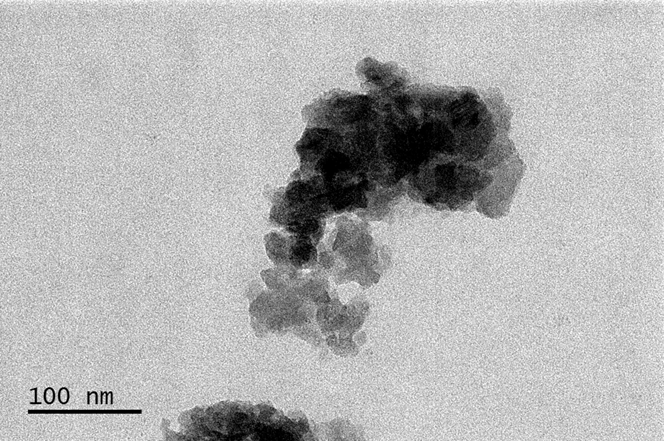
The transmission electron microscopy (TEM) image of the CSPs, as shown in Fig. 4, shows the nanoparticle size, shape, and dispersion. CSPs agglomerate slightly owing to the strong polarity of their terminal epoxide groups, high specific surface area, and surface energy. The CSP sizes range from 60 to 80 nm.
TEM micrograph of CSP.
B. Glass transition temperature
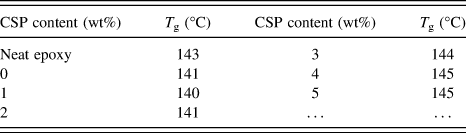
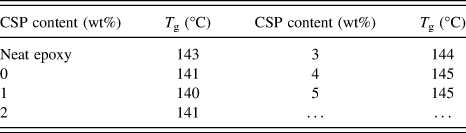
The T gs of the epoxy thermosets are listed in Table I. The neat epoxy displays a T g at 143 °C. Those of epoxy/HBPH thermosets with 0, 1, 2, 3, 4, and 5 wt% CSPs are 141, 140, 141, 144, 145, and 145 °C, respectively. The increase in T g may be ascribed to a high polarity of the epoxide groups grafted on the CSP surface, which can modify the epoxy thermoset network and inhibit the segmental motion of the epoxy.Reference Qian, Yu, Xie, Li and Jiang43
The glass transition temperatures (T gs) of the epoxy compositesa.
a Neat epoxy means the epoxy thermosets without neither HBPH nor CSP.
C. Mechanical performance
The incorporation of HBPs can improve the impact toughness of the epoxy resins but may sacrifice other mechanical properties, such as the tensile and flexural strength, because of the introduction of flexible chains in their frameworks.Reference Lv, Yuan and Shi44 Our previous report demonstrated that an incorporation of 16 wt% HBPH could improve the impact strength by ∼32.8% but decrease the flexural strength of the epoxy resins.Reference Li, Cui, Hou, Wu and Zhang36 To improve the epoxy thermoset strength, some rigid phases should be incorporated into epoxy resins, such as nanoparticles, carbon tubes, or CSPs, which were mentioned above. In this work, a new type of CSP that consists of HBPE and silica nanoparticles was chosen as a good solution. Figure 5 shows the variation in tensile strength and percent elongation at break as a function of CSP content. As shown in Fig. 5(a), the tensile strength of the epoxy/HBPH thermoset with 0 wt% CSP is lower than that of the neat epoxy. The tensile strength increases with increasing amount of CSP in the epoxy/HBPH thermosets. The maximum tensile strength improves by 46% with an addition of 2 wt% CSP compared with that at 0 wt%. It is difficult to summarize and predict the tensile strength of epoxy resin because this mechanical property depends mainly on the strength of the weakest part of the test specimens, instead of the average strength.Reference Quan and Ivankovic29 The addition of HBPH increases the percent elongation at break compared with the neat epoxy [Fig. 5(b)], which may be attributed to the low crosslink density and the special HBPH spherical shape. Lv et al. suggested that the spherical HBPH molecule had a loose architecture and made the epoxy matrix softer than neat epoxy.Reference Lv, Yuan and Shi44 The decrease can be attributed to CSP aggregation.
(a) Tensile strength (b) and percent elongation at break of epoxy/HBPH thermosets as function of CSPs content.
Figure 6 shows the flexural strength of epoxy/HBPH thermosets with different CSP contents. The flexural strength increases from 46.6 MPa for the unmodified epoxy/HBPH thermoset to 81.4 MPa for the formulation with 2 wt% CSPs. Thereafter, the trend alters and the flexural strength decreases to 51.4 MPa for the thermoset with 5 wt% CSPs. The maximum value increases by ∼29.8% and 74.7%, compared with the neat epoxy and unmodified epoxy/HBPH thermoset, respectively. Figure 7 shows the impact strength of epoxy/HBPH thermosets as a function of CSP content. Similarly, the impact strength increases with CSP content, which shows a reduction in increasing trend. All modified epoxy/HBPH thermosets show a higher impact resistance than that of the neat epoxy. By comparison with the neat epoxy and other epoxy/HBPH thermosets, the formulation with 2 wt% CSPs shows the highest impact strength of 15.709 kJ/m2. These results indicate that the impact resistance of epoxy/HBPH thermosets can be improved by the addition of a small amount of CSPs. However, the CSPs may be easily agglomerated especially when the CSP concentration exceeds the percolation threshold.Reference Wang, Schuman, Vuppalapati and Chandrashekhara45 Aggregation can induce stress concentration and result in crack initiation and a reduction in interfacial interaction between the nanoparticles and the polymer matrix.Reference Qi, Zhang, Bannister and Mai46 In conclusion, epoxy thermosets with excellent impact resistance are obtained.
Flexural strength of epoxy/HBPH thermosets as function of CSPs content.
Impact strength of epoxy/HBPH thermosets as function of CSPs content.
Wang et al. proposed a yield function to quantify the effects of tensile stress on the plastic yielding behavior of rubber-modified epoxies and found good agreement with experimental results.Reference Wang, Xiao, Ye, Mai, Wang and Rose47 Chen et al. demonstrated that the predictions of the Halpin–Tsai and the Lewis–Nielsen models showed good agreement with the experimental data.Reference Chen, Kinloch, Sprenger and Taylor26 Quan and Ivankovic also suggested that the addition of core–shell rubber nanoparticles reduced the tensile strength of epoxy reins according to the experiment and model prediction.Reference Quan and Ivankovic29 Different from rubber particles filled epoxy, CSP incorporation can improve the strength and impact toughness because of the synergistic effect of the rigidity of silica nanoparticles and the excellent compatibility between HBPE and the epoxy matrix. The reason for this improvement can be explained by the following four aspects: firstly, the enhancement in mechanical properties of epoxy/HBPH thermosets modified with CSPs can be attributed to the interaction between epoxide groups attached to the silanized silica particle surfaces and hydroxyl groups in epoxy resins.Reference Pan, Lu, Xiao, He, Zeng, Gao and Yu33 Secondly, the formed domains, which are attributed to the incorporation of CSPs, can withstand a greater mechanical loading from the matrix when the matrix is under stress.Reference Meng, Zhang, Du, Zhou, Zhou and Qi28,Reference Srivastava48 This means that when the applied loading exceeds the elastic deformation stress, the CSPs have a stress transfer effect and enhances the strength and plasticity of the epoxy matrix.Reference Zhang and Jiang49 Thirdly, CSPs can produce more microcrack surface area, which leads to an increase in the epoxy thermoset toughness.Reference Srivastava48 Finally, the enhanced impact toughness may originate from the crack tip pinning/bridging effect of the CSP chemically bonded to the epoxy matrix, which is similar to other reported epoxy that is toughened by rigid nanofillers.Reference Thitsartarn, Fan, Sun, Yeo, Yuan and He50 However, the mechanical properties of epoxy/HBPH thermosets are expected to undergo decay if the CSP content exceeds 2 wt%. Although, the graft of HBPE on the silanized silica particle surface can improve the compatibility between CSPs and epoxy matrix; the dispersion of CSPs in epoxy resins worsens with CSP content and results in a defect in the epoxy matrix.Reference Pan, Lu, Xiao, He, Zeng, Gao and Yu33
D. Morphological analysis
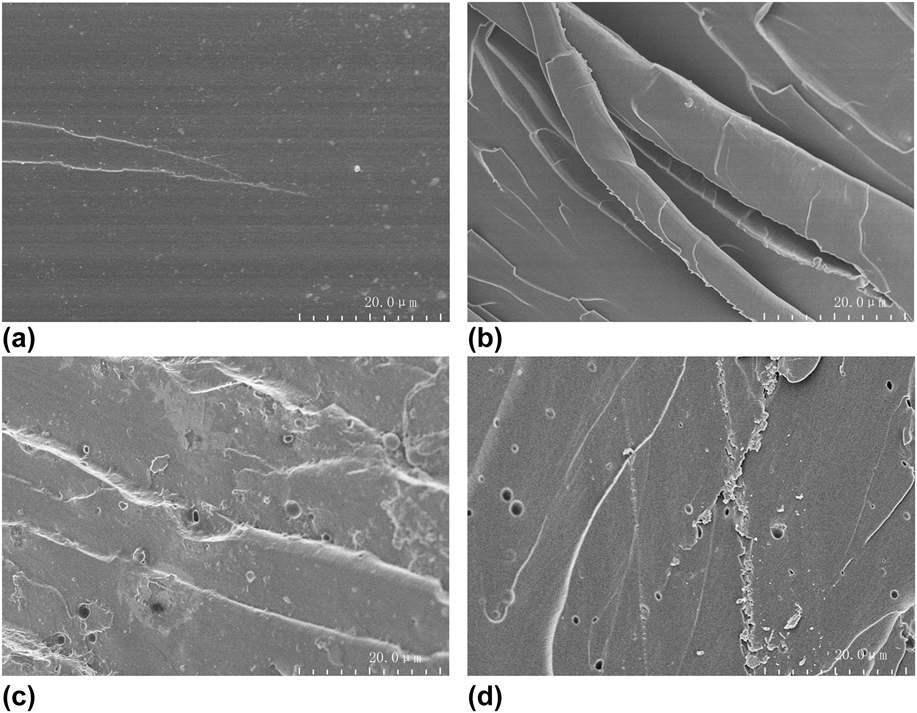
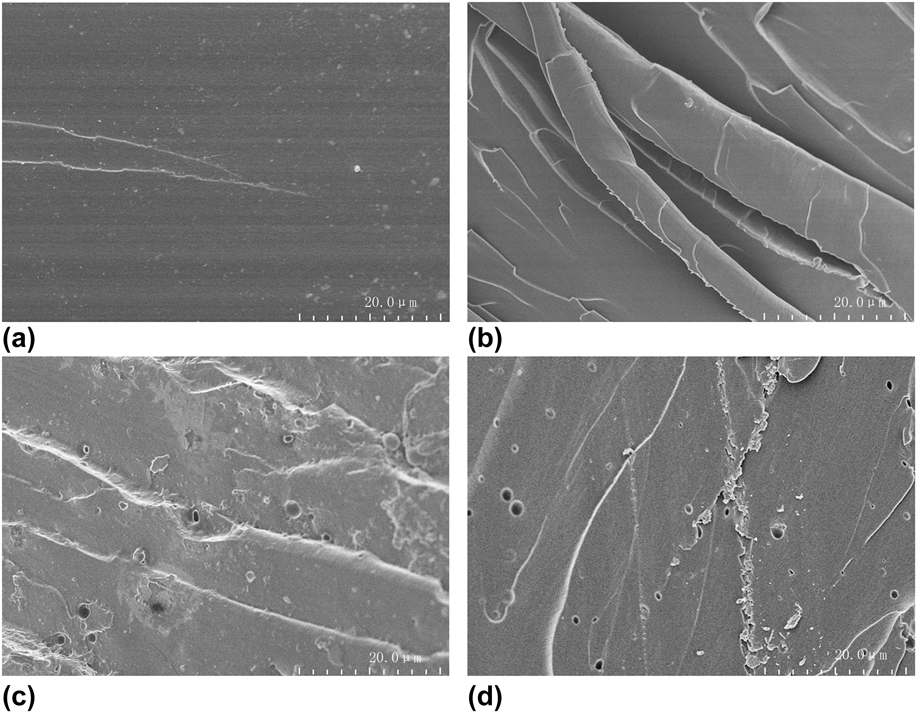
The impact behavior of epoxy thermosets can be explained in terms of the morphology observed by FESEM. The fracture surface morphologies of epoxy thermosets are shown in Fig. 8. The fracture surface of the neat epoxy indicates a brittle fracture with no uninterrupted crack propagation path and leads to poor resistance to crack initiation and propagation [Fig. 8(a)]. The fracture surface morphology of the unmodified epoxy/HBPH thermoset [Fig. 8(b)] presents a homogeneous appearance without any phase separation. This phenomenon can account for the good compatibility between the epoxy matrix and the HBPH. This morphology also exhibits a rough and coarse surface that contains a large number of propagated cracks, crack deflection and shear deformation. This may result from the high density of hydroxyl groups in the HBPH architecture. The epoxy/HBPH thermoset morphology with 2 wt% CSPs shows several large shear deformations and crack propagation [Fig. 8(c)]. CSPs can induce stress concentrations, which lead to extensive shear deformation.Reference Lv, Yuan and Shi44 When cracks initiate, the shear deformation can absorb fracture energyReference Buonocore, Schiavo, Attianese and Borriello51 and interrupt crack propagation. The CSPs disperse uniformly in this thermoset, which indicates the good compatibility between CSPs and epoxy matrix in the HBPH.Reference Naguib, Grassini and Sangermano27 Several exposed CSPs debond from the epoxy matrix. The morphological characterization highlights several cavities, which are ascribed to the debonding of embedded CSPs from the epoxy matrix. CSP debonding absorbs impact energy and improves the epoxy resin impact resistance. Thus, the use of an appropriate amount of CSPs can improve the impact resistance of epoxy/HBPH thermosets. However, the fracture surface morphology of the thermoset with 5 wt% CSPs shows large crack propagation from CSP aggregation [Fig. 8(d)]. The impact energy has been absorbed and is focused on these aggregates, which results in deterioration in impact resistance.
FESEM images of (a) neat epoxy thermoset, (b) epoxy/HBPH thermoset, (c) epoxy/HBPH thermoset with 2 wt%, and (d) 5 wt% CSPs.
IV. CONCLUSIONS
A new CSP has been prepared by grafting HBPE on the surface of silanized silica nanoparticles. The CSP was used as a toughening modifier of epoxy resin modified with HBPH. The effect of the CSP content on the mechanical properties of epoxy thermosets was investigated. The toughening mechanisms were identified and discussed.
The results show that the T gs of epoxy/HBPH thermosets increase with CSP content. The tensile strength, percent elongation at break, flexural strength, and impact strength of epoxy/HBPH thermosets were also improved. For instance, the tensile strength, percent elongation at break, flexural strength, and impact strength of the epoxy/HBPH thermoset modified with 2 wt% CSPs were 42.77 MPa, 6.67%, 81.41 MPa, and 15.709 kJ/m2, respectively. These values represent improvements of 45.97, 18.47, 74.71, and 21.18%, respectively, compared with unmodified epoxy/HBPH thermoset.
Based on our results, the use of CSPs may be a feasible approach to increase the mechanical properties of epoxy resin modified with HBPH.
ACKNOWLEDGMENTS
The authors gratefully acknowledge supports from the National Natural Science Foundation of China (51402251, 51578289, 51572234 and 51502259), the National Science and Technology Major Project of the Ministry of Science and Technology of China (2012ZX04010032), the joint research fund between Collaborative Innovation Center for Ecological Building Materials and Environmental Protection Equipments and Key Laboratory for Advanced Technology in Environmental Protection of Jiangsu Province (CP201506 and GX2015107), the project funded by the Flagship Major Development of Jiangsu Higher Education Institutions (PPZY2015A025), and the Natural science fund of Jiangsu Province (BK20130428).