‘Say it with flowers’, say the Americans … and the florists. May the formula ‘Say it with Georges Auric’ become the motto of the French and of the blabbermouthed filmmakers.
Jean LauryFootnote 1Following the December 1931 première of René Clair's A Nous, la Liberté! the Parisian press erupted into debate.Footnote 2 The highly anticipated film surprised many critics with its unexpected satire of the dehumanizing aspects of assembly-line manufacturing and Taylorist business principles.Footnote 3 While most reviews debated whether the film promoted communist or anarchist agendas, there was general agreement about three aesthetic issues: the film was one of Clair's best yet, the then-unknown actors gave solid performances that attested to Clair's skill as a director, and the work of Clair's primary collaborators – composer Georges Auric and set designer Lazare Meerson – contributed positively to the atmosphere and to the success of the film. The comments about Auric's music were overwhelmingly complimentary, ranging from Jean Laury's effusive review in Le Figaro to passing comments about the music's ability to accompany, rather than simply underline, the on-screen action. Only Emile Vuillermoz, with whom Auric had had a public feud throughout the 1920s, judged the score negatively, though even he admitted that the music worked well with the film: ‘I must also praise the deft use of the musical element, though the score by Georges Auric is lacking a bit too much in originality and skill. But his simplistic and slightly monotonous elements were most felicitously employed.’Footnote 4 Although a critical success from the start, A Nous, la Liberté! was initially less successful at the box office than Clair's previous film, Le million (1931). After a second gala première, in January 1932 in Berlin, however, the film was soon a popular success worldwide.
A Nous, la Liberté! was Auric's second film score, following his music for Jean Cocteau's Le sang d'un poète (1932).Footnote 5 Several times throughout his life, however, Auric referred to this film – rather than the earlier Cocteau film – as the true starting-point of his career as a composer for the medium.Footnote 6 But, although he was new to film composition in the early 1930s, Auric was hardly new to the cinema. His correspondence and his music criticism show that by 1919 he was an avid cinéphile. As a follower of the esprit nouveau aesthetic of Guillaume Apollinaire and Jean Cocteau, he viewed the cinema as offering the potential for a new and modern means of expression for composers. Auric's attachment to the musical ideals of the esprit nouveau remained a dominant force from his first encounters with Apollinaire in 1915 and 1916 to his first film scores.Footnote 7
The esprit nouveau and Auric's film music criticism
The poet Guillaume Apollinaire outlined his idea of the esprit nouveau over the course of several articles and lectures in 1917 and 1918.Footnote 8 This ‘new spirit’ called for a French reaction against the influence of Wagner, whose music dramas cast a long shadow over French music and poetry even into the 1920s. It also called for a reaction against impressionism and symbolism. The spirit further demanded that poets (by which he meant artists in any medium) find their inspiration in quotidian Parisian life. A wounded veteran writing at the height of World War I, Apollinaire argued: ‘Art increasingly has a country. Furthermore, poets must always express a milieu, a nation.’Footnote 9 He went on to conclude that
The new spirit [esprit nouveau] is above all the enemy of estheticism, of formulae, and of cultism. It attacks no school whatever, for it does not wish to be a school, but rather one of the great currents of literature encompassing all schools since symbolism and naturalism. It fights for the reestablishment of the spirit of initiative, for the clear understanding of its time, and for the opening of new vistas on the exterior and interior universes, which are not inferior to those which scientists of all categories discover every day and from which they extract endless marvels.Footnote 10
Following Apollinaire's death on 9 November 1918 the banner for his artistic call to arms was taken up by Jean Cocteau, whose Le coq et l'arlequin had been completed several months earlier and was purportedly written on behalf of Erik Satie and the young composers who gathered around him, the Nouveaux Jeunes. The aphoristic manifesto is prefaced by a two-page dedication to Auric that praises him for escaping the influence of nineteenth-century German Romanticism, which the two saw as an ever-present disease crippling mainstream French art music of the day. Following Apollinaire's model, the tract goes on to outline a new and distinctly French musical aesthetic inspired by the popular music found in Paris – that of the circus, the music-hall, the café-concert, and the street fair. Further inspiration was found in the naïveté, simplicity, and clarity of Henri Rousseau's paintings. In Satie's 1917 credo ‘L’idée et la main d'œuvre' (Subject Matter [Idea] and Craftsmanship [Construction]) these poetic descriptions were translated into musical attributes. As Robert Orledge notes in his discussion of the credo, ‘[Melody] constitutes the idea behind the work, traces its outlines and conditions its form and content. The work that emerges from it is illuminated by its harmony, which is tonal in origin.’Footnote 11 Satie's criticism of composers such as Jules Massenet and Camille Saint-Saëns – who were also targets of Cocteau and Auric – is that their music relies on harmony more than melody and is thus more about craft than substance. The composer and music critic Roland Alexis Manuel Lévy, better known under the pen name Roland-Manuel, further clarified in musical terms the new aesthetic of Apollinaire and Cocteau: ‘Above all, the esprit nouveau seeks purity of design, plain expression, and a clear line.’Footnote 12
The influence of the esprit nouveau is apparent in Auric's writings from the late 1910s and 1920s, especially in his film music criticism. Throughout the 1920s Auric was an active and outspoken music critic, most notably in the pages of Les nouvelles littéraires, for which he wrote from 1922 to 1926. Rarely, however, was he allowed to write about film music. Out of several hundred articles by Auric from this decade, only three pertain to film music: a 1919 survey response published in Le film and music reviews of the film premières of Raymond Bernard's Le miracle des loups (1924), and William S. van Dyke and Robert Flaherty's White Shadows in the South Pacific (1927).Footnote 13 The survey response lays out Auric's hopes for the genre of film music, while the two film score reviews reflect his disappointment in the actual state of film music in the 1920s. In all three his arguments are couched in the rhetoric and word choices of the esprit nouveau.
These articles allowed Auric to address such issues facing film music as the consistency of musical resources, aesthetic considerations, and the collaborative process. The first of these, dealt with almost in passing in the penultimate paragraph of his Le film response, is simply a practical concern – a composer cannot write for an unknown ensemble. While one option was to compose the score for full orchestra, then to publish a variety of arrangements, Auric notes in the review of White Shadows that this is at best a daunting task; at worst it is a waste of time and effort. In fact this issue may have been the determining factor in Auric's decision to neither accept nor seek out any opportunities to compose for silent films.
Auric's aesthetic concerns were, however, less practical than political. In the survey response for Le film he writes that film music is a genre for the young, ‘those who have tasted life and fresh air, and whose art aims to be plain (net) and stripped-down (dépouillé), like a good film.’Footnote 14 ‘Life’ here means life beyond the trenchant confines of the Parisian musical establishment – above all the Conservatoire and the Opéra. A perusal of concert programmes from the late 1910s and 1920s shows that the major performance organizations – such as the Opéra, the Concerts Pasdeloup, the Concerts du Conservatoire, and the Concerts Lamoureux – all strongly favoured nineteenth-century German music, particularly Beethoven and Wagner, in addition to the music of Debussy and the Impressionists of the pre-war generation. For Auric, then, to taste life and fresh air meant to compose music that reflected modern, post-war Paris. His use of the words net and dépouillé reflects the esprit nouveau's reaction against German Romanticism and musical Impressionism. These words also recall the introduction to Le coq et l'arlequin, in which Cocteau defines the esprit nouveau's simplicity as modernist refinement and the condensation of richness.Footnote 15 In addition, in his survey response to Le film Auric is at pains to distinguish his vision of film music from incidental music, which he describes as ‘a bastardized genre, without resources of any depth, that uses the orchestra to fill in silences, to underline the play, to accompany the moonlight, or to garnish interludes’.Footnote 16 Auric's rhetoric again recalls Le coq et l'arlequin: ‘Enough with clouds, waves, aquariums, water sprites, and the scent of night; we need music on the ground, a music of the everyday.’Footnote 17
Auric's review of Henri Rabaud's score for Le miracle des loups must also be read in this political context. Rabaud, an older composer whose music tended towards Wagnerian and Debussyan styles and who held positions at both the Opéra and the Conservatoire, was in several ways Auric's ideal target. Auric condemns Rabaud's rich harmonic language in Le miracle by writing that the ‘facile recourse to overly academic “progressions”’ covers up the lack of melodic inspiration and of a clear line. He also suggests that the lack of melodic ideas is the result of a reliance on Wagnerian leitmotivic techniques.Footnote 18 The lush orchestral textures suggested by the piano score are described as ‘ill-defined orchestral resources’ that oscillate between Saint-Saëns and Wagner.Footnote 19 Here again the comment draws on the rhetoric of the esprit nouveau, in particular the scathing comments about these two composers in Cocteau's Le coq et l'arlequin.Footnote 20 For Auric, this is music that quite simply fails to meet the aesthetic criteria demanded by the esprit nouveau – it is neither plain nor stripped-down. Instead, this is German operatic music invading a film that claims in every other way to be French.
On the other hand, Auric's review of the music in White Shadows shows the positive arguments that he has derived from Apollinaire's esprit nouveau. First, the score is important to Auric because White Shadows was the first synchronized sound film he attended. The use of a recorded soundtrack meant that the composer could now control what audiences heard (as long as those audiences attended theatres with the correct sound technology).Footnote 21 In addition, Auric's choice of the words ‘hardiesse’ (hardiness) and ‘musique pure’ (absolute music) are drawn from the esprit nouveau. According to Auric, hardiness was a positive trait associated with young composers who distanced themselves from the absolute music traditions of the Conservatoire. Finally, even though Auric was disappointed in the quality of the sound editing, he appreciated the use of appropriate music – in other words, music that did not rely on the logic of absolute music, opera, or incidental music, but rather drew on the logic of filmmaking.
The final issue Auric raises in his film music criticism from the 1920s is related to the collaborative process in cinema. The third and fourth paragraphs of his survey response suggest the pitfalls that he saw in film music of the day. When the collaboration between filmmaker and composer is not ‘serious’ – by which he means cooperation and discussion between equals – one of two situations occurs. Either the filmmaker adapts a pre-existing musical work or the music is relegated to being little more than an add-on, effectively becoming the ‘bastardized genre’ he described in Le film. For Auric, neither case is an example of serious collaboration. Instead, the balance of power has been tipped in favour of one artist's vision – inevitably that of the filmmaker.
Auric clarifies this position in the two film score reviews, stating that collaboration in film music is a delicate balancing act. In order to create an artwork that presents one unified aesthetic vision, the composer and filmmaker must work together from start to finish. The biggest problem with Le miracle des loups, according to Auric, is that the music portrays a c1890s Wagnerian aesthetic, whereas a well-edited film like this one, by its very nature, represents the modernist esprit nouveau.Footnote 22 In the case of White Shadows, the only problem Auric discusses is the imbalance of power in editing – for whatever reason, the score's arranger ‘submitted’ to the editor, corrupting the effectiveness of the score.
The esprit nouveau in A Nous, la Liberté!
Auric and René Clair had known each other since at least 1924. At that time Erik Satie was collaborating with Francis Picabia on the Dadaist ballet Relâche (No Show Tonight). Clair was hired to produce a cinematic piece for the ballet's intermission, a film that was simply titled Entr'acte. Appearing in that film were many of the prominent figures of the day, most of whom regularly spent time at the Boeuf sur le Toit bar: Picabia and Satie start things off with a bang (firing a cannon directly into the camera), Man Ray and Marcel Duchamp play chess, Jean Börlin appears as both a Tyrolean hunter and a magician, and Inge Friss is a ballerina. In one of the most iconic scenes from the short film, Auric is reputedly part of the funeral procession, running alongside Marcel Achard, Georges Charensol, Georges Lacombe, Roger Le Bon, Jean Mamy, Rolf de Maré, and Darius Milhaud, among others. Whether or not Auric actually appears on screen – this author has been unable to pick him out – Auric and Clair were moving in the same circles and were both regulars at the Boeuf sur le Toit between 1922 and 1925.Footnote 23
In 1930 Auric and Cocteau collaborated on Le sang d'un poète, Auric's first film score and the first of eleven films on which they would collaborate.Footnote 24 Initially the project seems to have been of great interest to Auric. By some accounts the inspiration for the film even came from Auric's desire to score an animated film.Footnote 25 By August, however, he seems to have become so frustrated that his soon-to-be-wife, Nora, expressed her fear that he would accept another film project and declared that she could not wait for the ‘terrible’ project to be finished.Footnote 26 Nearly twenty years later Auric was still complaining that the sound engineer, Henri Labrély, had convinced him that certain instruments recorded more poorly than others and that the highest and lowest registers would be entirely lost. Because of Labrély's advice he ultimately scored the film for a village band, ‘the epitome (I was convinced of it!) of what was imposed on me by film and that famous “mike”’.Footnote 27 In addition, Cocteau used this film as an experiment in ‘accidental synchronization’Footnote 28 – a decision that, in 1962, still made Auric feel uncomfortable.Footnote 29 Nora's fear of another film project would soon be realized with René Clair's A Nous, la Liberté! Like the previous film, this was a project born out of friendship. Unlike Le sang d'un poète, however, this time it was one that would justify Auric's esprit nouveau-influenced optimism about the possibilities of film music and that he would always regard as a decisive moment in his musical career.
During the late summer of 1930 Auric and Nora honeymooned in Hyères, some fifty kilometers from Saint-Tropez, where Clair and his wife, Bronia, were renting a home. One day Clair invited Auric to Saint-Tropez to discuss the possibility of working together on a project. At the time Clair's first sound film, Sous les toits de Paris, was rapidly becoming a critical and popular success, and he was writing the script for Le million. He wanted to begin work on a third sound film, one in which music would play a central role. Although Auric initially hesitated – at the time he often spoke despondently of his collaboration on Le sang d'un poète – his concerns dissipated after Clair showed him Walter Ruttmann's Melodie der Welt, Wilhelm Thiele's Die Drei von der Tankstelle, and G. W. Pabst's Die Dreigroschenoper. Whereas Le sang d'un poète had been made using the RCA Photophone system, these films (as well as Clair's first two sound films) used the superior Tobis-Klangfilm system.Footnote 30 Auric later described the conversations and screenings in Saint-Tropez as opening his mind to the possibilities that the cinema could actually offer to musicians.Footnote 31
By the time work began on A Nous, la Liberté! Clair had staked out his ground in the aesthetic debates surrounding the arrival of synchronized sound.Footnote 32 Deeply concerned that the new technologies would convert the cinema into a new medium for spoken plays, Clair limited the use of dialogue and realistic sound effects in his early sound films. For example, during the fight scene of Sous les toits de Paris, the spectator either sees the fight or hears it, but never both at the same time. Similarly, much of the dialogue in that film is replaced by Armand Bernard's score. Similar audio-visual games were played in Le million. In one scene two lovers end up on stage, hidden behind the scenery during an opera performance. The lovers' conversation is replaced on the soundtrack by the love duet being sung on the other side of the décor. In another scene, perhaps the most famous in the film, several men are wrestling over a coat that contains a winning lottery ticket. As the scene develops into a chase sequence, the realistic sounds of the scuffle are replaced by the radio broadcast of a rugby game. Such sonic effects, taking advantage of the editing possibilities of the new technology, were viewed as a continuation of the silent film aesthetic. In both films songs frequently allow characters to express their emotions without resorting to dialogue. As such, they were celebrated by those reviewers who favoured films sonores, but were denigrated as fanciful and unrealistic by those who favoured films parlants. The former category was viewed as more closely connected to the silent film tradition, while the latter was seen as fortifying the links between theatre and cinema. Both categories were criticized by some for the same reasons that they were praised by others – films sonores for reducing cinema to song-and-dance routines, films parlants for reducing cinema to filmed plays or, as is suggested in the epigraph to this article, for being too focused on dialogues.
With A Nous, la Liberté! Clair aimed for a middle ground between films sonores and films parlants. For the first time he decided to make a satirical film, which pushed him towards the verisimilitude of films parlants. Concerned, however, about how well audiences would swallow his ‘bitter pill’, Clair inserted operetta-like elements – characters break into song and the plot contains several fantastic reversals.Footnote 33 While the spoken word is indeed more prominent here than in his previous two films, many of the originally planned dialogues were replaced by Auric's score.Footnote 34 In addition, almost all of the sound effects were removed during the editing process and replaced by music.Footnote 35
The prominence of the music reflects Auric's status as the primary collaborator. In all of the film's publicity material Auric is given second billing, behind Clair but ahead of the actors and the other two collaborating artists, cameraman George Périnal and set designer Lazare Meerson, both of whom had already established solid reputations in the French cinema. Like his name, Auric's music played a prominent role in advertising the film. Four songs were published in both piano/vocal and voice-only sheet music editions, in addition to being distributed on 78 rpm discs. The popularity of the score's march, waltz, and foxtrot led to the publication of dance-band arrangements the following spring.Footnote 36 Auric's name and music lent the film an aura of the 1920s années folles – a period that was both the height of Auric's career and a golden age for the French silent cinema. Significantly, at a time when French filmmakers sought to assert the inherent Frenchness of their works, Clair's film actively featured and promoted the music of the composer most closely associated with Apollinaire's nationalist esprit nouveau.
For Auric A Nous, la Liberté! offered an ideal opportunity for the type of serious collaboration he longed for in the three articles discussed above. Not only was he present when Clair conceived the film, but he was an active participant throughout its production. During filming, the enterprising young film critic Nino Frank sneaked onto the set and observed Clair discussing takes with Auric.Footnote 37 Auric was on set for most, if not all, of the days devoted to shooting the film – a total of forty-six days from 17 August to 20 October 1931.Footnote 38 According to Auric, an orchestra was also present for every day of shooting.Footnote 39 Although this may well have been the original plan, the orchestra was probably present for only five days, during which synchronized cues were recorded with the actors singing. The remainder of the score was recorded and synchronized during post-production.Footnote 40 In addition, Auric participated in the review sessions at the end of each day of shooting and claims to have had a voice in deciding which takes to keep.Footnote 41
As Clair promised Auric, music plays an essential role in the plot, which follows the escapades of two cellmates, Louis and Emile, beginning with their first attempt to break out of prison (Louis gets out, but Emile does not). Although he always claimed an ignorance of music, Clair clearly had ideas about how the music should be incorporated, since the shooting script includes detailed descriptions of all the themes heard in the film.Footnote 42 The occasional discrepancies between the script and the final print suggest the possibility that Auric's opinions were heard and, perhaps, heeded.
The music constantly shifts in and out of the diegesis, a feature that is evident from the first scene of the film. Over shots of toy horses on a worktable, the music seems to be extradiegetic (2′05″).Footnote 43 As the camera pans to the right and the whole assembly line comes into view, however, the music becomes an accompaniment to the ‘Chant de la prison’, sung by the prisoners as they work.Footnote 44 While similar examples can be called upon for each of the songs, this type of play is a central structural feature of the soundtrack in two scenes.
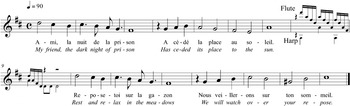
First, as Emile is lying in a field facing away from the factories surrounding Paris, the music enters as underscoring (17′40″).Footnote 45 Soon, however, it exposes itself as a figment of his imagination. He begins conducting the music that seems to emanate from the river, trees, and grass surrounding him. As he reaches towards the wild morning glory that is growing next to him, one flower begins singing the ‘Chanson de la fleur’ (see Example 1). At the second couplet the soloist is joined by all of the flowers on the vine.Footnote 46 The dreamy atmosphere of the song is maintained by an ethereal accompaniment consisting of piano, bells, flute, and harp. As if reinforcing the spectator's belief that this cue is actually Emile's inner soundtrack, it ends on an unresolved leading note as he closes his eyes and falls asleep.
Auric, A Nous, la Liberté!, ‘Chanson de la fleur’ (all transcriptions and translations by the author). Reproduced by permission of Michèle Auric.

The second scene accompanies the montage of Louis's rise to success after his successful prison break (12′55″). The sequence begins with a shot of a phonograph, establishing that the music is diegetic. The ballad-like trio for trombone, muted cornet, and harp is set in a homophonic texture with the brass instruments alternating. The image fades to a medium shot of a shabbily attired Louis – the actor, Raymond Cordy, is wearing the same clothes that he wore as a cab driver in real life and that he wore under an overcoat and scarf as the Chauffeur de taxi in Le million – standing in a cluttered phonograph booth at a flea market and wrapping up a disc for a woman and her police-officer husband. As the customers leave, he leans over and winds up a phonograph. The music cross-fades to a new piece, this time a livelier dance piece that features piccolo, trumpet, bells, xylophone, and harp. The images follow the music by fading to a shot of Louis – clothed now as a petit-bourgeois businessman rather than as a cab driver – standing in front of a phonograph shop. Whereas the machine in the previous shot had been an old-fashioned table-top model with a large brass horn, this shot features him standing next to a free-standing cabinet model with built-in speakers. When a customer drops his wallet, Louis demonstrates his new-found honesty – and his comfort in his new-found wealth – by returning the wallet to its owner. He then ushers another customer inside and resets the phonograph arm, causing the dance music to start over again. As the images fade to a long shot of Louis's factory, another cross-fade takes place in the score, this time leading to a full jazz band playing a contrapuntally complex foxtrot. The camera pans downwards and eventually finds a limousine and Louis, now a capitalist fat cat, talking with three of his assistants and his chauffeur. The musical styles parallel Louis's rise in society through increasing textural complexity, changing timbres, and increasingly sophisticated styles of popular music. While the music is clearly diegetic at the beginning, its exact status is unclear at the end, since the music may be playing on phonographs in the factory or on speakers outside it. In the process the music changes function, becoming underscoring even as it continues to be source music.Footnote 47
Another special function of this score is the use of music for sound effects. For example, both times that Louis's car appears, the shooting script calls for ‘bruits d’auto'.Footnote 48 Rather than using the realistic sound of a car's engine – as was done for the car owned by Louis's mistress, Maud (48′05″) – the noise is approximated by drumrolls, flutter-tonguing trumpets, trombone glissandos, and harp arpeggios (57′55″ and 82′32″). The contrast between realistic and fantastic sound effects highlights the fundamental difference between Louis and Maud, signalling the reason that their relationship cannot end happily. Maud's car sounds real because she is a mondaine. She stays with Louis because of his money and the gifts he gives her, even as she runs around with a gigolo boyfriend whom she seems actually to love. Louis, on the other hand, is a tramp at heart with no need for money, women, or fancy cars. As long as he attaches himself to the life of a successful capitalist, he is living in a fantasy world.
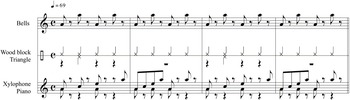
In the same manner the ambient sounds of cafeterias have been replaced by music (4′51″ and 17′04″). Instead of hearing metal spoons banging on metal bowls, as the images and shooting script suggest, the final print includes an ostinato played by bells, wood-block, triangle, xylophone, and piano (Example 2). The dry, metallic sound of the music suggests the ambient noises as people eat, while the cyclical repetition and the minor harmony depict the unrelenting drudgery of life in the prison and in the factory. The music and images here highlight the main satire of the film: though schoolchildren are taught that ‘Work is necessary because work is freedom’, this maxim is a lie. Thanks to assembly line factories and Taylorism, workers' lives have become nothing more than monotonous routine. After making the same mechanical motion for hours at work, they march to the cafeteria and eat at another assembly line. According to the film's parallelism, which is emphasized by the recurring music in the score, a Taylorist factory enslaves and dehumanizes its workers just as effectively as a prison does its inmates.Footnote 49
Auric, A Nous, la Liberté!, excerpt from cue 3. Reproduced by permission of Michèle Auric.

At times the music also functions like that for silent film music, principally in scenes that are closely linked to silent film clichés. Clair's silent films were particularly known for their chase scenes, and there is no shortage of such sequences in A Nous, la Liberté! The nine chases are accompanied by four different themes. When the guards arrive before Emile can climb the prison wall at the beginning of the film (8′10″), the first cue of chase music begins with a triangle roll suggesting an alarm in the prison. Throughout the cue the melody's call-and-response pattern alternates between solo instruments and tutti combinations (see Example 3). The same theme recurs in almost exactly the same manner when Emile successfully breaks out of prison (21′58″).
Auric, A Nous, la Liberté!, first chase theme. Reproduced by permission of Michèle Auric.

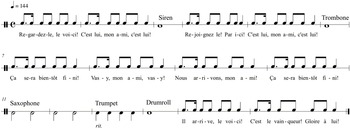
Once Emile has freed himself from prison, his chases arise from his attempts to woo Jeanne. Like the first chase theme, the second is a fast-paced cue in call-and-response fashion, alternating between solo trombone and a variety of instrumental combinations. The circus-like nature of the music parallels the slapstick comedy that it accompanies. The second chase theme first appears after Jeanne's uncle kicks Emile's backside and pulls Jeanne away (23′25″). The butcher next door, who had been watching Emile, now begins laughing at him. After Emile shoves him back into his shop, the chase is on, and the trombone begins the principal melody of the cue (see Example 4). The theme recurs when Emile kicks another worker's backside for tossing Jeanne's handkerchief out a window (32′00″). As Emile runs through the factory's courtyard, searching for Jeanne and disrupting lines of marching workers, he is pursued by three workers and three foremen. The theme is reprised one final time after Emile gives Jeanne a bouquet of flowers (50′27″). The trombone begins the cue as her uncle kicks Emile in the backside again, though the actual chase is delayed until Emile kicks his foreman's backside.
Auric, A Nous, la Liberté!, second chase theme. Reproduced by permission of Michèle Auric.

The third chase theme is linked to the pursuit of glory. The tempo is slower, a chorus chants lyrics, and the call and response alternate between a rhythmically active group and a rhythmically static one (see Example 5). The cue first appears following Louis's escape from prison (10′10″). After colliding with a cyclist, he grabs the bicycle and, seeing a car following him, he begins pedalling furiously. Only when he crosses a finish line to the cheers of a crowd does he realize that he has inadvertently joined – and won – a cycle race. The cue is later reprised during the windstorm that blows money into the crowd at the inauguration of Louis's new plant (79′35″). The music begins as the stage collapses and the orderly crowd of respectable men falls into pandemonium. On this appearance the chant melody is played at a faster tempo by a solo muted trumpet, and the third and sixth bars are omitted. The increased urgency of the music underscores images depicting masses in motion – a group of tuxedo-clad capitalists chasing someone who has filled his top hat with bank notes runs in one direction, then a group of gendarmes and inspectors looking for Louis runs in the opposite direction.Footnote 50
Auric, A Nous, la Liberté!, ‘Choeur des poursuivants’. Reproduced by permission of Michèle Auric.

While the chase music amplifies the energy of visual sequences, other themes carry semiotic significance. The melody of the march, for example, symbolizes the friendship of Emile and Louis, the idea of liberty, and life outside the capitalist machine. All of this is summed up in the lyrics:
This march is first heard during the main titles of the film, complete but in a version that is entirely instrumental until a men's chorus joins the orchestra for the final four lines of the refrain. The presence of the words at this point explicitly associates the music with the concept of liberty, and throughout the film that signification is further refined and associated with specific types of liberty. The song appears as Emile and Louis finish cutting the bars in the window of their prison cell (6′40″). As Emile climbs onto Louis's shoulders and disappears off the top edge of the screen, Louis sings the first verse and chorus. He is interrupted after the fourth line of the refrain, when Emile cuts his wrist and shouts. The music, however, continues as the orchestra finishes and then repeats the chorus. As the orchestra reaches the fourth line of the repetition (‘The fresh air is good for our health’), Louis bandages Emile's wrist, hoists him up to finish the job, and resumes singing where he left off. The screen fades to black during the penultimate line of the refrain, fading back in on a shot of the open window with a hand disappearing on the outside as Louis and Emile sing together the final line of the refrain, ‘A nous, à nous la liberté!’. The first specific association of the march is taken directly from its first verse – liberty as freedom from prison.
This particular theme disappears for the next half hour of the film, while Louis rises to capitalist success and Emile first languishes in prison and then longs for Jeanne. It returns during the scene in which Emile and Louis run into each other again (25′00″). Emile sees Jeanne through the window and tries to race out of the office after her. Concerned that his former cellmate will reveal his chequered past and ruin his present situation, Louis prevents him from leaving. In the scuffle Emile cuts his wrist, just as he had during their prison break. As Louis bandages the wound, the underscoring reprises the march theme (referred to by Clair as ‘the friends’ tune'). A second association becomes clear when Louis and Emile embrace each other, clap each other on the shoulders (as they had done just prior to their escape from the prison cell), and sing together the last line of the refrain: liberty as unconditional friendship.
As the two pals get reacquainted, Louis forgets the responsibilities that are a part of his life as the owner of a large factory. His mistress and dinner guests anxiously await his return home so that they can begin eating. His business associates, who are designing a new factory with him, are forced to wait outside his office for hours. When the two friends finally leave Louis's office (39′10″), they tip their hats to the business associates but do not slow down to talk. As Louis sings the final four lines of the refrain, another association of the song is evident: liberty as freedom from work.
The march appears again at the end of Louis's dinner party, during which he and Emile behave so scandalously that the guests leave before they have finished eating (44′00″). Once the guests are gone, Maud chastises Louis for his behaviour. His response is simply to throw money at her. The underscoring reprises the march as the two friends throw glasses and a bottle at the larger-than-life portrait of Louis as a business tycoon. Their fun ends with a hole in the portrait, creating the illusion that Louis's shirt has been untucked from his otherwise perfect tuxedo. Seeing this, the two join the underscoring, singing the last four lines of the refrain. As they dance around the dining room with one of Louis's servants, another association drawn from the lyrics emerges: liberty as the freedom from conventional etiquette.
The final appearance of the march indicates Emile's eventual discovery of liberty (81′35″). Following a shot of Jeanne dancing with her lover, Emile is seen in close-up, singing the third verse of the march. At the third line Louis moves into the shot and joins Emile in singing. The two then sing the final chorus together before turning and walking down the road, away from the camera and towards their future together. The final association of the song is then made explicit: liberty as the freedom to love without making a long-term commitment.
In contrast to the many variations on liberty represented by the march, the waltz is a signifier for the idealized version of love often seen in operettas. The lyricism of the music, balanced between hopeful sounding major-mode sections and a pessimistic minor-mode section, is matched by the longing of the first verse, the joy of the second, and the disappointment of the third:
The waltz first sounds as the second theme of the main titles, in an orchestral rendition that does little to suggest the meaning of the song. When the song is introduced as source music (20′13″), however, the meaning is immediately clear. Emile is in prison for the second time. His frustration gives way to despair when he hears a woman's voice singing the first verse and chorus. Looking out of the window, he sees Jeanne and assumes that she is singing the song.Footnote 51 Already smitten with her, he swoons to the music coming from outside his cell. Realizing that his imprisonment prevents him from becoming her ‘still unknown’ love, he hangs himself from his window. When the bars fall out of the window, Emile escapes and stands in front of Jeanne's window, listening as the voice sings the second chorus but not noticing that Jeanne is standing next to him. His enchanted expression changes to confusion when the phonograph winds down to a stop, just before the words ‘Qui berce tous les amoureux’ (the fourth line of refrain 2). For the spectator the illusion signals the impossibility of Emile's love. Instead of being in love with Jeanne, he has fallen in love with an ideal: her physical beauty combined with the beautiful but carefully edited voice on the recording.Footnote 52
The waltz next appears following the dinner celebrating Emile and Jeanne's engagement (63′44″).Footnote 53 Emile, standing on the street corner outside Jeanne's apartment, sees her in the window. Since there is no eye-line match, the spectator realizes that she does not see him. The camera finally pans to Emile's right, showing that Jeanne's eyes are directed to her lover, who is round the corner from Emile. The instrumental version of the waltz, unrestricted by the lyrics, is simultaneously representing the second and third verses. Jeanne and her boyfriend are madly in love. Emile, on the other hand, has already been forgotten by the woman who still holds a place in his heart.
The waltz appears for the last time after Louis's new factory has begun operations. The workers, who are now needed only to supervise the machines, are seen playing cards, fishing, and dancing. The waltz begins as the camera zooms in on the dance floor (81′08″). A women's chorus sings the last four lines of the second refrain, the lyrics suggesting that each dancing couple is happily in love. As the chorus arrives at the last line the images cut to Jeanne dancing and smiling in the arms of her lover. Since the third verse of the song never appears, the waltz remains linked to a happy love. This love is not attainable for Emile, however, and so he is left to sing the last verse of the march (‘Don't think about marriage’) in response to seeing Jeanne waltzing with her lover.
In L'esprit nouveau et les poètes Apollinaire proclaimed that cinema would soon replace books as the medium of choice for poets. In his 1919 survey response published in Le film Auric predicted that composers would soon turn to film music as a new genre ripe with undiscovered potential. Twelve years would pass, however, before cinema audiences could hear Auric's first attempts to realize that potential. With A Nous, la Liberté! Auric had a unique opportunity, ideally suited to his vision of film music. René Clair granted him almost complete freedom in composing the score and even sought out his advice as a partner and an equal; here was the ideal of ‘serious’ collaboration that Auric longed for throughout his early writings on film music. Aesthetically the film brought together two closely related strands of 1920s avant-garde art: Auric, representing the musical esprit nouveau, and Clair, representing the cutting edge of French silent cinema. Together, they created a film that offered one model for the expressive possibilities of synchronized-sound technology.
Like his score for Le sang d'un poète, Auric's score for A Nous, la Liberté! is closely tied to the esprit nouveau aesthetic that he argued for in his earlier writings on film music. Musically the film lives up to the ideals of Auric's esprit nouveau aesthetic in several ways. There is a constant emphasis on simple, singable melodies; even in the cues without singers, homophonic and unison textures abound. Harmonically the film music is consistently tonal and diatonic, with fewer seventh and ninth chords than are included in the published piano/vocal scores. Here is the very model of music that is net and dépouillé. Stylistically the music is derived from Parisian popular music genres such as the march, tango, and waltz. In addition, much of it is played by an ensemble that resembles a dance band.
To Auric, who had resisted the temptations of film music longer than some of his friends, participation in A Nous, la Liberté! offered a highly rewarding experience with the genre. As with his earlier balletic and theatrical collaborations, Auric was valued as an artist and as an equal, not just as a technician supporting the director's vision. In this climate of cooperation he could help shape the film and its music, creating the type of poetic-cinematic work that Apollinaire predicted in his writings on the esprit nouveau. Though Auric and Clair would never again manage to work together, the artists kept in touch throughout their lives, and this collaboration held a special place in their hearts.Footnote 54
For Auric A Nous, la Liberté! was not only the capstone of his attachment to the esprit nouveau aesthetic but the beginning of a new and fruitful part of his career. Over the next four decades or so he would go on to score 120 feature films, at least fifteen short films and adverts, and six television series.Footnote 55 During the rest of the 1930s and World War II his film scores were closely tied to his political involvement in leftist organizations and the French Resistance. After the Second World War his scores would define the sound-worlds of the French ‘tradition of quality’, British horror films and Ealing comedies, and American ‘internationalist’ films of the 1950s and 60s. Amongst his most successful scores are those for Jean Delannoy's La symphonie pastorale (1946), which won the music prize at the first Cannes International Film Festival; Cocteau's Orphée (1950), which won the music prize at the Venice Film Festival; and John Huston's Moulin Rouge (1952), for which Auric composed one of the most popular waltzes of the twentieth century. Throughout the years following World War II the motto ‘say it with Georges Auric’ would indeed become one standard by which film composition was measured.