Introduction
The diffusion of democratization and the enormous development of related research in different areas of the world (Morlino, Reference Morlino2008) has recently aroused great interest in the more specific theme of the spread of hybrid regimes. As a consequence, the view of Croissant and Merkel (Reference Croissant and Merkel2004: 1) that ‘…the conceptual issue of diminished sub-type of democracy…have begun the new predominant trend in democratic theory and democratization studies’, comes as no surprise. Nor is the assertion by Epstein et al. (Reference Epstein, Bates, Goldstone, Kristensen and O’Halloran2006: 556, 564, 565) that ‘partial democracies’ ‘account for an increasing portion of current regimes and the lion’s share of regime transitions’, adding, however, that there is little available information about ‘what prevents full democracies from sliding back to partial democracies or autocracies, and what prevents partial democracies from sliding back to autocracy’ and that ‘the determinants of the behaviour of the partial democracies elude our understanding’. Nor, finally, is it surprising that a variety of labels have been coined for these regimes by different authors: ‘façade democracies’ and ‘quasi-democracies’ (Finer, Reference Finer1970), dictablandas and democraduras (Rouquié, Reference Rouquié1975; O’Donnell and Schmitter, Reference O’Donnell and Schmitter1986), ‘exclusionary democracy’ (Remmer, Reference Remmer1985–1986), ‘semi-democracies’ (Diamond et al., Reference Diamond, Linz and Lipset1989), ‘electoral democracies’ (Diamond, Reference Diamond1999 and Freedom House), ‘illiberal democracies’ (Zakaria, Reference Zakaria1997), ‘competitive authoritarianisms’ (Levitsky and Way, Reference Levitsky and Way2002), ‘semi-authoritarianisms’ (Ottaway, Reference Ottaway2003), ‘defective democracies’ (Merkel, Reference Merkel2004), ‘partial democracies’ (Epstein et al., Reference Epstein, Bates, Goldstone, Kristensen and O’Halloran2006), and ‘mixed regimes’ (Bunce and Wolchik, Reference Bunce and Wolchik2008), to mention just some of the expressions and some of the scholars who have investigated what is denoted here by the broader term of hybrid regimes (see, in particular, Karl, Reference Karl1995; Diamond, Reference Diamond2002; Wigell, Reference Wigell2008).Footnote 1
In trying to gain a better understanding of the reasons for such attention it is worth bearing in mind that complex phenomena such as democratization are never linear, and cases of a return to more ambiguous situations have by no means been exceptional in recent years. Moreover, cases of democracies, even if minimal, going ‘all’ the way back to stable authoritarian regimes have been much less frequent:Footnote 2 it is more difficult, though not impossible, to recreate conditions of stable coercion once the majority of a given society has been involved and become politically active in the course of transition. If nothing else, as Dahl (Reference Dahl1971) noted many years ago, greater coercive resources would be required. Furthermore, in periods of democratization, even if only as a result of an imitation effect, authoritarian crises and the resulting initial phases of change should be more frequent. Consequently, there are several reasons for the greater frequency of regimes characterized by uncertainty and transition. Moreover, if the ultimate goal is to examine and explain how regimes move towards democracy, it is fully justified, indeed opportune, to focus on those phases of uncertainty and change. But here we have a relevant aspect that – this time surprisingly – the literature has failed to address and solve: when considering those phases of uncertainty and ambiguity, are we dealing with an institutional arrangement with some, perhaps minimal, degree of stabilization, namely a regime in a proper sense, or are we actually analysing transitional phases from some kind of authoritarianism (or traditional regime) to democracy, or vice versa?
In addressing this key issue, this article will pinpoint the pertinent analytic dimensions, starting with definitions of the terms ‘regime’, ‘authoritarianism’, and ‘democracy’; discuss and clarify the reasons for the proposed definition of hybrid regime; try to answer the key question posed in the title, which, as will become clear, is closely bound up with the prospects for change in the nations that have such ambiguous forms of political organization and, more in general, with the spread of democratization; propose a typology of hybrid regimes; and, in the last section, will reach a number of salient conclusions.
A widespread phenomenon?
The simplest and most immediate way of understanding the nature of the phenomenon under scrutiny is to refer to the principal sets of macro-political data that exist in literature. Data has been gathered by international bodies like the World Bank, the OECD and the United Nations; by private foundations, such as the IDEA and Bertelsman Stiftung; by individual scholars or research groups, like Polity IV, originally conceived by Ted Gurr, or the project on human rights protection undertaken by Todd Landman (Reference Landman2005), who formulated indicators of democracy and good governance, and also produced an effective survey (Landman, Reference Landman2003) of various initiatives in this field; and even by prominent magazines like the Economist, whose Intelligence Unit has drawn up a well-designed index of democracy. But it is not necessary to survey these here. Despite all the limitations and problems, which have been widely discussed,Footnote 3 for the purposes of this article, the data provided by Freedom House have the insuperable advantage of enabling a longitudinal analysis. In fact, they have been collected since the beginning of the 1970s and regularly updated on an annual basis. These data can, therefore, be used to gain a better grasp of the phenomenon.Footnote 4
In 2008, the Freedom House data feature 60 out of 193 formally independent countries (in 2007 there were 58), which have 30% of the world’s population and are political arrangements that can be defined as partially free, the concrete term closest to the notion of hybrid regimes.Footnote 5 ‘Partially free’ regimes have an overall rating ranging from three to five.Footnote 6 They are present in every continent: five in Europe (four of which are in the Balkans), 24 in Africa, 18 in Asia (six are in the Middle East), nine in the Americas (five in South America and four in Central America), and four in Oceania. There are also 43 non-free regimes, which might be defined as stable authoritarianisms and correspond to 23% of the population,Footnote 7 and 90 democracies, amounting to 47% of the world’s population. Overall, then, the partially free regimes exceed the non-free ones both in number and in terms of percentage of population. One further observation is that, with a few exceptions like Turkey,Footnote 8 most of the nations that fall within the ‘partially free’ category are medium-small or small. Finally, from a European point of view, despite the intense efforts of the European Union, other international organizations, and specific European governments, almost none of the Balkan nations have embraced democracy: apart from Slovenia and Croatia; Serbia is on the borderline while Albania, Bosnia-Herzegovina, Macedonia (which has even applied to join the European Union), and Montenegro are partially free regimes. The other European nation in the same situation is Moldova, which borders onto Romania and Ukraine. However, before proceeding any further with the empirical analysis, it is necessary to define some terms, which will hopefully help to give greater precision to the current rather fuzzy terminology.
Definition and analytic dimensions
Before proceeding with our analysis, it is worth stating that we prefer the term ‘hybrid regime’ to all the others present in the literature (see above) as this is the broadest notion, whereas most of the others (e.g. ‘exclusionary democracy’, ‘partial democracies’, ‘electoral democracies’, ‘illiberal democracies’, ‘competitive authoritarianisms’, ‘defective democracies’, and ‘semi-authoritarianisms’) seem to refer to more specific models, mainly diminished forms of democracy. And it seems appropriate to come up with a precise definition of the broadest notion before going ahead and mapping out the diversified realities inside it.Footnote 9 In short, we are looking here for the ‘genus’ that comes before the ‘species’.
Moreover, an adequate conceptualization of the ‘hybrid regime’ must start with a definition of both the noun and the adjective ‘trapped’ between a non-democratic (above all, traditional, authoritarian, and post-totalitarian) and a democratic set-up. As regards the term ‘regime’, consideration will be given here to ‘the set of government institutions and of norms that are either formalized or are informally recognized as existing in a given territory and with respect to a given population’.Footnote 10 Emphasis will be placed on the institutions, even if they are not formal, that exist in a given moment in a given nation. While they no longer configure some form of non-democracy and do not yet configure a complete democracy, such institutions still bear traces of the previous political reality. In addition, in order to have something that may be labelled as a regime we need an at least minimal stabilization. Fishman (Reference Fishman1990: 428) recalls that regimes ‘are more permanent forms of political organization’.Footnote 11 Otherwise, we ‘pick up fireflies for lanterns’ by confusing a temporary changing situation with a more stabilized one, whatever the reasons might be. Obviously, the consequences of making such a distinction are very significant. In any case, we will totally misunderstand the entire situation if we fail to assess if there is or has been stabilization or not. This will be a key element of our definition, one that differentiates it from those existing in the literature, even the most prominent ones (see above).
The second point that can be stressed is that a regime does not fulfil the minimum requirements of a democracy, in other words it does not meet all the more immediately controllable and empirically essential conditions that make it possible to establish a threshold below which a regime cannot be considered democratic. In this perspective for a minimal definition of democracy, we need at the same time: (a) universal suffrage, both male and female, (b) free, competitive, recurrent, and fair elections, (c) more than one party, and (d) different and alternative media sources. To better understand this definition, it is worth stressing that a regime of this kind must provide real guarantees of civil and political rights that enable the actual implementation of those four aspects. That is, such rights are assumed to exist if there is authentic universal suffrage, the supreme expression of political rights, that is the whole adult demos has the right to vote; if there are free, fair, and recurrent elections as an expression of the effective existence of freedom of speech and thought as well; if there is more than one effectively competing party, demonstrating the existence of genuine and practiced rights of assembly and association; and if there are different media sources belonging to different proprietors, proof of the existence of the liberties of expression and thought. One important aspect of this definition is that in the absence of just one of the requirements, or if at some point one of them is no longer met, there is no longer a democratic regime but some other political and institutional set-up, possibly an intermediate one marked by varying degrees of uncertainty and ambiguity.
Finally, it is worth stressing that this minimal definition focuses on the institutions that characterize democracy: elections, competing parties (at least potentially so), and media pluralism. It can be added that it is also important, according to Schmitter and Karl (Reference Schmitter and Karl1993: 45, 46), that these institutions and rights should not be subject to, or conditioned by, ‘non-elected actors’ or exponents of other external regimes. The former refers to the armed forces, religious hierarchies, economic oligarchies, a hegemonic party, or even a monarch with pretensions to influencing decision-making processes, or at any rate the overall functioning of a democracy. In the second case, a regime might be conditioned by an external power that deprives the democracy in question of its independence and sovereignty by pursuing non-democratic policies.
To avoid terminological confusion it should be pointed out that the ‘electoral democracies’ defined by Diamond (Reference Diamond1999: 10), solely with regard to ‘constitutional systems in which parliament and executive are the result of regular, competitive, multi-party elections with universal suffrage’, are not minimal liberal democracies, in which there is no additional room for ‘reserved domains’ of actors who are not electorally responsible, directly or indirectly; there is inter-institutional accountability, that is the responsibility of one organ towards another as laid down by the constitution; and finally, there are effectively applied norms to sustain and preserve pluralism and individual and group freedoms (Diamond, Reference Diamond1999: 10, 11).Footnote 12 The term ‘electoral democracies’ is also used by Freedom House with a similar meaning: an electoral democracy is understood as a multi-party, competitive system with universal suffrage, fair and competitive elections with the guarantee of a secret ballot and voter safety, access to the media on the part of the principal parties, and open electoral campaigns. In the application of the term by Freedom House, all democracies are ‘electoral democracies’ but not all are liberal. Therefore, even those regimes that do not have a maximum score in the indicators for elections continue to be considered electoral democracies. More specifically, a score equal to or above seven, out of a maximum of 12, is sufficient for partially free nations to be classified as electoral democracies.Footnote 13 Thus, in both uses of the term, an ‘electoral democracy’ could only be a specific model of a hybrid regime, but not a minimal democracy.
As regards the definition of non-democratic regimes, reference must be made at least to traditional and authoritarian regimes. The former are ‘based on the personal power of the sovereign, who binds his underlings in a relationship of fear and reward; they are typically legibus soluti regimes, where the sovereign’s arbitrary decisions are not limited by norms and do not need to be justified ideologically. Power is thus used in particularistic forms and for essentially private ends. In these regimes, the armed forces and police play a central role, while there is an evident lack of any form of developed ideology and any structure of mass mobilization, as a single party usually is. Basically, then, the political set-up is dominated by traditional elites and institutions’ (Morlino, Reference Morlino2003: 80).
As for the authoritarian regimes, the definition advanced by Linz (Reference Linz1964: 255) is still the most useful one: a ‘political system with limited, non-responsible political pluralism; without an elaborated and guiding ideology, but with distinctive mentalities; without either extensive or intense political mobilization, except at some points in their development, and in which a leader, or, occasionally, a small group, exercises power from within formally ill-defined, but actually quite predictable, limits’. However, with respect to such a definition, which identifies five significant dimensions – limited pluralism, distinctive values,Footnote 14 low political mobilization, a small leading group, ill-defined, but predictable limits to citizens’ rights – for our purpose we need to stress the constraints imposed on political pluralism within a society that has no recognized autonomy or independence as well as no effective political participation of the people, with the consequent exercise of various forms of state suppression. A further, neglected, but nonetheless important dimension should also be added – the institutions that characterize authoritarian regimes, which are invariably of marked importance in many transitional cases. Once created and having become stabilized over a certain number of years, institutions often leave a significant legacy for a new regime, even when it has become firmly democratic.
In addition to Morlino (Reference Morlino2003), other authors stress this aspect. For example, it is worth recalling the whole debate on ‘electoral authoritarianisms’ (Schedler, Reference Schedler2006). In fact, with this term Schedler (Reference Schedler2006: 5) refers to specific models of authoritarianism – not to a hybrid regime – specifically characterized by electoral institutions and practices; in this instance, hybrid regimes are the result of changes that begin within these types of authoritarianism. Moreover, the attention given to authoritarian institutions is relevant for other important reasons. Firstly, the existence of efficient repressive apparatuses capable of implementing the above-mentioned demobilization policies, for instance security services, which may be autonomous or part of the military structure. Secondly, the partial weakness or the absence of mobilization structures, such as the single party or unions which may be vertical ones admitting both workers and employers, or other similar state institutions, that is, structures capable of simultaneously generating and controlling participation. There could be distinct forms of parliamentary assembly, possibly based on the functional and corporative representation of interests (see below); distinctive electoral systems, military juntas, ad hoc constitutional organs, or other specific organs different from those that existed in the previous regime.Footnote 15 Obviously, there is also another implicit aspect that it is worth stressing: the absence of real guarantees regarding the various political and civil rights.
Limited, non-responsible pluralism, which may range from monism to a certain number of important and active actors in the regime, is a key aspect to recall. For every non-democratic regime, then, it is important above all to pinpoint the significant actors, for whom a distinction can be made between institutional actors and politically active social actors. Examples of the former are the army, the bureaucratic system or a part thereof and, where applicable, a single party; the latter include the Church, industrial or financial groups, landowners, and in some cases even unions or transnational economic structures with major interests in the nation concerned. Such actors are not politically responsible according to the typical mechanism of liberal democracies, that is, through free, competitive, and fair elections. If there is ‘responsibility’, it is exercised at the level of ‘invisible politics’ in the real relations between, for instance, military leaders and economic groups or landowners. Furthermore, elections or the other forms of electoral participation that may exist, for instance direct consultations through plebiscites, have no democratic significance and, above all, are not the expression of rights, freedom, and the genuine competition to be found in democratic regimes. They have a mainly symbolic, legitimating significance, an expression of consensus and support for the regime on the part of a controlled, non-autonomous civil society.
Having proposed definitions for minimal democracy, traditional regime, and authoritarianism, it is now possible to start delineating hybrid regimes. They are more than just ‘mixed regimes’, which, as defined by Bunce and Wolchik (Reference Bunce and Wolchik2008: 6), ‘fall in the sprawling middle of a political continuum anchored by democracy on one end…and dictatorship on the other end’. As suggested by Karl (Reference Karl1995: 80) in relation to some Latin American countries, they may be characterized by ‘uneven acquisition of procedural requisites of democracy’, without a ‘civilian control over the military’, with sectors of the population that ‘remain politically and economically disenfranchised’, and with a ‘weak judiciary’. But again this definition only refers to authoritarianisms that partially lose some of their key characteristics, retain some authoritarian or traditional features and at the same time acquire some of the characteristic institutions and procedures of democracy, but not others. A hybrid regime, on the other hand, may also have a set of institutions where, going down the inverse path, some key elements of democracy have been lost and authoritarian characteristics acquired. Thus, it has to be adequately completed, for example, by including some of the aspects mentioned by Levitsky and Way (Reference Levitsky and Way2002: 52–58) in their analysis of a specific model of hybrid regime (competitive authoritarianism), such as the existence of ‘incumbents (who) routinely abuse state resources, deny the opposition adequate media coverage, harass opposition candidates and their supporters, and in some case manipulate electoral results’.
This discussion, however, prompts reflection about two elements. First, a hybrid regime is always a set of ambiguous institutions that maintain aspects of the past. In other words, and this is the second point, it is a ‘corruption’ of the preceding regime, lacking as it does one or more essential characteristics of that regime but also failing to acquire other characteristics that would make it fully democratic or authoritarian (see definitions above). Consequently, to define hybrid regimes more precisely it seems appropriate to take a different line from the one suggested in the literature and to explicitly include the past of such regimes in the definition itself. The term ‘hybrid’ can thus be applied to all those regimes preceded by a period of authoritarian or traditional rule, followed by the beginnings of greater tolerance, liberalization, and a partial relaxation of the restrictions on pluralism; or, all those regimes which, following a period of minimal democracy in the sense indicated above, are subject to the intervention of non-elected bodies – the military, above all – that place restrictions on competitive pluralism without, however, creating a more or less stable authoritarian regime. There are, then, three possible hypotheses behind a definition taking account of the context of origin, which can be better explicated as follows: the regime arises out of one of the different types of authoritarianism that have existed in recent decades, or even earlier; the regime arises out of a traditional regime, a monarchy or sultanism; or the regime arises out of the crisis of a previous democracy. To these must be added a fourth, which is an important specification of the second: the regime is the result of decolonialization that has never been followed by either authoritarian or democratic stabilization.
If, to gain a closer empirical understanding of a hybrid regime, one develops at least the first and second of these hypotheses a little further – though the majority of cases in recent decades would seem to fall into the first category – it can be seen that alongside the old actors of the previous authoritarian or traditional regime, a number of opposition groups have clearly taken root, thanks also to some partial, relative respect of civil rights. These groups are allowed to participate in the political process, but have little substantial possibility of governing. There are, then, a number of parties, of which one may remain hegemonic-dominant in semi-competitive elections; at the same time there is already some form of real competition amongst the candidates of that party. The other parties are fairly unorganized, of recent creation or re-creation, and have only a small following. There is some degree of real participation, but it is minimal and usually limited to the election period. Often, a powerfully distorting electoral system allows the hegemonic-dominant party to maintain an enormous advantage in the distribution of seats; in many cases the party in question is a bureaucratic structure rife with patronage favours and intent on surviving the on-going transformation. This means that there is no longer any justification for the regime, not even merely on the basis of all-encompassing and ambiguous values. Other forms of participation during the authoritarian period, if there have ever been any, are just a memory of the past. Evident forms of police repression are also absent, and so the role of the relative apparatuses is not prominent, while the position of the armed forces is even more low-key. Overall, there is little institutionalization and, above all, organization of the ‘State’, if not a full-blown process of deinstitutionalization. The armed forces may, however, maintain an evident political role, though it is still less explicit and direct.Footnote 16
Moreover, hybrid regimes often stem from the attempt, at least temporarily successful, by moderate governmental actors in the previous authoritarian or traditional regime to resist internal or external pressures on the dominant regime, to continue to maintain order and the previous distributive set-up, and to partially satisfy – or at least appear to do so – the demand for greater democratization on the part of other actors, the participation of whom is also contained within limits. Consequently, there are potentially as many different variants of transitional regimes as there are types of authoritarian and traditional models. Many cases could be fitted into this model, which says a good deal about their potential significance.Footnote 17
In disentangling empirical realities that fit the previously formulated definition of the hybrid regime from different transitional situations, we should add that there has been some sort of stabilization or duration, at least – we submit – for a decade, of those ambiguous uncertain institutional set-ups. Consequently, to avoid a misleading analysis of democratization processes we can define a hybrid regime as a set of institutions that have been persistent, be they stable or unstable, for about a decade, have been preceded by an authoritarianism, a traditional regime (possibly with colonial characteristics), or even a minimal democracy and are characterized by the break-up of limited pluralism and forms of independent, autonomous participation, but the absence of at least one of the four aspects of a minimal democracy.
As a way of stressing the differences with the existing literature (see above) and of making sense of the definition above, it is useful to emphasize the reasons that justify it: to better understand what hybrid regimes are, it is necessary to disentangle cases of transitional phases from hybrid regimes stricto sensu, where the extent of achieved stabilization has to be taken into account. At the same time, it is important to grasp the ambiguities and the fuzziness of regimes in which features of both democracy and authoritarianism coexist, and in this vein, to consider the institutional past that is so important to them. But if this is the case, two key questions need to be addressed: Are there actually cases of hybrid regimes, or does reality just throw up transitional cases, as might sound more reasonable? If there actually are hybrid regimes and transitional phases as well, what characterizes one and the other? In other words, is it possible to elaborate a good typology of hybrid regimes and single out the recurrent characteristics of transitional phases? The remaining sections of the article will be devoted to answering these questions.
Empirical cases of hybrid regimes, or sheer fantasy?
A key element that runs against the effective existence of hybrid regime, that is, institutional set-ups that are neither democracy, nor authoritarianism, nor traditionalism is the expected low probability of duration. In fact, once some degree of freedom and competition exists and is implemented in various ways, it seems inevitable that the process will continue, even though the direction it will actually take is unknown. It might lead to the establishment of a democracy, but it could also move backwards, with the restoration of the previous authoritarian or other type of regime, or the establishment of a different authoritarian or non-democratic regime. Is this constitutive short duration or high instability confirmed by the Freedom House data?
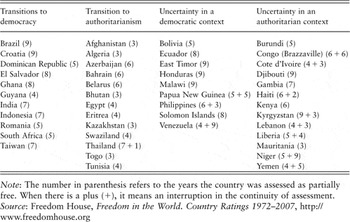
If we assume that we are facing a transitional period when the ‘partially free’ assessment is assigned for more than two years but less than a decade and there is a regime in the proper sense when the same/similar political set-up has been lasted for 10 years or more, and we consider all countries that were ‘partially free’ between 1989 and 2007, we can immediately detect and differentiate the 46 cases of transition from the hybrid regimes. Among the transitional cases (see Table 1), we can find four different situations. There are countries that after years of uncertainty became democracies, such as Brazil, Croatia, and El Salvador, which had long transitional periods, and countries with shorter transitions, such as Guyana, Romania, and South Africa; countries where transition led to authoritarian regimes, such as Algeria, Belarus, Thailand; countries where there is great uncertainty because a decade has not yet elapsed, but which have a democratic legacy, such as Bolivia, Ecuador, and Venezuela; and countries where there was also non-stabilization, but which have an authoritarian past.
Transitional cases: towards democracy, authoritarianism, or uncertainty (1989–2007)

Note: The number in parenthesis refers to the years the country was assessed as partially free. When there is a plus (+), it means an interruption in the continuity of assessment.
Source: Freedom House, Freedom in the World. Country Ratings 1972–2007, http://www.freedomhouse.org
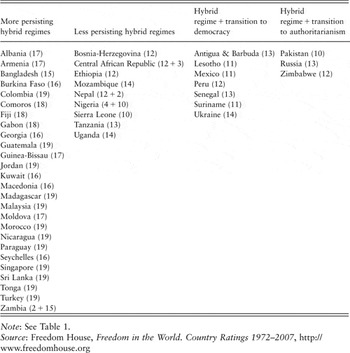
Table 2 surprisingly confirms that not only can hybrid regimes stabilize as such, but they are half (45) of the entire group (91). Here, if we distinguish between more stabilized hybrid regimes, that is regimes that have been ‘partially free’ for 15 years or more, we have 26 cases where at least there has been a continual stand-off between veto players and democratic elites resulting in a stalemate, where all the main actors, especially the elites, might even find satisfactory solutions for their concerns, perhaps not ideal but nonetheless viewed pragmatically as the best ones currently available; or because a dominant power or even a coalition keeps the regime in a intermediate limbo; or, finally, due to the lack of any central, governing institution. Moreover, we can immediately distinguish a second category of nine slightly less stabilized countries, at least in terms of duration until 2007. But we also have two smaller categories of hybrid regimes on the grounds of our assumptions: regimes that after a long period became democracies, such as Mexico or Peru, and regimes that became authoritarianisms, like Russia or Zimbabwe.
Hybrid regimes (1989–2007)

Note: See Table 1.
Source: Freedom House, Freedom in the World. Country Ratings 1972–2007, http://www.freedomhouse.org
Let us, however, consider the possibility that our assumptions (less than 10 years is to be considered a transitional phase; a decade or more to be regarded as a hybrid regime and more than 15 years as a more stabilized hybrid), as reasonable or practical as they might sound, are not accepted: Is one year’s difference (from nine to ten) enough to call the first one a case of transition and the second one a hybrid regime?Footnote 18 However, even if we do not make those assumptions, two basic findings have to be accepted and are worth singling out and emphasizing strongly: hybrid regimes do exist, as the first column of Table 2 shows beyond any doubt; the cases of hybrid regimes (according to our definition) that turn into democracies or authoritarianisms are very few vis-à-vis the other ones: 10 out of 45. In other words, at least the traditional, recurrent hypothesis that once some seed of competition is installed then it is difficult to stop it and some sort of democratic arrangement will come out is heavily undermined. On the contrary, uncertainty and constraints on competition (and rights) can last for decades: in the first column of Table 2 there 14 cases out of 26 where the hybrid regime has been in place for almost two decades. At this point, to try to understand the reasons that might explain all this, we need to look more closely at those regimes. The first important step in this direction is to develop a classification of the 35 regimes present in the first two columns of Table 2.
What kind of classification?
On the basis of the previous definition, then, a crucial aspect of hybrid regimes is the break-up of the limited pluralism or the introduction of limitations on an open, competitive pluralism where previously there had been at least a minimal democracy; or the prolonging of a situation of uncertainty when the country in question gains independence but does not have, or is unable to establish, its own autonomous institutions (authoritarian or democratic), and cannot revert to traditional institutions, which have either disappeared or have been completely delegitimated. In all these hypotheses, there may be (or there may emerge) veto players, that is, individual or collective actors who are influential or decisive in maintaining the regime in its characteristic state of ambiguity and uncertainty. These actors may be: an external, foreign power that interferes in the politics of the nation, a monarch or authoritarian ruler who has come to power with more or less violent means, the armed forces, a hegemonic party run by a small group or a single leader, religious hierarchies, economic oligarchies, other powerful groups, or a mixture of such actors, who, however, are either unable or unwilling to eliminate other pro-democratic actors, assuming that in the majority of current hybrid regimes the alternative is between democracy and non-democracy.Footnote 19
In the face of this variety in the origin and ambiguity of internal structures, four possible directions can be taken to understand what effectively distinguishes these regimes: the drawing up of a classification based on the legacy of the previous regime; scrutiny of the processes of change undergone by the nations in question and the consequences for the institutional set-up that emerges; a third line which, rather more ‘simply’, considers the result, that is, the distinguishing characteristics at a given point in time – for example, in 2007 – of those nations that fall within the genus of hybrid regimes; and a fourth possibility, where the key classificatory criterion is given by the constraints that prevented a country from becoming at least a minimal democracy. The objectives of the first possible classification would be more explicitly explanatory, focusing on the resistance of institutions to change; the second, though this too would have explicative ends, would be more attentive to how modes of change themselves help to define what kind of hybrid regime one is up against; the third would be chiefly descriptive, and would start from the results, that is, from the characteristic traits of the regime; the fourth, which has explicative goals, would focus on the reasons that prevent the transformation toward a democracy. But before going any further, it is essential to consider how the issue has been tackled by other authors in the past.
Without making any claim to being exhaustive, one might start by citing the simplest solution, proposed by Freedom House, which took the third approach mentioned above. Using its own data, it broke down the ensemble of nations defined as ‘partially free’ into semi-consolidated democracies, transitional or hybrid regimes in the strict sense, and semi-consolidated authoritarian regimes. The first type comprises regimes with an average rating between 3.00 and 3.99, the second has an average total between 4.00 and 4.99 while the third is between 5.00 and 5.99 (see Table 1). Merkel (Reference Merkel2004) also proposes an interesting classification of ‘defective democracies’. This category can be divided into ‘exclusive democracies’, which offer only limited guarantees with regard to political rights; ‘domain democracies’, in which powerful groups condition and limit the autonomy of elected leaders, and ‘illiberal democracies’, which only provide partial civil rights guarantees. Finally, Diamond (Reference Diamond2002), who starts from the more general notion of the hybrid regime as has been done here,Footnote 20 proposes four categories on the basis of the degree of existing competition: hegemonic electoral authoritarian, competitive authoritarian, electoral democracy (see above), and a residual category of ambiguous regimes. The regimes in three out of these four categories fail to provide the minimum guarantee of civil rights that would qualify them to be classified as an electoral democracy.Footnote 21 Starting from the elementary fact that hybrid regimes no longer have some of the essential aspects of the non-democratic genus, but still do not have all the characteristics required to meet the minimum definition of democracy, Morlino (Reference Morlino2003: 45) formulated another classification of hybrid regimes. First and foremost, if limits are placed by specific actors on people’s effective freedom to vote or even on the admission of dissent and opposition, and on the correct handling of the elections themselves, one can talk of a protected democracy. By this term it is understood that inside the regime being analysed – defined by Merkel (Reference Merkel2004: 49) as a ‘domain democracy’ – there are powerful veto players, such as the army, strong economic oligarchies, traditional powers like the monarch, or even forces external to the country, which heavily condition the regime. Moreover, there is a limited democracy when there is universal suffrage, a formally correct electoral procedure, elective posts occupied on the basis of elections and a multi-party system, but civil rights are constrained by the police or other effective forms of suppression. Consequently, there is no effective political opposition and, above all, the media are compromised by a situation of monopoly to the point that part of the population is effectively prevented from exercising their rights. The notion of the ‘illiberal democracy’ advanced by Merkel (2004) coincides with that of the limited democracy as presented here. The notion of ‘limited democracy’ is also well developed by Wigell (Reference Wigell2008) within a typology which still includes the ‘electoral democracy’ and the ‘constitutional democracy’ as sub-types of democracy, complemented by the ‘liberal democracy’ as the type of fully fledged democratic set-up.Footnote 22 The main difference between the different proposals lies in the fact that, while also having explanatory objectives, the authors point to different factors as the crucial elements for explaining the real nature of these regimes.
Without going on to review the literature in detail, it is better to stop here and to take stock of the more convincing solutions. In this perspective a combination of the first direction, that is, focussing on the legacy of the previous regime, and the fourth one, that is, factors that restrained a country from becoming or being a minimal democracy, seems to provide a more effective typology. Thus, if the criterion of classification concerns the reasons that prevent the transformation toward a democracy and the first hypothesis of institutional inertia is assumed in its entirety, what was sustained above can be reformulated more clearly: the types of hybrid regimes that might come into being depend directly on the typologies of authoritarian regimes and democracies that have already been established by focusing on the factors that prevent democratic change. As evidenced in Figure 1, the core assumption of this possible typology is that traditional and democratic regimes can, by virtue of their characteristics, give rise to different results, while it is more likely that the survival of authoritarian veto players points towards a single solution, that of protected democracies. In any case, the elaboration of this classification or typology leads us to propose three possible classes: the protected democracy and the limited democracy, which have already been described above; and a third, logically necessary one in which it is hypothesized that there are no relevant legacies or powerful veto players, nor are there any forms of state suppression or non guarantee of rights, but simply a situation of widespread illegality in which the state is incapable of performing properly due to poorly functioning institutions. This third class can be defined as ‘democracy without law’ or rather, ‘democracy without state’, as the state can be conceived as a ‘government based on the primacy of the law’.
What kind of hybrid regime?

The second perspective, that is, the focus on processes of change undergone by a country and the consequences for the institutional set-up that emerges, may be complementary to the first one. If the context is one of regime change and there is a hybrid resulting from a process of transition during which the characteristics of the previous regime have disappeared (as mentioned above), starting with the break-up of limited pluralism (the hypothesis here is obviously that of a transition from authoritarianism) – it is necessary to see what process of change has started and how, in order to assess and predict its future course. The advantage of this classificatory perspective is that, given that the regimes in question are undergoing transformation, the direction and possible outcomes of such change can be seen more clearly. So, if there is liberalization, without or with little resort to violence, that is, a process of granting more political and civil rights from above, never very extensive or complete, but so as to enable the controlled organization of society at both the elite and mass level, what one has is an institutional hybrid that should permit an ‘opening up’ of the authoritarian regime, extending the social support base and at the same time saving the governing groups or leaders already in power. The most probable result, then, would be a hybrid that can be defined as a protected democracy, capable, moreover, of lasting for a considerable or very long time. In order to have some probability of persistence, such a political hybrid must be able to rely not only on the support of the institutional elites, both political and social, but also on the maintenance of a limited mass participation (in other words, on the governing elite’s capacity to repress or dissuade participation) and on the limited attraction of the democratic model in the political culture of the country, especially amongst the elites. Another possibility is the occurrence of a rupture of authoritarianism as a result of a grassroots mobilization of groups in society or of the armed forces, or due to foreign intervention. If it proves impossible to move towards a democratic situation, even if only slowly, due to the presence of antidemocratic veto players, then a more or less enduring situation characterized by a lack of the guarantees regarding order and basic rights to be found in a limited democracy becomes a concrete outcome. In this dynamic perspective, the third solution, that of the democracy without state, does not even entail liberalization or the break-up of limited pluralism as such, in that there is no previously existing stable regime or working state institutions.
However, these modes of classification are a priori and do not include an empirical survey of the countries defined as hybrid regimes. In this respect, they still fail to carry out one of the principal tasks of any good classification, which is to examine all the empirical phenomena associated with hybrid regimes and then arrive at some form of simplification that makes it possible to grasp the phenomenon as a whole as well as its internal differences. So do the three classificatory types outlined above hold up when empirical cases are considered? Looking at the Freedom House data and assuming that the regimes regarded as ‘partially free’ coincide with the notion of the hybrid regime developed here, there seems to be a need for some revision and integration. Above all, it is worth examining in greater detail the ratings of the countries belonging to the category of hybrid regimes (Table 2) on the set of indicators relating to seven ambits that are important when analysing any political regime, democratic or otherwise: rule of law, electoral process, functioning of government, political pluralism and participation, freedom of expression and beliefs, freedom of association and organization, personal autonomy, and individual freedom.Footnote 23 If those ambits are matched with the elements that appear in the definition of the hybrid regime suggested above, the connections can be immediately grasped: all aspects of minimal democracy as well as the elements that are present in the definition of authoritarianism, such as limited pluralism and participation (to mention just the most salient ones), are prima facie closely related to all seven ambits. In his discussion of how to map political regimes, Wigell (Reference Wigell2008: 237–241) also refers to the same or similar aspects.Footnote 24 Levitsky and Way (Reference Levitsky and Way2002: 54–58) prefer to group the aspects around four arenas of contestation (electoral arena, legislative arena, judicial arena, and media). This, in fact, is correct, as research on democratic transition has shown that these four arenas frequently prove to be the most important ones.Footnote 25 However, a more detailed and precise set of indicators, as those suggested by Freedom House, seems in this case to be more appropriate for analysing the various key aspects of hybrid regimes, where the opposite process (from democracy toward authoritarianism) has to be included, whether or not there is the stabilization stressed above.
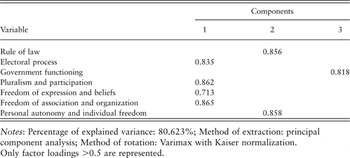
On the basis of the profiles for the 35 cases of hybrid regimes, a great variety of situations emerge. Thus, when a first implementation of a fuzzy set analysis is applied, that is a QCA (qualitative comparative analysis) method as elaborated by Ragin (Reference Ragin2000, Reference Ragin2008: esp. Ch. 4), the reduction of the truth table, built up from the seven different variables, leads to 17 different possible categories, with some of them including just one case. In other words, there are too many classes containing too few cases for meaningful classification.Footnote 26 One way of reducing the number of categories is to see if, when applied to the cases underneath the seven groups of indicators, some key conceptual elements emerge from the seven original variables. A factor analysis may help in singling out those elements. In fact, when applied to our 35 cases the result is very revealing. As displayed in Table 3, three components emerge with great clarity: a first component where electoral process, political pluralism and participation, freedom of expression and beliefs, freedom of association and organization are grouped together closely; a second component where rule of law and personal autonomy and individual freedoms are also strongly connected; and a third component, conceptually close to the second one, where state functioning stands alone. When considered in its entirety, the lack or the high weakness of the first component can be considered a key aspect of limited democracies while the lack of weakness of the second component can be regarded as a key element of democracies without law. The lack or weakness of the third component is the result of inefficient democracy.Footnote 27 If we consider that the second and third components are conceptually contiguous (see above), we can group them in just one category that could be labelled as democracies without state. But whether this is a good step to take or not must be decided by the empirical control.
The three components of hybrid regimes

Notes: Percentage of explained variance: 80.623%; Method of extraction: principal component analysis; Method of rotation: Varimax with Kaiser normalization.
Only factor loadings >0.5 are represented.
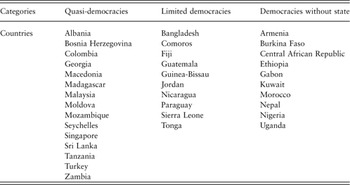
With these fairly precise indications we can go back to the QCA method. In particular, profiting from the strong correlations that emerged from our previous principal component analysis, we can build a truth table where: the lack or high weakness (0) of a new component with the four sets of indicators, that is absence/weakness of electoral process and/or political pluralism and participation and/or freedom of expression and beliefs and/or freedom of association and organization, shape a limited democracy; the lack or high weakness (0) of a new component with the two sets of indicators, that is absence/weakness of rule of law and/or personal autonomy and individual freedoms, depicts a democracy without law; and the lack or high weakness (0) of a component with one set of indicators, that is absence/weakness of state functioning, depicts an inefficient democracy.Footnote 28 When the related truth table is applied,Footnote 29 the results are very meaningful and empirically relevant (see Table 4). First of all, there are several cases with at least a weak presence of all three components or characteristics. Evidently, in the light of these new results a new category or class is required, which can be labelled quasi-democracies. Out of the 15 cases of quasi-democracies, six are European, five African, and only three Asian, with one additional case in Latin America (Colombia). There is also a sizeable group of limited democracies, as expected, and half of them are African. Third, because of the conceptual contiguity and limited presence of real cases (only Armenia and Morocco), the class of inefficient democracies can be merged with the democracy without law into a new more effective democracies without state with 10 cases; most of these (seven) are from Africa.
Classification and cases of hybrid regimes (2007)

Concluding remarks
In general, the analysis above has ended up moving in a different direction to the one considered in recent literature, a direction that is more consistent with that taken in an older, more traditional literature that appeared in the 1950s where the stress was on instability. The debate on democratization has led to neglect of this aspect, even though it is highly evident at an empirical level: the most significant problem in terms of specific cases is to ensure the existence of institutions more or less capable of performing their functions. One of the most relevant results of our analysis is that there are countries where a strengthening of the state and an effective guarantee of rights would transform several regimes into democracies. As far as the problem of state functioning and the rule of law are concerned, this theme has already been discussed by other authors, for instance Fukuyama (Reference Fukuyama2004), and is still a central issue that deserves attention.
Moreover, there are a number of more specific conclusions. First, although literature to date has failed to be precise on this and there are only a few case studies, some comparative analyses and good insights, on the grounds of our analysis we can conclude that hybrid regimes are a substantial reality and can be considered an autonomous model of regime vis-à-vis democracy, authoritarianism, and the traditional regime. Second, a good adequate definition of that regime was still required. In the proposal made in this article, the semantic field, that is the notions of democracy, authoritarianism, and traditional regime, was fully considered, the relevant analytic dimensions emerged clearly and we made a proposal which takes account of that semantic field. We hope it will be widely accepted. Third, once we went from an a priori classification, grounded on the criterion of the constraints to an effective minimal democracy, to an empirical one, a few changes and adaptations proved necessary. On the whole, even if different trajectories are theoretically relevant (see also Figure 1), all the cases that might be considered as hybrid regimes have either an authoritarian past or a traditional one. In other words, although they should by no means be discarded theoretically, the possibility of democracies reverting to some form of hybridism is not empirically supported by the existing cases.
For obvious reasons, namely the sort of data we had, the class of protected democracies did not emerge. However, for example, in cases such as Jordan and Morocco, which we would have unquestionably labelled as such because of the strong political role of a traditional power like that of the monarchy, our empirical analysis suggests that the inefficiency of the state (Morocco) or the limited guarantee of rights (Jordan) is more relevant. As regards this, the data and a different theoretical emphasis account for an unexpected result. However, the data clearly suggest is that what counts in hybrid regimes is not so much the existence of a legacy or of veto players, but a lack of state or the effective guarantee of basic rights in the case of a working non-democratic state.
The quasi-democracies are a more relevant class than expected, with 15 cases, and this perhaps forms a ground for optimism in terms of the future possibility of change towards democracy. In particular, in an international context characterized by cooperation rather than high conflict, a stronger role of international actors or of democratic governments is possible and seems to have some chance of success in a democratic perspective.Footnote 30
Limited democracies and democracies without state are confirmed as empirically relevant classes for which different, contrasting elements need to be stressed: on the one hand, the lack of an effective guarantee of rights despite the presence of state institutions and, on the other hand, the lack of the rule of law and of a functioning state, with laws that are not applied because the judiciary has no effective independence, there is widespread corruption and the bureaucracy is flawed and inefficient. In these cases too, governments and international organizations have a potentially strong role to play in helping to strengthen the respect of rights and building state institutions, prior even to establishing democracies, in countries that have manifested a strong incapacity in this respect over the years.
As a final remark, the present analysis suggests that the proposed classification has some explanatory potential and in this perspective seem more meaningful. However, as usually happens in this field of studies, in order to pursue this line of research, we need to return to the analysis of specific cases, either in the form of single case studies or a small-n comparative strategy.
Acknowledgements
I would like to thank warmly the referees and the editors of this journal to help me to improve this article. Moreover, I would like to gratefully acknowledge the help of Claudius Wagemann in teaching me how to apply the QCA method (despite my non-ortodox way of using it).