Children vary a great deal in how they develop physically, psychologically, and socially. For example, whereas some youth initiate sexual activity at an early age, engage in considerable risk taking, have poor-quality relationships, and/or are present oriented rather than future oriented, others develop in the opposite manner (e.g., delayed sexual activity, low risk taking, high-quality relationships, and/or future-oriented). Exactly what accounts for such variation in human development is a fundamental concern of scientists, parents, and policymakers alike.
In the current research, we draw on evolutionary life history theory to frame this issue, focusing specifically on effects of environmental harshness and unpredictability, while taking advantage of two unique longitudinal data sets, the NICHD Study of Early Child Care and Youth Development (NICHD SECCYD) and the Minnesota Longitudinal Study of Risk and Adaptation (MLSRA), each originally collected for other purposes. Hence, we will compare findings across two very different samples with outcomes measured at different points in development (i.e., adolescence and young adulthood). Specifically, whereas one sample drew on 10 different locations and included reasonably diverse families, both ethnically and demographically (NICHD SECCYD), the other was restricted to 1 location and was far more homogeneous (MLSRA). Compared to parents in the NICHD SECCYD, for example, the MLSRA parents were less educated (60% vs. 11% without a high school education) and more likely to be unmarried at the time of enrollment (61% vs. 14% single mothers). Moreover, the two samples were initially recruited a decade and one half apart (1975 vs. 1991), during a time of great social and economic change. Given these substantial differences, replication of findings across the two data sets would be especially noteworthy.
In addition, by building on the prior work of Belsky, Schlomer, and Ellis (Reference Belsky, Schlomer and Ellis2012) and Simpson, Griskevicius, Kuo, Sung, and Collins (Reference Simpson, Griskevicius, Kuo, Sung and Collins2012) chronicling independent effects of environmental harshness and unpredictability on adolescent and adult functioning, which was based on theorizing by Ellis, Figueredo, Brumbach, and Schlomer (Reference Ellis, Figueredo, Brumbach and Schlomer2009), we seek to illuminate the relative roles of different forms of environmental unpredictability in shaping human development. This is because the three unpredictability components that are the focus of this report (paternal transitions, residential changes and occupational changes) were composited in the aforementioned investigations. Even though each of these unpredictability components has been studied extensively, this has rarely been done in a single inquiry, thus making it difficult to compare the distinctive effects of each.
Life History Theory
Life history theory (e.g., Belsky, Steinberg, & Draper, Reference Belsky, Steinberg and Draper1991; Del Giudice, Gangestad, & Kaplan, Reference Del Giudice, Gangestad, Kaplan and Buss2015; Ellis et al., Reference Ellis, Figueredo, Brumbach and Schlomer2009; Roff, Reference Roff2002; Stearns, Reference Stearns1992) is a branch of evolutionary biology that seeks to explain how and why organisms allocate time and energy to different sets of competing life tasks. All organisms, including humans, distribute energy and resources across multiple life functions, including body maintenance (e.g., immune function and predation defenses), growth (acquisition of physical, social, and cognitive competencies), and reproduction (e.g., mating and parenting). Because energy and resources are inherently limited, individuals must make trade-offs, often unconsciously, in terms of when, where, and how to invest their resources. Thus, greater resource expenditure in one domain comes at a cost to other domains. For example, a trade-off exists between somatic growth and reproduction because both cannot be maximized simultaneously. This is witnessed in different primate species, with some having relatively short periods of growth and then reproducing early in life (e.g., prosimians), and with others delaying reproduction and using energy to grow and develop for longer time periods before reproducing (e.g., great apes and humans). A similar trade-off exists between quality and quantity of offspring, such that some species, as well as some individuals within certain species (e.g., homo sapiens), bear fewer offspring and invest more heavily in their own health and development, whereas others produce more offspring and provide limited or no parental care. Of importance is that although life history thinking was originally used to account for differences between species, it was subsequently used to explain variation among humans (e.g., Belsky et al., Reference Belsky, Steinberg and Draper1991; Draper & Harpending, Reference Draper and Harpending1982).
A well-established life history dimension within evolutionary biology is rate of development, with some species, and some individuals within species, adopting a faster life history strategy (i.e., an abbreviated period of growth, earlier mating and reproduction, and limited parental investment) and others adopting a slower one (i.e., prolonged growth, deferred mating and reproduction, and intensive parental investment). This slow–fast/quantity–quality distinction was central to Belsky et al.’s (1991) evolutionary theory of socialization. Building on the thinking of Draper and Harpending (Reference Draper and Harpending1982), this theory highlights the fact that life history strategies in humans are not exclusively a function of genetics (Rushton, Reference Rushton1996), but are also shaped by developmental experiences within the nuclear family, which are also affected by environmental conditions.
Variations in life history strategy depend on both an individual's characteristics (e.g., health and genetics) and the local ecology (e.g., resource availability and local mortality rates). The current research focuses on how unpredictable local ecologies developmentally entrain important life history outcomes. The adoption of faster strategies, it has been argued, should be (or at least once was) adaptive, in terms of increasing the likelihood of passing genes on to the next generation, when local conditions signal (or are perceived to signal) an increased risk of disability or death before reproducing (Chisholm et al., Reference Chisholm, Ellison, Evans, Lee, Lieberman, Pavlik and Worthman1993). In safer and/or resource-rich environments, however, slower strategies should be (or at least once were) favored since time spent growing and acquiring resources (including social, emotional, cognitive skills, and abilities) can help attract a high-quality mate as well as enhance the survival and reproduction of subsequent offspring. Consistent with such theorizing, it is even the case in the present that children who grow up in more adverse conditions (e.g., father absence, harsh parenting, and maltreatment), initiate sexual activity earlier than others (e.g., James, Ellis, Schlomer, & Graber, Reference James, Ellis, Schlomer and Garber2012), and their romantic relationships tend to be more unstable and less committed (e.g., Nettle, Reference Nettle2010).
It is important to qualify to some degree the points just made about life history theory. Although contextual adversity, especially that which threatens survival and reproduction, has been theorized to accelerate development in the service of fitness goals (i.e., bear more children sooner), even Belsky et al. (Reference Belsky, Steinberg and Draper1991) appreciated that under conditions that severely threatened survival due to extreme limitations in the availability of food and other resources necessary for growth and development, that it would be counterproductive to accelerate development. This view was informed by a wealth of evidence indicating that malnutrition and extreme physical exercise are associated with delayed pubertal maturation (Engelbregt, Houdijk, Popp-Snijders, & Delemarre-van de Waal, Reference Engelbregt, Houdijk, Popp-Snijders and Delemarre-van de Waal2000; Kulin, Bwibo, Mutie, & Santer, Reference Kulin, Bwibo, Mutie and Santner1982; Warren et al., Reference Warren, Brooks-Gunn, Fox, Lancelot, Newman and Hamilton1991). Others have also pointed out that if sources of adversity can be mitigated by, for example, actions taken by parents that increase their child's reproductive value (e.g., enhanced health and intelligence), the anticipated accelerating effects of adversity should also be mitigated (Chisholm et al., Reference Chisholm, Ellison, Evans, Lee, Lieberman, Pavlik and Worthman1993; MacDonald, Reference MacDonald1997; Wittenberger & Tilson, Reference Wittenberger and Tilson1980).
Theory further suggests that when ecological niches are open, with few competitors, that development should be accelerated, nutritional resources permitting, because of the reproductive opportunities that such conditions afford. In other words, contextual adversity should not necessarily accelerate reproduction and foster a quantity-oriented reproductive strategy, at least when survival is at stake due to difficulty meeting basic energetic needs, and conversely, if the environment is rich in resources, this should not necessarily delay development in the service of a quality-oriented reproductive strategy if there is substantial opportunity for progeny to flourish due to the general absence of competitors (Ellison, Reference Ellison2003; MacDonald, Reference MacDonald1997). Perhaps the most important point to make is that life history theory is more complex than it may at times appear to be and that efforts to test and refine it remain ongoing. It remains the case, nevertheless, that neither of the samples that are the focus of this report meets the two conditions (adversity resulting in severe energetic stress and open ecological niches) that most strongly qualify theoretical expectations that adversity should accelerate development, whereas the availability of resources should slow it down.
Basic Dimensions of Environmental Adversity
Given that developmental conditions can and do shape life history, what features of the environment are most important and influential? An insightful within- and between-species analysis by Ellis et al. (Reference Ellis, Figueredo, Brumbach and Schlomer2009) suggests that, although correlated, unpredictability and harshness are two key environmental dimensions that exert a distinct influence on whether individuals adopt faster versus slower life history strategies. Harshness refers to extrinsic mortality rates in which mortality reduction tactics have little pay-off or incur substantial energetic costs. In Western societies today, socioeconomic status (SES) is a key indicator of environmental harshness, as lower levels of SES are related to nearly all forms of morbidity and mortality (e.g., Adler, Boyce, Chesney, Folkman, & Syme, Reference Adler, Boyce, Chesney, Folkman and Syme1993; Chen, Matthews, & Boyce, Reference Chen, Matthews and Boyce2002). Early exposure to environmental harshness, indexed by low SES, should and does bias developmental resource allocations toward faster life history strategies, at least when energetic stress is not so great as to make developmental acceleration too “expensive,” even life threatening (see Ellis et al., Reference Ellis, Figueredo, Brumbach and Schlomer2009, for a review).
Unpredictability, in contrast, refers to stochastic variation in life history relevant environmental conditions (i.e., morbidity/mortality) over time. In modern humans, family fluctuations such as frequent changes in parental employment, residential changes, and paternal transitions are central indicators of unpredictability (Belsky et al., Reference Belsky, Schlomer and Ellis2012; Simpson et al., Reference Simpson, Griskevicius, Kuo, Sung and Collins2012), proving to be associated with less sensitive and supportive parenting and more child behavior problems (e.g., Ellis et al., Reference Ellis, Figueredo, Brumbach and Schlomer2009). Specifically, children who experience greater paternal transitions are exposed to increased environmental instability (e.g., changes in rules, relationships, and routines) and go on to develop faster life history strategies even when controlling for levels of harshness (see Ellis et al., Reference Ellis, Figueredo, Brumbach and Schlomer2009, for a review). Likewise, residential mobility is associated with frequent changes in peer groups, school environments, as well as community ties and has been shown to independently predict developmental outcomes despite being associated with lower SES (for a review, see Ellis et al., Reference Ellis, Figueredo, Brumbach and Schlomer2009). As for parental job transitions, changes in resource availability and security (e.g., loss of income) have documented effects on parental caregiving behavior, which is a key regulator of children's later reproductive strategy (for a review, see Ellis et al., Reference Ellis, Figueredo, Brumbach and Schlomer2009).
To date, two prospective studies have tested this “unique influence” proposition central to Ellis et al.’s (2009) theorizing within the context of observational work. The first (Belsky et al., Reference Belsky, Schlomer and Ellis2012) investigated the effects of harshness and unpredictability during the first 5 years of life on sexual behavior during adolescence (at age 15) using data from the NICHD SECCYD. In this work, harshness was operationalized as income to needs ratio during the first 5 years of life, and unpredictability was operationalized by a composite measure of total number of paternal transitions, parental job changes, and residential changes. Results showed that greater unpredictability (but not harshness) experienced during early childhood directly and independently predicted greater oral and sexual intercourse partners, an index of accelerated life history strategy, as well as indirectly, via their effects on maternal depression and sensitivity.
The second investigation utilized data from the MLSRA. Simpson et al. (Reference Simpson, Griskevicius, Kuo, Sung and Collins2012) examined the effects of unpredictability and harshness in early childhood (from birth to age 5) and in middle childhood (from age 6 to 16) on sexual and risk-taking behavior in young adulthood (at age 23). Once again, harshness was operationalized as SES, and a composite measure of unpredictability was composed of the same three components as in the Belsky et al. (Reference Belsky, Schlomer and Ellis2012) study (i.e., paternal transitions, occupational changes, and residential moves). Results were similar in that unpredictability experienced during the first 5 years of childhood was the strongest predictor of both sexual behavior and risk taking.
The Current Study
What remains unclear given the results of the two studies just highlighted is whether one or another component of the three-component unpredictability composite used in each investigation contributed more to the predictive power of the composite than other components. Thus, the empirical issue that we address herein is not, as in the original reports, whether unpredictability and harshness exert independent effects or whether one appears more influential, but whether certain forms of unpredictability predict future functioning more strongly than other forms of unpredictability. This is important because identifying which specific form(s) of unpredictability is (or are) more responsible for the emergence of traits associated with the adoption of a faster versus slower life history strategy in adolescence and adulthood can clarify the theoretical source of these effects. Thus, in the current study, we “unpack” the unpredictability composite used in both the NICHD SECCYD and the MLSRA project to directly contrast the predictive power of paternal transitions, occupational changes, and residential moves in order to further illuminate the forces shaping development. Such empirical unpacking is important because each of these unpredictability components has, until recently, been studied in isolation. This partly explains why there are separate literatures on effects of father absence and remarriage/cohabitation (e.g., Ellis, Reference Ellis2004; Quinlan, Reference Quinlan2003), residential changes (e.g., Crowder & Teachman, Reference Crowder and Teachman2004; Tucker, Marx, & Long, Reference Tucker, Marx and Long1998), and employment changes (e.g., Bianchi & Milkie, Reference Bianchi and Milkie2010; Moorehouse, Reference Moorehouse1991) on psychological and behavioral development.
As it turns out, theory and evidence suggest that paternal transitions may be the most influential component of unpredictability in shaping and thus forecasting later behavior. In Draper and Harpending's (Reference Draper and Harpending1982) life history analysis of the effects of father absence, the role of the father was emphasized as a critical regulator of reproductive strategy. Although this work did not directly address the effect of multiple paternal transitions, it asserted that existing evidence was consistent with the claim that father absence should foster a fast life history strategy. These ideas were further developed in Ellis's (Reference Ellis2004) paternal-investment theory that privileged the influence of fathers, including the quality of their relationships with their daughters, not just their presence or absence. In regard to paternal transitions in particular, Ellis (Reference Ellis2004) theorized that exposure to many different male partners coming into the home, along with mothers’ sexual attitudes and behavior, could be a potent signal that pair bonds are unstable and paternal investment is unreliable, thereby fostering a faster reproductive strategy. To be noted is that Belsky et al.’s (1991) psychosocial acceleration theory, so named by Ellis (Reference Ellis2004), also sought to extend life history theory, applied to humans, beyond Draper and Harpending's (Reference Draper and Harpending1982) narrow focus on father absence, highlighting in particular the quality and stability of adult pair bonds and parent–child relationship in regulating the child's reproductive strategy.
To our knowledge the other two unpredictability components that are foci of this report, residential changes and employment changes, have not been highlighted in the literature as key regulators of life history strategy other than being indicators of a more general unpredictable environment. It is possible that effects on child development of residential and employment change chronicled in separate literatures focused on these contextual conditions may be spurious and due to their association with paternal transitions. Perhaps consistent with this possibility is research showing that children are not adversely affected by multiple residential changes when they live in families that include both biological parents (Tucker et al., Reference Tucker, Marx and Long1998). Then, of course, there is the possibility that residential and/or employment change results in improvements in living conditions, such as better health care, a larger home, a safer neighborhood, or a better school system, something that is probably less likely when a father or male figure exits the home.
A second major goal of the current research was to extend the assessment of developmental functioning beyond sexual behavior and risk taking, which were the two primary life history traits investigated in both prior longitudinal studies testing propositions derived from Ellis et al.’s (2009) theorizing. Thus, we selected a diverse set of dependent variable constructs such as those pertaining to risk taking (e.g., nonsexual risk taking and criminal activity) and sexual behavior (e.g., number of sex partners), and/or those widely studied by scholars concerned with whether and how early developmental experiences generally shape adjustment and well-being, broadly conceived (e.g., future orientation, social skills, and behavior problems). We expect these additional developmental outcomes to also be subject to the effects of early experience and indicators, although perhaps more distal, of life history strategy. Consistent with this possibility is Belsky et al.’s (1991) hypothesis that early adversity would inculcate an “opportunistic and advantage-taking” rather than “reciprocal and mutually-beneficial” social orientation.
Although the focus of this report is to test the predictive power of three unpredictability components, SES is another key factor known to be associated with both the unpredictability components and the developmental outcomes we are testing. Therefore, to account for both direct and indirect effects of SES, we included SES as a variable predicting the three unpredictability components and developmental outcome in each model. In comparing the two samples of interest on SES levels, the NICHD SECCYD sample is considered to be a midrange resourced sample while the MLSRA started as a low-resource sample with mothers below the poverty line although about half escaped poverty later in childhood.
Method
The methods of the NICHD SECCYD are presented first, followed by those of the MLRSA.
NICHD SECCYD
Participants
Data on enrollment in the NICHD SECCYD were collected in 1991 through hospital visits at 10 US locations. During selected 24-hr intervals, all women giving birth (N = 8,986) were screened for study eligibility (see NICHD Early Child Care Research Network, 2001, 2005, for detailed sampling plan, recruitment procedures, and sample characteristics; http://www.icpsr.umich.edu/icpsrweb/ICPSR/series/233). In total, 1,364 families were recruited into the study and completed a home interview when the infant was 1 month old. At the baseline assessment, 26% of mothers had no more than a high school education, 21% had incomes no greater than 200% of the poverty level, and 22% were minority (i.e., not non-Hispanic European American).
When study children turned 15 years old, outcome data were obtained from 958 (70%) of them using computer-assisted, self-administered interviews to enhance confidentiality and comfort. The 406 (30%) who did not provide data were more likely to be male (56% vs. 50%), have mothers who were less educated (13.4 vs. 14.3 years), and have experienced more residential changes, t (1,298) = 2.80, p < .01. However, families with and without missing data did not significantly differ in ethnicity, income to needs ratio, or on other core indicators of unpredictability used in this report (paternal transitions and parental job changes). To utilize the full sample of 1,364 adolescents, full information at maximum likelihood estimation was used in Mplus for all analyses (see Muthén & Muthén, Reference Muthén and Muthén1998–2011; Schlomer, Bauman, & Card, Reference Schlomer, Bauman and Card2010).
Measures
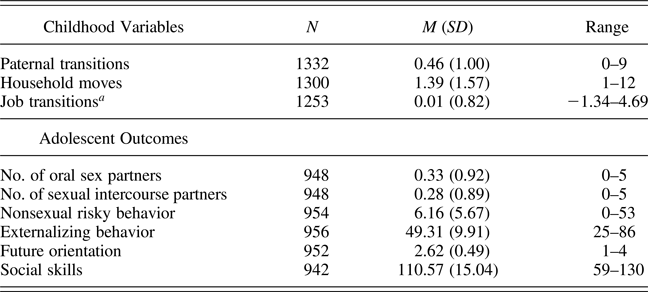
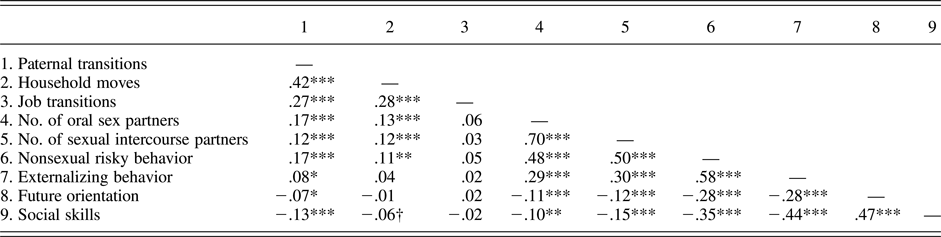
We used multiple assessments provided by the NICHD SECCYD data set to measure environmental unpredictability and SES between birth and 5 years of age. Outcome variables were assessed at age 15. Table 1 provides the descriptive statistics, and Table 2 provides the intercorrelations for the measures of childhood unpredictability and adolescent functioning at age 15.
Descriptive statistics for NICHD childhood and adolescent variables

a Based on z scores of maternal and paternal job transitions.
NICHD correlations among predictor and outcome measures
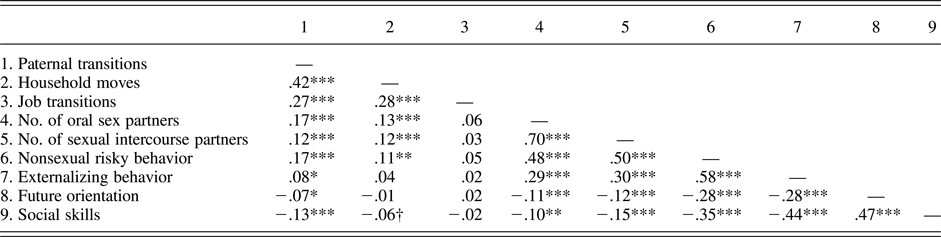
†p < .10. *p < .05. **p < .01. ***p < .001.
Environmental quality
Two indicators of childhood environmental quality were used: unpredictability and SES.
Unpredictability: Three measures were used to assess levels of unpredictability in and around the family during the first 5 years of each target child's life, each of which is explained in detail in Belsky et al. (Reference Belsky, Schlomer and Ellis2012): (a) paternal transitions, the number of changes in the male parental figure within the home (i.e., male partners moving in or out), based on interviews with mothers about household composition when their children were 1, 3, 6, 9, 12, 15, 18, 21, 24, 30, 33, 36, 42, 46, 50, 54, and 60 months of age; (b) household moves, the number of changes in residences based on documentation of when families relocated during the child's first 5 years of life; and (c) parental employment transitions, the number of changes in the mother's and father's employment status (i.e., employed or unemployed) during the child's first 5 years, based on reports from mothers at approximately 3-month intervals.
SES: SES was assessed using an index of income to needs that was measured via mother report when the target children were ages 1, 6, 15, 24, 36, 54, and 60 months (see Belsky et al., Reference Belsky, Schlomer and Ellis2012, for greater detail). The income to needs ratio is an index of a family's income as a proportion of the official federal poverty line for a family of that size. A higher income to needs ratio indicates greater financial resources per person in the household. To create the SES composite, income to needs scores were standardized, averaged across time points, and reverse-scored so that higher scores indicate greater harshness.
Developmental outcomes
Seven developmental outcomes were obtained in the SECCYD data archive. They included the following:
Number of oral and sexual intercourse partners: Sexual behavior was assessed by asking adolescents two questions: (a) “How many different partners have you had oral sex with in your entire life?” and (b) “How many different partners have you had sexual intercourse with in your entire life?” The maximum response on the 0–5 measurement scale reflects five or more partners by age 15. Both items were subjected to square root transformation to reduce skew and kurtosis.
Nonsexual risk-taking behavior: Thirty-six risk-taking items were drawn from instruments used in prior adolescent risk studies (see Halpern-Felsher, Biehl, Kropp, & Rubinstein, Reference Halpern-Felsher, Biehl, Kropp and Rubinstein2004). Adolescents reported the extent to which, over the past year, they used alcohol, tobacco, or other drugs or behaved in ways that threatened their own safety (e.g., rode in a vehicle without using seatbelts, used or threatened to use a weapon, stole something, or harmed property). Responses were made on a 3-point scale (0 = never, 1 = once or twice, 2 = more than twice). Items were summed and then subjected to square root transformation to reduce skew and kurtosis (α = 0.89).
Externalizing behavior: The Youth Self-Report (Achenbach & Rescorla, Reference Achenbach and Rescorla2001), which consists of 119 items that tap a broad range of behavioral/emotional problems as well as 16 socially desirable items, was used to assess externalizing behavior (30 items, e.g., “I disobey at school” and “I try to get a lot of attention”; α = 0.86).
Future orientation: The 8-item Future Outlook Inventory (Cauffman & Woolard, Reference Cauffman and Woolard1999) was used to assess time perspective (i.e., the ability to foresee the short-term and long-term consequences of one's actions). Items for this instrument were drawn from various measures of similar constructs and summed (Scheier & Carver, Reference Scheier and Carver1985; Strathman, Gleicher, Boninger, & Edwards, Reference Strathman, Gleicher, Boninger and Edwards1994; Zimbardo, Reference Zimbardo1980; e.g., “I usually think about the consequences before I do something” and “I will keep working at difficult, boring tasks if I know they will help me get ahead later”; α = 0.73).
Social skills: The Social Skills Rating System was used to assess adolescent social competence on two dimensions: social skills and problem behaviors. The scale consisted of 39 items with responses made on a 3-point scale (0 = never, 1 = sometimes, 2 = very often). Standard scores ranged from 59 to 130, with higher scores indicating a greater affinity to demonstrate socially acceptable behaviors (e.g., “I make friends easily” and “I ask before using other people's things”; α = 0.88).
MLSRA
Participants
The MLSRA (Sroufe, Reference Sroufe2005) is a prospective study that has followed initially at-risk children and their families from before children were born into adulthood. In total, 267 pregnant mothers were recruited into the study at free public health clinics in Minneapolis, Minnesota, between 1975 and 1976. At initial recruitment, all mothers (M age = 20.6) were low in SES, 61% were single, and 60% had less 12 years of education. Approximately 50 mothers dropped out or moved away during the first 2 years of the project, and there has been relatively little attrition since that time. As of the time of this article, approximately 165 of the original target participants still participate in assessments.
The current analyses focus on participants for whom we had measures of early life stress and relevant adult outcomes assessed at age 23 (N = 133; 66 males, 67 females). In addition, t tests indicated no differences between the subsample used in the current analyses and the full MLSRA sample in terms of mothers’ original SES, age, marital status, or education level.
Measures
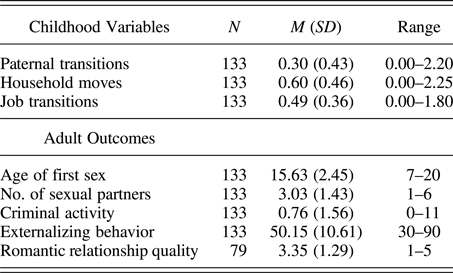
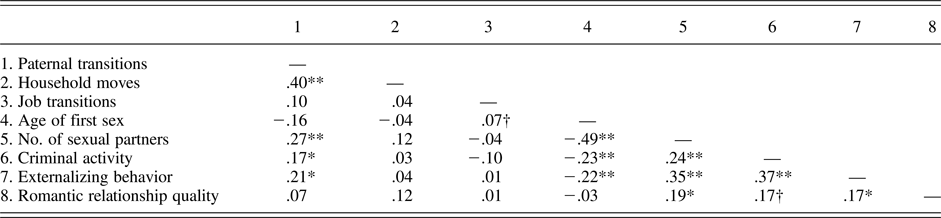
Table 3 provides the descriptive statistics and Table 4 provides the intercorrelations for the measures of childhood unpredictability and adult outcomes at age 23.
Descriptive statistics for Minnesota Longitudinal Study of Risk and Adaptation childhood and adult variables

Minnesota Longitudinal Study of Risk and Adaptation correlations among predictor and outcome measures

†p < .10. *p < .05. **p < .01.
Environmental quality
Two indicators of childhood environmental quality, unpredictability and SES, were used.
Unpredictability: Early-childhood unpredictability (ages 0–5) was assessed by three measures of mother's coder-rated life stress stemming from three sources: (a) paternal transition, (b) changes in residence, and (c) changes in parents’ (mothers’ and fathers’) employment. These constructs were assessed when each child was 12, 18, 48, 54, and 64 months old. Trained coders read each mother's interview responses to questions pertaining to changes in cohabitation, residence, and employment and then considered both the total number of stressful events mentioned and the intensity of disruption of each event, rating each item on a 0 (no disruption) to 3 (severe disruption) scale. The interrater reliabilities for each item were all above 0.90. To create a score for each unpredictability item, the ratings were averaged across all five measurements.
SES: SES was assessed at three time points: prenatally (just before the target child was born) and then when the child was 42 months old and 54 months old. SES was assessed by household income, mother's educational attainment, and the revised version of the Duncan Socioeconomic Index (Duncan, Reference Duncan and Reiss1961; Stevens & Featherman, Reference Stevens and Featherman1981), which assessed participants’ occupational prestige. To create a SES composite, scores were standardized then averaged across all three assessments (see Simpson et al., Reference Simpson, Griskevicius, Kuo, Sung and Collins2012, for greater detail).
Developmental outcomes
The following developmental outcomes were assessed when participants were 23 years of age:
Age at first sexual intercourse: Participants reported the age at which they first had sexual intercourse. In the subsample used for the current analyses, all participants reported having had sexual intercourse by age 23.
Number of sexual partners: Participants also reported the total number of different partners with whom they had had sexual intercourse (i.e., their total lifetime sexual partners). Responses were made on a 6-point scale where 1 = 1 partner, 2 = 2 to 5 partners, 3 = 6 to 10 partners, 4 = 11 to 20 partners, 5 = 21 to 25 partners, and 6 = 26 or more partners. In all, 8.3% of participants reported having had sexual intercourse with one partner, 39.8% with 2 to 5 partners, 18.0% with 6 to 10 partners, 18.0% with 11 to 20 partners, 6.0% with 21 to 25 partners, and 9.8% with 26 or more partners.
Criminal activity: Participants answered questions asking if they had engaged in a range of criminal activities during the past 2 years. The list of criminal activities included 14 possible crimes, such as shoplifting, vandalism, assault, drug possession, and criminal sexual conduct. Answers for each crime were coded either 0 (not engaged) or 1 (engaged), and the total number of criminal activities each participant engaged was computed by summing all the items.
Externalizing problems: Externalizing problems were assessed by the behavior checklist of the Young Adult Self-Report (Achenbach, Reference Achenbach1997). The checklist consists of 119 items comprising a wide range of problems and socially desirable characteristics. The externalizing scale consists of 28 items comprising delinquent, aggressive, and intrusive behavior (α = 0.88).
Romantic relationship quality: Based on their answers to structured interview questions, the quality of each participant's current romantic relationship was evaluated by coders using a 5-point scale, with high scores indicating that their relationships were higher in quality and had positive features such as mutual caring, trust, and emotional closeness. The interrater reliability was 0.94.
Results
The results of the analyses from the NICHD SECCYD data set are presented first, followed by those from the MLSRA data set. For both data sets, path modeling was used to test relations between the three unpredictability components and the various adolescent (NICHD SECCYD) and adult (MLSRA) outcomes. For each of the described models, SES was included as variable predicting the three unpredictability components and the target developmental outcome. The analytic procedure for both data sets was as follows.
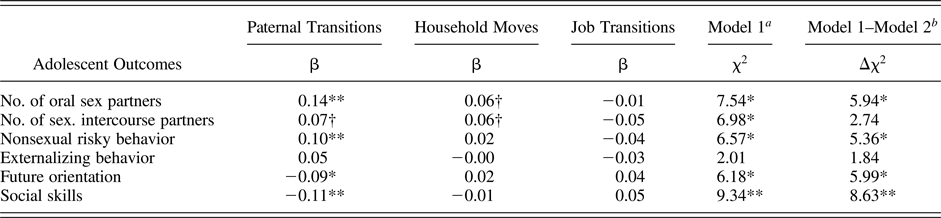
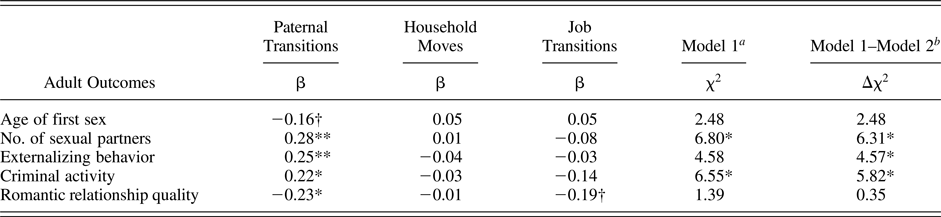
First, we estimated a constrained model (Model 1) in which predictive paths from each unpredictability component to the outcome were forced to be equal (the covariances between the three indicators were freely estimated). The fit of this model was then compared to a saturated model in which the paths were unconstrained. The chi-square difference test between Model 1 and the saturated model provides an omnibus test for differences among paths. Thus, significant model misfit indicates that the effect of each unpredictability component is not equal. A saturated model has zero degrees of freedom and, therefore, always fits the data perfectly. Next, an additional comparison was made between Model 1 (constrained, df = 2) and the second model in which only paternal transitions was freely estimated (Model 2, df = 1). Significant misfit between Models 1 and 2 was also evaluated via chi-square difference tests, which evaluate whether the effect of paternal transitions on an outcome is equivalent to the other two unpredictability components. Although we conducted this two-step model comparison for all variables studied (see Tables 5 and 6), it is notable that differences observed when comparing Models 1 and 2 should be considered most reliable when preceded by a significant omnibus test (i.e., Model 1 vs. saturated). For all analyses, each of the three unpredictability components was standardized to ensure that any detected differential prediction was not an artifact of unequal variance across predictors.
NICHD results of unpredictability components predicting adolescent functioning

Note: Betas are reported from the saturated model. For Model 1, all three unpredictability components were constrained to be equal; for Model 2, paternal transitions were freely estimated.
a Critical χ2 (2) = 5.99.
b Critical χ2 (1) = 3.84.
†p < .10. *p < .05. **p < .01.
Minnesota Longitudinal Study of Risk and Adaptation results of unpredictability components predicting adult outcomes

Note: Betas are reported from the saturated model. For Model 1, all three unpredictability components were constrained to be equal; for Model 2, paternal transitions were freely estimated.
a Critical χ2 (2) = 5.99.
b Critical χ2 (1) = 3.84.
†p < .10. *p < .05. **p < .01.
Path models
NICHD SECCYD
For the NICHD SECCYD data set, the analytic sample was 1,351 due to 13 cases that had missing data on all variables. Across all models, SES significantly predicted each unpredictability component and all adolescent outcomes with the exception of future orientation. As can be seen in Table 5, the saturated models fit the data best for all outcomes, as expected. When comparing Model 1 (i.e., constrained) to the saturated model, there were significant differences in model fit for almost all outcomes. These include number of oral sex partners, Δχ2 (2) = 7.54, p < .05, number of sexual intercourse partners, Δχ2 (2) = 6.98, p < .05, nonsexual risk taking, Δχ2 (2) = 6.57, p < .05, future orientation, Δχ2 (2) = 6.18, p < .05, and social skills, Δχ2 (2) = 9.34, p < .01. However, no differences emerged for externalizing behavior, Δχ2 (2) = 2.01, ns.
Secondary analyses that compared the fit of Model 1 and Model 2 (paternal transitions freely estimated; see Table 5) showed there was a significant difference in model fit for almost all outcomes tested. These include number of oral sex partners, Δχ2 (1) = 5.94, p < .05, nonsexual risk taking, Δχ2 (1) = 5.36, p < .05, having a future orientation, Δχ2 (1) = 5.99, p < .05, and less social skills, Δχ2 (1) = 8.63, p < .01, with the exception being number of sexual intercourse partners, Δχ2 (1) = 2.74, ns.
Taken together, these results indicate that paternal transition was the most consistent predictor across outcomes. Path coefficients for the three unpredictability components suggest paternal transitions exerted a consistently stronger effect relative to the other two components. Specifically, exposure to more paternal transitions early in life predicted more oral sex partners, marginally more sexual intercourse partners (p < .10), greater nonsexual risk taking, weaker future orientation, and less social skills but not externalizing behaviors. In addition, more household moves early in life marginally predicted more oral (p < .10) and sexual intercourse partners (p < .10) but not nonsexual risky behaviors, externalizing behaviors, future orientation, or social skills. Of note, the number of parental job transitions was unrelated to all of these outcomes.
MLSRA
Analysis of MLSRA data proceeded in the same fashion as the NICHD analyses. Across all models, SES significantly predicted each unpredictability component but did not significantly predict any of the adult outcomes. Constraining paternal transitions, household moves, and job transitions effects to be equal (Model 1) resulted in significant model misfit for number of sexual partners, Δχ2 (2) = 6.80, p < .05 (see Table 6), and marginally significant model misfit for criminal activity, Δχ2 (2) = 6.55, p < .10, relative to the saturated model. However, no differences emerged for age of first sex, Δχ2 (2) = 2.48, ns, externalizing behavior, Δχ2 (2) = 4.58, ns, or romantic relationship quality, Δχ2 (2) = 1.39, ns. Thus, these results indicate that there are significant differences between unpredictability components in predicting number of sexual partners and risky criminal activity.
Secondary analyses revealed a significant difference in model fit when predicting number of sexual partners, Δχ2 (1) = 6.31, p < .05, externalizing behavior, Δχ2 (1) = 4.57, p < .05, and criminal activity, Δχ2 (1) = 5.82, p < .05, which indicated that the effect of paternal transitions was significantly different from household moves and job transitions.
Taken together, it appears that paternal transition was the stronger predictor of outcomes at age 23, especially for number of sexual partners and criminal activity. Path coefficients from the saturated model indicate that paternal transitions was the strongest and only predictor of number of sexual partners, externalizing behavior, criminal activity, romantic relationship quality, and marginally age of first sex (p < .10). Household moves did not predict any of the outcomes at age 23, and job transitions only marginally predicted lower romantic relationship quality (p < .10).
Discussion
The purpose of this research was to extend prior work originally undertaken to test Ellis et al.’s (2009) proposition that environmental harshness and unpredictability should independently predict psychological and behavioral indicators of fast versus slow life history strategies. Building on the prior work by Belsky et al. (Reference Belsky, Schlomer and Ellis2012) using the NICHD SECCYD and Simpson et al. (Reference Simpson, Griskevicius, Kuo, Sung and Collins2012) using the MLSRA, both of which showed that a composite index of early life unpredictability was a better predictor of later life functioning than environmental harshness, we sought to determine whether particular components of the same unpredictability composite used in both studies differentially predicted diverse measures of adolescent (NICHD SECCYD) and adult (MLSRA) functioning. Because most research on the three unpredictability features that are the focus of this report have typically been studied in isolation, the current effort offered the opportunity to illuminate the relative developmental significance of these widely studied contextual conditions.
Results from both data sets revealed that early life paternal transitions proved to be a more consistent and stronger predictor of adolescent and adult outcomes than did the other two unpredictability measures: household moves and job transitions. In the NICHD SECCYD study, more paternal transitions predicted more oral and sexual intercourse partners, greater nonsexual risk taking, less future orientation, and less social skills. In the MLSRA study, more paternal transitions predicted younger age of first sex, more sexual partners, greater externalizing behavior, greater criminal activity, and lower romantic relationship quality.
In contrast, residential and occupational change significantly predicted few to no outcomes in both of these data sets. In the MLSRA sample, greater household moves did not significantly predict any of the adult outcomes while job transitions only marginally predicted lower romantic relationship quality. In the NICHD sample, more household moves predicted marginally more oral and intercourse partners while job transitions did not significantly predict any outcome.
Viewed together, the results from both samples appear consistent with Draper and Harpending's (Reference Draper and Harpending1982) and Ellis's (Reference Ellis2004) “privileging” of the role of fathers in shaping reproductive strategy development, at least relative to two other widely studied environmental conditions thought to shape children's lives and development. What remains unclear, however, is whether the findings highlighting paternal transitions are specific to fathers or simply to a parental figure because women are less likely to transition in and out of families than men. Although not evolutionary in nature, the results are also consistent with Bronfenbrenner's (Reference Bronfenbrenner1979) bioecological framework, which emphasizes how proximal processes can shape development. According to our thinking, the presence and absence, and goings and comings, of men within the household should be more likely to affect a child's everyday life than residential or occupational changes, based in part on the considerable importance that male caregivers assume in the lives of young children. Our results support this view. Future work, however, needs to determine whether family dynamics, including parenting processes, are more strongly affected by paternal transitions than the other changes we assessed in this research. Quite conceivably, paternal transitions proved more predictive than residential or occupation changes because they more than these other two contextual conditions affect proximal family processes.
In other words, it could be the case that the paternal-transition effects chronicled herein result from other, unmeasured family processes (e.g., sibling conflict) and conditions (e.g., household chaos) correlated with paternal transitions. Consider in this regard evidence that quality of maternal investment (Hofferth, Reference Hofferth2006), including parental supervision (Henderson & Taylor, Reference Henderson and Taylor1999) and maternal substance abuse (Simmons, Havens, Whiting, Holz, & Bada, Reference Simmons, Havens, Whiting, Holz and Bada2009), is associated with paternal transitions and later adolescent behavior. Thus, future studies should investigate through what family processes, if any, paternal transitions prove to be predictive of adolescent development and functioning in early adulthood.
Although we anticipated that paternal transitions would emerge as the strongest predictor of the developmental outcomes included in this report, the strikingly limited predictive power of the other two unpredictability components, household and employment transitions, was somewhat surprising given prior research that has documented their developmental importance (e.g., Bianchi & Milkie, Reference Bianchi and Milkie2010; Crowder & Teachman, Reference Crowder and Teachman2004; Moorehouse, Reference Moorehouse1991; Tucker et al., Reference Tucker, Marx and Long1998). It is conceivable that if these other investigations had measured and controlled for other unpredictability components as we did in the current research, their results might have been more similar to our own. Thus, if one particular form of unpredictability is going to be the sole source of inquiry, as has been the case so often in the past, it is important to appreciate that its effect may be the result of other, separable, even if not entirely independent, forms of unpredictability. This, of course, could even be true of our primary finding highlighting the effect of paternal transitions; it is certainly possible that if a fourth and even fifth unpredictability indicator had been included in this inquiry, one or the other could have proven to be the best predictor, even eliminating the effects of paternal transitions discerned herein.
Another possibility for why household and employment transitions did not predict developmental outcomes is that both of these events may not be as inherently negative as paternal transitions are. For example, there are circumstances where an employment or household transition may be a positive event (e.g., finding a better job or moving to a better neighborhood). Nevertheless, experiencing a paternal transition as a positive event is less likely, although not improbable, given situations of abuse or high levels of conflict. Thus, heterogeneity of positive and negative valence within household and employment transitions may account for why almost no effects of these two unpredictability components were observed.
From a more general perspective, our findings suggest that there is value in decomposing multi-indicator composites, like cumulative-risk scores, in order to determine whether any particular component is responsible for effects detected of the composite. To be appreciated, however, is that it is quite conceivable that such efforts could yield little, making clear that the primary empirical “action” is in the additive effect of the multiple indicators that comprise a composite. Ultimately, this is an empirical question, one, that has implications for intervention. If a particular component of an unpredictability composite or cumulative-risk score is found to be disproportionately responsible for detected effects of the composite, that could underscore the wisdom of targeting that contextual feature, for example.
Beyond considering the benefit of looking at components of composite predictors individually, developmental understanding would likely be advanced by considering the timing of measurement of unpredictability. In the current research, we focused on experiences during the first 5 years of life given the general importance accorded to these putatively “formative” years, especially when considering the contextual regulation of reproductive strategies (Belsky et al., Reference Belsky, Steinberg and Draper1991). If we had examined these experiences at older ages, such as during adolescence, changing residences may have proven more important for the outcomes investigated herein due to the role that locale plays in friendship networks. What might be expected for occupational changes remains less clear.
When evaluating the merits and contributions of this research, the fact that the results were strikingly consistent, in both factor structure and associations, across two dissimilar samples, is especially intriguing. As highlighted previously, the two samples differed in demographics, year of data collection, and the developmental period in which outcomes were measured. Thus, the highly consistent findings highlighting the developmental salience of paternal transitions across the two samples suggest that results reported herein are more rather than less broadly generalizable.
However, it must be noted that neither study is genetically informed. Many, if not all, of the developmental outcomes studied here within have been found to be heritable (e.g., Harden, Reference Harden2014; Mendle et al., Reference Mendle, Turkheimer, D'Onofrio, Lynch, Emery, Slutske and Martin2006). Thus, even though there are reasonably good grounds to conclude that paternal transitions are more influential than occupational or residential changes in forecasting the later life outcomes we examined, the fact that genetic mediation could account for the results cannot be discounted (e.g., Comings, Muhleman, Johnson, & MacMurray, Reference Comings, Muhleman, Johnson and MacMurray2002). After all, as in all observational research, genetic factors of mothers and/or (biological) fathers that affect paternal transitions could be inherited by children and also contribute to many of the adolescent and adult outcomes that were the focus of this report. For example, increased paternal transitions may reflect a general and heritable disposition toward unstable pair-bonds, which would predict greater sexual activity in risk taking when the child matures. This issue was highlighted in a study by Mendle et al. (Reference Mendle, Turkheimer, D'Onofrio, Lynch, Emery, Slutske and Martin2006), who found that presence of a stepfather failed to predict earlier age of menarche when accounting for shared genetic influence. Although this work is certainly informative, there is other reproductive-strategy-related research to suggest that relations between early environmental factors and later outcomes are not solely the result of genetic confounding (Belsky, Steinberg, Houts, & Halpern-Felsher, Reference Belsky, Steinberg, Houts and Halpern-Felsher2010; Tither & Ellis, Reference Tither and Ellis2008). Furthermore, reproductive-strategy research investigating Gene × Environment interactions has yielded and replicated results (e.g., Hartman, Widaman, & Belsky, Reference Hartman, Widaman and Belsky2015) that would seem to indicate that not all experience-development associations are going to be genetically mediated.
In this paper, we have drawn on life history and reproductive-strategy theory and research to interpret our findings. As highlighted above, some theories emphasize the importance of paternal transitions (Draper & Harpending, Reference Draper and Harpending1982; Ellis, Reference Ellis2004) whereas others emphasize more general features of the environment (Belsky et al., Reference Belsky, Steinberg and Draper1991; Ellis et al., Reference Ellis, Figueredo, Brumbach and Schlomer2009). Because paternal transitions emerged as the most predictive unpredictability component of the composite used in both studies, there are grounds for wondering whether reproductive-strategy related research should focus on specific and narrow developmental experiences and environmental exposures, such as father absence or paternal transitions, or more general measures, such as SES, or even multiple-indicator composites, such as cumulative-risk scores. Part of the reason we regard it as premature to embrace either of these nonmutually exclusive alternatives is because some prior research has included father-related variables along with other environmental indicators have failed to detect father-related effects (e.g., Belsky, Steinberg, et al., Reference Belsky, Steinberg, Houts, Friedman, DeHart, Cauffman and Susman2007; Moffitt, Caspi, Belsky, & Silva, Reference Moffitt, Caspi, Belsky and Silva1992). This suggests that when it comes to highlighting more and less valid theoretical models that our results should be considered in the broader context of the field of study, not just within the frame of our one study.
While we believe this work is best interpreted in the context of life history theory, we can imagine that others, like traditionally trained sociologists, psychologists, and economists, would disagree. The not unreasonable issue raised by them would likely be whether this work is really much more than “old (social-science) wine in a new (life-history) bottle.” Certainly one could carry out this work from more traditional perspectives, but even if that is so, we are forced to wonder why it has not been done before, first combining multiple indicators of unpredictability and harshness to create separate constructs and then examining in a single effort the differential effects of multiple unpredictability indicators. That traditional social science analysis can explain on a post hoc basis our results does not eliminate that only a life history informed perspective led us to formulate the empirical questions we have addressed in this report and our previous one. We believe that that, in and of itself, speaks strongly to the utility of including evolutionary minded thinking in the study of human development. Simply put, it expands intellectual horizons, while raising new and original questions.