Pyroxasulfone inhibits very long chain fatty acid synthesis (Tanetani et al. Reference Tanetani, Kaku, Kawai, Fujioka and Shimizu2009, Reference Tanetani, Fujioka, Kaku and Shimizu2011) and is registered for use in corn (Zea mays L.), cotton (Gossypium hirsutum L.), fallow, soybean, and wheat (Triticum aestivum L.) with use rates of 49 and 210 g ai ha−1 (Anonymous 2016). Pyroxasulfone only has PRE activity as a function of its site of action; thus, POST applications only provide residual weed control. Pyroxasulfone is categorized within the K3 group of herbicides (Tanetani et al. Reference Tanetani, Kaku, Kawai, Fujioka and Shimizu2009) along with acetochlor, dimethenamid-P, S-metolachlor, and others (Shaner Reference Shaner2014). Mueller and Steckel (Reference Mueller and Steckel2011) reported the half-life (DT50) values of acetochlor, dimethenamid-P, pyroxasulfone, and S-metolachlor were 3.5 to 5 d, 5 to 9 d, 8.2 to >70 d, and 8.7 to 27 d, respectively. Due to the longer residual activity, pyroxasulfone provided greater control of broadleaf signalgrass [Urochloa platyphylla (Nash) R.D. Webster] over a longer period of time compared with the other herbicides (Mueller and Steckel Reference Mueller and Steckel2011).
Pyroxasulfone controls field sandbur (Cenchrus spinifex Cav.), Florida beggarweed [Desmodium tortuosum (Sw.) DC.], green foxtail [Setaria viridis (L.) Beauv.], Italian ryegrass [Lolium perenne L. ssp. multiflorum (Lam.) Husnot], kochia [Kochia scoparia (L.) Schrad.], large crabgrass [Digitaria sanguinalis (L.) Scop.], Palmer amaranth (Amaranthus palmeri S. Wats.), puncturevine (Tribulus terrestris L.), shattercane [Sorghum bicolor (L.) Moench ssp. arundinaceum (Desv.) de Wet & Harlan], smallflower morningglory [Jacquemontia tamnifolia (L.) Griseb.], Texas millet [Urochloa texana (Buckl.) R. Webster], velvetleaf (Abutilon theophrasti Medik.), and tall waterhemp [Amaranthus tuberculatus (Moq.) Sauer] (Geier et al. Reference Geier, Stahlman and Frihauf2006; Grey et al. Reference Grey, Cutts, Newsom and Newell2014; Hulting et al. Reference Hulting, Dauer, Hinds-Cook, Curtis, Koepke-Hill and Mallory-Smith2012; King and Garcia Reference King and Garcia2008; King et al. Reference King, Ritter, Hagood and Menbere2007; Knezevic et al. Reference Knezevic, Datta, Scott and Porpiglia2009; Steele et al. Reference Steele, Porpiglia and Chandler2005). Additionally, PRE or POST applications of pyroxasulfone did not injure corn (Geier et al. Reference Geier, Stahlman and Frihauf2006; King and Garcia Reference King and Garcia2008; Knezevic et al. Reference Knezevic, Datta, Scott and Porpiglia2009; Steele et al. Reference Steele, Porpiglia and Chandler2005). PRE pyroxasulfone did not injure soybean; however, injury 7 d following POST application was as high as 14% (Grey et al. Reference Grey, Cutts, Newsom and Newell2014; Mahoney et al. Reference Mahoney, Shropshire and Sikkema2014; McNaughton et al. Reference McNaughton, Shropshire, Robinson and Sikkema2014). Prostko et al. (Reference Prostko, Grey, Webster and Kimerait2011) observed 5% to 48% injury to peanut (Arachis hypogaea L.) following PRE pyroxasulfone, and injury was greater as silt and clay content in the soil increased. Injury to peanut was no more than 10% following POST pyroxasulfone.
Pyroxasulfone potentially offers soybean producers another tool for mitigation or management of herbicide-resistant weeds. Norsworthy et al. (Reference Norsworthy, Ward, Shaw, Llewellyn, Nichols, Webster, Bradley, Frisvold, Powles, Burgos, Witt and Barrett2012) stated that most US soybean producers have adopted portions of an herbicide-resistant weed management strategy, but further diversification of weed management practices and increased utilization of multiple herbicide sites of action is needed. Unfortunately, little research has been conducted to address soybean tolerance following PRE or POST applications of pyroxasulfone. The objectives of this research were to evaluate soybean injury, growth, and yield following PRE or POST pyroxasulfone application.
Materials and Methods
Experiments were conducted at the Louisiana State University Dean Lee Research and Extension Center near Alexandria, Louisiana (31.178°N, 92.411°W) in 2011, 2012, and 2013, and at the Ben Hur Research Farm (30.379°N, 91.167°W) near Baton Rouge, Louisiana in 2012 and 2013. Soil in Alexandria was a Coushatta silt loam (fine-silty, mixed, superactive, thermic Fluventic Entrudept), with a pH of 8.0 and 1.5% organic matter. Soil in Baton Rouge was a Mhoon silt loam (fine-silty, mixed, nonacid, thermic Typic Fluvaquent), with a pH of 6.3 and 1.9% organic matter.
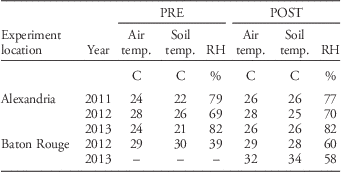
The experimental design was a randomized complete block with 12 treatments in a two-factor factorial arrangement replicated four times in all years at all locations. Factor one was pyroxasulfone applied PRE or POST to soybean with four fully expanded trifoliate leaves, and factor two consisted of pyroxasulfone rates of 0, 60, 120, 180, 240, and 300 g ha−1. All pyroxasulfone treatments were applied with glyphosate at 870 g ha−1, and glyphosate was applied as needed throughout the season to maintain weed management. Plots at Alexandria comprised four 9-m rows spaced 0.97 m apart, and plots at Baton Rouge comprised four 8-m rows spaced 0.38 m apart. Treatments at both locations were applied with a tractor-mounted, compressed-air sprayer calibrated to deliver 187 L ha−1 at 145 kPa using TeeJet® 11002 flat-fan nozzles (TeeJet Memphis, Collierville, TN). Dates of planting, emergence, treatment application, and harvest for each experiment are shown in Table 1. Table 2 provides environmental conditions at the times of PRE and POST applications for the two locations.
Dates of planting, emergence, preemergence (PRE) and postemergence (POST) herbicide applications, and harvest, by year at Alexandria and Baton Rouge, Louisiana.

Air and soil temperatures (temp.) and relative humidity (RH) at the time of preemergence (PRE) and postemergence (POST) applications by year at Alexandria and Baton Rouge, Louisiana.

In Alexandria, ‘Pioneer P94M80’ was planted at 306,000 seeds ha−1 in all years. In Baton Rouge, ‘Pioneer P95Y31’ and ‘Progeny P5711RY’ were planted at 300,000 seeds ha−1 in 2012 and 2013, respectively. Soybean was seeded 2.5 cm deep at both locations in all years. All studies were conducted using conventional tillage methods with no supplemental irrigation, using a fertility program based on Louisiana State University AgCenter soil test analysis recommendations.
Visual estimates of soybean injury were recorded 7, 14, and 28 d after treatment (DAT) for both PRE and POST application timings using a 0 to 100 scale (0 meaning no injury and 100 meaning soybean death). To evaluate soybean growth, soybean plant population was determined 30 d after PRE treatment application by counting the number of plants present in two randomly selected 1-m2 areas of each plot. In addition, soybean plant height was recorded 30 d after PRE treatment application and 14 d after POST treatment application by measuring height of 10 randomly selected plants in each plot. Yield was determined by harvesting the center two rows of plots at Alexandria and all rows of plots at Baton Rouge using conventional harvesting equipment. Soybean plant population, height, and yield (adjusted to 13% moisture) were converted to a percentage of the nontreated control values prior to analysis.
Data were subjected to PROC GLIMMIX in SAS® release 9.4 (SAS Institute, Cary, NC). The fixed effects for the visual injury model were pyroxasulfone application timing, rate, the repeated measures effect of evaluation date, and all interactions. Random effects were location and years, replications within locations and years, and plots. The fixed and random effects for the soybean plant population, height, and yield models were the same as those for visual injury, except that the repeated measures effect for evaluation date did not apply. Analysis indicated a significant interaction between pyroxasulfone rate and soybean injury (P=0.0013) where the linear effects of rate (b=0.4850) were highly significant (P<0.0001) and fit effects were negligible (P=0.7996). Of the effects of rate on soybean plant population, height, and yield, only the effect on plant population was significant (P=0.0196). The means revealed a nonsystematic effect of rate on plant population. Least-square means were calculated and effects were separated using Tukey’s honest significant difference test at P≤0.05.
Results and Discussion
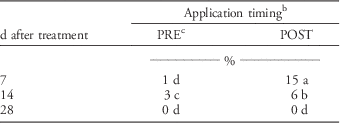
Analysis indicted the significant interaction of pyroxasulfone application timing and evaluation date (P≤0.0001). At 7 DAT, soybean was injured 15% following POST pyroxasulfone at every application rate, but soybean was injured only 1% following PRE pyroxasulfone (Table 3). Injury following POST pyroxasulfone was primarily leaf necrosis and crinkling, with little to no chlorosis. Following PRE applications, injury was in the form of delayed emergence. At 14 DAT, injury following PRE and POST applications was 3% and 6%, respectively, but at 28 DAT no injury was observed following either the PRE or the POST pyroxasulfone application. McNaughton et al. (Reference McNaughton, Shropshire, Robinson and Sikkema2014) observed 7% to 14% injury at 7 DAT with pyroxasulfone applied POST at 89 and 178 g ha−1 to four soybean cultivars at the cotyledon growth stage; however, at 28 DAT injury had decreased to 4% to 6% for all cultivars.
Soybean injury as influenced by the interaction of pyroxasulfone application timing and evaluation date at Alexandria and Baton Rouge, Louisiana. Abbreviations: POST, postemergence herbicide application; PRE, preemergence herbicide application.Footnote a

a Data pooled over pyroxasulfone rates of 0, 60, 120, 180, 240, and 300 g ai ha–1.
b Glyphosate at 870 g ae ha–1 co-applied with PRE and POST pyroxasulfone treatments.
c Means within and across columns followed by the same letter are not significantly different according to Tukey’s honest significant difference test at P≤0.05.
Soybean was injured 3%, 4%, 4%, 5%, and 5% following 60, 120, 180, 240, and 300 g ha−1 of pyroxasulfone, respectively (data not shown). Yamaji et al. (Reference Yamaji, Honda, Kobayashi, Hanai and Inoue2014) reported that 14 DAT with PRE pyroxasulfone at 125, 250, and 500 g ha−1, soybean had approximately 2%, 10%, and <15% injury, respectively, with injury decreasing to <5% at 28 DAT for all rates. Similarly, Grey et al. (Reference Grey, Cutts, Newsom and Newell2014) observed no more than 5% injury 21 d after planting following PRE pyroxasulfone at 60 to 180 g ha−1. PRE pyroxasulfone at 89 or 178 g ha−1 resulted in soybean injury of 0% to 3% 2 to 8 wk after treatment (Mahoney et al. Reference Mahoney, Shropshire and Sikkema2014; McNaughton et al. Reference McNaughton, Shropshire, Robinson and Sikkema2014).
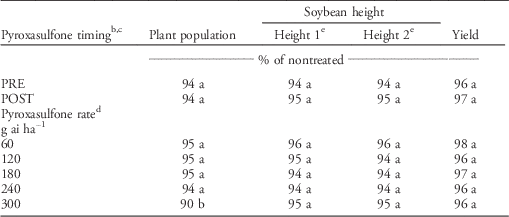
Regardless of pyroxasulfone rate, soybean plant population, height, and yield were not affected by pyroxasulfone application timing: all of the variables ranged from 94% to 97% of the nontreated (Table 4). When averaged over application timing, the only treatment that reduced soybean plant population was PRE pyroxasulfone at 300 g ha−1 (Table 4). Grey et al. (Reference Grey, Cutts, Newsom and Newell2014) found that PRE pyroxasulfone at 60 to 180 g ha−1 did not affect soybean emergence and stand establishment at 11 to 20 d after planting. Similar to pyroxasulfone application timing, pyroxasulfone rate did not influence soybean plant height and yield, which ranged from 94% to 98% of the nontreated (Table 4). Soybean yield was not reduced following PRE or POST application of pyroxasulfone at 89 or 178 g ha−1 (McNaughton et al. Reference McNaughton, Shropshire, Robinson and Sikkema2014). These data indicated that PRE or POST pyroxasulfone will not affect soybean growth (plant population and height) and yield.
Soybean plant population and height 30 d after preemergence (PRE) application and 14 d after postemergence (POST) application, and yield as a percent of the nontreated, as influenced by pyroxasulfone application timing and application rate.Footnote a

a Means within columns followed by the same letter are not significantly different according to Tukey’s honest significant difference test at P≤0.05.
b Glyphosate at 870 g ae ha–1 co-applied with PRE and POST pyroxasulfone treatments.
c Data pooled over pyroxasulfone application rates of 0, 60, 120, 180, 240, and 300 g ai ha–1.
d Data pooled over pyroxasulfone PRE and POST application timings.
e Height 1 and 2 were recorded 30 d after PRE and 14 d after POST, respectively.
Although POST pyroxasulfone was associated with 15% injury to soybean at 7 DAT (Table 3), the injury did not result in significant height or soybean yield reductions, and no injury was recorded 28 DAT. In addition, regardless of rate, PRE pyroxasulfone did not injure soybean more than 5%, and did not reduce soybean plant population, height, or yield. These observations indicate that early season soybean injury following PRE or POST pyroxasulfone application is temporary, and that soybean is able to recover from the injury with little to no effect on yield when compared to nontreated soybean. This research indicates that pyroxasulfone, regardless of application timing or rate, can safely be applied to soybean without a detrimental effect on plant growth or yield.
Acknowledgments
The authors would like to thank the Louisiana Soybean and Feed Grain Research and Promotion Board for funding this research. In addition, we thank the support staff at the Louisiana State University Agricultural Center Dean Lee Research and Extension Center and the Ben Hur Research Farm for their help with this research. Approved for publication as journal article no. 2016-263-30643 of the Louisiana State University Agricultural Center.