I. INTRODUCTION
Carbon allotropes have been useful for many applications such as electronic devices,Reference Zhong, Wang, Cui, Bockrath and Lieber1–Reference Guo, Ghazinejad, Qin, Sun, Wang, Zaera, Ozkan and Ozkan3 sensors,Reference Guo, Lin, Penchev, Yengel, Ghazinejad, Ozkan and Ozkan4–Reference Ang, Chen, Wee and Loh7 photovoltaic devices,Reference Wu, Agrawal, Becerril, Bao, Liu, Chen and Peumans8–Reference Alivisatos, Gur, Fromer, Chen and Kanaras10 and energy storage devices.Reference Zhu, Murali, Stoller, Ganesh, Cai, Ferreira, Pirkle, Wallace, Cychosz, Thommes, Su, Stach and Ruoff11, Reference Dai, Chang, Baek and Lu12 Recently, supercapacitor has attracted attention due to its high power density and long cycle lifetime compared to batteries.Reference Zhu, Murali, Stoller, Ganesh, Cai, Ferreira, Pirkle, Wallace, Cychosz, Thommes, Su, Stach and Ruoff11, Reference Zhai, Dou, Zhao, Fulvio, Mayes and Dai13, Reference El-kady, Strong, Dubin and Kaner14 Carbon nanotube has been recognized as a significant material for such application due to its high surface area as well as high conductivity and stability under electrochemical conditions. There are several processing challenges limiting the use of single-walled carbon nanotubes (SWCNTs) for many applications: (i) low solubility or dispersion concentration in water or organic solvents and (ii) aggregation without surface functionalization or surfactant assistance due to the van der Waal’s interaction, which reduces its surface area and further reduces the capacitance.Reference Ziegler, Gu, Peng, Flor, Hauge and Smalley15, Reference Sato and Sano16 Therefore, it is crucial to develop an approach to overcome such processing challenges.
Many methods have been used to disperse SWCNTs with various functionalization method, including acid treatment,Reference Ziegler, Gu, Peng, Flor, Hauge and Smalley15, Reference Peng and Wong17 surfactant binding,Reference Zhan, Du, King, Hakim, Liang, McCormick and Weimer18 and noncovalent binding molecules.Reference Campbell, Tessmer, Thorp and Erie19, Reference Ou and Huang20 While noncovalent functionalization could disperse SWCNT without introducing any surfactant or reducing its conductivity, it is still challengeable to achieve high concentration of SWCNT dispersion. Graphene oxide (GO) has attracted a lot of attention due to the amphiphilic property. Huang et al.Reference Luo, Cote, Tung, Tan, Goins, Wu and Huang21 reported GO as surfactant, and Dai and YuReference Yu and Dai22 applied this for carbon nanotube dispersion. Such findings indicate the powerful role that GO flakes can play in dispersing SWCNTs. Recently, it is reported that the content of carboxyl group may affect the capacitance of carbon nanotube (CNT).Reference Shen, Liu, Tu, Foo, Yeo, Chan-Park, Jiang and Chen23 Meanwhile, varying reduction rate significantly affects the performance of reduced graphene oxide (rGO) as supercapacitor electrodes.Reference Zhao, Liu, Jiang, Pan, Tao, Song, Fang and Xu24 Although combining CNT and rGO for higher performance supercapacitor has been broadly studied,Reference Chen, Zhang, Zhang, Yu and Ma25–Reference Li, Xu, Srivastava and Banerjee29 it is very important to investigate GO–SWCNT composite system instead of rGO–SWCNT in terms of supercapacitor performance to achieve a lower cost fabrication approach.
One of important aspects in fabricating energy storage devices is the current collector. Many types of current collector were utilized for carbon material-based supercapacitor researches, such as Ni foam,Reference Wang, Shi, Huang, Ma, Wang, Chen and Chen30, Reference Wang, Guo, Penchev, Ruiz, Bozhilov, Yan, Ozkan and Ozkan31 Ti foil,Reference Chen, Zhang, Zhang, Yu and Ma25 stainless steel,Reference Aboutalebi, Chidembo, Salari, Konstantinov, Wexler, Liu and Dou27 and copper mesh.Reference Zhao, Liu, Jiang, Pan, Tao, Song, Fang and Xu24 However, these types of current collector require binder material for fabrication. Recently, paper-based electrodes are attractive for supercapacitor due to its low cost, light weight, high flexibility, binder-free process, and the fact that there is no need for having an extra current collector.Reference Kaempgen, Chan, Ma, Cui and Gruner32, Reference Hu, Choi, Yang, Jeong, La Mantia, Cui and Cui33 Hence, the development of high stability ink material is crucial for low-cost and high-throughput preparation of paper-based electrodes.
In this work, we describe the synthesis and application of a GO and SWCNT composite ink (GO–SWCNT ink) for fabricating electrochemically stable supercapacitors. The interaction between GO and SWCNT not only provides means to separate SWCNTs but also offers approaches to separate individual GO sheets, which increases the effective active area for electrochemical reaction. We achieved over 12 mg/mL of SWCNT dispersed in water without surfactant assistance. The obtained mixture demonstrates high stability and permeability as ink material to prepare paper electrodes. Paper-based supercapacitor electrodes were easily fabricated with such material without other additives, binders, or additional current collectors. Our approach provides a binder-free ink printing method for large-scale fabrication of electrochemical energy storage devices.
II. EXPERIMENTAL
A. Preparation of GO
GO was prepared by using a modified Hummers method.Reference Kim, Cote, Kim, Yuan, Shull and Huang34–Reference Marcano, Kosynkin, Berlin, Sinitskii, Sun, Slesarev, Alemany, Lu and Tour37 1 g of graphite (Sigma-Aldrich, St. Louis, MO) and 0.75 g of NaNO3 were placed in a flask. Then, 75 mL of H2SO4 was added with stirring in an ice water bath, and 4.5 g of KMnO4 was slowly added over about 1 h. Stirring was continued for 2 h in the ice water bath. Then, the flask was placed in 35 °C oil bath for 2 h. 100 mL of water was added into the flask, which causes the temperature rising to 95 °C, after 1 h stirring, 3 mL of H2O2(30 wt% aqueous solution) was added, and the mixture was stirred for 2 h at room temperature. The mixture was washed thoroughly with deionized water through filtration, and then, the GO flake was dispersed in water with mechanical agitation. The obtained GO (0.1 g) was dispersed in water (100 mL). This dispersion was sonicated for 30 min. To get pure single-layer GO, the following repeated method was applied. First, the obtained dispersion was sonicated another 30 min, and the dispersion was centrifuged at 1000 rpm/min for 20 min to remove large particles in the solution. After several centrifugations, the upper solution was then centrifuged at 8000 rpm/min for 20 min to remove soluble impurities and small GO layers. This step was repeated several times until the upper part is clear. Then, the precipitation was dispersed in deionized water with mild sonication.
B. Preparation of GO/SWCNT supercapacitor
Various amount of SWCNT (Sigma-Aldrich 05925) were added into as-obtained GO solution with concentration of 2 mg/mL. After 10–25 min of ultrasonication, the black ink was formed. A piece of woven paper was dipped into the solution and then dried in vacuum oven at 45 °C for 2 h. A two-electrode measurement technique was used for the electrochemical measurements, where two pieces of carbon ink soaked paper were assembled into a sandwich structure with a porous membrane (Celgard 3501, Charlotte, NC) separator. 6 M KOH aqueous solution was used as the electrolyte. The packaging of the supercapacitor cell was conducted at room temperature in atmosphere. The two electrodes of the packaged cell were connected to an electrochemical analyzer (Gamry Reference 600™, Warminster, PA) with an alligator clip. Cyclic voltammetry (CV), chronopotentiometry [charge–discharge (CD)] were conducted to evaluate the performance of the supercapacitors. CV scans were performed with a voltage window of 1 V in the range −0.5 to 0.5 V at scan rates ranging from 5 to 500 mV/s. Potentiostatic electrochemical impedance spectroscopy measurements were performed between 0.1 Hz and 1 MHz with amplitude of 10 mV.
C. Characterization
Atomic force microscopy (AFM) was conducted with (Multimode-5; Veeco, Plainview, NY) operated in the tapping mode using standard silicon cantilevers. Fourier transform infrared (FTIR) spectra were recorded with a Bruker Equinox 55 (Billerica, MA) with microscope and step scan (0.5 cm−1 resolution) at room temperature. Raman spectra were taken using a Renishaw micro-Raman spectrometer (Hoffman Estates Illinois, IL) with a 532-nm visible laser as the excitation source. The scanning electron microscopy (SEM) images were recorded with Leo SUPRA 55 microscope (San Diego, CA).
III. RESULTS AND DISCUSSION
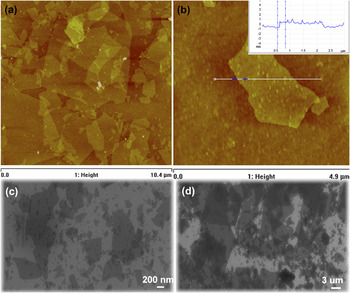
With the modified Hummer’s method, we synthesized single-layer GO. AFM images demonstrate that the thickness of as-synthesized single-layer GO is 0.5 nm [Figs. 1(a) and 1(b)]. SEM images demonstrate that the size distribution of obtained GO is in the range of 100 nm to 20 μm [Figs. 1(c) and 1(d)]. Raman spectra of D (1320 cm−1), G (1573 cm−1), and 2D (2640 cm−1) bands demonstrate the characteristic peaks of GO. I D/I G ratios of 1:1 and 2:1 confirm double-layer or single-layer GO (Supporting Fig. 2).Reference Guo, Ghazinejad, Qin, Sun, Wang, Zaera, Ozkan and Ozkan3 Uniform size of GO could be obtained with various centrifuge steps. Size distribution from 200 to 500 nm of GO was applied for dispersing SWCNT (supporting Fig. 1). With uniform and smaller size of GO, we expect to see a better interaction with SWCNT.
AFM and SEM images of as-synthesized GO: (a, b) AFM images; inset shows a single layer of GO height profile of AFM image. (c, d) SEM images at different magnification factors.

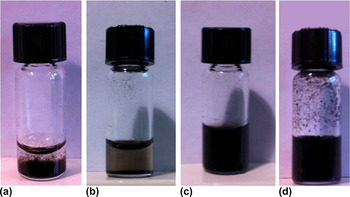
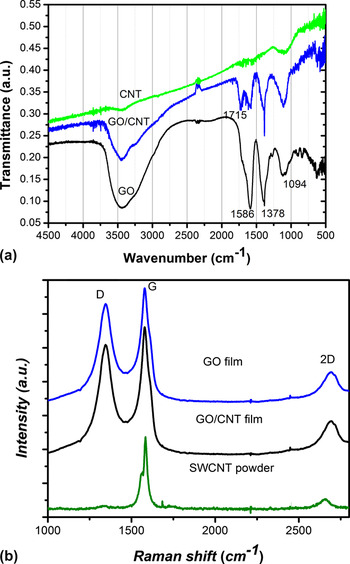
It has been studied that the dominant chemical structures present on the surface of GO are tertiary alcohols and ethers with very low quantities of carboxylic acid at the periphery of the GO.Reference Dreyer, Park, Bielawski and Ruoff38 These structures provide fascinating property for GO. While hydroxyl group, ketone group, ether group, and carboxylic group provide chance for hydrogen bonding between GO and water molecules, the intact π bond will provide chance for π–π stacking. FTIR spectra of GO further confirm the presence of these functional groups [Fig. 4(a)]. Bending of C–OH groups (1378 cm−1), C = O (1715 cm−1) stretching vibration, and the C–O, C–C stretching of epoxy groups at 1094 and 857 cm−1, characterize the spectrum of air dry GO.Reference Yu and Dai22, Reference Szabo, Berkesi and Dekany39 Dai and YuReference Yu and Dai22 and Li et al.Reference Qiu, Yang, Gou, Yang, Ma, Wallace and Li40 have demonstrated the negative charge effect of GO facilitating the dispersion of CNT with electrophoresis experiments. We tune the pH of dispersion with NaOH or/and HCl to further test the property of the dispersion. With increase of pH, the dispersion becomes stable without precipitation even after 1 mo. When the pH is 4, the dispersion is very unstable; precipitation appears 10 min after ultrasonication-assisted dispersion. However, with the addition of 1 M NaOH, the stability of the dispersion increases, which is demonstrated in Fig. 2(d). The stability of such dispersion demonstrates potential for long-term use of the solution. It is possible that with the increase of OH− concentration, carboxylic group was deprotonated resulting in more negatively charged species, which facilitates separation of SWCNT bundles.
Photoimages of 5 mg SWCNT dispersed in 2 mg/mL of GO at different pH values: (a) 4, (b) 7, (c) 9, (d) 12, and the volume difference results from the addition of NaOH. Note that black materials visible inside in (d) are residues after shaking. High concentration of SWCNT results in high viscosity.

To investigate the ability of GO to disperse SWCNT, we intentionally increase the weight ratio between SWCNT and GO. Surprisingly, 12 mg/mL of SWCNT could be achieved with 2 mg/mL GO solution. To our knowledge, this is the highest concentration achieved and provides further opportunities for achieving SWCNT dispersions for a number of applications without surfactant assistance.
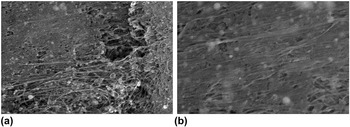
GO and SWCNTs tend to restack or form bundles due to the van der Waals force. The noncovalent interaction between GO and SWCNT impacts not only on the separation of SWCNT bundles but also on the prevention of GO restacking. Figure 3 shows the SEM images of as-obtained material on paper. It is very clear that SWCNT was separated and embedded in GO film. Though partial restacking of GO sheets happens after mixing with the SWCNTs, they play a role in preventing further restacking, which provides the chance for realizing single GO sheets (Sch. 1). Interaction of molecules with graphene could be characterized with Raman spectra where D, G, and 2D band are useful in understanding the effects of chemical interaction.Reference Das, Voggu, Rout and Rao41 The full-width at half-maximum of the G band increases with the mixing of SWCNT and GO indicating electronic structure changes with π–π interaction of GO sheets and SWCNTs [Fig. 4(b)].
(a, b) SEM images of aligned GO/SWCNT composite ink material transferred on paper with different magnifications.

(a) FTIR and (b) Raman spectra of GO, SWCNT, and GO/SWCNT composite ink. GO and GO/SWCNT are prepared by dropping a solution on glass slides followed by drying in air. SWCNT original powder is used for characterization. FTIR spectra are taken with KBr pellet.

Such a synergetic effect increases the surface area of both SWCNT and GO, which increases the active sites for electrochemistry reaction. Effortless binding with paper of such material provides means for low-cost fabrication of electrodes without any binder or additives. Hence, this composite ink material could provide tremendous opportunities for low-cost roll-to-roll fabrication of electrochemical double-layer capacitors (EDLCs). We further demonstrate this potential by characterizing the EDLCs based on SWCNT–GO paper electrodes.
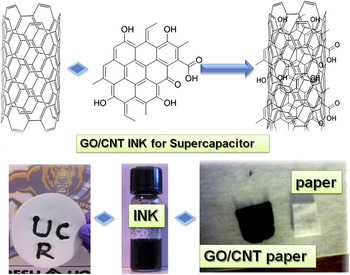
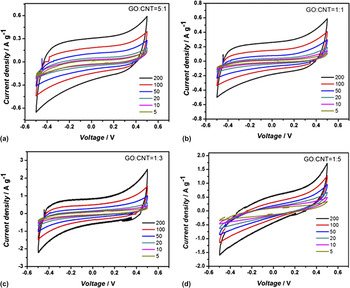
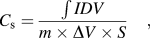
Woven paper is utilized for fabricating the paper-based electrodes by dipping in the as-obtained GO–SWCNT ink for few seconds and subsequently drying in a vacuum oven at 45 °C for 2 h. The process enables a convenient and scalable way of fabricating low-cost binder-free electrode. As it is shown in Sch. 1, the as-prepared material is easily patterned and attached on paper by either simply drawing or printing. Here, GO/CNT acts not only as active material but also as current collector, which offers possibility for miniature energy storage devices.Reference Chen, Augustyn, Wen, Zhang, Shen, Dunn and Lu42 CV was performed to evaluate the electrochemical performance of the electrodes assembled in a symmetric two-electrode supercapacitor cell. It can be seen from Fig. 5 that with different ratio of GO/SWCNT, the achieved specific capacitance is different. The specific capacitances of GO/CNT ratio 5:1, 1:1, 1:3, 1:5 at 5 mV/s are 42.8, 24.0, 102.8, and 124.2, respectively. The specific capacitance C s values are calculated from CV curves by using Eq. (1):
 $$C_{\rm{s}} = {{\int {IDV} } \over {m \times \Delta V \times S}}\quad,$$
GO-SWCNT non-covalent interactions, and preparation of supercapacitor electrodes with GO/SWCNT ink and paper.

where C s is the specific capacitance, ∫IdV is the integrated area of the CV curve, m is the mass of the active materials of one electrode, ∆V is the voltage window, and S is the scan rate. With the increase of SWCNT, the capacitance increases. The slight distortion from rectangular shape of CV curve is due to pseudocapacitance resulted from various functional groups on GO.Reference Yu and Dai22
CV characterization for different ratios of GO/SWCNT at different scan rates. All the measurements are conducted with 6 M KOH electrolyte at room temperature.

The calculated specific capacitance is lower for 1:1 ratio than for reported 90 F/g,Reference Qiu, Yang, Gou, Yang, Ma, Wallace and Li40 which may attribute to the actual mass of used active material in current measurement. In our process, both sides of woven paper were covered with GO–SWCNT. Although the woven paper has high porosity, ions transport from one side to the other side of the paper would be somehow prevented. Therefore, the actual active material, i.e., material that has contribution to capacitance, is much less than the total material used for preparation of the electrode. And the calculated value of specific capacitance is thus lower than reported value. Note that each specific capacitance is higher than GO itself (10.9 F/g reported previously).Reference Aboutalebi, Chidembo, Salari, Konstantinov, Wexler, Liu and Dou27 Very recently, a higher value of 417 F/g for functionalized GO has been achieved at 0.5 A/g.Reference Yang, Luo, Jia, Li, Wang, Song, Kang and Zhi43 Here, the highest capacitance at 0.5 A/g is 295 F/g, which is comparable with GO–multi-walled carbon nanotube (251 F/g).Reference Aboutalebi, Chidembo, Salari, Konstantinov, Wexler, Liu and Dou27 Many SWCNT-based supercapacitors have demonstrated specific capacitances in the range of 32–142 F/g depending on the functional groupsReference Shen, Liu, Tu, Foo, Yeo, Chan-Park, Jiang and Chen23 or types of SWCNT, i.e., metallic or semiconducting tubes.Reference Al-zubaidi, Inoue, Matsushita, Ishii, Hashimoto and Kawasaki44, Reference Yamada, Tanaka, Machida, Suematsu, Tamamitsu, Kataura and Hatori45
Cycling stability is crucial for supercapacitor devices. We investigated the cycling stability of the material with galvanostatic CD measurements.
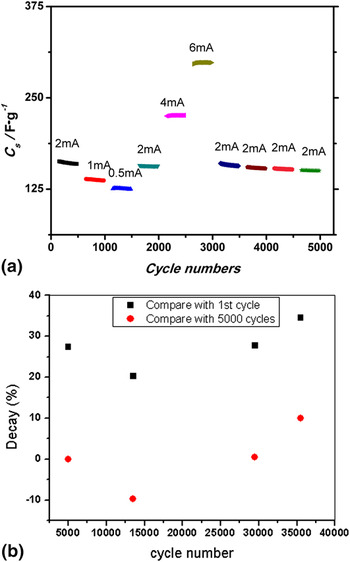
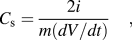
Figure 6(a) presents the cyclic performance measured at different current densities for the first 5000 CD cycles. The specific capacitances at different current densities are calculated through the Eq. (2):
 $$C_{\rm{s}} = {{2i} \over {m(dV/dt)}}\quad,$$
Cycling stability characterization. (a) Variation of specific capacitance under different current density values (500 cycles for each current density). (b) Comparison of specific capacitance decay with the 1st cycle and the 5000th cycle. The measurements conducted with a GO/SWCNT ratio of 1:5.

where m is the carbon mass of one electrode, i is the discharge current, and dV/dt is the slope of the discharge curve.
The GO/SWCNT ratio of 1:5 demonstrates the highest specific capacitance, which consistently decreases with an increase in the CD current density [Fig. 6(a)]. We ascribe this phenomenon to reduced access of ions to the active surface, especially for relatively slow faradic reactions.46 And after 5000 cycles, the capacitance decreased 11%, which shows the higher stability of the material compared with rGOReference Wang, Shi, Huang, Ma, Wang, Chen and Chen30 alone. We continued with CD cycle at 2 A/g for 60,000 cycles. Only 64% capacitance retention was observed compared with the first cycle. However, 85% retention was achieved compared with the 5000th cycle [Fig. 6(b)]. This proves the high stability of composite material for supercapacitor electrode. Interestingly, we observe capacitance increase after 5000 cycles. Active sites for both sides of active material may increase after many cycles, and GO maybe partially reduced to graphene or tips of SWCNTs maybe open, which increases surface area; therefore, the capacitance increased. This phenomenon further assures the stability of the electrode material during long cycling usage.
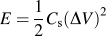
The energy density (E) and power density (P) are calculated by using Eqs. (3) and (4):
 $$E = {1 \over 2}C_{\rm s} (\Delta V)^2 $$
and
 $$P = {E \over t}\quad,$$
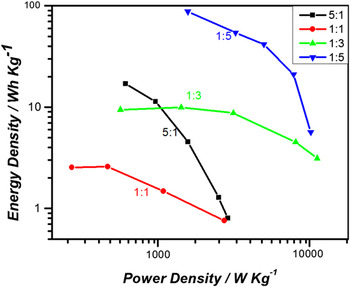
where t is the total time of discharge. C s is the specific capacitance value from CD and ∆V is the potential range, which is 1.0 V for aqueous normally. Ragone plots were obtained accordingly for different ratio of GO/SWCNT (Fig. 7). It is clear that the composite material has highest power density with the GO/SWCNT ratio of 1:5, which is in accordance with the capacitance measurements. A 1:1 ratio for the ink shows lower performance, which is in accordance with CV measurements. Too many bundled SWCNTs or stacked GO due to the interaction between GO and SWCNT maybe the reason for such low performance. The power density of the capacitors reaches 10 kW/kg, which is higher than GO-based or CNT-based supercapacitors.Reference Wang, Shi, Huang, Ma, Wang, Chen and Chen30, Reference Chen, Tsai, Chung, Lee, Chen and Huang47, Reference Arepalli, Fireman, Huffman, Moloney, Nikolaev, Yowell, Higgins, Kim, Kohl, Turano and Ready48
Ragone plots for different GO/SWCNT ratios.

IV. CONCLUSION
Our studies indicated SWCNTs dispersed using GO material at concentration of 12 mg/mL, the highest reported value so far without surfactant assistance. Binder-free GO/SWCNT composite paper electrodes were prepared via simply dipping paper in aqueous dispersions containing GO and SWCNTs, followed by 40 °C drying in vacuum oven. Without reduction of GO, the composite material displays high relative high gravitational specific capacitance of 295 F/g at the CD current density of 0.5 A/g. 85% capacitance retention after 60,000 CD cycles demonstrates its high electrochemical stability as supercapacitor electrodes. These findings pave the way for preparing high performance ink material of energy storage devices.
ACKNOWLEDGMENTS
We gratefully acknowledge financial support for this work by the Winston Chung Global Energy Center at UCR, The Riverside Public Utilities, the CMMI Division of the National Science Foundation (Award No. 0800680), the Materials Research Science and Engineering Center (NSF-MRSEC) on Polymers (Award No. 0213695), and the Nanoscale Science and Engineering Center (NSF-NSEC) on hierarchical manufacturing (CHM, Award No. 0531171).