Introduction
Child welfare services are designed to provide a safety net for vulnerable children. To understand the role of contemporary out-of-home care (OOHC) services, it is helpful to understand the past and what the history of providing ‘care’Footnote 1 has been. During the last century, many children were placed in orphanages and a range of institutions run by the state, religious groups and other organisations during the last century. These children included the ‘Forgotten Australians’, ‘Child Migrants’ and the ‘Stolen Generations’ who were Indigenous Australians. It is estimated that during the 20th century, 500,000 children spent time in care in Australia (Senate Community Affairs References Committee, 2004). This article presents selected findings from a national research study that explored the in-care and post-care experiences of the three cohorts in institutional and OOHCFootnote 2 during the period 1930–1989. A fuller account of the study is available in Fernandez et al. (Reference Fernandez, Lee, Blunden, McNamara, Kovacs and Cornefert2016). Specific aims of the study were to investigate patterns of older care leavers’ experiences and life trajectories in both care and after care; to identify their current unmet needs and ways to support them and to apply learnings to contemporary care systems to enhance outcomes and transition services. This study's findings reinforce earlier evidence that survivors of neglect and abuse in care carry complex trauma into adult life. Apologies have been made and a service system is slowly developing. However, the level of need remains great and current responses are clearly inadequate. As one participant in this study aptly remarked: ‘There's more to be done; “sorry” is just a word’.
Beginnings of Care
State interventions designed to target families and assume control over children can be traced to the early days of white settlement with the establishment of orphanages, industrial schools and boarding out systems. There were significant child welfare concerns during the colonial era, often associated with other concerns that prevailed, including economic, housing, physical and mental health issues, high mortality rates, incarceration and the implementation of social control (Scott & Swain, Reference Scott and Swain2002; van Krieken, Reference van Krieken1991). The 19th century saw the establishment and proliferation of a range of institutions responding to child welfare needs (Liddell, Reference Liddell, Goddard and Carew1993). The pattern of responding to children and families reflected a ‘rescue and reform’ tradition whereby moral evaluations of parents, discourses of rescue and punitive approaches to children dominated, driven by views of children as ‘victims’, who were susceptible to immoral influences that would, in turn, render them ‘threats’ to social order (Scott & Swain, Reference Scott and Swain2002; van Krieken, Reference van Krieken1991).
The conditions experienced by children in these institutions were harsh, and destitute and offending children were often placed together (Dickey, Reference Dickey1987). Concern about conditions in institutions triggered many public inquiries – there have been approximately 83 inquiries since 1852. Regulatory oversight was provided by inspectors; however, as many inquiries have reported, this did not prevent abuse from occurring in what were frequently poorly maintained settings. Once placed in care, children were generally forced to undertake many hours of work, often to the detriment of schooling. Children were trained for little more than farm work or domestic help and used as a source of cheap labour – although this was necessarily an experience exclusive to children in care prior to World War II.
Core Populations in Australian Care Institutions
The Forgotten Australians formed a significant population of children in institutional care in Australia, especially in the 20th century. The term ‘Forgotten Australians’ refers to the many thousands of mainly non-Indigenous Australian-born children who were in OOHC and were, for many reasons, hidden in institutions and ‘forgotten’ by society when they were placed in care and again when they were released into the outside world (Mendes, Reference Mendes2005; Senate Community References Committee, 2004, p. 6). While they were a heterogeneous group of children in relation to age and specific circumstances, they were almost inevitably from unsupported, poor families (Harrison, Reference Harrison2008). As the Alliance for Forgotten Australians affirms, the effects of being placed in institutional care were profound and lifelong: ‘These children suffered from deep and lasting feelings of separation and abandonment. The loss of family, usually including separation from siblings, caused grief, feelings of isolation, guilt, self-blame and confusion about their identity’ (2016, p. 8).
Another cohort placed into institutions was the Child Migrants from the British Isles (a minority also came from British-controlled territories such as Malta). The extent of child exportation from Britain is documented by Bean and Melville (Reference Bean and Melville1989) and publicised through the Child Migrants Trust founded by Margaret Humphreys. It is estimated that 10,000–12,000 children were exported to Australia during and after the Second World War.
Australia's Stolen Generations comprise a third cohort of people who experienced care in institutions and foster homes. The forced removal of Aboriginal children from their families and their placement in white families and institutions is widely documented (Haebich, Reference Haebich2000; Human Rights and Equal Opportunity Commission [HREOC], 1997; Read, Reference Read1982; van Krieken, Reference van Krieken1991). It is estimated that from 1910 to 1970, between one in three and one in ten Aboriginal and Torres Strait Islander (ATSI) children – equating to 25,000 children – were forcibly removed from their families and communities (HREOC, 1997). The practice of removal was pursued in the context of racist, segregationist and assimilationist policies that sought to enculturate the children with the norms, beliefs and values of white society. Children were separated from parents using compulsion (court orders) and duress through threats of charges of neglect if the removal was not agreed to (HREOC, 1997).
Sources of Knowledge About the Experience and Impact of Care
Published research into the long-term impacts of living in institutional care is relatively limited and tends to come from overseas rather than Australia (e.g. Ferguson, Reference Ferguson2007; McKenzie, Reference McKenzie2003; Perry, Sigal, Boucher, & Pare, Reference Perry, Sigal, Boucher and Pare2006; Sigal, Rossignol, & Perry, Reference Sigal, Rossignol and Perry1999; Skold, Reference Sköld2013). These studies and other formal inquiries overseas (Government of the Republic of Ireland, 2009; Law Commission of Canada, 2000) document widespread practices across many care institutions that were psychologically and physically abusive or that constituted neglect. The experiences of Australian care leavers and the impacts of being in care have also been documented in autobiographical accounts and analyses of the care system and care records (Care Leavers Australia Network [CLAN], 2008; Daly, Reference Daly2015; Find and Connect, 2016; Hill, Reference Hill2007; Hil & Brannigan, Reference Hil and Branigan2011; Murray, Reference Murray2008; Musgrove, Reference Musgrove2013; Penglase, Reference Penglase2005; Swain, Reference Swain2007), and in personal submissions to national inquiries and various state investigations (Commission of Inquiry, 1999; Ombudsman Tasmania, 2006).
A significant source of information about institutional and OOHC in Australia has also emerged from the Commonwealth and State Inquiries into child removal policies and institutional care of children. The Inquiry into Children in Institutional Care (Senate Community Affairs References Committee, 2004) focused on Australian-born children who were placed into care and the unsafe, improper and unlawful care or treatment of children in institutions. It produced the Forgotten Australians report (2004), which recommended compensation for victims, files to be opened to investigate the prevalence of abuse, a Royal Commission to investigate criminal sexual assault and funding for specialist services. The National Inquiry into the Separation of Aboriginal and Torres Strait Islander Children from Their Families (HREOC, 1997), which investigated the removal of Aboriginal children from families during the assimilationist period (1910–1975), made many recommendations including provision of compensation, a formal apology and measures for guarantees against repetition. The Inquiry into Child Migration (Senate Community Affairs References Committee, 2001) identified eight categories of abuse experienced by care leavers while they were in care: physical assault; depersonalisation; psychological abuse; abusive work practices; lack of education; inadequate food and clothing and a lack of aftercare (pp.72–73).
There have also been a number of state-based inquiries, among them, notably, the Commission of Inquiry into Abuse of Children in Queensland Institutions (1998–1999), which covered the period 1911–1999. Inquiries including the Forde Inquiry documented statutory breaches of laws and regulations relating to food, clothing, education and disciplinary and corporal punishment practices (Commission of Inquiry, 1999). National concern about children's victimisation through sexual abuse has led to the Australian Government's Royal Commission into Institutional Responses to Child Sexual Abuse, focusing particularly on organisations with responsibility for children in their care. At the time of preparing this paper, the issue of redress for victims of sexual abuse while in care is in the spotlight. The federal government announced a best practice Commonwealth Redress Scheme, inviting state governments and institutions to ‘opt-in’ to the Commonwealth scheme on the ‘responsible entity pays’ basis recommended by the Royal Commission (Minister for Social Services and Attorney-General, 2016).
Apologies, memorials and redress have also been part of Inquiry outcomes. The Stolen Generations received a belated formal Apology on 13 February 2008, and apologies were tendered to the Forgotten Australians and former Child Migrants on 16 November 2009, acknowledging atrocities and their stolen childhoods.
Internationally, there are many studies on trajectories in care, and the effects of the deprivation of stable, consistent relationships that foster emotional security and social bonds (Corby, Doig, & Roberts, Reference Corby, Doig and Robert2001; Courtney et al., Reference Courtney, Dworsky, Brown, Cary, Love and Vorhies2011; Gunnar, Reference Gunnar, Nelson and Luciana2001; Rubin, Dwyer, Booth-LaForce, Kim, & Burgess, Reference Rubin, Dwyer, Booth-LaForce, Kim and Burgess2004; Rutter, Quinton and Hill, Reference Rutter, Quinton, Hill, Robins and Rutter1990; Sen, Kendrick, Milligan, & Hawthorn, Reference Sen, Kendrick, Milligan and Hawthorn2008). Retrospective accounts from care leavers allude to the high level of disruption and dislocation experienced while in care, resulting from movements between Children's Homes and foster families (Duncalf, Reference Duncalf2010; Fries & Pollak, Reference Fries and Pollak2004). In addition, trauma, in the form of acts of commission (abuse) and omission (neglect), is pervasive in narratives of those who experienced sub-optimal care. Experiencing abuse compounds the trauma already suffered leading to an extreme lack of trust, impaired ability to form relationships, and vulnerabilities to self-harm, and drug and alcohol abuse (Moore et al., Reference Moore, Scott, Ferrari, Mills, Dunne, Erskine and Norman2015; Widom, Reference Widom2000).
Purpose
The research reported in this paper adds to an existing empirical foundation, and forms part of a comprehensive and independent, national, university-led study that sought in-depth knowledge about the in-care and post-care experiences of Forgotten Australians, former Child Migrants and the members of the Stolen Generations. Key areas of inquiry included the identification of significant events during and after care, problems, strengths and protective factors, and the provision or absence of services or experiences that, in retrospect, are thought to have been critical for long-term health and wellbeing outcomes. The study sought to capture a wide range of outcomes including physical and psychological health, education and wellbeing and identify areas for intervention. The research also sought to identify any barriers to inclusion/or access to generalist services at various stages in the life cycle. The conceptual framework used in this research involved a life-course approach. Those leaving care between 1930 and 1989 have experienced a range of life stages: young, middle and late adulthood. A life-course approach (Santrock, Reference Santrock2010) provides a broad framework that allows the consideration of experiences in early life and their influence on development at critical points over the lifespan. Living in an orphanage or other OOHC setting is a non-normative individual experience that impacts periods of developmental sensitivity – infancy, childhood and adolescence – with potential to influence life outcomes.
Method
Study Design
This study used a mixed-methods design to gain broad and in-depth information (Doyle, Brady, & Byrne, Reference Doyle, Brady and Byrne2009; Sandelowski, Reference Sandelowski2000). The mixed-methods approach served complementary, triangulation and expansion purposes (Johnson & Onwuegbuzie, Reference Johnson and Onwuegbuzie2004). It included surveys, semi-structured interviews and focus groups. Using a convergent parallel design (Creswell & Plano Clark, Reference Creswell and Plano2011), quantitative and qualitative research components were run simultaneously with equal priority. The study formally commenced in February 2015. From the development of the project to reporting of findings, this research benefited from the active involvement of six partner organisations with extensive experience working with adult care leavers, and collaboration with the Universities of Chicago and York. To complement the expertise and input of the researchers and partners, the project included a Critical Reference Group (CRG) with representation from researchers, policy makers and representatives of care leaver organisations (approximately 25% of the membership was Aboriginal and Torres Strait Islander people). Ethics approval was obtained from the Human Research Ethics Committee at the University of New South Wales, Relationships Australia NSW and the Aboriginal Health and Medical Research Council of New South Wales.
Participants
The target population was people who have lived in child welfare institutions and other substitute care as children between 1930 and 1989. Because there was no comprehensive list of care leavers, we used diverse non-probability sampling strategies including purposive and opportunity sampling. The information about the study was distributed through the media and some selected advertising avenues as well as through partner organisations and other service providers.
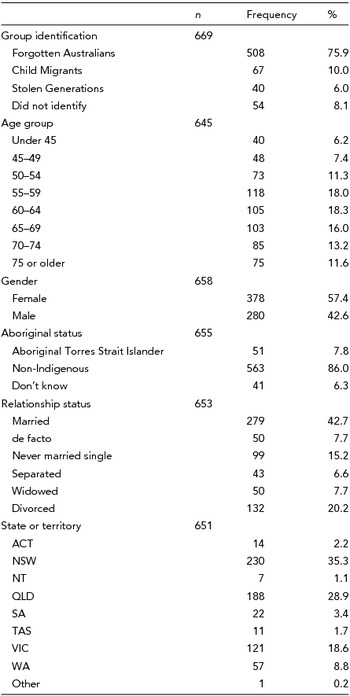
Of the 669 survey participants, 75.9% were Forgotten Australians, 10.0% were Child Migrants, 6.0% identified themselves as members of the Stolen Generations and 8.1% did not report their group identification. The mean age of survey participants was 61.74 (SD = 11.24) where the youngest participant was 27 years old and the oldest participant was 100 years old. More than half (57.4%) were female and 7.8% were Aboriginal/Torres Strait Islander. About half of respondents were married (42.7%) or in a de facto relationship (7.7%) at the time of surveys. Participants were from all Australian states and territories although the majority of participants were from the most populated states, New South Wales, Queensland and Victoria. See Table 1 for details of demographics.
Demographics.

Participants for interviews and focus groups were chosen to reflect the diversity of care leavers and to capture a range of experiences. The selection criteria included gender, age, Indigenous status, education, region and experiences during and after care (both negative and positive). In-depth interviews were conducted with 92 participants in every state or territory except for the ACT (due to a lack of participants). Forty-nine were female (53%) and 44 were male (46%); 12 persons identified as Aboriginal or Torres Strait Islander (13%). In addition, 15 interviews with specialist informants were conducted. Seventy-seven persons participated in 20 focus groups in a variety of locations throughout Australia. Forty-five were female (58%), and 32 were male (45%); 10 identified as Aboriginal or Torres Strait Islander (13%).
Instruments
The survey questionnaire was developed drawing on Australian and international research literature and modified based on feedback from partner investigators and members of the CRG. The questionnaire focused on experiences in care, experiences of leaving care, life outcomes after care (education, employment, health, wellbeing and relationships), current service needs and participation in organisations for care leavers and the Royal Commission into Institutional Responses to Child Sexual Abuse. The questionnaire included two standardised scales: the Kessler Psychological Distress Scale (K10) (Kessler et al., Reference Kessler, Andrews, Colpe, Hiripi, Mroczek, Normand and Zaslavsky2002) and the Multidimensional Scale of Perceived Social Support (MSPSS) (Zimet, Dahlem, Zimet, & Farley, Reference Zimet, Dahlem, Zimet and Farley1988). The K10 scale measures non-specific psychological distress on a five-point scale (10 items) and is widely used in Australia (Andrew and Slade, Reference Andrews and Slade2001). Following the ABS categorisation (ABS, 2007), K-10 scores are grouped into ‘low’ (10–15), ‘moderate’ (16–21), ‘high’ (22–29) and ‘very high’ (30–50). MSPSS is a measure which subjectively assesses social support on a seven-point scale (12 items). It has three domains of significant other, family and friends.
The survey questionnaire was designed to include a short form and a long form. The short form had 19 questions about demographics and key information, whereas the long form had an additional 110 questions on the themes outlined earlier.
The interview guide for care leavers focused on the same themes explored in surveys. In addition, participants were asked about their coping strategies and resilience, significant events post-care to the present, and their views on formal apologies. The interview guide for specialist informants focused on the nature, types, usage and values of services provided to the study population. They were also asked about gaps in services, the adequacy of resourcing and some broader policy issues. The focus group guide covered the same themes; however, less emphasis was given to questions about individual experiences, due to focus groups being collective in nature. The guides used for interviews and focus groups with Aboriginal and Torres Strait Islander peoples were designed to capture their unique experiences in OOHC (e.g., cultural deprivation), and were developed in consultation with Aboriginal members of the CRG.
Data Collection
Participants who contacted researchers directly for paper or telephone surveys, received a long version of the survey and pre-paid envelope. In the case of telephone surveys, a researcher administered the survey by telephone at the time agreed by participants. When participants completed online surveys, they were asked at the end of the short form if they would like to continue to the long form online, or complete it on paper or over the telephone. Two-thirds (n = 445) completed online surveys and one-third (n = 224) completed paper or telephone surveys. Among them, 65.5% (n = 438) completed the long form and 34.5% (n = 231) completed the short form only.
Interviews usually ran for 45 minutes to 1 hour 15 minutes. Focus groups usually involved 4–8 people and typically ran for 1.5 hours. For groups of Aboriginal care leavers, an Aboriginal co-facilitator attended and co-facilitated. With the permission of participants, interviews and focus groups were audio recorded and transcribed.
Data Analysis
Because the current study is exploratory in nature, mainly descriptive statistics were examined. IBM SPSS Statistics 23 (IBM Corp., 2015) was used for all analyses of survey data. Due to the small number of participants in some states and territories, no state-level information is provided to protect confidentiality. Qualitative data from interviews, focus groups and open-ended questions of the surveys were analysed using NVivo software. Thematic analysis was conducted following Braun & Clarke (Reference Braun and Clarke2006).The data was examined to capture the range and depth of different perspectives and ideas that emerged from semi-structured interviews and focus groups. These were developed into key themes that captured the views and the meanings ascribed by participants (Bazeley, Reference Bazeley2009). In reporting, all study participants have been assigned a pseudonym. Findings from quantitative data and qualitative data were integrated within broad themes. In achieving complementary, triangulation and expansion purposes (Johnson & Onwuegbuzie, Reference Johnson and Onwuegbuzie2004), points of convergence were identified to confirm and validate key findings of this study and points of divergence were also identified and interpreted. These provided the basis for considering implications and recommendations for practice, policy and future research to promote wellbeing of adult care leavers and to improve the current care system.
Results
The results from the study are presented sequentially to illuminate different dimensions of the care experience: people's initial experience of entering care, the care placements they experienced, their educational trajectories, their experience of maltreatment in care and their transition out of care. This is followed by an overview of post-care adult outcomes with regard to socio-economic status, health and wellbeing and access to services. Findings from quantitative and qualitative data are integrated within the above broad dimensions in presenting results.
Entry to Care
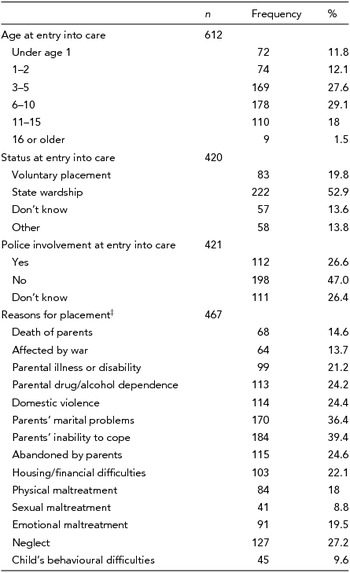
At the time of entry into care, survey participants were, on average, 6.28 years old (ages ranged from at birth to 17.58 years old). At the time of entry, about half of the children were state wards, and police were involved in 26.6% of placements. Respondents were placed in care for multiple reasons. The most cited reasons were parents’ inability to cope (39.4%), marital problems between parents (36.4%), neglect (27.2%), abandonment (24.6%), domestic violence (24.4%), parental drug and alcohol problems (24.2%), financial difficulties (22.1%) and parental illness (21.2%). Less frequently mentioned reasons included maltreatment by parents, parental death, circumstances arising from war or a child's behavioural difficulties. Table 2 displays details at entry into care.
Entry into care.

Note. ‡ The total exceeds 100% because participants were able to choose more than one option.
Research participants provided detailed comments on their perceptions of the circumstances that led to their entry to care. They also commented on the regimented orientation of institutions and the depersonalisation experienced.
When I went in there, I was only a number, and it wasn't until I was 10, 11 years old when I found out that I had a name. (Frank)
You had to grow up quickly, you know, it was very little love, it was very little understanding, in fact, there was no love . . . children were just, especially how I felt, like cattle, that's how I can sort of express my own feelings while I was there. It's probably the best way to describe it. (Shane)
Participants from Aboriginal backgrounds grieved the loss of family, language and culture alluding to the racism that was blatant and unremitting.
They tried to turn us into white . . . My mother was clean, you know, we knew how to be clean. We were the most, me and my sister. They said, ‘sit down, we're gonna wash you up straight away!’ . . . you know what I mean? But they got this all wrong. They took us away and they split us up. (Von)
Well you had many different languages. It's not just one Aboriginal language, like not just one Aboriginal country, so because we were taken away from it and it was bashed out of us . . . they called it ‘bashing the black out of you’ and they literally did that. (Thelma)
Research participants also commented on the demeanour of staff and the lack of warmth in the care environment.
There was a sort of militaristic background to a lot of them, but there was always this glass barrier between you and the staff, and the staff were never to get close. There were never allowed to hug the children, they could never show any bit of love to the children. (Ethan)
Trajectory in Care
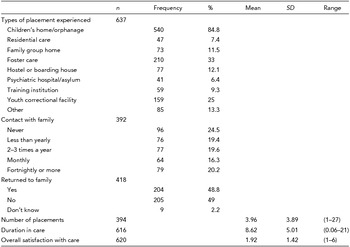
Respondents experienced various types of placements as shown in Table 3. The majority of them (84.8%) had experience of being placed in Children's Homes/orphanage, 33% in foster care, 25% in youth correctional facilities and other care settings (such as residential care, family group home, boarding house, psychiatric hospital or training institution). While in care, 24.5% of respondents did not have any contact with their family. Nearly half of respondents (48.8%) had returned to family at least once while in care. On average, respondents had 3.96 placements while in care (ranging from 1 to 27 placements) and lived in care for 8.62 years (ranging from 3 weeks to 21 years). The majority of participants (83%) were dissatisfied with their care experiences to varying degrees (61% very dissatisfied, 15% dissatisfied and 7% somewhat dissatisfied).
Trajectories in care.

Note. SD refers to standard deviation. ‡ The total exceeds 100% because participants were able to choose more than one option.
In terms of their trajectories in care, while some participants experienced the stability of a single institution over a lengthy period, many were subject to multiple placements. Hannah and Eileen described their extreme experiences of instability.
From 1961 to 1968, they moved me 30 times. Backwards and forwards, backwards and forwards, another place, another place, another place . . . I was never in the one place long enough to get settled. Never let me settle anywhere. (Hannah)
You would come home from school your bags would be packed, you are going to another home you were told to behave. No reason why you are behaving the way you are is ever looked at. You are going to the next placement . . . 19 placements in 12 years, 9 schools in 8 years. (Eileen)
Schooling in Care
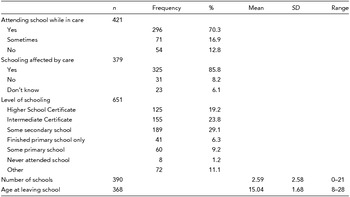
The majority of survey participants (87.2%) attended school while in care. Most respondents (85.8%) said their schooling was affected by their experience of being in care. As shown in Table 4, only 19.2% obtained a Higher School Certificate (or equivalent), 23.8% obtained an Intermediate Certificate (or equivalent) and 56.9% did not obtain any school certificate. On average, respondents attended 2.59 schools and left school at age 15.
Schooling in care.

Note. SD refers to standard deviation.
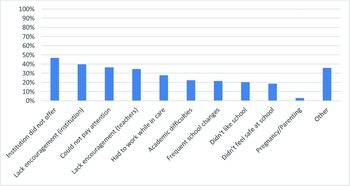
Survey participants were asked about the reasons for not finishing a Higher School Certificate (or equivalent). Almost half of respondents reported that institution did not offer the opportunity (46.7%). Participants also reported that there was a lack of encouragement from institutions (39.6%) and teachers (34.6%), they could not pay attention at school (36.4%), and they had to work (27.8%). Figure 1 displays the reasons for non-completion of the Higher School Certificate (or equivalent).
Reason for not finishing higher school certificate/leaving certificate or equivalent.

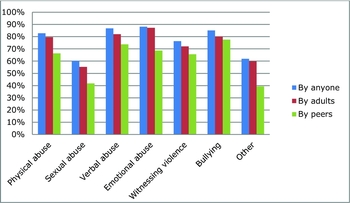
Experience of maltreatment in care.

Participants in this study faced many challenges and frustrations in their education and schooling. Luan's disappointment with his schooling is evident here.
What education? My education, my educational potential was like my childhood, stolen, I don't know what I could have been. I had no education. I was taken out of school before I turned 14 and was sent to work on a dairy farm. (Luan)
As children, participants experienced oppressive attitudes from authority and peers based on their ‘care’ status. One of the participants observed that being a ‘home kid’ attracted low expectations and stigma.
We were never permitted to be called by name. We were all called simply “home kid”. We were ostracised by both teachers and students. Our school work and/or homework was never checked as we were told that we were only home kids and not expected to do anything in life other than live on government assistance. (Anon)
Work was a constant in the life of children in institutions, constraining opportunity for learning and play.
There was very little bit of schooling only. You either worked in the orchard, you worked in the farm or you worked in the dairy or you worked in the kitchen. And everyone who was there was allocated a job, so you worked. You had to work and that was all there is about it. And if you didn't work, the guys who were there, the so-called wardens, the people who were supposed to be looking after you would come around and belt you. (Eddie)
I never really knew from the age of 10 to just be a little girl. I always had chores. From getting up – this is why I enjoy my sleeps now – 4 o'clock in the morning before anybody got up, I had to have so many uniforms ironed, ironed morning, noon and night. Morning before breakfast, after breakfast until going to school. Then lunchtime, iron again until afternoon. Then iron again, at playtime until going to bed. (Meg)
Experience of Maltreatment in Care
Maltreatment was extensive in care. The majority of participants (96.7%) had experienced at least some type of maltreatment, and 41% of participants reported having experienced all recognised forms of maltreatment. The most prevalent type of abuse by adults was emotional abuse (87.3%), followed by verbal abuse (82%). The most prevalent abuse by peers was bullying (77.6%), followed by verbal abuse (73.7%). Sexual abuse was widespread and over 60% experienced this form of abuse from someone: 55.3% by adults and 41.8% by peers. Figure 1 displays percentages of care leavers who experienced different types of abuse perpetrated by anyone, adults or peers while in care.
In interviews and focus groups, participants recounted their experiences of emotional, physical and sexual abuse. Mark offered a typical account of the negative messages that were made to the children:
You're always told – this is a common thing that runs through a lot of orphanages – you are never going to amount to anything. No one wants you and no one knows you're here. No one cares that you're here. (Mark)
Children need love, caring and nurturing, not knowing where next meal is coming from. And 8 hours scrubbing toilets with toothbrushes that could have been given to us for oral hygiene rather than punishment; this is mild to what I had received. It's still neglect, abuse and it's wrong. No child should ever have to suffer in silence and thinking of ways to end their life as just living daily was too much. (Anon)
Physical abuse was rife and reported by most respondents.
I got flogged [for that] with their little leather strap about that thick, by that, by that, up and down me arms, and all me wrists just swelled up, and I ended up in hospital. I was in the infirmary for a couple of weeks with that because I couldn't move my hands. (Edmund)
I've stated this before that a lot of people think the sexual abuse is the worst. I say that the physical abuse, which turned into the mental abuse . . . the beatings which were constant, were equal part to the sexual . . . and I've never forgotten that, and I lost my total faith in the Christian Church. It had a massive, massive effect on my life. (Andrew)
Accounts of a wide spectrum of sexual abuse came from participants of both genders.
I was raped by a priest, only to be flogged by the nuns and told that I was the one that was at fault . . . there was nothing nice about an orphanage. (Eliza)
Sexual abuse was as common as bricks in a wall [laughs]. If someone said they were not in any way sexually active, especially in the government's Children's Homes, I'm sorry, I just have to say [if] that's the perfect Children's Home, I've never heard of it. (Shane)
That was what led to me escaping from [institution] and I was in [institution] for not even two months. But when that stuff started happening, I escaped from the boys’ home. When they tried to take me back into there, the police, I was chucking tantrums and that. Going ballistic, I was. (‘Tommy’)
Transitioning from Care
At the time of leaving care, the average age of survey participants was 15.20, ranging from 3 weeks to 22 years old (one respondent continued staying at the convent as an adult until 31 years of age, so the maximum age in care was set to the next highest value of 22). About 62% did not have a job when they left care. Nearly half of respondents (51%) said that they were not prepared at all for living independently at the time. During this time, 35.1% did not receive any help from the institution and 49% did not have anyone to call on for help. See Table 5 for details.
Transitioning out of care.

Note. SD refers to standard deviation.
Post-Care Socio-Economic Outcomes
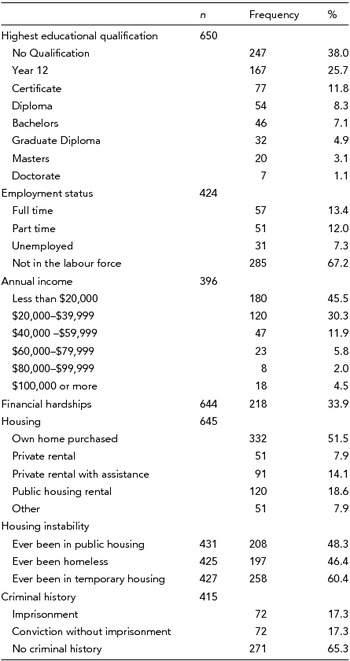
Although only 19.2% obtained a Higher School Certificate (or equivalent) many participants pursued further education or training after leaving care. As their highest educational qualification, 24.5% obtained at least one post-secondary education degree. At the time of surveys, 74.5% were not employed. Among people who were not employed, 48.3% were retired, 35.3% were unable to work and the rest had other reasons for not working (e.g. caring duties, full-time study). Accordingly, the most common source of income was government payments (60.8%) and this was followed by employment (22.3%), superannuation (6.0%) and other sources (investment, family or friends). Overall, care leavers in this study had low incomes. The majority of participants (75.8%) had annual incomes below $40,000. Nevertheless, about 4.5% of care leavers were able to earn high incomes of $100,000 or more per year. Unsurprisingly, 33.9% of participants reported having some types of financial hardships (e.g., not being able to pay bills or rent on time, going without meals).
As shown in Table 6, just over half of respondents (51.5%) owned a home, 22% were renting privately, and 18.6% were in public housing. A large proportion of respondents had experiences of housing instability. At some point in their lives, almost half of respondents had lived in public housing or been homeless, and 60% had experienced living in temporary housing. Over a third of survey participants (35%) mentioned a criminal history.
Socio-economic outcomes post-care.

Post-Care Health and Wellbeing
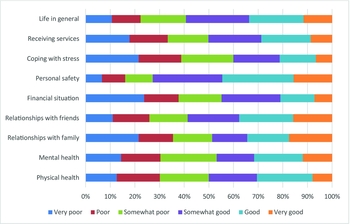
Survey participants rated their current wellbeing on a six-point scale. Items rated as ‘somewhat good’ (Mdn = 4) were physical health, relationships with friends, personal safety, receiving services and life in general, whereas items rated as ‘somewhat poor’ (Mdn = 3) were mental health, relationships with family, financial situation and coping with stress. Figure 3 displays self-assessed wellbeing on various domains.
Self-assessment of current wellbeing.

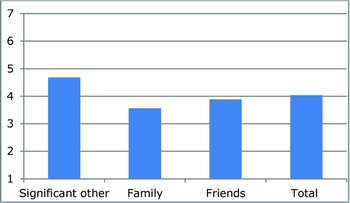
Survey participants reported on social and relational outcomes using MSPSS scale. The average score of perceived social support was 4.68 (SD = 2.07) for significant other domain, 3.56 (SD = 2.14) for family domain, and 3.88 (SD = 1. 94) for friends domain. See Figure 4 for details. The majority of participants (86.6%) believed that their experiences in care affected their relationships with partners in some way. Among respondents with children, 68% believed that their experiences in care influenced their children in some way.
Perceived social support.

The trauma associated with the severance of parental and family relationships had lasting impacts on social support available through family networks.
When we arrived at the orphanage we were systematically separated, gender separation, that in itself has created lifelong issues. I have five sisters that I don't have the capacity to get to know, simply because we are siblings so we didn't go through that natural process of getting to know each other . . . It's easier, I find it easier to get to know a stranger today than it is to get to know one of my sisters. (Douglas)
She's [mother] still alive. I did keep in contact the same amount of time with my father, and it's not all this lovey-dovey business . . . it's wonderful to find out about all this, but you have no connection, you know? What people don't understand is when children are taken away, whether it's today or in the past, you don't just lose your mum and dad. You lose your aunts, your uncles, your identity. (Janice)
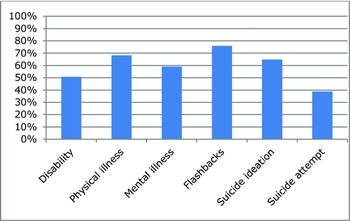
Survey participants reported on physical and mental health outcomes. Nearly half of survey participants (50.9%) had a disability. At the time of surveys, 68.2% had physical illnesses requiring on-going treatment and 6.1% had such illnesses in the past. Among them, 46.7% considered these physical illnesses were related to their experiences in care. Fifty-nine per cent of respondents reported having mental illnesses requiring on-going treatment at the time of surveys and about 11% had in the past. Among them, 85.9% considered these mental illnesses were related to their experiences in care. Seventy-six per cent of survey participants reported having flashbacks, 64.9% had suicide ideations and 38.8% had attempted suicide at some point. Figure 5 displays physical and mental health outcomes.
Physical and mental health.

Care leavers in this study experienced high levels of psychological distress. The average score of the K-10 psychological distress scale was 25.50 (SD = 11.04). Figure 6 illustrates that, compared to community samples (2007 HILDA and 2007 NSHMWB), much higher percentages of care leavers in this study reported ‘very high’ (38%) or ‘high’ (21%) levels of distress. For instance, when the percentages of people with ‘very high’ distress are compared, the percentage found in this study is 8.5 times greater than the percentage found in 2007 HILDA and 14.4 times greater than the percentage found in 2007 NSHMWB (Wooden, Reference Wooden2009).
Comparison of K10 psychological distress.

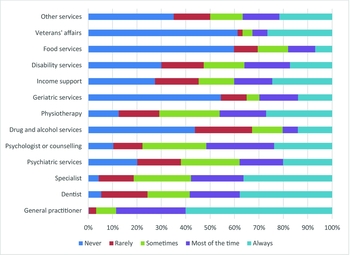
Survey participants reported on their access to various services as shown in Figure 7. Overall, respondents reported having good access to general practitioners (Mdn = 5, ‘always’), dentists, specialists and counselling (Mdn = 4, ‘most of the time’). Psychiatric services, physiotherapy, income support and disability services were less accessible (Mdn = 3, ‘sometimes’). Although smaller proportions of participants expressed their need, the least accessible services were drug and alcohol services (Mdn = 2, ‘rarely’), geriatric services, food services and veterans’ affairs (Mdn = 1, ‘never’).The biggest barrier for accessing services was reported to be an inability to afford the costs involved (69%).
Access to services at the time of need.

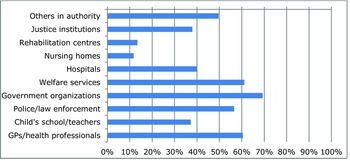
Survey participants reported that their care experiences caused them anxiety in relation to their contact with government organisations (69.3%), welfare services (61.1%), health professionals (e.g., general practitioners, specialists, dentists) (60.5%) or police/law enforcement (56.5%). They also worried about their contact with various authority figures. As detailed in Figure 8, these included GPs/health professionals, child's school/teachers, police/law enforcement, government organisations, welfare services, hospitals, nursing homes, rehabilitation centres, justice institutions and others in authority. Engaging with their children's school teachers, for example, was commonly experienced as intimidating. Care leavers worried about their ability to trust people (86.7%), the likelihood of not being taken seriously (65.8%), abuse (47.3%), privacy (46.4%), the ability to make decisions (41.2%), quality of care (40.3%) and relationships with staff (35.2%).
Perceived impact of care experiences on interactions with systems.

Care Leaver Specific Issues
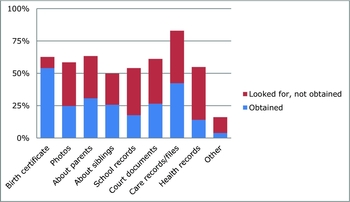
The majority of respondents (81.4%) had tried to access their records. Most of them searched for their care files (83%) but only half were able to obtain these (42.4%). The most commonly obtained item was the birth certificate (54%). See Figure 9 for details. Almost half of respondents (46.6%) reported being active in organisations that promote the welfare of care leavers (e.g. Alliance for Forgotten Australians, Care Leavers Australia Network, Lotus Place). Thirty-nine per cent of respondents participated in the Royal Commission into Institutional Responses to Child Sexual Abuse.
Accessing records.

Discussion
A key concern of this study was to ascertain care leavers’ experiences in care and life outcomes post-care. Key findings from this study reflect a lived experience of neglect and maltreatment. Following discussion of highlights from the data on specific domains of the care experience, implications for policy and practice in the context of contemporary debates will be considered.
The reasons many participants in this study were separated from their primary caregivers and placed in care derived from individual or family vulnerability (Lindsey, Reference Lindsey1994; Pelton, Reference Pelton2015). Immediate and distressful separation from parents and siblings was a source of trauma and loss for many, and often those relationships were never restored – Aboriginal children have been especially affected by this as parents and children were torn apart, often forever. Moreover, children lost their extended kin network and identity grounded in country, ethnicity, culture and language (Edwards & Read, Reference Edwards and Read1989; HREOC, 1997).
The Care Environment
Upon arrival at the care placement abusive cleansing and de-personalisation rituals were frequently inflicted upon new arrivals. Very few participants reported evidence of kindness, encouragement, respect, nurture, warmth or any form of affection from staff, replicating findings from previous research (Find & Connect, 2016; Musgrove, Reference Musgrove2013; Penglase, Reference Penglase2005). Such emotional neglect was perceived by many as a major contributor to serious mental health difficulties undermining their wellbeing across the life course. Child neglect was endemic in OOHC during the study period, most study participants experiencing a marginalised childhood devoid of education, fun or play. For participants overall, the daily regimen of drudgery and hard physical labour compromised normative developmental growth and learning.
In the case of Aboriginal children, an emphasis on ‘integration’ was in evidence for much of the study period with severe punishments in situ for speaking Aboriginal languages or identifying with culture or community in any way. Such cultural abuse and racism are consistent with the misguided values and policies that drove the practice of removing Aboriginal children, and saw their placement in institutions or with white families during the tragic Stolen Generations era (HREOC, 1997; Parry, Reference Parry2007).
Maltreatment in care
Participants described experiences of emotional, social, sexual and physical abuse on a scale that is extremely difficult to contemplate. Most participants (97%) experienced some type of maltreatment while 41% reported multiple types of maltreatment. Sexual abuse was widespread and over 60% experienced this form of abuse from adults and peers during their time in OOHC. Many more, if not sexually abused themselves, were aware of sexual abuse occurring in the institution. The physical abuse experienced resulted in horrendous injuries that led to chronic physical illness, serious mental health problems and a wide range of disabilities. The impacts of co-occurring forms of abuse have left indelible marks on participants including lifelong fear, mistrust, low self-esteem and hypervigilance.
Research indicates adverse childhood experiences including physical, emotional and sexual abuse can have long-lasting negative consequences that contribute to impaired health in adult life (Edwards, Holden, Felitti, & Anda, Reference Edwards, Holden, Felitti and Anda2003; Kaplan et al., Reference Kaplan, Pelcovitz, Salzinger, Weiner, Mandel, Lesser and Labruna1998; Schuster et al., 2014). Childhood maltreatment is linked to anxiety, depression, post-traumatic stress disorder and suicide ideation (Moore et al., Reference Moore, Scott, Ferrari, Mills, Dunne, Erskine and Norman2015; Mullen, Martin, Anderson, & Romans, Reference Mullen, Martin, Anderson and Romans1996; Norman, Byambaa, Butchart, Scott, & Vos, Reference Norman, Byambaa, De, Butchart, Scott and Vos2012; Widom, Reference Widom2000). There is also evidence of the relationship between experiencing a number of types of victimisation and a higher prevalence of psychological disorders (Felitti et al., Reference Felitti, Anda, Nordenberg, Williamson, Spitz, Edwards and Marks1998). In particular, the exposure to multiple and co-occurring types of maltreatment in care is linked to worse physical and mental health outcomes in later life (Fernandez & Lee, in press).
System failure
The frequent and systematic abuse combined with serious neglect described by participants in this study would appear to derive directly from authority figures invested with uncontained power and control, weak oversight and lack of regulatory frameworks (Musgrove, Reference Musgrove2013). Many staff who were charged with the explicit responsibility of administering care used their absolute and unchecked power over children to exploit and abuse them. Children without support networks inside or outside institutions or OOHC were preyed upon by adults and peers (Fernandez & Lee, in press). In this system, children had no voice, no reliable way of laying complaints and, as a result, their abuse was rendered invisible. Moreover, after being in care, they were released unprepared into society to embark on adulthood. The study period describes an era when psycho-social screening of recruits, referee reports and police checks were, for the most part, not mandatory. Orientation processes, professional qualifications, training programs, practice standards, supervision, oversight and quality assurance were either negligible or non-existent. There was effectively little or no oversight or accountability for individuals or for organisations until very late in the study period (Senate Community Affairs References Committee, 2004).
It is acknowledged that stability in care placements has the potential to promote resilience by providing the young person with a sustained relationship with a carer and, a compensatory secure attachment (Sinclair, Baker, Wilson, & Gibbs, Reference Sinclair, Baker, Wilson and Gibbs2005). While the significance of attachment to primary carers was being disseminated as mainstream child rearing wisdom by such leaders in child development as Bowlby, Ainsworth, Boston, and Rosenbluth (Reference Bowlby, Ainsworth, Boston and Rosenbluth1956) and Winnicott (Reference Winnicott1965), it was not applied in the institutional contexts reviewed here. Participants in this study were frequently moved from placement to placement until the end of the 1980s – and it can be argued that we have still to apply learnings about the vital role of placement stability to practice with young people in care currently (Fernandez, Reference Fernandez2008; McDowall, Reference McDowall2013; Reference McDowall2016).
Education
Education opens doors to life's opportunities, especially to work and financial stability. Education also supports long-term health, mental health and socio-emotional wellbeing (Fernandez, Reference Fernandez2008; Gilligan, Reference Gilligan2007; Harvey, McNamara, & Andrewartha, Reference Harvey, McNamara, Andrewartha, Mendes and Snow2016). For most participants in this study, those doors largely remained closed. Many participants left care without basic life skills and competencies such as literacy and numeracy. Where schooling was integrated into the programs of large institutions, sub-cultures of neglect and abuse often extended to the school experience. Physical, emotional and sexual abuse frequently occurred within the classroom. In mainstream schools, ‘homies’ were frequently bullied and ostracised.
Very few participants left care with an adequate education. That deficit in formal preparation, together with health and mental health issues and financial disadvantage, has made participation in continuing education enormously difficult. The number of participants who moved on to successfully complete post-school training or tertiary study is proportionately very small. This study's narratives are consistent with existing research (Courtney et al., Reference Courtney, Dworsky, Brown, Cary, Love and Vorhies2011; Goddard, 2000; Harvey et al., Reference Harvey, McNamara, Andrewartha, Mendes and Snow2016; Mendes & Snow, Reference Mendes and Snow2016; Pecora et al., Reference Pecora, Kessler, O'Brien, Roller, Williams and Hiripi2006).
Child labour
Accounts from research participants revealed that children were forced to work at the same or similar physical capacity of adults from a very young age, typically under oppressive staff supervision. Participants relayed that all domestic work in the institutions, and much of that in cottage and even foster homes, was undertaken by children in care, this trend being consistent with earlier evidence (CLAN, 2008; HREOC, 1997; Humphreys, Reference Humphreys1996; Musgrove, Reference Musgrove2013; Senate Community Affairs References Committee, 2004). Australia's seeming lack of accountability in the area of child labour has been subject to contemporary critique. Australia is one of only 20 member countries that have not yet signed the International Labour Organisation's (ILO) Minimum Age Convention of 1973; which ensures that countries are committed to the effective abolition of child labour (The University of Adelaide, 2017).
Leaving care
Participants reported that leaving care was an experience of profound fear and abandonment. During the study period, the abrupt and accelerated discharge of care leavers was a widespread and systemic practice with predictably tragic consequences for many research participants. Protracted periods of homelessness and various forms of institutionalisation, especially in mental health facilities, youth justice facilities or prisons, have been described by many participants as the outcomes of care leaving; this is consistent with existing evidence (McFarlane, Reference McFarlane, Cunneen and Salter2008; Mendes & Snow, Reference Mendes and Snow2016; Senate Community Affairs References Committee, 2004). Many young people attempted to reconnect with their families; most of these attempts were unsupported and proved unsuccessful, resulting in a further experience of trauma and abandonment. In many instances, parents themselves were living in vulnerable circumstances: in poverty; dealing with family violence, health problems and mental health or disability issues; and caring for other children (Scott & Swain, Reference Scott and Swain2002; Tierney, Reference Tierney1963). They were usually in no position to support estranged children with complex needs. For Child Migrants whose families lived oceans away (Humphreys, Reference Humphreys1996) and for many Aboriginal children dislocated from communities and culture, reunification was challenging in the extreme (Edwards & Read, Reference Edwards and Read1989; HREOC, 1997).
Adult Outcomes
Health
Chronic illnesses, injuries and permanent disabilities are still experienced by this study's participants as a legacy of their engagement in child labour while in care (Fernandez et al., Reference Fernandez, Lee, Blunden, McNamara, Kovacs and Cornefert2016). Physical injuries experienced by participants were often severe. Unset broken bones and muscular–skeletal damage, hearing loss and neurological impacts (of untreated ear infections and savage blows to the head) and serious trauma to internal organs (especially from being kicked and punched by physically powerful adults and sometimes as result of violent sexual assault) have resulted in ongoing medical problems. Reparative surgeries (rarely completely successful) and a wide range of permanent disabilities, especially mobility issues, have had lifelong consequences for many participants in this study; premature ageing was common in this research cohort. This is consistent with earlier findings (Senate Community Affairs References Committee, 2004).
Mental health
The adult mental health impacts of trauma experienced in care have almost without exception proved the most profound impediments to lifelong wellbeing. When compared to community samples, care leavers in this study presented extremely higher levels of psychological distress. Ongoing anxiety, depression, flashbacks, dissociation, phobias, mistrust and paranoia, instability of mood, suicidality and self-harm, poor impulse control and hypervigilance are some of the disturbed mental health phenomena described by participants (Fernandez et al., Reference Fernandez, Lee, Blunden, McNamara, Kovacs and Cornefert2016). Many participants described having tried to end their lives and having been hospitalised in a psychiatric facility on numerous occasions. For many of the Aboriginal participants, the experience of multiple losses and disrupted identity has had a ruinous impact on their own mental health and, in many instances, that of their children and grandchildren (HREOC, 1997; Korff, Reference Korff2017; McComsey, Reference McComsey, Thelen and Haukanes2010).
Living with serious mental health problems, often co-morbidly, and for the most part effectively untreated, has much constrained the wellbeing of adult care leavers in this study. It has frequently prevented the establishment and maintenance of long-term adult relationships; in many instances, it has greatly compromised parenting, impaired people's ability to engage with partners and children and led to permanent estrangement from children; it has resulted in a wide range of addictions, including those to alcohol, drugs and gambling. For many participants, mental health difficulties have made adult learning and paid employment impossible. The mental health impacts of trauma experienced in care have led to extreme levels of marginalisation, disempowerment and social isolation for many participants, corroborating findings from previous accounts (CLAN, 2008; Hil & Brannigan, Reference Hil and Branigan2011; Musgrove, Reference Musgrove2013; Senate Community Affairs References Committee, 2004).
Employment
Lack of education and training, and social, economic and geographic disadvantage have impeded opportunities for accessing rewarding employment. A lifetime of unemployment has predictably been the reality for far too many of this study's participants; this is an all too common experience for Forgotten Australians (Penglase, Reference Penglase2005; Senate Community Affairs References Committee, 2004). Long-term unemployment has meant financial hardship and, in many instances, lifelong poverty.
Family and social network support
As children, most participants reported feeling sad, lonely, unstimulated and socially isolated; many described adulthood similarly. The majority of participants have struggled to re-establish positive connections with family and extended family. Many have found friendships and intimate relationships confronting and difficult to sustain; this is consistent with previous research findings (Musgrove, Reference Musgrove2013; Senate Community Affairs References Committee, 2004). The demands of parenting, without positive role models, or a nurturing experience of caregiving in their own childhood to draw upon, have proved predictably challenging.
The trauma associated with the severance of parental and family relationships, the added alienation from culture and the attempted erasure of Aboriginality, has had a severe and lasting impact on the Stolen Generations and their descendants. The legacies of the policies that created the Stolen Generations continue to be felt by Aboriginal communities across Australia. Currently, Aboriginal children continue to be disproportionately represented in the care system nationally (Australian Institute of Health and Welfare, 2016).
Housing and aged care
Many participants reported episodes of homelessness, evictions and multiple changes of address as a result of financial disadvantage and housing shortages. Among study participants, there was a lower than average rate of home ownership and a higher than average rate of social housing rental. One of the greatest fears expressed by older participants in this study is an anticipation of placement in aged care institutions. For most participants, entry to aged care represents a return to the vulnerability, fear and disempowerment they experienced as children in care (Fernandez et al., Reference Fernandez, Lee, Blunden, McNamara, Kovacs and Cornefert2016).
Implications for Policy, Practice and Services
The findings from this research serve to underline the importance of responding effectively to issues long associated with children who are in need of care and protection. There are two preeminent issues that arise from this study. First, developing an appropriate response to those who are victims of the atrocities in care captured by the study, and second, ensuring that such harm can never occur again.
The long-term emotional, cognitive and social impacts of the trauma associated with maltreatment and cumulative adversities in care has therapeutic, legal and policy implications for adult care leavers. It cannot be overstated that a far better developed health safety net is urgently needed to support the increasing frailty, illness and disability within this vulnerable and ageing cohort; this has been argued convincingly by advocacy groups (Alliance for Forgotten Australians, 2016; CLAN, 2008). Audiology, pathology, optometry, dentistry, physiotherapy, occupational therapy, prosthetics and orthotics are just some of the ancillary health services which participants identified as health needs on an ongoing basis (Fernandez et al., Reference Fernandez, Lee, Blunden, McNamara, Kovacs and Cornefert2016). These are in addition to their primary health care needs for ongoing assessment, review and management of chronic health issues, disabilities and illnesses.
The long-term mental health impacts of trauma associated with abuse in care such as flashbacks, anxiety, depression, self-harm, dissociation and suicidality underline the need of ongoing counselling and specialist psychiatric help. Some have been able to access the public mental health provisions currently in place, but frequently reported that these were inadequate or inappropriate. The Forgotten Australians, the former Child Migrants and the Stolen Generations should be recognised as a special needs group with respect to free or low cost access to health services in recognition of the significant trauma they have experienced. The immediate health needs of the cohort are profound, and the life-long disadvantage suffered by many has resulted in calls for a high levels of services – such as a ‘gold health card’ (Bravehearts), access to legal representation and special consideration when being accommodated in old age facilities. Services also need to be attuned to the unique trauma and loss experienced by care leavers. For instance, the impacts for members of the Stolen Generations are profound and require culturally competent services. Specialist social and emotional wellbeing services, like the Bringing Them Home program, are crucial in this regard, along with support, healing and family reunion programs like Link-Up (McComsey, Reference McComsey, Thelen and Haukanes2010).
A particular fear expressed by older participants, now part of an ageing population is placement in aged care institutions and the likelihood experiencing disempowerment and oppression anew. For ageing care leavers, non-institutional forms of aged care need to be considered to minimise disruption to living arrangements and ensure care settings do not replicate the oppressive conditions that people were exposed to as children.
Training social workers and health practitioners to understand the impact of exposure to maltreatment on psychosocial development across the life course is also crucial. The findings underline the importance of thorough trauma assessments for this vulnerable population as they present to adult and aged care services. The continuation and expansion of Find and Connect Services (www.findandconnect.gov.au) that support care leavers in accessing health and housing services, counselling and their records, are essential for their emotional and social wellbeing and their healing journeys (Humphreys & Kertesz, Reference Humphreys and Kertesz2012; Murray & Humphreys, Reference Murray and Humphreys2014).
The case for redress is irrefutable, and discussions about what this should comprise have been generated by this research, and also in the discussion papers and responses to the Royal Commission. The elements of a redress framework articulated by the Royal Commission include a number of components: a personal apology from senior representatives of the institutions concerned; counselling and psychological care; and monetary payments. In addition, there should be no diminishment of services currently available through social security or health programs. The redress should be ‘survivor focused’, operate with a ‘no wrong door’ approach, be informed by knowledge of the nature of child abuse in institutions and any cultural needs; and be responsive to particularly vulnerable survivors (Royal Commission into Institutional Responses to Child Sexual Abuse, 2016, pp. 129–135).
The responsibility for leading the design and financing of a redress scheme has been taken on by the by federal government (in the announcement at the end of 2016 by Minister Christian Porter (ABC News, 5 November 2016)). This announcement included the provision of up to $150,000 for each applicant, in addition to psychological and health services. States and territories have been asked to opt in, with the federal government reserving the option to legislate to compel their participation if needed. It is proposed that the institutions where abuse occurred will also shoulder the costs.
In the face of institutions’ contracted obligations to provide care for children, it is evident that there were comprehensive failures of governance at every level: from commissioning and oversight, to the implementation of practices consistent with legal obligations and the wider community's care expectations. The widespread occurrence of brutal abuse and neglect is shocking; particularly, when the standards of care offered to children in large institutions has been observed, historically, to vary greatly (Van Krieken, Reference van Krieken1991).
Participants in this research were emphatic that children in contemporary OOHC systems should not be subject to the neglectful and abusive care practices they experienced. It is imperative that OOHC is underpinned by the principles enshrined in the UN Convention of the Rights of the Child (United Nations, 1989), is monitored by independent oversight at the state and federal levels, and complies with the 10 child safe principles identified by the Royal Commission into Child Sexual Abuse (ECIRCSA, 2016).
In Australia, there have been a number of developments over the last decade that strengthen the focus on the quality and standardisation of service delivered to children in OOHC. There are now National Out-of-Home Care Standards, and the work of the Royal Commission into Institutional Responses to Sexual Abuse has provided impetus for regulatory, organisational and systemic reforms across service areas to ensure child safe organisations.
The Royal Commission's in-depth forensic investigation illuminated how organisations reflexively act in their own interests by denying those of the children in their care. This systematic interrogation of the protection of perpetrators and refusal to listen to children's claims has provided the impetus to find alternative ways to privilege the voices and experiences of vulnerable children who were cared for by services. It cannot be overemphasised that there is a need for educational strategies to effect a culture change in OOHC service delivery to ensure a high value is placed on the safety of children and young people. Recognising the intrinsic value of every child is essential for creating safe care environments, and cultural change at government and service levels is needed to ensure this (Fernandez, Reference Fernandez and Moore2016). A culture that prioritises safety is clearly critical. This cannot be achieved without a well-qualified and highly skilled workforce.
21st century approaches to OOHC delivery would seem far removed from the cruel and unjust system endured by participants in this study (Brouwer, 2007; Scott & Swain, Reference Scott and Swain2002). Yet, outcomes of a childhood in care remain poor overall, locally and internationally (Skold, Reference Sköld2013). Many young people around the world continue to be forced out of the care system prematurely with very few real supports (Mendes & Snow, Reference Mendes and Snow2016). In comparison to the general population, both within Australia and internationally, relatively few care leavers finish high school and progress to tertiary education (Cameron, Connelly, & Jackson, Reference Cameron, Connelly and Jackson2015; Harvey et al., Reference Harvey, McNamara, Andrewartha, Mendes and Snow2016; Sebba et al., Reference Sebba, Berridge, Luke, Fletcher, Bell, Strand and O'Higgins2015). Within a short period of leaving care, many young people find themselves homeless, often confronting major mental health issues and even incarceration. A lack of skills and qualifications resulting in long-term unemployment is a common prospect (Mendes & Snow, Reference Mendes and Snow2016; Pecora et al., Reference Pecora, Kessler, O'Brien, Roller, Williams and Hiripi2006). Aboriginal and Torres Strait Islander children in care are especially disadvantaged educationally; they are also often disrupted socially and culturally. It remains the reality that Indigenous children are removed from home and placed in OOHC 10 times as often as non-Indigenous children (Australian Institute of Health and Welfare [AIHW], 2017) raising concern that the experiences of the Stolen Generation have not been entirely consigned to history.
Residential care, the care type dominating the OOHC sector during the study period, remains highly contentious in policy and practice today. Its viability is contested locally and internationally; this is based on evidence of poor outcomes and questionable contemporary practice standards, especially in relation to safety (Besser, Stockell, & Worthington, Reference Besser, Stockell and Worthington2016; Moore, McArthur, Roche, Death, & Tilbury, Reference Moore, McArthur, Roche, Death and Tilbury2016; Whittaker, Holmes, & del Valle, 2015). Whilst encouraging progress has been made in addressing trauma over the past decade, especially with the introduction of therapeutic approaches to foster and residential care (Frederico, Long, McNamara, McPherson, & Rose, Reference Frederico, Long, McNamara, McPherson and Rose2016; McNamara, Reference McNamara, Whittaker, del valle and Holmes2015), close parallels between past and present care experiences remain apparent. It seems that too many themes in the narratives of Forgotten Australians and other former care recipients are mirrored by those of today's children and young people in care, and those of care leavers (McDowall, Reference McDowall2013; Mendes & Snow, Reference Mendes and Snow2016). Impediments to children in care participating equally in public education and accessing public health services remain, and the goal of keeping children out of the system continues to be undermined by a lack of cohesive policy at government levels, a challenge noted in the National Framework for Protecting Australia's Children (Australian Government, 2009) and also in a report undertaken by David Tune for the NSW Government (2016). As his report indicates, many of the fundamental drivers that push families into situations where children are taken into care lie outside the influence and jurisdiction of the child welfare system.
While the findings of this study support the need for increased regulation and oversight to enforce quality standards for children's care – and support the development of critical, reflective processes among social work, social welfare, social policy and educational professionals involved in decision making and administering these care systems – there is an overarching imperative to prevent children from entering care by providing better family support services. Such example include the proposal for a system of care based on non-stigmatised universal services championed by the National Framework for Protecting Australia's Children 2009–2020 (Council of Australian Governments, 2009).
There is an imperative to recognise the impact of past practices, to prevent the repeat of systemic failures in the OOHC system, and to provide services that are modelled on evidence-based best practice. In short, it is important that we learn from the failures of the past and apply those learnings to today's practice. This has been the message delivered in strongest possible terms by almost every participant in this study. The study's participants are ‘insiders’ with lived experience of OOHC; they are confronted each day by the terrible social, emotional and physical impacts of multiple failures in the flawed child welfare system they experienced. Their tragic experience of trauma, and the courage and resilience they manifest in the face of this, does indeed make each an ‘expert informant’ whose voice must be heard.
Acknowledgements
We thank the Forgotten Australians, members of the Stolen Generations and former Child Migrants who gave generously of their time in participating in this research. The authors also acknowledge the collaboration of Professor Mark Courtney (University of Chicago) and Professor Mike Stein (University of York) and the community partners on this research: Alliance for Forgotten Australians, Association of Children's Welfare Agencies, Berry Street Victoria, Relationships Australia NSW, CatholicCare Diocese of Broken Bay, Micah Projects and Families Australia. The funding supporting this research from the Australian Research Council is gratefully acknowledged.