Historians of Senegal often locate the beginning of modern politics with the emergence of the originaires, an assertive group of Western-educated urban Africans who challenged the French and métis (mixed race) monopoly of electoral politics in the early twentieth century.Footnote 1 Accordingly, they view Blaise Diagne's 1914 election to the Chamber of Deputies of the French National Assembly as the beginning of modern Senegalese politics. Such histories, thus, situate the métis population as predecessors to the emergence of an authentic African political consciousness or characterize them as a monolithic group that mimicked colonial powers. Closer examination of the period of ‘Creole dominance’ in commune politics, however, shows the urban community's embrace of elected institutions and criticism of colonial excesses in the late nineteenth century.Footnote 2 This article re-examines the role of republican institutions in early colonial Senegal by considering how métis assemblymen used local assemblies to shape colonial policy and practice.Footnote 3 Examining how politics actually operated in Senegal's nineteenth-century capital sheds light on the structural ambiguities that resulted from the liberalization of electoral politics under the Third Republic at the same time that the regime embarked on territorial conquest in French West Africa.
Considering Senegal's political history through the lens of the métis population raises questions about the emergence and development of racial identities in colonial Africa. The offspring of unions between African or Afro-European women and European men who formed the nexus of coastal society during the slave and mercantile trade era, the métis of nineteenth-century Senegal straddled multiple worlds. They inherited the last names of their European fathers and generally adopted a cultural outlook that conformed to the norms and expectations of the French bourgeoisie. While most enjoyed paternal recognition, their maternal line of descent situated them within African locales. By the late nineteenth century, the métis constituted a French educated, property-owning group divided between the grandes familles who possessed status and/or wealth due to their connections to Bordeaux commercial interests or higher positions within the colonial bureaucracy, and those who occupied the lower strata of the administration or served as agents for French commercial firms. I use the term métis, more a social construction rather than a biological fact, to refer to this group of inter-connected families that dominated electoral politics in late nineteenth-century Senegal.Footnote 4
Research on inter-racial mixing in French West Africa and Southeast Asia illustrates the problematic category of the ‘mulatto’ for officials and settlers in the formal period of empire and yet these studies tend to render the métis as anonymous objects of colonial power.Footnote 5 Interracial unions and the mixed race populations that issued from them, however, served as critical sites for the emergence of new race, class, and gender identities.Footnote 6 This article takes up the concept of ‘colonial kinships’, advanced by Christopher Lee, as an analytical lens for examining the ‘contingent ways’ that Africans and Europeans were tied together through overlapping familial ties.Footnote 7 As the formation of a politically conscious Anglo-African community in Nyasaland led to colonial officers' rethinking of the categories of ‘native’ and ‘non-native’ at a crucial period in the ascendancy of indirect rule, so too the emergence of politically savvy métis assemblymen influenced French officials to abandon the idea of assimilation as the guiding ideology of colonial rule in French West Africa. I contend that the restructuring of electoral politics in the colony occurred, in part, because colonial officials sought to minimize the interference of métis assemblymen in colonial affairs. Examining how politics worked in the early colonial period situates the métis as individuals seeking to safeguard their own interests but who also became more radicalized as the process of colonial conquest unfolded.
As a group who did not fit neatly into either category of colonized or colonizer, the métis complicated conquest and the establishment of imperial overrule by using French republican institutions in ways that colonial officials had not envisioned. They considered Senegal's General Council as their field of power. Winning election to the assembly afforded councilors the ability to assert their interests in matters pertaining to the colonial economy and political affairs. In the transition from mercantile outpost to colonial capital, French officials relied on people of mixed racial ancestry to act as colonial go-betweens. The race and class position of métis men, particularly those of the grandes familles, afforded this group access to power and politics at a critical time in the expansion of French overrule. Exploring how people of mixed racial ancestry interpreted French republicanism demonstrates the emergence of racial identities within Africa but also has important implications for understanding state power at a crucial moment in its formation. Between 1870 and 1920, the local assemblies served as a symbol of the French regime's commitment to republican ideals but the activities of Senegal's assemblymen complicated the process of elaborating colonial power. The General Council, in particular, embodied the struggle for power between metropolitan and ‘Senegalese’ interests.
MÉTIS IDENTITY IN NINTEENTH-CENTURY SENEGAL
While the field of colonial studies has focused critical attention on how race, class, gender, and sexuality were critical to the politics of modern empires, gaps remain in our understanding of how individuals interacted with and interpreted these social categories and practices. Africa's urban elites are typically cast as either the willing agents of colonial powers or agitators seeking to overthrow colonial control and yet town residents played pivotal roles as intermediaries in imperial situations. Empires relied on co-opting local intermediaries who had the skills, knowledge, and authority over the lands where they ruled.Footnote 8 Africa's city dwellers participated in the colonial bureaucracy and in colonial economies for survival and socioeconomic mobility. Their familiarity with the local situation, however, also afforded certain individuals the ability to influence colonial policy and at times subvert imperial control. African interpreters, bureaucrats, and middlemen traders who gained access to colonial institutions used the system to their advantage.Footnote 9 In nineteenth-century Senegal, French officials relied on strategic cooperation with black and métis traders as well as Muslim clerics in the towns to achieve their imperialist aims. As the descendants of African women and European men who maintained close cultural identification with the French bourgeoisie but who also possessed intimate knowledge of the local situation, métis men served as valuable intermediaries to military officials.
People of mixed racial ancestry occupied a particular place in the formation and development of colonial regimes in West Africa. George Brooks and Peter Mark have detailed the social and cultural practices that emerged in Senegambia from the fifteenth to eighteenth centuries and gave rise to EurAfrican populations. Portuguese commerce from the Petite Côte to Bissau resulted in ‘country style’ marriages between African women and European men. This practice continued as French mercantile trade companies established fortified outposts on the islands of Gorée and Saint Louis in the late seventeenth century. By the mid-eighteenth century, a self-conscious métis population developed in these locations. After 1820, when France regained possession of the territories after the Napoleonic Wars, officials sought to ‘regularize’ racial mixing by emphasizing conformity to bourgeois notions of family and marriage, instituting Catholic orthodoxy, and providing French education for the métis and black Catholics of the towns, known as grumets.Footnote 10
Exact population statistics for the self-identified métis are difficult to discern for the nineteenth century. Official reports typically divided town dwellers into categories of European or African; français or indigène. Métis, especially those with close ties to the administration or commerce, were likely counted among the European officials and commercial agents who resided in the country temporarily. One historian has estimated that the métis of Senegal numbered approximately 1,600 at their zenith in 1860.Footnote 11 A combination of endogamy, financial losses, and low fertility led to demographic stagnation thereafter.
In the early nineteenth century, Saint Louis became a thriving Atlantic port. Called habitants, free black and métis residents of the town who owned property controlled the provisional trade and acted as middlemen in import/export commerce.Footnote 12 While French officers and merchants spent on average one to three years in the Senegal colony, then consisting only of Saint Louis, Gorée, and a few riverposts, habitants resided permanently in the coastal towns. The descendants of African women known as signares, métis children had familial ties to European men and lived in close proximity to French cultural institutions. At the same time, they maintained kin networks among the Wolof of the lower Senegal, or among the Pulaar and Soninke of the middle and upper Senegal.Footnote 13 Their ties to both worlds allowed métis men and women to capitalize on their dual identity at critical moments in the expansion of French power in West Africa.
Between 1820 and 1840, the métis dominated the intermediary niche of the gum trade. Inhabitants of the Senegal River valley knew gum arabic as an edible resin produced by the acacia trees that grew on the north bank of the Senegal. Industrializing Europe sought new supplies of gum to use for a variety of purposes including book-binding, pharmaceutical preparations, and textile manufacturing. In Senegal, European merchants exchanged gum arabic for indigo-dyed cotton cloth called guinées. Produced in India then later manufactured in Rouen and French-owned factories in Pondicherry (India), these textiles served as both currency and an item for trade. As the most highly capitalized middlemen in the gum trade, métis men established client networks with Trarza and Brakna emirs and caravan traders on the north bank. They also acted as creditors to the Wolof aristocracy of Walo and Cayor, on the south bank of the Senegal, supplying them with guinées and other trade goods.Footnote 14Métis habitants' ties to the ruling elites of the Senegal River left them well positioned to facilitate diplomatic relations between the Wolof kingdoms, the Trarza emirs, and colonial officers in Saint Louis.
In the 1840s, the majority of the highly capitalized métis trading firms suffered financial ruin with the fall of gum prices. The ‘crisis’ faced by Saint Louis's trading elite has been well documented.Footnote 15 Bordeaux merchants' introduction of peanut culture restructured the colonial economy to the peanut basin in Senegal's interior. While the golden age of the gum trade faded away, a few métis traders responded by reorienting their business to the frontiers of the colonial economy. Some of the most successful continued to operate independent trade houses supplying cattle for officials in the colonial towns, importing guinées for Moor caravan traders and Wolof consumers, engaging in peanut exports, and profiting from the perpetuation of slave markets in the interior. Others acted as trade agents for Bordeaux merchants or invested in businesses like brickmaking, or electrical lighting in the towns. Although the métis lost ground to Muslim Saint Louis traders who dominated the intermediary niche of the peanut trade after 1850, métis men continued to operate in commercial depots of the interior from the north bank of the Senegal to Podor on the middle Senegal to Sine and Saloum and as far south as the frontier with Sierra Leone.
By the 1870s, métis families socialized with French officials, shared similar educational experiences, attended Church, and dined together. Notable habitants (typically métis men) participated in or sat on the governor's advisory councils, held seats in the Chambers of Commerce, and served as members of the local barristers' organization together. Métis men completed secondary and higher education in France and pursued careers in law, the colonial bureaucracy, and as pharmacists, doctors, and businessmen. A generation of young men, educated in metropolitan lycées and universities, returned to Senegal with a keen understanding of French law and an awareness of the civic and political debates shaping France and its overseas territories during the ascendancy of the Third Republic.Footnote 16 Their socialization in the industrial, intellectual, and political centers of late nineteenth-century metropolitan France, as well as their knowledge of commerce and customs of Senegal's countryside, left this group well positioned to capitalize on the expansion of electoral politics in Senegal under the Third Republic. While Frenchmen and a few African town residents participated in the local assemblies, the métis proved the most assertive and skilled at using this field of electoral politics to their advantage in the late nineteenth century.
ELECTORAL INSTITUTIONS IN NINTEENTH-CENTURY SENEGAL
Seminal studies of Senegal's modern political history have provided a useful narrative for the emergence of urban African political consciousness.Footnote 17 The role of Senegal's urban elite in commune politics before Diagne's election to the Chamber of Deputies is commonly understood as an intermediary phase in the evolution of modern African political life; a period of ‘creole domination’ typically characterized by bribery, corruption, and the uncontested control of European cultural elites over the uneducated African masses. François Zuccarelli describes this era in Senegal's political history as ‘clan politics’ marked by patron-clientage in which Bordeaux merchants and their métis agents bought African votes. Colonial officials and French observers writing about Senegal's elections at the turn of the nineteenth century, moreover, characterized the activities of métis assemblymen as the last gasp of over-reaching, impoverished ‘mulatto’ elite.Footnote 18 Rather than viewing this era as a failure to adopt modern political behavior, I consider patron-clientage in Senegal's colonial towns to have operated in a similar manner to ‘boss politics’ that characterized elections in the municipalities and departments of metropolitan France or even New York's Tammany Hall in the late nineteenth century.Footnote 19
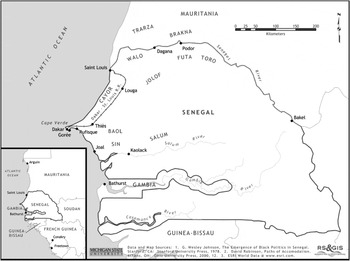
Unlike other colonies in French West Africa, Senegal operated according to a peculiar dichotomy of citizenship in the towns and subject-hood in the protectorate. In the late nineteenth century, the inhabitants of Senegal's colonial towns possessed an ambiguous legal status; neither fully subject to the authoritarian and arbitrary practices of protectorate rule nor citizens entitled to all the protections of French law. The former kingdoms of the interior that came under French ‘protection’ comprised the protectorate, administered by the political affairs bureau while the municipal decree of 10 August 1872 granted Saint Louis and Gorée commune status. Dakar and Rufisque, key ports for the peanut basin received commune status shortly thereafter. Designated as territories of direct administration, inhabitants of the Four Communes together with a scattering of rural trade posts and administrative centers were subject to the ‘regime of laws’ that gave African, French, and métis the right to seek justice in French courts.Footnote 20 By the 1890s, the Senegal colony extended from the Senegal River to the Saloum and Casamance rivers. The vast majority of the African population faced practices such as summary justice and forced labor because these territories were administered by the political affairs bureau. The creation of an urban enclave of republican rights, however, created a nexus for the development of a civic-minded urban community in late nineteenth-century Senegal that could bring colonial abuses to light.
Senegal Late Nineteenth and Early Twentieth Century.

During the nineteenth century, republican institutions in Senegal developed haltingly and in an ambivalent fashion.Footnote 21 The mayors and assemblies, Senegal's seat in the Chamber of Deputies, and assemblymen positions in the General Council constituted the three major elected institutions. Beginning in the early 1820s, Senegal's governors followed local practice by choosing a mayor elected by notable town residents until Louis-Napoleon's regime disallowed this practice. As early as 1822, Paris and Saint Louis debated the necessity of establishing some sort of consultative body for Senegal yet officials remained ambivalent about establishing such an esteemed institution as the General Council in a remote outpost considered a comptoir (factory) instead of one of the Grandes Colonies. The naval ministry granted Senegal, owing to its status as a commercial outpost, an advisory council called the Conseil Privé, comprised of seven administrative officials (all Frenchmen) plus one habitant (always a métis) and one notable. The council, appointed by the governor, advised the administration on issues of regional importance and provided opinions on relevant economic questions.Footnote 22
On 7 September 1840, King Louis Philippe issued a royal ordinance that established a General Council for Senegal similar to the assemblies instituted in the grandes colonies. Forty to sixty habitants and notables of Saint Louis elected ten delegates, eight négociants (French wholesalers), and two traitants (métis middlemen), who served a five-year term. The council met annually to advise the governor on budgetary matters, economic policy, and administrative questions, and selected a delegate to the naval ministry's advisory council in Paris. At the time, Paris considered Saint Louis as the commercial and administrative capital of the Senegal colony, then consisting only of the two coastal towns, and a fortified post on the upper Senegal. Consequently, only Saint Louis habitants could serve on the General Council. The 1848 revolution resulted in the dissolution of the body. Paris did, however, reconsider Senegal's proposal for a legislative representative. Senegal sent métis habitant Durand Barthélémy Valantin to Paris to express their desire for representation in the Second Republic. On 5 March 1848 a presidential decree awarded Senegal a legislative seat and Valantin remained in Paris to serve as Senegal's first representative.Footnote 23
A political victory for Senegal's urban elite, the 1848 decree crafted a legal framework later used to argue for an expansion of the legal status of originaires. In an attempt to unify metropolitan and colonial legal systems, a decree of 5 November 1830 confirmed that all adult men, born free and living in Senegal had the same rights as those granted to French citizens by the Civil Code.Footnote 24 Effectively, this law opened voting rights to all free adult men who owned property but specified that these rights only pertained to voting within the colony not in metropolitan France. The 1848 decree granting Senegal a legislative seat clarified voting procedures by stating that residents of the colony did not have to show proof of naturalization, only five years residency, in order to vote. Unlike in Algeria, Muslims in the Saint Louis community did not have to conform to the cultural provisions of the Civil Code in order to exercise voting rights; a provision that would become the cornerstone of originaire arguments against officials seeking to deny their legal and political rights in the early twentieth century.
The Third Republic completed the project of establishing republican institutions in Senegal begun under the short-lived Second Republic. On 1 February 1871, Paris re-established representation for Senegal in the National Assembly. The 1872 decree that organized the Four Communes also created municipal councils responsible for deciding the local tax rate, collecting commune revenues, and reviewing the annual commune budget and presenting it to the governor for approval. The mayor published all laws and rules pertaining to the commune, served as the officer of the civil registry, set local market prices, oversaw community works projects, and supervised the police, local roads, and public health concerns.Footnote 25 The mayor and the municipal assemblies served as the voice of each urban community in the management of local affairs as well as in the apparatus of the colony's administrative system.
Paris lawmakers rationalized extending electoral institutions in Senegal's capital as the elaboration of French rule. In the nineteenth century, Saint Louis stood as the place where France imagined how their ‘civilizing mission’ would spread. Instituting a regime of laws in the coastal towns was emblematic of a vision of French empire that united metropole and colony. The exercise of political rights in Senegal's coastal towns, however, stemmed from a combination of town residents' loyalty to France and the French military's reliance on African residents to carry out trade in the interior, and provide needed services for European merchants and administrators on the coast. Top colonial officials understood the importance of cultivating allies within the urban community to facilitate colonial expansion. In the mid-nineteenth century, Senegal's governors and metropolitan merchants viewed the métis as logical individuals to serve as advisers, agents, board members, mayors, and members of the local assemblies because of their cultural proximity to France.
SENEGAL'S GENERAL COUNCIL
In the debate over instituting a General Council for Senegal, the urban community first articulated a distinction between metropolitan interests and ‘Senegalese interests’ in the affairs of the colony. Métis merchant Gaspard Devès situated himself as head of an electoral group willing to challenge the administration and Bordeaux commerce by advocating ‘Senegalese interests’. On 2 May 1878, the municipal council discussed the government's proposal to suppress the municipalities in order to reestablish a General Council for Senegal, which would subsume all municipal functions. Some supported the proposal, arguing that the majority of commune residents found the municipal assemblies too costly and ineffective. Another group sent a petition to Paris requesting the ‘full complement of representation’ for Senegal. According to the report of the meeting, Gaspard Devès took the position that Senegal should be afforded the same electoral rights as the grandes colonies and metropolitan departments. He maintained that ‘those who do not wish Senegal to be a colony … but merely a comptoir [commercial outpost] to exploit’, sought to hinder the growth of Senegal's institutions. Predicting that the minister's commission would side with the wishes of the urban community rather than the Bordeaux merchant lobby, Devès concluded that the ministry's decision to award Senegal a General Council would confirm that ‘Senegal is not in Bordeaux but among us’.Footnote 26 In articulating an alternative vision for carrying out colonial policy, Gaspard Devès and his allies shifted commune politics from an avenue solely for agents of metropolitan commercial firms to affect decisions regarding commercial affairs in the colony to an arena for the urban elite to articulate their interests.
On 4 February 1879, Jules Grévy, president of the Republic, authored a decree organizing a General Council for Senegal. The new assembly consisted of sixteen members comprised of ten seats for representatives from Saint Louis, four from Gorée-Dakar, and two from Rufisque.Footnote 27 Members held six-year terms and the body was renewed by half every three years. Candidates had to be at least twenty-five years of age, have lived in the colony for at least a year, and had to be able to read, write, and speak French. The last two stipulations favored métis men as they resided permanently in Senegal and had exclusive access to French education.Footnote 28 Grévy's decision, while likely motivated by the desire to unify metropolitan and colonial systems, had the unintended consequence of working in the favor of Devès and his allies since it enlarged the field of political activity for town residents. Senegal's General Council surpassed other forms of limited representation such as the Legislative Councils that Britain established in Freetown and Lagos because the decree organizing the assembly gave members the authority to vote on a portion of the colonial budget. Moreover, councilors could address complaints and formulate their requests to the colonial ministry, giving them access to the highest levels of French authority.
The assembly met during one annual session, usually from November to December, following the close of the trading season, although extraordinary sessions could be called at any time.Footnote 29 The meeting opened with a procession in which the president of the council accompanied the governor to the assembly. The president and vice-president of the body were elected by their peers in the assembly. In deference to age as a quality of notable status, a special position called Président doyen d’âge was reserved for the eldest member of the assembly and the youngest filled the position of secretary, responsible for transcribing the proceedings. Bacre Waly Guèye, head of an important trade house and Saint Louis notable, held the position of doyen d’âge from the first session until 1897.Footnote 30 In paying attention to age principles, Senegal's urban community shaped French republican institutions according to African political values.
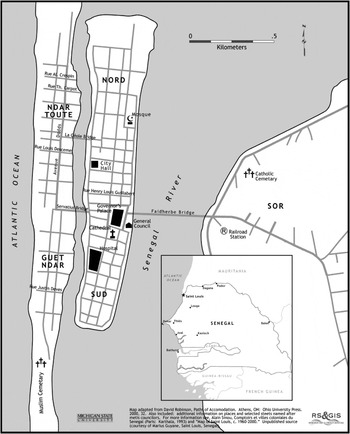
Saint Louis and Institutions of City Life.

As a symbol of the Republic, protocol played an important role in the operation of Senegal's General Council. At the beginning of each annual session, the governor gave a speech to open deliberations then departed the room. The director of the interior, second to the governor, presented the annual budget to the assembly on the opening day of the session. The director remained in the room for the entire proceedings of the session to serve as the eyes and ears of the administration.Footnote 31 The councilors deliberated on the budget and voted on amendments to it. After the assembly's recommendation, the governor certified the final draft of the budget and presented it to his executive council for final approval. At the end of the session, the councilors presented a summary of their deliberations to the governor in a speech delivered by the president of the assembly. A member's refusal to participate in these opening and closing rituals could be interpreted as an act of defiance against the government, subject to harsh rebuke.Footnote 32 Such acts served as a reminder of the hierarchy of power in the colony, despite the promotion of institutions that embodied democratic governance and upheld a political role for civil society.
For Senegal's General Council, budgetary authority constituted the most important responsibility. The councilors gave the administration their advice on the establishment and regulation of taxes, customs duties, and the octroi de mer (a tax on imported goods). In addition, they had direct control over the portion of the budget that involved optional expenses such as distribution of funds for public works projects in the towns and allocation of government scholarships for higher education in France. In the first session, the councilors voted unanimously for a loan of 800,000 francs for fresh water for Saint Louis and a ‘meager sum’ for the creation of an underwater cable to connect the Saint Louis-Dakar railway to a relay point in Europe; an expense the majority viewed as an unnecessary financial burden for the colony. Members heard requests from widows for financial assistance and deliberated on the importance of local expenditures such as furnishing the public library and providing concessions for the Catholic Church. Bacre Waly Guèye proposed funds to improve fish drying in the coastal village of Guet Ndar, and to repair the island's mosque.Footnote 33 For métis families, holding power in the local assemblies gave access to resources that mediated financial losses sustained by women and children with the decline of the gum trade. The institution also served as an avenue to gain access to higher education and a means to argue for improvement of public works in the towns.
In the 1870s, members of the local assemblies viewed the ability to influence policy related to commerce, customs duties, and the colonial budget as central to their role as middlemen traders and agents for commercial firms. The General Council weighed in on a decree that raised customs duties on guinées imported from factories outside of France, the source of most textiles imported by Bordeaux merchants. Senegal's assemblymen voted to repeal the law but specified their desire to see a uniform tax instituted immediately as customs on guinées constituted the colony's most important source of revenue.Footnote 34 The assembly also discussed the administration's plan to abolish licensing laws for traders and merchants that required traders to conduct trade only at specified river ports. In his closing speech of the 1879 session, Louis Descemet concluded that the ‘longtime principles of freedom of trade rigorously enforced in France and in civilized countries', should be applied in Senegal so that Senegalese traders could compete freely in the intermediary niche of the colonial economy.Footnote 35 Protecting the right to compete as middleman traders in the colonial economy had long been a central issue for the Saint Louis community. The General Council provided a mechanism to protect their trade interests.
THE LIMITS OF REPUBLICAN INSTITUTIONS IN THE COLONY
While economic matters most concerned métis assemblymen in the 1870s, political affairs involving the ‘pacification’ of African rulers in the interior became a greater concern in the 1880s. French officials relied on members of the General Council to mediate crucial administrative projects such as the creation of the telegraph line in Fouta Toro and the construction of the Dakar to Saint Louis railway through the Wolof kingdom of Cayor.Footnote 36 In 1886, a delegation from the General Council journeyed to the middle and upper Senegal to observe steamship transportation and to re-establish good relations between local rulers and Saint Louis after a series of military operations destabilized the area. While French officials needed the assistance of the councilors, all of whom operated trade houses or were creditors of rulers in the region, they also kept surveillance on their activities. The commandant of Podor alerted the political affairs director that Louis Descemet was using his position as president of the General Council to pressure his creditors for repayment of debt. He also warned that deposed rulers, some of whom shared kin ties with Descemet, sought his assistance in re-establishing their sovereignty in territories ceded to the French. The commandant subsequently reminded the deposed Futanke ruler that ‘there is only one chief, the Governor, and I am his representative’.Footnote 37 Although viewed as a necessary diplomatic mission, this event illustrates the intricate ties that the métis had to rulers, traders, and kin in the countryside and suggests how they might pose challenges to colonial officials seeking to impose their authority in the interior.
In the 1890s, Senegal's governors became increasingly concerned about the interference of the councilors from the first arrondissement in affairs related to the protectorate. Gaspard Devès and his allies publicly criticized the administration for the killing of the Damel of Cayor. He also convinced the Senegal judiciary as well as several Antillean justices, concerned with slavery and abuses of power in the colonies, to investigate the political affairs director's retaliation for the murder of commandant Abdel Jeandet in Podor.Footnote 38 Devès and his allies developed a reputation for exposing abuses of power by the administration and garnered the ire of top officials. In response to the Devès group's involvement in the Jeandet affair, Governor Clément-Thomas required that the inspector of colonies sit in on the General Council meetings.Footnote 39 The governor could request the inspector, presumably a neutral observer, to investigate elections and the activities of elected officials that the administration viewed with suspicion. In addition, Saint Louis diminished the budgetary authority of the General Council first by de-annexing territories of direct administration then by instituting a finance law to separate the protectorate budget from the direct rule territories, effectively limiting the General Council's authority to make decisions regarding expenditures in the interior.Footnote 40
At the turn of the century, the métis held the majority of seats in the General Council. After Gaspard Devès's retirement, his three sons continued to run the family business and control their group's coalition in the local assemblies. Justin and François Devès represented Saint Louis in the General Council. Hyacinthe Devès won election to the assembly from Rufisque. The creation of the Governor General's office in Dakar, the new seat of power for French West Africa, further diminished Saint Louis's role as the headquarters of French expansion. In addition, the influx of Frenchmen who served as clerks, lower level administrators, and agents for metropolitan firms in Rufisque changed the dynamic of commune elections. To maintain power, métis candidates looked to the African electorate, often campaigning in Wolof, relying on their ties to Muslim clerics, and enlisting originaire candidates to fill their voting lists for municipal and General Council elections.Footnote 41
In the opening session of the 1905 General Council, Hyacinthe Devès requested a motion to discuss the colonial inspector's report on voting rights and to reform of the General Council. Devès argued that the General Council was created by a liberal regime that sought to balance the extraordinary power of colonial governors. In presenting the naval minister's directions to re-establish the institution in Senegal, Devès noted that the minister understood that considerable progress had been made in India and Senegal to warrant a General Council. Hyacinthe Devès concluded that Senegal's populations have ‘already given the measure of their devotion to France’. He went on to say:
If I judge from the conclusions of the report of Colonial Inspector Verrier, the electoral lists are threatened to disappear and they are disputing our status as French citizens. So that for twenty-five years instead of going forward we have gone backward. If the doctrine expressed by the report represents the opinion – I do not say of France but of the Minister's office – what security do we have in this country? What is left for us is to clamp desperately to all that is the Law, because, outside of the Law, all is arbitrary.Footnote 42
Later in the 1905 session, councilors criticized the administration's excess use of force in military campaigns against Shaykh Ma al-Aynayn in northern Mauritania. Hyacinthe Devès and his allies objected to the governor general's characterization of Lt. Coppolani's death as the result of ‘fanatical Moors’. Doing so, they argued, only escalated conflict in a way that disrupted the livelihood of fishermen, farmers, and shop keepers.Footnote 43 The assembly's response to the administration shows the importance that the Saint Louis community placed on their role as a moderating force on the extraordinary powers afforded colonial governors. While not necessarily opposed to colonial rule, Senegal's métis advocated the existence of democratic institutions to balance the use of excessive and arbitrary force by colonial officials.
In response to the 1905 session, Governor General Roume presented the colonial minister with a proposal to reorganize the General Council into a hybrid institution in which members would no longer be elected by voters in each commune but rather half of the body would be elected by universal suffrage and the remainder appointed by Senegal's governor.Footnote 44 The governor general called the creation of a General Council in Senegal ‘premature’ and an ‘exaggeration’ to give budgetary authority to metropolitan merchants with no roots in the country and a ‘small but agitated mulatto aristocracy’, seeking, in his view, to maintain control over the African population. Roume sought to diminish the influence of Saint Louis by providing more representation to ‘Europeans, assimilés, and indigènes’, of the peanut basin. By disqualifying Africans in the communes from the voting lists and reforming the budget decree to give ultimate authority to a colonial ministry in Paris, Roume sought to take power away from the ten or eleven councilors from Saint Louis who, he maintained, halted progress in the colony. The proposal called for the replacement of an ‘old institution’, with a ‘younger one – more subtle and better adapted’, to the needs of the empire.
On 4 December 1920, the colonial ministry issued a decree that dissolved the General Council and replaced it with the Colonial Council.Footnote 45 The decree came four years after Blaise Diagne succeeded in passing legislation in the Chamber of Deputies of the Paris legislature that guaranteed citizenship rights for the originaires of Senegal's communes. Paris rewarded Senegal's loyalty to France in war time by shoring up legal status for commune residents. The new Colonial Council consisted of forty members; half were elected by citizens of the communes and half, nominated by French-appointed canton chiefs of the protectorate. Louis Guillabert, a métis, served as the first president of the assembly. He joined Blaise Diagne's coalition by appearing on the list of candidates presented by Diagne for commune elections.Footnote 46 With the end of conflict in Europe and the consolidation of colonial rule in West Africa, Dakar finally eliminated the republican institution that many administrators considered incompatible with colonial objectives.
CONCLUSION
Study of the political position of métis in Africa's colonial towns shows the ambiguities and paradoxes of establishing colonial control. People of mixed racial ancestry complicated the rigid racial hierarchy that European rule sought to impose on African societies. In late 1920s and 1930s British east, central, and southern Africa, the existence of mixed race people created a problem for officials seeking to impose indirect rule.Footnote 47 In early twentieth-century Senegal, racial categories solidified in colonial towns. The métis community in Senegal's coastal ports emerged in an eighteenth- and early nineteenth-century world in which racial categories mattered less than access to capital. The existence of métis and African habitants in Senegal's coastal towns facilitated European commerce to remote West African outposts. By the late nineteenth century, these same relations posed thorny problems for imposing French authority over Africans in the countryside. According to Françoise Vergès, the ‘colonized’ understood métissage as a term that spoke to the social and cultural diversity that was born of the French idea of assimilation. Cultural and inter-racial mixing furthered the goals of imperialism, in some ways, while carrying the potential for disruption of the colonial order, in others.Footnote 48 ‘Colonial kinships’ that linked métis to French merchants and officials, in an intimate way, appeared out of sync with a new colonial order that downplayed the universalist notions of assimilation in favor of the ideas that advocated separate paths of development for Africans and Frenchmen.
Histories of Senegalese politics tend to cast the period of ‘Creole dominance’ in terms of a rivalry between competing electoral clans led by Louis Descemet and Gaspard Devès. Yet, a closer examination of their discourse and activities as members of the local assemblies shows that despite differences in their networks and allegiances, both groups considered the right to participate in republican institutions as fundamental to their urban community. As the descendants of African women and European men who shared biological and cultural ties to the educated classes of metropolitan Europe, but who also possessed familiarity with trade practices, politics, and customs of Senegal's countryside, the métis considered themselves better qualified than French officials to make decisions regarding economic policy and political relations in the colony. For the métis, gaining power in the local assemblies strengthened their position as valuable political intermediaries after losing their dominance as intermediaries in the colonial economy. In focusing on intra-group rivalries and the politics of patron-clientage, previous scholarship has glossed over the ways in which the assemblies became sites for challenging colonial policy and articulating ‘Senegalese’ interests over metropolitan ones.
Recent scholarship on colonial citizenship has drawn attention to the ambivalent nature of French policies that sought to uphold the ideal of universalism while creating mechanisms of exclusion. Gregory Mann points out that the regime of citizenship laws established in Senegal's communes masked the regime of the protectorate that ruled by practices such as forced labor and summary justice. The legal framework for obtaining naturalization provided obstacles to all but a handful of people in French West and Equatorial Africa who met the social and cultural qualifications.Footnote 49 And yet black and métis residents of Senegal's towns claimed citizenship rights because of their long history of loyalty to France and their engagement with republican political institutions. Struggles within and around the General Council provide important insight into how Senegal's urban residents understood and articulated their position within the expanding French empire.
Senegal's long history of republican politics and town residents' demonstration of their loyalty to France interfered with the imposition of colonial rule in Senegal's countryside. In the late nineteenth century, the métis, in particular, had the ability to publicize certain abuses to the colonial ministry, Paris lawmakers, and humanitarian groups. The General Council provided an arena to contest colonial policies and make abuses of power visible to the highest levels of French authority. In order to consolidate colonial rule, Dakar and Saint Louis had to eliminate the General Council and weaken the authority of the urban community. As Blaise Diagne secured citizenship rights for originaires, the center of commune politics shifted away from the local assemblies and their scrutiny of protectorate practices to Senegal's seat in the Paris legislature. Closing one of the most venerable republican institutions – the General Council, thus, worked to strengthen and perpetuate the protectorate regime.