Introduction
The widespread, global misuse of antimicrobials is a public problem that has significant implications for human and animal health (D'Costa et al., Reference D'COSTA, KING, KALAN, MORAR, SUNG, SCHWARZ, FROESE, ZAZULA, CALMELS, DEBRUYNE, GOLDING, POINAR and WRIGHT2011; World Health Organisation, 2014; Sneeringer et al., Reference SNEERINGER, MACDONALD, KEY, MCBRIDE and MATHEWS2015; Ventola, Reference VENTOLA2015). While similarities in disease patterns in both animals and humans have been observed, researchers have struggle to clearly understand health outcomes from the animal-human interface (Howard and Fletcher, Reference HOWARD and FLETCHER2012). Emerging zoonoses are becoming resistant to antimicrobials, further increasing the burden of diseases (International Livestock Research Institute, 2012; King, Reference KING2011; Ventola, Reference VENTOLA2015; World Health Organisation, 2014;). Zoonoses, whether as a stand-alone issue or coupled with resistance to antimicrobials, have had a significant impact on economies (King, Reference KING2011; Sneeringer et al., Reference SNEERINGER, MACDONALD, KEY, MCBRIDE and MATHEWS2015) and healthcare systems in both developed and developing countries (Gebreyes et al., Reference GEBREYES, DUPOUY-CAMET, NEWPORT, OLIVEIRA, SCHLESINGER, SAIF, KARIUKI, SAIF, SAVILLE, WITTUM, HOET, QUESSY, KAZWALA, TEKOLA, SHRYOCK, BISESI, PATCHANEE, BOONMAR and KING2014). Developing countries, however, have been disproportionately impacted, given that they have fewer resources available to monitor, control and treat diseases (King, Reference KING2011).
Zoonoses affect over two billion people globally and result in over two million deaths each year (Gilbert, Reference GILBERT2012; International Livestock Research Institute, 2012). Along with the United States of America, South America, South East Asia and Western Europe (Gilbert, Reference GILBERT2012; International Livestock Research Institute, 2012), the Caribbean region has experienced a high burden of zoonotic diseases (Gilbert, Reference GILBERT2012; University of the West Indies, n.d.). The World Health Organisation (WHO) estimates that about 75% of diseases that have emerged in humans over the past 10 years were from direct contact with animal or animal products (World Health Organisation, 2016). The ‘true’ burden associated with zoonotic diseases and antimicrobial resistant pathogens, however, remains largely unknown and under-reported, particularly in developing countries where disease prevalence is high and surveillance systems are lacking (King, Reference KING2011; International Livestock Research Institute, 2012). The World Organisation for Animal Health, which goes under its old name, the Office International des Epizooties (OIE), found that about 50% of countries did not have adequate legislative and regulatory frameworks to control the use of antimicrobials that could prevent the development and spread of treatment-resistant organisms. Consequently, while animal food products constitute a significant part of the human diet, zoonoses and, in particular, resistant zoonotic pathogens, pose serious challenges for food safety and security. In addition, the global travel of people provide unconstrained opportunities for pathogens to spread and multiply (King, Reference KING2011). Ongoing climate change also favours vector multiplication and colonisation (Githeko et al., Reference GITHEKO, LINDSAY, CONFALONIERI and PATZ2000).
At the international level, the WHO, OIE, and the Food and Agricultural Organisation (FAO) have collaboratively undertaken initiatives to support research, policy development and interventions to improve animal and human health (Food and Agricultural Organisation, World Organisation for Animal Health, World Health Organisation, 2010). Supported by the WHO Global Action Plan on Antimicrobial Resistance, the OIE established the Terrestrial Animal Health Code (the Terrestrial Code) as a set of guidelines to improve animal health and welfare (World Organisation for Animal Health, 2016). The OIE's initiatives are hinged on two overarching pillars: (i) establishing well-structured veterinary services, and (ii) strong national legislation (World Organisation for Animal Health, n.d.). One hundred and eighty Member Countries including Haiti, the Bahamas, Barbados, Trinidad and Tobago, Jamaica, Cuba, and the Dominican Republic adopted the OIE Terrestrial Code. Grenada presently has an observer status, which allows for participation in OIE's activities.
The overall goal of this paper is to review Grenada's legislative and institutional compliance with OIE guidelines focused on antimicrobial utilisation in poultry production. Available documents and multiple interviews of key governmental officers were used to evaluate the degree to which Grenada currently complies with the OIE's Terrestrial Animal Health Code in use of antimicrobials in poultry production. This paper presents recommendations to address the identified gaps to improve Grenada's compliance with the OIE's guidelines.
The document review was conducted over a two month period, from June-July, 2016. Four legislative documents were reviewed: (1) the Public Health Act of 1958; (2) the Revised Edition Pharmacy Act No. 25 of 1987; (3) the Revised Edition Food and Drug Act, Chapter 110, No. 14 of 1986; and (4) the Revised Edition Medical Products (Regulations) Act, No. 10 of 1995. In addition to these four Acts, two standards developed by the Grenada Bureau of Standards with specific guidelines for poultry production and processing were included: (1) the Grenada National Standards Specification for Whole Chicken (Eviscerated) and Chicken Parts of 1994, and (2) the Grenada National Standards Code of Hygienic Practice for Poultry Processing of 1999. Interviews were conducted with the Chief Veterinary Officer and agricultural officer designated to provide technical support for poultry farmers. These interviews were focused on reviewing sources and quantities of imported and locally produced poultry products, use of antimicrobial drugs in poultry production and regulations, sensitisation and awareness about use of antimicrobials and related issues in Grenada and antimicrobial resistance surveillance. Interviews with the four veterinary drug distribution centres in Grenada were focused on reviewing quantities and types of antimicrobials distributed, practices in the distribution of veterinary drugs, technical support, supervision of veterinary drug distribution and use and compliance with local policies for importation and distribution of veterinary drugs. Interviews with the Chief Pharmaceutical Officer and Chief Environmental Officer at the Ministry of Health were focused on reviewing policies and guidelines for importation and use of veterinary drugs, systems for monitoring use of veterinary drugs by poultry producers, ante- and post-mortem meat inspection procedures, and AMR surveillance and response systems.
Findings were recorded and reported under five main themes: (1) legislative and institutional arrangements; (2) surveillance and reporting; (3) risk associated with importation of poultry meat; (4) ante- and post-mortem inspection; and (5) procurement and use of antimicrobials. Findings under each theme were compared with relevant sections of the OIE's Animal Terrestrial Animal Health Code, 2016.
Grenada's compliance with OIE guidelines in poultry production
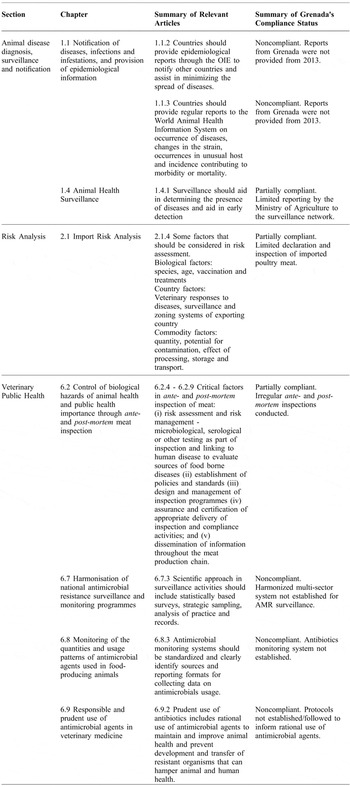
A summary of Grenada's compliance with selected guidelines of the OIE's Animal Terrestrial Animal Health Code, 2016, in the use of antimicrobials in poultry production is provided in Table 1 . Grenada is shown to be non- or partially compliant with guidelines on animal disease diagnosis, surveillance and notification, risk analysis and veterinary public health.
Grenada's compliance with OIE's Animal Terrestrial Animal Health Code, 2016, in the use of antimicrobials in poultry production.

Legislative and institutional arrangements
In relation to the use of antimicrobials in poultry production, the relevant government ministries are guided by the four Acts listed above as well as by the guidelines developed by the Grenada Bureau of Standards. Regulations for the Medical Products (Regulations) Act of 1995 were created however, although enforceable regulations for the other three Acts have not yet been developed. Although the Food and Drug Act of 1986 and Pharmacy Act of 1958 were revised in 2011, these Acts and the Guidelines produced by the Bureau of Standards do not address some developments in poultry food safety, such as the need to monitor drugs used, or the chemical and microbiological residues in meat and eggs. The Public Health Act of 1958 has never been revised and does not address recent developments in public health, including food safety.
The Veterinary and Livestock Unit in the Ministry of Agriculture (MOA) has primary oversight responsibilities of veterinary practices in Grenada. The Unit is presently staffed by 13 people including animal health assistants, livestock extension officers, and veterinarians. One officer is specially designated to provide technical and advisory services for poultry farmers. Veterinary services, such as advice on technical issues, conduction of inspections, animal treatment, assistance with the installation of equipment, and technology transfer and adaptation are provided to the poultry industry by eight other private veterinarians. At the time of this review, approximately 350 farmers were registered as members of the Grenada Poultry Association (GPA).
St. George's University's (SGU) Veterinary School of Medicine provides laboratory and ambulatory services to the local poultry industry. This academic institution conducts research on poultry on the island and has a strong ongoing collaboration with the MOA. Further, on an ongoing basis, the MOA makes reports on zoonoses to regional agencies such as the Caribbean Public Health Agency (CARPHA) and other international agencies.
Surveillance and reporting
Section 1 of the OIE's Terrestrial Code focuses on animal disease diagnosis, surveillance, and notification. In Grenada, rabies, bovine tuberculosis Mycobacterium bovis, avian influenza (HPAI), swine influenza, bovine spongiform encephalopathy (BSE), and leptospirosis are given priority in monitoring activities conducted by the MOA. These diseases are considered major threats to human and animal health, and outbreaks in other regions have placed significant burdens on healthcare systems. The prime responsibility for conducting epidemiologic surveys of zoonotic diseases in Grenada is placed within the MOH. The MOA, however, focuses solely on documenting cases of zoonotic diseases in animals.
There is a need for communication channels to be established between these two ministries, especially since each uses different approaches in the collecting, recording and disseminating of information. The MOH utilises a more formalised approach to surveillance, including the employment of surveillance officers, the use of an electronic-based data collection system, stipulated reporting periods for institutions under its jurisdiction, and provisions of periodic written reports to regional organisations. On the other hand, the MOA utilises a less formalised reporting system. Medical institutions sometimes voluntarily provide reports on cases and suspected cases of zoonotic diseases in humans to the MOA.
District officers are required to provide monthly reports on veterinary activities, however, this is not done on a regular basis, giving rise to gaps in the data and thus placing limits on the government's ability to predict and respond to any disease patterns and/or public health risks. Further, while the MOA has jurisdiction over veterinary health, there is no system in place stating that private veterinarians and institutions must report to the ministry. The MOA also does not collect information from poultry farmers on infections and use of drugs in a systematic manner. As a result, the value of the MOA's surveillance activities are significantly limited and it lacks the ability to provide up-to-date information on poultry production and related issues. This is in contradiction with Article 1.4.1 of the Terrestrial Code.
The MOA provides verbal reports on human cases and suspected cases of zoonosis to the National Surveillance and Response Team through its representative. These verbal reports, however, do not allow for any reliable epidemiological assessment. Thorough and comprehensive analysis of any report is currently not undertaken. As a result, the impact of zoonotic diseases on humans is largely being excluded from discussion where prevention strategies are being explored. The net result is that the National Surveillance and Response Team is limited in its ability to implement preventive measures and to comply with the OIE's recommendations found in Articles 1.1.2 and 1.1.3 of the Terrestrial Code.
Another major gap in the local surveillance system stems from the lack of research that is directly focused on zoonotic diseases etiology and trends in local animal and human populations. As a result, there is limited information to help guide the government in developing systems for the early detection and reporting of diseases and response for the poultry industry.
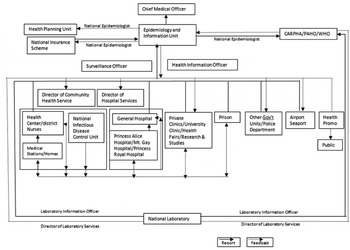
In 2012, the MOH developed the Grenada Integrated Surveillance Manual. This provides guidelines for the establishment of a national integrated protocol and implementation unit for surveillance of communicable and non-communicable diseases and demonstrates the country's compliance with regional and international surveillance systems. Explicitly, the manual states that communicable and non-communicable diseases data from health centres, hospitals, laboratories and private physicians should be reported at the district/parish level from where reports are sent to the national level (Grenada Ministry of Health, 2012).
The reporting network for health data and information as outlined in the Ministry of Health's Surveillance Manual is shown in Figure 1 . While this flowchart appears to adequately identify and include institutions concerned with human health in the surveillance network, those concerned with animal health are not specifically identified. Furthermore, it does not appear that consideration was given to include veterinary type laboratories, clinics and hospitals. This reflects the current lack of a strong communication system between the MOH and the MOA which ultimately impacts on the effectiveness of national surveillance.
Grenada health data and information flow.
Source: Grenada Integrated Surveillance Manual, October 2012

The MOH submits reports to the Caribbean Public Health Agency (CARPHA) which, in turn, reports to the WHO and other international agencies. The limited inclusion, however, of the MOA in the national surveillance network affects the quality of information provided to regional and international organisations which in turn limits decision maker's capacity to properly identify areas in need of interventions and how to facilitate effective responses.
The MOA receives daily briefings from the OIE on disease outbreaks and responses in specific countries and regions. This, in turn will provide similar information on Grenada to the OIE as stipulated in Articles 1.1.2 and 1.1.3 of the Terrestrial Code. Since 2013, however, the MOA has not been providing information to the OIE due to a lack of human resources, as well as other challenges connected with data collection and dissemination. This situation warrants attention to ensure that the roles of key stakeholders are clearly identified in the network and that each institution is enabled to actively contribute to surveillance at various levels.
Risks associated with importation of poultry meat products
Section 2 of the Terrestrial Code focuses on risk assessment related to importation of animal and animal products. The OIE outlines four steps for conducting risk assessments as cited in Chapter 2, Article 2.1.4, of the Terrestrial Code: (i) entry assessment, (ii) exposure assessment, (iii) consequence assessment, and (iv) risk estimation. The Terrestrial Code identifies entry assessment as the first step in determining the possibility of importing pathological agents through animal and animal products into a country which would then trigger further assessments.
The MOA reported that Grenada imports approximately 1.2 million pounds of poultry meat each month from the USA, Brazil, Canada, and the United Kingdom (UK). The Grenada National Standard Specification for Whole Chicken (Eviscerated) and Chicken Parts define the commercial quality requirements for imported and locally produced poultry meat. The Standard includes guidelines on requirements for processing plants, grading characteristics, refrigeration, marking and packaging, however, specific indicators or thresholds for pathological and microbiological fitness of poultry meats for consumption are not specified.
The MOH has responsibility for the inspection of meats at ports of entry. Routine inspection is usually limited to organoleptic observations and further tests are only required when there is an enquiry into doubtful quality of the meat, or when it originates from a country where a notifiable animal disease is present. While exporters are required to declare use of antibiotics and other treatments in live animals exported to Grenada, there are no established guidelines of allowable levels of antibiotic residues or reference to antimicrobials used in imported meats. For the most part, current entry assessment is based on a declaration from the exporting country, indicating the country of origin of the meat, its status in relation to the presence of notifiable animal diseases, and vaccinations administered against these diseases. Grenada does not require exporters to declare information about ‘other’ diseases, treatments and testing which are also important biological factors, and other commodity factors recommended by the OIE for consideration in importation.
Ante- and post-mortem meat inspection
Section 6 of the Terrestrial Code focuses on veterinary public health and the importance of veterinary services in the management of events in the food chain. Grenada produces approximately 130,000 pounds of poultry meat and 24,000 trays of eggs each month. While local industry is able to meet the demand for eggs for most of the year, poultry meat is imported to supplement limited local supply levels. Local studies have found evidence of antimicrobial resistant organisms in chicken eggs and meat from farms in Grenada (Eid et al., Reference EID, NASEF and ERFAN2015; Stone et al., Reference STONE, DAVIS, BAKER, BESSER, ROOPNARINE and SHARMA2013; Tambur et al., Reference TAMBUR, MILJKOVIĆ-SELIMOVIĆ, RADAKOVIĆ, KULIŠIĆ and MARKOVIĆ2013). These organisms can be transferred to humans through consumption.
The MOA has responsibility for conducting ante-mortem evaluations and issuing certificates declaring that an animal is fit for food. These evaluations, which are generally limited to the observation of injuries, pregnancy, etc., are not conducted regularly owing to the small number of staff that is available to provide the service. Consequently, the MOA cannot consistently identify and debar unfit meat from sale in local markets. Similarly, the MOH has limited human resources to conduct post-mortem inspection of meat, as well as microbiological, serological or other testing, as recommended in the Terrestrial Code. The irregularity of inspections can result in missing potential public health hazards associated with the consumption of resistant antimicrobials in food. Poultry farmers and their household members, in particular, are at high risk of contracting resistant organisms through contact with infected animals and contaminated meat.
The National Standards Code of Hygienic Practice for Poultry Processing of 1999, developed by the Grenada Bureau of Standards, is generally consistent with recommendations by the OIE for safe animal food production. This document contains information on environmental hygiene, plant facilities and operation requirements, hygienic operating requirements, packaging and end-product specification. In relation to pest and disease control, the National Standards Code states that qualified persons from the MOA and the MOH should recommend and supervise physical, biological or chemical treatments based on their understanding of potential hazards, including toxic residues (Grenada Bureau of Standards, 1999). Nonetheless, several challenges confront the MOH and the MOA in relation to implementation of this guideline. These have negative implications for Grenada's compliance with Article 6.2.4 of the Terrestrial Code. Firstly, in addition to the lack of regulations, there are insufficient personnel to administer and supervise pest and disease control measures. Secondly, guidelines on use of antimicrobials are not made available for poultry farmers and data from the survey of poultry producers suggests that their level of knowledge about the subject is very low. Thirdly, while the National Standards Code cites that meats should not contain antibiotic residues in end products, a systematic approach has not been taken to inspect and monitor use of drugs and residues in poultry meat. These challenges reflect gaps that must be addressed to ensure food safety and security.
Procurement and use of antimicrobials
The OIE's Terrestrial Code, Article 6.7.3, recommends that a scientific approach be taken in the surveillance of antimicrobials use. Article 6.9 also recommends the prudent use of antimicrobials in veterinary practice. Several studies have been conducted in Grenada to determine prevalence of antimicrobial resistant organisms in chicken and to assess their correlation with the use of antibiotics (Stone et al., Reference STONE, DAVIS, BAKER, BESSER, ROOPNARINE and SHARMA2013; Tambur et al., Reference TAMBUR, MILJKOVIĆ-SELIMOVIĆ, RADAKOVIĆ, KULIŠIĆ and MARKOVIĆ2013; Amadi et al., Reference AMADI, WATSON and ONYEGBULE2015; Eid et al., Reference EID, NASEF and ERFAN2015). The findings from these studies drew attention for the urgent need for resources to be allocated to facilitate implementation of the recommendations in Article 6.9 in the Terrestrial Code related to the prudent use of antimicrobials. Training activities have not been conducted by the MOA for established and new poultry farmers since 2013. The lack of training activities may have negative implications for poultry farmers’ knowledge about safe use of antimicrobials.
The non-regulated procurement and use of antimicrobials in veterinary practices continue to be major challenge. While the sale and distribution of antimicrobials for human use are better managed and monitored, regulations and guidelines do not exist to guide poultry farmers’ use of antimicrobials. This is contrary to Article 6.9.2 of the Terrestrial Code.
Chlortetracycline (CTC), norfloxacin and oxytetracycline plus (OTC Plus) with oxytetracycline, vitamins and other additives, are all sold as over-the-counter drugs. Sales staff dispenses antimicrobials based on familiarity with the purchaser or the purchaser's history of purchasing the product, rather than having a prescription presented from a veterinarian.
The Pharmacy Act stipulates that veterinary drugs should be prescribed by a veterinary practitioner, verbally or in writing, and dispensed by a pharmacist (‘Revised Edition Pharmacy Act of 1958’, 2011). The Pharmacy Act further states that a veterinary practitioner can, in an emergency, dispense veterinary drugs, but must report this within 48 hours to the pharmacy council. The Food and Drugs Act, Section 26 (f), and the Pharmacy Act, Section 23 (2) (3) states that records of all drugs sold should be maintained for inspection by an inspector (‘Revised Edition Food and Drugs Act of 1986’, 2011; ‘Revised Edition Pharmacy Act of 1958’, 2011). These guidelines are currently not being adhered to in the dispensing of drugs for veterinary use in Grenada which is contrary to the OIE's Animal Terrestrial Animal Health Code.
The Pharmacy Act, Section 7 (1), states that only registered persons should engage in the practice of pharmacy (Revised Edition Pharmacy Act of 1958, 2011). Irregularities, however, currently exist in the licensing of premises for the sale of drugs. The Pharmacy Act stipulates that a Registrar is the Chief Pharmacist and this person is responsible for inspection of premises, importing agencies, pharmacies, retail outlets, wholesalers, hospital dispensaries, other distributors, and the granting of licenses. Although veterinary drugs are sold at various outlets, the Pharmacy Council does not make provision for inspection of these premises.
The Medical Products Regulation Act, Part I Section 2, stipulates that a medicinal product is any medicine used by humans or in food producing animals in its finished dosage form or as a starting material for use in dosage form. Part II, Section 14 (1) of the Act further states that medicinal products should not be imported or manufactured without a license (Revised Edition Medical Products (Regulations) Act of 1995, 2011). Contrary to the Act, prescription drugs are imported by farmers without license and documentation is not maintained for stated purposes.
New guidelines have been drafted by the MOH for pharmaceutical practices, however, these guidelines do not appear to deal with drug procurement and use for veterinary practices. Hence, there is a need for specific guidelines to be developed which specifically address practices in the poultry industry in Grenada. Reviews of the utilisation of drugs for humans are conducted about every one to two years by the MOH in collaboration with the Organisation of Eastern Caribbean States (OECS) pharmaceutical procurement Services (PPS) to assess antibiotics in blood samples of chronic disease patients and patients in hospitals and geriatric care. The results and recommendations of these reviews are then presented to district doctors for consideration on future follow-up treatments. This approach taken by the MOH to monitor human drug utilisation can be a very useful approach that the MOA can adopt with veterinary practices which ultimately can lead to an improvement in Grenada's compliance with the OIE's recommendations for drug use and monitoring.
Conclusions and recommendations
This is the first major review of the poultry industry that examines its compliance with OIE guidelines. It should be noted that only selected OIE guidelines were included in this review and that there is need for a broader review to be undertaken to determine Grenada's compliance with the other OIE guidelines. The OIE guidelines that were selected, however, are the most applicable to the local poultry industry and the importation of poultry meat and eggs into the island.
Another limitation of this review was that it did not include a comprehensive survey of poultry farmers’ practices, especially those related to the area of antibiotic procurement and use. The findings of this review are therefore reflective of findings based on a review of local legislative and institutional documents, coupled with interviews of several key informants. A follow-up study of poultry farmers is therefore recommended to capture actual levels of compliance or noncompliance of this component of the food industry to OIE guidelines.
This review has found that Grenada currently lacks an adequately rigorous system to monitor drug use and antimicrobial resistance within the context of veterinary practices. Overall, there are many gaps in Grenada's systems for documenting procurement, storage, distribution and sale of veterinary drugs, including antibiotics and many practices in the country are inconsistent with guidelines of the OIE which promotes antibiotic stewardship.
Several deficiencies are apparent in the current surveillance system due to a lack of clarity of which governmental ministry does what, and how to best share and combine collected information, a lack of adequate tools for recording and reporting findings, and limitations in human and other resources. The absence of a proper communication structure for disease notification impedes detection and intervention efforts targeted at comprehensively addressing any problems that may be related to antibiotic use and abuse in the poultry industry. This, in turn, negatively affects the country's ability to report to the OIE and other organisations that conduct disease surveillance.
With the continuing rise of many zoonotic diseases, there is need for a more rigorous system to monitor imported meats into the country. Facilities need to be made available for testing and validating the declaration of the importing company and thus ensuring that incoming meats are fit for human consumption.
In its report on combating antimicrobial resistance in the Caribbean, CARPHA highlighted weaknesses in several of its member countries and made recommendations on how to strengthen epidemiological surveillance systems (Caribbean Public Health Agency, 2014). As a member country, Grenada should seek to access technical resources that reside in this regional institution to build institutional capacity, recognising that improvement in the surveillance system will also place Grenada in a more strategic position to report to other monitoring agencies such as the OIE. Additionally, a multi-level ongoing education and sensitisation program must also be undertaken to heighten sensitisation about veterinary public health and its critical linkages with human health.
This review has clearly established the need to strengthen existing legislation and guidelines to ensure that the gaps identified in this review are adequately addressed. As one example of a guideline that needs updating, the poultry guidelines developed by the Grenada Bureau of Standards currently does not specifically address the proper usage of antibiotics. Further, any new legislation or guidelines should allow for the inclusion of controlling and monitoring AMR measures that include the wider Caribbean region. Owing to their proximity, extensive trading and travel between the islands, it is imperative that measures be taken not only at the local level but also at the regional level to properly address AMR. Given that most Caribbean countries are small island, developing states (SIDS), these countries have limited resources to combat AMR and therefore emphasis should be placed on prevention. Finally, within the context of globalisation, this review has provided Grenada with an opportunity to play a leading role in soliciting cooperative action to address AMR using an evidenced-based approach with the Caribbean region.