Introduction
To what extent are partisan divisions in America hardening under Trump? There is an ongoing debate about partisan polarization going back to Converse (1964) and revitalized most recently by Fiorina, Abrams, and Pope (Reference Fiorina, Abrams and Pope2005), McCarty, Poole, and Rosenthal (Reference McCarty, Poole and Rosenthal2016), Hetherington and Weiler (Reference Hetherington and Weiler2018), and Mason (Reference Mason2018) among others.Footnote 1 We contribute to this discussion using evidence from recent behavioral experiments. These tools have become increasingly common and useful for measuring “other-regarding preferences” across a range of contexts and social identities, but have been surprisingly underutilized to understand political partisanship, either in the United States or beyond (Iyengar et al. Reference Iyengar, Lelkes, Levendusky, Malhotra and Westwood2019). Our research builds upon previous work by Fowler and Kam (Reference Fowler and Kam2007), Iyengar and Westwood (Reference Iyengar and Westwood2015), and Carlin and Love (Reference Carlin and Love2013, Reference Carlin and Love2018) among others, by expanding the empirical record into the Trump era. We offer further empirical evidence of growing polarization across partisan as well as ideological lines.
We conduct our study using a nationally representative sample of Americans from an online survey in May 2019. We investigate how individuals respond to party identification treatments in classic behavioral experiments related to altruism, trust, and public good contribution. Our research shows that individuals with partisan affiliations display stronger affective polarization than unaffiliated Independents. Partisans are more altruistic toward and trusting of co-partisans in dictator and trust games and more willing to contribute to a co-partisan majority public good. Their behavior verges on ethnic cleavages we have observed in conflict-ridden societies. However, we also find that inter-group contact may help by increasing trust and reducing social distance across partisan divides. These observations provide support for a more expansive experimental research agenda on partisan polarization in the United States.
Theory and hypotheses
Through the lens of human evolutionary biology, tribalism (i.e. parochial bias favoring in-groups over out-groups) is often seen as a mechanism to enhance group fitness and prospects for survival in the face of threats (Choi and Bowles Reference Choi and Bowles2007). Social identity theory also provides a psychological framework for understanding how tribalism can result from individuals seeking out social identities (Tajfel Reference Tajfel2010). However, while in-group bonding may increase social cohesion, it can also lead to conflict with out-groups (Balliet, Wu, and De Dreu Reference Balliet, Wu and De Dreu2014).
In American politics, scholars are increasingly examining how manifestations of tribalism, referred to in the literature as affective polarization, are expressed through partisan political identities (Iyengar et al. Reference Iyengar, Lelkes, Levendusky, Malhotra and Westwood2019). Some cross-national evidence suggests that psychological attachment to partisan identity could be even more salient than race, religion, or ethnicity (Westwood et al. Reference Westwood, Iyengar, Walgrave, Leonisio, Miller and Strijbis2018), raising concerns about rising affective polarization. Researchers are also examining possible convergence between partisan identity and ideological orientation (Hetherington and Weiler Reference Hetherington and Weiler2018; Lelkes Reference Lelkes2019). If so, then individuals with stronger liberal and conservative ideological convictions should also display greater affective polarization along party lines than ideological moderates. Here, we investigate the following hypotheses:
H1: Partisans will display increased affective polarization along party lines compared to nonpartisans.
H2: Liberals and conservatives will display increased affective polarization compared to political moderates.
Finally, if tribal divisions are manifest, we consider mechanisms for overcoming them. Most research on affective polarization emphasizes the activation of superordinate identities to alleviate partisan bias (Carlin and Love Reference Carlin and Love2018; Levendusky Reference Levendusky2018). We consider an alternative mechanism based on inter-group contact, which has been shown effective at reducing tensions in other contexts (Pettigrew and Tropp Reference Pettigrew and Tropp2013), but whose effects on partisanship are unclear. We explore how inter-group contact could moderate the effects of affective polarization by building empathy, trust, and reducing social distance. We consider the following hypothesis:
H3: Contact with opposing partisans decreases affective polarization by building empathy, trust, and reducing social distance with opposing partisans.
Research design
To test our hypotheses, we measure affective polarization using behavioral experiments. We build off earlier work by Fowler and Kam (Reference Fowler and Kam2007), Iyengar and Westwood (Reference Iyengar and Westwood2015), and Carlin and Love (Reference Carlin and Love2013, Reference Carlin and Love2018), extending our analysis into the Trump era. Our key dependent variables are other-regarding preferences (altruism, fairness), inter-personal trust, and public good contribution. Collectively, these instruments capture aspects of trust, norms, and networks: the lubricants of cooperation vital to social capital (Putnam Reference Putnam2001). We introduce a wide range of instruments to assess the sensitivity of our results to design features.
To measure affective polarization in other-regarding preferences, we rely on a series of dictator games, where subjects allocate money between themselves and other recipients (Engel Reference Engel2011). In each dictator game, the recipient is randomly identified as either a Democrat or Republican for a between-subject design. Affective polarization is measured by how subjects behave toward recipients of different party identification than their own. The first dictator game measures empathy toward others in the form of altruism. Subjects decide how to divide a hypothetical $10 between themselves and another recipient. We also include a “reverse” dictator game where the subject plays the role of the recipient. Subjects predict how much they would receive from someone in a dictator game, randomly assigned to be Democrat or Republican. We then introduce a third dictator game where the subject and recipient each begin with $5 and the subject chooses whether to accept the status quo, send part of their endowment to the other recipient, or take money from the recipient’s endowment. This game varies from the previous one by introducing a punitive incentive along with a rewarding incentive, capturing underlying malevolence/benevolence toward others. Finally, we introduce a “third-party” dictator game, where subjects decide how to allocate a sum of $10 between a Democrat and a Republican for a within-subject design. Subjects also decide whether to reject or accept different hypothetical allocations of $10 between a Democratic and Republican recipient. This design measures affective polarization in resource allocation when self-interest is removed.
To measure trust and trustworthiness, we employ a hypothetical trust game (Johnson and Mislin Reference Johnson and Mislin2011). Subjects decide how to allocate $5 between themselves and another recipient, randomly identified as Democrat or Republican. Whatever is sent to the recipient is tripled in value, and then the recipient decides how much, if any, of the tripled sum to return to the subject. Subjects send and then predict how much they will receive back from a random Democrat or Republican recipient. Sending money signals trust, and predictions about returning money reflects beliefs about trustworthiness.
Finally, we examine group-effects of partisanship by measuring public good contribution (Zelmer Reference Zelmer2003). Subjects decide how to allocate $5 to a hypothetical public good with 9 other individuals. Whatever they contribute to the public good is doubled in value (incentivizing contributions) and divided evenly among recipients. In our first public good experiment, the subject is placed in a group randomized to majority Democrats or Republicans (7 out of 10). The second public good experiment is the same, except that subjects begin with $5 already allocated to the public good. They must decide whether to contribute additional funds (up to $5) or divest money from the group account (up to $5). The two experiments capture willingness to cooperate for mutually beneficial gains based on the partisan composition of the group.
If H1 is correct, partisans should give more money to co-partisans in the dictator and trust games and contribute more to public goods with co-partisan majorities.Footnote 2
To evaluate H2, we use a survey instrument measuring each subject’s ideological leanings, ranging from very conservative to very liberal on a five-point scale. If ideology and partisanship are converging, we anticipate that ideology will predict partisan division consistent with partisanship, potentially reinforcing partisan bias.
Finally, to test H3, we use self-reported measures of contact with people who are Democrats and Republicans, where response options range from never to often. To understand the moderating effects of contact on affective polarization, we examine how contact could build empathy and trust while reducing social distance toward out-groups. The empathy and trust-building effects of contact should be captured by our dictator and trust games as well as attitudinal measures of trust. We measure the distance-reducing effect of contact based on feelings of closeness to Democrats and Republicans reported in the survey. Our analyses control for sociological foundations of party affiliation related to gender, race, income, and other demographic covariates within treatment, although randomization should prevent confounding on observables between treatments. We test hypotheses related to partisanship (H1), ideology (H2), and inter-group contact (H3) on propensity for affective polarization using the following regression models:
-
1) Υ it = β 0 + β 1 PID it + β 2 X it + ϵ it ,
-
2) Υ it = β 0 + β 1 IDEO it + β 2 X it + ϵ it ,
-
3) Υ it = β 0 + β 1 PID it + β 2 IDEO it + β 3 CONTACT it + β 3 X it + ϵ it ,
where Υ it represents behavioral measures of altruism, trust, and public good contribution for an individual (i) in PID treatment (t). Subject PID, IDEO, and CONTACT are the key explanatory variables of interest for testing H1, H2, and H3, while X it is a vector of extended within-treatment controls. We now turn to details of sampling and data collection.
Sampling and data collection
We employ a nationally representative online sample of 1,210 participants who completed the study between May 24 and 28, 2019. Data were collected by the survey research firm, Dynata. Subjects participated in an online survey and behavioral experiments where they allocated money to others based on randomized partisan identification. Kolmogorov–Smirnov balance tests indicate the randomization successfully balanced subjects across treatment groups for each experiment. In the subsequent analysis, we report the effects of partisanship, ideology, and contact on behavioral decision-making. We provide further discussion of survey methodology, demographic summary statistics, and balance tables in an online supplementary appendix (see also Whitt et al. Reference Whitt, Yanus, McDonald, Graeber, Setzler, Ballingrud and Kifer2020 for replication data).
Results
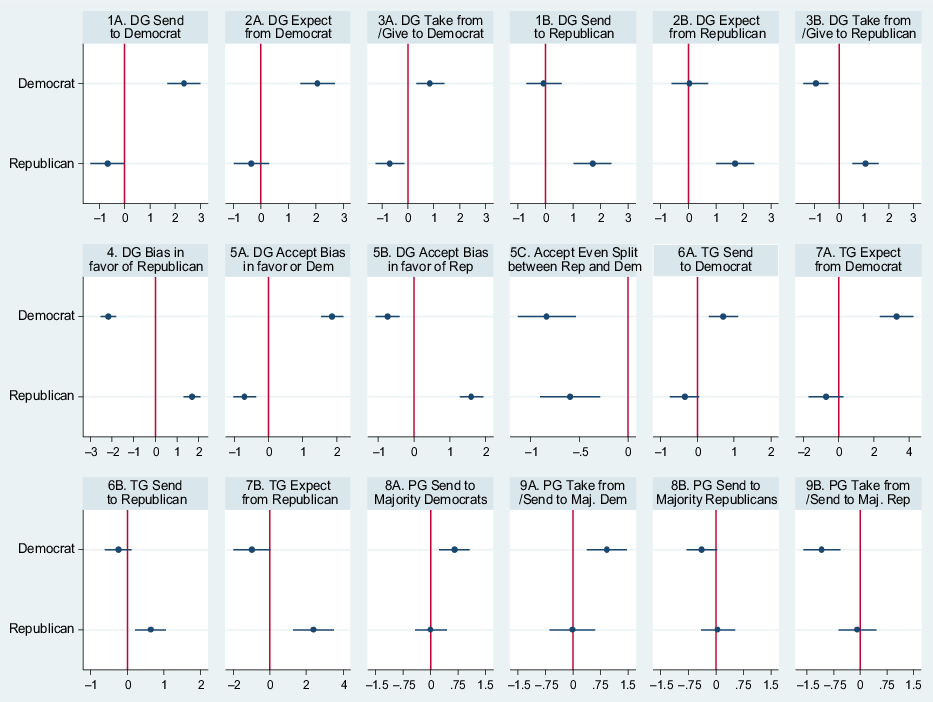
To test our hypotheses, we turn to regression analysis of behavior in our dictator, trust, and public good experiments. Figure 1 provides results from Ordinary Least Squares (OLS) and Logit models using regression model (1). Each regression plots the estimated effect of a subject’s partisan affiliation (Democrat or Republican) on experimental behavior for each treatment separately. Nonpartisan Independents are the comparison group, represented by the line at x = 0. Our sample consists of 36.7% Democrats, 29.7% Republicans, and 22.6% Independents.Footnote 4
Effects of Partisanship on Experimental Behavior.Footnote 3

First, we report results from dictator games 1–5, which are labeled “DG” in Figure 1. Consistent with H1, we find that partisans display stronger affective polarization (favoring their in-group over out-groups) than nonpartisans with varying degrees of magnitude. Democrats and Republicans send more money to co-partisans than opposing partisans (DG 1), expect to receive more money from co-partisans (DG 2) and are more willing to give than take money from co-partisans (DG 3). When self-interest is removed from the decision (DG 4), Democrats and Republicans are more likely than Independents to divide money in favor of co-partisans over opposing partisans. In DG 5, subjects make a series of 11 choices about how to divide $10 between a Democrat and a Republican over varying levels of inequality as well as an even 50/50 split. DG 5A–B indicates that Democrats and Republicans are more likely to choose unequal divisions in favor of their co-partisan compared to Independents. DG 5C shows that nonpartisans, in contrast, are more likely to choose an egalitarian allocation of 50/50.
Next, we report the results of the trust and public goods experiments labeled TG and PG as shown in Figure 1. As with the dictator games, we find that Democrats and Republicans, in comparison to Independents, are more likely to trust and expect trustworthiness from a co-partisan than an opposing partisan (TG 6, 7). In the public good experiment, Democrats are less willing to invest in a public good when the group is majority Republican (PG 8A, 9A). Republicans, in contrast, appear less concerned about the partisan composition of the group when investing in public goods, and their behavior mirrors Independents more than Democrats (PG 8B, 9B). Overall, we find strong support for H1 in the dictator and trust games, and mixed support in public good contribution.
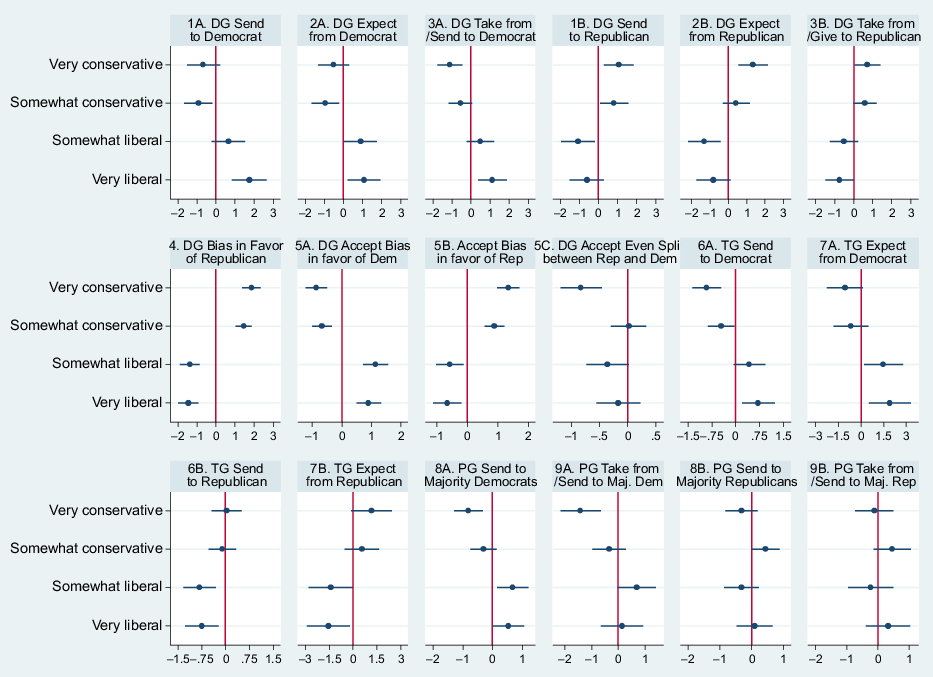
Next, we consider whether ideology is converging with partisanship and reinforcing affective polarization as predicted by H2. Figure 2 reports result from regression model (2), where PID is replaced with an ideological instrument (IDEO) ranging from 1 = very conservative, 2 = somewhat conservative, 3 = moderate, 4 = somewhat liberal, and 5 = very liberal. Regressing the IDEO variable on experimental behavior, Figure 2 plots the predicted values for conservatives and liberals relative to moderates who are represented at x = 0. Consistent with H2, we find that people who identify as liberals and conservatives send more money to co-partisans than opposing partisans in the dictator games (DG 1,3), expect more money from co-partisans (DG 2), and show more partisan bias in the allocation of money than ideological moderates (DG 4–5). Similar effects are observed in the trust game (TG 6–7), especially among ideological liberals. Finally, there is a stronger ideological effect on public good contributions involving groups of majority Democrats (PG 8A, 9A) than majority Republicans (PG 8B, 9B). Overall, we find strong support for H2 in Dictator and Trust games and mixed support in public good contributions.
Effects of Ideology on Experimental Behavior.

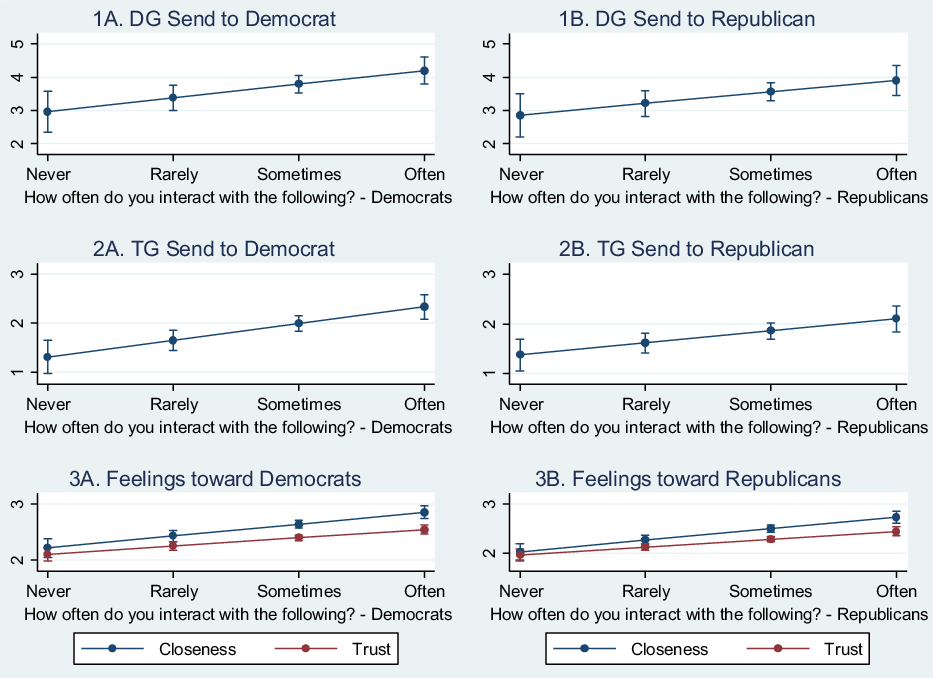
Our analysis so far has revealed affective polarization in how partisans treat one another compared to nonpartisans. We conclude by exploring how inter-group contact might serve as a mechanism for reducing partisan bias. In Figure 3, we focus on results in the first dictator and trust game using regression model (3). In support of H3, even when controlling for party ID and ideology, we find a positive effect of contact on altruistic giving to partisan Democrats and Republicans (1A, 1B) and trust (2A, 2B). We also find positive effects of contact using alternative attitudinal measures of social distance (closeness to Democrats, Republicans) and trust (3A, 3B), which shows how contact could work to build empathy, trust, and reduce social distance in attitudes and behavior.Footnote 5
Inter-Group Contact and Partisan Division.

Discussion
We find clear evidence of affective polarization in experimental behavior. Partisans are more favorable to in-group over opposing partisans in comparison to nonpartisans and ideological moderates. What is missing, however, is a sense of context. Next, we compare our results to past behavioral studies of social and partisan division.
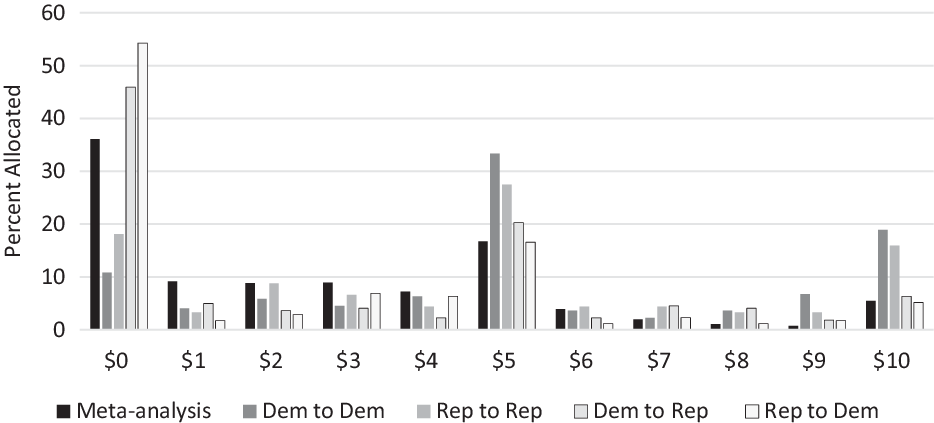
In a meta-analysis of dictator behavior, Engel (Reference Engel2011) reports that dictators give an average of 28.3% of the allotment to the recipient, 36% give nothing, 16.7% give half, and 5.4% give everything. Figure 4 plots the distribution of responses in our dictator experiment by party ID against the distribution from the Engel (Reference Engel2011) meta-analysis. In our dictator games, subjects tend to be less selfish, more egalitarian, and more hyper-altruistic toward co-partisans and more selfish toward opposing partisans in comparison to average Engel (Reference Engel2011) dictator distributions. Our results also appear stronger than the small-to-medium-size in-group effects reported in the second meta-analysis by Balliet et al. (Reference Balliet, Wu and De Dreu2014), but neither meta-analysis involved studies with partisan treatments.
Dictator Giving, Meta-Analysis versus US Partisanship.

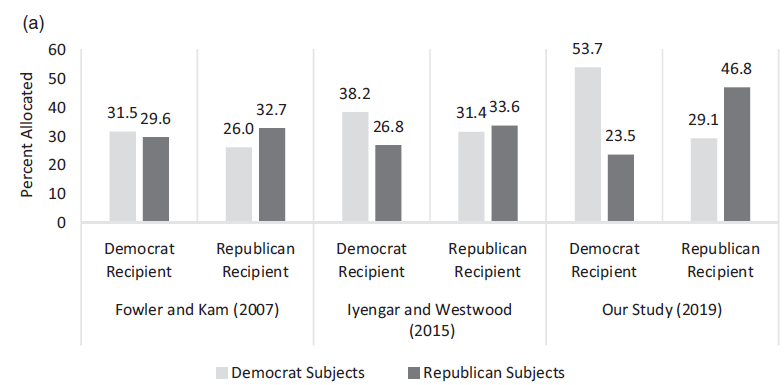
To examine dictator giving with explicit partisan treatments, we compare our results to earlier work by Fowler and Kam (Reference Fowler and Kam2007) and Iyengar and Westwood (Reference Iyengar and Westwood2015).Footnote 6 Figure 5a reports partisan treatment effects from these studies alongside our own data. Compared to these earlier studies, we find greater partisan bias in the Trump era than previously.
Comparative US Partisan Dictator Behavior.

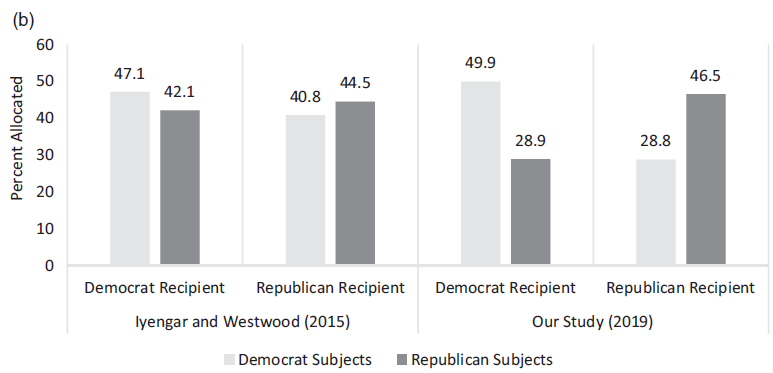
We observe similar effects with trust games (Figure 5b). A meta-analysis of trust games by Johnson and Mislin (Reference Johnson and Mislin2011) indicates that subjects typically send and return half (50%) of their endowments. Our study observes this for co-partisans, but not out-group counterparts. Partisan bias appears stronger in our trust games than those reported by Iyengar and Westwood (Reference Iyengar and Westwood2015) as well as Carlin and Love (Reference Carlin and Love2013, Reference Carlin and Love2018, see SI). We reach similar conclusions comparing public good behavior with results from a meta-analysis by Zelmer (Reference Zelmer2003), especially among Democrats. In our study, Republicans are less sensitive to group partisan dynamics than Democrats, and these asymmetries should be explored further in future research.
Comparative US Partisan Trust Behavior.

Finally, most data from experimental meta-analyses consisted of studies where individuals are not inherently in conflict with one another. Comparisons to earlier work by Fowler and Kam (Reference Fowler and Kam2007) and Iyengar and Westwood (Reference Iyengar and Westwood2015) suggest that partisan relationships are becoming more contentious. Do increasing experimental biases suggest that Americans are becoming more conflict-prone? It may be fruitful to compare our results to experimental behavior among groups in real conflict with one another, as reported by others as well as our own experimental data.
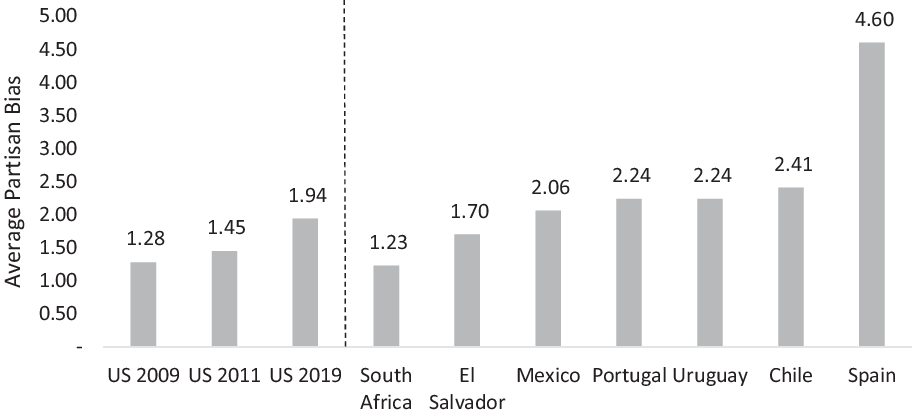
First, a meta-analysis by Bauer et al. (Reference Bauer, Blattman, Chytilová, Henrich, Miguel and Mitts2016) finds a significant effect of conflict on in-group giving relative to out-group giving in the dictator game. Conflict makes people more parochially biased, often along ethnic or partisan lines. No studies to our knowledge have employed behavioral experiments within partisan or ideological treatments in active conflict. However, when we compare average partisan bias from our trust data to cross-national work by Carlin and Love (Reference Carlin and Love2013, Reference Carlin and Love2018), we find US bias approaching cases having experienced the major partisan conflict or social unrest (Figure 6).Footnote 8
Comparative Partisan Trust Gaps.Footnote 7

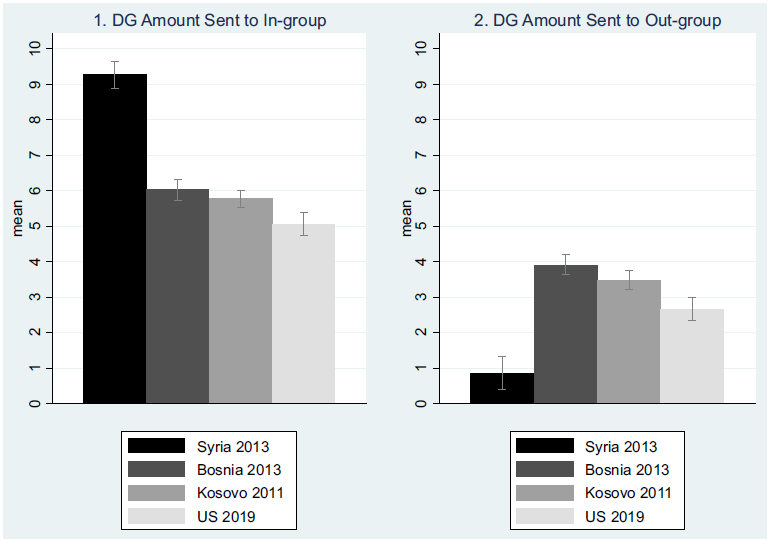
We also find that partisan bias mirrors ethnic and sectarian parochialism from our own previous work in conflict environments. Figure 7 reports mean in-group and out-group dictator giving based on prior research in war-torn Syria and postwar Bosnia and Kosovo using comparable designs. In each case, the dictator allocation was between ethnic and sectarian out-groups (Alawites vs. Sunnis in Syria, Serbs vs. Albanians in Kosovo, and Serbs, Croats, and Bosniaks in Bosnia). While partisan bias in the United States is not nearly as severe as sectarian bias in the ongoing Syrian civil war, it does approach levels of ethnic parochialism in Bosnia and Kosovo, suggesting how partisan identities may be “balkanizing” in the United States. Our findings speak to Westwood et al. (Reference Westwood, Iyengar, Walgrave, Leonisio, Miller and Strijbis2018) on partisanship as a powerful social identity marker relative to race and ethnicity. At the same time, we urge caution on inferences between partisanship and ethnic bias, because ethnic markers may be more fixed, enduring, and exclusionary than partisanship, and the United States is presently maintaining relative order and stability in the face of rising affective polarization. The comparison is nevertheless a cause for concern.
US Partisan Bias Compared to Parochialism in Conflict Environments.

Conclusion
Research on prejudice and inter-group conflict has traditionally focused on paradigms related to race or ethnicity. In the United States, scholars do not typically observe widespread, overt ethnic or racial bias in the survey and behavioral research, which may be due to self-censoring of implicit biases out of social desirability. With respect to partisanship, in contrast, Americans do not seem to have a comparable filter. Our research shows that partisans are quite willing to express in-group favoritism and out-group aversions in experimental behavior. The tribalization of partisan identities is troubling, as it could have a detrimental impact on building blocks for social capital: norms, networks, and trust. On one hand, our research also shows how inter-group contact may offer a way to overcome partisan divisions. Exposure to out-groups could reduce affective polarization and potentially also help cultivate superordinate identities that transcend partisanship (Levendusky Reference Levendusky2018). However, if Americans are increasingly sorting themselves along partisan lines, such contact may be too limited to prevent tribalism from becoming an enduring fixture of American political life (Hetherington and Weiler Reference Hetherington and Weiler2018). It is too early to tell if increasing affective polarization will have detrimental consequences for democracy (Levitsky and Ziblatt Reference Levitsky and Ziblatt2018) or is only a short-term phenomenon that will eventually recalibrate to earlier more cooperative norms (Stimson Reference Stimson2018). But in the short term, our research underscores the need for more attention to the causes and consequences of affective polarization in America, and the utility of behavioral experimental methods to this broader research program.
Supplementary material
To view supplementary material for this article, please visit https://doi.org/10.1017/XPS.2020.29
Acknowledgments
We would like to thank High Point University for research development funding for this project and Frank Markowitz at Dynata for data collection. We also thank Adam Chamberlain, Nicholas Pyeatt, Tyler Steeleman as well as the anonymous reviewers at JEPS for their helpful comments. Any errors or omissions are our own.