The Classic Maya broke ceramic vessels apart and scattered them; they added exotic artifacts and burned everything before burying these ritual deposits in white marl. The palaces and temples, where the most elaborate versions of these events took place, were often intentionally damaged or torn down. This set of activities has been classified as a termination ritual. In analyzing ritual, Catherine Bell (Reference Bell1992:69–74) critiques how the categorization of practices as ritual creates the intellectual category that is then studied by itself. She promotes confronting the ritual act, asking “how ritual activities, in their doing, generate distinctions between what is or is not acceptable ritual” (80). As situational and strategic activities, rituals need to be understood in relation to other actions.
This perspective informs our study of deposits in a nonroyal residential group at the Classic Maya capital of Tamarindito, Department of Petén, Guatemala. Although some elements overlap with known termination rituals, others diverge. In this article, we discuss whether the deposit records a ritual and, in particular, a termination ritual. Previously, variations have been seen from a functional perspective. Here, the nonroyal context leads us to ask to what degree Classic Maya shared the sense of a termination ritual; that is, the underlying principle that generates and organizes ritual practices. We argue that this sense should not be assumed in a heterogeneous society whose members likely did not recognize themselves as Maya. Instead, we advance termination rituals as discursive processes that entangle practices, participants, and places.
Classic Maya Ritualization
Traditionally, rituals have been understood as material manifestations of religions and their associated beliefs, supernaturals, and myths. Scholars have challenged this understanding in recent decades (summarized in Fogelin Reference Fogelin2007; Swenson Reference Swenson2015). It is difficult if not impossible to differentiate rituals from other types of action (Douglas Reference Douglas1966; Leach Reference Leach1966; Moore and Myerhoff Reference Moore and Myerhoff1977). Practitioners often struggle to explain why they perform rituals: “what is clear and explicit about ritual is how to do it—rather than its meaning” (Lewis Reference Lewis1980:19). Correspondingly, theories of ritual have come to emphasize how ritualization transforms action (e.g., Bell Reference Bell1992:74; Humphrey and Laidlaw Reference Humphrey and Laidlaw1994:3; Lewis Reference Lewis1980:19–22).
In the past several decades, complex midden-like deposits at various Maya sites have been identified as the outcome of termination rituals (Stanton et al. Reference Stanton, Brown and Pagliaro2008; also Bradley Reference Bradley2005:57–64; Inomata and Webb Reference Inomata and Webb2003; LaMotta and Schiffer Reference LaMotta, Schiffer and Allison1999:24; Schiffer Reference Schiffer1985:29). Classic Maya termination rituals share burnt artifacts, intentionally damaged buildings, white marl covers, scattered pottery, rapidly deposited artifacts, dense artifact assemblages, and exotic artifacts (Stanton et al. Reference Stanton, Brown and Pagliaro2008:237–238). The most elaborate and publicly visible examples come from elite contexts at Aguateca, Altun Ha, Cerros, Piedras Negras, and Yaxuna (Figure 1). Comparable deposits, however, have been found in non-elite contexts as well (Garber et al. Reference Garber, Driver, Sullivan, Glassman and Mock1998; Guderjan and Hanratty Reference Guderjan, Hanratty, Iannone, Houk and Schwake2016; Houk Reference Houk, Iannone, Houk and Schwake2016; Lamoureux-St-Hilaire et al. Reference Lamoureux-St-Hilaire, Macrae, McCane, Parker and Iannone2015; Lucero Reference Lucero, Mills and Walker2008). These archaeological cases resonate with ethnohistorical and ethnological practices (e.g., Mock, ed. Reference Mock1998; Tozzer Reference Tozzer1941:151–152). Archaeological contexts, ethnohistorical sources, and ethnoarchaeological analogies suggest that Classic Maya termination rituals “killed” an object, structure, person, or place (Stanton et al. Reference Stanton, Brown and Pagliaro2008:235; also Mock Reference Mock and Mock1998:6–11). The people who performed them did so intentionally, but “the identity of a ritualized act does not depend, as is the case with normal action, on the agent's intention in acting” (Humphrey and Laidlaw Reference Humphrey and Laidlaw1994:89; emphasis in the original).
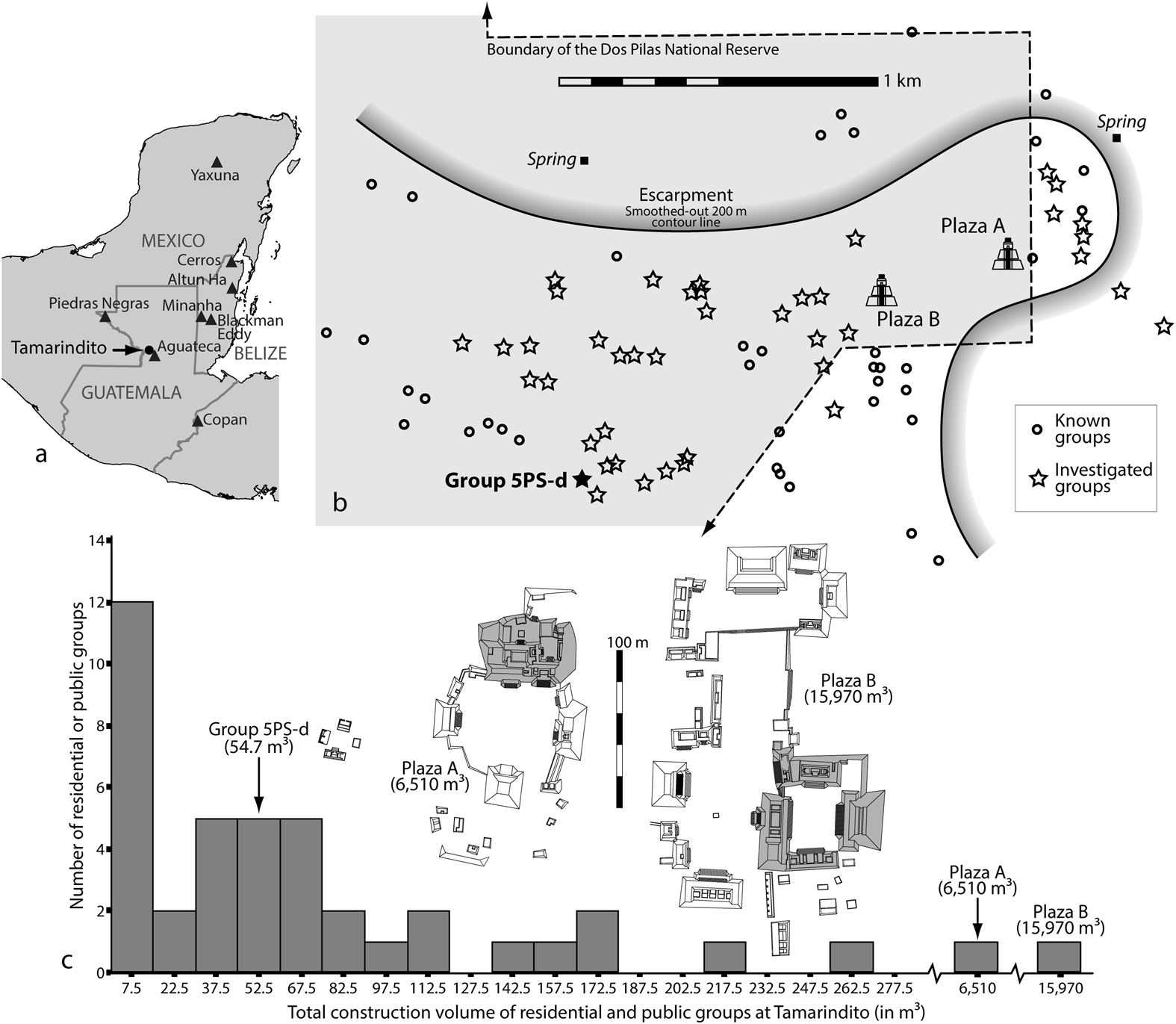
The royal capital of Tamarindito: (a) Map of the Maya Lowlands showing the site and selected sites with termination rituals; (b) site map showing the location of Group 5PS-d; (c) total construction volumes of investigated residential and public groups (note the discontinuous horizontal scale to accommodate Plaza A and B); maps of Group 5PS-d, Plaza A, and Plaza B are shown at the same scale to illustrate size differences; the royal palaces in Plaza A and B are grayed out. (Diagram and maps by Markus Eberl.)

Rituals require differentiating practices, which may take many forms, as shown by variations among termination ritual deposits. For example, ceramic sherds could not be refitted in termination ritual deposits in the palace at Aguateca; instead, at least one whistle fragment matches one found in a building elsewhere (Inomata et al. Reference Inomata, Triadan, Ponciano, Terry and Beaubien2001:297). These variations have been interpreted as different types of termination rituals (Lamoureux-St-Hilaire et al. Reference Lamoureux-St-Hilaire, Macrae, McCane, Parker and Iannone2015:553; Navarro-Farr et al. Reference Navarro-Farr, Freidel, Prera, Stanton and Magnoni2008:136, 142; Pagliaro et al. Reference Pagliaro, Garber, Stanton, Kathryn Brown and Stanton2003:75). Desecration rituals relate to the destruction of buildings, whereas reverential termination rituals target ancestors. These functional distinctions accept termination rituals as a preexisting category. Bell critiques this approach. Informed by practice theory, she calls attention to ritualization or the ways “in which certain social actions strategically distinguish themselves in relation to other actions” (Bell Reference Bell1992:74). Rituals are not universal, but rather contingent strategies of privileged differentiation.
Bell's definition implies culture-specific ways of ritualizing practices. For example, the Christian Eucharist differs from a regular meal (Reference Bell1992:90–91). Making this distinction requires knowledge about Western religion and customs. Labels like “Western” and “Classic Maya” suggest a shared cultural background. Nonetheless, scholars increasingly critique the assumption of homogeneous societies (for the Classic Maya, see Beyyette and LeCount Reference Beyyette and LeCount2017; Restall Reference Restall2004). In a heterogeneous society, individuals should not be assumed to act uniformly. This possibility is absent in Bell's depersonalized definition of ritualization. To address agency, we reformulate Bell's definition and ask how Classic Maya distinguished termination rituals strategically from other practices.
To differentiate strategically, people require a frame of reference. For example, bone splinters sometimes appear in Maya termination ritual deposits. From a classificatory perspective, the presence of bones—interpreted as the remains of ancestors—distinguishes desecration from reverential termination rituals. From a ritualization perspective, the question becomes why the Classic Maya handled bones with special consideration. Maya rulers attributed life essences to bones and sometimes wore the skulls of their predecessors (e.g., Bird Jaguar III of Yaxchilan on La Pasadita Panel 2; Houston et al. Reference Houston, Stuart and Taube2006; Novotny Reference Novotny2014; Scherer Reference Scherer2015:96). Conversely, they destroyed bones to annihilate their life essence. In AD 710, Naranjo king K'ahk’ Tiliw Chan Chaak conquered nearby Yaxha. He smashed the bones of Yax B'olon Chaak, an earlier ruler of Yaxha, and then scattered them on an island (Supplemental Figure 1a; cf. Houston Reference Houston1993:109; McAnany Reference McAnany and Houston1998:288–289). Not content to kill the living, K'ahk’ Tiliw Chan Chaak pulverized his enemy's past and basis for future rebuilding. At least for Classic Maya rulers, bones were culturally significant enough to differentiate practices.
In heterogeneous societies, members may not share the same practices, but they are aware of differences (Eberl Reference Eberl2014:327–329, Reference Eberl2017:162–169). Analysis of action “cannot be vested in the substantive intentions of a single, isolated actor, but rather can only be understood in the confluence of both first and third person views” (Smith Reference Smith2001:166; see also Eberl Reference Eberl2017:39–41). Ritualization implies a metadiscussion about the set of practices that practitioners regard as relevant. The white marl layers of termination rituals exemplify this point. In 1635, Martín Tovilla was among the first Europeans to observe the Manche in the southeastern Peten before they were conquered (these Ch'ol-speaking Maya descended from the Classic Maya; Robertson et al. Reference Robertson, Law and Haertel2010:4). He compares highland K'iche’ and lowland Manche mortuary practices:
When someone died, they buried him clothed and conducted the same rituals as the Manche people, meaning that they offered him something to eat on top of his tomb and that they did not tear down his house but whitewashed it completely and diligently painted it with some histories of his past. When a [K'iche’] king died, they whitewashed all roads and palaces on the inside and outside, and they painted them with new histories [Scholes and Adams Reference Scholes and Adams1960:222; translation by authors].
The Manche burial customs extended beyond the tomb to the renovation of the dead person's residence. The verb encalar, which we translate as “to whitewash,” refers both to “capping or covering something with lime” and to “whitening something with lime” (Real Academia Española Reference Española1963:2:426). The first meaning particularly resonates with the white marl caps observed in Classic Maya palaces and temples (Wagner Reference Wagner, Colas, Fort and Persson2006). The context of Tovilla's description makes it clear that by “someone” he means nobles and lords whose funerals occasioned an implicit discourse of proper and appropriate customs. Some practices like food offerings were widely shared, whereas others, such as the whitewashing of residences, were socially constricted.
The situatedness of practices makes cultural production an ongoing process, and ritualization requires a critical examination of synchronous and diachronous cultural continuities. Burnt artifacts are a common feature of termination ritual deposits. Classic Maya used fire on a daily basis for cooking, lighting, and other practices. They ritualized fire and associated artifacts such as torches and hearths (e.g., Grube Reference Grube, Colas, Delvendahl, Kuhnert and Schubart2000; Stuart Reference Stuart and Houston1998; Taube Reference Taube and Houston1998, Reference Taube, Carrasco, Jones and Sessions2000, Reference Taube, Bell, Canuto and Sharer2004a). Piedras Negras Ruler 4 died on November 28, 757, and was buried three days later (glyphs V4–V6 in Supplemental Figure 1b). One Tzolk'iin round later, or 260 days, torches were burned, presumably in or at the tomb (glyphs E7–F8 on Piedras Negras Stela 23). Twenty-four years after Ruler 4's death, his grave underwent el naah, or “house-censing” (glyphs V8–U10 in Supplemental Figure 1b). Comparable colonial and modern ceremonies involve fire and smoke (Stuart Reference Stuart and Houston1998:389–393). Ruler 4 was likely buried in Tomb 13 (Houston et al. Reference Houston, Escobedo, Forsyth, Hardin, Webster and Wright1998). Excavations show that Tomb 13 was reentered and its contents were burned (Houston et al. Reference Houston, Escobedo, Forsyth, Hardin, Webster and Wright1998:19). The discoloration pattern of the bones demonstrates that the firing occurred after the decay of soft tissues. The tomb reentry presumably corresponds to the house-censing mentioned on Panel 3. Maya elites employed the el naah and other fire rituals as powerful insignia of office (Fash et al. Reference Fash, Tokovinine, Fash, Fash and Luján2009; Grube Reference Grube, Colas, Delvendahl, Kuhnert and Schubart2000; Stuart Reference Stuart and Houston1998). Nevertheless, ethnohistorical and ethnological sources suggest a much wider use of fire rituals. In comparable ceremonies, a lit incense burner is placed in the entrance to a new building, and the smoke that enters signals its transformation into a home. Analogies like this help interpret material remains and reconstruct ancient practices, but they also imply continuity within the same culture and across time. Ritualization emphasizes what people do and thus requires asking whether all people act within the same cultural framework.
The Maya Capital of Tamarindito
One of the prominent natural features of the southwestern Maya Lowlands is the escarpment, up to 70 m high, that traverses the Petexbatun region in an inverted L shape (Figure 1). The site of Tamarindito occupies the spot where the escarpment turns and offers spectacular views toward the north and east. It was occupied from about 300 BC to AD 1300 and served as the capital of the Foliated Scroll dynasty during the Classic period. Often fragmentary hieroglyphic texts attest to at least 12 divine rulers between AD 472 and 764 (Gronemeyer Reference Gronemeyer2013:8–27; cf. Houston Reference Houston1993). They intermarried with the royal dynasty of nearby Dos Pilas and Aguateca and acknowledged them as overlords during the eighth century.
Architecture, burials, and hieroglyphic texts identify Plazas A and B as ceremonial centers and as homes of elites. Plaza A sits on a leveled hilltop at the steepest edge of the escarpment, whereas Plaza B is on the less prominent but more spacious horst upland. Several dozen residential groups are dispersed across the hilly upland. Only a few are found in the sometimes marshy lowlands. The escarpment serves as a natural boundary in the north and the east. In the west, residential groups line up along the escarpment and thin out toward the site of Arroyo de Piedra. The southernmost residential groups are at the transition from the hilly escarpment to the flat upland.
Archaeological investigations first took place in the 1990s as part of the Petexbatun Regional Archaeological Project (Chinchilla Reference Chinchilla, Valdés, Foias, Inomata, Escobedo and Demarest1993; Valdés Reference Valdés1997). They focused on Plazas A and B but also included nine residential groups near Plaza A. The first author initiated the Tamarindito Archaeological Project in 2009 and has directed with the third author seven field and laboratory seasons since then (Eberl and Vela González Reference Eberl and González2016). Tamarindito is nominally protected as part of the Dos Pilas National Reserve; yet, the scarcity of private land and weak protection of the reserve motivate farmers to invade the site illegally, cut down the forest, and plant crops. Since the 2000s, the loss of about 80% of the forest cover facilitated the systematic survey of Tamarindito. Ongoing looting made the documentation of its archaeological features a project priority.
Our topographic map extends over 1.5 km2 and includes approximately 400 archaeological features. Only 10–15 cm of soil accumulated on ancient buildings since they were abandoned: this thin soil cover allows architectural details to be discerned through surface inspection and trowel probing (Levithol et al. Reference Levithol, Eberl, Hernández, Eberl and González2016). We have studied 45 residential and public groups through test pits, the clearing of looted structures, and extensive excavations. These and earlier investigations cover about two-thirds of all groups at Tamarindito and enable a comprehensive understanding of the site.
The population of Tamarindito was diverse. Oxygen isotope studies of skeletal remains indicate that three out of four tested individuals likely grew up elsewhere and migrated to Tamarindito as adults (Tung et al. Reference Tung, Johnson and Eberl2019). Construction volumes vary widely, with the royal palaces in Plazas A and B being by far the largest residential buildings (Figure 1c). They mirror a complex socioeconomic hierarchy that privileged Maya rulers and their families (for construction volume as a proxy of status, see Abrams Reference Abrams1994; Smith Reference Smith1987).
Group 5PS-d
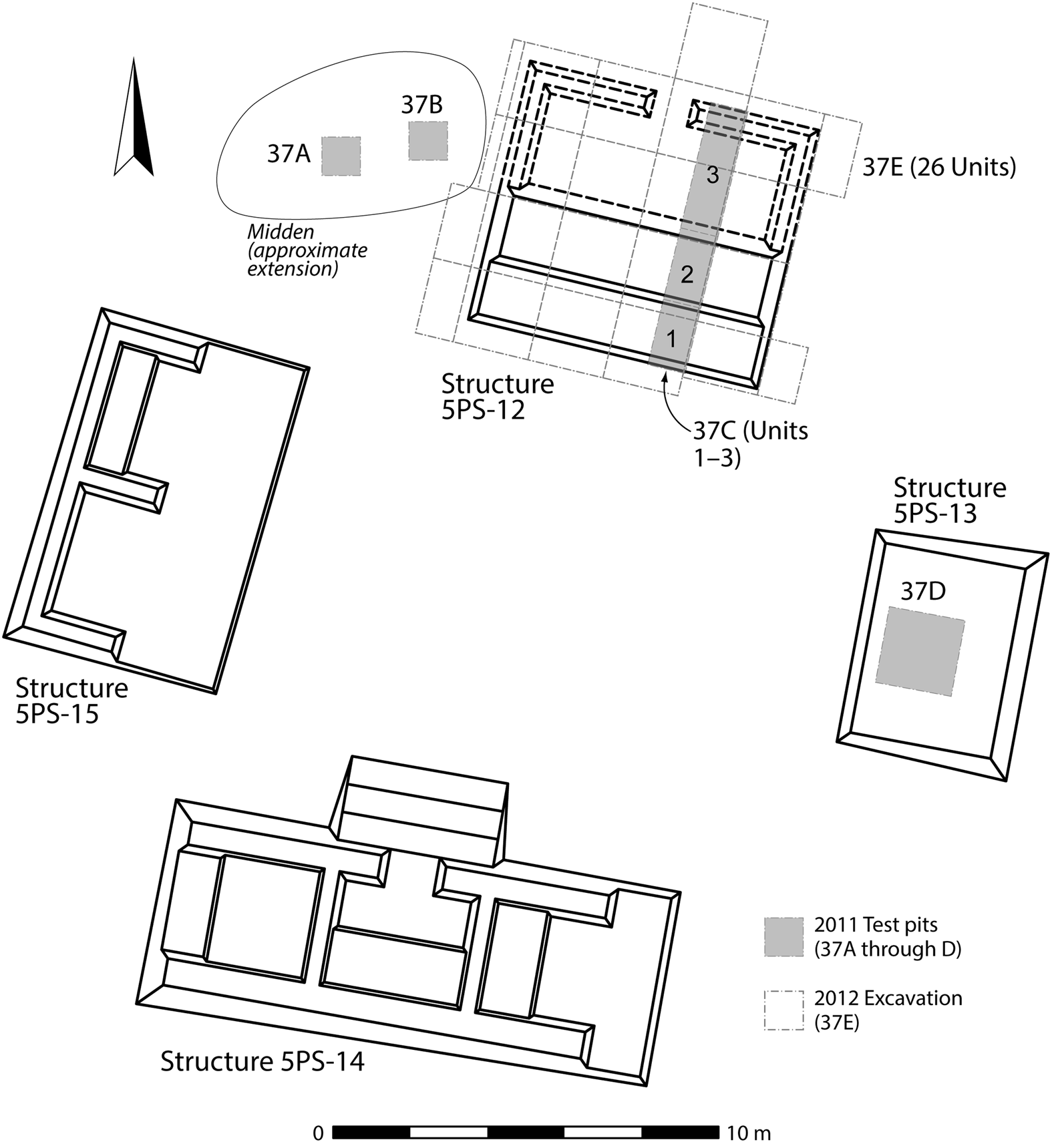
Among the extensively investigated groups is Group 5PS-d. Its four buildings surround a square plaza (Figure 2). Its total construction volume of 54.7 m3 makes it a medium-sized residential group at Tamarindito (Figure 1c; Eberl and Vela González Reference Eberl, González, Arroyo and Salinas2013). The southern building (Structure 5PS-14) has three rooms and, judging from similar buildings elsewhere, served as a residence (cf. Eberl Reference Eberl2014:236–237). A low building with two rooms (Structure 5PS-15) occupies the west side, and a square building (Structure 5PS-13) the east side. The northern building, Structure 5PS-12, has a peculiar shape and was selected for further investigations (see the later discussion).
Map of Group 5PS-d, showing the locations of the Operation TM37 test pits and extensive excavation. (Map by Markus Eberl.)

After mapping the group, test pits were placed over superficial artifact concentrations in the northwest corner (sub-operations 37A and B in Figure 2). The excavation revealed a dense midden: 961 (37A) and 1,262 (37B) ceramic sherds per cubic meter. Test pit 37D into the eastern building exposed several caches and secondary burials. Associated vessels include a seventh-century Saxche Orange Polychrome bowl, an eighth-century Palmar Orange Polychrome tripod plate, and a likely late eighth-century incised-punctated cylinder from the Infierno ceramic group (ceramic types after Foias and Bishop Reference Foias and Bishop2013; Inomata Reference Inomata, Inomata, Triadan, Inomata and Triadan2010). They date Structure 5PS-13 to the Late Classic (AD 600–830 in the Petexbatun region). The ritual deposits and skeletal remains, the location of the building on the east side of the group, and the square shape indicate that Structure 5PS-13 served as a shrine (cf. Eberl Reference Eberl2014:237). The dead in Group 5PS-d were likely honored there (cf. Becker Reference Becker1999, Reference Becker and Sabloff2003).
The inhabitants of Group 5PS-d belonged to the nonroyal residents at Tamarindito. More than 1 km separated them from Plaza B; they occupied the southwestern outskirts of the site (Figure 1). The construction volume of the group corresponds to 0.3% of that of Plaza B, which accentuates the lower status of its inhabitants (see the later discussion).
Structure 5PS-12
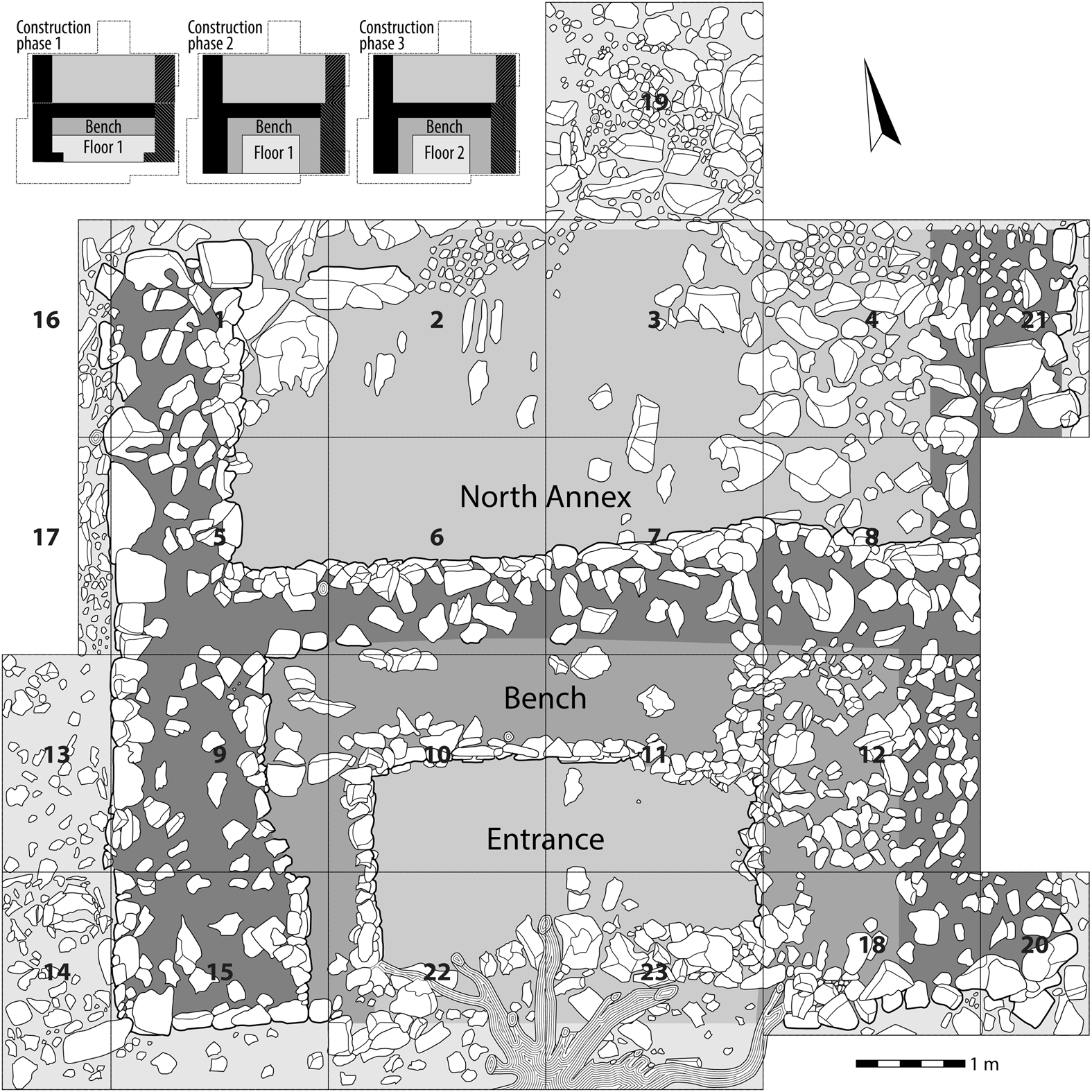
During the survey of Group 5PS-d, the first author noted the unusual layout of its northern building. Surface details pointed to an annex north of a rectangular room with a bench (for mapping methods, see Eberl Reference Eberl2014:229; Levithol et al. Reference Levithol, Eberl, Hernández, Eberl and González2016:14). After the 2011 survey, we investigated Structure 5PS-12 with a trench (TM 37C) across the entire building. The trench encountered the annex floor and revealed on its surface a large number of artifacts, including partial ceramic vessels and two obsidian cores. To contextualize these findings, Structure 5PS-12 was extensively excavated during the following field seasons by the second author (Figure 3), exposing the entire original surface. Units 6, 24, 25, and 26 were excavated down to bedrock to document earlier construction phases.
Structure 5PS-12 after extensive excavation. The exploratory trench TM37C and a higher degree of destruction obscure the eastern part of the building; the upper left insets show the three construction phases (not indicated are Units 24–26 that explore details of Units 9 and 10. (Plan based on a field drawing by Sven Gronemeyer.)

Wall fall covered the entire building evenly (Supplemental Figure 2). As the highest and most massive feature of the building, the south room bench was the reference point for the slow removal of wall fall and the exposure of the walls. The stones were embedded in a clayey matrix that originally may have held them together in lieu of mortar. Further excavation revealed the wall foundations on the west side of the building, whereas the ones on the east side were destroyed. In total, we removed 9.7 m3 of wall fall. Given that the walls cover an area of 20 m2, wall fall adds approximately 0.5 m to the remaining wall foundations. The walls of Structure 5PS-12 were originally about 1 m high and consisted of stone slabs and roughly shaped rocks. Its stone walls likely supported upper walls and a roof made of perishable materials (Supplemental Figure 3).
Structure 5PS-12 had two unconnected rooms that opened to the north and the south; its layout differs in this regard from the Postclassic tandem plan (Freidel Reference Freidel and Ashmore1981:315; Smith Reference Smith, Pollock, Roys, Proskouriakoff and Smith1962:217, 266). The building had three construction phases (Figure 3). It originated as a H-shaped building with a south room that had small doorjambs and a rectangular bench. The annex was built at the same time because its wall stones are tenoned in the back wall of the bench. Its east side is destroyed, but we assume that it had a straight wall like the west side. During the second construction phase, the southern sidewalls were extended south and widened by burying the earlier doorjambs. Wings were added to the bench to give it a C shape. During the third construction phase, a floor was added on top of the earlier floor in the south room. The overall shape of the building remained the same.
In the south room, few artifacts were found in the wall fall or on the floors. It resembles similarly cleanly swept living spaces elsewhere (cf. Johnston and Gonlin Reference Johnston, Gonlin and Houston1998:160). The annex presented a different picture with artifacts mixed into the wall fall and littering its entire original surface. Dense artifact concentrations occurred, especially behind the south room bench (Supplemental Figure 4). Carbon specks were common on the annex floor, but we found no ash layer that would indicate extensive burning.
Artifacts from Structure 5PS-12
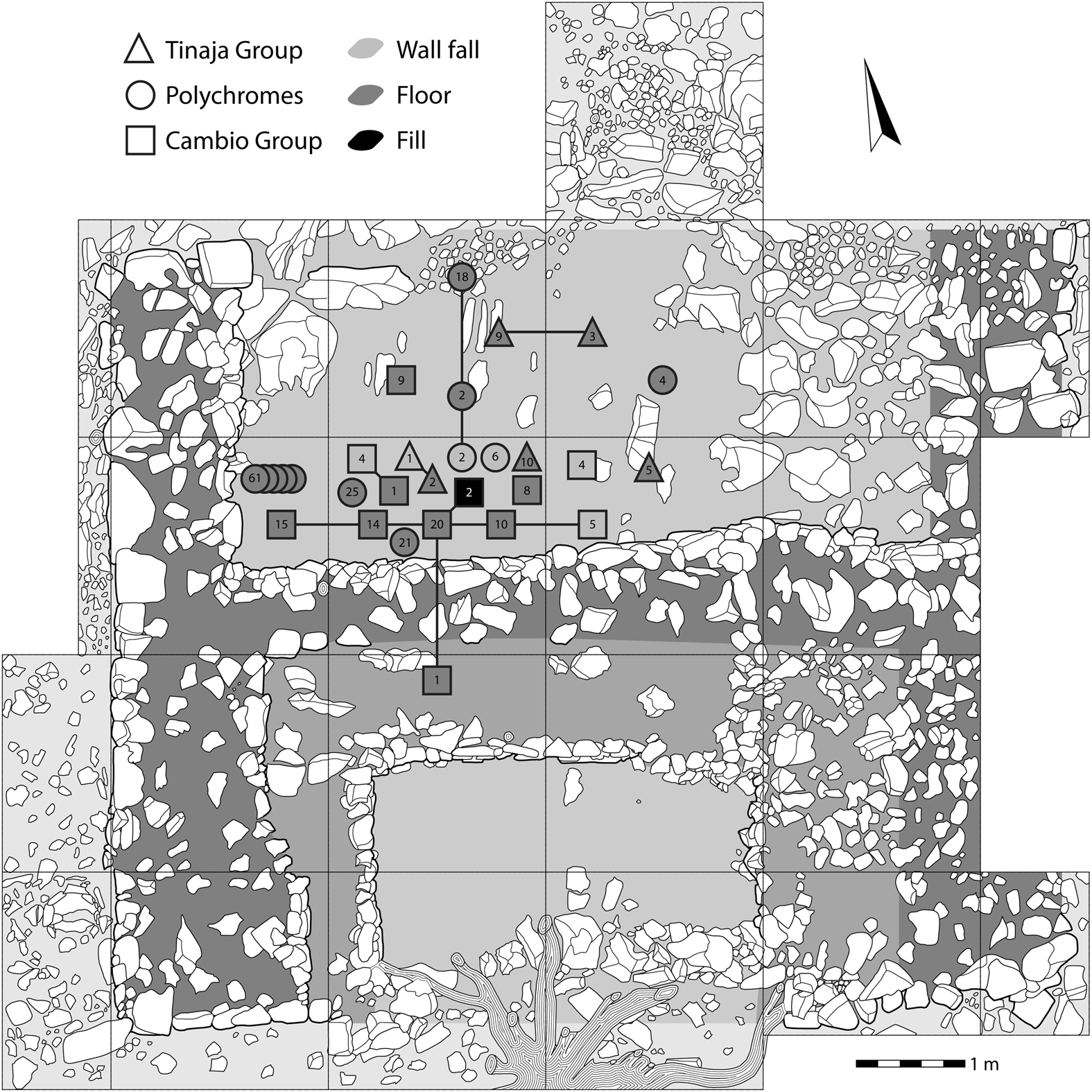
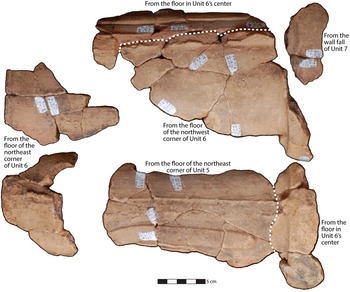
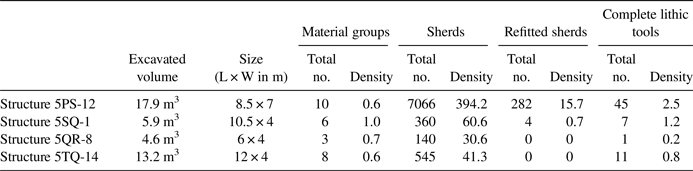
The artifact collection of Structure 5PS-12 is diverse and plentiful (Table 1). Almost 7,400 ceramic sherds were excavated. Of these, 40.7% were too eroded to be classified. Among the remaining sherds, 47.0% were unslipped, 26.5% were monochrome, and 25.7% were polychrome (Vela González, Díaz, Gronemeyer, Levithol, and Eberl Reference Vela González, Díaz, Gronemeyer, Levithol, Eberl, Eberl and González2016:97). None of the polychrome sherds are elaborately painted; their decoration consists mostly of simple linear and geometric motifs. Plain polychromes appear in all socioeconomic contexts throughout the Petexbatun region (Eberl Reference Eberl2014:321; see also LeCount Reference LeCount1999; Sheets Reference Sheets2000). About 300 sherds could be refitted into 19 partial ceramic vessels (Figure 4). Of these, 10 vessels are polychrome bowls, cylinders, and plates. Three jars and a Subin Red bowl are red-slipped vessels of the Tinaja group. The remaining five vessels—four jars and a Pedregal Modeled incense burner—belong to the unslipped Cambio Group (Figure 5). The unique shape and paste of the incense burner made it easy to identify matching sherds. Otherwise, the high degree of erosion made it difficult to refit sherds across different lots.
Refitted ceramic sherds from Tamarindito Structure 5PS-12. Lines connect sherds from the same vessel, and symbols appear at the approximate find location (annex units were divided into two or more horizontal lots for finer spatial control). Symbol numbers indicate the number of refitted sherds; gray tones identify the stratigraphic level; not shown are partial vessels from the 37C trench. (Diagram by Markus Eberl.)

Partially reconstructible Pedregal Modeled incense burner from Structure 5PS-12 annex. Labels identify the provenance of particular vessel parts; dotted lines separate adjoining vessel parts that were found in distinct lots; isolated sherds are omitted. (Photo by Markus Eberl.) (Color online)

Comparison of Artifact Assemblages from Structure 5PS-12 and Three Extensively Excavated Buildings at Tamarindito.

Note : Numbers refer only to surface, wall fall, and floor levels.
The reconstructible vessels differ from those found in rapidly abandoned buildings at Aguateca and Cerén (Inomata and Triadan Reference Inomata and Triadan2014; Sheets Reference Sheets1992, Reference Sheets2002). In the latter cases, most vessels were complete, whereas all of the vessels from Structure 5PS-12 are partial and few if any seem to have been functional. For example, we were able to reconstruct only about one-third of the Pedregal Modeled incense burner (Figure 5).
Refitted sherds were often dispersed over a wide area; in the case of the incense burner, they were scattered over approximately 10 m2. With one exception, they all come from the annex (Figure 4). In rapidly abandoned buildings at Aguateca, many ceramic vessels were stored above ground or hung in rafters, and they crashed to the floor when the building was burned down and its walls collapsed (Inomata and Triadan Reference Inomata and Triadan2010). The bottom sherds of these vessels remained in close proximity, whereas body and rim sherds were scattered more widely. We failed to observe this distribution in the Structure 5PS-12 annex. Body, rim, and bottom sherds of the same vessel mingle randomly. Even sherds that were originally adjacent ended up in different places (indicated by dotted lines in Figure 5). Sherds of different sizes co-occur, and their distribution differs from the gradation—small sherds at the point of impact and larger sherds elsewhere—that would result from accidentally dropping a vessel (Evans and Barrera Hernandez Reference Evans and Hernandez2017). Individual fragments tend to be palm-sized. Thus, the reconstructible vessels were likely broken apart intentionally and their sherds spread throughout the building.
Refitted sherds link several stratigraphic levels. About two dozen sherds are from the wall fall, two are from the fill, and all the others are from the original floor of the annex. Incense burner sherds were found in all three levels. Two sherds from the fill likely slipped through the cracks of the coarse annex floor. In the case of three vessels, matching sherds occur both in the wall fall and on the annex floor. These linkages between the wall fall and floor indicate that the destruction of the annex walls of Structure 5PS-12 and the deposition of the associated artifacts occurred simultaneously.
The excavation produced numerous lithic tools, including 45 complete tools: 24 chert hammerstones, 6 manos, 4 quartz hammerstones, 5 chert scrapers, 3 chert bifaces, 2 greenstone polishing tools, and 1 chert chopper (Supplemental Figure 5). Twenty-four tools came from humus and wall fall, 16 tools are on the original floor, and 5 tools are from the bench and floor fills in the South Room. The distribution of these tools over Structure 5PS-12 varies by context. Although tools from humus and wall fall are found across the entire building, those from the floor are exclusively in the annex. The distribution of tools also differs from the annex-specific distribution of ceramic sherds. Among the tool fragments are a bark beater fragment and three sandstone fragments. The latter likely came from the same grinding stone before being broken apart and dispersed throughout the wall fall.
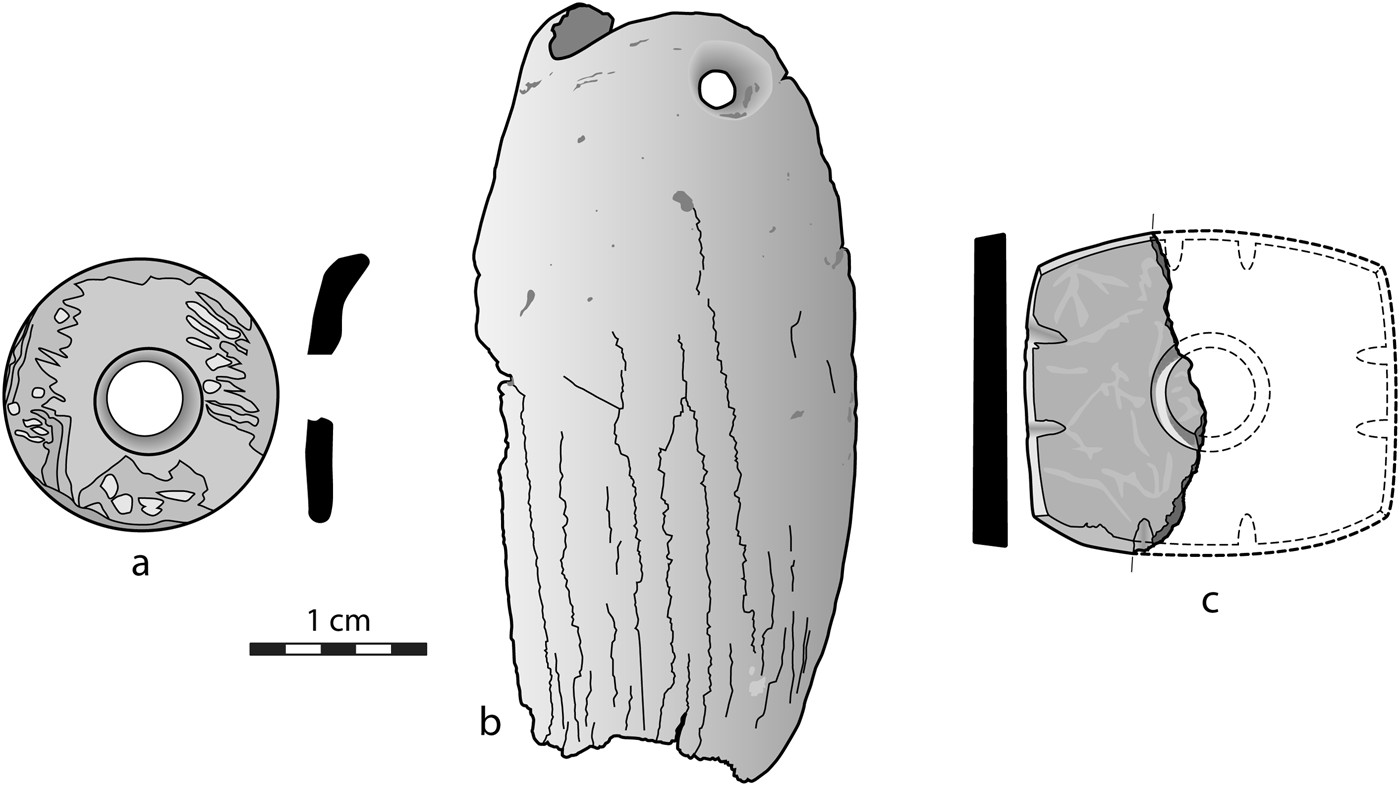
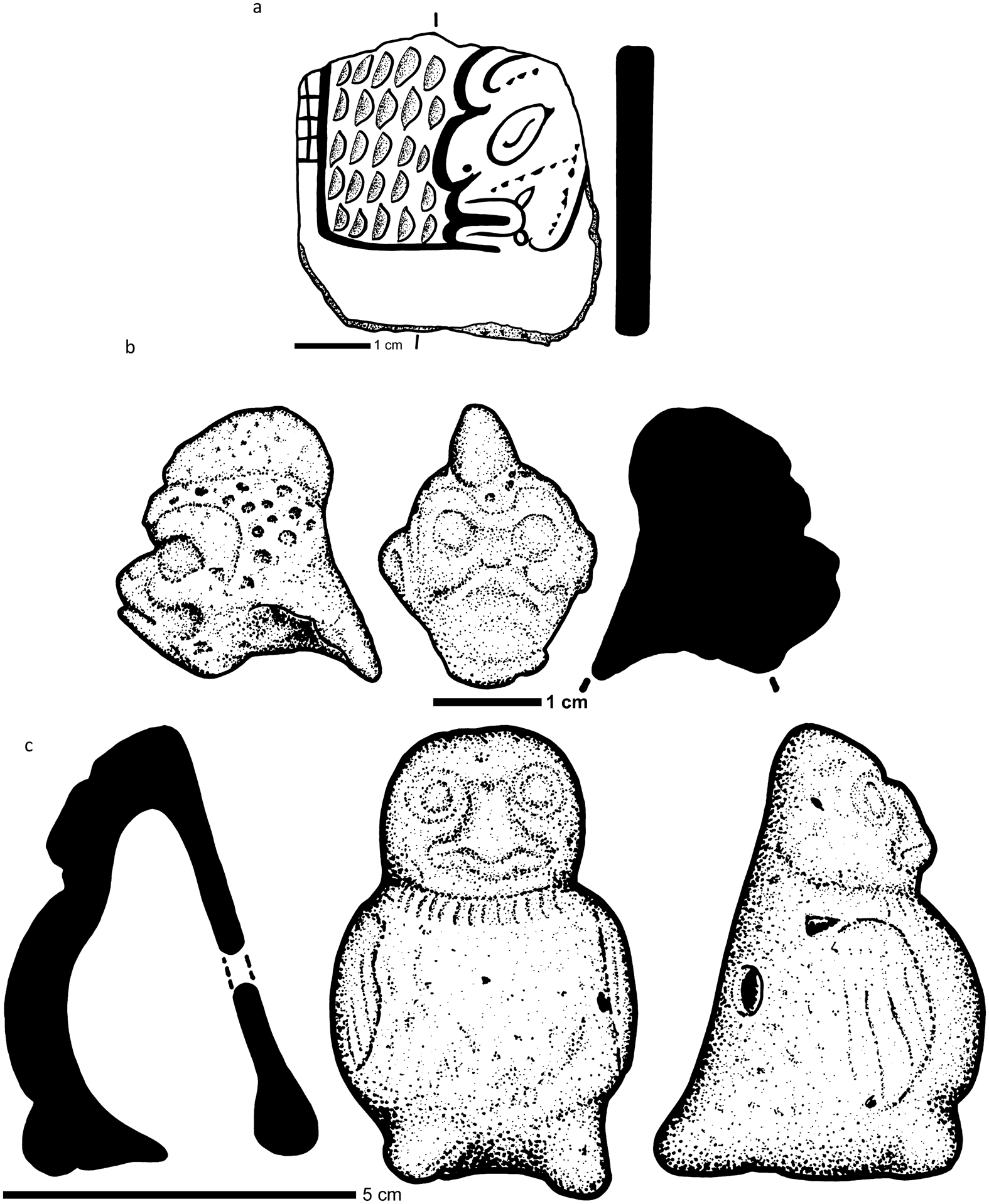
The collection from Structure 5PS-12 contains artifacts that are rare in nonroyal contexts at Tamarindito. These include a shell ring, three delicate shell fragments with nacre, and a univalve fragment with a hole (Figure 6a, 6b). Maya art shows the latter dangling from the belts of nobles. Eleven ceramic sherds come from drums, but none could be refitted. A fragmentary pyrite plaque has the shape of the glyph nich for “flower” (Figure 6c). It evokes Maya concepts of beauty and perfection to which Maya nobles claimed privileged access (Houston et al. Reference Houston, Stuart and Taube2006:154; Taube Reference Taube2004b). A well-preserved sherd shows the head of a supernatural being, possibly the maize god (Figure 7a; compare to ceramic vessel K9124). Sixty-five figurines and figurine fragments include a monkey head, a complete owl whistle, and a complete bell clapper (Figure 7b, 7c; for figurines as part of termination rituals, see Halperin Reference Halperin2017). Some were used as musical instruments.
Shell and pyrite artifacts from the Structure 5PS-12 annex: (a) Marine shell ring, made of an unidentified species (TM37C-3-2-1, artifact number 167-1); (b) Olivella shell tinkler (TM37E-6-4-2, artifact number 276); (c) Pyrite plaque fragment shaped like the glyph T646 nich “flower” (TM37E-6-2-2, artifact number 116-1). (Drawings by Markus Eberl.)

Ceramic artifacts from Structure the 5PS-12 annex: (a) Infierno group ceramic sherd (TM37E-6-3-2, artifact number 229); (b) figurine fragment of a monkey (TM37C-3-2-1, artifact number 168); (c) owl whistle (TM37E-2-2-2, artifact number 193). (Drawings by Markus Eberl.)

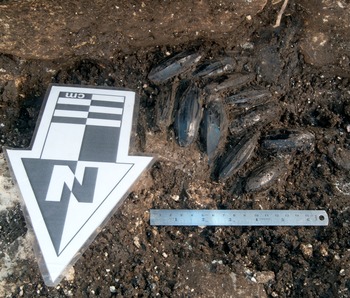
Finally, the excavation encountered 18 obsidian cores on the original floor of the annex and stashed behind the back wall of the bench. Sixteen cores were piled up in three rows (Figure 8). They may have been originally in a bundle made of organic materials. The cores measure between 6.7 cm and 8.3 cm in length (average of 7.5 cm), have diameters between 1.3 cm and 3.8 cm (average of 2.4 cm), and are between 28.8 and 112.8 grams (average of 52.6 grams) in mass. Their color and texture indicate that they come from the El Chayal source (cf. Braswell et al. Reference Braswell, Clark, Aoyama, McKillop and Glascock2000:272). Seven cores still preserve patches of original clast cortex. The large size of several patches impeded knappability and point to low-quality cores (Zachary Hruby and Hattula Moholy-Nagy, personal communication 2015). Although five are exhausted, the remaining cores have platforms that are still large enough for knapping prismatic blades. These obsidian cores are noteworthy because obsidian is a scarce and potentially elite-controlled resource in the Petexbatun region (Aoyama Reference Aoyama2009; Eberl Reference Eberl2014:249–253).
Sixteen obsidian cores stashed in the Structure 5PS-12 annex behind the back wall of the bench. (Photo by Sven Gronemeyer.) (Color online)

Comparison with Known Termination Rituals
The extensive excavation of Tamarindito Structure 5PS-12 documented unique characteristics. First, the artifact collection from the building floor and wall fall is diverse and dense, with objects clustering on the annex floor. Second, the artifacts from the wall fall and floor include complete tools, valuable artifacts, and partial vessels. Third, several hundred ceramic sherds could be refitted into partial vessels. Their wide distribution across the annex suggests that the vessels were broken and spread apart. Fourth, refits among wall fall and floor sherds show that the abandonment proceeded quickly and in an interlinked sequence. Fifth, the even wall fall distribution and partially destroyed wall foundations contrast with wall decay patterns in gradually abandoned buildings; for a similarly buried Postclassic building in the central Maya lowlands, see Pugh and colleagues (Reference Pugh, Rice, Nieto and Rice2016). The walls of the latter leave behind cone-shaped mounds that still hint at the original layout (Schiffer Reference Schiffer1987:220–231). In contrast, Structure 5PS-12 was likely intentionally destroyed.
Structure 5PS-12 differs from other extensively excavated buildings at Tamarindito (Table 1; for excavation details, see Eberl and Vela González Reference Eberl and González2016). All four buildings are comparable in size. Structures 5SQ-1 and 5QR-8 are in small and medium-sized residential groups, whereas Structure 5TQ-14 is in Plaza B. Structure 5PS-12 has an unusually diverse artifact collection with artifacts made from 10 different materials. Only Structure 5TQ-14 comes close with eight material groups, which likely reflect its location in Plaza B. The diversity of the other two structures is noticeably lower and closer to the 4.8 material groups observed in non-elite contexts elsewhere in the Petexbatun region (Eberl Reference Eberl2014:137). The sherd density of the collection from Structure 5PS-12 is almost seven times higher than the one in the next densest building and comparable to middens at Tamarindito. In contrast to the hundreds of sherds that could be refitted in the case of Structure 5PS-12, the other buildings contained none or only a handful. Although all buildings had a few complete lithic tools above their floors and in their wall fall, none match the 45 tools from Structure 5PS-12.
We consider various explanations for the abandonment of Structure 5PS-12. Differences from the three extensively excavated buildings at Tamarindito make gradual abandonment unlikely (Table 1). Alternatively, squatters or passersby may have reused the building and left the annex but not the South Room littered. This interpretation, however, does not explain the contrast between the two rooms. Modern and historic Maya prefer cleanly swept use spaces (Johnston and Gonlin Reference Johnston, Gonlin and Houston1998:160; see also Stanton et al. Reference Stanton, Brown and Pagliaro2008). In addition, matching sherds from floor and wall fall levels suggest that the breaking of ceramic vessels coincided with the destruction of the building. A third explanation is rapid abandonment. Although it can account for complete tools and prestige artifacts, it fails to explain the even distribution of wall fall and the reconstructible but partial artifacts and ceramic vessels. One would also expect to find heavy items like grinding stones and large ceramic vessels, but not valuable items like obsidian cores that could have been carried away easily.
Fourth, we consider a termination ritual. Its characteristics in royal contexts are intense burning, intentional structural damage, white marl deposition, scattered pottery, rapid deposition, and dense deposits with exotic artifacts (Stanton et al. Reference Stanton, Brown and Pagliaro2008:237–238). We observed most of these characteristics in Structure 5PS-12. Burning is limited to small specks of carbon, and a white marl cover is absent.Footnote 1 In addition, we hesitate to classify the artifact assemblage from Structure 5PS-12 as ceremonial because the objects either have complex use-lives (see Triadan Reference Triadan2007 for figurines) or are partial, as in the case of the incense burner (cf. Bradley Reference Bradley2005; Brady and Peterson Reference Brady, Peterson and Fogelin2008).
Contextualizing Structure 5PS-12
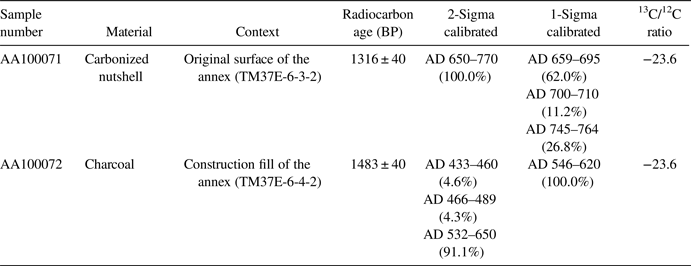
Ritualized action is not unintentional, but it is non-intentional in the sense that its identity does not depend on the agent's intention (Humphrey and Laidlaw Reference Humphrey and Laidlaw1994:89). The activities encoded in Structure 5PS-12 deposits have to be understood in the context of contemporary norms and practices. Construction techniques, radiocarbon dating, and ceramic chronologies date the use of Structure 5PS-12 to the first half of the eighth century AD and its abandonment around AD 750 (Supplemental Text 1; Table 2). The deposits overlap with the main occupation in Plazas A and B and predate termination rituals in the Pasión Valley and the Maya Lowlands (cf. Bazy and Inomata Reference Bazy and Inomata2017; Iannone et al. Reference Iannone, Houk and Schwake2016; Inomata Reference Inomata1997). They are contemporary with the last flowering of the Tamarindito royal dynasty. In 761, King Chanal Bahlam expelled the last king of nearby Dos Pilas and initiated the balkanization of the Petexbatun region (Martin and Grube Reference Martin and Grube2008:64–65). Among his royal gestures is a fire ritual that torched a Plaza B royal burial in 762 and was likely witnessed by the inhabitants of Tamarindito.
Radiocarbon Dates from Tamarindito Structure 5PS-12.

Note : Calibrated with Calib 7.1 using IntCal13 as a calibration curve (Reimer et al. Reference Reimer, Bard, Bayliss, Warren Beck, Blackwell, Ramsey, Buck, Cheng, Lawrence Edwards, Friedrich, Grootes, Guilderson, Haflidason, Hajdas, Hatté, Heaton, Hoffmann, Hogg, Hughen, Felix Kaiser, Kromer, Manning, Niu, Reimer, Richards, Marian Scott, Southon, Staff, Turney and van der Plicht2013; Stuiver and Reimer Reference Stuiver and Reimer1993; Stuiver et al. Reference Stuiver, Reimer and Reimer2015).
The inhabitants of Group 5PS-d were aware of contemporary practices. Although they occupied a modest residential group at the outskirts of Tamarindito, they reference the broader culture. The artifact collection from Structure 5PS-12 includes obsidian cores, a pyrite plaque, marine shell artifacts, and polychrome pottery. Some of these objects are decorated with motifs from Maya iconography and writing. Nonetheless, all these artifacts are fragmentary or of low quality or both. From our point of view, these characteristics of the collection from Structure 5PS-12 indicate limited access to luxury goods but not elite status (following criteria discussed in Chase and Chase Reference Chase, Chase, Chase and Chase1992:3–7; Lohse and Valdez Reference Lohse, Valdez, Lohse and Valdez2004). Petexbatun villagers enjoyed comparable access (Eberl Reference Eberl2014:325–327). The noteworthy artifacts concentrate in the annex of Structure 5PS-12; few comparable artifacts have been found elsewhere in Group 5PS-d. In the following, we argue that the inhabitants of Group 5PS-d employed their limited resources to contextualize and to differentiate their practices during the abandonment of Structure 5PS-12 (cf. Brumfiel Reference Brumfiel2011; Lohse Reference Lohse, Gonlin and Lohse2007).
Maya Termination Rituals as a Differentiating Cultural Practice
Instead of accepting ritual as a natural category, we emphasize the ways in which people strategically differentiate rituals from other activities. Bell (Reference Bell1992:87) argues that ritual, like any other practice, “sees the problem it is intent upon; it does not see what it itself produces in the very operation of practice: it does not see the production process [that] constitutes the ‘object.’” Yet her definition downplays practitioners and the situatedness of practices. People ritualize practices knowing which activities are possible and permissible. They observe other people and implicitly engage with the cultural framework that defines proper customs and behaviors. We apply this perspective to Tamarindito Structure 5PS-12 and Classic Maya termination rituals. We acknowledge that the label “Classic Maya” conceals an underlying heterogeneity: as a royal capital, Tamarindito was diverse and likely included people with a wide variety of cultural backgrounds (Figure 1c; Tung et al. Reference Tung, Johnson and Eberl2019).
The artifactual and architectural evidence from Structure 5PS-12 and the northern annex in particular allow us to reconstruct a unique set of activities. People took at least 19 partial ceramic vessels, broke them into hand-sized pieces, and scattered them across the annex. They laid down complete figurines, tools, and obsidian cores. At the same time, they tore up the building and evenly dispersed the rocks of its wall foundations. Over the annex, they mixed in sherds from partial vessels while they scattered stone tools over the entire building.
People “do not necessarily provide an explanation in words of what they express, what they communicate or what they symboli[z]e by their rituals” (Lewis Reference Lewis1980:19). Yet, they know how to perform rituals by choosing right over wrong performance. Insights can be gained by comparing their behaviors. Some of the activities that happened in Structure 5PS-12 also took place elsewhere. For example, the sherds of a reconstructible ceramic vessel were thrown into the trash in Group 5QT-a (Vela González, Díaz, Gronemeyer, Levithol, Palomo et al. Reference Vela González, Díaz, Gronemeyer, Levithol, Palomo, Velásquez, Eberl, Eberl and González2016:70–71), and complete artifacts have been found in other residential groups (Table 1). The distribution pattern of wall stones from Structure 5PS-12 echoes local mortuary practices. After inserting them into structure fills, people covered nonroyal burials and caches haphazardly with unshaped rocks and slabs (e.g., Vela González, Díaz, Gronemeyer, Levithol, and Eberl Reference Vela González, Díaz, Gronemeyer, Levithol, Eberl, Eberl and González2016:91; Vela González, Díaz, Gronemeyer, Levithol, Palomo et al. Reference Vela González, Díaz, Gronemeyer, Levithol, Palomo, Velásquez, Eberl, Eberl and González2016:26, 54). What sets the abandonment of Structure 5PS-12 apart is the complex and interrelated sequence of events. This complex sequence differs from the handling of trash, preparation of food, or other behaviors attested in Group 5PS-d. The activities encoded in the Structure 5PS-12 deposits reveal a strategy of differentiation and likely followed constitutive rules.
Termination rituals call for the breaking and scattering of objects. In Structure 5PS-12, some artifacts were already fragmented (e.g., Figures 6b, 6c, 7a, and 7b), and the torn-down building was covered with wall stones instead of marl. These variations show that differences in wealth, status, and power influenced the way in which rituals were conducted. At the same time, they attest to a widely available ontology. Artifacts with recognizable imagery and of material value manifest shared norms (also Brumfiel Reference Brumfiel2011; Eberl Reference Eberl2014:325–329). Presumably public ceremonies like the AD 762 fire ritual acquainted the population of Tamarindito population with elite-sanctioned ways of doing (cf. Inomata Reference Inomata2006). Participants may not have ascribed the same meaning to these public ceremonies, but they saw how to perform them properly (Humphrey and Laidlaw Reference Humphrey and Laidlaw1994:89).
People ritualize practices by distinguishing them from other practices. The act of differentiation requires reference actions. The inhabitants of Tamarindito set off rituals from their own daily practices and from ritual acts that they knew from public ceremonies. We argue that their ritualization involved a discursive process. The public character of elite performances and the lack of comparable ceremonies elsewhere at Tamarindito make royal termination rituals the reference point for Structure 5PS-12. The ritual at Structure 5PS-12 replicates four of six characteristics of termination rituals (Stanton et al. Reference Stanton, Brown and Pagliaro2008:237–238): dense deposits with exotic artifacts, the breaking and scattering of pottery, rapid deposition, and structural damage to the building. Burning and a white marl cover, two aspects tied to the royal identity (Supplemental Figure 1), are not clearly present. Instead, the abandonment of Structure 5PS-12 includes unique practices. People scattered ceramic vessel fragments over the annex while scattering complete stone tools over the entire building. Like the piling of rocks and slabs over local burials, they dismantled and dispersed wall stones to bury the building. The materially encoded practices at Structure 5PS-12 are different from locally attested practices, and yet they reference, assimilate, and manipulate socially shared ways of doing. People ritualize practices by differentiating them not only from other activities but also from other people and their practices.
Acknowledgments
Guatemala's archaeological institute graciously facilitated the work permits (esp. Convenio de Investigación Arqueológica DGPCYN-25-2014) and also gave permission for the publication of this article. Funding for the Tamarindito project came from the Henkel Foundation and Vanderbilt University. Takeshi Inomata, Rach Cobos, Nan Gonlin, anonymous reviewers, and the Latin American Antiquity editorial staff provided valuable feedback on earlier versions of this article. We thank them for their valuable input. The authors declare no financial interests.
Data Availability Statement
The text includes the data used in this article. Digital copies are available from the senior author.
Supplemental Materials
For supplementary material accompanying this article, visit https://doi.org/10.1017/laq.2019.76.
Supplemental Text 1: Dating Structure 5PS-12.
Supplemental Figure 1. Postmortem rituals in Maya hieroglyphic inscriptions: (a) Glyphs F17–E21 from Naranjo Stela 23; (b) glyphs V4–U10 from Piedras Negras Panel 3.
Supplemental Figure 2. Even wall fall distribution over Structure 5PS-12 after the removal of humus.
Supplemental Figure 3. Three-dimensional reconstruction of the final construction phase of Structure 5PS-12, showing the south room with its C-shaped bench; here, the upper walls are assumed to be made of wattle and daub.
Supplemental Figure 4. Example for the dense floor deposits of the Structure 5PS-12 annex (unit 6).
Supplemental Figure 5. Distribution of complete stone tools made of chert, quartz, and greenstone over Structure 5PS-12.