Dairy farming in tropical climates relies primarily on Bos taurus indicus cattle, particularly the Gir breed and its crossbreeds, such as Girolando, which account for approximately 80% of the milk produced in Brazil (Embrapa, Reference Embrapa2021). Genetic improvement programmes have substantially increased the productivity of the Gir breed, with milk yield rising by 31% over the last decade, from approximately 5,100 L per lactation in 2011 to about 6,900 L in 2021 (Embrapa, Reference Embrapa2024), highlighting its growing economic and productive importance (Milanesi et al., Reference Milanesi, Obrien, Utsunomiya, Feres, Sonstegard and Garcia2022). However, for the genetic potential of these animals to be fully expressed, management practices must be optimised, particularly during early life stages.
One characteristic of zebu-based dairy systems is the frequent use of calf presence during milking to stimulate milk let-down (Assis et al., Reference Assis, Stock, Campos, Gomes, Zoccal, Silva and de Leite2005; Negrão and Marnet, Reference Negrão and Marnet2006). In many Brazilian dairy farms, cow-calf contact is limited to the milking period, when calves briefly stimulate milk ejection and may suckle before or after milking. Although the calf is not strictly required to induce milk let-down, studies with Gir and Gir × Holstein cows have shown that calf presence can influence oxytocin release, residual milk and milking behaviour (Negrão and Marnet, Reference Negrão and Marnet2006; Negrão, Reference Negrão2008). However, when suckling opportunities are restricted to milking time, individual milk intake may vary among calves, potentially increasing variability in body weight (Fröberg et al., Reference Fröberg, Gratte, Svennersten-Sjaunja, Olsson, Berg, Orihuela, Galina, García and Lidfors2008; Meagher et al., Reference Meagher, Beaver, Weary and von Keyserlingk2019).
Milk feeding strategies and nutritional management of dairy calves, such as milk allowance, feeding frequency (Rosenberger et al., Reference Rosenberger, Costa, Neave, von Keyserlingk and Weary2017; Costa et al., Reference Costa, Cantor, Adderley and Neave2019), starter physical form (Mortazavi et al., Reference Mortazavi, Tomaluski, Marino, Feliciano, Alvarado-Castro, Rocha De Oliveira, Carvalho and Bittar2025), forage inclusion (Toledo et al., Reference Toledo, Dantas, Barboza, Tomaluski, Oliveira, Carvalho, Marino, Polizel, Miller-Cushon and Bittar2024) and liquid diet solids concentration (Virgínio Júnior et al., Reference Virgínio Júnior, Duranton, De Paula and Bittar2024), have been widely studied. However, most available evidence comes from studies conducted in North America and Europe or focus on taurine breeds (Bos taurus taurus) raised in confinement systems (Meagher et al., Reference Meagher, Beaver, Weary and von Keyserlingk2019; Ockenden et al., Reference Ockenden, Russo, Leury, Giri and Wales2023). These systems differ markedly from pasture-based production systems dominated by zebu cattle (Bos taurus indicus), which are adapted to tropical climates and typically exhibit greater heat tolerance, lower metabolic heat production and higher behavioural reactivity (Beatty et al., Reference Beatty, Barnes, Taylor, Pethick, McCarthy and Maloney2006; Sartori et al., Reference Sartori, Monteiro and Wiltbank2016; Okamoto et al., Reference Okamoto, Crump and Thornton2025). Consequently, information derived from taurine production systems may not fully represent the management conditions and biological responses of zebu cattle raised in tropical environments.
In this context, characterising the production and composition of colostrum, transition milk and whole milk is essential for understanding the nutritional environment experienced by calves in zebu-based dairy systems. Colostrum provides immunoglobulins, energy and bioactive compounds that are essential for passive immunity transfer and early calf development (Godden, Reference Godden2008; McGrath et al., Reference McGrath, Fox, McSweeney and Kelly2016). Colostrum quality is commonly assessed using Brix refractometry as an indirect indicator of immunoglobulin concentration (Quigley et al., Reference Quigley, Lago, Chapman, Erickson and Polo2013). Following colostrum, transition milk, typically defined as milk obtained from milkings 2–6 postpartum, gradually shifts in composition towards whole milk (Blum and Hammon, Reference Blum and Hammon2000).
Zebu cattle are also often characterised by greater behavioural reactivity compared with taurine breeds, which can make handling and human–animal interactions more challenging (León-Llanos et al., Reference León-Llanos, Flórez-Díaz, Duque-Muñoz, Villarroel and Miranda-de La Lama2022). Positive human–animal interactions, such as talking and touching animals gently, can reduce animals’ fear of humans and facilitate management procedures (Schmied et al., Reference Schmied, Boivin and Waiblinger2008; Lürzel et al., Reference Lürzel, Windschnurer, Futschik and Waiblinger2016). Tactile stimulation can be performed by handlers touching the animal’s body using their hands (i.e. stroking) or using a brush (Lürzel et al., Reference Lürzel, Windschnurer, Futschik and Waiblinger2016; Shahin, Reference Shahin2018; Ujita et al., Reference Ujita, El Faro, Vicentini, Pereira Lima, Oliveira Fernandes, Oliveira, Veroneze and Negrão2021; Wada et al., Reference Wada, Fukasawa, Chiba, Shishido, Tozawa and Ogura2021). Body region is an important factor to consider when tactile stimulation is performed. Cows perceive tactile stimulation in the neck region as positive (Lürzel et al., Reference Lürzel, Windschnurer, Futschik and Waiblinger2016; Shahin, Reference Shahin2018). In addition, positive responses to tactile stimulation have also been reported when contact is applied to other body regions, such as the udder and hind legs (Ujita et al., Reference Ujita, El Faro, Vicentini, Pereira Lima, Oliveira Fernandes, Oliveira, Veroneze and Negrão2021), as well as the back, belly and neck (Wada et al., Reference Wada, Fukasawa, Chiba, Shishido, Tozawa and Ogura2021). This contact activates skin receptors (C-tactile afferents) and may stimulate oxytocin release, promoting positive emotional states and buffering stress responses by reducing cortisol concentrations (Moberg and Petersson, Reference Moberg and Petersson2022). In calves, positive tactile contact may mitigate the negative effects of stressful events, such as weaning, by modulating physiological responses, including reduced cortisol and increased oxytocin concentrations (De-Sousa et al., Reference De-Sousa, Miranda, Negrão, Vercesi Filho, Salles, Simili and El Faro2025).
Therefore, we hypothesised that calf management strategies, such as tactile stimulation and optimised feeding, could alter calf suckling dynamics and indirectly influence milk yield and milk composition of their dams. Accordingly, this study aimed to (1) describe the production and composition of colostrum (first milking postpartum), transition milk (milkings 2–6 postpartum) and whole milk (from the seventh milking onwards) in pasture-managed dairy Gir cows and (2) evaluate the effects of tactile stimulation and feeding plan on circulating hormone concentrations in dairy Gir calves.
Materials and methods
This study was divided into two complementary experiments, both approved (protocol number 339-2021) by the Ethics Committee on Animal Use of the ‘Instituto de Zootecnia’ of São Paulo State. Experiment 1 evaluated milk yield and milk quality of Gir cows from calving until 120 days of lactation. Experiment 2 evaluated their Gir calves from birth through 30 days post-weaning, focusing on the effects of feeding plan and tactile stimulation. As cows and calves had daily contact during milking, both experiments were conducted concurrently to evaluate whether calf management could influence maternal milk production and milk composition.
Location and climate pattern
The study was conducted on a single experimental farm operating under management conditions representative of zebu-based dairy production systems in Brazil. The experiment was carried out from October 2021 to April 2022 at the Getúlio Vargas Experimental Field (total area of 560 ha) of the Agricultural Research Company of Minas Gerais (EPAMIG), located in Uberaba, Minas Gerais, Brazil (19°45′1″ S, 47°55′57″ W; 752 m above sea level). According to the Köppen classification, the regional climate is tropical, characterised by hot, rainy summers and dry winters. During the experimental period, the average air temperature was 23.8°C and the average relative humidity was 77.4%.
Experiment 1: Production and composition: colostrum, transition milk, residual milk and whole milk of Gir cows
Animals and management
Thirty-eight Gir cows with an average body weight of 455 ± 61 kg between 1 and 8 lactations (15 cows with 1–2 lactations, 18 cows with 3–4 lactations and 7 cows with more than 5 lactations) participated in this study from calving to 120 days in milk (DIM). All cows received female-sexed embryos through in vitro fertilisation. In total, 45 cows from the EPAMIG herd received embryos; however, only those that became pregnant and calved during the experimental period were included in the study.
Approximately 60 days before the expected calving date, cows were kept in a maternity paddock (1.5 ha, stocking density ranging from 10 to 15 cows, depending on calving events, as cows were moved to the lactating group after parturition) with free access to water trough, pasture (Panicum maximum ‘BRS Quenia’, ‘Tanzania’ and ‘BRS Zuri’) and mineral supplementation (Supplementary Table S1). After calving, they were allocated to the lactating herd in a pasture area predominantly composed of Brachiaria spp. and Panicum spp. The grazing area comprised 9 ha divided into nine paddocks (1 ha each), and each paddock was subdivided into six sub-paddocks (0.17 ha). Pasture was managed under a rotational grazing system, with cows remaining in each paddock for approximately 5 days. During the experimental period, the average pre-grazing forage mass was 4.3 t of dry matter/ha, with a chemical composition of 25.5% dry matter, 12.4% crude protein, 65.2% neutral detergent fibre, 34.6% acid detergent fibre, 8% ash and 3% lignin. During lactation, cows received 4 kg of concentrate (22% crude protein) after milking.
Cows were milked twice daily (7 a.m. and 1 p.m.) using a mechanical milking system (Westfalia, GEA Farm Technologies) in the presence of their calves. The tandem milking parlour had a double line (6 cows per line), with a total capacity of 12 cows milked simultaneously. After cows were positioned in the milking parlour, calves were gently brought in by a handler and tied beside their dams using a neck collar attached to a 1.5 m rope, allowing them to freely choose a teat to suckle. Because the order in which cows entered the parlour was not fixed, cows could choose which side to enter, and then the teat suckled by the calf could vary between milkings.
Until 90 days of age, each calf was allowed access to one teat of its dam to stimulate milk let-down. After 90 days of age, the calves were brought to the milking parlour to stimulate milk let-down but were not allowed to suckle.
Experimental procedures
As the calves had access to one of their dam’s teats until 90 days of age, measurements of colostrum, transition milk and milk yield were obtained from the remaining three teats from calving until 90 DIM. After calves were weaned (90 days old), milk production measurements were performed using all four teats.
The volume of colostrum produced at the first milking and the volume of transition milk (from the second milking until the sixth day postpartum) were measured using an electronic milk meter attached to each milking cluster (OpenWay, NN Ordenhadeiras, Brazil®). Colostrum from first milking and transition milk from morning milkings were sampled to estimate immunoglobulin content and to determine fat, lactose, total solids, protein and mineral levels. Immunoglobulin concentration was estimated using a Brix optical refractometer (0–32%; Contec®, China). During colostrum management, calves were allowed access to only one cow’s teat. Simultaneously, the cow was milked, and colostrum samples used for composition analyses were obtained as a pooled sample from the remaining three non-suckled teats, thereby representing first-milking colostrum. Samples of colostrum and transition milk were stored frozen and analysed at the end of the 120 days of experimental period at the Lactation Physiology Laboratory, FZEA/USP, Pirassununga, São Paulo, Brazil. Colostrum and transition milk composition were analysed by ultrasound using the MilkoScope Expert Automatic Milk Analyzer (Scope Electric Ltd., Razgrad, Bulgaria).
Residual milk yield was defined as the milk remaining in the udder after machine milking and calf suckling and was recorded using the electronic milk meter attached to the milking system (OpenWay, NN Ordenhadeiras, Brazil®). Residual milk yield was measured at five time points representing different stages of the lactation curve during early and mid-lactation: (1) when cows averaged 18 DIM (range: 7–24 days); (2) when cows averaged 32 DIM (range: 22–39 days); (3) when cows averaged 60 DIM (range: 60–67 days); (4) when cows averaged 89 DIM (range: 78–95 days) and (5) when cows averaged 117 DIM (range: 107–124 days). On the days of residual milk measurement, calves were removed from the milking parlour immediately after milking. Subsequently, 2 mL of oxytocin (synthetic oxytocin, 10 IU; vehicle q.s.p. 1 mL, UCBvet®) was administered intravenously in the mammary vein using a 5 mL syringe and disposable needles, always by the same veterinarian responsible for the procedure. Oxytocin was administered to ensure complete milk ejection and allow accurate estimation of residual milk (Negrão and Marnet, Reference Negrão and Marnet2006; Lechuga et al., Reference Lechuga, Caldara, de Castro Burbarelli, Odakura, Dos Ouros, Garcia, Félix, de Lima Almeida Paz, Oliveira Dos Santos and Braz2023). After 10 minutes, cows were milked again, and residual milk was collected from all four teats.
After the transition milk period, milk yield and whole milk composition were recorded weekly for all cows from 7 to 120 DIM, totalling 15 measurements per cow. The procedures for milk sampling and composition analysis were the same as those previously described for colostrum and transition milk.
Experiment 2: Milk intake and physiological variables of Gir calves
Animals and experimental design
Although 38 cows participated in Experiment 1, 37 calves were included in the calf-related analyses because one male calf was not enrolled in Experiment 2.
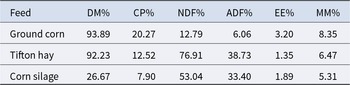
Thirty-seven Gir female calves were included in this study, from birth to 120 days of age, in a 2 × 2 factorial design with two birth blocks. The two factors evaluated were feeding plan (conventional vs. optimised) and tactile stimulation (with vs. without tactile stimulation). The evaluated treatments were as follows: (1) Conv-NS (n = 9): conventional feeding plan + no tactile stimulation; (2) Conv-TS (n = 10): conventional feeding plan + tactile stimulation; (3) Opt-NS (n = 9): optimised feeding plan + no tactile stimulation and (4) Opt-TS (n = 9): optimised feeding plan + tactile stimulation. Optimised feeding (Opt) and conventional feeding calves both had access to natural suckling at the dam during each milking (morning and afternoon). The difference consisted of the optimised feeding (Opt) treatment, in which calves received additional milk via a teat bottle immediately after each milking, following natural suckling. Furthermore, from 30 days of age onwards, Opt calves were provided with 50% more solid feed compared with calves in the conventional feeding system. The description of each feeding plan (conventional vs. optimised) is presented in Table 1 and in the section ‘Calf management after birth’. The diet composition is described in Table 2. The tactile stimulation protocol is described in the section ‘Tactile stimulation’.
Description of the feeding plan (conventional [Conv] and optimised [Opt]) to which Gir female calves (n = 37) were subjected throughout the 120-day experimental period

Table 1 Long description
The table outlines a 120-day feeding schedule for Gir female calves, comparing conventional and optimised plans across four age ranges. From days 0 to 60, both plans allow natural milk intake during morning and afternoon milking, but only the optimised plan adds 2 litres after each milking, totaling 4 litres per day. Concentrate is the same in both plans from days 0 to 30 at 0.5 kilograms per day per animal. From days 31 to 60, the optimised plan increases ground corn to 1.5 kilograms per day versus 1.0 in conventional, and increases Tifton hay to 0.15 kilograms versus 0.1. From days 61 to 90, the optimised plan continues higher ground corn at 2.0 kilograms versus 1.5 and higher hay at 0.2 kilograms versus 0.15, while additional afternoon milk stops in the optimised plan and remains absent in conventional. Corn silage begins at days 61 to 90 and is the same in both plans at 5.0 kilograms per day, continuing unchanged through days 91 to 120. Overall, the optimised plan mainly differs by adding milk early and providing more ground corn and hay after day 30, while corn silage is identical once introduced.
Nutritional composition of the concentrate, Tifton hay and corn silage offered to Gir calves throughout the 120-day experimental period

Table 2 Long description
The table reports nutrient composition for three feeds, listing dry matter and percentages of crude protein, fiber (neutral detergent fiber and acid detergent fiber), ether extract, and mineral matter. Tifton hay is the most fibrous, with neutral detergent fiber 76.91 percent and acid detergent fiber 38.73 percent, and it has moderate crude protein at 12.52 percent. Ground corn is very dry at 93.89 percent dry matter and has the highest crude protein at 20.27 percent, along with the highest ether extract at 3.20 percent and the lowest fiber values (neutral detergent fiber 12.79 percent; acid detergent fiber 6.06 percent). Corn silage has far lower dry matter at 26.67 percent, indicating much higher moisture, and it has the lowest crude protein at 7.90 percent with midrange fiber (neutral detergent fiber 53.04 percent; acid detergent fiber 33.40 percent). Mineral matter is highest in ground corn at 8.35 percent, compared with 6.47 percent in Tifton hay and 5.31 percent in corn silage. Values are presented as percentages, so comparisons reflect composition rather than total nutrient intake.
DM, dry matter; CP, crude protein; NDF, neutral detergent fibre; ADF, acid detergent fibre; EE, ether extract; MM, mineral matter. All values are expressed as a percentage (%) of dry matter.
Calvings occurred in two concentrated periods, referred to as ‘birth blocks’, due to variability in conception success and gestation length. In the first birth block, 15 calves were born, and in the second block, 22 calves were born. Within each block, calvings occurred within an interval of approximately 15 days. Calves from each birth block were allocated across all four treatments to avoid confounding treatment effects with birth period.
Within each birth block, calves were assigned to one of the four treatments in a pseudo-randomised design, meaning that treatment allocation followed the order of births while maintaining a balanced distribution of calves among treatments within each birth block. In the first birth block, the first calf was allocated to Cont-NS, the second to Cont-TS, the third to Opt-NS and the fourth to Opt-TS, with this sequence repeated as subsequent calves were born. In the second birth block, the allocation order was reversed to avoid systematic bias: the first calf was allocated to Opt-TS, the second to Opt-NS, the third to Cont-TS and the fourth to Cont-NS, and the sequence was then repeated for the remaining calves.
Calves’ management after birth
Within 3 hours of birth, calves were taken to the milking parlour for colostrum feeding and body measurements (Table 3). Body weight was measured using an electronic scale (Digitron®, model UL-300, 300 kg capacity). Body measurements (height, body length, rump width and chest circumference) were obtained using a measuring tape.
Mean, minimum and maximum values of body measurements of Gir calves (n = 37) at birth, by block

Table 3 Long description
The table summarizes birth body measurements for Gir calves, reporting mean, minimum, and maximum values for two groups: Block 1 with 15 calves and Block 2 with 22 calves. Average body weight was higher in Block 1 at 27.7 kg compared with 24.6 kg in Block 2, and Block 1 also had a higher maximum weight at 33 kg versus 28.7 kg. Average height was close between blocks, at 77.8 cm in Block 1 and 79.2 cm in Block 2, with Block 2 showing a higher maximum height at 101.1 cm compared with 95.5 cm. Body length averages were nearly the same, 55.0 cm in Block 1 and 55.3 cm in Block 2, and Block 2 had a slightly higher maximum length at 74.4 cm versus 71.6 cm. Rump width averaged 21.6 cm in Block 1 and 22.2 cm in Block 2, with Block 2 reaching a higher maximum of 30.4 cm compared with 27.8 cm. Chest circumference means were almost identical, 82.1 cm in Block 1 and 82.3 cm in Block 2, and maximum values were similar at 107.1 cm and 106.6 cm. Because the blocks have different sample sizes and only summary statistics are provided, these comparisons describe overall patterns but do not indicate whether differences are statistically meaningful.
At birth, calves were assisted by trained personnel and allowed to suckle one teat of the dam, while the remaining three teats were milked. No specific teat was selected for suckling. When calves were unable to establish effective suckling after approximately 40 minutes of assisted attempts, colostrum was administered artificially via bottle or oesophageal tube. In these cases, the volume of colostrum provided was standardised at approximately 10% of the calf's birth weight. In total, 11 calves experienced difficulty suckling, mainly due to udder oedema and large teat diameter in their dams, which hindered natural colostrum intake. Of these calves, nine received colostrum via bottle and two via oesophageal tube.
Navel care was performed by applying 10% iodine from birth for 3 consecutive days or until the umbilical cord detached naturally. After colostrum feeding, calves were separated from their dams and moved to the paddocks corresponding to their respective treatments. Each paddock was equipped with artificial shade, a single polyethylene trough for solid feed and a concrete water trough, with ad libitum access. The paddocks assigned to each treatment were adjacent to each other.
All calves were taken twice daily to the milking parlour, where they had access to one of their dam’s teats and returned to their respective paddocks after milking. In the optimised feeding group, calves received additional milk (2 or 4 L, depending on age – Table 1) in individual feeders with a teat (Milk Bar™ 4 L, product code 910120, New Zealand – McInnes Manufacturing Limited). The additional milk was drawn from the cooling tank, and its temperature was checked with a thermometer prior to feeding to ensure it was within the recommended range (37–38°C). If the milk temperature was below the recommended range, it was warmed in a water bath until reaching the recommended temperature. All calves were completely weaned at 90 days of age. In the optimised feeding (Opt) treatment, the weaning process began at 60 days of age by reducing the additional milk offered to 2 L, provided only after the morning milking. In contrast, calves in the conventional feeding system were abruptly weaned at 90 days of age.
To estimate the volume of natural milk consumed from their dams during milking, calves were weighed before and after the morning and afternoon milkings on days 30, 60 and 90 of age. As calves only had access to solid feed after the morning milking, this did not interfere with the consumption of natural milk or the additional milk. Additional milk intake was measured daily as the difference between the amount offered and the leftover milk.
The solid diet (concentrate, Tifton hay and corn silage) was weighed daily and provided in a single polyethylene trough (2.1 × 0.6 m) per paddock, which was shared among calves within the same treatment group. The amount of feed offered to each calf at different ages was multiplied by the total number of calves in the paddock. To estimate collective intake, leftovers from each paddock were collected daily before providing the new feed. Because the troughs used for solid feed were uncovered and rainfall occurred during approximately 50% of the experimental period, it was not possible to measure leftovers daily. However, the collected data represent the entire calf rearing period. Therefore, solid feed intake is presented as the percentage consumed, calculated as the difference between the amount of feed offered (kg) and the estimated leftovers, relative to the total amount offered to the group.
Tactile stimulation
The tactile stimulation (Conv-TS and Opt-TS) was applied from birth (D0) until 60 days of age, twice a day. For the Conv-TS calves, tactile stimulation was performed after the provision of solid feed, whereas for the Opt-TS calves, it occurred after the intake of additional milk. Both groups received tactile stimulation in the calf’s paddock. For calves that did not receive tactile stimulation, the usual farm management was adopted, in which they were moved to paddocks after each milking session, without receiving tactile stimulation.
For the tactile stimulation procedure, silicone grooming gloves with small bumps, typically used for brushing dogs and cats, were used. The stimulation was applied simultaneously with both hands of the handler on the calf’s body, in the following order: neck, back (from the withers to the tail insertion), hind legs (one hand on each leg), forelegs (one hand on each leg) and udder, totalling 1 minute per calf per session (morning and afternoon). To avoid errors and inconsistencies, a trained team of four people performed this procedure throughout the experimental period. If a calf did not accept the tactile stimulation, up to three additional attempts were made, and acceptance was recorded. Four calves did not accept the tactile stimulation for consecutive periods: two refused for five consecutive mornings; one calf did not accept it for 14 consecutive mornings and 19 consecutive afternoons; and another calf refused it for five consecutive afternoons.
Physiological variables
To assess serum cortisol and oxytocin concentrations, blood samples were collected at three time points, corresponding to the calves’ average ages of 60 days (pre-weaning), 67 days (weaning; 7 days after weaning start) and 97 days (post-weaning; 7 days after complete weaning). For blood sample collection, all calves were calmly conducted together to the handling area (approximately at 10:00 a.m.). To measure cortisol and oxytocin, blood samples were collected from the jugular vein into heparinised vacuum tubes and kept refrigerated until the end of the procedure. In the laboratory, the tubes were centrifuged at 3,000 × g for 15 minutes to separate the plasma. The supernatant (plasma) was transferred to 1.5 mL Eppendorf tubes and stored at –20°C for subsequent analysis. Plasma cortisol and oxytocin concentrations were determined by enzyme immunoassays using commercial kits from Diagnostic Systems Laboratories (Enzo, USA) at the Animal Physiology Laboratory, FZEA–USP.
Statistical analysis
All descriptive (mean, median, standard deviation, minimum and maximum) and inferential analyses were performed using R software (version 4.2.2; R Core Team, 2025). All statistical analyses were conducted considering a 95% confidence level, and differences were considered statistically significant when P < 0.05.
Occasional missing observations due to technical issues (e.g. equipment malfunction or unsuccessful blood sampling) were retained as missing values and handled within the mixed-model framework.
Experiment 1: Gir cows
Production and composition: colostrum, transition milk, residual milk and produced milk. Considering that the calves had access to one of their dam's teats during milking for natural milk consumption, we evaluated the effect of the treatments (Conv-NS, Conv-TS, Opt-NS and Opt-TS) on colostrum (day 0 to first milking postpartum), transition milk (1st–6th day postpartum), milk production (15 measurements per cow) and residual milk (5 measurements per cow). To this end, a linear mixed model was fitted using the lme4 package (Bates et al., Reference Bates, Mächler, Bolker and Walker2015), with treatment as a fixed effect and cow nested within lactation order category as a random effect. Model assumptions were evaluated by inspecting residual plots to verify normality and homoscedasticity. Lactation order was divided into three categories based on the distribution of cows in the herd: low (n = 14; 1–2 lactations), intermediate (n = 18; 3–4 lactations) and high (n = 6; ≥5 lactations). These categories were defined based on the distribution of lactation order in the herd, allowing a more balanced distribution of animals among groups while still reflecting differences in productive maturity across lactations. We also assessed the effect of lactation order (low, intermediate and high) on colostrum, transition milk, residual milk and milk production using a linear mixed model with lactation order as a fixed effect and cow as a random effect. Results are presented as adjusted means (obtained using the emmeans function from the emmeans package; Lenth, Reference Lenth2017), followed by the standard error of the mean. Brix quality results were available for 32 cows (lactation categories: low, n = 12; intermediate, n = 15 and high, n = 5), as samples from 5 cows were not obtained during colostrum collection. Missing data represented 3.15% (6/190) of the residual milk observations, 4.38% (25/570) of the total milk yield observations and 2.81% (16/570) of the milk quality observations.
Experiment 2: Gir calves
Intake and circulating hormone concentrations. To evaluate the effect of the treatments (Conv-NS, Conv-TS, Opt-NS and Opt-TS) on additional intake (milk and solid feed), a linear mixed model was applied for each evaluated period using the lme4 package (Bates et al., Reference Bates, Mächler, Bolker and Walker2015). Additional milk intake was analysed in two periods: (1) during pre-weaning (from 0 to 60 days of age) and (2) during weaning (from 60 to 90 days of age). In all models, treatments were considered fixed effects, and calf nested within the birth block was included as a random effect. The estimation of volume of natural milk consumed was obtained at three time points and is presented descriptively due to the logistical constraints of data collection in a cow-calf contact system.
Solid feed (ground corn, Tifton hay and ground corn plus corn silage) intake was analysed with a linear mixed model including treatment, its interaction with age as fixed effect and block birth as random effect using the lme4 package (Bates et al., Reference Bates, Mächler, Bolker and Walker2015).
To evaluate the effect of the treatments on circulating hormone concentrations (cortisol and oxytocin), a generalised linear mixed model with a Gamma distribution was used. This distribution was chosen because both cortisol and oxytocin are continuous variables with skewed distributions that cannot be adequately modelled using a normal distribution. Fixed effects included treatments (Conv-NS, Conv-TS, Opt-NS and Opt-TS), periods (pre-weaning, weaning and post-weaning) and their interactions, while calves nested within birth blocks were included as a random effect. Model estimates are presented as exponentiated coefficients (expressed as ratios), which facilitate interpretation of treatment effects on hormone concentrations. Missing data represented 5.4% (6/111) of the observations for calf hormone concentrations.
After fitting the model, adjusted means (least-squares means) were obtained for each combination of treatment and period using the emmeans package (Lenth, Reference Lenth2017). Multiple comparisons of means between treatments within each period and between periods within each treatment were performed using the pairs() function from the same package, which applies the Tukey method for p-value adjustment.
Results
Experiment 1: Gir cows
Colostrum and transition milk
On average, cows produced 4.9 ± 0.69 L of colostrum at the first milking postpartum. Lactation number had no significant effect (P = 0.43) on colostrum production. The average transition milk production (from the 1st to the 6th day postpartum) was 5.96 ± 0.24 L/day at the morning milking and 3.44 ± 0.16 L/day at the afternoon milking. Cows with low lactation order produced less (P ≤ 0.05) transition milk (3.62 ± 0.2 L/milking) than cows with high (5.55 ± 0.41 L/milking) or intermediate lactation order (5.38 ± 0.25 L/milking). There was no significant effect (P = 0.11) of the treatments applied to the calves (Conv-NS, Conv-TS, Opt-NS and Opt-TS) on transition milk production. Adjusted mean values of colostrum and transition milk production are shown in Fig. 1.
Adjusted mean values (emmeans), confidence intervals and trends of (a) colostrum and transition milk production (1st–6th day postpartum) and (b) Brix values (%) for colostrum (day 0) and transition milk (1st–6th day postpartum) in dairy cows during the early postpartum period. White circles represent the adjusted means for each milking or sampling, vertical bars indicate the confidence intervals and grey points show the observed values. The grey points were slightly displaced using the ‘geom_jitter’ function (ggplot2 package; Wickham, Reference Wickham2016) to improve visualisation and avoid overlap.

Table 1 Long description
The table outlines a 120-day feeding schedule for Gir female calves, comparing conventional and optimised plans across four age ranges. From days 0 to 60, both plans allow natural milk intake during morning and afternoon milking, but only the optimised plan adds 2 litres after each milking, totaling 4 litres per day. Concentrate is the same in both plans from days 0 to 30 at 0.5 kilograms per day per animal. From days 31 to 60, the optimised plan increases ground corn to 1.5 kilograms per day versus 1.0 in conventional, and increases Tifton hay to 0.15 kilograms versus 0.1. From days 61 to 90, the optimised plan continues higher ground corn at 2.0 kilograms versus 1.5 and higher hay at 0.2 kilograms versus 0.15, while additional afternoon milk stops in the optimised plan and remains absent in conventional. Corn silage begins at days 61 to 90 and is the same in both plans at 5.0 kilograms per day, continuing unchanged through days 91 to 120. Overall, the optimised plan mainly differs by adding milk early and providing more ground corn and hay after day 30, while corn silage is identical once introduced.
Overall, cows produced colostrum with an average Brix value of 19.2 ± 2.72 (range: 14–23). Most cows (14/32, 43.7%) produced colostrum of intermediate quality (Brix ≥ 18 and <22), while 10/32 (31.3%) cows had low-quality colostrum (Brix < 18) and 8/32 (25.0%) cows had high-quality colostrum (Brix ≥ 22). Brix values decreased (p ≤ 0.05; Fig. 1b) over the first week postpartum. Specifically, colostrum (day 0) showed a 26% reduction in Brix on the first day after calving. Brix values decreased from 19.2% at the first milking (day 0) to 9.8% by day 6 postpartum, representing a 48.9% of reduction.
Residual milk volume
On average, cows produced 1.14 ± 0.08 L of residual milk (range: 0–5.1 L) at the morning milking and 0.58 ± 0.05 L (range: 0–4.2 L) at the afternoon milking. Regarding lactation order, a difference (P ≤ 0.01) in residual milk production was observed only between cows with low lactation order (1.42 ± 0.17 L/milking) and intermediate lactation order (1.91 ± 0.16 L/milking), while both did not differ from cows with high lactation order (1.73 ± 0.18 L/milking). The treatment Opt-NS applied to the calves influenced (P = 0.05) the residual milk volume. Cows whose calves were in the Opt-NS treatment had higher mean residual milk values (1.78 ± 0.26 L/milking; OR: 1.52, P = 0.04) compared to cows whose calves were in the Conv-NS treatment (1.16 ± 0.18 L/milking). While Conv-TS (1.72 ± 0.25 L/milking) and Opt-TS (1.64 ± 0.25 L/milking) did not differ from Conv-NS treatment.
Milk yield
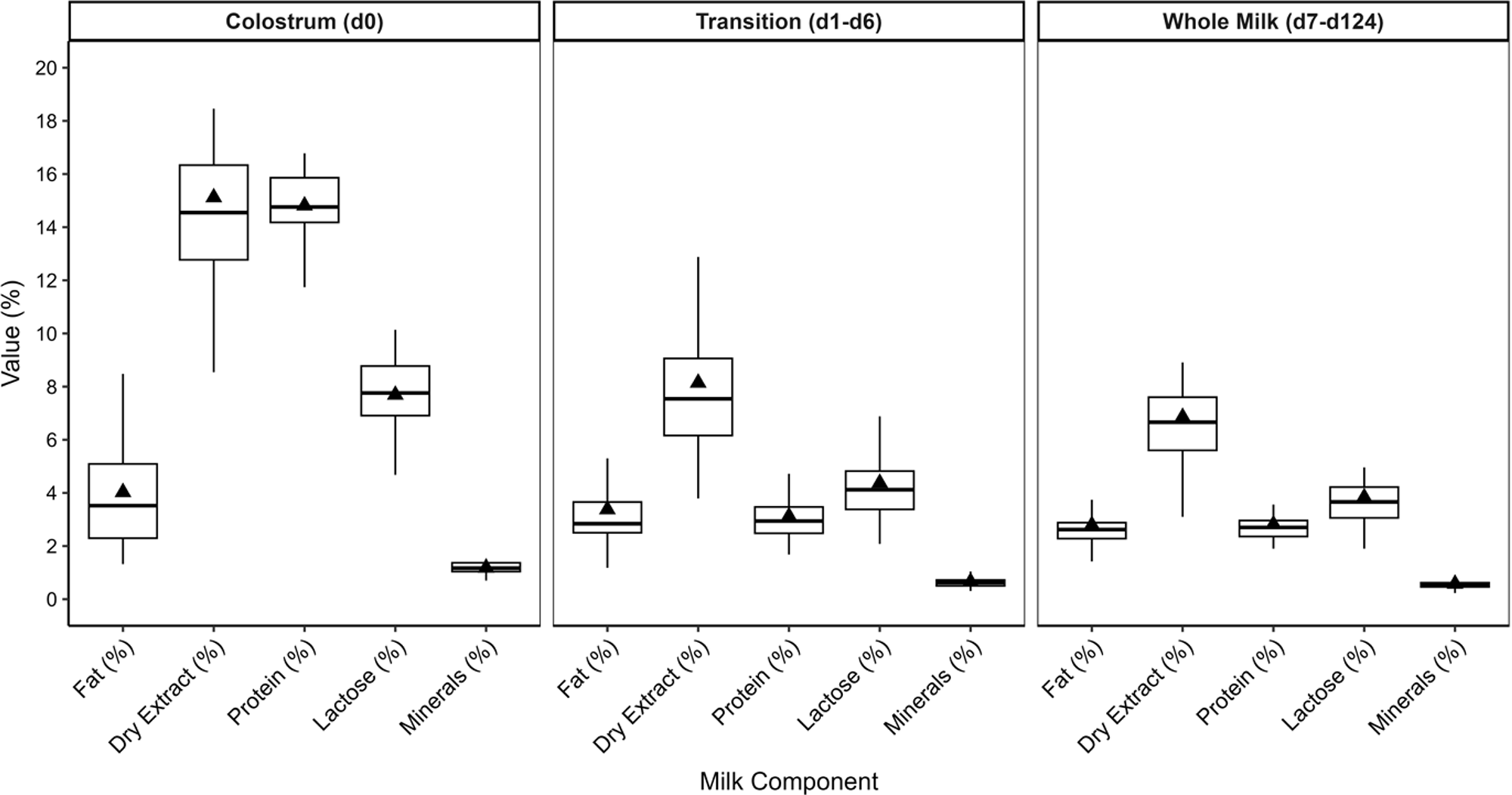
On average, cows produced 6.23 ± 0.11 L of milk (range: 0.01–12.6 L) during the morning milking and 2.67 ± 0.06 L/day (range: 0.01–6.92 L) during the afternoon milking, across three teats. Lactation order influenced (P ≤ 0.01) whole milk production. Cows in higher lactation orders produced more milk (10.9 ± 0.34 L/day) than cows in intermediate lactation order (P ≤ 0.01; 9.31 ± 0.21 L/day) and cows in lower lactation order (P ≤ 0.01; 7.37 ± 0.25 L/day). Treatment also influenced (P ≤ 0.01) maternal milk yield. Cows with calves in the Opt-NS treatment presented lower milk yield (7.44 ± 0.34 L/day) compared with dams of calves in the Conv-NS (P ≤ 0.001; 9.87 ± 0.27 L/day), Conv-TS (P = 0.009; 9.20 ± 0.29 L/day) and Opt-TS (P = 0.01; 8.93 ± 0.29 L/day) treatments. Variation in colostrum, transition milk and whole milk composition is shown in Fig. 2, while their variation throughout lactation is presented in the Supplementary Figure S1.
Boxplots illustrating the distribution of fat, dry extract, protein, lactose and mineral content (%) in colostrum (day 0), transition milk (days 1–6) and whole milk (days 7–124) from Gir cows (n = 38).

Experiment 2: Gir calves
Milk intake
Descriptively, the estimated natural milk intake during the milk-feeding period (30 days of age) was 3.44 ± 0.19 L/calf/day (range: 1.1–5.4 L). At 60 days of age, estimated natural milk intake was 2.76 ± 0.19 L/calf/day (range: 0.9–4.6 L), and during the weaning period (90 days of age), estimated natural milk intake was 2.96 ± 0.19 L/calf/day (range: 0.6–4.8 L).
During the optimised feeding treatments (Opt-NS and Opt-TS), tactile stimulation did not influence the amount of additional milk consumed by calves (P > 0.05). During the milk-feeding period (0–60 days of age), calves in the Opt-NS treatment consumed an average of 1.66 ± 0.39 L/calf/day, while calves in the Opt-TS treatment consumed 1.60 ± 0.09 L/calf/day. In this same period (0–60 days), all calves had at least 1 day without consuming additional milk. During the milk-feeding period, 33.3% of the calves (6/18) did not consume additional milk between 1 and 15 days, 11.1% (2/18) did not consume additional milk between 16 and 30 days and 50.0% (9/18) did not consume additional milk between 31 and 60 days.
During the weaning period (60–90 days of age), calves in the Opt-NS treatment consumed an average of 1.75 ± 0.03 L/calf/day of additional milk, while calves in the Opt-TS treatment consumed 1.87 ± 0.03 L/calf/day. Within the weaning period, 76.5% of the calves (n = 13) did not consume additional milk between 1 and 15 days, whereas 23.5% (n = 4) did not consume between 16 and 30 days.
Solid feed intake
Ground corn intake increased from 0 to 60 days old (P ≤ 0.001), and there was an interaction between age and treatment (P ≤ 0.05; Fig. 3). The Conv-NS showed the highest rate of increase (0.0249 kg/day), while the other treatments had lower rates (Conv-TS: 0.015 kg/day, Opt-NS: 0.013 kg/day; Opt-TS: 0.017 kg/day).
Predicted solid feed intake (kg/day) of dairy calves over time (days of age), according to treatment (Conv-NS: conventional feeding plan + no tactile stimulation; Conv-TS: conventional feeding plan + tactile stimulation; Opt-NS: optimised feeding plan + no tactile stimulation and Opt-TS: optimised feeding plan + tactile stimulation). Lines represent model-predicted values obtained from a linear mixed model including the fixed effects of age, treatment and their interaction, and birth block as a random effect.

Regardless of treatment, Tifton hay intake increased 0.0057 kg/day (P ≤ 0.001; Fig. 3) from 30 to 120 days of age and intake of ground corn plus corn silage increased 0.228 kg/day from 60 to 120 days. For both, no interaction between age and treatment was observed (P ≥ 0.05).
Circulating hormone concentrations
Pairwise comparisons of circulating hormone concentration among treatments and periods were performed using estimated marginal means and are presented in Table 4.
Pairwise comparisons and adjusted means (estimated marginal means ± standard error) for cortisol (ng/dL) and oxytocin (µIU/mL) concentrations in calves at three time points corresponding to average ages of 30 days (pre-weaning), 60 days (weaning) and 120 days (post-weaning) by treatment

Table 4 Long description
The table reports adjusted mean concentrations with standard errors for two hormones in calves, cortisol in ng/dL and oxytocin in micro international units per milliliter, measured at pre-weaning, weaning, and post-weaning for four feeding and tactile-stimulation treatments. For cortisol, Conv-NS is low at pre-weaning and weaning (about 0.8) but increases markedly post-weaning to about 1.7, the largest within-treatment rise. The other treatments show smaller cortisol changes across time, staying roughly between about 1.1 and 1.6, with Opt-NS among the higher cortisol values at pre-weaning and post-weaning. For oxytocin, all treatments are in a narrow range around the mid threes, with values generally increasing from pre-weaning to weaning and remaining similar or slightly higher post-weaning. The lowest oxytocin at pre-weaning appears in Opt-TS (about 3.3), while the highest post-weaning oxytocin appears in Opt-TS (about 4.0). Letter groupings attached to means indicate statistically significant differences within the comparison scheme used, so interpretation should rely on those groupings rather than small numeric gaps alone.
1 Conv-NS, conventional feeding plan + no tactile stimulation; 2Conv-TS, conventional feeding plan + tactile stimulation; 3Opt-NS, optimised feeding plan + no tactile stimulation and 4Opt-TS, optimised feeding plan + tactile stimulation.
Treatment, period and their interaction affected cortisol concentrations (P ≤ 0.05). In general, cortisol concentrations were 2.5 times higher during the post-weaning period compared with the pre-weaning period (P ≤ 0.001). Regardless of the period, calves in the Opt-NS treatment showed higher cortisol concentrations than calves in the reference group (Conv-NS), with concentrations approximately 1.95 times greater (P = 0.009). A significant interaction between treatment and period was observed (P ≤ 0.05). During the post-weaning period, calves in the Conv-TS, Opt-NS and Opt-TS treatments had lower cortisol concentrations than calves in the Conv-NS (control) treatment, with estimated reductions to 0.49 (P = 0.004), 0.45 (P = 0.002) and 0.41 (P = 0.0004) of the reference level, respectively.
Period and the interaction treatment × period affected oxytocin concentrations (P ≤ 0.05). Overall, oxytocin concentrations were 1.44 times higher during weaning period (P = 0.003) and 1.36 times higher during the post-weaning period (P = 0.01) compared with the pre-weaning period. Additionally, calves in the Opt-TS treatment during the post-weaning period showed 1.49 times higher oxytocin concentrations (P = 0.02) compared to Conv-NS at pre-weaning.
Same lowercase letters in a row or uppercase letters in a column indicate no significant difference between means.
Discussion
This study investigated milk production and composition of pasture-managed dairy Gir cows, and the effects of tactile stimulation and feeding plan on circulating hormone concentrations in dairy Gir calves. Our hypothesis was partially confirmed, as the interaction between treatment and period indicated that calves receiving tactile stimulation and/or optimised feeding plan (Conv-TS, Opt-NS and Opt-TS) tended to show lower cortisol concentrations during the post-weaning period compared with calves that did not receive these managements (Conv-NS). The post-weaning period represents a major challenge for dairy calves, as it involves changes in environment, social group and diet. Therefore, appropriate management practices during weaning (e.g. gradual reduction in milk offer or weaning over longer durations) are necessary to reduce stress at post-weaning, which is generally associated with a higher likelihood of disease occurrence and, consequently, weight loss (Weary et al., Reference Weary, Jasper and Hötzel2008; Welk et al., Reference Welk, Neave and Jensen2024).
Our results show great variation in the amount of colostrum, transition milk and whole milk produced among the evaluated Gir cows. As reviewed by Westhoff et al. (Reference Westhoff, Borchardt and Mann2024), several factors may influence both the quantity and quality of colostrum, such as nutrition, prepartum management and season of the year. Despite this knowledge, the same authors highlight that the results currently available in the scientific literature are not consistent. In general, younger cows are expected to produce lower volumes of colostrum compared to older cows (Robinson et al., Reference Robinson, Moorby and Gisi2009; Angulo et al., Reference Angulo, Gómez, Mahecha, Mejía, Henao and Mesa2015). However, Silva et al. (Reference Silva, Martin, Camargo, Daza, Defensor and Gomes2024), when evaluating Girolando cows, observed similar colostrum yields between primiparous and multiparous cows. Similarly, in our study, we found no effect of lactation order on colostrum production, although an effect was observed for transition milk, residual milk and whole milk production. Studies that have directly evaluated the Gir breed in relation to colostrum characteristics remain scarce, which is particularly problematic considering that this breed is a valuable genetic resource for improving the resilience of cattle in tropical production systems under climate change scenarios (Kumari et al., Reference Kumari, Devi, Amrutha, Sandeep, Sathish Kumar, Kapila, Hussain and Manoj Kumar2025). Unlike colostrum, lactation order influenced transition milk production, with cows in their first and second lactations producing lower volumes than those in their third or subsequent lactations. Silva et al. (Reference Silva, Martin, Camargo, Daza, Defensor and Gomes2024) also reported an effect of parity on transition milk yield in Girolando cows, with lower values in primiparous (5.48 ± 0.25 kg) compared with multiparous cows (7.91 ± 0.20 kg). According to the authors, this difference may be associated with the smaller amount of secretory tissue present in the mammary parenchyma of primiparous cows (Silva et al., Reference Silva, Martin, Camargo, Daza, Defensor and Gomes2024).
Regarding milk composition, the concentrations of fat, dry extract, protein, lactose and minerals progressively decreased over the first days of lactation. These results reflect the typical decline in milk components as the postpartum period advances and lactation becomes established. Similar findings were reported by Puppel et al. (Reference Puppel, Gołębiewski, Grodkowski, Slósarz, Kunowska-Slósarz, Solarczyk, Łukasiewicz, Balcerak and Przysucha2019) in a review on bovine colostrum composition, describing a progressive decrease in most constituents, although lactose showed an increase, rising from 2.9% at 0 hours to 4.6% at 120 hours postpartum. Milk composition can be influenced by factors such as pasture-based diets and the animal’s breed (Kostovska et al., Reference Kostovska, Horan, Drouin, Tobin, O'Callaghan, Kelly and Gómez-Mascaraque2024). These authors observed a significant effect of breed (Holstein-Friesian and Jersey Holstein-Friesian) on milk components and a limited effect of diet on colostrum production in multiparous cows grazing either monoculture ryegrass or multispecies pastures. Understanding milk composition throughout lactation is essential for nutritional planning of calves, particularly in systems such as the one in the present study, where the calf remains suckling from the dam.
In our study, the combination of tactile stimulation with an optimised feeding plan may have helped calves during weaning period, as those receiving this treatment (Opt-TS) were more likely to exhibit higher oxytocin concentrations. Tactile stimulation activates skin receptors that can trigger oxytocin release (Moberg and Petersson, Reference Moberg and Petersson2022). These mechanisms are associated with feelings of pleasure and help to reduce stress and anxiety (Moberg and Petersson, Reference Moberg and Petersson2022). The positive effects of tactile stimulation can be enhanced when combined with positive management practices, such as group housing of calves, milk provision in buckets with teats and gradual weaning, making calves calmer and promoting healthy growth (Silva-Antunes et al., Reference Silva-Antunes, Ceballos, Negrão and Paranhos Da Costa2024). Moreover, Miranda et al. (Reference Miranda, Lima, Vercesi Filho, Salles, Simili, Negrão, Ribeiro and Faro2023) observed higher oxytocin concentrations in crossbred dairy calves (Holstein × Gyr) raised in an enriched environment and subjected to tactile stimulation from 30 to 60 days of age compared with those exposed only to tactile stimulation. Together, these results reinforce the role of tactile stimulation, especially when combined with proper management practices, in improving calf welfare during critical periods.
The absence of negative effects of the treatments applied to the calves (tactile stimulation and feeding plan) on the cows’ milk composition represents a promising result. Future research could investigate how tactile stimulation and additional milk provision may influence the calf’s nutritional dependence on the dam, as well as the potential effects of these factors on the future milk production of these animals. It is important to note that, even when receiving additional milk (optimised feeding plan), the calves continued to suckle from their mothers, indicating that neither artificial feeding with bucket teats nor tactile stimulation suppressed the motivational drive associated with suckling from the dam. Moreover, establishing a database on milk yield and composition of Gir cows in tropical systems is an essential step towards developing more precise and efficient feeding plans for enhancing performance. This gap in scientific knowledge highlights the importance of studies characterising the lactation curve and milk composition of Gir cows in pasture-based systems to support targeted feeding strategies that ensure optimal growth of zebu calves.
Potential limitations
Overall, the additional milk intake by the calves at optimised feeding plan was lower than the amount offered, and some calves did not consume it daily, which may have reduced the contrast between treatments and potentially contributed to the absence of differences observed in some of the evaluated variables. The limited intake may be related to the timing of supplementation, which occurred immediately after milking, when the calves had already suckled from their mothers and were therefore likely satiated. Given the potential benefits of additional milk feeding for welfare and development, intake would likely have been higher if supplementation had been offered between the morning and afternoon milkings rather than immediately afterwards. Naturally, calves have a limited intake capacity per meal and tend to distribute their milk consumption across several small suckling bouts throughout the day (Whalin et al., Reference Whalin, Weary and Von Keyserlingk2021). Therefore, management recommendations include feeding calves three or more times per day to reduce the intervals between meals and better align feeding practices with natural suckling behaviour. When milk is offered ad libitum, as in systems with automatic feeders, intake can range from 8 to 15 L per day, distributed across multiple meals (Jorgensen et al., Reference Jorgensen, Adams-Progar, De Passillé, Rushen, Godden, Chester-Jones and Endres2017; Perttu et al., Reference Perttu, Peiter, Bresolin, Dórea and Endres2023).
We also acknowledge the limitations associated with estimating natural milk intake in cow-calf contact systems. The estimated natural milk intake during the milk-feeding period was included in this study only as descriptive information to provide contextual insight into calf feeding dynamics under this production system and was not used as an explanatory variable in the statistical models. In addition, the methodology used to estimate milk intake under natural suckling conditions may be influenced by calf behaviour, milk availability and individual variation in suckling efficiency, which should be considered when interpreting these results. Nevertheless, given the limited information available in the literature regarding milk intake of Gir calves managed under cow-calf contact systems, we believe that reporting these descriptive estimation provides valuable preliminary information and may contribute to future research in this area.
Conclusion
The combination of tactile stimulation and optimised feeding did not impair milk yield in cows, even under systems where calves have access to their dams during milking. However, our study indicates that integrating improved feeding strategies with tactile stimulation led to reduced cortisol during the weaning period, which may have a positive impact on calf welfare. When incorporated into conventional management practices, tactile stimulation represents a promising approach to reduce stress during challenging periods, such as weaning. Moreover, its effects appear to be amplified when combined with an optimised feeding plan, promoting beneficial physiological responses, including increased oxytocin concentrations.
Supplementary material
The supplementary material for this article can be found at https://doi.org/10.1017/S0022029926102490.
Acknowledgements
We thank the staff of Epamig, Uberaba, Minas Gerais State, Brazil, for helping in the data acquisition. Also, we thank the São Paulo Research Foundation (FAPESP – https://fapesp.br/en; grant – 2021/06446-7), Fapemig, Finep and INCT-CA for the financial support to perform data collection and equipment. M.I.P. acknowledges FAPESP (grant – 22-06266-1) for the scholarship. K.T.D.-S. acknowledges FAPESP for the postdoctoral scholarship (grant – 2022/12148–1). R.C.C. and G.H.C.B. acknowledge CAPES (Coordination for the Improvement of Higher Education Personnel, Brazil) for the scholarship. L.E.F., M.S.V.S. and J.A.N. acknowledge support from CNPq (National Council for Scientific and Technological Development, Brazil).
Artificial intelligence
Artificial intelligence (AI) tools, specifically ChatGPT (OpenAI), were used solely to assist with language translation and grammar correction. All scientific content, analyses and interpretations were produced by the authors.