Introduction
Zenker's diverticula are most commonly seen in patients over 50 years of age.Reference Westrin, Ergun and Carlsoo1 They were first described by Ludlow in 1767, and further characterised by Zenker and Von Ziemssen in 1867.Reference Zenker and Ziemssen2 Pharyngoesophageal diverticula are extremely rare in children; at this age, most are congenital in nature. To the best of our knowledge, only two cases of acquired Zenker's diverticulum in childhood have previously been reported.Reference Dokucu, Fabre, Otçu, Sari, Onen and Oztürk3, Reference Fiser, Euler and Golladay4
Here, we report a unique case of acquired pharyngoesophageal diverticulum in a 10-year-old child following excision of an oesophageal duplication cyst.
Case report
A 10-year-old boy had previously been diagnosed and successfully treated for an oesophageal duplication cyst. The cyst had initially been excised when the child was five years of age. However, further surgical excision of a cyst remnant was undertaken at the age of seven years. The child was then followed up in the paediatric surgery out-patient department.
The child presented two years later with a lump in the neck which occasionally swelled up. He complained of dysphagia and food sticking in his throat; his mother had also noticed halitosis.
Examination revealed a swelling in the left posterior triangle.
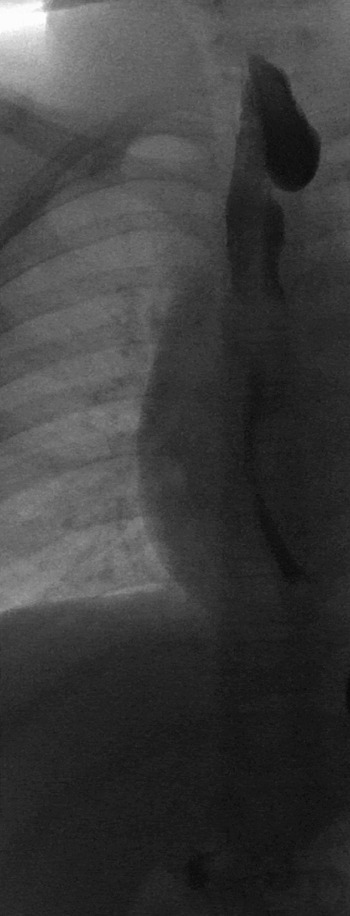
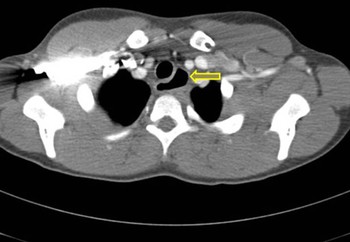
A contrast barium swallow study and computed tomography scan showed a pouch in the upper third of the oesophagus in the region of the previous oesophageal duplication cyst (Figures 1 and 2).
Barium swallow study demonstrating collection of contrast in a left-sided pouch in the upper third of the oesophagus, at the site of the previous duplication cyst.

Axial computed tomography scan showing a large, left-sided pouch (arrow).

A rigid pharyngoesophagoscopy confirmed a pouch at the level of the cricopharyngeus muscle, and the child was hence referred to the otorhinolaryngology team for further treatment.
The child was subsequently seen in the otolaryngology out-patient department and underwent pharyngoesophagoscopy, which identified a shallow, broad pouch unsuitable for stapling. A decision was made to opt for conservative treatment, with follow up in the ENT out-patient department.
Discussion
Zenker's diverticula are pulsion diverticula which typically present in the elderly population. They are more common in males and present more frequently on the left side. There is no consensus regarding the pathophysiological cause of the condition. Hypothetical explanations include congenital muscular defects, muscular incoordination, muscular spasm and gastro-oesophageal reflux disease.Reference Dokucu, Fabre, Otçu, Sari, Onen and Oztürk3 Abnormalities of the cricopharyngeus muscle have also been mentioned, including incomplete cricopharyngeus muscle relaxation, elevated resting tone of the upper oesophageal sphincter, loss of cricopharyngeus muscle elasticity, cricopharyngeus myopathy and denervation atrophy. Patients normally present with dysphagia, regurgitation of undigested food, a sensation of food sticking in the throat, halitosis, noisy deglutition and unexplained weight loss. They may also suffer aspiration, which can lead to pneumonia.
Zenker's diverticula are exceedingly uncommon in children; at this age, most are of congenital origin.Reference Fiser, Euler and Golladay4 They typically present in newborn babies with regurgitation of milk and secretions. The cause relates to a weak muscular point at the pharyngoesophageal junction at the time of birth.Reference Van Overbeek5 These lesions are indistinguishable clinically and radiologically from non-congenital diverticula. Nevertheless, they can easily be identified pathologically due to their complete muscular walls.Reference Theander6
Our patient had a unique presentation of an acquired diverticulum at the site of excision of a previous oesophageal duplication cyst. We suspect that muscle weakness at the site of surgery, coupled with two operations at the same site, had eventually led to herniation and development of the diverticulum.
The management of Zenker's diverticula has been controversial. Botulinum toxin may be used to provide temporary relief of dysphagia.Reference Spinelli and Ballardini7 A number of surgical interventions exist, including cricopharyngeal myotomy, dilatation, invagination, diverticulopexy, diverticulectomy and endoscopic myotomy.Reference Westrin, Ergun and Carlsoo1 Our patient had a shallow diverticulum which was not suitable for endoscopic stapling or resection, and we thus opted for a conservative approach.