Introduction
A major and complex challenge when trying to support individuals with behavioral and psychological symptoms of dementia (BPSD) is understanding and assessing their needs and, based on that, providing adequate support. It is crucial to appropriately recognize and describe the symptoms, and accurately distinguish between different symptoms to be able to understand BPSD for the individual. This can be challenging not only considering overlap between symptoms, but also because of difficulties in interpreting different behaviors in people with impaired verbal communication skills (Cerejeira et al., Reference Cerejeira, Lagarto and Mukaetova-Ladinska2012). How behaviors are interpreted will heavily affect what care interventions will be applied. According to Johansen and O'Brien (Reference Johansen and O'Brien2016), it is important that nursing staff analyze the current situation and evaluate all available information and options before making a decision and deciding on nursing actions. In this, the clinical reasoning between nursing staff is important since it renders different perspectives and interpretations to be addressed.
BPSD, also known as neuropsychiatric symptoms, affects more than 90% of individuals at some point during the course of the disease (Bergh et al., Reference Bergh, Engedal, Røen and Selbæk2011). The symptoms fluctuate and vary over time (Woods et al., Reference Woods, Yefimova and Brecht2014), and people with dementia may present non-characteristic symptoms, making it harder to assess and distinguish different BPSD. BPSD is associated with impaired functional ability (Peters et al., Reference Peters2006), misuse of medication (Wetzels et al., Reference Wetzels, Zuidema, de Jonghe, Verhey and Koopmans2011), decreased quality of life (Karttunen et al., Reference Karttunen2011), and increased healthcare costs (Herrmann et al., Reference Herrmann2006). In addition, BPSD also constitutes a major challenge and distress for nursing staff and relatives (Zwijsen et al., Reference Zwijsen2014; Feast et al., Reference Feast, Orrell, Russell, Charlesworth and Moniz-Cook2017).
A significant issue regarding the interpretation and evaluation of BPSD relates to the source of the information. It is difficult even for professional nursing staff to understand the needs of a person with dementia whose verbal communication has been impaired (Holst and Hallberg, Reference Holst and Hallberg2003). To be aware of and understand the discrepancies of the sources is important to determine the usefulness and limitations of the information obtained (Cerejeira et al., Reference Cerejeira, Lagarto and Mukaetova-Ladinska2012). Caregivers may have incomplete or inaccurate perceptions of BPSD and may misinterpret symptoms and, therefore, overestimate or underestimate them (Stella et al., Reference Stella2015). The assessment of BPSD requires information from a reliable relative or caregiver to be able to collect specific and detailed information about the situation and the behavior (Cerejeira et al., Reference Cerejeira, Lagarto and Mukaetova-Ladinska2012). However, the caregiver may not have the skills to perform sophisticated observations, and the periods of available observations may be shorter and fewer when information is provided from, for example, visiting nurses (Conn and Thorpe, Reference Conn and Thorpe2007). Another issue might be that the information may be influenced by the level of distress that the symptom causes (Zwijsen et al., Reference Zwijsen2014), or the relationship between the individual providing the information and the person with dementia (Conn and Thorpe, Reference Conn and Thorpe2007).
To support the assessment and evaluation of BPSD, several instruments have been developed. Currently, one of the most widely used and recommended (Jeon et al., Reference Jeon2011) for people living in nursing homes is the Neuropsychiatric Inventory Nursing Home version (NPI-NH). It is care-provider-based and developed to assess neuropsychiatric symptoms (BPSD) in individuals with mild, moderate, and advanced dementia. The NPI-NH is thoroughly validated and established in several languages (Cummings, Reference Cummings1997). It consists of a semi-structured interview retrospectively evaluating 12 different symptoms that are common in dementia: delusions, hallucinations, agitation/aggression, depression/dysphoria, anxiety, elation/euphoria, apathy/indifference, disinhibition, irritability/lability, aberrant motor behavior, night time disturbances, and appetite/eating change. The structure of the NPI-NH consists of a screening question for each domain to determine if changes in behavior exist. If the answer is positive, probing questions are assessed. The questions concern behaviors that have been present in the last four weeks that were not characteristic of the person prior to the onset of dementia. For each of the 12 domains, the frequency and severity of the symptoms are rated (Cummings, Reference Cummings1997). In Sweden, an assessment with the NPI-NH is included as a fundamental part of a quality register called BPSD-registry (www.bpsd.se). The BPSD-registry consists of repeated measurements of the frequency and severity of BPSD per the NPI-NH, analysis of needs, intervention design, and evaluation, and has, for example, been described in Emilsson et al. (Reference Emilsson, Lindahl, Köster, Lambe and Ludvigsson2015) and Krysinska et al. (Reference Krysinska, Sachdev, Breitner, Kivipelto, Kukull and Brodaty2017). The registry has been shown to reduce BPSD and increase quality of life in people with dementia (Mayer et al., Reference Mayer, Granvik, Minthon and Nägga2014). However, the usage of structured instruments has general concerns, such as statements being interpreted differently; choices provided by the instrument may not be applicable to the situation at hand, as well as limiting and restricting the communication of relevant information (Taylor, Reference Taylor2005). Despite the many strengths of the original NPI-NH, various weaknesses and limitations have been identified, such as a few items are specific to capture symptoms most evident in advanced dementia and that caregiver reports may be influenced by caregiver mood, cultural beliefs, and the educational level of the caregiver (de Medeiros et al., Reference de Medeiros2010).
In summary, the ability to detect and evaluate different behaviors to determine when to intervene is essential for the person with dementia. However, understanding the perspective of an individual whose verbal ability has been impaired is challenging. In addition, the disease and its needs are ever changing and assessing behaviors based upon observations is difficult. To assist with the assessment process, the current use of the NPI-NH is internationally accepted. Even though the NPI-NH is thoroughly validated and has several advantages, there are also challenges with implementing the system. Thus, understanding both how nursing staff reason when assessing BPSD and how the NPI-NH supports the assessment is important to develop the knowledge concerning the complexity of understanding BPSD and assessing the symptoms with a structured instrument. Therefore, the importance of studying how nursing staff makes use of the NPI-NH in the assessment process in a natural setting becomes clear. Consequently, the aim of this study was to explore clinical reasoning employed by assistant nurses when utilizing the NPI-NH as a tool to assess frequency and severity of BPSD in individuals with advanced dementia.
Methods
The study utilizes a qualitative approach based on a method of empirical discourse analysis in which clinical reasoning exercised by assistant nurses when assessing BPSD was in focus (Wetherell and Potter, Reference Wetherell, Potter and Antaki1988; Gill, Reference Gill, Bauer and Gaskell2000; Hodges et al., Reference Hodges, Kuper and Reeves2008). The discourse analysis focused on the activities in the clinical reasoning, as well as the manner in which argumentations were translated into actions.
Participants and context
Twenty-one assistant nurses who worked at eight different dementia units within five different nursing homes in northern Sweden were included in the study. All included nursing homes were connected to the BPSD-registry prior to inclusion in the study, meaning that they used a structured system for assessing BPSD, relying on the NPI-NH. As a part of the BPSD-registry the nursing staff had completed a web-based training encompassing basic knowledge of dementia and BPSD, as well as training in administering NPI-NH. Criteria for participation were assistant nurses who ordinarily participated in the structured assessment sessions of BPSD. In each session, there were usually two assistant nurses participating; both participants were involved in the daily care of the individual with dementia being assessed, and one had specific training in administering the NPI-NH. Most of the participants had a high school diploma within nursing and extensive experience working in dementia care. The assistant nurses included in the study had a mean age of 49 (range 23–64). There were 20 women (95%) and 1 man (5%). They had worked between 4 and 38 years (mean 21) and most of them (90 %) had received special education in the care of people with dementia.
The assessment sessions were conducted as a part of the daily work in the nursing homes and the NPI-NH was administered by an assistant nurse trained in using the instrument. The questions in the instrument were read and discussed, and the assistant nurses decided together whether the behavior described was present or not. If the behavior were regarded to be present the frequency and severity were rated. The first author, a specialized geriatric care nurse and PhD student with experience in working with people with advanced dementia, conducted the data gathering, but did not take an active part in the clinical reasoning. The assistant nurses gave their verbal and written consent to participate in the study. A proxy for the person with dementia was informed and consented to a researcher attending and audio recording the assessment. Ethical approval was obtained by a Regional Ethical Review Board for research, No. 2013/10-31.
Data collection
The assessment sessions, which were audio recorded by the first author, were collected during 2015–2016. In total, 20 structured assessment sessions were recorded, which lasted from 7 to 81 min, and the original audio recordings were handled as the unit of analysis.
Data analysis
Data were analyzed as a joint effort by the team of authors. The second, third, and fourth authors were all trained researchers and experienced in qualitative research. The focus was on nursing staff's reasoning process leading to a shared assessment and decision. Therefore, we chose a method of discourse analysis focusing on the content and the activities in the communication to analyze the original audio recordings (Wetherell and Potter, Reference Wetherell, Potter and Antaki1988; Gill, Reference Gill, Bauer and Gaskell2000), in accordance to the objectives of this study. This supported us to maintain the process of reasoning between the participants as a whole, instead of dividing to separate pieces. The original audio recordings were used as the unit of analysis in order to reduce the risk of neglecting important aspects of naturally occurring speech when transcribing. This approach may also strengthen interpretation and analysis, as the researcher may remain in-context and respect coherence and narrative flow when analyzing a spoken conversation as opposed to text (Wainwright and Russell, Reference Wainwright and Russell2010). To handle the large data sets, the qualitative data analysis software NVivo 11 plus was used (Zamawe, Reference Zamawe2015). With the software, it was possible to select segments of the recording for coding, define and organize coding and information, and analyze relationships and themes in the data. The software could handle the original audio recordings as the unit of analysis. This strategy was used since transcriptions of the large data set may result in misinterpretation of meaning, and it is preferable to use recorded sounds in analysis of data comprising naturally occurring social interaction (Hutchinson, Reference Hutchinson2005).
The process of analysis was carried out in several steps following the principles outlined by Gill (Reference Gill, Bauer and Gaskell2000) and Wetherell and Potter (Reference Wetherell, Potter and Antaki1988). Using this method, we made attempts to explain and, from there, comprehend the way people talk about and understand the world, and the different patterns that these utterances follow when they perform structured assessments of BPSD. The entire audio recordings were first listened to several times to become acquainted with the content and to gain insight into the recording as a whole. To explore the reasoning within different aspects of the NPI-NH, the next step was to divide, label, and sort sequences of the audio recording per the structure of the NPI-NH. After all audio sequences had been sorted and labeled, each statement or utterance within each sequence was coded with more detailed descriptions of the content. In this process, the coding units were established through rules for interpreting the features of speech as, for example, signs of genuine certainty. When multiple codes were possible, different interpretations were discussed within the research group to reach agreement. The next step in the analysis was to search for patterns of both differences and consistencies by posing questions to the data. These patterns helped to sort and group all coded audio segments together to describe similarities and differences. In the next step, the audio sequences were then listened through again and a descriptive running text was formed for each sequence. The text was the basis for further interpretation and for forming categories of ways of reasoning in a process of abstraction in several steps. Finally, a synthesis was formed based on an interpretation of the categories.
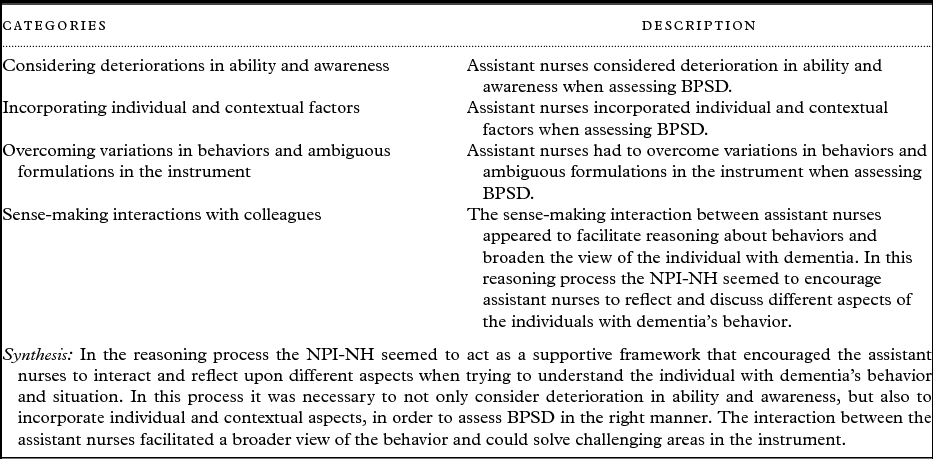
Overview of the categories and synthesis with a short description of the content

Results
The manners of reasoning employed by the assistant nurses are presented as categories followed by a synthesis of the results.
Considering deteriorations in ability and awareness
Questions in the instrument that required verbal communication from the person with dementia were experienced as difficult to assess by the assistant nurses. Questions such as, “Does XX complain of butterflies in his/her stomach, or of racing or pounding of the heart because of being nervous?” for which the person was supposed to narrate and describe his or her experiences, or use metaphorical expressions, could complicate the assessment. Assistant nurses expressed that the person with dementia had deterioration in the ability to perform many of the aspects described in the follow-up questions in the NPI-NH. They also stated that it was difficult to know what the person with dementia felt and experienced, since the person could seldom describe what he or she was feeling and why.
Assistant nurses explained that certain behaviors that could be interpreted as signs of BPSD were often more likely consequences of cognitive disabilities making the assessment complicated. For example, having a different perception of reality, which caused the person with dementia to act in a particular way, could be assessed as BPSD. Related to this were challenges in relation to deteriorated awareness of time and the surrounding environment. There were questions in the instrument that asked the person with dementia about his or her awareness of time and the ability to remembering upcoming activities, such as, “Does XX say that s/he is worried about planned events such as appointments or family visits?”. These questions could make assistant nurses hesitant, since the person with dementia had not had the ability for long. Questions as, “Does XX talk openly about very personal or private matters not usually discussed in public?” that involved the individuals with dementia to be aware of where they were and with whom they were interacting were also challenging to assess, since the individuals were often both unaware of their behavior and in what place they were located. Questions in the instrument requiring that the person with dementia understood his or her own behavior as being inappropriate, such as, “Does XX seem to have a childish sense of humor with a tendency to giggle or laugh inappropriately (such as when something unfortunate happens to others)?” caused assistant nurses to be uncertain as to how to assess the behavior. They expressed that the individuals with dementia had lost the ability to judge and value their own actions, meaning that even though they had challenging behaviors, they did not intentionally act or behave inappropriately.
Incorporating individual and contextual factors
Assistant nurses regarded some BPSD-like behaviors of the person with dementia as understandable and explainable by the specific situation and context in which they occurred. For example, the context allowed for strangers to talk to each other in a way that might not have been appropriate elsewhere. This made it challenging to answer questions such as, “Does XX talk to total strangers as if s/he knew them?” and decide whether BPSD or the situation caused the behavior. Care interventions and restrictions used to hinder the person with dementia from performing and developing behaviors made assistant nurses question how to assess the situation. They argued that without the care interventions and restrictions, the behavior would be present, but with these methods in place, the behavior was limited or not present at all, which was challenging to assess. Not knowing how the person had been and acted previously in life, as well as what preferences the person had earlier in life, caused difficulties for the assistant nurses when analyzing observed behaviors. When the assistant nurses lacked this knowledge, they expressed that it was difficult to assess if behaviors should be regarded as pathological or if they were a part of the personality of the individual in question.
Overcoming variations in behaviors and ambiguous formulations in the instrument
The assistant nurses argued that variations in behavior made it difficult to construct an overall and comprehensive picture of the situation, since the participants were not constantly present and only knew about the behaviors that happened when they were working. They also expressed that it was aggravating to assess behaviors that seldom occurred, fluctuated often, or only occurred in situations in which the behavior was understandable, e.g. if the person was provoked. This complicating aspect meant that the behavior was only rated in the assessment process when it was at its worst, meaning that lower levels were not assessed even though they occurred more frequently.
The assistant nurses expressed that it was challenging to assess behaviors when there were ambiguous formulations in the instrument. For example, they became uncertain how to interpret questions as, “Does s/he believe any other unusual things that I haven't asked about?” which required the assistant nurses to think of examples of behaviors or activities aside from the ones already stated in the instrument. The assistant nurses also argued that the questions that consisted of several examples or two parts, such as, “Does XX say crude things or make inappropriate sexual remarks?” were challenging to assess. These formulations often led to that only certain aspects of the question were addressed, and that other aspects were neglected. Contrary to this problem, certain questions in the instrument included examples that supported reasoning tactics employed by the assistant nurses. For example, “Does XX fail to show emotional reactions that would be expected (happiness over the visit of a friend or family member, interest in the news or sports, etc.)?” provided the assistant nurses with examples that could be used to compare against the behavior of the person being assessed.
Sense-making interactions with colleagues
The questions in the instrument seemed to encourage assistant nurses to reflect and discuss different aspects of the individuals with dementia's behavior. These discussions appeared to facilitate reasoning about behaviors and, in this way, broaden the view of the behavior. Even when the information was limited or incoherent, they could jointly put together the pieces of information and thus, reach an understanding of the behavior. They counter argued when they disagreed, and provided alternative explanations to compare to opinions given by the other participant. Although this appeared to support the assistant nurses when elaborating and further developing the understanding of behaviors and manners of interpreting them, in some situations, the discussions caused more uncertainties to arise. In situations of uncertainty, it seemed even more important to continue discussing and arguing with each other by giving suggestions, confirming thoughts and opinions, and describing the behavior.
By giving descriptions of observed behavior, the conduct could be viewed from different perspectives. Therefore, participants could discuss whether the behavior could be related to the question in the NPI-NH, determine how often it occurred, and assess if the behavior could be changed or controlled. The assistant nurses also gave descriptions of observed behavior and situations that contradicted with the question to mark that the behavior did not exist. By contrasting present behavior to previous conduct, prior assessments, or the behavior of other residents, the assistant nurses could compare and gain a deeper understanding of the current behavior of the person assessed. They used examples more often when they were uncertain and wanted a confirmation from the other participant, not only to confirm that they had observed the same thing, but also to verify that the behavior had been understood in the correct manner, relative to the question in the instrument.
Synthesis of the categories
In the reasoning process, assistant nurses used the content and structure of the NPI-NH as a supportive framework for interpretation, rather than a tool that could provide specific answers. Contributing to this was that some of the specific questions attached to the different dimension in the instrument could be challenging to apply to the situation of the individual person with advanced dementia, due to his or her verbal difficulties in expressing feelings and experiences. There were necessities to incorporate individual and contextual aspects in the assessment in order to assess BPSD in the right manner. For example, was the perceived behavior caused by the context, a part of the personality of the individual, or a logical response for the individual?
NPI-NH as a supportive framework encouraged the participants to interact and discuss to broaden and elaborate on the understanding of the observed behavior. Challenging areas in the instrument could be solved in the dialogue between the participating assistant nurses. The quality of the assessment was enhanced through a combination of the structured questions, and interaction through discussions between the participants, for which specific knowledge of the person with dementia and his or her life story was important.
Discussion
The results of this study indicate that assistant nurses used the content and structure of the NPI-NH as a supportive framework that supported them to view different aspects when trying to understand the individual with dementia's behavior and situation. There were necessities to considerate individual and contextual aspects in the assessment in order to assess BPSD in the right manner. However, the interaction with colleagues can be interpreted as a search for sense-making and common understanding by presenting arguments on how to understand and interpret the person with dementia and his or her behaviors. The dialogue can be illuminated by Habermas (Reference Habermas1984), who described that through communication, people try to understand not only the world and the people around them, but also their own intentions and feelings. This communicative action consists of a mutual deliberation and a search for a shared understanding, driven by the compelling power of the better argument. To reach a shared understanding, there needs to be some degree of trust and no claim for power between the participants.
In this study, the reasoning and discussions between assistant nurses when using the NPI-NH seemed to assist them to view and assess different alternatives, described by Dowding et al. (Reference Dowding2004) as making a judgment. When making judgments, assistant nurses appeared to use a process of hypothetico-deductive reasoning in which available information was used to formulate hypotheses that were then evaluated and reformulated until a common conclusion was reached. This way of reasoning has also been shown to be employed when nursing staff assess pain in people with dementia (Dowding et al., Reference Dowding2016). Eriksen and Weigård (Reference Eriksen and Weigård2003) remarked that this way of reasoning does not guarantee an arrival at the right answer every time, but rather it guarantees that the answers are continuously tested when there are reasons to question them. The reasoning process of the assistant nurses in this study supported them to reach a deeper and consensual understanding by testing their thoughts and opinions against each other. Habermas (Reference Habermas1984) explained that a fundamental condition for communicative actions to reach a mutual understanding is that the participants use the same vocabulary and understand the meaning in the communication in the same way. In this study, the structure in the NPI-NH contributed to a common language for the assistant nurses when assessing BPSD, as well as a way to understand the meaning in the communication in the same way. This structure can be seen as an important tool that enhanced the consensus in the conversations between the assistant nurses, which otherwise may have not only been performed and unstructured differently from time to time, but also with different meanings in the communication.
In this study, the NPI-NH supported assistant nurses to evaluate and structure the observations of behavioral cues to identify the presence of BPSD. The usage of the NPI-NH can, therefore, be seen as beneficial both for the communication process and the course of reasoning. However, Habermas (Reference Habermas1984) argued that there is a risk when trying to steer the communicative process towards a given purpose and structure, and thus, making it more instrumental. The consequence of this is that the communication that should aim to reach an understanding might instead be replaced with communication based on impersonality and alienation. The ability to reach an understanding of many processes involves a need for this deliberative communicative action to take place, and it cannot be transformed into instrumental and purpose-steered action. In this study, assistant nurses used the instrumental and purposive structure of the NPI-NH as a supportive and important framework for their reasoning, rather than a tool that could provide specific answers. In this process, they gained support from the instrumental framework to enhance their understanding of the assessed behaviors, but still used communicative action to reach a consensual understanding of the behaviors.
In this study, the assistant nurses worked shift and were not always present to observe the person with dementia, which made it difficult for them themselves to have an overall and comprehensive picture of the behavior and the situation in which it occurred. Dowding et al. (Reference Dowding2016) suggested that the assessment and management of symptoms and behaviors of people with dementia with impaired verbal communication skills is distributed across individuals and over time. Assessing and managing complex symptoms and behaviors should be a collective task in which different aspects are executed by different individuals; it is when these aspects are gathered that a comprehensive picture of the situation is created. It was evident that the assistant nurses in this study needed to perform a thorough preparation and gathering of information before the assessment to strengthen the reasoning and the quality of the assessment. Thus, it is important to increase opportunities for them to reason and interact not only during the assessment process, but also over time. O'Neill (Reference O'Neill1996) showed that knowing the person affects clinical inferences and enhances the range of alternatives that nursing staff reflect upon before determining nursing actions. In this study, knowledge of the person with dementia supported the explanation and understanding of behaviors by enabling assistant nurses to view a wider range of alternatives and causes. This, in turn, is important to not incorrectly assess behaviors that would be regarded as understandable if the nursing staff had knowledge about previous routines, habits, preferences, and personality, as BPSD. Tan et al. (Reference Tan, Adzhahar, Lim, Chan and Lim2014) describe the transactive memory system that may help nursing staff remembering something collectively. By combining their individual memories through communication, nursing staff can tap upon the distributed knowledge about the individual with dementia and the professional expertise that resides within the team to acquire, and retrieve relevant information. This in turn may help them to overcome the challenges of variations in behaviors and incorporating individual and contextual factors in the assessment process, as well as circumvent limitations, such as not being present at all times or not knowing the prior preferences of the individual with dementia.
The result of this study shows that assistant nurses need to assess and understand behavior in relation to the context and the situation in which it occurs. Habermas (Reference Habermas1984) emphasized that context may act as an important part when trying to reach a shared understanding. However, Gitlin et al. (Reference Gitlin, Marx, Stanley, Hansen and Van Haitsma2014) illuminated that none of the existing measurements for assessing BPSD identify risk factors for behaviors or enable an evaluation of the context in which they take place, including the NPI-NH. The interaction and reasoning between assistant nurses in this study included descriptions that provided valuable clues to identify causes and context-related factors. Gitlin et al. (Reference Gitlin, Marx, Stanley, Hansen and Van Haitsma2014) denoted the importance of paying attention to potential causes and risk factors to find strategies that minimize their contribution to BPSD. This would also support nursing staff when choosing appropriate nursing actions to meet the assessed needs (Johansen and O'Brien, Reference Johansen and O'Brien2016). To provide a care regime that focuses on preventing BPSD and minimizes the situations that causes these symptoms, the communicative actions during the assessment process are essential. The very purpose of assessing and evaluating BPSD is to try to better understand the individual and support him or her. To achieve this, we suggest that nursing staff in this context is trained in using the NPI-NH, in combination with raising awareness of the importance of conversations during the clinical reasoning process. The combination of the supportive structure in the NPI-NH, along with opportunities for interaction and conversations between assistant nurses that go beyond the formulations in the instrument, can be seen as fundamental parts to view different dimensions and reach a consensual understanding of the person with dementia.
Limitations
In this study, 20 different audio recordings were used to provide a picture of patterns in the reasoning used when assessing with the NPI-NH. It is a sufficient number for patterns to be repeated and for variations to appear. However, there is a risk that certain reasoning may not have occurred in the sample. Even though discourses are constructed within a particular context, and thus, can be seen as occasional (Gill, Reference Gill, Bauer and Gaskell2000), the data in this study were collected from eight different wards within five different nursing homes in two different cities, building a variation of contexts and increasing the possibility of transferring the results to other similar settings.
To handle the large data sets and to enhance validity and rigor, the original audio recordings were used as a unit of analysis in this study (Mishler, Reference Mishler1984; Hutchinson, Reference Hutchinson2005). To try to reduce interpretative bias of the audio recordings, the first author both gathered the data and took part in the analysis. NVivo 11 plus allowed for all instances of the audio sequences and codes to be easily located and understood within their original context, which can enhance the trustworthiness of the interpretations, according to Tame (Reference Tame2009). NVivo assists with tracking changes and systematic analysis, which may enhance scientific rigor. Creating an audit trail also addresses dependability and confirmability. All of these elements aided in achieving trustworthiness. Credibility was established through constant discussions of interpretations along with reviewing the emerging codes within the research team.
Conclusion
Supporting the lives of people with severe dementia and BPSD is an essential part of the care of the elderly worldwide, and the NPI-NH is often used to support the assessment and evaluation process. Understanding the reasoning process that formulates the basis of assessing and evaluating BPSD when using the NPI-NH is important when trying to develop a care that targets the care of people who experience BPSD. The NPI-NH served as a supportive frame and structure for the reasoning performed during the assessment. By sense-making interactions with colleagues, the assistant nurses could overcome challenges when applying the structure of the NPI-NH to behaviors that were difficult to understand. The clinical reasoning employed by assistant nurses became a way to reach a consensual and broader understanding of the individual with dementia, with the support of NPI-NH as an important framework.
Conflict of interest
None.
Description of authors' roles
S. Sävenstedt and C. Melander designed the study. C. Melander collected and analyzed the data and wrote the manuscript. S. Sävenstedt supervised the data collection and contributed to the writing and review of the manuscript together with B.-M. Wälivaara and M. Olsson.
Acknowledgments
This research was supported by funding from Vårdalstiftelsen, and was accomplished while C. Melander was affiliated with the Swedish National Graduate School for Competitive Science on Ageing and Health (SWEAH), which is funded by the Swedish Research Council.