Introduction
The US older adult population has become increasingly diverse due in part to the rapid rise in the foreign-born Asian and Latino populations, the two largest immigrant groups currently in the US (Pew Research Center, 2019). Asian Americans are the fastest-growing racial population in the US (Pew Research Center, 2015). By 2055, Asian Americans are projected to become the largest group of immigrants in the US, and by 2065, nearly two out of the five immigrants will be Asian American (Pew Research Center, 2015), yet very little is known about their trajectory of cognitive aging and Alzheimer’s disease and related dementias (ADRD) risk. Latinos comprise the second fastest-growing minority group in the US and are the largest immigrant group in the US (Stepler and Brown, Reference Stepler and Brown2016). From 2014 to 2060, the proportion of Latinos aged 65 years and older is projected to increase by 275%, compared to a 29% decrease for non-Hispanics Whites (NHWs) (Mather et al., Reference Mather, Jacobsen and Pollard2015). It is important to understand the trajectory of health outcomes for an increasingly diverse older adult population, as some research suggests older Latinos have a higher prevalence of cognitive impairment and dementia, compared to NHWs (Garcia et al., Reference Garcia and Reyes2018; Santos et al., Reference Santos2019; Tang et al., Reference Tang2001). Specifically, Mexican American older adults may face an increased risk of cognitive decline and dementia, due to a variety of social and structural factors that contribute to a higher prevalence of diabetes, obesity, low physical activity, and low educational attainment (Beard et al., Reference Beard, Markides, Al Ghatrif, Kuo and Raji2010; Centers for Disease Control and Prevention, 2014; Downer et al., Reference Downer, Kumar, Veeranki, Mehta, Raji and Markides2016). Far less is understood about Asian Americans and cognitive decline; and for both Asian and Latino immigrants, it is unclear how the experience and timing of immigration itself impact cognition.
Although there is heterogeneity in the cognitive and health outcomes of older Asian and Latino immigrants, the Immigrant Paradox or Healthy Immigrant Effect suggests that those born outside of the US have an advantage in health, including cognition, despite having lower socioeconomic status compared to their counterparts born in the US (Budhwani et al., Reference Budhwani, Hearld and Chavez-Yenter2015; Corlin et al., Reference Corlin2014; Ruiz et al., Reference Ruiz, Hamann, Mehl and O’Connor2016). The effect may be due to a selection bias in the types of individuals that choose (i.e. have unobservable social and structural advantages) and are able (i.e. physically healthy) to immigrate to the US. Characteristics of these immigrants, such as a healthier diet and more active lifestyle or collectivistic family values that provide resilience, may also be factors that protect against cognitive impairment in late life (Angel et al., Reference Angel, Angel, Díaz Venegas and Bonazzo2010; Garcia and Reyes, 2017; Xu et al., Reference Xu2018).
Empirical evidence of the paradox is demonstrated by recent research from the Health and Retirement Study, which indicated that foreign-born Mexican Americans had a 36% lower risk for incident cognitive impairment than NHWs, while US-born Mexican Americans had a 27% higher risk for incident cognitive impairment (Weden et al., Reference Weden2017). In a study by Hill and colleagues (Reference Hill, Angel, Balistreri, Angel, Torres-Gil and Markides2012) using the Hispanic Established Populations for the Epidemiologic Study of the Elderly (H-EPESE), Mexican American men who immigrated to the US in midlife showed both better cognitive function at baseline as well as slower decline over time compared to US-born Mexican American men; this pattern was not observed for Mexican American women (Hill et al., Reference Hill, Angel, Balistreri, Angel, Torres-Gil and Markides2012). Similarly, Garcia and colleagues (2017) demonstrated that age at immigration as well as gender were important influences on later life cognition.
Compared to the literature on cognition in Latinos, much less is known about Asian Americans and the influence of immigration characteristics on cognitive impairment and ADRD risk. The little epidemiological work that exists suggests that dementia incidence for Asian Americans is similar or lower compared to NHWs (Borenstein et al., Reference Borenstein2014; Mayeda et al., Reference Mayeda, Glymour, Quesenberry and Whitmer2016). Findings from Honolulu-Asia Aging Study and the Kame Project suggest that Japanese living in the US have a higher prevalence of AD (HAAS: Grant, Reference Grant1999) and dementia (Kame Project: Graves et al., Reference Graves1996) compared to those living in Japan. However, a more recent study showed that second-generation Japanese had lower cognitive scores than third-generation individuals, particularly in verbal learning memory and executive function (Kemmotsu et al., Reference Kemmotsu, Enobi and Murphy2013). In this study, second-generation Japanese had fewer years of education than the third generation. The authors speculated that other unmeasured factors, such as culturally specific experiences and environment of earlier generations of immigrants from Japan (e.g. potential influences of internment) also affect cognitive processes. Results from a study by Boone and colleagues (Reference Boone, Victor, Wen, Razani and Pontón2007) indicated that associations between measures of acculturation and cognitive scores were limited to select verbal skills involving word retrieval and verbal attention span. These findings are in line with previous research conducted with healthy, ethnically diverse adults (Harris et al., Reference Harris, Tulsky, Schultheis and Tulsky2003; Razani et al., Reference Razani, Burciaga, Madore and Wong2007). Thus, it may be that immigration experiences are associated with specific domains of cognition.
Immigrant/generational status can be conceptualized broadly as a variable reflecting a specific point in time that indicates exposure to US social and cultural norms (Portes, Reference Portes1996); it is a proxy for acculturation, a process in which members of one cultural group adopt the beliefs and behaviors of another more dominant group through continuous exposure and contact (Abraído-Lanza et al., Reference Abraído-Lanza, Armbrister, Flórez and Aguirre2006; Gordon, Reference Gordon1964). The degree to which immigrants have become acculturated to US society and adopted American norms will likely affect their health beliefs, health behaviors, and subsequently their risk for cognitive impairment. The healthy immigrant perspective would suggest that those who immigrate, compared to those who are US-born have better cognition because they have not adopted the unhealthy behaviors or lifestyle that might be associated with adverse cognition. On the other hand, acculturation theories posit that a longer time in the US would be associated with social mobility and to the extent that the immigrant population achieves educational, social, and economic parity with NHWs, their cognition would be better than earlier immigrants (Portes and Zhou, Reference Portes and Zhou1993).
In this study, we attempt to address these competing theories by examining the role of immigration on cross-sectional measures of cognition in a diverse sample of older Latinos and Asian Americans. Although there are important differences between the two groups, some similarities exist, including recency of immigration (for certain subgroups) and distinct language preferences and proficiency. We first examine how generational status and age at immigration are associated with cognition in the combined sample of Latinos and Asians using data from the Kaiser Healthy Aging and Diverse Life Experiences (KHANDLE) study. Then, given the differences in Latino and Asian immigration and acculturation histories and lived experiences, we subsequently assess whether the association between immigration and cognition is modified by race/ethnicity in race-stratified analyses. Given the previous literature, we also tested for moderation by gender.
This study adds to the current literature on early life immigration characteristics and later life cognition by including a large, diverse cohort of Latino and Asian participants – both US- and foreign-born, as well as by including psychometrically sophisticated measures of cognition. Much of the prior literature in this area has relied on global cognitive measures such as the Mini-Mental State Examination (MMSE: Folstein et al., Reference Folstein, Folstein and McHugh1975), which are susceptible to bias when used with racially/ethnically or educationally diverse groups (Borson et al., Reference Borson, Scanlan, Watanabe, Tu and Lessig2005, Ramirez et al., Reference Ramirez, Teresi, Holmes, Gurland and Lantigua2006). The current study also extends the knowledge base by utilizing a psychometrically robust neuropsychological battery that encompasses several domains of cognition, tested across two often underrepresented major racial/ethnic groups.
Methods
Sample and measures
We used 2017 baseline data from the KHANDLE cohort, which comprises community-dwelling older adults residing in the San Francisco Bay and Sacramento areas of California. KHANDLE aims to evaluate how race/ethnicity and life course health and sociocultural factors influence late-life brain health and cognitive decline. Individuals eligible for KHANDLE were long-term members of Kaiser Permanente Northern California, an integrated healthcare delivery system, were aged 65 years or older on January 1, 2017, spoke English or Spanish, and had previously participated in Kaiser Permanente (KP) multiphasic health checkup exams between 1964 and 1985. Stratified random sampling by race/ethnicity and educational attainment was used with the goal of recruiting approximately equal proportions of Asian, Black, Latino, and White participants and diversity in educational attainment. Exclusion criteria included electronic medical record diagnosis of dementia or other neurodegenerative diseases (frontotemporal dementia, Lewy body disease, Pick’s disease, Parkinson’s disease with dementia, and Huntington’s disease), and presence of health conditions that would impede participation in study interviews, defined by hospice activity in the past 12 months, history of severe chronic obstructive pulmonary disease in the past 6 months, congestive heart failure hospitalizations in the past 6 months, and history of end-stage renal disease or dialysis in the past 12 months. At baseline, 1712 individuals were enrolled. Given the focus of this study, our sample consisted of the 751 KHANDLE participants who self-reported the Asian or Latino race/ethnicity.
As mentioned, participants were recruited into KHANDLE using their KP health record classification of self-reported race obtained during the multiphasic health checkup exams. Race/ethnicity was also self-reported at KHANDLE enrollment, in which participants selected any of the 24 racial/ethnic categories in addition to an open-field write-in option that was condensed into major racial/ethnic groups of Asian, Black, Latino, or White. If individuals reported multiple responses for race/ethnicity at KHANDLE baseline, and responses fell within the same of the four racial/ethnic recruitment groups (i.e. Chinese and Filipino as both Asian ethnic groups), this was categorized as a single (e.g. Asian) race. If multiple race/ethnicity classifications were self-reported at KHANDLE baseline and the race/ethnicity classifications encompassed multiple racial-ethnic groups (Asian, Latino, and White), individuals retained their primary enrollment racial/ethnic classification, with an additional indicator variable for multiracial/ethnic identity across the four major racial/ethnic groups.
Cognitive outcomes
Three cognitive outcomes (verbal episodic memory, semantic memory, and executive functioning) were derived from the Spanish and English Neuropsychological Assessment Scales (SENAS), which was given to all participants at the KHANDLE baseline assessment. Language of administration was (English or Spanish) was determined by an algorithm that considered preferred language and everyday language usage in a variety of settings (conversing at home, listening to radio or television, conversing outside the home, and preferred language for reading). The SENAS is a battery of cognitive tests that have previously undergone extensive development for valid comparisons of cognitive change across racial/ethnic and linguistically diverse groups (Mungas et al., Reference Mungas, Reed, Crane, Haan and González2004). Item response theory and confirmatory factor analysis methods were used to construct measures that are psychometrically matched across domains with respect to the level of reliability across the ability continuum. Importantly, these measures do not have floor and ceiling effects and are normally distributed in the older adult population. The episodic memory score is derived from a multi-trial word-list learning test (Mungas et al., Reference Mungas, Reed, Crane, Haan and González2004). The semantic memory measure is a composite of highly correlated verbal (object naming) and nonverbal (picture association) tasks. The executive function composite is constructed from component tasks of category fluency, phonemic (letter) fluency, and working memory (digit span backward, list sorting) (Crane et al., Reference Crane2008). Details of the administration procedures, development, and psychometric characteristics have been extensively described in previous publications (Mungas et al., Reference Mungas, Reed, Crane, Haan and González2004, Reference Mungas, Reed, Farias and DeCarli2005). Each domain was z-standardized using the full KHANDLE baseline sample mean and standard deviation across all race/ethnicity classifications.
Immigration
Our main independent variable of interest is a combination of generational status and age at immigration. We assessed generational status on the basis of nativity of the participant and the participant’s parents. A five-level categorical variable incorporating both generational status and age of immigration (in years) was created to indicate whether participants were third generation or higher (US-born participant with both parents born in the US), second generation (US-born participant with at least one foreign-born parent), or first generation (foreign born) and immigrated in childhood, in adolescence, or in adulthood. Similar to prior studies (e.g. Alegría et al., Reference Alegría, Mulvaney-Day, Torres, Polo, Cao and Canino2007) and based on the distribution of age of immigration in our sample, we classified individuals as immigrating in childhood (0–13 years of age), adolescence (14–18 years of age), or adulthood (19+ years of age).
Covariates
Demographic variables included age at interview (years), gender (male vs. female), parental education (both mother’s and father’s, each classified as less than high school, high school or more, or missing/refused), and own education (self-reported as years of schooling completed if completed 12 years or less, or as degree attainment if greater than 12 years: some college, associate degree, bachelor degree, master’s degree, doctoral, or equivalent professional degree). Given that KHANDLE enrolled Latino participants who could be tested in English or Spanish, while Asian participants could only be tested in English, we included an additional indicator for interviewer rating of participant’s familiarity with the English language: (1) illiteracy or major cultural differences, (2) lack of facility in English, or (3) English was not the first language. This variable was scored as 0 for no problems or 1 if the interviewer noted any one of these three issues.
Data analysis
We conducted χ2 and t-tests to examine Latino and Asian group differences on the main variables of interest and demographic covariates. In the complete sample, we used domain-specific linear regression analyses to estimate the effect of immigration variables separately on domains of verbal episodic memory, semantic memory, and executive function. Model 1 included the effects of immigration, controlling for age, gender, and race/ethnicity. Model 2 included effects in Model 1 with the addition of parental education and familiarity with English. Model 3 included effects in Model 2 with the addition of own education, which was conceptualized as both a potential confounder and mediator. In all models, we tested for effect heterogeneity between immigration and cognition by gender and between immigration and race/ethnicity (Latino vs. Asian), defined as a significant (p < 0.05) interaction between gender or race/ethnicity and the immigration indicator.
Results
Descriptive analyses
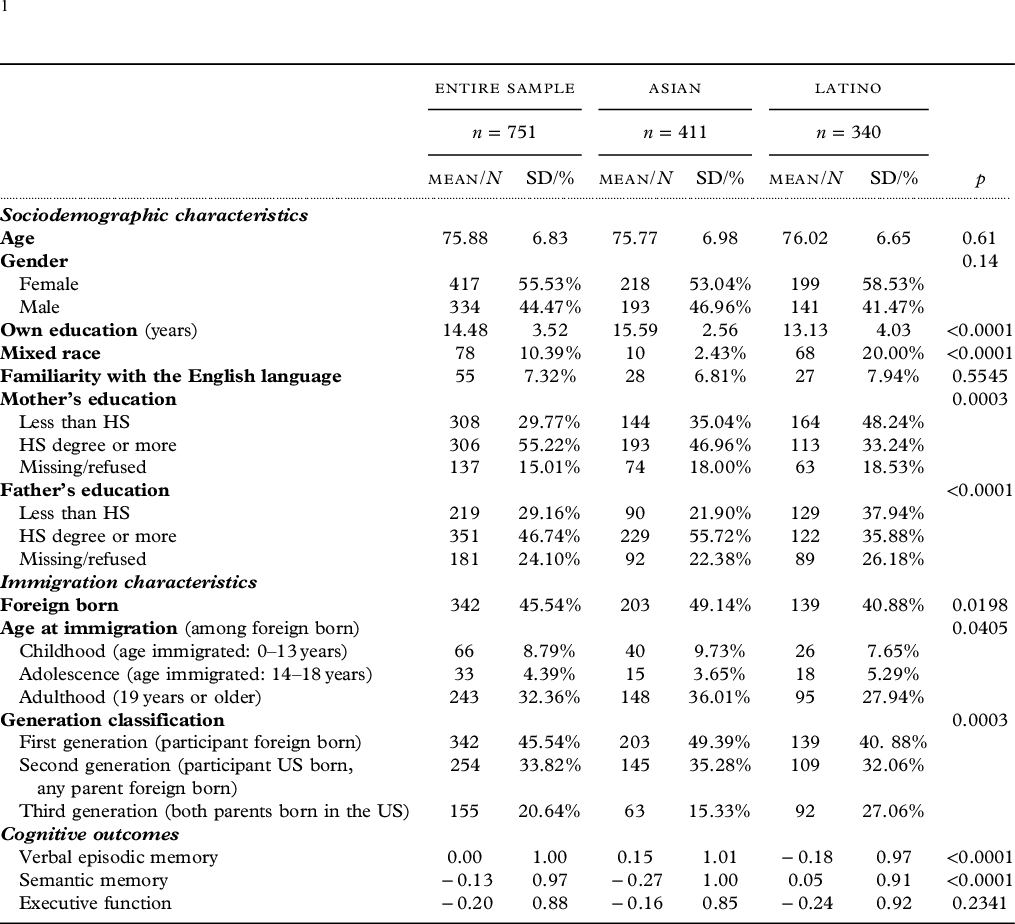
Table 1 presents the characteristics of the 751 participants in the study by race/ethnicity. Mean age of participants was 75.9 years (SD = 6.8) and the majority were female (55.5%). On average, Asian participants had more years of education (M = 15.6) than Latinos (M = 13.1), and had higher scores on verbal episodic memory (Asian: 0.2 ± 1.0; Latino: −0.2 ± 1.0; p < 0.01), while Latinos had higher semantic memory scores (Asian: −0.3 ± 1.0; Latino 0.1 ± 0.9; p < 0.01). In terms of immigration characteristics, a higher percentage of Asian participants (49.1%) reported being foreign-born compared to Latinos (40.9%; p = 0.02), and Asian participants reported being older at immigration (22.2 ± 10.8 years) compared to Latinos (20.4 ± 9.5 years; p = 0.10). Poor English language familiarity noted during interviews did not differ across race/ethnicity (Latino: 7.9%; Asian: 6.8%; p=0.55).
Demographic characteristics of the sample

Cognitive outcomes
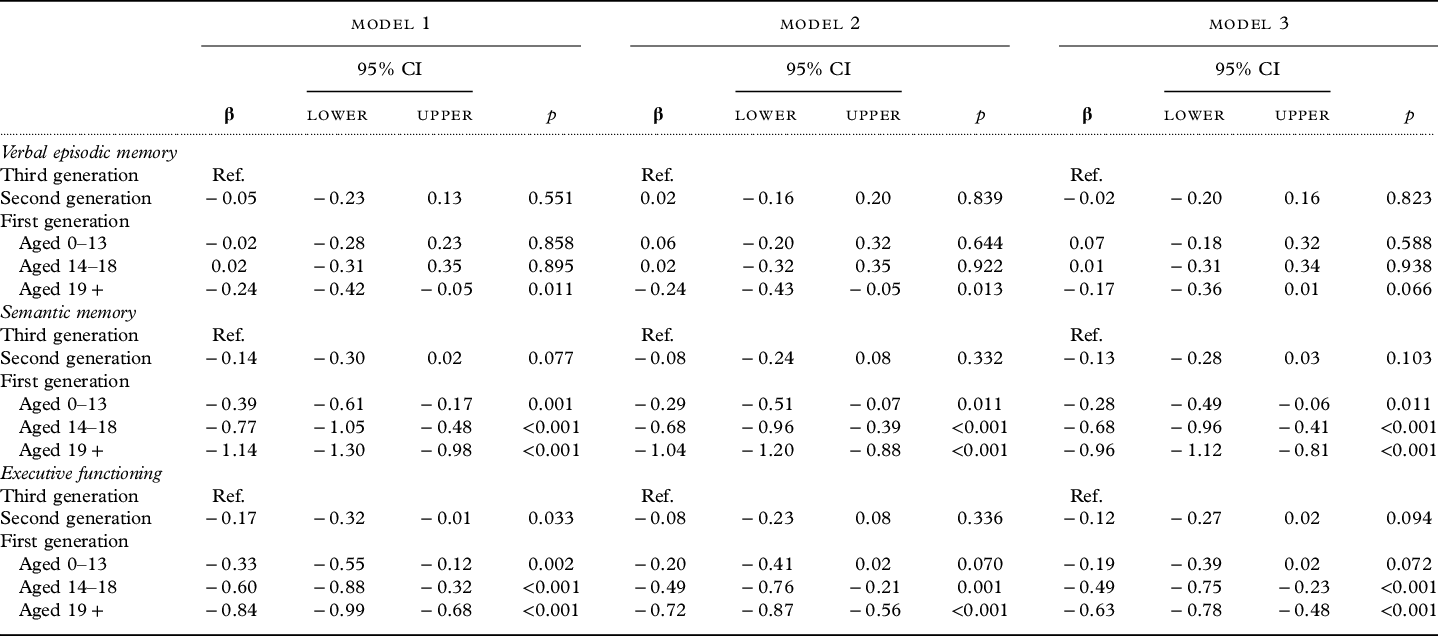
In Table 2, we present linear regression results for each cognitive outcome. Analyses indicated no significant modifying effect of gender or race/ethnicity on the relationship between immigration age and cognition for verbal episodic memory and executive functioning; thus, pooled results are presented (although nonsignificant p-values are shown below). After adjustment for own education, the relationship between immigration age and semantic memory was modified by race/ethnicity but not gender (described below).
Adjusted associations between immigration and cognitive outcomes for entire sample

Model 1 is adjusted for age, gender, primary race/ethnicity, and mixed-race status. Model 2 adjusts for covariates in Model 1 with additional adjustment for parental (mother’s and father’s) education and English language familiarity. Model 3 adjusts for covariates in Model 2 with additional adjustment for own education (in years). The reference group is third generation (US-born participant with US-born parents).
Verbal episodic memory
In Model 1, verbal episodic memory scores were similar for third generation (reference group: US born with both parents born in the US) compared to second-generation individuals, or those who immigrated at the age of 18 or younger; however, immigrating as an adult (19 years and older) was related to lower episodic memory scores (β = −0.24; 95% CI: −0.42, −0.05; p = 0.01) compared to third generation or higher participants. After controlling for parental education (Model 2), immigrating as an adult was still related to lower episodic memory (β = −0.24; 95% CI: −0.43, −0.05; p = 0.01). However, the effect was attenuated after adjusting for own education in Model 3 (β = −0.17; 95% CI: −0.36, 0.01; p = 0.07). No significant interaction between gender and immigration (p = 0.33) or between race/ethnicity and immigration (p = 0.09) was observed for verbal episodic memory.
Semantic memory
Compared to third generation or higher, participants classified as second generation had slightly lower semantic memory (β = −0.14; 95% CI: −0.29, 0.02; p = 0.08), and first-generation immigrants also had lower semantic memory scores, with a graded association by age of immigration. Compared to third generation or higher immigrants, immigration in adulthood was associated with lower semantic memory (β = −1.14; 95% CI: −1.30, −0.98; p < 0.01) than immigration in adolescence (β = −0.77; 95% CI: −1.05, −0.48; p < 0.01) or childhood (β = −0.39; 95% CI: −0.61, −0.17; p < 0.01). Effects were slightly attenuated, but the pattern of results and null hypothesis tests did not change after controlling for parental education in Model 2 or their own education in Model 3. We found a significant interaction effect for race/ethnicity in Model 3 (p < 0.01) for semantic memory. Among those who immigrated as adults, Asians had lower average semantic memory scores than Latinos (see Supplementary Table 1).
Executive function
In Model 1 those who were third generation had higher executive function scores than second generation (β = −0.17; 95% CI: −0.32, −0.02; p = 0.03) individuals, but results were not significant after adjustment for own and parental education. Similar to semantic memory, compared to participants classified as third generation, all foreign-born participants had lower executive functioning scores. However, across immigration age groups, immigration in adulthood was associated with lower executive function (β = −0.84; 95% CI: −0.99, −0.68; p < 0.01) than immigration in adolescence (β = −0.60; 95% CI: −0.88, −0.32; p < 0.01) or childhood (β = −0.33; 95% CI: −0.55, −0.12; p < 0.01). Effects were slightly attenuated and effects of immigration in childhood for executive functioning were no longer significant after adjustment for parental education (p = 0.07) and further adjustment for own education (p = 0.07). We found no significant interaction between gender and immigration or between race/ethnicity and immigration for executive functioning.
Summary of results
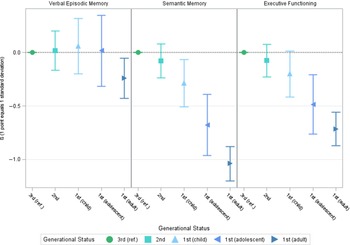
Figure 1 displays the summary of results: overall, those who immigrated as adults had lower scores in all three cognitive domains. For semantic memory and executive functioning, a trend emerged such that third-generation individuals (US born with both parents born in the US) had the highest cognitive scores, followed by second-generation immigrants (US born with one parent born in the US), followed in a graded fashion by first generation (immigrants) who arrived in childhood, adolescence, and adulthood.
Association of generational status, age at immigration, and cognitive outcomes. Error bars indicate 95% confidence intervals.

Discussion
Our results indicate that the impact of immigration differs across cognitive domains, ranges from small-to-medium to large-to-very large, and is dose/exposure dependent. We found very strong effects for semantic memory and executive function and more length of time exposure to US culture was associated with better cognitive scores. Thus, cognitive scores of second-generation individuals resembled the third generation, while for those who were foreign-born, older age at immigration was associated with progressively lower cognitive scores.
In this cross-sectional analysis, our findings did not support the Healthy Immigrant Effect. However, they are consistent with Gonzalez et al.’s (Reference Gonzalez, Ceballos, Tarraf, West, Bowen and Vega2009) analysis of cross-sectional data of Mexican immigrants and Jang et al.’s (Reference Jang, Choi, Rhee, Yoon, Park and Chiriboga2020) data with Korean Americans showing a longer length of time in the US was associated with higher levels of cognitive functioning. Results also corroborate findings from the Sacramento Area Latino Study on Aging, which indicated that more acculturated individuals performed better on cognitive measures than less acculturated individuals (Martinez-Miller et al., Reference Martinez-Miller2020). From a broad sociological perspective, increasing generations (i.e. second, third, etc.) can be viewed as a marker of cumulative exposure to a new sociocultural and physical environment. In this regard, our study provides evidence of an acculturation advantage whereby being born in the US or immigrating as a child affords some advantage on cognitive performance not present in earlier generations. We use Castaneda et al.’s (Reference Castañeda, Holmes, Madrigal, Young, Beyeler and Quesada2015) discussion of immigration as a social determinant of health, in which individual and structural factors are taken into consideration, to further contextualize our findings.
Latinos and Asians who immigrated at younger ages may have higher cognitive scores because of better English language proficiency or awareness of and access to US resources and culture (Coffey et al., Reference Coffey, Marmol, Schock and Adams2005; Kemmotsu et al., Reference Kemmotsu, Enobi and Murphy2013). Moreover, adult immigrants may experience more acculturative stress due to economic insecurity, combined with navigating the legal system and American cultural norms, in addition to experiencing disruption of social networks and social support (Angel et al., Reference Angel, Angel, Lee and Markides1999; Kim et al., Reference Kim, Keovisai, Kim, Richards-Desai and Yalim2019; Singh et al., 2016). Although we were unable to investigate the presence and role of individual support networks, it may be that those who immigrated as children and adolescents had greater social capital and social support networks compared to those who immigrated in adulthood (Glass and Balfour, Reference Glass, Balfour, Kawachi and Berkman2003).
In addition to being able to examine generational differences in cognition, we were able to look at the timing of exposure – that is, when individuals immigrated to the US, permitting us to disentangle the effect of immigration and specific timing of immigration. Our finding that immigration affects cognition in a graded manner adds to the literature on the timing of exposures in early life that affect later life cognition. Age at immigration may reflect historical, structural effects on migration trends. Members of the KHANDLE cohort experienced childhood, adolescence, and young adulthood from the 1920s to the 1960s. Immigration to the US at the time was highly restricted, particularly following the Immigration and Naturalization Act of 1924, which established quotas from almost all Asian countries (except for the Philippines). Prior to 1965, primary paths to immigration consisted of family members of Asians already residing in the US or those with high-status social and economic connections (Takaki, Reference Takaki2012). Mexico was exempt from the quotas of 1924, but several states (including California), enacted mass deportations of both Mexican immigrants during the Great Depression (Johnson, Reference Johnson2005). The primary path to immigration from Mexico was the Bracero Program, which allowed Mexican laborers into California to fill the agricultural labor shortage resulting from World War II, starting in 1942 and ending in 1964 (Molina, Reference Molina2011). Thus, immigrants in the KHANDLE cohort who are older adults now were more likely to have arrived during a time in which occupational and educational opportunities for immigrants were quite limited, particularly relative to those who arrived as children or were second-generation or higher. They may have experienced harsh racism and discrimination in education and occupational opportunities, which are factors that can contribute to poor cognition in late life (Sutin et al., Reference Sutin, Stephan, Carretta and Terracciano2015).
In this study, we found no evidence that associations between immigration characteristics and cognitive outcomes varied by gender; however, we did find effect heterogeneity by race/ethnicity for semantic memory: among those who immigrated as adults, Asians had lower average semantic memory scores than Latinos. This result should be interpreted with caution, because study measures were administered in only English and Spanish; therefore, some Asians may not have been tested in their native and/or preferred language (49% of Asians in KHANDLE were immigrants). Lower English proficiency would certainly affect cognitive scores in domains such as executive function and semantic memory (Boone et al., Reference Boone, Victor, Wen, Razani and Pontón2007), which were the domains found impacted by immigration status in the current study. This finding, as well as our overall (pooled) results, may partly be due to the fact that immigration effects seem to emerge more strongly in cognitive domains that are influenced by sociocultural and contextual experiences (i.e. semantic memory and executive function) (Meyer et al., Reference Meyer2018; Mungas et al., Reference Mungas, Reed, Farias and DeCarli2005).
Consistent with the sparse literature on this topic, immigration effects on episodic memory were much smaller than on semantic memory and executive function. This is largely due to the fact that episodic memory is a fluid ability that is largely not dependent on acquired knowledge whereas semantic memory is a crystallized ability that reflects accumulated knowledge (Patterson et al., Reference Patterson, Nestor and Rogers2007). Executive function is a mix of fluid abilities applied in the context of retrieving semantic knowledge. This is relevant because episodic memory has a relatively light contribution of acquired knowledge, semantic memory carries a stronger load, and executive function is somewhere in the middle. Hence, one would expect sociocontextual effects such as generational status and age at immigration to be most related to semantic memory and least to episodic memory, as semantic memory reflects an accumulated knowledge over time that is impacted by cultural and occupational engagement and life experiences (Patterson et al., Reference Patterson, Nestor and Rogers2007).
A limitation of the current study is that Asian participants were mostly Chinese, Filipino, and Japanese. Asian Americans are a heterogeneous group, with different patterns of immigration and levels of acculturation, but sample sizes restricted further subgroup analyses. We were also unable to capture the experiences of Southeast Asians, who have a vastly different sociopolitical, acculturation and immigration history, culture, and SES level (US Census Bureau 2013–2015). Moreover, study measures were administered in only English and Spanish; therefore, some Asians may not have been tested in their native and/or preferred language, which may have affected cognitive performance. However, we attempted to address this by controlling for interviewer ratings of English language familiarity, which did not differ between Latino and Asians. Nevertheless, English language proficiency could affect semantic memory and should be assessed in future studies. This was a cross-sectional study, which did not allow for studying key dynamic aspects of immigration or related factors that might affect cognitive change over time. Family intergenerational studies (parents and their children) and prospective cohort studies of new immigrants are needed to control for heterogeneity by country of birth, to study acculturation over time, and to assess immigrant selection. Additionally, our sample was recruited from long-term KP Northern California health plan members, which may limit the generalizability of our findings. However, health plan members are generally representative of the catchment area (though with underrepresentation at extreme tails of the income distribution) and Kaiser members are likely to have similar residential stability and access to healthcare throughout adult life, regardless of race/ethnicity (Gordon, Reference Gordon2012).
A strength of this study is the use of a comprehensive neuropsychological battery validated in both English and Spanish. Rather than assessing just a global measure of cognition (e.g. MMSE), we were able to study how immigration characteristics might affect specific domains of cognition, like semantic rather than episodic memory, and adds to the literature in this area. An additional strength was the ability to potentially capture acculturation processes through multiple measures, including generational status and age at immigration. Although not without limitations, ours is the first study to our knowledge that includes a large sample of both Latinos and Asians with varying levels of acculturation with which to study multiple cognitive domains in older adults. Indicators of acculturation level, such as age at immigration are important to examine as they might indicate sociocultural and historical influences in early life that could affect later life cognition. This is especially relevant given the heterogeneity found within Latino and Asian populations and global migration trends. Another advantage of the study was that approximately 45% of study participants were male, which could be due to the fact that 4 out of the 10 interviewers were male, and contributes to greater generalizability of results across men and women. Future research should replicate this study using a larger and more diverse sample of Asians and Latinos to enable comparisons of further ethnic subgroups, evaluate longitudinal cognitive change, and examine how acculturation and immigration-related policies might impact trajectories of decline. Doing so would have implications for clinical assessment and intervention for diverse individuals who may be most vulnerable to cognitive impairment. Above and beyond known demographic factors that affect cognitive scores (age, educational attainment), nativity status, and age when immigrants come to the US have impacts on cognition, which may have implications for eventual cognitive impairment and dementia. Results also suggest that special attention might be paid to domain-specific effects, such as those found for semantic memory and executive function in the current study, which may be obfuscated in global cognitive measures. Thus, immigration factors are important to understand as clinicians work to support the cognitive health of our growing diverse communities.
Source of funding
This work was partially supported by the National Institute on Aging [P30AG010129 and K01AG052646 (Meyer)], [RF1AG052132 (Whitmer)], [R01AG063969 (Mayeda)], and [R01AG066132 (Gilsanz)]; the National Center for Advancing Translational Sciences [UL1 TR000002 (Meyer)]; and the Alzheimer’s Association [AARGD-19-619832 (Meyer)].
Description of authors’ roles
O.L. Meyer formulated the research question, conceptualized the analysis, and wrote the manuscript. C. Eng was responsible for the statistical analysis and interpretation and writing of results. M.J. Ko and M.L. Chan assisted with conceptualizing the study and assisted in writing the manuscript. U. Ngo conducted the literature review and assisted in writing the manuscript. P. Gilsanz, M.M. Glymour, E.R. Mayeda, D.M. Mungas, and R.A. Whitmer designed the KHANDLE study and assisted in writing the manuscript.
Conflict of interest
None.
Acknowledgments
The authors would like to thank the KHANDLE participants and staff for their help in this study. Data analytic methods will be available upon request. Preregistration was not required for this study.
Supplementary material
To view supplementary material for this article, please visit https://doi.org/10.1017/S1041610220003774