1. Introduction
A striking syntactic characteristic of the Continental West Germanic languages, including extraterritorial varieties such as Afrikaans and Pennsylvania Dutch, is the clustering of multiple verb forms in a VERBAL COMPLEX. Such complexes exhibit microparametric variation in the number, type, and ordering of elements that cluster, according to language, dialect, and idiolect (see den Besten & Edmondson 1983, Evers 1975, Haegeman & van Riemsdijk 1986, Schmid & Vogel 2004, and Wurmbrand 2006 among others). For example, the relative ordering of past participle, auxiliary, and modal in the verbal complex is fixed in standard German, as illustrated in 1.Footnote 1
(1)


By contrast, in standard Dutch and Bernese Swiss German more than one ordering is possible.
(2) Standard Dutch
a.
b.
c.
(3) Bernese Swiss German
a.
b.
The elements that appear in the verbal complex are not restricted to verb forms but may also include non-verbal material, such as adverbs, DPs, and PPs.Footnote 2 Example 4 illustrates one such complex in which the PP auf n Ruckn ‘onto the (his) back’ appears between the auxiliary hån ‘have’ and past participle bråcht ‘brought’.
(4)
Finally, a constituent may be extraposed from its canonical position in the inner field to the right of the verb cluster, as evidenced in 5.
(5) Austrian German (Upper Austria)
Over the past several decades, verbal complex phenomena have attracted the attention of scholars from various research traditions. The results of this interest include, among other works, a thorough typology of the phenomena in the Bavarian dialects spoken in Austria (Patocka 1997), the treatment of verbal complex data in Dutch and Swiss German syntax atlases, in particular the Syntactische Atlas van de Nederlandse Dialecten (SAND 2009.2) and the Syntaktischer Atlas der Deutschen Schweiz (SADS), and numerous generative studies such as Haegeman 1992, a book-length investigation of West Flemish dedicated in large part to the verbal complex.
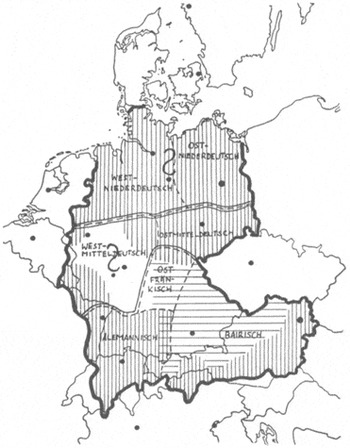
However, as Schmid & Vogel (2004:272) lament, “the number of (not only) generative explorations into the syntax of German dialects in Germany has been extremely small, and there is little hope that this situation will change soon.” Wurmbrand (1999, 2000a, 2000b, 2002, 2004, 2006) has provided us with the most complete picture of verb clusters in varieties spoken across the German-speaking area, yet detailed data for the West Central German (WCG) dialects remain lacking.Footnote 3 This state of affairs is reflected in the graphic from Patocka 1997:265 (see figure 1), which shows the distribution of the 2-3 vs. 3-2 order in what is known as the modal IPP construction.Footnote 4
Empirical gap in the distribution of the 2-3 vs. 3-2 order, modal IPP construction (Patocka 1997:265).

The question mark located squarely over the WCG dialect area (Westmitteldeutsch) clearly indicates an empirical lacuna to be filled.
What data we do have come mainly from subordinate clauses. With some exceptions, such as Patocka 1997, studies that examine verbal complexes exclude those from main clauses. Sapp (2006:5), for example, does so because “comparing verb clusters in main and subordinate clauses may be comparing unlike types.” As examples 4 and 5 above illustrate, verbal complexes in subordinate and main clauses differ crucially in that the former, but not the latter, include the finite verb. Nonetheless, data from verbal complexes in main clauses are rich, meriting proper documentation, and can give valuable insight into verbal complex formation, as this paper will demonstrate. Provided that main clauses are treated separately, their inclusion here should be unproblem-atic.
Previous research in generative frameworks has yielded a range of formal descriptive analyses that give important insight into how verbal complexes are derived. As Wurmbrand (2006) notes, however, what remains outstanding is an explanatory account of why verbal complexes arise. Beyond strictly formal syntactic analyses, there has been progress on this front: Lötscher (1978), on the basis of Zurich Swiss German data, has proposed a multi-causal approach to verbal complex phenomena involving grammatical, functional, and performance rules, and Sapp (2006, 2007) has made great strides in defining the role of functional rules with his investigation of focus in Early New High German (ENHG) verbal complexes. Yet the role of performance rules and the way in which the three rule types interact require further elucidation.
The purpose of this paper is twofold. First, it classifies and analyzes subordinate and main clause verbal complex phenomena in the WCG dialects spoken in the Federal Republic of Germany, attested in transcripts of 187 dialect recordings from the Zwirner Corpus.Footnote 5 Second, it contributes to our theoretical understanding of verbal complexes, com-plementing Lötscher's (1978) multi-causal account and Sapp's (2007) investigation of the relationship between word order in the verbal complex and focus. Following Hawkins' (1994, 2004) notions of Early Immediate Constituents and Minimize Domains, this study links particular serializations to extraposition, a productive syntactic oper-ation in German, and to processing constraints. I argue that the type of verbal complex exemplified in 4 above, known in the generative literature as Verb Projection Raising (VPR), can be linked in part to an advantage in language production.Footnote 6 My analysis is compatible with the concept of the klammerndes Verfahren (bracketing) outlined in Ronneberger-Sibold 1994 and the so-called speaker-hearer dichotomy. In particular, I maintain that the verbal bracket, which according to Ronneberger-Sibold 1991 and 1994 serves to mark syntactic boundaries for the benefit of the hearer, can be disrupted through VPR partly because this entails a processing benefit for the speaker.
The remainder of the paper is structured as follows. In section 2, the WCG dialect area and corpus are introduced, followed by an empirical and statistical analysis of verbal complexes in sections 3 and 4. Sections 5, 6, and 7 outline a multi-causal account of these complexes with an emphasis on performance, building on Lötscher 1978 and Sapp 2007. The paper concludes with a summary in section 8.
2. Dialect Area and Corpus
2.1. West Central German
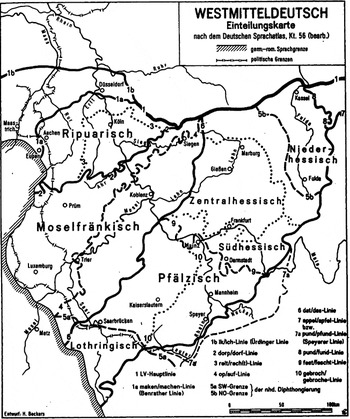
Since the 19th century, a number of scholars have made proposals for the division of the German dialect space (see, for example, Behaghel 1891, Bernhardi 1844, Bremer 1892, Martin 1959, Mitzka 1943, and Wiesinger 1983). Niebaum & Macha (2005:217) consider Wiesinger's (1983) division, which is based on a set of phonological and morphological features, the closest to linguistic reality since it clearly indicates the exis-tence of transitional zones. As the authors point out, however, the majority of recent overviews of German dialects differentiate one dialect region from another on the basis of sound shift boundaries, resulting in a conception of dialect space in which one dialect area begins where another ends.Footnote 7The Institut für Deutsche Sprache in Mannheim, which maintains the material from which the data treated in this paper are drawn, organizes the sound recordings in its archives according to this type of division. Since the question of dialect differentiation is not central here, I therefore assume divisions of the WCG dialect area according to sound shift isoglosses, adopting those in Beckers 1980 as presented in figure 2 below.
WCG belongs to the central region of the High German dialect area bordering on Low German to the north, East Central German to the east, and Upper German to the south. The WCG region can be subdivided into two larger dialect areas along isogloss 6 in figure 2, the dat/das line, namely Central Franconian and Rhine Franconian. The former comprises the smaller dialect areas Ripuarian and Moselle Franconian, the latter Pfälzisch and Hessian.Footnote 8 The dialects spoken in Lorraine (Lothringisch) were not included in this study.
West Central German dialect area (Beckers 1980:469).

2.2. The Corpus
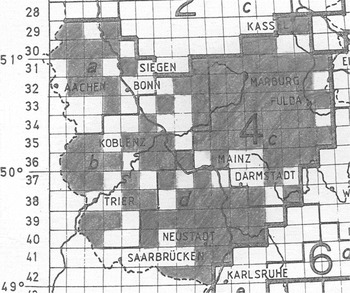
The corpus for the present study consists of 2,578 clauses from transcripts of 187 dialect recordings in the Datenbank Gesprochenes Deutsch (Spoken German Databank), maintained online by the Institut für Deutsche Sprache. The transcripts, classified as Vollmundart (base dialect), were taken from the Zwirner Corpus compiled between 1955 and 1970 under the direction of Eberhard Zwirner.Footnote 9 These include all 73 available transcripts from the Central Franconian dialect area and 114 transcripts from the Rhine Franconian dialect area.Footnote 10 The number of transcripts from the Rhine Franconian dialect area totals roughly 175, yet only a subset of these was selected in order to strike a better balance between the number of transcripts from both major dialect regions. To this end, only one transcript from the oldest male and female speaker per Planquadrat (quadrant) was included for analysis.Footnote 11
Figure 3 above indicates the quadrants from which at least one transcript was taken. The WCG dialect area as a whole is demarcated by the heavy black line. The smaller dialect areas, further distinguished by the medium-heavy lines, are labeled “a” (Ripuarian), “b” (Moselle Fran-conian), “c” (Hessian), and “d” (Pfälzisch).
Quadrants represented in the corpus study (map from Haas & Wagener 1992:1611).

The 2,578 total tokens include 1,450 subordinate and 1,128 main clauses that fall into four complex categories: subordinate clause two- and three-verb complexes and main clause two- and three-verb com-plexes.Footnote 12 Only those tokens whose clausal status could be unambiguously determined were included in the corpus. Consider the examples in 6 and 7.
(6)
(7)
Since no constituent appears between the subject die Leute ‘the people’ and the verb sollen ‘should’ in 6 or the pronominal subject wir ‘we’ and the verb sollten ‘should’ in 7, it is not possible to determine whether these are examples of main clauses with verb-second word order or subordinate clauses with the 1-X-2-(X) word order. Both clauses are introduced by a subordinating conjunction, dass and wenn, respectively; it is well known, however, that the subordinating conjunction weil may be followed by main clause word order in spoken German (see, for example, Gaumann 1983, Günther 1993, Louden 2000, Schwitalla 2003: 144–146, Wegener 1993). Thus, the type of conjunction alone is not sufficient to determine clausal status. For this reason, only clauses in which an element appears between the subject and first verb were included, as in 8 and 9.
(8)
(9)
After excluding eight clauses that did not meet this criterion, all those remaining were checked against the audio recordings, entered into a database, and then coded and classified according to verb form and verb type for further analysis.
3. Results of the Empirical Analysis
This section presents the results of an empirical analysis of verbal complexes attested in the corpus, namely, subordinate clause two- and three-verb complexes and main clause two- and three-verb complexes. Because of space limitations, it is not possible to include the three-verb complexes in the discussion of VPR and extraposition (see Dubenion-Smith 2008:95–96, 107 for an analysis). However, an analysis of the two-verb complexes is sufficient with respect to these phenomena for the theoretical discussion of verbal complexes below. For each of the four complex categories, sentences exemplifying the syntagms attested in the corpus are presented, followed by tables summarizing their distribution. The syntagms were determined by first sorting the clauses in the database by verb form (INF, IPP, PTC, Vfin) and verb type (AUX, LEX, MOD), and then further differentiating tokens with identical verb form-type combinations until all distinct constructions had been identified.Footnote 13
3.1. Subordinate Clause Two-Verb Complexes
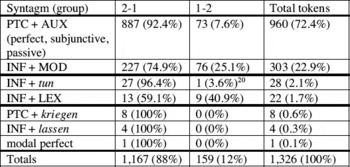
The corpus contains 1,326 subordinate clause two-verb complexes that fall into the syntagms illustrated in 10–16. The distribution of these syntagms is presented in table 1.Footnote 14
- (10)
a.
b.
c.
d.
e.
(11)
(12)
(13)
(14)
(15)
(16)
Distribution of subordinate clause two-verb complexes by syntagm (group).

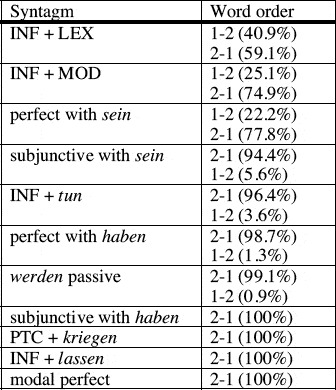
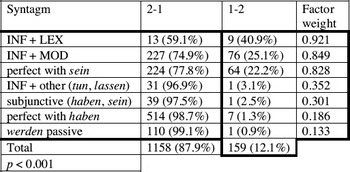
As shown in table 1, the overall preferred order is 2-1, which occurs far more frequently than the 1-2 order, at a rate of 88% to 12%.Footnote 21 The group of syntagms involving a past participle and an auxiliary verb, namely PTC + AUX (perfect, subjunctive, passive), and INF + MOD occur most frequently in the corpus, accounting for 1,263 out of 1,326 total tokens (95.2%), and display both the 2-1 and 1-2 orders.Footnote 22 INF + tun and INF + LEX, which occur far less frequently, also display both the 2-1 and 1-2 orders, though the 1-2 order is rare with the former syntagm.Footnote 23 Finally, the syntagms with the lowest frequencies, the PTC + kriegen, INF + lassen, and the modal perfect, display only the 2-1 order. The last syntagm is very rare in the corpus, occurring in a single token. Table 2 shows the breakdown of word order rates for PTC + AUX (perfect, subjunctive, passive).
Breakdown of word order rates for PTC + AUX.

With the perfect with haben, subjunctive with sein, and werden passive, the rate of the 1-2 order is very low, occurring in only 7 out of 521 tokens (1.3%), 1 out of 18 tokens (5.6%), and 1 out of 111 tokens (0.9%), respectively. The 1-2 order is far more frequent with the perfect with sein, occurring in 64 out of 288 (22.2%) tokens. Finally, the 1-2 order is unattested with the subjunctive with haben.
3.2. Subordinate Clause Three-Verb Complexes
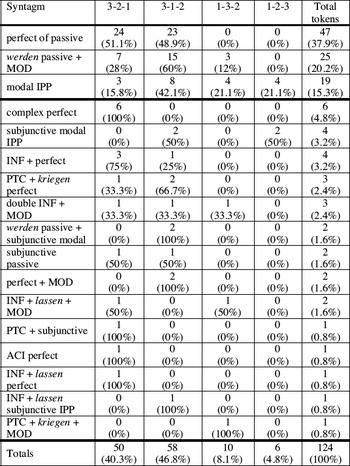
The corpus contains 124 subordinate clause three-verb complexes that fall into the syntagms illustrated in 17–30. The distribution of these syntagms is presented in table 3.
- (17)
a.
b.
- (18)
a.
b.
- (19)
a.
b.
(20)
(21)
(22)
(23)
(24)
(25)
(26)
(27)
(28)
(29)
(30)
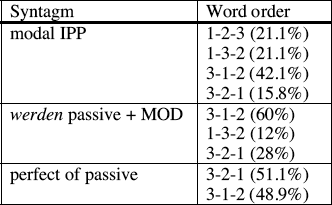
As shown in table 3, the 3-1-2 order occurs most frequently overall, in 58 out of 124 total tokens (46.8%). However, the 3-2-1 order occurs nearly as frequently, in 50 out of 124 total tokens (40.3%). Thus, there is no robust predominance of a single word order as with the subordinate clause two-verb complexes. The most frequently occurring syntagms are the perfect of passive, werden passive + MOD, and modal IPP, representing 91 out of 124 total tokens (73.4%). Instances of the perfect of passive are nearly equally divided between the 3-2-1 and 3-1-2 orders, though the 3-2-1 order is slightly more frequent. With the werde n passive + MOD and modal IPP, the 3-1-2 order occurs most frequently by a wide margin. The remaining syntagms are represented by 33 out of 124 total tokens (26.6%).
Distribution of subordinate clause three-verb complexes by syntagm.

Note that the orders 2-3-1 and 2-1-3 are unattested in the corpus. This fact is unsurprising: The 2-3-1 order is relatively uncommon, limited to modal constructions in Afrikaans, Swabian, and West Flemish, while the 2-1-3 order is conspicuously absent from the inventories of three-verb complexes cross-linguistically and has thus been treated extensively in the generative literature.Footnote 27 (See Wurmbrand 2006:239–242 and Dubenion-Smith 2008:43–62 for discussions of these word orders.)
3.3. Main Clause Two-Verb Complexes
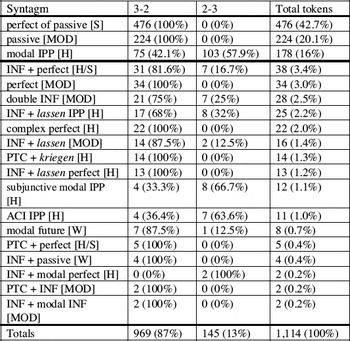
The corpus contains 1,114 main clause two-verb complexes that fall into the syntagms illustrated in 31–48. The distribution of these syntagms is presented in table 4.Footnote 28
(31)
(32)
- (33)
a.
b.
(34)
(35)
(36)
(37)
(38)
(39)
(40)
(41)
(42)
(43)
(44)
(45)
(46)
(47)
(48)
Distribution of main clause two-verb complexes by syntagm.

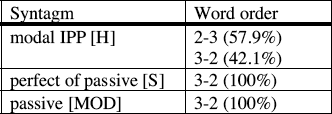
As table 4 shows, the overall preferred order is 3-2, which occurs far more frequently than the 2-3 order, at a rate of 87% to 13%. Note that this distribution is very similar to that for the subordinate clause two-verb complexes (88% 2-1 to 12% 1-2). The syntagms perfect of passive [S], passive [MOD], and modal IPP [H] occur most frequently in the corpus, accounting for 878 out of 1,114 total tokens (78.8%). Strikingly, the 2-3 order does not occur at all with the perfect of passive [S] and passive [MOD], both involving a past participle and a form of werden, while this is by far the preferred order with the modal IPP [H], at a rate of 57.9%. In section 4.1, we see that this distribution can be attributed in part to the combination of verb forms and types that comprise these syntagms. Among the remaining syntagms, both the 3-2 and 2-3 orders occur with seven, but the 2-3 order is preferred with only three: the subjunctive modal IPP [H], ACI IPP [H], and INF + modal perfect [H].
3.4. Main Clause Three-Verb Complexes
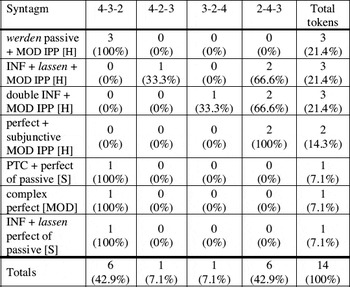
The corpus contains 14 main clause three-verb complexes that fall into the syntagms illustrated in 49–55. The distribution of these syntagms is presented in table 5.
(49)
(50)
(51)
(52)
(53)
(54)
(55)
Compared to the other complex categories, the main clause three-verb complexes are relatively scarce, as table 5 shows. Nonetheless, 4 of the 6 possible word orders are attested in the corpus: 4-3-2, 4-2-3, 3-2-4, and 2-4-3. The 4-3-2 and 2-4-3 orders occur most frequently, each in 6 out of 14 total tokens (42.9%). Syntagms involving an IPP construction account for the majority of tokens, 11 out of 14 (78.6%). As with the subordinate clause three-verb complexes, there is no robust predominance of a single word order.
Distribution of main clause three-verb complexes by syntagm.

3.5. Verb Projection Raising and Two-Verb Complexes
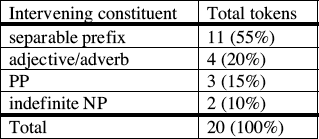
This section deals with verb projection raising in subordinate clause two-verb complexes and main clause two-verb complexes. Recall from the previous section that 159 out of 1,326 subordinate clause two-verb complexes display the 1-2 order. Of these, 20 (12.6%) involve VPR with a constituent appearing between the members of the verb cluster. The intervening constituents fall into four types, illustrated in 56–59. Their distribution is presented in table 6.
(56)
(57)
(58)
(59)
Distribution of VPR intervening constituents, subordinate clause two-verb complexes.
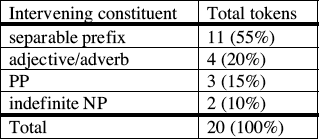
Table 6 shows that the majority of intervening constituents are separable prefixes. Note that unlike standard German (but like languages such as standard Dutch), WCG readily allows separable prefixes to be stranded. This is exemplified in the following example in which the particle an ‘on’ does not appear raised with schneiden ‘cut’.Footnote 32
(60)
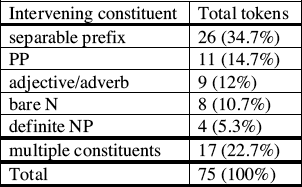
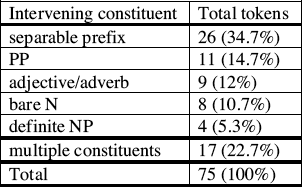
Let us now examine verb projection raising in main clause two-verb complexes. Compared to the subordinate clause two-verb complexes, the main clause two-verb complexes display VPR at a much higher rate. Of the 145 clauses with the 2-3 order (13%), 75 (51.7%) involve an inter-vening constituent. The attested VPR constructions fall into five types with a single intervening constituent and an additional 13 types with two or more intervening constituents. Table 7 shows the distribution of con-structions with one intervening constituent, illustrated in 61–65.Footnote 33
(61)
(62)
(63)
(64)
(65)
Again, we see that the majority of intervening constituents are separable prefixes. A comparison of tables 6 and 7 reveals that for both the subordinate and main clause complexes, the three most common types of intervening constituent are the same (separable prefix, PP, adjective/ adverb), followed by at least one nominal category (indefinite NP, bare N, definite NP).
Distribution of VPR intervening constituents, main clause two-verb complexes.
3.6. Extraposition and Two-Verb Complexes
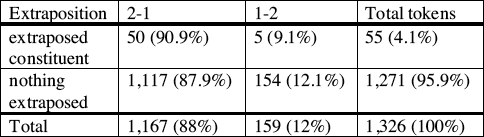
In this section, I discuss extraposition in subordinate clause two-verb complexes and main clause two-verb complexes. As noted in section 1, verbal complexes may occur not only with elements appearing inside the cluster, but also with extraposed elements to the right of the cluster. The distribution of extraposition in the subordinate clause two-verb com-plexes is presented in table 8.Footnote 34
Distribution of extraposition, subordinate clause two-verb complexes.
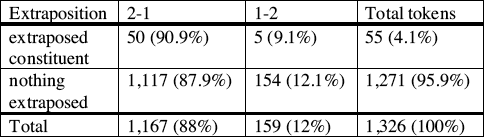
As table 8 shows, extraposition occurs in 55 out of 1,326 total tokens (4.1%). 50 out of 55 instances (90.9%) occur with the 2-1 order, while only 5 out of 55 (9.1%) occur with the 1-2 order. Thus the 1-2 order occurs less frequently than the expected rate (12%) in constructions that display extraposition.
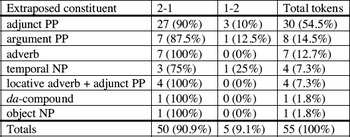
Table 9 shows the distribution of extraposition by constituent type, illustrated in 66–72.Footnote 35
(66)
(67)
(68)
(69)
(70)
(71)
(72)
Distribution of extraposed constituents, subordinate clause two-verb complexes.

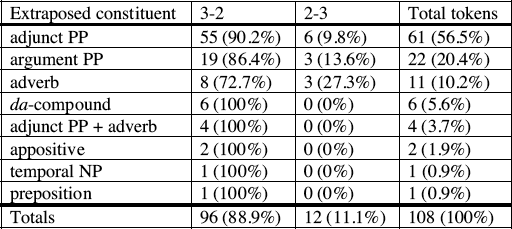
The majority of extraposed constituents are adjunct PPs, accounting for 30 out of 55 tokens (54.5%). The adjunct PPs, in combination with the other adverbials and da-compound, comprise 47 out of 55 total tokens (85.5%), while argument PPs make up the remaining 8 out of 55 tokens (14.5%). The occurrence of only one instance of an extraposed object NP falls in line with the increased unacceptability of object NP extraposition in the ENHG period to its general ungrammaticality in modern German (see Bies 1996).
Like the subordinate clause two-verb complexes, the main clause two-verb complexes display extraposition. The distribution of extra-position is presented in table 10.
Distribution of extraposition, main clause two-verb complexes.

As table 10 shows, extraposition occurs in 108 out of 1,114 total tokens (9.7%) at a rate significantly higher than in the subordinate clause two-verb complexes (4.1%). Ninety-six out of 108 instances (88.9%) occur with the 3-2 order, while only 12 out of 108 (11.1%) occur with the 2-3 order. Thus the 2-3 order occurs less frequently than the expected rate (13%) in constructions that display extraposition, as we saw above for the 1-2 order in the subordinate clause two-verb complexes.
Table 11 below shows the distribution of extraposition by constituent type, illustrated in 73–80.
(73)
(74)
(75)
(76)
(77)
(78)
(79)
(80)
Distribution of extraposed constituents, main clause two-verb complexes.
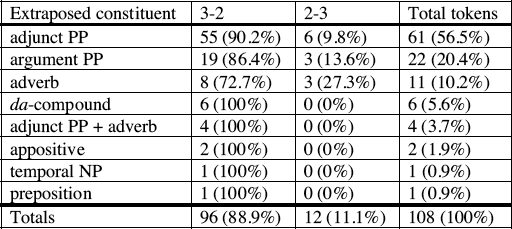
As we saw above with the subordinate clause two-verb complexes, adjunct PPs account for the majority of extraposed constituents in the main clause two-verb complexes as well, comprising 61 out of 108 total tokens (56.5%). These plus the adverbials, da-compound, appositives, and preposition make up 86 out of 108 total tokens (79.6%). Argument PPs account for the remaining 22 out of 108 tokens (20.4%). Extraposed object NPs do not occur in the main clause two-verb complexes.
3.7. Summary of Main Findings
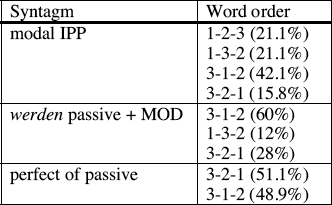
The syntagms and word orders attested in the Zwirner Corpus data were introduced in section 3.1–3.4. For the subordinate clause two- and three-verb complexes and the main clause two-verb complexes, these are presented in the summary tables 12–14 below.Footnote 38
Word orders in WCG, subordinate clause two-verb complexes.

Word orders in WCG, subordinate clause three-verb complexes.
Word orders in WCG, main clause two-verb complexes.
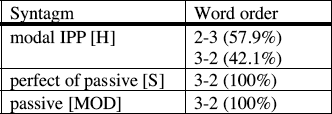
In the subordinate clause two-verb complexes, both the 2-1 and 1-2 orders occur, at a rate of 88% and 12%, respectively. The syntagms INF + LEX, INF + MOD, and perfect with sein display the non-canonical 1-2 order at rates higher than the expected rate. Four word orders are attested in the subordinate clause three-verb complexes, 3-2-1, 3-1-2, 1-3-2, and 1-2-3, occurring at respective rates of 40.3%, 46.8%, 8.1%, and 4.8%. The modal IPP displays the non-canonical word orders 1-2-3 and 1-3-2, the werden passive + MOD the order 1-3-2, and the perfect of passive the order 3-2-1 more frequently than the expected rates. The main clause two-verb complexes display both the 3-2 and 2-3 orders, at rates nearly identical to those in the subordinate clause two-verb complexes: 87% and 13%. The syntagm modal IPP [H] displays the non-canonical order 2-3 at a rate far higher than the expected rate. Finally, the four word orders 4-3-2, 4-2-3, 3-2-4, and 2-4-3 are attested in the main clause three-verb complexes, at respective rates of 42.9%, 7.1%, 7.1%, and 42.9%.
Sections 3.5 and 3.6 presented the distribution of elements in VPR and extraposition constructions, limited to the two-verb complexes. The analysis of VPR showed that the rate of occurrence is far higher in the main clause than in the subordinate clause complexes (51.7% vs. 12.6%) and that separable prefixes comprise the largest group of intervening constituents. Similarly, the rate of extraposition is higher in the main clause than in the subordinate clause complexes (9.7% to 4.1%). For both complex categories, the rate of the non-canonical word order is lower than the expected rate when an element is extraposed, and adjunct PPs comprise the largest group of extraposed constituents.
4. Results of the Statistical Analysis of the Zwirner Corpus Data
This section presents the results of a statistical analysis of the Zwirner Corpus data. I take as the point of departure Sapp 2006, a study of subordinate clause verbal complexes from ENHG to modern German. Based on a corpus of ENHG texts and experimental data, Sapp aims to determine the effect of various factors on word order, many of which have been shown in previous studies to influence serialization in the verbal complex (see, for example, Ebert 1981). The linguistic and rhythmic factors Sapp tests are class or phonological weight of the word/phrase preceding the verb cluster, VP coordination, clause type, syntagm, verbal prefix type, and extraposition. The non-linguistic factors are time period, dialect, occupation, and genre.Footnote 39 Finally, Sapp investi-gates the influence of the pragmatic factor focus (see Sapp 2006:6–8).
Sapp (2006) determines that syntagm, verbal prefix type, extra-position, time period, dialect, occupation, and genre have statistically significant effects on word order in the two-verb complexes, while in the three-verb complexes only syntagm and verbal prefix type show clear effects. Sapp (2006, 2007) also demonstrates that in both the two- and three-verb complexes, variation in word order can be linked to focus.
The results of the empirical analysis presented in section 3 suggested that word order variation in the verbal complex may be linked to several factors, namely syntagm, verbal prefix type, and extraposition—factors shown in Sapp's (2006) study to have statistically significant effects on word order. While it is possible that the factors that have no statistically significant effect in Sapp's study might have such an effect in the Zwirner Corpus data, here I limit the statistical analysis to syntagm, verbal prefix type, extraposition, and one additional factor linked to word order in Sapp's (2006, 2007) work: object focus. As we see below, both syntagm and verbal prefix type have a statistically significant effect on word order in the subordinate clause two-verb complexes. In the main clause two-verb complexes, syntagm, verbal prefix type, and a gram-matical correlate to focus have statistically significant effects. Because of statistical insignificance, the results for the subordinate clause three-verb complexes are not discussed.Footnote 40
The Zwirner Corpus data were analyzed with the statistics package GoldVarb X.Footnote 41GoldVarb is a multivariate analysis application originally developed for use in sociolinguistics that allows the researcher to deter-mine the effect of various independent variables or factors, organized into factor groups, on the occurrence of a single dependent variable. For each factor, the program outputs a probabilistic weight or factor weight, a value ranging from 0 to 1.0. A value below 0.5 indicates that the factor has a disfavoring effect on the occurrence of the dependent variable; a value above 0.5—a favoring effect. Values very close to 0.5 indicate that a factor has neither a disfavoring nor a favoring effect on the occurrence of the dependent variable. Within a particular factor group, only factors for which all possible word orders are attested may be included in the statistical analysis as an independent factor, otherwise GoldVarb will not run the analysis. These so-called *knockout* factors must either be combined with other factors in logical groupings or be eliminated from the analysis altogether. In the present study, the dependent variable is word order, and examples of the factor groups tested are syntagm and focus.
Recall from section 3.1 that in the subordinate clause two-verb complexes, the 1-2 order occurs at an overall rate of 12%, the expected rate. Generally speaking, factors for which the rate of 1-2 is higher than the expected rate will be favoring factors, while factors for which the rate of 1-2 is lower than the expected rate will be disfavoring factors. This principle holds for the main clause two-verb complexes as well. Note, however, that because of the mechanics of the program, the rates of occurrence and factor weights do not always correspond exactly. In the tables below, factor weights are presented from highest to lowest. Following common practice, the results of the tests to follow will be considered statistically significant when p ≤ 0.05.
4.1. Syntagm and Two-Verb Complexes
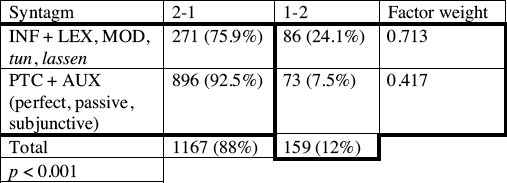
In this section, I consider the effect of syntagm on word order in subordinate and main clause verb complexes. I begin with subordinate clause two-verb complexes. In the corpus, syntagms with an infinitive display the 1-2 order at a far higher rate than those with a past participle. Table 15 shows that the former favor, and the latter disfavor, the 1-2 order. Table 16 presents the factor weights for these syntagms broken down into specific types.Footnote 42
Effect of general syntagm on word order, subordinate clause complexes.
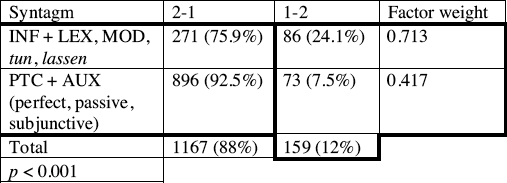
Effect of specific syntagm on word order, subordinate clause complexes.

As the table illustrates, the syntagms INF + LEX, INF + MOD, and perfect with sein favor the 1-2 order, while this order is disfavored by INF + other (tun, lassen), the subjunctive (haben, sein), the perfect with haben, and the werden passive. The syntagms can be placed on a hierarchy according to factor weight: INF + LEX > INF + MOD > perfect with sein > perfect with haben > werden passive. This hierarchy is similar to those found in previous studies of ENHG. Compare the hierarchies in 81a–d.Footnote 43
- (81)
a.
b.
c.
d.
The four hierarchies are nearly identical, with the exception of the relative ordering of the constructions perfect with sein and INF + MOD on Ebert's hierarchy. Despite this deviation, the order perfect with sein > perfect with haben > werden passive holds in each case. Thus, it may be concluded that the relationship between syntagm and word order in the subordinate clause two-verb complexes has not changed from Early New High German to modern German, as far as the WCG dialects are concerned.
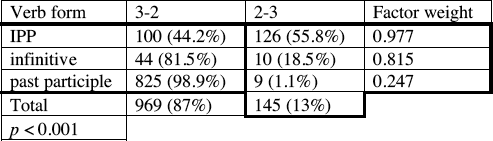
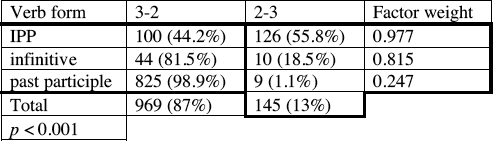
Let us now consider main clause two-verb complexes. Since 11 of the main clause two-verb syntagms, including two of the three principal syntagms, are unattested with either the 3-2 or 2-3 order and are therefore *knockout* factors, it was not possible to conduct a statistical analysis with each separate syntagm. However, it was possible to analyze the syntagms in three larger groupings, namely syntagms involving an IPP, an infinitive, or a past participle.Footnote 44 Recall that sub-ordinate clause two-verb complexes with an infinitive favor, and those with a past participle disfavor, the 1-2 order. This generalization holds for the main clause two-verb complexes as well. As table 17 shows, syntagms with two infinitives favor the 2-3 order, as do the syntagms with an IPP. The syntagms with a past participle, on the other hand, disfavor the 2-3 order.
Effect of verb form on word order, main clause complexes.
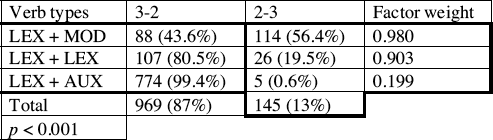
The syntagms may also be categorized according to whether the lexical verb occurs with another lexical verb, a modal, or an auxiliary.Footnote 45Table 18 shows that when a lexical verb is combined with a modal or another lexical verb, the 2-3 order is favored. In contrast, combinations of a lexical and an auxiliary verb disfavor the 2-3 order.
Effect of verb types on word order, main clause complexes.
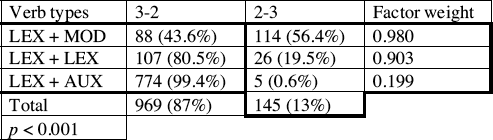
In conjunction, the hierarchies IPP > infinitive > past participle and LEX + MOD > LEX + LEX > LEX + AUX correspond roughly to the hierarchy for the subordinate clause two-verb complexes, namely INF + LEX > INF + MOD > perfect with sein > perfect with haben > werden passive, whereby complexes involving a lexical or modal verb and an infinitive more greatly favor the 1-2 order than those involving an auxiliary verb and a past participle. These hierarchies are also reflected in the three most frequently occurring main clause two-verb syntagms, the perfect of passive [S], passive [MOD], and modal IPP [H], presented in table 19.
Distribution of the three most frequently occurring syntagms, main clause complexes.

Here the additive effect of verb form and verb type is particularly striking. With the perfect of passive [S] and passive [MOD], which involve a past participle and the auxiliary werden, both at one end of their respective hierarchies, 0 out of a total 700 tokens (0%) occur with the 2-3 order. The modal IPP [H], on the other hand, which involves verbal elements at the other end of the hierarchies, an IPP and a modal, displays the 2-3 order at a rate of 58.4%, far higher than the expected rate of 13%.
4.2. Verbal Prefix Type and Two-Verb Complexes
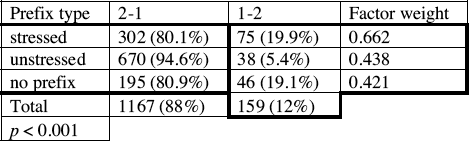
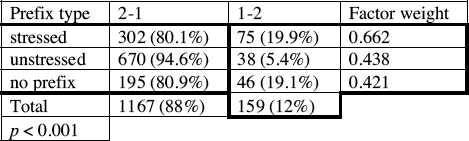
This section deals with the effect of verbal prefix type on word order in subordinate and main clause complexes. I begin with the subordinate clause two-verb complexes. The results in table 20 reveal that the 1-2 order is favored by the presence of a stressed separable prefix on the non-finite verb in the complex and disfavored by the presence of an unstressed prefix or the absence of any prefix.
Effect of verbal prefix type on word order, subordinate clause complexes.
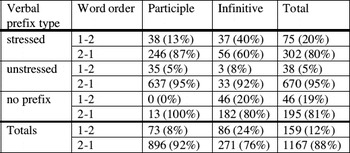
Sapp (2006:61–62) points out that the correlation between stressed separable prefix and the 1-2 order might be attributed to an interaction between verbal prefix type and syntagm. Past participles typically begin with the unstressed prefix ge-, and as we saw in section 4.1, syntagms involving a past participle disfavor the 1-2 order. Sapp tests for this interaction using GoldVarb's cross-tabulation function. The results of the cross-tabulation for the Zwirner Corpus data are presented in table 21 below.
Cross-tabulation of verbal prefix type with syntagm, subordinate clause complexes.

These results show that the factor groups syntagm and verbal prefix type are, in fact, independent of each other. For both syntagm groupings, that is, syntagms involving either a participle or an infinitive, the rate of 1-2 is above the expected rates (8% and 24%) when the prefix on the non-finite verb is stressed and below the expected rates for the other two prefix types. Note, however, that for all three prefix types the rate of 1-2 is higher for the infinitive grouping than for the participle grouping. It may be concluded, then, that while syntagm and verbal prefix type are independent factor groups, their effect on word order is additive.
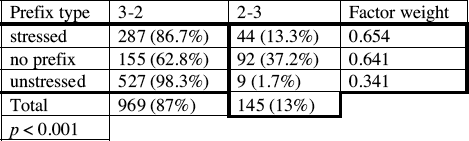
Like the subordinate clause two-verb complexes, the main clause two-verb complexes exhibit an effect of verbal prefix type on word order, illustrated in table 22.
Effect of verbal prefix type on word order, main clause complexes.
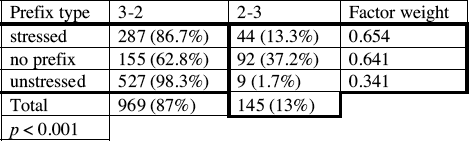
The results show that a stressed separable prefix or no prefix on the main lexical verb in the complex favors the 2-3 order. Yet unlike the subor-dinate clause two-verb complexes in which the presence of an unstressed prefix or the absence of any prefix has a disfavoring effect on the 1-2 order, only unstressed prefixes have a disfavoring effect in the main clause two-verb complexes overall.
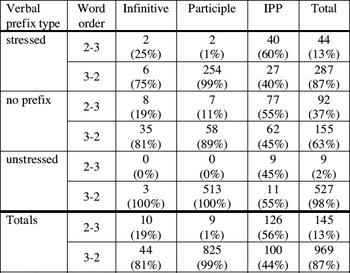
As with the subordinate clause two-verb complexes, an interaction between verbal prefix type and syntagm can be tested for using GoldVarb's cross-tabulation function, the results of which are presented in table 23.
Cross-tabulation of verbal prefix type with syntagm, main clause complexes.

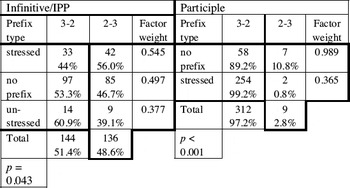
The results of the cross-tabulation suggest that the effect of verbal prefix type on word order is not independent of syntagm. For syntagms involving two infinitives or an IPP, the rate of 2-3 is above the expected rates (19% and 56%) when the prefix on the main lexical verb is stressed and at or around the expected rates when there is no prefix. For syntagms involving a participle, on the other hand, the rate of 2-3 is at the expected rate (1%) when the prefix is stressed but far above the expected rate when there is no prefix. The fact that the verbal prefix types stressed and no prefix favor the 2-3 order with different syntagms indicates an interaction between the factor groups verbal prefix type and syntagm. Table 24 shows the effect of verbal prefix type on the groupings infinitive/IPP and participle separately.
Effect of verbal prefix type on word order, main clause complexes, infinitive/IPP, and participle.

The favoring effect of a stressed separable prefix on the 2–3 order in the syntagms with two infinitives or an IPP appears less robust than in table 22, while the favoring effect of the absence of a verbal prefix on syntagms with a participle is even clearer.Footnote 46
4.3. Focus and Two-Verb Complexes
As discussed in section 4, Sapp (2006, 2007) investigates the relationship between word order in the verbal complex and object focus, in particular contrastive and new information focus, and, by extension, old infor-mation focus.Footnote 47 Sapp (2006:58–59, 2007:302–303) finds that contrastive focus strongly favors the 1-2 order in his ENHG corpus. New information focus also favors the 1-2 order, though less so than contrastive focus. Old information focus, on the other hand, somewhat disfavors the 1-2 order. Sapp (2006:81, 2007:304) also determines that new information and contrastive focus favor every attested order except 3-2-1 (1-3-2/1-2-3/3-1-2 in combination) in the subordinate clause three-verb complexes.
Sapp (2006:37, 2007:303) concedes the difficulties inherent in ascertaining the information status of clauses in a written language. Without the intonation cues present in spoken language it is not always possible to correctly determine focus. For this reason, Sapp (2006:58–61) seeks to corroborate his findings based on information structure with focus-related linguistic correlates.
One such correlate is the status of the object NP preceding the verb cluster. Definite NPs, including pronouns, tend to represent old information, while indefinite NPs tend to represent new information and, by extension, new information focus. Sapp also examines the intervening NPs (including pronouns and QPs) in VPR constructions. He assumes that an NP that remains inside the VP and is raised, regardless of its definiteness, is focused.Footnote 48
A second piece of evidence that Sapp considers is scrambling, which has been shown to correlate with focus in German (see Haider & Rosengren 2003). If an object appears to the left of either an adverbial immediately preceding the verb cluster or a negator, it is scrambled and represents old information, and if it appears to the right, it is not scrambled and represents new or contrastive information.
In the present study, I chose to preliminarily limit the examination of focus to grammatical correlates. Since the occurrence of objects with adverbials or negators is too rare in the Zwirner Corpus data to determine whether objects have been scrambled, I analyzed only the information status of preceding/intervening object NPs.Footnote 49
The preceding NPs in the subordinate clause two-verb complexes are assignable to four groups: definite, indefinite, non-NP, and zero. The definite NPs include NPs preceded by a definite article, possessive pronoun, or NumP, as well as proper names and pronouns.Footnote 50 The indefinite NPs include bare Ns, NPs preceded by an indefinite article, a QP (jeder ‘every’, kein ‘no’, alle ‘all’), or a quantificational adverb (viel ‘much’, ein bisschen ‘a bit’), as well as etwas ‘something’, etwas + adjective, alles ‘everything’, and nichts ‘nothing’. Finally, adjectives, adverbs, nicht ‘not’, modal particles, and da-compounds comprise the group of non-NPs. Since the syntagms werden passive, perfect with sein, and subjunctive with sein may not occur with object NPs, tokens with these constructions were excluded from the analysis.
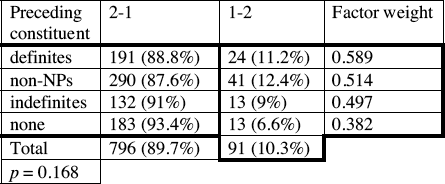
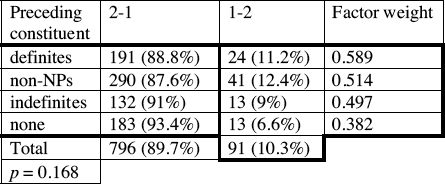
The effect of the information status of the preceding object NP on word order is inconclusive. Table 25 shows factor weights for definites and no constituent above and below 0.5, respectively, and for non-NPs and indefinites around 0.5. However, with p = 0.168, the results for the factor group are statistically insignificant.
Effect of the information status of the preceding constituent on word order, subordinate clauses.
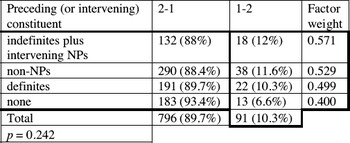
The addition of intervening NPs in the VPR constructions to the indefinite NPs results in a factor weight for this factor above 0.5, but this has little effect on the factor weights overall. As can be seen in table 26, the values are even closer to 0.5 than in table 25, and the p-value is higher.
Effect of the information status of the preceding/intervening constituent on word order, subordinate clauses.

Thus, there is a possible effect of object focus on word order in the subordinate clause two-verb complexes as indicated by the occurrence of precluster indefinite NPs and intervening NPs in the VPR constructions. Because of statistical insignificance, however, no firm conclusions may be drawn.
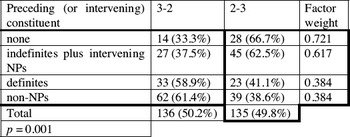
To test the effect of focus in the main clause two-verb complexes, I once again examined the occurrence of precluster NPs. These NPs are assignable to the same four groups as for the subordinate clause complexes: definite, indefinite, non-NP, and zero. The definite NPs include NPs preceded by a definite article, possessive pronoun, or NumP, as well as proper names and pronouns. Included in the group of indefinite NPs are bare Ns, NPs preceded by an indefinite article, a QP (jeder ‘every’, kein ‘no’, alle ‘all’), or a quantificational adverb (viel ‘much’, ein bisschen ‘a bit’), as well as etwas ‘something’, etwas + adjective, manch ‘many a’ + adjective, alles ‘everything’, and nichts ‘nothing’. Finally, adjectives, adverbs, nicht ‘not’, modal particles, and da-compounds comprise the group of non-NPs. Since the majority of tokens involving a participle are passive constructions (perfect of passive [S], passive [MOD]), which may not occur with an object NP, only the groupings infinitive and IPP were included in the analysis.
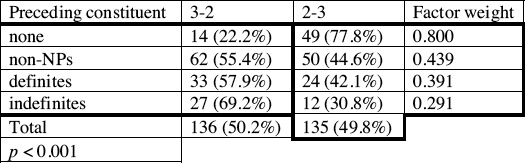
As table 27 shows, only when no constituent precedes the verb cluster is the 2-3 order favored. In contrast, the occurrence of any constituent, whether a definite or indefinite NP or non-NP, disfavors the 2-3 order.
Effect of the information status of the preceding constituent on word order, main clauses (infinitive and IPP).
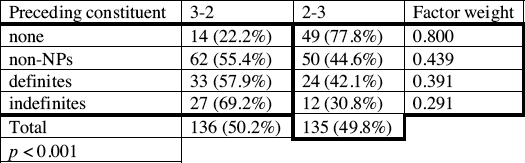
When the intervening NPs in the VPR constructions are added to the indefinite NPs, however, the 2-3 order is favored by the absence of a constituent and by indefinites plus intervening NPs, and disfavored by definites and non-NPs. These results are shown in table 28.
Effect of the information status of the preceding/intervening constituent on word order, main clauses (infinitive and IPP).

Thus, it may be concluded for the main clause two-verb complexes that object focus, as indicated by the occurrence of precluster indefinite NPs and intervening NPs in the VPR constructions, has an effect on word order in the Zwirner Corpus data.
4.4. Extraposition and Two-Verb Complexes
The final factor group tested in the statistical analysis is extraposition. Sapp (2006:57–58) demonstrates that the rate of 1-2 in his corpus is far higher than the expected rate when some constituent is extraposed, but very close to the expected rate when no extraposed constituent appears to the right of the verb cluster. However, Sapp's (2007:303–304) analysis reveals that when extraposed adjunct PPs and argument NPs/PPs are tested separately, the latter but not the former favor the 1-2 order. Since Bies (1996) shows that extraposed arguments in her ENHG corpus tend to be heavy or focused, Sapp (2007:304) concludes that the correlation in his data between the 1-2 order and argument extraposition can be attributed to focus, not to extraposition in general. He takes these findings as a further piece of indirect evidence for the effect of focus on word order.
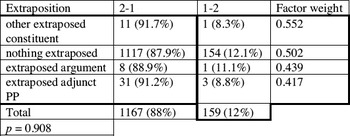
The effect of extraposition on the 1-2 order in the subordinate clause complexes is shown in table 29.
Effect of extraposition on word order, subordinate clause complexes.

Factor weights for extraposed arguments and adjuncts PPs indicate that these have a disfavoring effect on the occurrence of the 1-2 order, while the factor weight for other extraposed constituents points to a slight favoring effect. No firm conclusions may be drawn, however, since the results are statistically insignificant with p = 0.908.
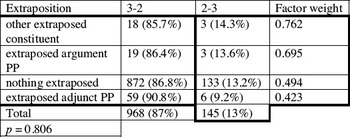
The results of the analysis of extraposition in the main clause complexes are presented in table 30. Recall from section 3.6 that no argument NPs are attested in these data.
Effect of extraposition on word order, main clause complexes.

In contrast to extraposed adjunct PPs, extraposed argument PPs and other extraposed constituents have factor weights that indicate a favoring effect on the 2-3 order. However, no firm conclusions may be drawn since the results are statistically insignificant with p = 0.806.
4.5. Summary of Main Findings
Four factor groups (syntagm, verbal prefix type, focus, and extraposition) were tested with the statistical analysis program GoldVarb to determine their effect on word order in the subordinate and main clause two-verb complexes. The factor groups syntagm and verbal prefix were shown to have statistically significant effects on word order in both the subordinate and main clause complexes. Focus, as indicated by the occurrence of pre-cluster indefinite NPs and intervening NPs in the VPR constructions, has a statistically significant effect on word order only in the main clause complexes with the groupings infinitive and IPP. Finally, extraposition has no statistically significant effect on word order in either the sub-ordinate or main clause complexes.
A glance at the corpus and the factor groups that have a statistically significant effect on word order in the subordinate and main clause two-verb complexes reveals that 156 out of 159 complexes with the 1-2 order and all 145 out of 145 complexes with the 2-3 order can be linked to one or more of these factor groups. One-hundred forty-nine out of 159 subordinate clause two-verb complexes and 136 out of 145 main clause two-verb complexes involve a syntagm or verb form that favors the 1-2 or 2-3 order, respectively. As for the factor group verbal prefix type, the rates are 75 out of 159 subordinate clause two-verb complexes and 49 out of 145 main clause two-verb complexes. Finally, the factor group focus can be linked to the 2-3 order in 45 out of 135 main clause two-verb complexes in the groupings infinitive and IPP.
Recall from section 1 that Lötscher (1978) proposed the interplay of grammatical, functional, and performance rules to account for word order variation in the verbal complex. In sections 4.1–4.3, we saw how word order in the verbal complex is influenced by the linguistic (grammatical) factor groups syntagm and verbal prefix type as well as the functional factor group focus. While performance has not yet come to the fore, one important finding from section 3.5 was the high rate of VPR in the main clause two-verb complexes. In section 6, I argue that the occurrence of VPR, alone and in conjunction with extraposition, which in this section was not conclusively shown to affect word order, can be attributed in part to the third set of rules in Lötscher's account, namely performance rules. First, however, let us turn to a discussion of the multi-causal account of word order in the verbal complex proposed in Lötscher 1978.
5. A Multi-Causal Account of Word Order in the Verbal Complex
In recent decades, a substantial amount of generative literature on verbal complexes has appeared. As Wurmbrand (2006:249) points out in her empirical and theoretical overview, most analyses rest on the notion that verbal complexes arise through syntactic movement (see, for example, den Dikken & Hoekstra 1997, Haegeman 1995, 1998a, 1998b, Koopman & Szabolcsi 2000, Robbers 1997, Zwart 1996).Footnote 51 In her evaluation of these analyses, Wurmbrand (2006:285–286) maintains that an explana-tory syntactic analysis must be able to predict the attested and unattested word orders in verbal complexes cross-dialectally, on the basis of independent principles found elsewhere in the grammar. She notes, how-ever, that the rules formulated to derive verbal complexes are often no more than stipulated parameters that provide only a formal description of the word order facts. She concludes the following:
While it is undoubtedly the case that descriptive accounts […] are unattractive for their lack of explanatory value, it is not clear at the current stage of the research on verb clusters that it is trivial (possible at all) to come up with an alternative that does not suffer from these very same inadequacies (Wurmbrand 2006:294).
Wurmbrand (2006:234) sums up below what seems to be the current state of affairs, ending with a challenge for further research:
Many interesting accounts have been suggested addressing the question of how verb clusters are derived. However, what still appears to be an open question is that of why the elements of a verb cluster are inverted in certain languages and constructions. An answer to the question of what the (deep) motivation of verb-cluster formation is and why this phenomenon exists only in certain languages is still outstanding, and any new insight into this question would be highly beneficial not only to the study of verb clusters and restructuring, but also to our general understanding of clause structure and the architecture of grammar.Footnote 52
It would thus appear that an explanation for verbal complex phenomena perhaps cannot be adequately captured solely by a formal syntactic account.Footnote 53 The question arises, then, whether the bulk of the explanation for variation in the verbal complex might not instead lie outside the core syntax. Indeed, when we look beyond the core syntax, we discover im-portant insights into why such variation exists.
To my knowledge, Lötscher (1978) is the first to discuss the multi-faceted nature of verbal complex phenomena. In his study of verb placement in Zurich German and other varieties, he writes the following:
Es ist also die Frage zu beantworten, ob es, wenn schon keine einfache Einzelregel formulierbar ist, doch wenigstens eine kleine Anzahl von generellen Regeln gibt, die die Vielfalt systematisch geordnet darstell-bar machen. Dabei muß die zusätzliche Komplikation berücksichtigt werden, daß für die Erklärung der Wortstellung wohl kaum ein einziger Regeltyp vorausgesetzt werden kann. Vielmehr lassen sich mindestens drei interagierende, aber primär voneinander unabhängige Arten von Regeln ansetzen: Erstens grammatisch bedingte Regeln—Regeln wie die der Adjektivstellung bei Nomen, der Verbzweitstellung usw., die mehr oder weniger willkürlich eine Abfolge bestimmen, die aber auch anders aussehen könnten; performanzbedingte Regeln—Regeln, welche es ermöglichen, performanzmäßig allzu komplexe Strukturen in leichter zu verarbeitende Strukturen umzubilden, wie etwa die ver-schiedenen Extrapositionsregeln in vielen Sprachen; endlich funktional bedingte Regeln—Regeln, deren Zweck die Ermöglichung des Aus-drucks von bestimmten funktionalen Satzverhältnissen im Sinne der Thema-Rhema-Unterscheidung ist. Alle drei Regeltypen wirken bei der Formation eines bestimmten Satzes natürlich mit, und so sind ihre Interaktionen oft nicht leicht zu erfassen. Dennoch würden wohl die Gegebenheiten allzu sehr simplifiziert, wollte man sämtliche Stellungs-phänomene von einem einzigen Gesichtspunkt her darstellen (Lötscher 1978:10–11).Footnote 54
In the remainder of section 5, I examine the components of Lötscher's catholic approach to verbal complex formation—grammar, function, and performance—in succession, taking into account Sapp's (2007) work and the results of the empirical and statistical analyses of the Zwirner Corpus data presented in sections 3 and 4.
5.1. Grammar
Lötscher (1978:12) formulates a grammatical rule in terms of the position of the verbal elements in a complex in relation to one another. In effect, the instantiation of this rule arranges the verbal elements in their order of subcategorization from right to left, as in standard German for the majority of syntagms, to yield a left-branching structure.Footnote 55 The basic orderings derived through this rule may then be altered through inversion in interaction with a performance rule and are subject to functional rules (Lötscher 1978:12–13, 17–18).
I propose here that Lötscher's (1978) grammatical rule be modified and expanded to encompass a rule and factors that interact and feed verbal complex formation. First, a grammatical rule defines, for a particular grammar, the range of word order variation in the verbal complex.Footnote 56 This moves us already beyond the scope of a purely core-syntactic investigation concerned with exactly how the orders permitted and not permitted may be predicted, motivated, and constrained. In contrast to such an investigation, I take for granted the range of variation for a given grammar.Footnote 57 A set of grammatical factors then constrains the orders defined by the grammatical rule. In sections 4.1 and 4.2, we saw that in the Zwirner Corpus data, the grammatical factor groups syntagm and verbal prefix type have statistically significant effects on word order in subordinate and main clause two-verb complexes. Given a set of all possible word orders in a particular grammar, there will be a number of subsets of these possible word orders, linked to different syntagms.Footnote 58 The factor group verbal prefix type may then influence the occurrence of a particular word order within these subsets of word orders.
In the Zwirner Corpus data, for example, two word orders are possible in the subordinate clause two-verb complexes: 2-1 and 1-2. Not every syntagm allows both these orders, however; while both are attested with INF + MOD, for example, only the 2-1 order is attested with PTC + kriegen.Footnote 59 Which of the two word orders, 2-1 or 1-2, is realized in complexes with the syntagm INF + MOD is further determined in part by the type of verbal prefix on the lexical verb.
5.2. Function
Lötscher suggests that functional rules also determine word order in the verbal complex. Lötscher (1978:4–6, 17–18) discusses a correspondence between certain word orders, specifically in main clause verbal com-plexes involving a modal and lexical verb plus a non-verbal element, and the position of both sentential accent and rhematic/thematic material.
Sapp (2007) more closely examines the relationship between word order and function—focus in particular. As discussed in section 4.3, Sapp found that in his ENHG corpus, new information and contrastive object focus favor the 1-2 order in subordinate clause two-verb complexes, while in subordinate clause three-verb complexes, focus favors all attested orders but 3-2-1 when taken together. Sapp supports this finding with evidence from scrambling, extraposition, and experi-ments testing the effect of focus on word order in modern German (see Sapp 2007:305–315). As for the Zwirner Corpus data, it was shown in section 4.3 that there is a statistically significant link between focus, as indicated by the occurrence of precluster indefinite NPs and intervening NPs in the VPR constructions, and the 2-3 order in 45 out of 135 main clause two-verb complexes in the groupings infinitive and IPP.
5.3. Performance
The last of Lötscher's (1978) rules deals with the connection between word order and performance. Recall that this rule allows structures that in terms of performance are too complex to be restructured to facilitate processing. On the basis of psycholinguistic evidence indicating that left-branching structures are more difficult to parse than right-branching ones, Lötscher (1978:12–17) proposes a rule to invert the elements in the strictly left-branching verbal complexes generated by the grammatical rule described in section 5.1 above. This inversion rule applies not only to verbal elements, but non-verbal elements as well, allowing for the derivation of VPR constructions. Similarly, Kaufmann (2007:157–158, 198), following Haider 2003:91, 119–123, associates V(P)R structures with lower costs in parsing. He concludes that “the raising of VPs may be the speaker's attempt to reduce the hearer's processing load by producing less complex, right-branching structures” (p. 198).
The assumption that right branching structures are easier to parse than left-branching ones would seem to rest on the notion that the structural and semantic/thematic analysis of arguments is postponed in left-branching phrases, where the occurrence of the head is delayed. This delay places a load on working memory that can be alleviated through mechanisms that enable earlier analysis, for example, through V(P)R. These assumptions are compatible with head-driven approaches to parsing, as advocated by Pritchett (1991). However, it has been argued, on the basis of more recent psycholinguistic evidence from German (Bader & Lasser 1994) and Korean (Koh 1997) and confirmed, for example, in later studies of Japanese (Aoshima et al. 2003, Kamide & Mitchell 1999 among others), that the structural analysis of arguments occurs before the appearance of the verbal head, which belies a head-driven approach. Furthermore, the semantic/thematic interpretation of arguments has been shown to proceed incrementally (see, for example, Bornkessel et al. 2003 and Schlesewsky et al. 2003). If an incremental pre-head attachment account is assumed to be correct, then arguments for the advantage of right-branching V(P)R constructions for the hearer are weakened. In addition, an account that assumes the production of V(P)R structures for the benefit of the hearer entails speaker altruism, the notion that the speaker “packages” utterances in ways easiest for the hearer to parse, which has been shown in the literature to be problematic (see Kirby 1999:60–62, 135–136).Footnote 60
Alternatively, the occurrence of V(P)R constructions may be associ-ated with lower derivational costs of some sort for the speaker, as Kaufmann (2007:157–158) also suggests. In section 6, I first outline a speaker-oriented account of VPR based on principles of language processing proposed in Hawkins 1994 and 2004, linking this process to a productive syntactic operation in spoken German (including the Zwirner Corpus data), namely extraposition.Footnote 61 I then place VPR in the broader context of speaker-hearer dichotomies, specifically those linked to bracketing, a salient characteristic of German.
6. Performance Efficiency in Word Order
Building on earlier groundbreaking work, Hawkins (2004) aims to define the relationship between word order preferences in performance and fixed word order conventions in grammars. Noting the commonly held view, dating back to Chomsky 1965, that performance has not signifi-cantly shaped grammars, Hawkins maintains that grammars are, in fact, inextricably linked to performance preferences. He defines this linkage in the Performance-Grammar Correspondence Hypothesis (PGCH):
(82) Performance-Grammar Correspondence Hypothesis (PGCH)
Grammars have conventionalized syntactic structures in proportion to their degree of preference in performance, as evidenced by patterns of selection in corpora and by ease of processing in psycholinguistic experiments (Hawkins 2004:3).
To test this hypothesis, Hawkins (2003, 2004) develops a set of general principles of efficiency and complexity that underlie word order preferences in performance and grammars: Minimize Domains, Minimize Forms, and Maximize On-line Processing. Here I limit the discussion to Minimize Domains since this is the key principle of the analysis of VPR presented in section 6.1.
Hawkins (2004:25) captures the main idea of Minimize Domains with the slogan “Express the most with least.” This principle is defined in 83.
(83) Minimize Domains (MiD)
The human processor prefers to minimize the connected sequences of linguistic forms and their conventionally associated syntactic and semantic properties in which relations of combination and/or dependency are processed. The degree of this preference is proportional to the number of relations whose domains can be minimized in competing sequences or structures, and to the extent of the minimization difference in each domain (Hawkins 2004:31).Footnote 62
This principle follows from the observation that in languages that display variation in the size of the domain in which relations of combination and/or dependency are processed, there are clear preferences in per-formance for minimized domains. When domain sizes have been fixed in a grammar, this same preference is reflected in the grammatical convention, according to the PGCH.
One instantiation of MiD is the principle Early Immediate Constituents (EIC), developed in Hawkins 1990 and 1994, which states that words and constituents occur in the orders they do so that syntactic groupings called Phrasal Combination Domains (PCDs), consisting of a phrasal mother node M and its Immediate Constituents (ICs), can be produced and recognized in performance as rapidly and efficiently as possible.Footnote 63 The formal definitions of PCD and EIC are given in 84 and 85.
(84) Phrasal Combination Domain (PCD)
The PCD for a mother node M and its I(mmediate) C(onstituent)s consists of the smallest string of terminal elements (plus all M-dominated non-terminals over the terminals) on the basis of which the processor can construct M and its ICs (Hawkins 2004:107).
(85) Early Immediate Constituents (EIC)
The human processor prefers linear orders that minimize PCDs (by maximizing their IC-to-nonIC [or IC-to-word] ratios), in proportion to the minimization difference between competing orders (Hawkins 2004:107).
I now illustrate these principles and the mechanics of the metric involved in measuring IC-to-word ratios, beginning with the following sentences, which exemplify a performance rule of English commonly known as Heavy NP Shift:
- (86)
a.
b.
In these sentences, the VP consists of three ICs: V, NP, and PP. In 86a, these ICs can be constructed within a thirteen-word PCD, extending from the word that constructs the first IC (V), gave, to the word that constructs the last IC (PP), to. (NP is constructed at its left edge at D, the.Footnote 64) The IC-to-word ratio, which measures the words that must be processed to construct the ICs of a phrase, is calculated by dividing the number of ICs by the number of words in the PCD. The higher the ratio, the more minimal the PCD. This follows since a higher ratio is achieved when a given number of ICs can be constructed within fewer words.Footnote 65 Thus, the ratio for 86a is 3/13 = 23%. In 86b, on the other hand, the same three ICs can be constructed on the basis of a much smaller PCD consisting of only four words, yielding a much higher IC-to-word ratio of 3/4 = 75%.
Given this difference in IC-to-word ratios, we would thus predict a preference in performance for 86a over 86b, a prediction supported by the results of a corpus study presented in Hawkins 1994:182–184.Footnote 66 Hawkins (1994:83–95, 121–249; 2004:103–123) provides compelling cross-linguistic evidence that certain patterns of word order preference in performance can be derived from EIC and, more generally, MiD. I forego further discussion of the evidence here since the main purpose of this section is to introduce the mechanics of the EIC calculations.
The sentences in 86 above involve a single phrase, VP, with three ICs. In cases where more than one phrase or PCD is involved, it is necessary to determine the IC-to-word ratio for each PCD and calculate an aggregate score.Footnote 67 I now illustrate such a calculation on the basis of obligatory CP extraposition in German. Consider the following sen-tences:
- (87)
a.
b.
Let us assume that C1 (hatte) constructs CP1, V (gewusst) VP, and C2 (dass) CP2. Let us further assume that CP2 is attached to VP when extra-posed. The IC-to-word ratios for 87a and 87b can then be calculated, according to Hawkins (1994:305), as follows:
- (88)
a.
b.
We see that the aggregate score for 88b is far higher than the score for 88a, indeed an optimal score of 200, which is reflected in the grammaticality of 88a vis-à-vis 88b. Notice that the results support the PGCH since the preference pattern in performance has been gram-maticalized. Hawkins (1994:95–102, 250–341; 2004:123–136) discusses EIC predictions for preferences in grammar in detail; again I leave a discussion of these details aside.
The benefits of domain minimization and EIC for the hearer seem clear since the ICs in a smaller domain can be parsed more quickly. Indeed, in its initial formulation in Hawkins 1990 and 1994, the PCD is referred to as the “Constituent Recognition Domain” (CRD), the definition of which entails the parsing of terminal and non-terminal nodes. Likewise, the original definition of EIC makes reference to the “human parser.” In Hawkins 2004, on the other hand, the author formulates his principles more neutrally in order to capture the benefits for both the hearer and speaker, using the terminology “construct” and “human processor.” Hawkins (2004:106) cites evidence from production experiments (see Stallings 1998) that confirm the benefits for the speaker and argues that in fact, the metric involved in measuring EIC as outlined above is more plausible from the speaker's perspective than from the hearer's.Footnote 68 Hawkins (2004:271) readily admits that the benefits for the speaker and hearer, as they relate to his principles, must be more clearly defined. I assume here, in light of issues raised in section 5.3 above, benefits for the speaker in domain minimization, an assumption sup-ported by independent evidence, as we see in section 6.2 below.Footnote 69
6.1. Minimize Domains: VPR and Extraposition in the Zwirner Corpus
With the tools of the IC-to-word ratio calculation in hand, let us now examine how Hawkins' principles of MiD and EIC can account, in part, for constructions involving VPR formation and extraposition attested in the Zwirner Corpus data. For the derivation of the sample sentences below, I assume Haegeman's (1992) analysis, which treats VPR as rightward adjunction of the VP with its arguments to a maximal pro-jection, preceded by optional scrambling. Furthermore, I adopt Frey & Pittner's (1998) analysis of adverbials, which, as they argue, are gener-ated in different base positions according to semantic class and may undergo scrambling. Full underlying and surface representations for the sample sentences are provided in the footnotes; however, to facilitate EIC calculations, simplified structures appear in the main text.Footnote 70
I begin with a main clause involving both extraposition and VPR:Footnote 71
(89)
Based on this derivation, I posit the clausal structure in 90 as the “basic” order associated with 89.Footnote 72
(90)
This sentence, comprising the projections CP, VP2, and VP3, consists of the following ICs:
1. CP = C (habe), VP2
2. VP2 = V2 (sollen), VP3
3. VP3 = V3 (gehen), PP1, PP2
I assume that C constructs CP, V2 VP2, V3 VP3, P1 (mit) PP1, and P2 (in) PP2. Given these ICs and their constructors, the IC-to-word ratios and aggregate score for the basic sentence in 90 are as follows:
(91)
I now calculate the ratios and aggregate score for a theoretical sentence with extraposed PP1 that has been attached to VP2. Following Hawkins 1994 and 2004, I assume discontinuous constituency.Footnote 73
(92)
If we compare the aggregate scores in 91 and 92, we see that the extraposition of PP1 results in an improvement of the aggregate score over the score for the competing basic clause, like CP extraposition in 88 above.
The aggregate score calculations for a second theoretical sentence with VPR (raising of VP3) alone and the attested sentence with both VPR and extraposition are as follows:Footnote 74
(93)
(94)
We see that in 93, VPR alone results in an aggregate score only slightly higher than the score for the basic sentence, but in 94, VPR and extra-position together show an additive effect with a greater improvement in aggregate score than with either operation alone.
Next, I calculate the aggregate scores for a pair of attested main clauses with similar S-structures that display VPR alone.Footnote 75
(95)
(96)
I assume that 95 and 96 are related to the basic sentences in 97 and 98, respectively.
(97)
(98)
I begin with 97, which consists of three projections: CP, VP2, and VP3. For present purposes, we need be concerned with only CP and VP2. The ICs of these phrases are as follows:
1. CP = C (hatte), VP2
2. VP2 = V2 (müssen), VP3
I assume that C constructs CP, V2 VP2, and V3 (greifen) VP3.
Below are the calculations of the aggregate scores for the basic 99 and attested 100 sentence with VPR.
(99)
(100)
As in 93, in 100 the occurrence of VPR alone, involving a VP with an embedded PP, improves the aggregate score only slightly.
For 98, I assume the same projections and ICs as for 97.
1. CP = C (hat), VP2
2. VP2 = V2 (müssen), VP3
However, there is a difference between these sentences in the constituent structure of VP3 and the way in which this phrase is constructed. While in 97 the ICs of VP3 are V3 and PP, and V3 constructs VP3, in 98 the ICs of VP3 are V3, DP1, and DP2. Furthermore, as Hawkins (1994:393–397) argues, an accusative- or dative-marked determiner can construct VP.Footnote 76 Thus, in 98 above, VP3 is constructed upon the occurrence of the dative-marked D1 (dem) of DP1. Based on these assumptions, then, the fol-lowing are the aggregate score calculations for the basic sentence 101 and the attested sentence with VPR 102.
(101)
(102)
We see that VPR with left-edge construction of VP3 results in a far improved aggregate score.
I now calculate aggregate scores for the following subordinate clause, which displays both extraposition and VPR:Footnote 77
(103)
Based on this derivation, I posit the clausal structure in 104, in which AgrP and TP have been conflated as IP for expository reasons, as the basic order associated with 103.
(104)
As we can see, the sentence in 104 consists of four projections, CP, IP, VP2, and VP3, with the following ICs:
1. CP = C (wo), IP
2. IP = I (soll), DP1, VP2
3. VP2 = V2 (kriegen), VP3
4. VP3 = V3 (abgemacht), Adv1, Adv2, PP, DP2
I assume that C constructs CP, V2 VP2, V3 VP3, P (mit) PP, and D2 (ein) DP2. The construction of IP, on the other hand, is less straightforward. As the phrasal head, I can construct IP. Additionally, Hawkins (1994: 384–385, 398) proposes that in languages such as German, S (IP) can be constructed by the complementizer C or by a nominative-marked NP (DP) at the left edge of S.Footnote 78 Therefore, both wo and ich can also construct IP in 104.
Below, I present the aggregate score calculations for four sentences: the basic sentence 105, theoretical versions with extraposition 106 and VPR 107 alone, and the attested sentence 108 with both extraposition and VPR. To simplify the calculations, I do not include the ratios for CP and VP2 since these remain constant, and I assume that DP1 constructs IP.Footnote 79
(105)
(106)
(107)
(108)
As we can see, extraposition alone results in an aggregate score higher than that of the basic sentence, but VPR alone results in a lower score. Additionally, we see that the score for the sentence with extraposition and VPR together is identical to that for the sentence with extraposition alone.
For cases in which aggregate scores for competing structures are non-optimal and need to be further distinguished since they are very close or identical, Hawkins (1994:82–83) proposes an on-line EIC metric that takes into account not only the size of the PCD but also the position of the ICs within the domain. The idea behind this metric is the preference for a leftward skewing of ICs within a domain.Footnote 80 On-line calculations for the four sentences are as follows, again including ratios only for those projections for which they do not remain constant, namely IP and VP3:
(109)
(110)
(111)
(112)
The aggregate scores reveal that if the position of ICs within each PCD is taken into account, then both extraposition and VPR alone result in a score higher than that of the basic sentence, and, in combination, the highest score.Footnote 81
Finally, I calculate aggregate scores for a subordinate clause that displays only VPR.Footnote 82
(113)
I posit that 113 is related to the basic sentence 114 with conflated IP.
(114)
114 consists of three projections, CP, IP, and VP, with the following ICs:
1. CP = C (dass), IP
2. IP = I (müssen), DP1,VP
3. VP = V (kochen), Adv, DP2
I assume that C constructs CP, DP1 IP, accusative-marked DP2 VP, and D2 (einen) DP2.
In the following, I present the aggregate scores for the basic sentence 115 and attested sentence 116, based on ratios for only the relevant phrases, IP and VP.
(115)
(116)
A comparison of the scores for 115 and 116 reveals an improved score for the attested VPR construction over that for the competing basic order.
In conclusion, the example calculations presented above suggest a potential processing-related motivation for VPR, namely more efficient language production through domain minimization and/or leftward skewing of ICs within a domain. In this respect, VPR, an operation involving rightward movement, is related to the more general syntactic operation of extraposition, which also involves rightward movement and can result in more efficient structures. Extraposition was shown in section 3.6 to be productive in WCG verbal complexes. In addition, a sample of 1,082 subordinate and main clauses without a verbal complex from 80 Zwirner Corpus transcripts display extraposition in 366 (33.8%) of these. To be sure, I am not arguing here that the occurrence of VPR constructions in production—let alone the grammaticalization of VPR—can be predicted solely on the basis of MiD.Footnote 83 Rather, efficiency in language production is just one of the factors that can account for the occurrence of VPR.
6.2. Discussion
Section 6 began with an introduction to Hawkins' (1994, 2004) efficiency principles Minimize Domains and Early Immediate Constituents. The first principle, MiD, reflects the hypothesis that the shortest possible strings of words necessary to process relations of combination and/or dependency are preferred. The second principle, EIC, follows from the first and predicts the preference for the minimal string of words, the Phrasal Combination Domain (PCD), on the basis of which a mother node M and its Immediate Constituents (ICs) can be constructed. The degree of preference is proportional to the difference in minimization between competing orders.
Applying the metrics for determining aggregate IC-to-word ratios, it was demonstrated, on the basis of clauses from the Zwirner Corpus data, that VPR, alone or in combination with extraposition, can result in smaller PCDs than those found in competing basic orders. Consideration of the relative position of ICs within the PCD also revealed a potential processing advantage for extraposition and VPR when this did not follow from domain minimization alone. The increased efficiency was con-strued as a factor contributing to the occurrence of VPR.
The connection between performance and VPR follows from Lötscher's (1978) proposal that V(P)R arises in order to make sentences easier to parse, taken up in Kaufmann's (2007) recent work. However, the approach in this paper differs from the others in that it presents the potential processing advantages of VPR solely from the perspective of the speaker. This view fits well with the notion of the klammerndes Verfahren (bracketing), which involves the creation of discontinuous constituents. This phenomenon, discussed in detail in Ronneberger-Sibold 1994, is a characteristic (and, for observers like Mark Twain, notorious) feature of German syntax that has developed over the course of centuries from Old High German to modern German and is a develop-ment that continues today. Nübling (2006:91) outlines three main types of bracketing as follows, with underlined words indicating the left and right brackets:
(117) Main clause bracket
a. Grammatical or verbal bracket
b. Lexical bracket
c. Copula bracket
(118)
(119)
Following Ronneberger-Sibold (1994:115), Nübling (2006:91, 97–98) sees the function of bracketing in the marking of boundaries in syntactic decoding for the benefit of the hearer.Footnote 84 Extraposition and VPR, operations which disrupt this bracketing, are from this perspective a dis-advantage for the hearer, but as we have seen, can nonetheless provide processing benefits—if not for the hearer, then for the speaker.Footnote 85 As Ronneberger-Sibold (1991:228–229) points out, this competition be-tween the hearer and speaker is found in other linguistic domains such as phonology and morphology (see Ronneberger-Sibold 1980).Footnote 86
7. Grammar, Function, Performance
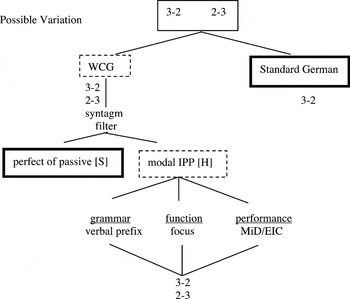
Let us now see how the grammatical, functional, and performance factors that have been shown to influence word order in the verbal complex may be unified in a single account. To facilitate discussion, I give a graphic representation of the interactions between these factors in figure 4 below.
Interaction of grammar, function, and performance in WCG.

The interactions may be exemplified by comparing word order in main clause two-verb complexes in two grammars: standard German and West Central German. We begin with all logically possible word orders, namely 3-2 and 2-3. For each grammar, a grammatical rule first determines which of these word orders is allowed. In standard German, the core syntax licenses only the 3-2 order, so no further factors may influence word order. In West Central German, on the other hand, the grammar licenses both the 3-2 and 2-3 orders, which allows the occurrence of these word orders to be influenced by additional factors. The factor group syntagm first comes into play in the form of a filter.Footnote 87 Recall from section 3.3 that the perfect of passive [S], for example, allows only the 3-2 order in WCG, so here again, no further factors may influence word order. In contrast, the modal IPP [H] allows both the 3-2 and 2-3 orders. The occurrence of these word orders may, in turn, be accounted for by an interaction of grammar, function, and performance.Footnote 88
What remains outstanding is a principled way to determine exactly how grammar, function, and performance interact. Indeed, Lötscher (1978:11) is correct in the notion that “alle drei Regeltypen wirken bei der Formation eines bestimmten Satzes natürlich mit, und so sind ihre Interaktionen oft nicht leicht zu erfassen” (All three types of rules play a role in the formation of a particular sentence, and for this reason, their interactions are often not easily captured). It seems clear that the gram-matical rule must apply first since if a grammar allows no variation, then none of the factors, for example, the presence of a stressed separable prefix, will have an effect on word order.Footnote 89 However, it is difficult to pinpoint the extent to which each factor can account for particular word orders and what the possible additive effects are. I leave this issue to further research.Footnote 90
Finally, the question arises as to how the movements involved in verbal complex formation are triggered. Sapp (2006:302–305) argues, following Haider & Rosengren's (2003) approach to scrambling in German, that the movements associated with focus are not syntactically triggered but are optional movements that take place at the syntax-semantics/pragmatics interface because they are “pragmatically felici-tous.” Similarly, movement as a result of grammatical- and performance-related factors could be seen to occur at this and additional interfaces. The key here is that verbal complex phenomena ought not to be analyzed solely in terms of core-syntactic operations, for they can more adequately be captured with concomitant reference to interfaces.
8. Conclusion
The main goal of this paper has been twofold. First, it classified the types of verbal complex phenomena that occur in WCG, a dialect region that so far has been neglected in this regard, and determined the factors that influence word order in these complexes. In the empirical part of the study, it was shown that the subordinate and main clause two- and three-verb complexes attested in the corpus display multiple word orders, VPR, and extraposition. The subsequent statistical analysis revealed that the factor groups syntagm, verbal prefix type, and focus have statistically significant effects on word order. Second, the paper outlined a multi-causal account of verbal complex phenomena, taking as the point of departure Lötscher 1978 and Sapp 2007. By demonstrating how VPR can be motivated in part as a result of more efficient processing for the speaker, this study furthers our understanding of verbal complexes beyond Lötscher and Sapp's contributions. Given the insights that accounting for verbal complex word order in terms of interactions at interfaces provides, this study can be viewed as a model for inves-tigations of other phenomena that have been proven difficult to explain solely in terms of core-syntactic operations.
APPENDIX
Subordinate clause two-verb complexes
1.
2.
3.
4.
5.
6.
7.
Subordinate clause three-verb complexes
8.
9.
10.
11.
12.
13.
14.
15.
16.
17.
18.
19.
20.
Main clause two-verb complexes
21.
22.
23.
24.
25.
26.
27.
28.
Main clause three-verb complexes
29.
30.