INTRODUCTION
Betaine is one of the main dietary sources of labile methyl groups in animal diets and is considered to be essential in the regulation of methylation processes (Kettunen et al. Reference Kettunen, Tiihonen, Peuranen, Saarinen and Remus2001). Betaine actively participates in methionine metabolism by donating methyl groups for the remethylation of homocysteine to methionine (Banskalieva et al. Reference Banskalieva, Puchala, Goetsch, Luo and Sahlu2005); this, in part, meets methionine requirements and improves meat or milk production.
Early in vitro and in vivo studies demonstrated that betaine is metabolized by ruminal microbes to produce acetate and trimethylamine. Mitchell et al. (Reference Mitchell, Chappell and Knox1979) reported that the addition of [methyl 14C]betaine to the rumen was followed by a rapid production of 14C-labelled trimethylamine; 14C recovered in the urine amounted to 0·23 of the original dose, of which 0·71 was trimethylamine and its N-oxide. Other losses of the methyl label were: expired CO2, 0·16; rumen methane, 0·10; and rumen CO2, 0·03. An estimated turnover rate of 0·45/h was measured for the period of most active betaine utilization in the rumen. However, the quantity of betaine degraded in the rumen varied across experiments (Mitchell et al. Reference Mitchell, Chappell and Knox1979; Löest et al. Reference Löest, Titgemeyer, Drouillard, Blasi and Bindel2001) or type of diet fed (Löest et al. Reference Löest, Titgemeyer, Drouillard, Blasi and Bindel2001). Nevertheless, betaine could alter ruminal fermentation by serving as a source of either ruminally available nitrogen or methyl groups.
The dietary addition of betaine increased feed intake of steers (Löest et al. Reference Löest, Titgemeyer, Drouillard, Coetzer, Hunter, Bindel and Lambert2002; Bock et al. Reference Bock, Brethour, Harmoney and Goodall2004), milk yields and milk fat content with goats (Fernández et al. Reference Fernández, López-Saez, Gallego and De La Fuente2000, Reference Fernández, Sánchez-Seiquer, Sánchez, Contreras and De La Fuente2004), ruminal volatile fatty acid (VFA) concentration (Wiedmeier et al. Reference Wiedmeier, Tanner, Bair, Shenton, Arambel and Walters1992) and average daily gains (ADG) of steers (Bock et al. Reference Bock, Brethour, Harmoney and Goodall2004). However, other studies found no effect of betaine supplementation on dry matter (DM) intake (Löest et al. Reference Löest, Titgemeyer, Drouillard, Blasi and Bindel2001), ruminal total VFA concentration (Bonner et al. Reference Bonner, Gaughan, Al Jassim and Bryden2008) and ADG (Gralak et al. Reference Gralak, Leśniewska, Puchaa, Barej and Dymnicki1998; Löest et al. Reference Löest, Titgemeyer, Drouillard, Coetzer, Hunter, Bindel and Lambert2002) in ruminants. Furthermore, studies using rumen-protected betaine showed no effects on DM intake, milk yields and milk components (Davidson et al. Reference Davidson, Hopkins, Odle, Brownie, Fellner and Whitlow2008), or ruminal total VFA concentration (Davidson Reference Davidson2006).
These inconsistent effects of betaine on DM intake and lactation performance may be due to differences in the form and rumen availability of the betaine fed, the dose of betaine supplemented, basal methionine supply and amino acid status of the animals, as well as the crude protein (CP) content in basal diet (Puchala et al. Reference Puchala, Sahlu, Herselman and Davis1995; Fernández et al. Reference Fernández, Gallego and Lopez-Bote1998; Shenkoru Reference Shenkoru2001; Fernández-Figares et al. Reference Fernández-Figares, Wray-Cahen, Steele, Campbell, Hall, Virtanen and Caperna2002). Furthermore, the information available on the role of betaine in dairy cow nutrition is scarce. Therefore, the aim of the present work was to study the effects of betaine supplementation on rumen fermentation, lactation performance and plasma characteristics in dairy cows.
MATERIALS AND METHODS
Animals and experimental design
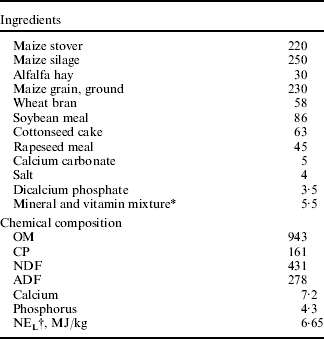
Twenty multiparous Holstein dairy cows (597±11·8 kg body weight (BW), 88±4·5 days in milk (DIM) and average daily milk production of 26·3±0·5 kg/cow) were assigned to a replicated 4×4 Latin square experiment. The treatments were: control (without betaine), low-betaine (LB), medium-betaine (MB) and high-betaine (HB) with 0, 50, 100 and 150 g betaine/cow/day, respectively. The supplement of feed grade betaine (anhydrous betaine with 0·97 purity, Shanxi Xinliyuan Biotechnology Co. Ltd, Taiyuan, China) was purchased commercially and was hand-mixed into the top one-third of the daily ration immediately after feed was delivered. Experimental periods were 30 days with 15 days of adaptation and 15 days of sampling. Cows were housed in a naturally ventilated tie-stall barn and allowed to exercise for 2 h in an open dry lot before milking at 14.00 h. Cows were milked three times daily at 06.00, 14.00 and 21.00 h and were fed ad libitum a total mixed ration (TMR) (Table 1) after each milking. The diet was formulated based on NRC (2001) recommendations for a 590 kg cow producing 26 kg/day of milk containing 33 g/kg of milk fat and 32 g/kg CP. The experimental protocol was approved by the Animal Care and Use Committee of the Shanxi Agriculture University (Taigu County, Jinzhong City, Shanxi Province).
Ingredients and chemical composition of the basal diet (g/kg DM)
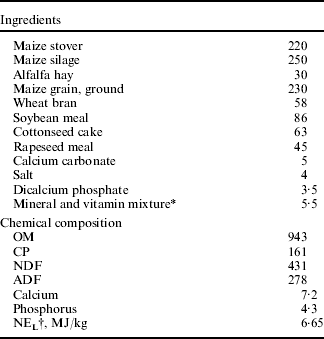
* Contained 42 mg Co/kg, 3·5 g Cu/kg, 20 g Fe/kg, 12 g Mn/kg, 12 g Zn/kg, 1·2 g I/kg, 600 mg Se/kg, 3800 IU vitamin A/g, 1200 IU of vitamin D/g and 30 IU vitamin E/g.
† Estimated based on NRC (2001). NEL=Net energy required for lactation.
Dry matter intake, milk production and milk composition
Feed offered and refusals were individually recorded daily through the experimental period to calculate DM intake. Samples of TMR and refusals were collected weekly and stored at −20°C for later chemical analysis. Milk yields were recorded daily during each period. Milk samples from each cow were collected weekly from each milking on three consecutive milkings within a day. Milk samples were preserved with 2-bromo-2-nitropropane-1,3-diol and pooled by day (in proportion to milk yield at each milking) for each cow before chemical analysis.
Rumen pH and fermentation
Rumen pH, VFA and ammonia concentrations were measured on 2 consecutive days during days 26 and 27 of the period. At 0, 3, 6 and 9 h after the morning feeding, samples (c. 100 ml) of rumen fluid were obtained anaerobically via the oesophagus using a stomach tube (outside diameter 10 mm, inside diameter 8 mm, length 3 m) connected to a Speedivac 2 vacuum pump (Edwards High Vacuum, Crawley, UK) from the rumen (Jacobson et al. Reference Jacobson, Lindahl, Mcneill, Shaw, Doetsch and Davis1957). The first 50 ml of rumen fluid collected was discarded to avoid saliva contamination; a back and forth action was found to be desirable for obtaining large quantities of rumen contents from different areas of the rumen (Melaku et al. Reference Melaku, Peters and Tegegne2004). Ruminal pH was immediately measured using an electric pH meter (Sartorius Basic pH Meter PB-20, Sartorius AG, Goettingen, Germany). The samples were then strained through four layers of cheesecloth. Five millilitres of filtrate was preserved by adding 1 ml of 250 g/l (w/v) meta-phosphoric acid to determine VFA, and 5 ml of filtrate was preserved by adding 1 ml of 20 g/l (w/v) H2SO4 to determine NH3. The samples were subsequently stored frozen at −20°C until analysis.
Apparent digestibility in the total tract
Cows were dosed daily via the oesophagus with 5 g of chromic oxide in two equal portions at 07.00 and 19.00 h during days 9 and 25 of each period for use as a digestion marker (Kozloski et al. Reference Kozloski, Moraes Flores and Martins1999). Faecal samples (approximately 200 g wet weight) were collected for each cow from the rectum three times daily at various times (3 h intervals) during days 16–26 of the period and pooled by cow for each period (Liu et al. Reference Liu, Wang, Huang, Dong, Yang and Wang2008). After being dried at 55°C for 48 h, the samples were ground to pass through a 1 mm sieve in a feed mill (FZ102, Shanghai Hong Ji Instrument Co., Ltd, Shanghai, China) for chemical analysis. DM excreted in faeces was calculated by dividing chromium input (g chromium/day) by chromium concentration (g chromium/kg DM) in the faeces (Ferret et al. Reference Ferret, Plaixats, Caja, Gasa and Prió1999). Excretion of other nutrients in the faeces was calculated by multiplying DM flow by their concentration in faecal DM.
Blood Metabolites
Blood samples were obtained on days 28, 29 and 30 of each period 2 h after the morning feeding from the coccygeal vein into 7 ml vacuum tubes (Vacutainer®, Becton Dickinson, Rutherford, NJ, USA) containing potassium oxalate and 4 g/100 ml sodium fluoride for glucose analysis, and 10 ml tubes containing sodium heparin for analyses of β-hydroxybutyrate (BHBA) and non-esterified fatty acids (NEFA). Blood samples were immediately placed on ice and transported to the laboratory to separate plasma from whole blood by centrifuging at 2000 g for 15 min at 4°C. All plasma samples were stored frozen at −20°C until analysis.
Chemical analyses
Samples of TMR and refusals were dried in an oven at 55°C for 48 h and ground to pass through a 1 mm screen with a mill (FZ102, Shanghai Hong Ji Instrument Co., Ltd, Shanghai, China) for chemical analysis. The DM content of the TMR samples was determined by oven drying at 65°C for 24 h. Analytical DM content of oven-dried samples was determined by drying at 135°C for 3 h (AOAC 1990; method 930.15). The content of organic matter (OM) was calculated as the difference between DM and ash contents, with ash determined by combustion at 550°C for 5 h. Contents of neutral detergent fibre (NDF) and acid detergent fibre (ADF) were determined using the methods described by Van Soest et al. (Reference Van Soest, Robertson and Lewis1991) with heat-stable α amylase and sodium sulphite used in the NDF procedure, and expressed inclusive of residual ash. The content of N in the samples was determined by the Kjeldahl method (AOAC 1990; method 976.05). Ruminal VFA was separated and quantified by gas chromatography (GC102AF; Shanghai Specialties Ltd, China) using a 2 m (diameter 4 mm) fused PEG2000, Chromsob WAW DMCS column (GC102AF; Shanghai Specialties Ltd, China) with 2-ethylbutyric acid as the internal standard. The ammonia N content of ruminal samples was determined using the method of AOAC (1990). Milk samples were analysed for fat, true protein and lactose using infrared spectrophotometry (Foss 120 Milko-Scan, Foss Electric, Hillerød, Denmark) according to AOAC (1997; method 975.16) procedures. Concentrations of glucose in plasma were determined using glucose oxidase (Sigma kit no. 315, Sigma Diagnostics, St. Louis, MO, USA) based on the method of Trinder (Reference Trinder1969). Concentrations of BHBA were determined (Sigma kit 310-A, Sigma Diagnostics) following the method of Williamson et al. (Reference Williamson, Mellanby and Krebs1962). Concentrations of NEFA were determined using a colorimetric assay (NEFA C Assay kit, Nanjing Jian Cheng institute of Bio-engineering, Nanjing, China) with the modifications of Johnson & Peters (Reference Johnson and Peters1993).
Statistical analyses
Data were analysed using the mixed model procedure of Statistical Analysis System (SAS Institute 2002) to account for the effects of square, period within square, animal within square and treatment. The treatment was considered a fixed effect; square, period within square, and animal within square were considered random effects. Data for ruminal pH, VFA and ammonia N were summarized by sampling time and then analysed using the same mixed model but with time included as a repeated measure using compound symmetry covariance structure. The effects of betaine (control v. betaine) per se and linear and quadratic orthogonal contrasts were tested using the CONTRAST statement of SAS with coefficients estimated based on the betaine application rates. Effects of the factors were declared significant at P<0·05 unless otherwise noted and trends are discussed at P<0·10.
RESULTS
Dry matter intake, milk yield and milk components
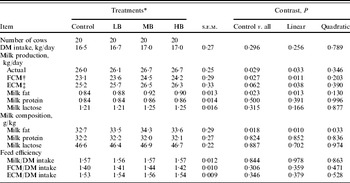
DM intake was not affected by betaine supplementation (Table 2). Milk yields were higher (P=0·029) for betaine supplementation than for control and increased linearly (P=0·033), and milk fat content was higher (P=0·018) for betaine supplementation than the control, and increased linearly and quadratically. As a result, the yields of milk fat and milk yield (corrected to 40 g fat/kg; fat corrected milk (FCM)) were higher (P<0·03) for betaine supplementation than for the control and linearly (P<0·02) increased with increasing the betaine supplementation. Yields of energy-corrected milk (ECM) increased linearly (P=0·038) with increasing the betaine supplementation. Yields and proportion of milk protein and milk lactose, and feed efficiency were not affected by betaine supplementation.
Effects of betaine supplementation on DM intake, milk yield and milk components in dairy cows

* Control (without betaine), low-betaine (LB), medium-betaine (MB) and high-betaine (HB) with 50, 100 and 150 g betaine/cow/day, respectively.
† FCM was corrected for 40 g fat/kg milk.
‡ ECM=0·3246×milk yield+12·86×fat yield+7·04×protein yield.
Linear and quadratic effects of betaine with 0, 50, 100 and 150 g of betaine/cow/day.
Ruminal pH and fermentation
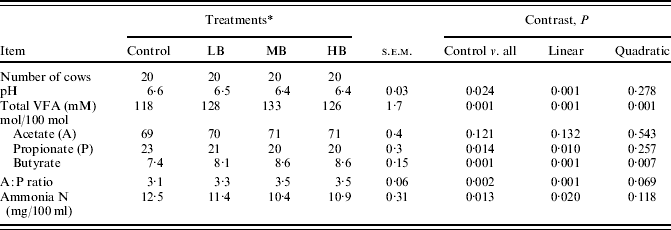
Mean ruminal pH was lower (P=0·023) for betaine supplementation than for the control and decreased linearly (P=0·001) with increasing the betaine supplementation (Table 3). Total ruminal VFA concentration was higher (P=0·001) for betaine supplementation (129 mM) than for control (118 mM) and increased linearly (P=0·001) and quadratically (P=0·001) with increasing the betaine supplementation. Molar proportion of acetate was not affected, whereas that of propionate decreased linearly (P=0·010) with increasing the betaine supplementation. In consequence, the ratio of acetate to propionate (A:P) increased linearly (P=0·001). Molar proportion of butyrate was increased linearly (P=0·001) by betaine supplementation. Supplementation of betaine decreased ruminal ammonia N content linearly (P=0·020).
Effects of betaine supplementation on ruminal pH and fermentation in dairy cows
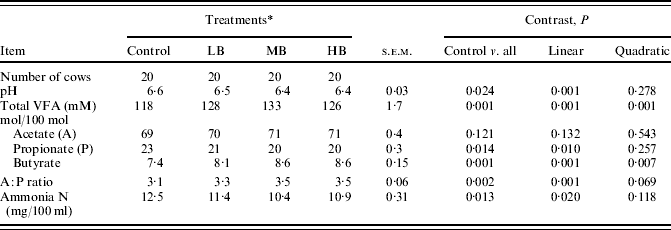
* Control (without betaine), low-betaine (LB), medium-betaine (MB) and high-betaine (HB) with 50, 100 and 150 g betaine/cow/day, respectively.
Linear and quadratic effects of betaine with 0, 50, 100 and 150 g of betaine/cow/day.
Digestibility in the total tract
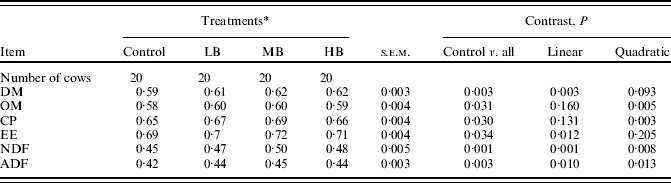
Digestibilities of DM, OM, CP, ether extract (EE), NDF and ADF in the total tract were increased (P<0·05) by betaine supplementation than for the control (Table 4). Supplementation of betaine increased digestibilities of DM and EE in the total tract linearly, whereas digestibilities of OM and CP in the total digestive tract increased quadratically. Digestibilities of NDF and ADF in the total tract increased linearly and quadratically with increasing the betaine supplementation.
Effects of betaine supplementation on the coefficient of component digestibility in the total tract of cows
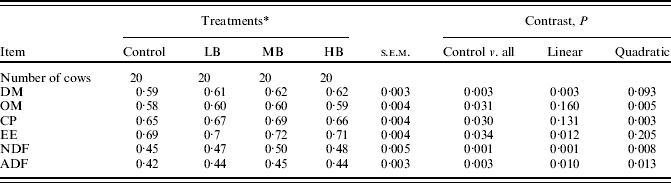
* Control (without betaine), low-betaine (LB), medium-betaine (MB) and high-betaine (HB) with 50, 100 and 150 g betaine/cow/day, respectively.
Linear and quadratic effects of betaine with 0, 50, 100 and 150 g of betaine/cow/day.
Blood metabolites
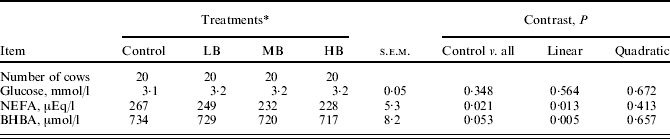
Concentration of glucose in plasma was not significantly affected by betaine supplementation (Table 5). Plasma concentrations of NEFA were linearly (P=0·013) decreased with increasing the betaine supplementation. Similarly, plasma concentrations of BHBA were linearly (P=0·005) decreased with increasing the betaine supplementation.
Effects of betaine supplementation on concentrations of glucose, BHBA and NEFA of plasma in dairy cows
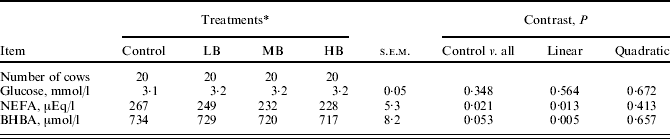
* Control (without betaine), low-betaine (LB), medium-betaine (MB) and high-betaine (HB) with 50, 100 and 150 g betaine/cow/day, respectively.
Linear and quadratic effects of betaine with 0, 50, 100 and 150 g of betaine/cow/day.
DISCUSSION
According to the recommendations of NRC (2001), metabolizable protein (MP) requirements were estimated to be 1853, 1858, 1894 and 1891 g/day for the control, LB, MB and HB, respectively. However, the MP estimated from the present diets would be slightly lower than the NRC recommendations with 1833, 1843, 1881 and 1872 g MP/day for the control, LB, MB and HB, respectively. Furthermore, the diets used in the current study contained c. 18·3 g methionine/kg, which is only 0·76 of the optimal concentrations of methionine in MP (240 g/kg) required for maintenance and milk protein production recommended by the NRC (2001). Therefore, the positive effects of supplementary betaine on milk production and feed digestibility could be attributed in part to limiting methionine supply from the basal diets.
The lack of any effect of betaine supplementation on DM intake in the current study is consistent with the finding of Löest et al. (Reference Löest, Titgemeyer, Drouillard, Blasi and Bindel2001), who reported that supplemental lipid-coated betaine product at 4·2 g/day and concentrated separator by-product (CSB; a source of betaine, 250 g/day CSB, 15·5 g betaine/day) did not change DM intake of young calves (260 kg initial BW) fed soybean hulls. In contrast, Löest et al. (Reference Löest, Titgemeyer, Drouillard, Coetzer, Hunter, Bindel and Lambert2002) reported increased DM intake by Holstein steers fed feed-grade betaine at 10·5 and 21 g/day and CSB at 250 and 500 g/day (supplying 15·5 and 31 g betaine/day, respectively). Similarly, Bock et al. (Reference Bock, Brethour, Harmoney and Goodall2004) reported that supplementing 20 g betaine/steer/day increased feed intake. These inconsistent effects of betaine on DM intake may be due to the quality and dose of the betaine product used in the diets, the extent to which the betaine fed is available in the rumen, and the metabolic response to supplementation.
The increased milk yield as a result of betaine supplementation in the current study is consistent with the finding of Fernández et al. (Reference Fernández, Sánchez-Seiquer, Sánchez, Contreras and De La Fuente2004), who reported that anhydrous betaine increased milk yield and milk fat concentration when primiparous lactating goats were fed a diet with a betaine concentration of 4 g/kg dietary DM from 10 days before parturition and through the 5 month lactation period. In contrast, Davidson et al. (Reference Davidson, Hopkins, Odle, Brownie, Fellner and Whitlow2008) reported that DM intake, milk yield and milk components were not affected by supplementing 45 g rumen-protected betaine/day when lactating Holstein cows from 21 to 91 DIM were fed a corn silage-based TMR estimated to be limiting in methionine supply. These inconsistent effects of betaine on milk yield and milk composition may be due to the form of betaine fed (rumen-protected v. unprotected), the amount of betaine fed, basal methionine supply, amino acid status of the animals, or the CP content of, basal diet. Puchala et al. (Reference Puchala, Banskalieva, Goetsch, Sahlu and Prieto2000) reported that growing Angora goats consuming a low-protein forage-based diet supplemented with ruminally protected betaine increased ADG by 60%, whereas there was no effect of betaine with a diet high in protein. The linearly and quadratically increased milk fat content observed (Table 2) is consistent with the increases in ruminal acetate concentrations observed (81, 90, 95 and 90 mmol/l for the control, LB, MB and HB, respectively).
Betaine could alter ruminal fermentation by serving as a source of either ruminally available nitrogen or methyl groups (Löest et al. Reference Löest, Titgemeyer, Drouillard, Coetzer, Hunter, Bindel and Lambert2002). Supplementation of betaine in the diet of cows altered the rumen VFA profiles, as shown by the linear increase in A:P ratio with increasing the betaine doses. The increase in A:P ratio and in total VFA concentration was mainly due to an increase in acetate and butyrate concentration. The linear increase in total ruminal VFA concentration is consistent with the linear reduction in mean ruminal pH associated with increasing betaine supplementation. Mitchell et al. (Reference Mitchell, Chappell and Knox1979) reported that betaine is metabolized by ruminal microbes to produce acetate and trimethylamine. Similarly, Wiedmeier et al. (Reference Wiedmeier, Tanner, Bair, Shenton, Arambel and Walters1992) observed that betaine-rich sugar beet by-products supplementation enhanced ruminal VFA production and improved microbial fermentation of the NDF fraction. The increased VFA concentrations indicate a greater microbial fermentation rate. Although total VFA and acetate production were not affected, propionate concentration tended to be lower and butyrate concentration tended to be higher with betaine supplementation at 5 g/day in sheep fed a mixed diet consisting of 0·70 grain and 0·30 roughage (Bonner et al. Reference Bonner, Gaughan, Al Jassim and Bryden2008). It could be speculated that the primary effects of feeding betaine may be changes in ruminal fermentation rather than changes in methyl metabolism.
The linear reduction in ruminal ammonia N concentration with betaine supplementation could be due to an enhanced growth of ruminal microbial populations that would increase ammonia N utilization, especially by the fibre-degrading populations. Cellulolytic bacteria derive their N exclusively from ammonia N (Russell et al. Reference Russell, O'Connor, Fox, Van Soest and Sniffen1992). One can suggest that betaine supplementation may improve ruminal fibrolytic bacterial activity as total digestibilities of NDF and ADF were improved linearly and quadratically. Reduced rumen ammonia concentration suggests that postruminal N availability was enhanced as a result of betaine addition to a methionine-limited diet. In addition, the quadratic response to the dose of betaine supplementation indicated that further increase of betaine dose from 100 to 150 g/day was not beneficial to increase the total VFA concentration. The results suggest that stimulation of microbial activity and VFA production by betaine occurred in a dose-dependent manner.
The quadratically improved total digestibility of dietary components is consistent with increased rumen VFA concentration and production of milk fat and FCM by betaine supplementation. A number of studies reported increased ADG of steers (Bock et al. Reference Bock, Brethour, Harmoney and Goodall2004) and goats supplemented with betaine. Improved animal growth rate could be partially attributed to the increased nutrient digestibility in the digestive tract with betaine supplementation. In contrast, Gralak et al. (Reference Gralak, Leśniewska, Puchaa, Barej and Dymnicki1998) reported that supplemented with 25 g betaine/kg basal diet had no effect on ADG, concentrate efficiency ratio and relative growth rate of 6-month-old calves fed meadow hay and a control granulated concentrate. The dose used in that study was much higher than that used in the present study (<10 g betaine/kg basal diet). Löest et al. (Reference Löest, Titgemeyer, Drouillard, Coetzer, Hunter, Bindel and Lambert2002) reported that steers fed feed-grade betaine had no effects on ADG and gain efficiencies. These inconsistent effects of betaine on feed digestibility or feed efficiency may be due to the dose of betaine supplemented or CP content in the basal diet. In fact, Banskalieva et al. (Reference Banskalieva, Puchala, Goetsch, Luo and Sahlu2005) reported that the metabolic responses to rumen-protected betaine fed at 9 g/kg dietary DM in goats (43±5·1 kg) depended on the level of dietary CP (90 or 150 g CP/kg). The quadratic response to the dose of betaine supplementation in the present study indicated that further increase of betaine dose from 100 to 150 g/day was not beneficial to increase total digestibility.
Blood NEFA concentration can be used as an indicator of energy balance and energy mobilization status (Canfield & Butler Reference Canfield and Butler1991). The linearly reduced plasma NEFA suggests that energy availability was improved with betaine supplementation in the present study. However, Davidson et al. (Reference Davidson, Hopkins, Odle, Brownie, Fellner and Whitlow2008) reported that plasma NEFA and BHBA concentrations were not affected when lactating Holstein cows from 21 to 91 DIM were fed a corn silage-based TMR supplemented with 45 g rumen-protected betaine/day, even though the diet was limited in methionine.
The differences in the response of plasma NEFA to betaine supplementation between the present study and the study by Davidson et al. (Reference Davidson, Hopkins, Odle, Brownie, Fellner and Whitlow2008) could be attributed to the difference in lactation stage of the cows used. The early lactation cows used by Davidson et al. (Reference Davidson, Hopkins, Odle, Brownie, Fellner and Whitlow2008) had greater body mobilization to meet the high milk production and thus may have been less sensitive to betaine supplementation compared with the mid-lactation cows used in the present study.
CONCLUSION
Increasing supplementation of mid-lactation cow diets with betaine increased milk and FCM yield linearly and increased milk fat percentage linearly and quadratically. Supplementation of betaine linearly and quadratically increased rumen total VFA concentration and A:P ratio, as well as the digestibilities of DM, NDF and ADF in the total digestive tract. Plasma concentration of NEFA and BHBA decreased linearly with increasing the betaine supplementation. The results suggest that betaine might modulate the rumen micro-organisms to improve feed fermentation in the rumen and thus provide cows more energy (i.e. VFA) and possibly more microbial protein. The results also suggest that the action of betaine in the digestive tract of cows occurs in a dose-dependent manner when cows are fed corn silage-based TMR containing limited methionine. Further study is warranted to confirm the level of betaine supplementation most appropriate for specific diets and productive states.
This work was supported by a grant from 11th Five-Year key projects of the National Scientific Research Foundation of China (2007BAD5B04). The authors thank the staff of the Shanxi Agriculture University beef unit for care of the animals.