INTRODUCTION
Suboptimal temperature is one of the most important limiting factors that inhibit germination and growth of plants and consequently reduce yield. As one of the typical tropical and subtropical species, maize (Zea mays L.) is planted worldwide. Optimum temperature for maize growth is between 25 and 28 °C, and maize is susceptible to chilling injury at low non-freezing temperatures below 12 °C. Cold exposure can alter the structure of membranes due to lipid peroxidation, changes in protein content and enzymatic activity, cellular leakage of electrolytes and many others (Posmyk and Janas, Reference Posmyk and Janas2007). A common consequence of most environmental stresses is the increased production of reactive oxygen species (ROS). Plants protect cell and sub-cellular systems against H2O2 and other harmful ROS with the help of enzymatic antioxidants, such as catalases (CAT), ascorbate peroxidases (APX), peroxidases (POD), glutathione reductases (GR) and non-enzymatic antioxidants, for example glutathione and ascorbate (Alscher et al., Reference Alscher, Donahue and Cramer1997).
Several studies have shown that the preliminary treatment of plants with low concentrations of salicylic acid (SA) might enhance the plant tolerance towards most kinds of abiotic stresses, through the activation of antioxidant enzyme activities (Horváth et al., Reference Horváth, Szalai and Janda2007). For example, Horváth et al. (Reference Horváth, Janda, Szalai and Páldi2002) found that SA and other phenolic compounds (e.g. benzoic acid and acetyl-SA) increased the chilling tolerance of young maize plants when applied hydroponically at a concentration of 0.5 mM. Drazic and Mihailovic (Reference Drazic and Mihailovic2005) suggested that 10−6, 10−5 or 10−4 mol L−1 SA alleviated the adverse effects of cadmium on soybean seedlings. Shi et al. (Reference Shi, Bao, Zhu, Ying and Qian2006) also noted that foliar spraying with 1 mM SA induced the heat tolerance of cucumber plants (Cucumis sativa L.), as indicated by lower membrane electrolyte leakage, H2O2 and lipid peroxidation, together with a higher Fv/Fm chlorophyll fluorescence value. Gunes et al. (Reference Gunes, Inal, Alpaslan, Eraslan, Bagci and Cicek2007) reported that SA added to the soil had an ameliorating effect on the survival of maize plants under salt stress and decreased the Na+ and Cl− accumulation.
All the above-mentioned studies demonstrated that abiotic stress effects can be moderated by application of exogenous SA. However, the mechanism of tolerance to abiotic stress induced by SA was still ambiguous. In addition, it is not clear whether the effects of exogenous SA are direct or they are connected with that of endogenous SA. Recently, Szalai et al. (Reference Szalai, Horgosi, Soos, Majlath, Balazs and Janda2011) investigated the distribution of SA in young pea (Pisum sativum L.) seedlings grown from seeds soaked in 3H-labelled SA solution before sowing. They found that SA pre-treatment increased the genes expression of the chorismate synthase and isochorismate synthase in the epicotyls, and that the increased level of free and bound SA was the product of de novo synthesis, rather than having been taken up and mobilized by the plants. They proposed that the endogenous SA rather than the exogenous SA may function directly in inducing defence mechanisms in plants. Therefore, the investigation of changes in endogenous SA of plants under abiotic stress may be useful for understanding the accurate mechanism of SA in inducing tolerance towards abiotic stress. However, there is little information available in the literature about changes of endogenous SA of plants under abiotic stress, especially under chilling stress. In this research, changes of endogenous SA contents, antioxidant enzyme activities and malondialdehyde (MDA) concentrations in two different chilling-tolerant maize seedlings under chilling stress were investigated to evaluate the possible differences in constitutive activities of these antioxidant enzymes and correlations between endogenous SA contents and antioxidant enzyme activities or MDA concentrations both in roots and in leaves of maize seedlings.
MATERIALS AND METHODS
Plant material
Seeds of two maize (Zea mays L.) inbred lines, Huang C (chilling-tolerant) and Mo17 (chilling-sensitive; Zheng et al., 2006), were used. Maize seeds were surface sterilized in 0.5% NaOCl for 5 min and germinated for 4 days (day 4) in darkness at 25 °C in rolled towels moistened with water. After that, seedlings were transferred to pots supplied with 500-ml aerated Hoagland solution. Each pot contained nine seedlings. Eighteen pots containing 162 seedlings of each maize line were used. Seedlings were then divided into three groups, each group containing six pots. One group was maintained at 25 °C for 6 days as control (treatment 1). The remaining two groups were transferred for chilling treatment for 3 days (day 7) at 15 °C (treatment 2) or 5 °C (treatment 3), respectively; then seedlings were transferred back to 25 °C for a recovery growth period of 3 days (day 10). All seedlings were incubated in growth chambers with a photosynthetic photon flux density of 250 μmol m−2 s−1 and a 12-h photoperiod.
Seedlings were harvested before the chilling treatment (day 4), immediately after the chilling treatment (day 7) and at the end of the recovery growth period (day 10), respectively. Seedlings were excised into roots and leaves and stored at −70 °C before biochemical measurements.
Malondialdehyde measurement
MDA concentrations were determined as described by Cao et al. (Reference Cao, Hu, Zhu, Hu and Knapp2010). Briefly, 0.3-g fresh tissues were ground in 8 ml of 0.05-M sodium phosphate buffer (pH 7.8) and centrifugated at 10,000×g for 15 min. To a 1.5-ml aliquot of the supernatant, 2.5 ml of 5% (w/v) thiobarbituric acid in 5% trichloroacetic acid (TCA) was added. The mixture was heated at 100 °C, maintained constantly for 15 min and cooled immediately. After centrifugation at 1800×g for 10 min, the absorption of the supernatant was measured spectrophotometrically both at 532 and 600 nm. MDA concentration was calculated using an extinction coefficient of 155 mM−1 cm−1.
Antioxidant enzyme assay
For the analysis of antioxidant enzyme activity, 0.3-g fresh tissues were ground in 8 ml of 0.05-M sodium phosphate buffer (pH 7.8) and centrifugated at 10,000×g for 15 min, the supernatant was used as the crude enzyme extract (Hu et al., Reference Hu, Xie, Wang and Song2006; Zhu and Zhong, Reference Zhu and Zhong1990). CAT activity was measured by supervising the decline in absorbance due to hydrogen peroxide at 240 nm according to the method of Hu et al. (Reference Hu, Xie, Wang and Song2006). The reaction mixture contained 2.8 ml of 25-mM sodium phosphate buffer (pH 7.0, containing 2-mM disodium edetate dehydrate (EDTANa2)), 100 μl of 300 mM H2O2 and 100-μl enzyme extract. APX activity was assayed by monitoring the decrease in absorbance at 290 nm, as described by Nakano and Asada (Reference Nakano and Asada1981). The 3-ml reaction mixture contained 2.7 ml of 25-mM sodium phosphate buffer (pH 7.0, containing 2-mM EDTANa2), 100 μl of 7.5-mM ascorbic acid, 100 μl of 300-mM H2O2 and 100-μl enzyme extract. POD activity was determined according to Guan et al. (Reference Guan, Hu, Wang and Shao2009). The reaction mixture contained 2.7 ml of 25-mM sodium phosphate buffer (pH 7.0, containing 2 mM EDTANa2), 100 μl of 1.5% guaiacol, 100 μl of 300-mM H2O2 and 100-μl enzyme extract. The increase in absorbance at 470 nm was followed for 1 min. GR was determined by measuring the decrease in absorbance at 340 nm due to the oxidation of nicotinamide adenine dinucleotide phosphate (NADPH) (Smith et al., Reference Smith, Vierheller and Thorne1988). The 3-ml reaction mixture contained 2.7 ml of 25-mM sodium phosphate buffer (pH 7.0, containing 2-mM EDTANa2), 100 μl of 10-mM GSSG, 100 μl of 2.4-mM NADPH and 100-μl enzyme extract.
Salicylic acid measurement
Analysis of SA was carried out using a high-performance liquid chromatography (HPLC) method based on Zawoznik et al. (Reference Zawoznik, Groppa, Tomaro and Benavides2007) with some modifications. Note that 0.5-g fresh tissues were ground in liquid nitrogen, homogenized in 1-ml aliquot of 90% (v/v) methanol, vortexed and sonicated for 3 min. After centrifugation at 10,000×g for 15 min, the supernatants were transferred and pellets were re-extracted with 0.5 ml of 100% methanol, followed by sonication and centrifugation as described above. The combined supernatants were then evaporated under a stream of N2 and the residue was dissolved in 0.25 ml of 5% (w/v) TCA and partitioned twice by using 0.8 ml of ethyl acetate and cyclohexane mixture (1:1). The upper phase containing free SA was concentrated under a stream of N2. However, a lower aqueous phase with salicylic acid glucoside was subjected to acid hydrolysis by adding 0.3 ml of 8-M HCl and the mixture was heated at 80 °C for 1 h. The released free SA was then extracted with the organic mixture and concentrated as described above. Both of the SA collected from the upper phase and recovered from the lower phase were combined and dissolved in a 600-μl mobile phase, consisting of 0.2-M sodium acetate buffer (pH 5.5) (90%) and methanol (10%), then filtered through a 0.22-μm membrane filter. Quantification of SA was performed by HPLC (Waters 600, Waters 717 automatic sampler, Waters, Milford, USA) under fluorescence detection (Waters 474), using a C18 reverse phase column (Waters Nova-Pak) and the mobile phase as described above. The flow rate was 0.8 ml min−1. And the excitation and emission wavelengths were 305 and 407 nm, respectively.
Statistical analysis
Analysis of variance (ANOVA) of the obtained data was performed by using the Statistical Analysis System (SAS) software. Before the analysis, percentage data were arcsin-transformed according to ŷ = arcsin [sqrt (x/100)]. Regression equations were calculated between salicylic acid concentrations and physiological parameters in maize seedlings after chilling stress.
RESULTS
Effects of chilling stress on MDA concentrations
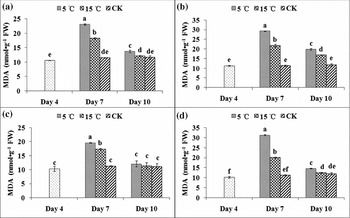
There was no significant difference in MDA concentrations in roots and leaves of both maize lines incubated at normal temperature (25 °C, CK) from day 4 to day 10 (Figure 1). Chilling stress significantly increased MDA concentrations in roots and leaves of both lines. In addition, seedlings incubated at 5 °C had significantly higher MDA concentrations than those at 15 °C. After transferred back to 25 °C for a recovery growth for 3 days (day 10), MDA concentrations significantly decreased in roots and leaves of both lines, though the concentrations were still marginally higher than those of CK.
Effects of chilling stress on MDA concentrations in (a) roots of Huang C, (b) roots of Mo17, (c) leaves of Huang C and (d) leaves of Mo17. Day 4, seeds were germinated for 4 days in darkness at 25 °C; day 7, seedlings were maintained at 25 °C (CK), 15 °C or 5 °C, respectively, for 3 days; day 10, seedlings were transferred back to 25 °C for a recovery growth period of 3 days. Lowercase letters indicate significant difference (p = 0.05, LSD) among treatments (the same as below).

Effects of chilling stress on antioxidant enzyme activities
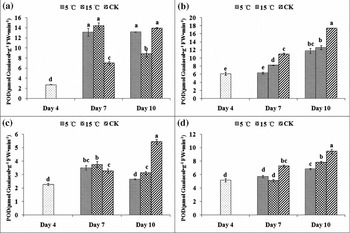
POD activities increased dramatically between days 4 and 10 in seedlings of CK, reaching a peak of 13.9, 17.4, 5.4 and 9.4 μmol Guaiacol g−1 FW min−1 in roots of Huang C, roots of Mo17, leaves of Huang C and Mo17, respectively (Figure 2). In addition, irrespective of the treatment, POD activities of roots were higher than those of leaves. Chilling stress significantly increased POD activities of both roots and leaves of Huang C (Figures 2a and c), but decreased the activities of Mo17 (Figures 2b and d). POD activities of seedlings incubated at 15 °C were higher than those at 5 °C, except those of leaves of Mo17 (Figure 2d). After recovery growth (day 10), POD activities significantly increased in roots and leaves of Mo17, while these decreased in roots and leaves of Huang C, except those of roots incubated at 5 °C. However, POD activities of seedlings that suffered chilling stress were all lower than those of CK.
Effects of chilling stress on POD activities in (a) roots of Huang C, (b) roots of Mo17, (c) leaves of Huang C and (d) leaves of Mo17.

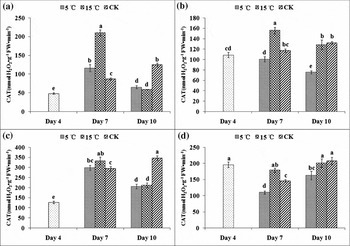
Under normal temperature (25 °C, CK), CAT activities significantly increased between days 4 and 10 in roots and leaves of Huang C (Figures 3a and c) and roots of Mo17 (Figure 3b). On day 7, after 3 days of chilling treatment incubated at 15 °C, CAT activities were significantly higher in roots and leaves of both lines than those of CK. However, seedlings incubated at 5 °C had lower CAT activities than those of CK, except those in roots of Huang C, which were higher than those of CK. After recovery growth, CAT activities of seedlings that suffered chilling stress were lower than those of CK.
Effects of chilling stress on CAT activities in (a) roots of Huang C, (b) roots of Mo17, (c) leaves of Huang C and (d) leaves of Mo17.

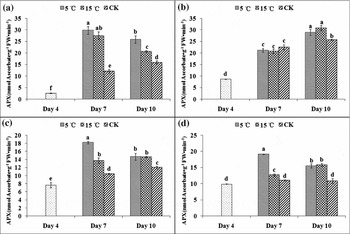
APX activities of CK seedlings significantly increased between days 4 and 10 (Figure 4), except those in leaves of Mo17 (Figure 4d). Chilling stress significantly increased APX activities in roots and leaves of Huang C and leaves of Mo17 (Figures 4a, c and d), but had no significant impact on the activities in roots of Mo17 (Figure 4b). In addition, APX activities of seedlings incubated at 5 °C were significantly higher than those at 15 °C. After recovery growth, APX activities of seedlings that suffered chilling stress were still higher than those of CK. Irrespective of the treatment, APX activities of roots were higher than those of leaves.
Effects of chilling stress on APX activities in (a) roots of Huang C, (b) roots of Mo17, (c) leaves of Huang C and (d) leaves of Mo17.

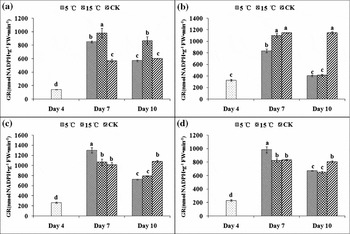
GR activities were low at the time of chilling treatment in roots and leaves of both lines (Figure 5). After chilling stress at 5 °C, GR activities were significantly higher in roots and leaves of Huang C and leaves of Mo17 (Figures 5a, c and d) than those of CK, while the activities were lower in roots of Mo17 than those of CK. However, chilling stress at 15 °C had no significant effect on GR activities in roots and leaves of Mo17 and leaves of Huang C (Figures 5b, c and d), except that GR activities in roots of Huang C (Figure 5a) were higher than those of CK. After recovery growth, GR activities were significantly lower in roots and leaves of both lines than those of CK, except those in roots of Huang C incubated at 15 °C, which were still higher than those of CK.
Effects of chilling stress on GR activities in (a) roots of Huang C, (b) roots of Mo17, (c) leaves of Huang C and (d) leaves of Mo17.

Effects of chilling stress on salicylic acid contents
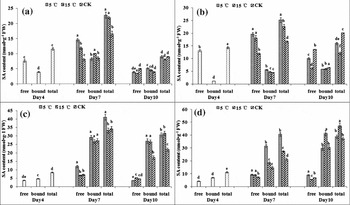
Free SA contents of CK seedlings were higher in roots than those of leaves in both lines on days 4, 7 and 10 (Figure 6). Chilling stress significantly increased free SA contents in roots and leaves of both lines, except that chilling stress at 15 °C had no significant impact on the contents of leaves of Huang C (Figure 6c). In addition, free SA contents of seedlings incubated at 5 °C were higher than those at 15 °C. After recovery growth (day 10), free SA contents were lower than those of CK, except those in leaves of Huang C incubated at 15 °C and leaves of Mo17 incubated at 5 °C, which were higher than those of CK.
Effects of chilling stress on endogenous SA contents in (a) roots of Huang C, (b) roots of Mo17, (c) leaves of Huang C and (d) leaves of Mo17. Lowercase letters indicate significant difference (p = 0.05, LSD) among treatments in the same form as of SA.

Bound SA contents were higher in leaves than in roots in both lines, irrespective of the treatment (Figure 6). In addition, bound SA contents of CK seedlings increased dramatically in roots and leaves of Mo17 between days 4 and 10 (Figures 6b and d), while in Huang C, bound SA contents reached a peak of 8.5 and 27.2 ng g−1 FW in roots and leaves (Figures 6a and c) on day 7, respectively. There was no significant difference between 5 °C and CK in bound SA contents in roots and leaves of Huang C; however, the contents in roots and leaves of Mo17 incubated at 5 °C were significantly higher than those of CK. Chilling stress at 15 °C had no significant effect on bound SA contents of both lines, except those in roots of Huang C (Figure 6a). After recovery growth, bound SA contents of Huang C were still higher than those of CK; however, the contents of Mo17 were lower than those of CK, except those in leaves of Mo17 incubated at 15 °C, which were still higher than those of CK.
For Mo17, total SA contents of CK seedlings significantly increased between days 4 and 10, while in Huang C, total SA contents reached a peak on day 7 both in roots and leaves (Figure 6). In addition, total SA contents in leaves of both lines were higher than those in roots, irrespective of the treatment. Chilling stress significantly increased total SA contents in roots and leaves of both lines, except those in leaves of Huang C incubated at 15 °C (Figure 6c). After recovery growth, total SA contents in roots of both lines were all lower than those of CK, while the contents in leaves of both lines were still higher than those of CK.
Relationship between changes of salicylic acid contents and MDA concentrations in maize seedlings under chilling stress
MDA concentrations were regressed against contents of three forms of SA under chilling stress (Table 1). Two significant equations were obtained in roots and leaves of maize seedlings, respectively. MDA concentration was positively correlated with total SA contents in roots (r = 0.9776, p = 0.0224) and bound SA in leaves (r = 0.9974, p = 0.0458), respectively.
Stepwise regression analysis between changes of salicylic acid contents and MDA concentrations in different tissues of maize seedlings under chilling stress.

*Y was MDA concentrations under chilling stress; X 1 and X 2 were bound SA and total SA contents under chilling stress, respectively.
Relationship between changes of salicylic acid contents and antioxidant enzyme activities in maize seedlings under chilling stress
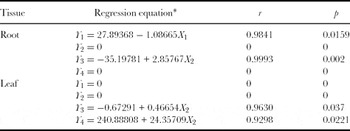
The relationship between four antioxidant enzyme activities and endogenous SA contents was assessed using stepwise regression analysis in maize seedlings after chilling treatment (Table 2). In roots of maize seedlings, there was no correlation between CAT, GR activities and endogenous SA contents. However, POD activities were positively correlated with free SA contents (r = 0.9841, p = 0.0159), and APX activities were correlated with total SA contents (r = 0.9993, p = 0.002). In leaves of maize seedlings, no correlation was found between POD, CAT activities and endogenous SA contents. However, APX activities had positive correlation with total SA contents (r = 0.9630, p = 0.037) and GR activities were also correlated with total SA contents (r = 0.9298, p = 0.0221).
Stepwise regression analysis between the changes of salicylic acid contents and antioxidant enzyme activities in different tissues of maize seedlings under chilling stress.

*Y 1, Y 2, Y 3 and Y 4 were POD, CAT, APX and GR activities under chilling stress, respectively; X 1 and X 2 were free SA and total SA contents under chilling stress, respectively.
DISCUSSION
Maize is sensitive to chilling temperatures, due to its tropical origin. Chilling temperature has a negative effect on maize plant development, morphology and physiology (Holá et al., Reference Holá, Kočová, Rothová, Wilhelmová and Benešová2007). Chilling tolerance could be achieved through several adaptive mechanisms, and the modulation of antioxidant enzyme levels could be a part of the whole mechanism (Pinhero et al., Reference Pinhero, Rao, Paliyath, Murr and Fletcher1997). In addition, several low molecular chemicals have been reported to induce chilling tolerance of plants, such as salicylic acid (Horváth et al., Reference Horváth, Szalai and Janda2007). In this study, the effects of chilling stress on endogenous SA contents, antioxidant enzyme activities and MDA concentrations were investigated in two different chilling-tolerant maize inbred lines. The results showed that SA contents and MDA concentrations increased under chilling stress, while the change of antioxidant enzyme activities was different between two maize lines.
The primary damage of chilling temperatures is the loss of membrane integrity due to lipid peroxidation (Kuk et al., Reference Kuk, Sin, Burgos, Hwang, Han, Cho, Jung and Guh2003), and MDA is a common product of lipid peroxidation that reflects the extent of oxidative injury. This study showed that chilling stress significantly increased MDA concentrations both in roots and leaves of both lines, which was consistent with previous reports on chickpea (Turan and Ekmekçi, Reference Turan and Ekmekçi2011) and cucumber (Liu et al., Reference Liu, Lin, Xu, Wang and Bai2009). In addition, as the temperature decreased, the concentrations increased adversely, which indicated that chilling injury of seedlings became more severe at lower temperature. Moreover, MDA concentrations were higher in Mo17 than in Huang C, especially in roots. Even after recovery growth, MDA concentrations of Mo17 were still higher than those of CK, while there was no significant difference in Huang C between chilling stresses (15 and 5 °C) and CK. The above results demonstrated that Mo17 was more chilling sensitive than Huang C, which was in agreement with earlier studies (Gao et al., Reference Gao, Hu, Zhang, Zheng and Knapp2009; Zheng et al., Reference Zheng, Hu, Zhang and Gao2006).
Antioxidative systems prevent or ease the oxidative stress, which is a significant factor in relation to a chilling injury resulting from ROS under low temperature in plants (Xu et al., Reference Xu, Guo, Bai, Shang and Wang2008). In this study, the chilling-tolerant inbred line (Huang C) exhibited higher activities of antioxidant enzymes after chilling stress. However, antioxidant enzyme activities in Mo17 (chilling-sensitive line) showed different patterns of changes. APX is the first enzyme of the ascorbate–glutathione cycle that oxidizes ascorbate in the presence of H2O2 in the chloroplasts (Hodges et al., Reference Hodges, Andrews, Johnson and Hamilton1997). Exposures to chilling stress induced the APX activities in leaves of both lines and in roots of Huang C, while chilling stress had no significant effect on APX activities in roots of Mo17. Enhancement of total APX activities was also found in chilling-induced leaves of cucumber (Lee and Lee, Reference Lee and Lee2000; Liu et al., Reference Liu, Lin, Xu, Wang and Bai2009) and long-term chilling maize leaves (Holá et al., Reference Holá, Kočová, Rothová, Wilhelmová and Benešová2007). Moreover, this study found that seedlings incubated at 15 °C had higher APX activities than those at 5 °C. And APX activities of roots were higher than those of leaves, which was consistent with previous results on maize (Pinhero et al., Reference Pinhero, Rao, Paliyath, Murr and Fletcher1997). Moreover, only APX activities of the four antioxidant enzymes that were determined were still higher than those of CK after recovery growth for 3 days, which indicated that APX may have more dramatic effect on the protection of plants against chilling stress than with the other enzymes.
Changes of CAT activities showed different patterns under different chilling temperatures (15 and 5 °C). Seedlings incubated at 15 °C had higher CAT activities than those of CK both in roots and leaves of both lines. However, CAT activities of seedlings incubated at 5 °C were higher in roots and leaves of Huang C but lower in Mo17 than those of CK. These results were consistent with previous reports by Hodges et al. (Reference Hodges, Andrews, Johnson and Hamilton1997), who found that the chilling-tolerant inbred line showed increased CAT activities under chilling temperature, while CAT activities decreased in the chilling-sensitive line. GR is known to act in conjunction with APX to metabolize H2O2 to water through the ascorbate–glutathione cycle (Lee and Lee, Reference Lee and Lee2000). Our results indicated that GR activities in roots and leaves of Huang C increased under both chilling temperatures (15 and 5 °C), which were consistent with previous reports on cucumber (Lee and Lee, Reference Lee and Lee2000), maize (Holá et al., Reference Holá, Kočová, Rothová, Wilhelmová and Benešová2007) and chickpea (Turan and Ekmekçi, Reference Turan and Ekmekçi2011). However, GR activities were partially lower in Mo17 than in CK. POD decompose H2O2 by oxidation of co-substrates such as phenolic compounds and/or antioxidants (Morsy et al., Reference Morsy, Jouve, Hausman, Hoffmann and Stewart2007). The enhancement of POD activities was achieved in both roots and leaves of Huang C exposed to chilling stress, while in Mo17, POD activities were particularly decreased. These results were in accordance with those of Lee and Lee (Reference Lee and Lee2000). In addition, in Huang C, tissues subjected to mild chilling (15 °C) had higher POD activities than those of severe chilling (5 °C). Changes of GR and POD activities under chilling stress showed that increases in POD activities in conjunction with higher GR activities appear to contribute to the chilling tolerance exhibited by Huang C. Moreover, from the leaves and roots tested, roots were found to have inherently higher activities of POD and APX irrespective of the treatment. Therefore, even though the potential contribution of the roots towards chilling tolerance of the whole plant is not fully understood, roots may influence the chilling tolerance of aerial portions (Pinhero et al., Reference Pinhero, Rao, Paliyath, Murr and Fletcher1997).
The abiotic stress effect can be moderated by application of exogenous SA and, on the contrary, the endogenous SA of plants can be affected by abiotic stress. For instance, Dat et al. (Reference Dat, Foyer and Scott1998) found that endogenous bound and free SA levels increased during heat acclimation of mustard seedlings. Sawada et al. (Reference Sawada, Shim and Usui2006) reported that the endogenous level of SA and the activity of the SA biosynthesis enzyme, benzoic acid 2-hydroxylase, increased in rice seedlings under salt stress. However, another work in Iris hexagona showed that SA declined in response to salinity (Wang et al., Reference Wang, Mopper and Hasenstein2001). In maize (Pál et al., Reference Pál, Horváth, Janda, Páldi and Szalai2005) seedlings, the endogenous free SA increased under cadmium treatment. The conflicting evidence on the changes of endogenous SA may be related to the different basal levels of SA in different species and the type and duration of abiotic stresses (Vicente and Plasencia, Reference Vicente and Plasencia2011). This study showed that endogenous free and bound SA increased significantly both in roots and leaves of both lines under chilling stress, which indicated that the biosynthesis of SA was induced by chilling stress in maize seedlings. In addition, irrespective of the treatment, free SA contents were higher in roots of both lines than in leaves, whereas bound and total SA contents were higher in leaves than in roots. Moreover, after recovery growth, total SA contents in leaves were still higher than those of CK, while the contents decreased in roots, which suggested that endogenous SA in roots response to chilling stress was more rapid than those of leaves. These results indicated that leaves may be the resource of endogenous SA in maize seedlings, and as the active form, free SA may play an important role mainly in roots, mediating the response of maize seedlings to chilling stress. In fact, there is evidence that free SA can move rapidly in plants. Ohashi et al. (Reference Ohashi, Murakami, Mitsuhara and Seo2004) studied SA movement autoradiographically supplying 14C-SA from the cut petiole and stem ends of tobacco plants. They found that the majority of SA can move as free SA form to all nodes of adult plants within 10 min to 1 h. Furthermore, bound SA contents were higher both in roots and leaves of Huang C than those of Mo17, and total SA contents were higher in leaves of Huang C than those of Mo17. These findings suggested that more accumulation of endogenous SA contents under chilling stress may contribute to chilling tolerance of maize seedlings, as Huang C is more chilling tolerant than Mo17.
Relationships were assessed between endogenous SA contents and MDA concentrations in maize seedlings under chilling stress. The results showed that MDA concentrations were positively correlated with total SA contents in roots and bound SA in leaves, respectively. Therefore, it was suggested that lipid peroxidation in roots under chilling stress was more correlated with changes of total SA contents, while it was related with bound SA contents in leaves. The extent of lipid peroxidation could be indicated by the endogenous SA contents under chilling stress. Furthermore, present results showed that antioxidant enzymes had positive correlation with endogenous SA contents. Note that only APX activities of four enzymes had positive correlation with endogenous total SA contents both in roots and leaves. Combining the results that APX activities increased in maize seedling both after chilling stress and recovery growth may indicate the substantial contribution of the APX in the repair of damaged tissues after chilling of maize seedlings, and the accumulation of APX may relate to endogenous SA. Therefore, to clarify a more accurate mechanism of SA in mediating the response of plants to chilling stress, in the future it would be important to know the effect of exogenous application of SA on physiological parameters, such as antioxidant enzymes, in seedlings suffering chilling stress.
Acknowledgements
This research was supported by a key project of the Natural Science Foundation of Zhejiang Province (No. Z3100150), Special Fund for Agro-scientific Research in the Public Interest (No. 201203052), and a Major Special Project of the Ministry of Agriculture (No. 2011ZX08005-005), China.