INTRODUCTION
The extent of the typicality of the developmental profiles of children with neurodevelopmental disorders bears upon the theoretical debate between neuroconstructivism and the normalcy approach to language acquisition that has engaged the field for the past fifteen years (e.g. Musolino, Chunyo & Landau, Reference Musolino, Chunyo and Landau2010; Thomas & Karmiloff-Smith, Reference Thomas and Karmiloff-Smith2003). The normalcy approach argues that the computational component of language is preserved even in the face of general cognitive deficits and genetic abnormalities and the course of grammatical development in children with neurodevelopmental disorders follows typical developmental trajectories. The normalcy approach typically espouses a modular approach to grammatical knowledge, viewing Universal Grammar (UG) as a set of constraints on possible grammars that limit the role of learning as well as the potential for alternative routes to mastery (e.g. Roeper, Reference Roeper2010). Contrary to this approach, neuroconstructivism (e.g. Thomas & Karmiloff-Smith) argues that genetic disorders are likely to impact brain development in multiple ways, altering the internal brain environment and consequently its interaction with the external environment. Since development crucially depends on interconnectivity within brain areas and between components of the cognitive system, when brain development is atypical, the normal developmental course is equally unlikely, and deviance from typical pathways is expected. Interestingly, both approaches have considered Williams syndrome (WS) as a prime example supporting their theories (for a review, see Brock, Reference Brock2007).
Importantly, debates concerning the typicality of language development in disordered populations have focused on structural deviance, showing little theoretical consideration of discordant developmental timing (e.g. Musolino et al., Reference Musolino, Chunyo and Landau2010; Thomas & Karmiloff-Smith, Reference Thomas and Karmiloff-Smith2003). The latter were typically labeled ‘delays’, and deemed conceptually uninteresting. Given the interdependence between components of language, and the network properties of cognition, the lack of consideration of developmental timing is questionable. The role of timing in determining developmental outcome is supported by modern behavioral genetics research on the critical role of timing in regulating gene–environment interactions and gene transcription (Lenroot & Giedd, Reference Lenroot and Giedd2011). The notions of ‘critical’ or ‘sensitive’ periods in development, and that of ‘experience-expectant’ plasticity likewise call attention to the effects of timing (Greenough, Black & Wallace, Reference Greenough, Black and Wallace1987; Arshavsky, Reference Arshavsky2009).
In the current study we compared the developmental course of basic grammar in TD children, children with Williams syndrome, and children with Down syndrome (DS) in a mixed longitudinal and cross-sectional design. Children were learning Hebrew as their first language. Hebrew has a rich morphological structure with formal inflectional and morphosyntactic paradigms, and a morphologically derived lexicon.
Background on language development in children with Williams syndrome and children with Down syndrome
William syndrome is a rare genetic disorder with a prevalence of 1 in 20,000 live birth (Morris, Dilts, Demsey, Leonard & Blackburn, Reference Morris, Dilts, Demsey, Leonard and Blackburn1988), although more recent studies suggest it is more common (1:7,500, Stromme, Bjornstad & Ramstad, Reference Strømme, Bjørnstad and Ramstad2002). The majority of individuals with WS have mild to moderate cognitive deficits within an IQ range of 50–70. Verbal IQ typically exceeds performance IQ and language is considered a relative strength. This advantage is driven mainly by an exceptionally poor performance on the spatial motor subtests. Deficits in performance on these subtests seem highly specific and universal in WS (Mervis, Morris, Bertrand & Robinson, Reference Mervis, Morris, Bertrand, Robinson and Tager-Flusberg1999). Numerical skills are likewise poorer than predicted by general cognition (Paterson, Girelli, Butterworth & Karmiloff-Smith, Reference Paterson, Girelli, Butterworth and Karmiloff-Smith2006).
Beginning with the seminal work of Bellugi, Marks, Bihrle, and Sabo (Reference Bellugi, Marks, Bihrle, Sabo, Bishop and Mogford1988), the language of people with WS has been investigated in great detail. Results were seen as supporting a normal route to acquisition and the modularity of language by some (e.g. Anderson, Reference Anderson1998), and as a model for atypical development by others (e.g. Thomas & Karmiloff-Smith, Reference Thomas and Karmiloff-Smith2005). In a review of the literature, Brock (Reference Brock2007) concluded that language acquisition studies in WS did not support the modularity thesis, nor did it provide compelling evidence for unique pathways to language development in this syndrome.
Typical as well as atypical performance has been reported in school-age children and adolescents with WS. Perovic and Wexler (Reference Perovic and Wexler2007) reported intact binding principles in six- to sixteen-year-old children with WS, along with delays in the acquisition of constraints regulating co-referential interpretation of pronouns; more recently, these authors found deficits relating to the structure of verbal passives that were not directly predicted by the children's level of non-verbal abilities, receptive vocabulary, or general comprehension of grammar (Perovic & Wexler, Reference Perovic and Wexler2010). A mixed picture emerged from Jacobson and Cairns (Reference Jacobson and Cairns2010), who reported a profile of regular and irregular past tense use in an adolescent with WS that both approximated and diverged from normal expectations.
Of direct relevance to the current work are studies of children with WS at the early phases of language acquisition. Delays in the onset of combinatorial language have been observed, with reports of two-word combinations occurring at age 3;6–3;10 on average (Harris, Bellugi, Bates, Jones & Rossen, Reference Harris, Bellugi, Bates, Jones and Rossen1997). Although delayed, typical relationship between number of words and complexity of grammar in English-speaking children with WS and an overall typical acquisitional course were reported by Harris et al., as well as by Mervis, Robinson, Rowe, Becerra, and Klein-Tasman (Reference Mervis, Robinson, Rowe, Becerra, Klein-Tasman and Abbeduto2003). On the other hand, Karmiloff-Smith, Grant, Berthoud, Davies, Howlin, and Udwin, (Reference Karmiloff-Smith, Grant, Berthoud, Davies, Howlin and Udwin1997) observed atypical morphological development, and Capirci, Sabbadini, and Volterra (Reference Capirci, Sabbadini and Volterra1996) pointed to abnormal error patterns in young Italian-speaking children with WS.
Down syndrome is the leading genetic cause of intellectual disability, with a prevalence of 1:700 live births (Centre for Disease Control and Prevention, 2006). DS is associated with abnormalities in multiple organ systems and a characteristic phenotype that includes physical as well as behavioral features (Hazlett, Hammer, Hooper & Kamphaus, Reference Hazlett, Hammer, Hooper, Kamphaus, Goldstein and Reynolds2011). Individuals with DS display mild to moderate cognitive handicaps with an IQ of 50–70 on average. Short-term auditory memory is an area of particular weakness relative to tasks measuring visuo-spatial short-term memory, or non-verbal mental age (MA; Seung & Chapman, Reference Seung and Chapman2000; Jarrold, Baddeley & Phillips, Reference Jarrold, Baddeley and Phillips2002; Miolo, Chapman & Sindberg, Reference Miolo, Chapman and Sindberg2005).
The receptive language of individuals with DS is better than their expressive language, with considerable individual variability. Syntax and morphology present a recognized weakness. Individuals with DS produce less-complex noun phrases, verb phrases, and sentence structures than TD children matched on MA (Price, Roberts, Hennon, Berni, Anderson & Sideris, Reference Price, Roberts, Hennon, Berni, Anderson and Sideris2008). Interestingly, order of pronoun acquisition and presence and number of errors did not differ between children with Specific Language Impairment (SLI), children with hearing impairment (HI), and children with DS matched on Mean Length of Utterances (MLU; Bol & Kasparian, Reference Bol and Kasparian2009).
Fowler, Gelman, and Gleitman (Reference Fowler, Gelman, Gleitman and Tager-Flusberg1994) studied the development of basic language in DS. Fowler et al. affirmed that while their participants progressed at an exceedingly slow pace and did not reach beyond Brown's (Reference Brown1973) MLU Stage III, order of acquisition, types of errors, and evidence of generalizations resembled TD children matched on MLU. In contrast, Eadie, Fey, Douglas, and Parsons (Reference Eadie, Fey, Douglas and Parsons2002) reported impaired production of grammatical morphemes in young children with DS relative to controls matched on MLU. Laws and Bishop (Reference Laws and Bishop2003) reported delayed acquisition of first words but typical productive vocabularies in young children and adolescents with DS.
In view of the contrasting profiles of people with WS and DS, comparisons between their language development are intriguing. General cognitive scores in WS and DS are of comparable range. Both syndromes share personality traits that are thought to contribute to language learning, as both populations are sociable and welcome human contacts. However, differences with respect to language become noticeable as children mature. Whereas language appears to be a weakness in older children and adolescents with DS, it is thought to be a relative strength of people with WS.
Paterson, Brown, Gsödl, Johnson, and Karmiloff-Smith (Reference Paterson, Brown, Gsödl, Johnson and Karmiloff-Smith1999) did not find differences between infants with WS or with DS in word knowledge. Comparable early vocabularies were reported in children with WS, children with DS, and TD children matched on mental age (Laing et al., Reference Laing, Butterworth, Ansari, Gsodl, Longhi, Panagiota, Paterson and Karmiloff-Smith2002). Contrary to Laing et al. (Reference Laing, Butterworth, Ansari, Gsodl, Longhi, Panagiota, Paterson and Karmiloff-Smith2002), Harris et al. (Reference Harris, Bellugi, Bates, Jones and Rossen1997) reported advantages in expressive vocabulary of children with WS when compared to children with DS. Similar advantages of children with WS were reported in Mervis and Robinson (Reference Mervis and Robinson2000). Whereas there were no differences between English-speaking children with WS and children with DS on receptive vocabulary (Klein & Mervis, Reference Klein and Mervis1999), six-year-old Greek children with WS had an advantage over children with DS in receptive as well as expressive vocabularies (Ypsilanti, Grouios, Alveriadou & Tsapkini (Reference Ypsilanti, Grouios, Alevriadou and Tsapkini2005).
Harris et al. (Reference Harris, Bellugi, Bates, Jones and Rossen1997) reported significant advantages in the grammatical development of children with WS over children with DS, yet both populations were significantly impaired in language production compared to age-matched TD controls. Support for these results came from a study of Italian-speaking children with WS and DS who were compared to matched TD children (Vicari, Caselli, Gagliardi, Tonucci & Volterra, Reference Vicari, Caselli, Gagliardi, Tonucci and Volterra2002). No dissociation was evident between lexical and cognitive abilities in the DS and WS groups, but specific morphosyntactic difficulties emerged in both comprehension and production in children with DS.
In sum, studies of language acquisition in children with WS or DS were consistent in reporting delays in the acquisition of first words and the emergence of word combinations, while most studies did not report differences between children with WS or DS and MLU-matched TD children in early vocabulary (e.g. Harris et al., Reference Harris, Bellugi, Bates, Jones and Rossen1997; Laing et al., Reference Laing, Butterworth, Ansari, Gsodl, Longhi, Panagiota, Paterson and Karmiloff-Smith2002; Laws & Bishop, Reference Laws and Bishop2003; Paterson et al., Reference Paterson, Brown, Gsödl, Johnson and Karmiloff-Smith1999). Contrasting reports concerned grammatical development. While Mervis et al. (Reference Mervis, Robinson, Rowe, Becerra, Klein-Tasman and Abbeduto2003) reported good correlation between lexicon and grammar and typical grammatical development in children with WS, Karmiloff-Smith et al. (Reference Karmiloff-Smith, Grant, Berthoud, Davies, Howlin and Udwin1997) and Capirci et al. (Reference Capirci, Sabbadini and Volterra1996) reported unusual morphological patterns in children with WS. Fowler et al. (Reference Fowler, Gelman, Gleitman and Tager-Flusberg1994) reported a typical developmental profile in young children with DS, whereas Eadie et al. (Reference Eadie, Fey, Douglas and Parsons2002) reported impaired morphology in children with DS.
The current study
In the current work, Hebrew morphosyntax and the size of the lexicon were investigated in young children with WS or DS. The aim of the study was to delineate the acquisition pathways of early language in these syndromes and compare them to typical development. Importantly, in contrast to the data in the current study, most of the studies cited above report results obtained on language tests or experimental tasks. However, in light of the intellectual handicaps of these populations, naturalistic data may prove advantageous over testing or running experiments. The fact that the children were rather young reinforces this methodological decision. While the use of naturalistic data reduces concerns relating to attentional and memory interferences and minimizes metacognitive task demands, all of which are major impediments in the study of young, cognitively impaired children, this type of data offer limited opportunities to probe specific constructions, restricting the datasets to whatever has been spontaneously produced in the presence of the experimenter.
MLU is frequently used as a measure of language development in TD children. However, questioning the notion of ‘language age’ based on MLU, Plante, Swisher, Kiernan and Restrepo (Reference Plante, Swisher, Kiernan and Restrepo1993) argued that MLU was insensitive to qualitative differences between utterances of similar length and might reflect language level differently for disordered populations and for TD children. In contrast, Rice, Redmond, and Hoffman (Reference Rice, Redmond and Hoffman2006) reported significant correlations between MLU and grammatical variables in children with SLI, despite significant differences in age between participants and TD controls. In the current work, MLU was based on spontaneous conversations, and factors that may bias the mean were controlled for. Furthermore, the role of MLU in predicting development in children with WS or DS was not presupposed; rather, it constituted the first step in the data analysis.
Hebrew is a Semitic language, i.e. its words are composed of consonantal roots cast in vocalic word patterns. The roots are non-pronounceable and usually triconsonantal, while the patterns are in the form of consonantal and vocalic infixes, prefixes, and suffixes. All verbs are analyzable into root + pattern. With respect to nouns, while a great proportion is analyzable into root + pattern, there are nouns that do not have a recognizable root.
Hebrew has seven verb patterns and about three dozen noun patterns. It is generally the case that the roots convey core meanings, while the patterns are essentially derivational paradigms that introduce meaning modulations. Specific lexico-semantic features may be expressed through verb and noun morphology. For example, causation can be expressed through the use of the hif'il verb pattern, as in examples (1) and (2). These same roots can be cast in noun patterns, as in examples (3) and (4), in which root consonants are shown in upper case:
(1) hiGDiL
‘increased, made bigger’
(2) hiSHLiM
‘made peace’
(3) miGDaL
‘tower’
(4) SHaLoM
‘peace’
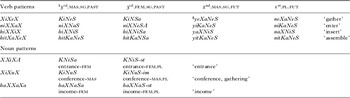
Hebrew has a rich system of inflectional morphology. Verbs in the past and future are inflected for tense, number, person, and gender. Present tense verbs are inflected for number and gender. Hebrew nouns are classified for gender, which determines forms of agreement and of plural marking. Apart from gender, noun agreement is required for number as well. Table 1 gives verb patterns and examples of tense, number, and person inflections, along with noun derivations, for the root K-N-S. The root K-N-S conveys the general meaning of ‘enter, put-in, gather’.
Verb and noun derivations of the root K-N-S

notes: The full inflectional paradigm consists of singular and plural, masculine and feminine, first, second, and third persons in past and future tenses, as well as singular and plural, feminine and masculine (but no person inflections) in the present tense.
1 mas-masculine; fem-feminine; sg-singular; pl-plural; fut-future.
2 K changes to X in certain phonological environments.
Hebrew has a relatively free word order, yet SVO is preferred in spoken language. Subject–complement constructions without auxiliary verbs, traditionally referred to as ‘nominal sentences’, are well-formed. For example:
(5) ha-ec yarok
the-tree green
‘The tree is green’
A direct object marker et marks definite accusative objects. Questions are formed by rising intonation. Hebrew has a mixed pattern of subject omission. Omission of overt subject is grammatical in the first and second persons in the future and past tense, but ungrammatical in the third person, past and future. It is likewise ungrammatical to omit overt subjects in the present tense (Levy & Vainikka, Reference Levy and Vainikka2000).
The current study focused on structural–descriptive features, taking advantage of Hebrew inflectional and derivational paradigms that offer ways of teasing apart components of grammatical knowledge as they appear in the spontaneous productions of young children. The decision to focus on the variables below was guided by the choice of features that are typically assessed in normative tests of young children. We referred particularly to the Clinical Evaluation of Language Fundamentals–Preschool (CELF–P; Wiig, Secord & Semel, Reference Wiig, Secord and Semel2004), the Communicative Developmental Inventory (MCDI Hebrew version; Maitel, Dromi, Sagi & Bornstein, Reference Maitel, Dromi, Sagi and Bornstein2000), and the Preschool Language Scale (Zimmerman, Steiner & Pond, Reference Zimmerman, Steiner and Pond2002).
The following variables were examined. Examples are given for variables that are specific to Hebrew and are not self-explanatory.
1. Agreement: Formal morphological paradigms such as person, number, and gender agreement are acquired early cross-linguistically in languages with rich morphologies (for a review, see Levy, Reference Levy1997). Examples of gender and number agreement in Hebrew are given in (6) and (7):
(6) ha-yelad-im ha-yaf-im nixnas-im
The-child- pl.mas. the-handsome-pl.mas enter-pl.mas.pres
‘The handsome children are coming in’
(7) ha-yald-a ha-yaf-a nixnes-a
The-child-sg.fem. the-pretty-sg.fem enter-sg.fem.past
‘The pretty girl came in’
2. Verb morphology: Hebrew verb derivations present regular and systematic morphophonological patterning, although some irregularities exist (for examples see Table 1).
3. Prepositions: Obligatory prepositions introduce indirect arguments, as example (8) demonstrates (Beckner & Bybee, Reference Beckner and Bybee2009).
(8) salaxti la al ma she-hiasta
forgive-past.sg.1st her on what relative-do-past.sg.fem. 3rd
‘(I) forgave her for what she did’
4. Subject ellipsis: Control over the optionality of overt pronominal subject has been the focus of cross-linguistic research (Caprin & Guasti, Reference Caprin and Guasti2009; Duffield, Reference Duffield2008; Levy & Vainnika, Reference Levy and Vainikka2000). Hebrew has a mixed pattern of subject omission (see above). Thus, while example (9) is grammatical, example (10) is ungrammatical.
(9) nas'ati le-telaviv
travel-past.sg.1st to-telaviv
‘(I) traveled to Tel-Aviv’
(10) *nasa le-telaviv
travel-past.sg.mas.3rd to-telaviv
*‘(he) traveled to Tel-aviv’
5. Verb use: Use of verbal predicates reflects the development of argument structure. Recall that Hebrew has ‘nominal’ sentences that are without verbs (see (5) above).
6. Tensed verbs: Encoding of finiteness is a developmental milestone whose vulnerability in children with language impairment has been shown in numerous studies (e.g. Rice, Hoffman & Wexler, Reference Rice, Hoffman and Wexler2009).
7. Relative clauses: As demonstrated in example (11), relative clauses involve grammatical principles of co-reference and antecedents and presuppose knowledge of hierarchical syntactic structure (Friedmann & Novogrodsky, Reference Friedmann and Novogrodsky2004).
(11) ha-ish she-pagashnu
the-man relative-meet-past.pl.1st
hizmin otanu le-exol
invite-past.sg.mas.3rd us to-eat
‘The man we met invited us to eat’
Finally, growth of vocabulary size was considered as well. In TD children, growth of vocabulary is correlated with MLU. This correlation is particularly evident in richly inflected languages (Devescovi, Caselli, Marchione, Pasqualetti, Reilly & Bates, Reference Devescovi, Caselli, Marchione, Pasqualetti, Reilly and Bates2005). In view of the fact that vocabulary size regularly serves as a significant predictor of children's language status (Wiig et al., Reference Wiig, Secord and Semel2004; Maitel et al., Reference Maitel, Dromi, Sagi and Bornstein2000), it too was compared between the groups.
In addition to the language variables listed above, typicality was assessed in relation to developmental timing. Developmental schedule was compared with respect to the following: (1) age at onset of combinatorial language; (2) age at the final stage of the study; and (3) growth in MLU, as well as the relative progress achieved in the linguistic variables within one calendar year. The latter served to test synchrony among the language variables in relation to growth in MLU in real time, among the groups. Note that since MLU is a central measure, it is possible that the relative contribution of specific variables to the total count will vary among the groups, whereas MLU will remain comparable. Furthermore, whereas MLU is affected by the variables listed above, other variables affect MLU as well; for example, plural nouns, inflected prepositions (elay ‘to me’), and inflected nouns (axi ‘my brother’) contribute to MLU, yet those were not included in the features that were analyzed in the current study. Thus, in order to establish the developmental trajectories in the participant groups, it was important to compare the developmental course of individual variables relative to growth in MLU.
Hypotheses
Based on previous research, it was hypothesized that if language development in the DS and WS groups was structurally intact, developmental trajectories of children with WS or DS would not be significantly different from trajectories of MLU-matched TD children. It was predicted that development within one calendar year would reflect synchrony among variables relative to growth in MLU in the participant groups.
With respect to developmental timing, it was predicted that age at the onset of combinatorial language, when MLU was 1–1·5, as well as age at the final stage of the study, would differ significantly among the groups. It was hypothesized that development within one calendar year would confirm the slow developmental pace of the DS and WS groups relative to TD children.
METHOD
Participants
Participants were native speakers of Hebrew with genetically diagnosed WS (positive FISH test) or DS (trisomy 21). Nine children with WS (six boys) and nine children with DS (eight boys) participated in the study. Participants were living at home, and families were monolingual. Children entered the study when they started to combine two words. This was ascertained through parental reports and confirmed in the first session with the child. Mean age when entering the study of children with WS and children with DS was 46·8 (8·8) and 54·7 (10·5) months, respectively. Note that in view of the rarity of WS, in a country of the size of Israel, the number of children at the appropriate developmental stage at any given time is limited, especially when other factors, such as growing up in a monolingual home, needed to be taken into consideration. As for children with DS, few children are born to secular families in Israel, whereas the ultra-orthodox do not do genetic screening and thus more women in that sector may give birth to children with DS. But since the Jewish ultra-orthodox community were often bilingual (Hebrew–Yiddish), as was the case in the Israeli–Arab community (Hebrew–Arabic), children from these sectors could not be included in the study.
Controls were eighty monolingual TD Hebrew-speaking children. The children were free of developmental problems, as reported by their parents. These data were available to us through our previous projects (e.g. Levy & Hermon, Reference Levy, Hermon, Howell, Fish and Keith-Lucas2000; Levy & Vainikka, Reference Levy and Vainikka2000). Information concerning the cognitive level of the TD controls was not available.
Procedure
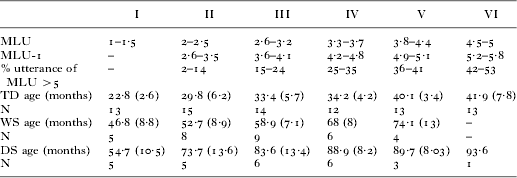
Each control child provided an hour of taped conversation with an experimenter. Conversations were conducted between child and experimenter in the course of play or daily routines, generally with no other family member present. Files of TD children were assigned to one of six developmental stages based on the following criteria:
1. MLU in morphemes calculated according to the system adapted for Hebrew by Dromi and Berman (Reference Dromi and Berman1982), and revised by Levy (Reference Levy1995). Adaptation was mainly concerned with maintaining a counting system that would allow cross-linguistic comparisons, given the rich and obligatory morphological system of Hebrew. For example, since Hebrew verbs are derived from root + pattern and are richly inflected, each verb typically has five to six morphemes. However, for the sake of calculating MLU, inflected verbs were counted as having a maximum of two morphemes. This upper limit applied to nouns as well. Despite such adjustments, MLU relative to the age of the child continued to be somewhat higher in Hebrew than in English-speaking children of comparable ages (see also Dromi & Berman).
2. A second measure of MLU, omitting utterances of length 1, was calculated to account for differences in conversational styles. This measure was introduced in order to minimize the effects of echolalia, repetitions, set phrases, and social speech acts, all of which received MLU 1 in our counting system.
3. To control for potential biases of the mean, the percentage of sentences with MLU longer than five was calculated.
Data collection of the DS and WS groups lasted two to two and a half years. Following the first session, children with WS or DS were assigned to the relevant developmental stage according to the criteria described above and follow-up began. In the course of the study, children were seen six to eight times in their homes by the same experimenter (A. Eilam), usually with no other person present. Sessions lasted as long as was necessary to produce an hour of taped conversation with the child. Following data collection, participants with WS or DS underwent a general cognitive assessment on the Developmental Ability Scales (DAS; Elliot, Reference Elliot1990).
It was often the case that MLU in the DS group did not increase from one session to the next; that is, a child might stay within the same developmental stage for more than one session. In fact, two children did not progress beyond MLU of Stage I for the entire period of data collection. When a child remained within the same MLU stage for more than one session, scores were averaged over these sessions. Thus, although nine children participated in the DS and WS groups, rarely were there nine children in a given developmental stage. As a consequence, the data from the DS and WS groups reflect a mixture between longitudinal and cross-sectional designs.
Table 2 gives criteria for the definition of the stages, along with ages in months of the participants and the controls, as well as number of children contributing to each stage. Note that the age range of the TD children was determined such as to exclude early as well as late talkers from the control group.
Criteria for developmental stages, ages (SD), and number of the participants in the developmental stagesard
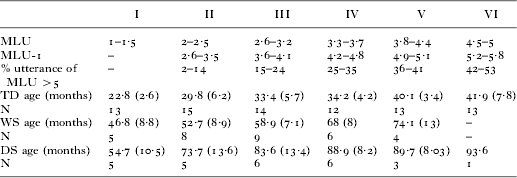
At the close of the study, one child with DS and no child with WS reached MLU levels that defined Stage VI. Comparisons were therefore confined to Stages I–V, MLU 1–4·4. Transcription and coding followed CHAT format (childes.psy.cmu.edu), with necessary adjustments that related to the unique features of Hebrew (Levy, Reference Levy1995). Coded files were checked by a different experimenter. Disagreements were resolved through discussion or discarded. Files were then rechecked before they were included in the analyses.
Language variables were scored as follows:
Agreement: Percentage of correct agreement within the NP (gender and number) and the VP (person, gender, number). Scores indicate percentage of correct agreement out of instances in which agreement was required.
Verb morphology: Percentage of correct verb forms, calculated out of the total number of verbs used.
Prepositions: Percentage of correct occurrences of obligatory prepositions, calculated out of the total number of prepositions used.
Subject ellipsis: Percentage of subject pronoun omission in past and future, third person, in discourse contexts that do not allow omission, calculated out of the total number of past and future, third person sentences. Note that improved performance on this variable is reflected in a decrease in the percentage of incorrect subject ellipsis.
Verb use: Percentage of sentences with verbs was calculated out of the total number of sentences produced. Recall that Hebrew allows verb-less, or ‘nominal’, sentences.
Tensed verbs: Percentage of verbs in the past and future tenses out of the total number of verbs produced.
Relative clauses: Percentage of relative clauses calculated out of the overall number of sentences produced.
Vocabulary: Types rather than tokens were counted. Inflected forms were counted once (for example, when a verb appeared in the masculine form and then again in the feminine it was counted once; verbs in different persons and tenses were likewise counted once).
Data analysis
In view of the small size groups and the type of data, i.e. spontaneous conversations, the data was analyzed in multiple ways with the aim of providing converging evidence concerning the structural similarity between the developmental trajectories of the participant groups. Standard descriptive statistics were performed, using SPSS 19 software (IBM Inc). Mann–Whitney U non-parametric tests were applied, comparing language variables between groups within similar developmental stages. Bivariate associations were performed using the Pearson correlation coefficient. Curve estimation for the best association between MLU and the language variables tested for linear, quadratic, and cubic trends using the CURVEFIT procedure. When there were no significant differences between R2 sizes, linear lines were chosen. Regression lines were drawn when R2 was significant and of a size that rendered such a line informative. A two-tailed alpha level of 0·01 was applied in all the comparisons.
Synchrony among variables in relation to growth in MLU in the course of one calendar year was tested with respect to the interval around the mean performance of the TD group. The interval chosen was 1·5 SD, as this interval is commonly used in clinical settings.
For the comparisons along the time axis, differences in ages of onset of two-word combinations (MLU 1–1·5) as well as age when the final stage of the study had been reached were compared.
RESULTS
Mean general cognitive scores (GCA) on the DAS were 63·6 (SD = 6·1) for the children with WS, and 52·7 (SD = 4·9) for the children with DS. Whereas both groups were within the characteristic distribution of their syndromes, the difference between their mean GCA scores was statistically significant (U = 5·500; p = ·003). Importantly, Pearson correlations between GCA and MLU at the end of data collection were r = − ·28 for the WS group and r = − ·07 for the DS group. Correlations between GCA and productive vocabulary at the end of data collection were r = ·04 for the WS group and r = ·05 for the DS group. We conclude that when children with WS or DS reached the final stage of the study, GCA did not account for their language status.
Across the entire period of data collection, correlations between MLU and MLU-1 were r = ·97 for the TD children, r = ·95 for the WS group, and r = ·95 for the DS group. Correlations between MLU and vocabulary size were r = ·88 for the TD children, r = ·82 for the WS group, and r = ·88 for the DS group. These results suggested that MLU was indeed a reliable measure of language development for all the participant groups.
Structural typicality
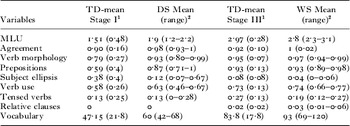
Tables 3–5 list scores achieved by the children in the study groups on the language variables, by stages. Scores indicate percentages except for vocabulary, which gives mean number of words. Note that unlike other variables, scores for subject ellipsis decreased as grammatical knowledge increased. Furthermore, while agreement, verb morphology, and prepositions refer to obligatory features and thus Brown's criterion for acquisition could apply (90% or beyond; Brown, Reference Brown1973), verb use, tensed verbs, and relative clauses are non-obligatory features and hence scores referred to percent of occurrences.
Mean (SD) scores achieved by TD children on the language variables

Mean (SD) scores achieved by children with WS on the language variables

Mean (SD) scores achieved by children with DS on the language variables

There were no statistically significant differences between the scores of children with WS and TD children on any of the variables. As for children with DS, statistically significant differences were found between the mean number of words produced by children with DS and TD children in Stage II (U = 7·000, p = ·005) and Stage III (U = 3·000, p < ·001). Comparisons between scores on other variables did not yield statistically significant results.
As can be determined from Tables 3–5, by Stage I agreement reached criterion for acquisition (Brown, Reference Brown1973) in all the participant groups. Verb morphology reached criterion by Stage I for the DS and WS groups and by Stage II for TD children. That is, participants had near-perfect performance on two of the obligatory formal morphological paradigms at the very early stages of the study.
In Stages I–III of the study, relative clauses were very few in all the participant groups. This confirms earlier reports of the paucity of relative clauses in the language of children of this developmental level (e.g. Friedmann & Novogrodsky, Reference Friedmann and Novogrodsky2004). Production of relative clauses by TD children and children with WS increased in Stages IV–V, yet this development was not uniform even in the TD group. For some TD children, relative clauses remained close to zero until Stage V, as suggested by the SD. Unlike TD children and children with WS, production of relative clauses remained minimal by children with DS even in the later stages of the study. Importantly, this could not be due to length considerations since the MLU of the children with DS matched that of TD children and children with WS. Note that the differences in the percentage of relative clauses produced did not reach statistical significance as noted above, presumably because of the large variability in the TD group.
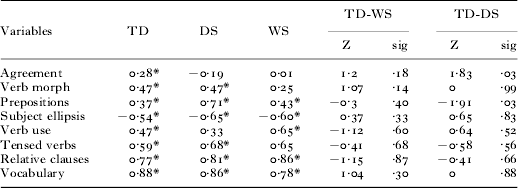
Table 6 lists the Pearson correlations between MLU and language variables in TD children, in children with WS, and in children with DS, and states the significance levels of between-group comparisons. As can be determined from Table 6, MLU was highly correlated with all the variables in the TD group. MLU was strongly correlated in the DS and WS groups with most variables, yet not with all. Thus, MLU was not correlated with agreement for either the WS or the DS groups, and was weakly correlated with verb morphology for WS. MLU was likewise weakly correlated with verb use in the DS group. Note that the lack of significant correlation between MLU and agreement, and MLU and verb morphology, in the DS and WS groups reflected the fact that the children were performing well on these variables at the start of the study, and thus there was little room for development as MLU increased. Similarly, the significant correlation between MLU and agreement in the TD group was due to growth beyond criterion for acquisition (Brown, Reference Brown1973) as, at Stage I, scores were already 90 percent correct (see Table 3). The correlation between MLU and verb morphology in the DS group is presumably due to the 97–98 percent correct performance at Stages IV and V and the very small SD that characterized those stages. Bivariate correlation coefficients of the groups were compared using the Fisher r-to-z transformation. Differences were not significant.
Pearson correlations by group (significance marked with *) between MLU and language variables, and between-group comparisons, of TD children and children with WS or DS
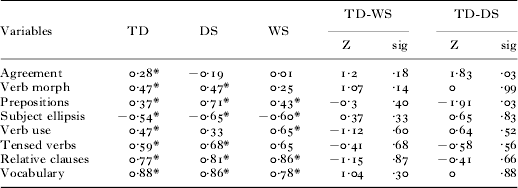
note: sig = between-group significance level, p = ·01.
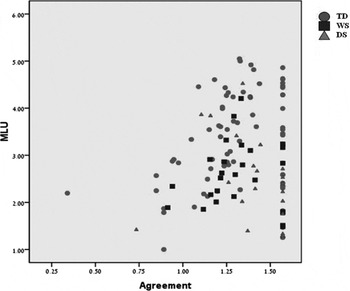
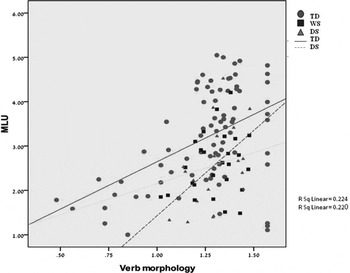
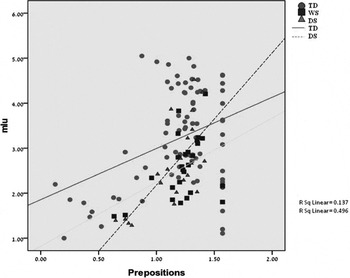
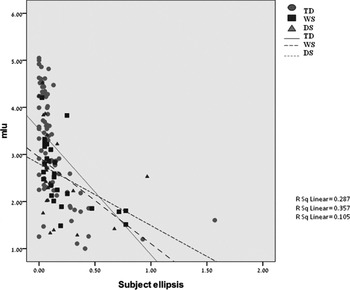
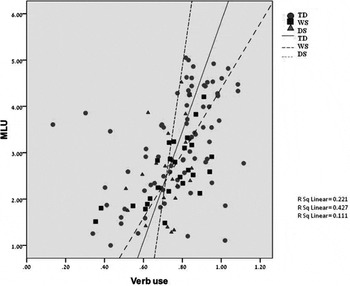
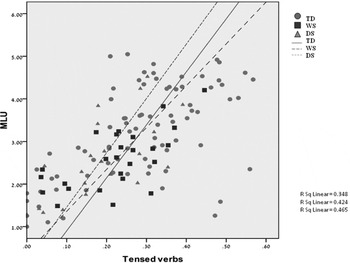
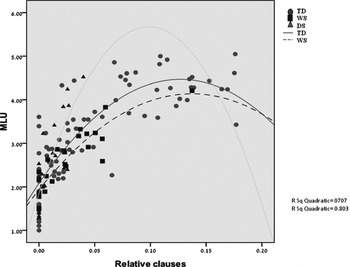
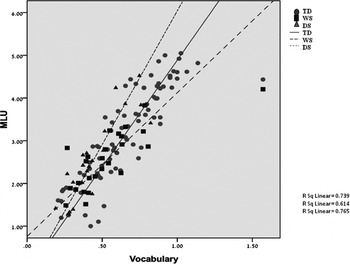
Figures 1–8 present curve estimation for the best association between MLU and the language variables. A noticeable feature of these distributions is the great variability in TD children, widely expanding the range of performance that may be considered typical.
Developmental trajectories of agreement in the participant groups.

Developmental trajectories of verb morphology in the participant groups.

Developmental trajectories of prepositions in the participant groups.

Developmental trajectories of subject ellipsis in the participant groups.

Developmental trajectories of verb use in the participant groups.

Developmental trajectories of tensed verbs in the participant groups.

Developmental trajectories of relative clauses in the participant groups.

Developmental trajectories of vocabulary in the participant groups.

Figure 1 shows good performance on agreement at the beginning of the study. This was particularly evident in the DS and WS groups, yet performance was very high in TD children as well. Linear R2 were small and hence no regression lines were drawn. R2 in Figure 2 for verb morphology and in Figure 3 for prepositions were small for WS, and hence regression lines were not drawn for this group. Figure 4 reflects the decrease in ungrammatical subject ellipsis as MLU increased. Figure 5 presents growth of verb use in the participant groups. Figure 6 presents growth in tensed verbs. Figure 7 presents growth in the use of relative clauses in the participant groups. While relative clauses were not very frequent in the spontaneous speech of either group, children with DS produced fewer relative clauses than children in the other groups, although some growth in production was noted as MLU increased. Finally, Figure 8 shows an increase in vocabulary, growing linearly as MLU grew in all the study groups.
Since b values representing the slope of linear regressions are based on similar mathematical concepts as Pearson r, the statistical comparisons between the regression coefficients are those presented in Table 6, columns 6 and 8, and none are significant. Note that this cannot be ascertained about quadratic lines representing the developmental trajectories of relative clauses.
Developmental pace
MLU 1–1·5, defining Stage I of the study, marked the beginning of combinatorial language. The average age at Stage I was 22·8 months (SD = 2·6) for TD children, 46·8 months (SD = 8·8) for children with WS, and 54·7 months (SD = 10·5) for children with DS. Thus, the initial delay of children with WS was 24 months, whereas it was ∼32 months for children with DS. Differences in the onset of Stage I between TD children and the DS and WS groups, and between WS and DS, were statistically significant (TD–WS: t(15) = −9·1, p < ·001; TD–DS: t(15) = −10·6, p < ·001).
Age of TD children at Stage V was 40·1 months (SD = 3·4). That is, in TD children MLU grew from Stage I to Stage V within sixteen months. Importantly, contrary to the wide variability seen in performance on the language variables for TD children (see Figures 1–8), the variance in age of onset of word combinations and age at MLU of Stage V was relatively small in this group, as shown by the SDs above.
Growth in MLU from Stage I to Stage V in children with WS took ∼28 months, and age at stage V was ∼74 months (SD = 13). Growth from Stage I to Stage V took ∼33 months in children with DS, and age at Stage V was 89·7 months (SD = 8·03). These differences were statistically significant (TD–WS: t(13) = −9·2, p = ·001; TD–DS: t(13) = −16·5, p < ·001), confirming our hypothesis as well as earlier reports of delay in age of language onset and acquisition pace in children with WS and children with DS (see Fowler et al., Reference Fowler, Gelman, Gleitman and Tager-Flusberg1994; Harris et al., Reference Harris, Bellugi, Bates, Jones and Rossen1997; Laws & Bishop, Reference Laws and Bishop2003; Mervis et al., Reference Mervis, Robinson, Rowe, Becerra, Klein-Tasman and Abbeduto2003).
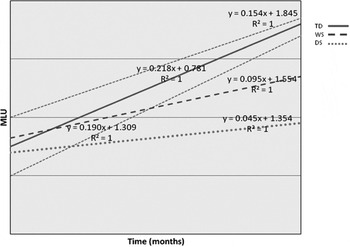
Synchrony among variables, defined as developmental ratio of the language variables relative to growth in MLU, is yet another measure of developmental pace. As can be seen in Figure 9, within twelve months, MLU in TD children rose from Stage I (MLU 1–1·5) to Stage IV (MLU 3–3·7). Growth in MLU in children with WS grew from Stage I (MLU 1–1·5) to Stage III (MLU 2·6–3·2), whereas growth in children with DS did not reach beyond the upper end of Stage I (MLU 1·5). Given these MLU values, it was expected that, if development was synchronous, by the end of that year scores on the language variables for children with WS would be within 1·5 SD of scores achieved by TD children at Stage III. With respect to children with DS, scores were expected to be within 1·5 SD of the Stage I scores of TD children.
Growth of MLU in one calendar year in the participant groups.

As can be determined from Table 7, these predictions were confirmed. Children with WS were within 1·5 SD of Stage III of TD children on all the variables. Children with DS were above 1·5 SD of Stage I of TD children in verb use, but otherwise within 1·5 SD of scores achieved by TD children at Stage I. These results converge with the results reported above, supporting developmental synchrony of the language variables among the study groups.
Comparison between scores achieved by TD children and children with WS or DS relative to growth in MLU by the end of one calendar year of data collection

notes:
1 In this column, figures in brackets indicate 1·5 SD.
2 In this column, figures in brackets indicate range of performance by the end of the twelfth month of data collection.
DISCUSSION
The current study investigated the development of Hebrew in young children with WS or DS. MLU in the period of data collection spanned 1·0–4·4. Children's productions in naturalistic contexts were compared to productions of Hebrew-speaking TD children, matched on MLU.
Delays in the onset of two-word combinations and slow developmental pace characterized the groups with WS and DS. Children with WS as well as children with DS were significantly older than TD children when they started to combine two words (Stage I of the study) and took significantly longer to get to Stage V MLU, replicating reports in previous research (e.g. Fowler et al., Reference Fowler, Gelman, Gleitman and Tager-Flusberg1994; Mervis et al., Reference Mervis, Robinson, Rowe, Becerra, Klein-Tasman and Abbeduto2003; and others).
Similarly to TD children, MLU turned out to be a good predictor of language development in the DS and WS groups, predicting growth on almost all variables of interest. This is in line with results reported in Rice et al. (Reference Rice, Redmond and Hoffman2006) with respect to children with SLI. Overall, the developmental trajectories of early language in children with WS or DS were typical and development of the language variables was synchronous. Structural typicality is reflected in the results reported in Tables 3–6, which list scores and correlations of the language variables across the developmental stages, and in Table 7, which attests to the developmental synchrony among variables relative to growth in MLU, as well as in Figures 1–8, which plot the developmental trajectories of the language variables. Based on these data, we conclude that the structural properties of the trajectories of early language did not differ between children with WS, children with DS, and TD children of matched MLU. Our results thus support results reported by Harris et al. (Reference Harris, Bellugi, Bates, Jones and Rossen1997) and by Mervis et al. (Reference Mervis, Robinson, Rowe, Becerra, Klein-Tasman and Abbeduto2003) with respect to young children with WS, and by Fowler et al. (Reference Fowler, Gelman, Gleitman and Tager-Flusberg1994) and Laws and Bishop (Reference Laws and Bishop2003) with respect to children with DS.
A notable exception to the correlation between MLU and the language variables concerned agreement and verb morphology, as those were already near ceiling at the start of the study in all the participant groups. Whereas ease of acquisition of these paradigms has been reported for TD children in earlier work on Hebrew (e.g. Dromi & Berman, Reference Dromi and Berman1982), early acquisition of these formal morphophonological paradigms by children with WS and DS is an impressive feat. It reinforces the conclusion that regular, formal morphophonological paradigms are easily mastered at a rather early stage of language development (for a review, see Levy, Reference Levy1997). These results contrast with studies such as Karmiloff-Smith et al. (Reference Karmiloff-Smith, Grant, Berthoud, Davies, Howlin and Udwin1997) and Eadie et al. (Reference Eadie, Fey, Douglas and Parsons2002), who reported on impairment in verb and noun morphology in children with WS and DS, respectively. Note that experimental tasks were used in these studies, which might have adversely affected children's performance. Capirci et al. (Reference Capirci, Sabbadini and Volterra1996), however, is a naturalistic case study of an Italian girl with WS. The methodology was therefore very similar to ours. Nevertheless, this study reported difficulties in morphology and atypical errors. Furthermore, both Italian and Hebrew are languages with rich morphologies, leading one to expect comparable results. Further research is needed in order to determine whether Capirci et al.'s case study would generalize to larger groups of young Italian-speaking children with WS.
In the course of the study the children with DS rarely produced relative clauses. The near-absence of such clauses in the language of children with DS could be due to the syntactic complexities of relative clauses or to the limited thought processes in children with DS of this developmental level. Since the data consist of spontaneous productions, it was not possible to test for these alternative explanations. Note, however, that while there was little evidence of embedding, sentences were of appropriate length as attested by MLU and there was evidence of ellipsis of subject pronouns, which according to some analyses involves empty categories. By contrast, GCA in the WS group was higher than in the DS group by almost eleven points on average, and this difference was statistically significant. Thus the cognitive level of children with DS might have been a major contributor to the paucity of the spontaneous productions of relative clauses.
The similarities in the early developmental trajectories of children with WS and children with DS are intriguing in view of the fundamentally different language profiles seen in later childhood and adolescent years in people with these disorders (e.g. Brock, Reference Brock2007; Harris et al., Reference Harris, Bellugi, Bates, Jones and Rossen1997; Klein & Mervis, Reference Klein and Mervis1999; Mervis & Robinson, Reference Mervis and Robinson2000; Vicari et al., Reference Vicari, Caselli, Gagliardi, Tonucci and Volterra2002; Ypsilanti et al., Reference Ypsilanti, Grouios, Alevriadou and Tsapkini2005). The seemingly lack of continuity between early and later profiles in these populations, showing similarities in the early years along with noticeable differences as they mature, may be a reflection of changes in the nature of the language of the more mature child. While early development is about basic grammar, basic lexicon, and basic semantics, later stages extend beyond primary computational properties, engaging complex grammar as well as cognitive–semantic processes. For example, sentence embedding, constituent-internal hierarchical structures, valence, conversational implicatures, and structured narratives play a larger part in a mature speaker's profile than they do in the language of a younger child. In view of such increasing linguistic and cognitive demands, later profiles indeed reveal syndrome-specific differences between older children with WS and DS. Whereas general cognitive level did not predict language development in the early phases (see also Jarrold et al., Reference Jarrold, Baddeley and Phillips2002), it is possible that differences in the cognitive level of children with WS and children with DS, will have more pronounced effects on the linguistic profiles of older children.
The typicality of the structural properties of the developmental trajectories of children with WS, and children with DS highlight the view of grammar as a computational system whose properties constrain development in unique ways, allowing a sole ‘normal route’ to acquisition. However, significant differences in developmental timing among the groups have been found, indicating atypical age of onset of combinatorial language and slowed developmental pace in the DS and WS groups. In our view, these disruptions of normal timing cannot be labeled ‘delays’; rather, they are indicators of deviance from normality. Given the network characteristic of cognition and the central role of language in perceptual and conceptual development, abnormal developmental schedules seem potentially accountable for developmental effects that could be no less deleterious than those brought about by structural atypicality.
Importantly, while variability among TD children in the development of the language variables was considerable (see Figures 1–8), the group was relatively homogenous with respect to timing, as seen in the small SDs around the mean age of onset of combinatorial language and developmental pace. This suggests that timing was a crucial determinant of typicality, perhaps of greater significance than structural homogeneity. As for the study groups, mean age at onset of combinatorial language and developmental pace were syndrome-specific, and unique schedules characterized children with WS and children with DS. This suggests that mechanisms of genetic timing are highly vulnerable and are differentially affected by genetic abnormalities.
Concern with developmental timing in disordered populations needs to be taken into consideration in the choice of control groups for research purposes. Matching on MLU, the validity of which in estimating the language level of a variety of populations has been amply demonstrated, is a reasonable practice, provided timing considerations are brought into the equation as well. On the other hand, the familiar practice of matching syndromic groups with TD children of similar MA, whether general or non-verbal, is based on the view of development in the pathological groups as ‘delayed’ rather than genuinely disordered. Indeed, the power of MA as an assessment tool lies in the fact that it contrasts chronological age with the child's actual achievements, on a composite of tasks. Yet it is evident that MA does not capture the extent of the deviance from normalcy that children with genetic syndromes show, nor does it reflect those areas of performance in which children with disorders are superior to normal children of similar MA, who are typically of younger chronological ages. An example in the current study of the beneficial effects of chronological age is seen in the advanced performance of the DS and WS groups on formal morphological paradigms. If disordered developmental timing is interpreted as signaling deviance, the use of MA-matched controls in research will need to be reconsidered.
Our results have clinical implications as well. They support the accumulated wisdom of clinical interventions with language-disordered populations that has typically been aimed at mixed groups of children, whose deficits are of diverse etiologies. In view of the similarities in the structural properties of the developmental trajectories of young children with WS or DS, intervention for this age group can continue to be aimed at genetically heterogeneous groups, although research into additional genetic syndromes is needed in order to find out whether the robustness of the grammatical system seen in WS and in DS will characterize other syndromes as well.
Finally, a potential limitation of the current study concerns the fact that the data from the DS and WS groups is in part longitudinal, as individual children figure in more than one developmental stage, although never in all five stages. We had to resort to this design because of the limitations on subject availability in a country of the size and demographics of Israel. Note that the non-parametric Mann–Whitney U that has been used to compare the groups is less affected by group variance than parametric tests. Nevertheless, a replication of this study will benefit from a full cross-sectional design. Such a study will probably need to be performed in a larger linguistic community where more participants are available.
In sum, language development over the entire span of data collection revealed minor structural differences between children with WS, children with DS, and TD controls of similar MLU. However, age of language onset and pace of acquisition in the DS and WS groups departed significantly from normal timing. Development within one calendar year showed remarkable synchrony among the language variables along with slowed developmental pace that was more pronounced in the DS group than in the WS group. Given the critical role of chronological age in interactions with the environment, the effects of age and environment on gene transcription and the importance of synchrony within and between domains that make up the cognitive web, we conclude that in neurodevelopmental disorders delay equals deviance, and the developmental trajectories of early grammars in children with WS and children with DS cannot be considered typical.