INTRODUCTION
Along the southern sector of the Central Volcanic Zone of the Andes (between 24° and 27° latitude), a magmatic arc of north–south general orientation, with prolongations toward the back-arc following the regional northwest–southeast tectonic lineaments, has developed since the Neogene (Kay and Coira, Reference Kay, Coira, Kay, Ramos and Dickinson2009; Petrinovic et al., Reference Petrinovic, Grosse, Guzman, Caffe, Muruaga and Grosse2017). Recent volcanic activity in this region is mainly associated with andesitic-dacitic stratovolcanoes along the main arc, some of which are considered potentially active, although most are poorly known (Siebert et al., Reference Siebert, Simkin and Kimberley2010; Grosse et al., Reference Grosse, Orihashi, Guzmán, Sumino and Nagao2018). Very few of these stratovolcanoes have recorded historical activity, and only Lascar volcano has registered regular eruptions in recent decades (Gardeweg et al., Reference Gardeweg, Sparks and Matthews1998). In addition, the most recent eruptive history of these volcanoes is characterized by the development of effusive or small explosive eruptions (e.g., Grosse et al., Reference Grosse, Orihashi, Guzmán, Sumino and Nagao2018), except for the Tres Cruces volcano, which had important explosive activity during the Holocene (Gardeweg et al., Reference Gardeweg, Clavero, Mpodozis, Pérez and Villeneuve2000). Besides, recent studies have revealed the importance of back-arc volcanism in this region during the Holocene (Báez et al., Reference Báez, Arnosio, Chiodi, Ortiz Yañes, Viramonte, Bustos, Giordano and López2015; Báez et al., Reference Báez, Chiodi, Bustos, Arnosio, Viramonte, Giordano and Alfaro Ortega2017; Bertin et al., Reference Bertin, Baez, Caffe, Elissondo and Lindsay2018). Especially relevant is the Cerro Blanco Volcanic Complex, defined as the youngest (middle Pleistocene–Holocene) collapse caldera system in the southern Central Andes. Over the past 100,000 yr, this complex has experienced at least two large-scale eruptions with Volcanic Explosivity Index (VEI) ≥6 (Báez et al., Reference Báez, Arnosio, Chiodi, Ortiz Yañes, Viramonte, Bustos, Giordano and López2015; Fernández-Turiel et al., Reference Fernández-Turiel, Perez-Torrado, Rodríguez González, Saavedra, Carracedo, Rejas and Lobo2019). Particularly, the caldera-forming Cerro Blanco eruption constitutes one of the greatest Holocene volcanic events in the Central Andes (Báez et al., Reference Báez, Arnosio, Chiodi, Ortiz Yañes, Viramonte, Bustos, Giordano and López2015; Fernández-Turiel et al., Reference Fernández-Turiel, Perez-Torrado, Rodríguez González, Saavedra, Carracedo, Rejas and Lobo2019). Other high-silica volcanic centers located in the back-arc, such as Cuero de Purulla volcano, have been proposed as plausible candidates for the source of large explosive eruptions during the upper Pleistocene–Holocene (Báez, Reference Báez2014; Fernández-Turiel et al., Reference Fernández-Turiel, Perez-Torrado, Rodríguez González, Saavedra, Carracedo, Rejas and Lobo2019).
Because of the influence of the subtropical westerly jet in the middle and upper troposphere (Garreaud et al., Reference Garreaud, Vuille, Compagnucci and Marengo2009), the explosive volcanic activity of the main arc, as well as that of the back-arc, tends to disperse the tephras toward the east. Thus, in the intermontane valleys located eastward of the Puna, such as Santa María and Tafí valleys, a record of the Holocene large explosive eruptions is preserved. Previous works have addressed the tephrochronology of this region. Strecker (Reference Strecker1987) identified some tephra layers in the Santa María and Tafí valleys and used them to establish the age of Pleistocene accumulations.
Later, tephra levels were used to determine the age of large Holocene landslides produced downstream of the confluence of the Santa María and Calchaquí Rivers (Hermanns et al., Reference Hermanns, Trauth, Niedermann, McWilliams and Strecker2000; Trauth et al., Reference Trauth, Alonso, Haselton, Hermanns and Strecker2000). Other studies have also correlated the tephras from Santa María and Tafí valleys (May et al., Reference May, Zech, Schellenberger, Kull, Veit, Salfity and Marquillas2011). The most comprehensive study about northwestern Argentina tephrochronology shows a unified analysis of all Quaternary layers recorded in the region until 2008 (Hermann and Schellenberger, Reference Hermanns and Schellenberger2008). Their study describes and dates 10 well-defined tephra layers, 5 of which belong to the Holocene (see further comments on them in the “Discussion”). In addition, Fernández-Turiel et al. (Reference Fernández-Turiel, Saavedra, Pérez-Torrado, Rodríguez-González, Alias and Rodríguez-Fernández2012, Reference Fernández-Turiel, Saavedra, Perez-Torrado, Rodríguez-González, Carracedo, Osterrieth, Carrizo and Esteban2013, Reference Fernández-Turiel, Saavedra, Pérez-Torrado, Rodríguez-González, Carracedo, Lobo and Rejas2015, Reference Fernández-Turiel, Perez-Torrado, Rodríguez González, Saavedra, Carracedo, Rejas and Lobo2019) studied the ash dispersion of the tephras of the Cerro Blanco Volcanic Complex, took samples from proximal and distal deposits, and dated them to 4290 ± 40 14C yr BP. Proximal deposits of the same volcanic complex were also studied in depth by Báez (Reference Báez2014) and Báez et al. (Reference Báez, Arnosio, Chiodi, Ortiz Yañes, Viramonte, Bustos, Giordano and López2015). Furthermore, Sampietro-Vattuone and Peña-Monné (Reference Sampietro-Vattuone and Peña-Monné2016), Peña Monné and Sampietro Vattuone (Reference Peña Monné, Sampietro Vattuone, Sampietro Vattuone and Peña Monné2016b), and Sampietro-Vattuone et al. (Reference Sampietro-Vattuone and Peña-Monné2016) reported three tephra levels in Tafí valley as reference geomorphological layers, named V0, V1, and V2.
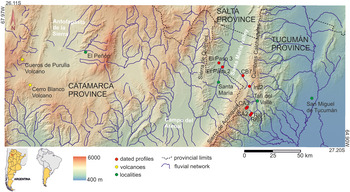
Despite previous studies, no data are available about tephra associations within Holocene deposits (slopes, debris flows, and alluvial accumulations) or soils. These tephras have never been analyzed for their evolutionary value in their geomorphological and geoarchaeological context. Moreover, not all tephras were previously described. In this context, the aim of this article is to present a comprehensive study of the complete set of Holocene tephras from Tafí and Santa María valleys (Fig. 1), their morphostratigraphic and geoarchaeological contexts, chronology, and some compositional characteristics, including a review of the previous data.
(color online) Study area and location of dated profiles.

Regional settings
The Santa María and Tafí valleys are located in northwestern Argentina, including three Argentinean provinces (Tucumán, Catamarca, and Salta). Both valleys are part of the northern sector of Sierras Pampeanas and are located about 300 km east of the Central Volcanic Zone of the Andean Ranges. They are two tectonic depressions bordered by the Sierra de Aconquija (4600 m), Cumbres Calchaquíes (4177 m), and Sierra de Quilmes (5468 m) (Fig. 1). Geologically, the surrounding mountains are composed of granite and metamorphic rocks of Precambrian–Lower Paleozoic ages (Ruiz Huidobro, Reference Ruiz Huidobro1972; Toselli et al., Reference Toselli, Rossi de Toselli and Rapela1978; Galván, Reference Galván1981). In the Santa Maria valley, Upper Cretaceous–Neogene sediments are also visible (Salta and Santa María Groups; Bossi et al., Reference Bossi, Georgieff, Gavriloff, Ibañez and Muruaga2001), whereas Paleogene deposits are present in Tafí valley (González, Reference González1997).
The climate is semiarid in Santa María valley, with an annual rainfall of 200 mm, and the vegetation is xerophitic with bushes (Larrea divaricata and L. cuneifolia) and carob trees (Prosopis sp.) on the valley floor. Although Tafí valley is also semiarid, annual rainfall reaches 500 mm, so grasslands dominate the landscape with development of small forests (Alnus acuminata and Polylepis australis) in the ravines and quebradas (Perea, Reference Perea1995).
In addition to the geomorphological analysis of Strecker (Reference Strecker1987) performed in Santa María valley, some studies have focused on large Holocene landslides and a paleolake formation related to them (Hermanns et al., Reference Hermanns, Niedermann, Villanueva García, Schellenberger, Evans, Scarascia-Mugnozza, Strom and Hermanns2006, Reference Hermanns, Folguera, Penna, Fauqué, Niedermann, Evans, Hermanns, Scarascia Mugnozza and Strom2011). Recent geomorphological research was performed by Sampietro Vattuone and Neder (Reference Sampietro Vattuone and Neder2011), Peña-Monné et al. (Reference Peña-Monné, Sancho-Marcén, Sampietro-Vattuone, Rivelli, Rhodes, Osacar-Soriano, Rubio-Fernández and García-Giménez2015, Reference Peña Monné, Sancho Marcén, Sampietro Vattuone, Rivelli, Rhodes, Osácar Soriano, Rubio Fernández, García Giménez, Sampietro Vattuone and Peña Monné2016), Peña-Monné and Sampietro-Vattuone (Reference Peña-Monné and Sampietro-Vattuone2016a, Reference Peña Monné, Sampietro Vattuone, Blanco, Castillo, Costa, Horacio and Valcárcel2018a, Reference Peña-Monné and Sampietro-Vattuone2018b), and Sampietro-Vattuone et al. (Reference Sampietro Vattuone, Sola, Báez, Peña Monné, Muruaga and Grosse2017, Reference Sampietro Vattuone, Peña Monné, Maldonado, Sancho Marcén, Báez and Sola2018a). These studies focused on the Quaternary and present fluvial dynamics, the Holocene eolian activity, and the regional geomorphological evolution.
There is a long tradition of geomorphological studies at Tafí valley (Sayago and Collantes, Reference Sayago and Collantes1991; Sayago et al., Reference Sayago, Powell, Collantes, Neder, Gianfrancisco, Puchulu, Durango de Cabrera and Aceñolaza1998; Collantes, Reference Collantes2001, Reference Collantes, Arenas, Manasse and Noli2007). However, recent studies have notably changed the geomorphological information, departing from wider data gathering and interpretation, where volcanic ash layers played an important role (Peña Monné and Sampietro Vattuone, Reference Peña Monné, Sampietro Vattuone, Sampietro Vattuone and Peña Monné2016b; Sampietro-Vattuone and Peña-Monné, Reference Sampietro-Vattuone and Peña-Monné2016; Sampietro Vattuone et al., Reference Sampietro Vattuone, Peña Monné, Báez, Ortíz, Aguirre, Sampietro Vattuone and Peña Monné2016; Sampietro-Vattuone et al., Reference Sampietro Vattuone, Peña-Monné, Roldán, Maldonado, Lefebvre and Vattuone2018b). Thus, the new geomorphological cartography (Sampietro-Vattuone and Peña-Monné, Reference Sampietro-Vattuone and Peña-Monné2019) and fieldwork have made it possible to establish the Holocene evolutionary model of the region. This model establishes the existence of four Holocene aggradation units separated by incision phases. Figure 2a shows a curve with estimated aggradation/degradation rates along these units. It also represents the position of the up to now three known tephras (V0, V1, and V2) and preliminary chronologies. Figure 2b shows a synthetic cross section of the sedimentary record produced by the geomorphological evolution of the area, including all paleoenvironmental features such as soil development. Radiocarbon dating indicate that the earliest evolutionary unit, named H1, spans from ca. 13,000 to 4200 yr BP and is mainly represented in the landscape by slope deposits. During the earliest times of this unit (H1A), wetter environments were dominant. A gradual shift to harsher conditions was also observed at the end of the period (H1B). There are two tephra layers related to H1 unit, named V0 and V1 (Fig. 2). The H1 unit was followed by the development of a Late Holocene accumulative unit (H2) dated between ca. 4200 and 600 yr BP. It is represented in the landscape by slopes, alluvial terraces, and alluvial fan deposits. This accumulation was formed at the beginning under wetter conditions, allowing the formation of a soil (s1) (Fig. 2). The H2 unit also includes features that have been attributed to general environmental degradation caused by intense human impact on the landscape after soil formation (Sampietro Vattuone et al., Reference Sampietro Vattuone, Peña-Monné, Roldán, Maldonado, Lefebvre and Vattuone2018b). On top of this unit, there is another tephra named V2 overlain by a soil (s2) (Fig. 2). Smaller deposits from the later H3 and H4 units are recognizable in the inner sections of the incision that cuts through the previous deposits (Fig. 2b). These units were dated from after ca. 600 yr PB to the present time, and they include the Little Ice Age and the present warm period (Fig. 2).
(color online) (a) Holocene evolutionary model of Santa María and Tafí valleys with V0, V1, and V2 relative tephra positions; the curve represents aggradation/degradation rates during the different units. (b) Synthetic cross section representative of the relative position of the different aggradative units and the tephra levels in ravines.

METHODS
We first made a detailed geomorphological map of the study area following Peña Monné’s proposal (Reference Peña Monné1997) and a subsequent systematic field survey recording about 150 stratigraphic profiles to define the morphosedimentary units of different genesis (fluvial deposits, alluvial fans, and slopes). Transversal and longitudinal profiles were also made to know the relative position of the tephras. Several tephras were described and sampled in their morphostratigraphic context (considering stratigraphic and geomorphological positions), and 91 samples were analyzed. We selected mostly primary tephras or scarcely reworked tephras for the analyses, by considering the layer thickness, color, homogeneity, contacts with under- and overlying deposits, and the lack of internal structures, bioturbation features, and inclusions. Simultaneously, we created a complete record of erosive features associated with tephra deposits. Tephra ages were determined indirectly by 14C radiometric dating of over- or underlying peats, organic matter from soils, and archaeological charcoals, together with ceramic potsherds by thermoluminiscence. Radiocarbon ages were calibrated with Oxcal v. 4.3 over the SHCal 13 curve and expressed with two sigmas.
To make a qualitative compositional and textural characterization of the tephras, bulk samples were described under binocular magnifying glass. For a better mineralogical characterization, the samples were sieved to concentrate the material retained in a #60 size mesh screen (250 µm). Further morphological analyses were based on scanning electron microscopy (SEM) images. For SEM analyses, a JEOL scanning microscope (LASEM–Universidad Nacional de Salta) was used at an acceleration voltage of 15 kV, and the samples were mounted on a holder and coated with Au.
The tephras were geochemically characterized by means of 86 bulk-rock analyses using portable X-ray fluorescence (pXRF), as proposed by Sola et al. (Reference Sola, Báez, Bustos, Hernandez, Sampietro Vattuone, Peña Monné and Becchio2016). Data were acquired using a handheld Thermo Scientific Niton XL3t GOLDD XRF spectrometer with a 50 kV, 200 μA Ag Anode X-ray tube, mounted on a test stand. Most pXRF spectrometers offer analyses in three modes: (1) test all GEO mode, where the expected elemental concentration is unknown by the user; (2) mining mode, where the expected elemental concentration is >1%; and (3) soil mode, where the expected concentration is <1%. All analyses were carried out in soil mode on powder material. All samples were analyzed with 30 s dwell times for main and low filters, and 40 s for the high filter, for a total of 70 s per analysis, following the values recommended by Knight et al. (Reference Knight, Kjarsgaard, Plourde and Moroz2013): >30 s and <70 s per filter. The elements to make the geochemical characterization (Sr, Rb, Zr, Cr, Zn, Pb, U, and Th) were selected based on the detection limits according to the rock type and relatively low 2σ errors.
RESULTS
Field descriptions, morphostratigraphic analysis, and geochronology
The complementary work of geomorphological mapping and field survey made it possible to recognize five tephra layers included in several morphostratigraphic profiles. These profiles were recorded from geomorphological units of different ages and genesis. The tephra levels were not continuous across the entire study area (note that we prospected two neighboring valleys), so stratigraphic positions were recorded in order to reconstruct a wide and confident morphostratigraphic context. The five tephras appear interbedded in several morphosedimentary contexts, from which we inferred their ages. Although about 150 profiles were described during the fieldwork, only seven were selected for this study (Figs. 1, 3, and 4), considering the presence of overlying tephra layers, absolute chronological data, and morphostratigraphic representativeness. We selected the RI01 profile (Fig. 3a) for the oldest tephra (V0) and RI03 (Fig. 3d) for V1a and V1b tephras. Besides, V1a, V1b, and V2 tephras were described and dated in CA2 and CA3 profiles (Fig. 3b and c), while V2 was described and dated in Inf2, El Paso 2, and CB7 profiles (Fig. 4, Table 1). After the stratigraphic records it was clear that the three tephras preliminary established were in fact five.
(color online) Representative stratigraphic profiles showing different morphosedimentary units: El Rincón (RI01) profile, with the chronostratigraphic location of the V0 tephras (a); Las Carreras (CA2 and CA3) and El Rincón (RI03) profiles, with chronological data of V0, V1a, V1b, and V2 tephras (b, c, d).

(color online) Stratigraphic profiles of the (a) El Infiernillo (INF2), (b) EL PASO2, and (c) Campo Blanco (CB7) showing tephra positions and chronologies in the different morphosedimentary units.

14C samples: u.s., underlying sediments; o.s., overlying sediments.

The cross sections recorded in several valleys contribute to improving the knowledge of the relative positions of the tephras (Fig. 2b). Several factors conditioned their positions and thickness. First, topography and wind circulation favored tephra accumulation in some specific locations (i.e., at present some deposits in the ravines reach 8 m in thickness), whereas there is no tephra accumulation in several outcrops because of environmental erosion. Another important factor related to tephra visibility is the ravine depth, with incisions in some cases reaching the oldest deposits (Fig. 2b). In all cases, tephra visibility is conditioned not only by its relative present position but also by the processes the tephra underwent during the geomorphological evolution of the area.
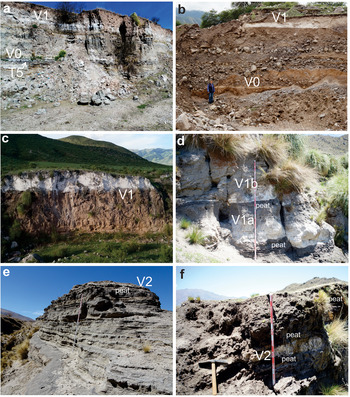
Tephra V0 never appears on the topographic surface. It is only visible in the incision scarps, rendering it an excellent marker for the transition between H1A and H1B accumulations (Figs. 2a, 3a). They are frequently visible in the bottom area of Las Carreras, El Rincón (Fig. 5a), the quarries exploited close to Tafí del Valle village (Fig. 5b), and the Carapunco and La Bolsa areas (Tafí valley). These tephras have a coarse ash texture and a high amount of biotite. Radiocarbon ages were obtained at El Rincón (RI01, Fig. 3a), on a 12-m-thick outcrop, where V0 tephra is located 5 m from its base (Fig. 3a). There are several peat layers under the ash level, the youngest dated to 11,802–11,192 cal yr BP (sample RI01-T5; Fig. 5a, Table 1). Accordingly, this tephra layer is younger than these ages (Fig. 6a). The tephra V0 was named El Rincón ash given the relevance of the information provided by the RI01 profile.
(color online) (a) RI01 profile showing V0 and V1 tephra positions and dated peat levels, El Rincón–Tafí valley (see Fig. 3a). (b) Profile from the quarries of La Costa (Tafí valley) showing V0 and V1 tephra levels. (c) V1 tephra from the top of an H1B unit in Tafí valley. (d) Lower section of CA2 profile showing V1a and V1b tephras with an interbedded peat in the Muñoz River, Tafí valley (see Fig. 3b). (e) INF2 profile showing V2 teprha lying over a peat level, El Infiernillo (Tafí–Santa María valleys water divide; see Fig. 4a). (f) Upper section of CA3 profile showing V2 position in the Muñoz River, Tafí valley (see Fig. 3b).

(color online) Synthesis of available chronological data and relative position of tephras showing the most probable sedimentation time and the reconstruction of the different events: V0 tephra (a), V1a and V1b events (b), V2a and V2b events (c).

Previous works identified in the study area one single Middle Holocene tephra that was dated from underlying peats to after 4290±40 14C yr BP (4955–4618 cal yr BP) by Fernández-Turiel et al. (Reference Fernández-Turiel, Saavedra, Pérez-Torrado, Rodríguez-González, Alias and Rodríguez-Fernández2012, Reference Fernández-Turiel, Saavedra, Perez-Torrado, Rodríguez-González, Carracedo, Osterrieth, Carrizo and Esteban2013) and later to after 3763 ± 36 14C yr BP (4228–3927 cal yr BP) by Sampietro-Vattuone and Peña-Monné (Reference Sampietro-Vattuone and Peña-Monné2016). However, during geomorphological mapping and field survey, two different tephras related to the top of the H1 morphostratigraphic unit were observed in several profiles. The two identified tephras were named V1a (Carreras 1a ash) and V1b (Carreras 1b ash), and the representative profile is the CA2 section in Figure 3b. The V1a and V1b tephras were much easier to locate and distinguish than the other tephras. However, they are virtually impossible to differentiate in the field, unless they are in the same profile. While recording V1a and V1b tephras, we found catena sequences across alluvial fans where the ashes lie on top of the outcrops at the apex of the alluvial fan (Figs. 2b, 5c) and in the middle section of the outcrops recorded in the middle-low fan area (Fig. 5d). The longitudinal profiles recorded, as described in the methodology, allowed us to understand the evolution of the landforms, reinforce the value of the tephras as sedimentary, chronological, and evolutionary indicators and differentiate between H1 and H2 units when they overlap (CA2 and CA3 profiles in Fig. 3b and c, 5d). In general, V1a and V1b tephras indicate the limit between the Middle and Late Holocene, coinciding with a change in the geomorphological dynamics of the region, because the incision period separating H1 and H2 accumulation phases was just starting when the tephras fell (Sampietro-Vattuone and Peña-Monné, Reference Sampietro-Vattuone and Peña-Monné2016) on top of H1B accumulations, filling shallow incisions (Fig. 2b).
As in some cases the outcrops of V1a and V1b developed interbedded peats (Fig. 5d), it was possible to make radiocarbon dating in the intermediate organic matter layers (Fig. 3b and c). In V1a, ages are later than 4789–4289 cal yr BP and earlier than 3830–3470 cal BP, while V1b tephra was dated later than 3830–3470 cal yr BP (Table 1; Figs. 3b and c, 6b). The estimated age of V1b tephra is younger than that of H2 unit, with H2 accumulation starting earlier than 2760–2188 cal yr BP, which is the radiocarbon dating of a paleosoil (s1; Fig. 2a and b) interbedded in the lower section of H2 (Sampietro-Vattuone and Peña-Monné, Reference Sampietro-Vattuone and Peña-Monné2016; Peña Monné and Sampietro Vattuone, Reference Peña Monné and Sampietro Vattuone2018c). Figure 6 offers a graphical synthesis of all available chronological data related to V1a and V1b tephras, demonstrating the existence of two eruptions very close in time and very similar in composition (see “Physicochemical characterization” section).
Finally, thin tephra layers related to the H3 morphostratigraphic units were observed in 48 profiles (i.e., Fig. 5e and f), in some cases overlying archaeological materials of the Late Period (Fig. 4b). Despite its similar compositional and macroscopic features, two different tephras were recognized, as they were dated in several outcrops (Figs. 4, 6c; Table 1). Considering only radiocarbon evidence from the CA2 profile (Fig. 4), it is possible to establish that V2 tephra is older than 991–774 cal yr BP and younger than 655–624 cal yr BP (Fig. 6c). However, other radiocarbon information from Inf2-T5 suggests that V2a tephras occurred after 716–553 cal yr BP (Figs. 4, 6c; Table 1). Moreover, the V2b tephras are lying above the paleosoil (s2) dated to 497–468 cal yr BP (Sayago et al., Reference Sayago, Collantes and Niz2012) and 490–333 cal yr BP at El Paso 2 (Sampietro-Vattuone et al., Reference Sampietro Vattuone, Peña Monné, Maldonado, Sancho Marcén, Báez and Sola2018a). There is also another V2 sample interbedded in an H3 unit at El Paso 3. This unit was estimated to be younger than 600 yr BP (Fig. 6c) according to the evolutionary model of Sampietro-Vattuone and Peña-Monné (Reference Sampietro-Vattuone and Peña-Monné2016) and Peña Monné and Sampietro Vattuone (Reference Peña Monné and Sampietro Vattuone2018c). All this evidence points to the existence of two upper Holocene tephras named V2a (Carreras 2 ash) and V2b (El Paso 3 ash) (Fig. 6c).
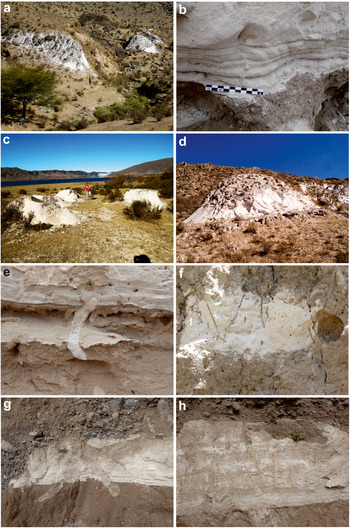
Several features associated with the tephras, especially V1a and V1b, were also recorded in order to have a better outcrop characterization. In many cases, the thickness of each tephra could vary from a few centimeters to more than 8 m (Fig. 7a). Besides their thickness and position (Figs. 5c and d, 7a), some tephras show laminar structures at their base, followed by massive, thick deposits (Fig. 7b). In other cases, when exposed on the surface as mantles, they later developed different and distinctive erosive features such as yardangs (Fig. 7c) and taffonis and crusts in vertical exposures (Fig. 7d). There are also bioturbations represented by roots, worms, and rodent galleries filled with ashes (Fig. 7e–g). Some deposits show interbedded sand facies (Fig. 7h) and oxides, the latter normally associated with peat formations.
(color online) Features associated with tephra deposits: thick V1 deposits (a), V1 basal laminations with deformation (b), V1 tephra yardangs (c), weathered scarp (taffonis) and crust formed on exposed V1 massive tephra deposits (d), worm bioturbation on V1 tephra deposit (e), roots on V1 tephra level (f), rodent galleries crossing V1 tephra deposit (g), and V1 tephras interbedded with sand facies including oxides (h).

Physicochemical characterization
The mineralogical, textural, and geochemical features (Supplementary Table 2) of the five tephras recognized in the Tafí and Santa María valleys are described in the following paragraphs. Because V1a-V1b and V2a-V2b pairs are impossible to differentiate by their mineralogy, glass shard-pumice morphology, or geochemistry, both pairs are described together.
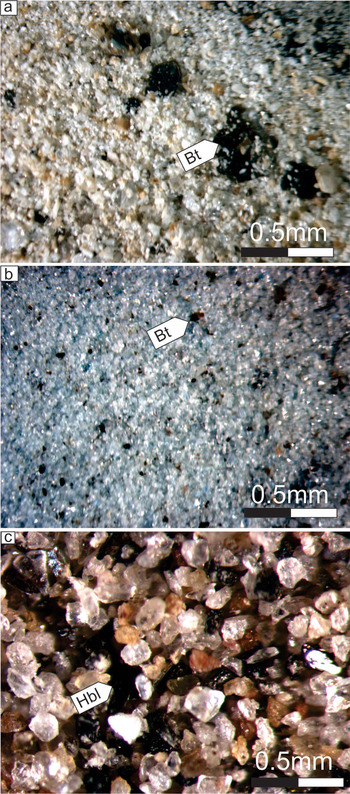
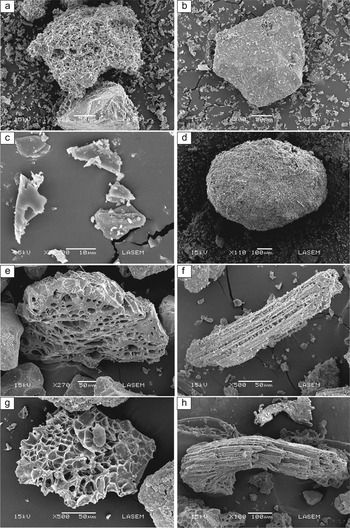
The V0 tephra is light brown and composed mainly of pumice particles and glass shards (~70%) and, to a lesser extent, crystal and lithics. The main mineral assemblage is biotite, quartz, and feldspars (mainly plagioclase) (Fig. 8a). The abundance of large crystals of biotite is an important feature that makes it possible to differentiate V0 from the other four tephras. In addition, magnetite, titanite, pyroxene, and muscovite are present as accessories. The lithics are granitic rocks, and, together with muscovite crystals, they represent a low degree of contamination of the original deposits. In V0 tephra, there is evidence of an incipient edaphization process such as the presence of oxide patinas, silty material, and organic matter, in concordance with the bioturbation observed at outcrop scale. The V0 tephra presents different morphological types of juvenile clasts. The most abundant ones are highly vesicular, irregular to subrounded pumice particles with small spherical to subspherical vesicles (Fig. 9a) or more elongated and tubular shapes separated by thin glass walls. The high vesicular pumice particles are usually covered by fine ash particles that hinder the characterization of the vesicle morphology (Fig. 9a). Another morphological type is represented by subangular, low vesicular to dense glass shards (Fig. 9b). The fine ash fraction is composed of small glass shards with flat plate and curved morphologies (Fig. 9c) derived from the fragmentation of large, highly vesicular pumice particles. In addition, we identified a low percentage of rounded, massive, slightly prolate aggregates of fine ash (Fig. 9d).
(color online) Photographs taken with binocular magnifying glass: abundance of large biotites (Bt) in V0 tephra (a); abundance of glass shards with respect to the crystal proportion in V1 tephra (b), and V2 tephra characterized by the high content of hornblende (Hbl) (c).

Scanning electron microscopy images: highly vesicular irregular to subrounded pumice particles in V0 tephra (a), subangular low vesicular to dense glass shards in V0 tephra (b), glass shard with flat plate and curved morphologies from V0 tephra (c), aggregates of fine ash from the V0 tephra (d), pumice clasts from V1 tephra characterized by rounded vesicle morphology separated by thick glass walls (e), pumice clasts from V1 tephra with fluid forms and elongated to tubular vesicles (f), highly vesicular pumice with complex vesicle shapes from V2 tephra (g), and tubular pumice in V2 tephra (h).

The V1a and V1b tephras are white and composed mainly of pumice particles and glass shards (~70%) and, to a lesser extent, crystals and lithics. The main mineral assemblage is quartz, feldspars (mainly plagioclase), and biotite (Fig. 8b). Magnetite, pyroxene, and amphibole are present as accessories. Edaphization and rework processes are not evident. The main compositional difference from V0 tephra is the higher percentage of pumice and glass shards and the lower proportion of crystals and crystal fragments. As in V0 tephra, the most conspicuous particle type is the highly vesicular, irregular to subrounded pumice. However, the pumice clasts from V1a and V1b tephras are characterized by more rounded vesicle morphology separated by thick glass walls (Fig. 9e) and a better development of clasts with fluid forms related to elongated and tubular vesicles (Fig. 9f). Large, subangular, low vesicular to dense glass shards and irregular prolate aggregates of fine ash are also present. The fine ash fraction consists of small glass shards with flat plate and curved morphologies.
The V2a and V2b tephras are light gray and composed of pumice particles and glass shards, with a relatively high proportion of crystals (~30%) and lower percentages of lithics. The main mineral assemblage is amphibole, quartz, feldspars (mainly plagioclase), and biotite (Fig. 8c). The abundance of amphibole is the key feature to differentiate V2a and V2b tephras from the other three tephras. Clinopiroxene, magnetite, apatite, muscovite, and rutile are present as accessories. The V2a and V2b tephras present similar types of juvenile components in terms of morphology and size. However, the most relevant feature of these tephras is the occurrence of irregular, highly vesicular pumice with complex vesicle shapes (Fig. 9g) and tubular pumice (Fig. 9h).
The data generated by pXRF are not suitable for classical geochemical classifications like the Total Alkali Silica (TAS) diagram (e.g., Le Bas et al., Reference Le Bas, Le Maitre, Streckeisen and Zanettin1986) because some elements such as Na are not measured. However, Sr/Rb versus K/Sr ratios are essentially controlled by feldspar proportion and thus reflect approximately the igneous rock type (Sola et al., Reference Sola, Báez, Bustos, Hernandez, Sampietro Vattuone, Peña Monné and Becchio2016). In this sense, Figure 10a shows the trace element ratios measured in our samples (Sr/Rb; K/Sr) compared with a database of volcanic rocks of the Central Andes (Mamani et al., Reference Mamani, Wörner and Sempere2010). Our geochemical data, along with the mineralogy of each ash level, indicate that V0, V1a, and V1b are probably rhyolitic in composition, whereas V2a and V2b are probably more dacitic in composition. This inference is consistent with the mineral assembly previously described. In addition, scatter plots combining trace elements with contrasting behavior, such as Rb-Sr or Zr- Sr, were used to identify the geochemical pattern for each tephra (Fig. 10b). The V1a and V1b tephras are characterized by high Rb content (>200 ppm) and low Sr content (<100 ppm). In contrast, V0, V2a, and V2b have low Rb content (<200 ppm) but can be differentiated by their Sr content: V0 < 300 ppm and V2a and V2b >300 ppm. In addition, V1a and V1b have lower Zr content (<100 ppm) than V0, V2a, and V2b (between 100 and 250 ppm).
(color online) (a) Relative geochemical classification using Sr/Rb versus K/Sr diagram proposed by Sola et al. (Reference Sola, Báez, Bustos, Hernandez, Sampietro Vattuone, Peña Monné and Becchio2016), with dacites and rhyolites of the Central Andes compiled by Mamaní et al. (Reference Mamani, Wörner and Sempere2010) and the samples analyzed in this work. (b) AL/BM: geochemical data of the Alemanía and Buey Muerto ashes taken from Hermanns et al. (Reference Hermanns and Schellenberger2008).

DISCUSSION
Nature and reliability of the tephras for tephrochronology studies
The studied tephras in the Tafí and Santa María valleys show different degrees of reworking. Although some of them can be interpreted as primary fallout deposits, abrupt changes in the tephra thicknesses through adjacent outcrops and incipient mixing with epiclastic material provide evidence that reworking occurred in most cases. The laminar structures at the base of some tephras, particularly V1a, are inferred as primary features related to eruptive column heights instability (e.g., Fernández-Turiel et al., Reference Fernández-Turiel, Perez-Torrado, Rodríguez González, Saavedra, Carracedo, Rejas and Lobo2019). Remobilization syn-eruptive and/or early posteruptive (tens of years after eruption) of primary tephras is a well-recorded process worldwide, especially in desert regions such as Patagonia (e.g., Wilson et al., Reference Wilson, Cole, Stewart, Cronin and Johnston2011; Forte et al., Reference Forte, Dominguez, Bonadonna, Gregg, Bran, Bird and Castro2018). The relative compositional homogeneity revealed by petrographic and geochemical data, along with the good preservation of the primary textural features of the studied tephras, suggests that the reworking was very localized and near contemporaneous with the primary fallout event. For this reason, the term “tephra” is maintained for the designation of the pyroclastic levels studied, as in other case studies (e.g., Froese et al., Reference Froese, Zazula and Reyes2006). We consider that the primary fall and the final disposition after the reworking of the studied tephras probably occurred over a period of tens of years. Therefore, the studied tephras are not reliable for very high-resolution tephrochronological studies, but they may still provide useful chronostratigraphic information depending on the expected temporal resolution (Lowe, Reference Lowe2011), such as for identification and correlation of the main Holocene aggradation units in the study area (e.g., Peña Monné and Sampietro Vattuone, Reference Peña Monné, Sampietro Vattuone, Sampietro Vattuone and Peña Monné2016b; Sampietro-Vattuone and Peña-Monné, Reference Sampietro-Vattuone and Peña-Monné2016).
Another finding from our research is the existence of tephras that are very similar in composition and relatively close in time. These compositional similarities suggest that they come from the same eruptive center. The occurrence of eruptions similar in composition throughout the evolution of one single eruptive center is not extremely strange in the Central Andes (e.g., Folkes et al., Reference Folkes, de Silva, Wright and Cas2011). The physicochemical characterization presented in this article does not have enough resolution to identify the fingerprints of these kinds of geochemically homogeneous eruptions. Thus, V1a-V1b and V2a-V2b tephras are not useful for high-resolution tephrochronological studies. However, tephras related to the same volcano accumulated as stratigraphically contiguous tephra layers over longer periods, from some years to millennia, are still able to provide chronostratigraphic information (Lowe, Reference Lowe2011). In this sense, each pair of tephras (V1a-V1b, V2a-V2b) can be understood as “composite” isochrons defined by a pair of maximum and minimum time lines (Lowe, Reference Lowe2011).
Tephrostratigraphy of Tafí and Santa María valleys
Although the chronological value of the tephras in reconstructing geomorphological and geoarchaeological evolutionary processes in the study area was recognized and reported by Peña Monné and Sampietro Vattuone (Reference Peña Monné, Sampietro Vattuone, Sampietro Vattuone and Peña Monné2016b) and Sampietro-Vattuone and Peña-Monné (Reference Sampietro-Vattuone and Peña-Monné2016), this is the first study of the complete set of Holocene tephras from Tafí and Santa María valleys. The morphostratigraphic analysis and new geochronological data presented here have allowed us to identify five temporally well-defined Holocene tephras, some of which are mentioned for the first time in the study area. Thus, these tephras had never been described, chronologically situated, placed into their morphosedimentary context, or physicochemically characterized before.
V0 is the oldest Holocene tephra in the study area. Our results indicate that V0 was deposited after 11,802–11,192 cal yr BP and before 4789–4289 cal yr BP (maximum age for the overlaying V1a tephra). Thus, V0 is probably equivalent to “El Paso ash,” previously characterized by Hermanns and Schellenberger (Reference Hermanns and Schellenberger2008), improving our chronological frame to after 11,152–10,573 cal yr BP and before 7567–7431 cal yr BP (Fig. 5a). This chronological frame also suggests that V0 is equivalent to the “CdP1 unit” (Cueros de Purulla sequence), defined by Fernández-Turiel et al. (Reference Fernández-Turiel, Perez-Torrado, Rodríguez González, Saavedra, Carracedo, Rejas and Lobo2019) in the northern sector of the Calchaquí valley. The physicochemical characteristics of V0 are roughly consistent with this interpretation. Our geochronological data show that V1a and V1b tephras probably represent the same tephras assigned by Fernández-Turiel et al. (Reference Fernández-Turiel, Perez-Torrado, Rodríguez González, Saavedra, Carracedo, Rejas and Lobo2019) to the Holocene Cerro Blanco caldera-forming eruption (Fernández-Turiel et al. Reference Fernández-Turiel, Saavedra, Pérez-Torrado, Rodríguez-González, Alias and Rodríguez-Fernández2012, Reference Fernández-Turiel, Saavedra, Perez-Torrado, Rodríguez-González, Carracedo, Osterrieth, Carrizo and Esteban2013; Báez, Reference Báez2014; Báez et al., Reference Báez, Arnosio, Chiodi, Ortiz Yañes, Viramonte, Bustos, Giordano and López2015). However, according to our chronological and morphosedimentary data, V1a and V1b represent two temporally well-defined, independent eruptions. In addition, V1a (Carreras 1a ash) and V1b (Carreras 1b ash) tephra layers represent the previously defined Buey Muerto and Alemanía ashes (Hermanns et al., Reference Hermanns, Trauth, Niedermann, McWilliams and Strecker2000, Reference Hermanns, Niedermann, Villanueva García, Schellenberger, Evans, Scarascia-Mugnozza, Strom and Hermanns2006; Hermanns and Schellenberger, Reference Hermanns and Schellenberger2008) because they cannot be differentiated by analytical procedures either and are contemporaneous with our V1a and V1b tephras. We agree with the interpretation of Hermanns and Schellenberger (Reference Hermanns and Schellenberger2008) that tephra reworking is unlikely to have occurred over the long period of time (~1000 yr) that separates both tephra layers. The lack of evidence of significant contamination in V1b tephra is also consistent with the inference that V1a and V1b tephras (Buey Muerto and Alemania ashes according to Hermanns and Schellenberger [2008]) represent two individual eruptions rather than long-lasting (hundreds of years) reworking processes.
Finally, the V2a and V2b tephras (Carreras 2 ash and El Paso 3 ash tephras) have been characterized and dated for the first time in the study area, and they represent the youngest large volcanic eruptions (younger than 800 yr BP) in this sector of the Central Andes. Fernandez-Turiel et al. (Reference Fernández-Turiel, Perez-Torrado, Rodríguez González, Saavedra, Carracedo, Rejas and Lobo2019) have identified a new tephra in the Fiambalá valley (BdF unit of the Fiambalá sequence) and suggested that it can be correlated with the youngest tephras of the Tafí valley (V2a and V2b). Yet, high-resolution tephrochronological studies are necessary to confirm these preliminary correlations.
Volcanological implications
Considering that the preservation potential of fallout deposits hundreds of kilometers away from their source is only related to large volcanic eruptions (VEI >6), the occurrence of the five tephras presented in this work has important implications in volcanic hazard and risk assessment in northwestern Argentina. At least five major eruptions affected the Tafí and Santa María valleys in the last 10,000 yr; therefore, this area should be considered a vulnerable zone in terms of tephra fall.
The source of the V0 tephra is unknown; however, explosive volcanic activity of rhyolitic composition during the Holocene along the southern edge of the Central Volcanic Zone was very scarce and mainly concentrated in the back-arc region (Guzmán et al., Reference Guzmán, Grosse, Montero-López, Hongn, Pilger, Petrinovic, Seggiaro and Aramayo2014; Grosse et al., Reference Grosse, Guzmán, Petrinovic, Muruaga and Grosse2017; Petrinovic et al., Reference Petrinovic, Grosse, Guzman, Caffe, Muruaga and Grosse2017). Few volcanic centers with Quaternary explosive rhyolitic activity were identified in this sector of the Central Andes, and they usually have relatively homogeneous geochemical compositions. Two examples of these centers are Cerro Blanco Volcanic Complex (Báez et al., Reference Báez, Arnosio, Chiodi, Ortiz Yañes, Viramonte, Bustos, Giordano and López2015 and references therein) and Cueros de Purulla volcano (Báez, Reference Báez2014) (Fig. 1). Fernández-Turiel et al. (Reference Fernández-Turiel, Perez-Torrado, Rodríguez González, Saavedra, Carracedo, Rejas and Lobo2019) proposed that “El Paso ash” (Hermanns and Schellemberger, Reference Hermanns and Schellenberger2008) and equivalent units were ejected from the Cueros de Purulla volcano. This correlation is weak, as it is based only on the compositional similarities with the proximal fallout deposits of the Cuero de Purulla volcano and “El Paso ash,” and no geochronological data are available for the Cuero de Purulla volcano.
To date, the only tephra in the study area that has correlated well with a specific volcanic center is the middle Holocene tephra related to the Cerro Blanco eruption (Fernández-Turiel et al., Reference Fernández-Turiel, Perez-Torrado, Rodríguez González, Saavedra, Carracedo, Rejas and Lobo2019). However, the results presented in this article point to two eruptions of the Cerro Blanco Volcanic Complex during Holocene times (V1a and V1b tephras).
The source of the V2a and V2b tephras is unknown, but their amphibole-rich and more “dacitic” composition suggests that they are related to some volcanic center located along the main arc with highly explosive activity during the Holocene, like the Nevado Tres Cruces (Gardeweg et al., Reference Gardeweg, Clavero, Mpodozis, Pérez and Villeneuve2000), as previously proposed by Fernández-Turiel et al. (Reference Fernández-Turiel, Perez-Torrado, Rodríguez González, Saavedra, Carracedo, Rejas and Lobo2019).
CONCLUSIONS
Five temporally well-defined Holocene tephra layers were identified in Tafí and Santa María valleys. The morphostratigraphic position of these tephras, together with radiocarbon data, contributed to establishing a valuable chronological framework. The oldest layer, named El Rincón ash (V0), is younger than 11,802–11,192 cal yr BP and older than 7567–7431 cal yr BP. Two younger tephras named Carreras 1a ash (V1a) and Carreras 1b ash (V1b) were identified. They are equal in their composition and were dated between 4789–4289 and 3830–3470 cal yr BP (V1a) and between 3830–3470 and 2760–2188 cal yr BP (V1b). Finally, two very young (upper Holocene) tephras named Carreras 2 ash (V2a), dated between 991–774 and 655–624 cal yr BP, and El Paso 3 ash (V2b), dated later than 497–468 cal yr BP, were identified in the study area.
Geochemical and mineralogical data allowed us to know that V0, V1a, and V1b tephras are rhyolitic in composition, whereas V2a and V2b are dacitic. Considering that in this sector of the Central Andes the occurrence of Quaternary explosive rhyolitic eruptions is restricted to the Puna region, the back-arc region was the most active area providing tephras to the region during the Holocene.
The new data presented in this work have important implications in volcanic hazard and risk assessment in northwestern Argentina. In this sense, we highlight the identification of one unknown Middle Holocene (V1b) and two other very young (<800 yr BP) tephra layers (V2a and V2b) in the study area.
ACKNOWLEDGMENTS
This work is a contribution of the “Primeros Pobladores del Valle del Ebro” research group (Government of Aragon and European Social Fund) and fits within the research scope of IUCA (Environmental Sciences Institute of the University of Zaragoza). This research was supported by Universidad Nacional de Tucumán (PIUNT G629), CONICET (PIP 837), Universidad Nacional de Salta (CIUNSa Type B - N° 2618), and Agencia Nacional de Promoción Científica y Tecnológica (PICT 2016-1359).
SUPPLEMENTARY MATERIAL
The supplementary material for this article can be found at https://doi.org/10.1017/qua.2019.78.