INTRODUCTION
The prediction of survival is described as one of the most important issues in palliative clinical practice and research (Maltoni & Tassinari, Reference Maltoni and Tassinari2004). It plays an important role in the provision of information to patients and their families, patient management, discharge planning, assessment of patients for social security benefits, and establishment of patients' eligibility to participate in clinical trials (den Daas, Reference den Daas1995; Vigano et al., Reference Vigano, Dorgan and Buckingham2000). However, clinical prediction in advanced cancer has repeatedly been shown to be unreliable (den Daas, Reference den Daas1995; Oxenham & Cornbleet, Reference Oxenham and Cornbleet1998; Glare et al., Reference Glare, Virik and Jones2003).
The main variables that have been investigated as predictors of survival are clinical factors, including biological data and clinicians' assessment of the patient's status, clinicians' prediction of survival (which is likely to take clinical variables into account), and patients' self assessments of their health-related quality of life (HRQoL), including symptom burden.
Literature reviews have clearly demonstrated the value of clinical variables (Vigano et al., Reference Vigano, Dorgan and Buckingham2000) and clinicians' estimates (Glare et al., Reference Glare, Virik and Jones2003) in the prediction of survival. However, a large number of studies suggest that patients' self-assessed HRQoL makes an important and independent contribution to prediction of survival alongside clinical variables and professional assessment for patients with lung cancer (Langendijk et al., Reference Langendijk, Aaronson and de Jong2000; Montazeri et al., Reference Montazeri, Milroy and Hole2001; Dharma-Wardene et al., Reference Dharma-Wardene, Au and Hanson2004; Efficace et al., Reference Efficace, Bottomley and Smit2006), advanced colorectal cancer (Maisey et al., Reference Maisey, Norman and Watson2002; Efficace et al., Reference Efficace, Bottomley and Coens2005; Lis et al., Reference Lis, Gupta and Granick2006), advanced cancer in general (Coates et al., Reference Coates, Porzsolt and Osoba1997; Dancey et al., Reference Dancey, Zee and Osoba1997), and the terminally ill (Tamburini et al., Reference Tamburini, Brunelli and Rosso1996; Llobera et al., Reference Llobera, Esteva and Rifa2000). In contrast, a few studies have concluded that the contribution of self-assessed variables was limited once clinical variables were accounted for in samples of lung cancer (Herndon et al., Reference Herndon, Fleishman and Kornblith1999) and terminal cancer patients (Toscani et al., Reference Toscani, Brunelli and Miccinesi2005), respectively.
If self-reported HRQoL aids prediction of survival, we should aim to establish what type of measure is most useful in adding predictive information alongside clinical measures and clinicians' predictions. The EORTC QLQ-C30 (Herndon et al., Reference Herndon, Fleishman and Kornblith1999) is an extensively used cancer-specific measure that has been designed to capture patients' functional status in several domains (physical, psychological, and social), their global health status/quality of life (QoL), and symptom severity. It has been investigated extensively in the prediction of cancer survival. Several studies have found its global health status/QoL scale to be the strongest HRQoL predictor in lung cancer patients (Langendijk et al., Reference Langendijk, Aaronson and de Jong2000; Montazeri et al., Reference Montazeri, Milroy and Hole2001), advanced colorectal cancer patients (Maisey et al., Reference Maisey, Norman and Watson2002), and in advanced cancer patients in general (Coates et al., Reference Coates, Porzsolt and Osoba1997; Dancey et al., Reference Dancey, Zee and Osoba1997). However, a few studies have found EORTC QLQ-C30 symptom scores (Herndon et al., Reference Herndon, Fleishman and Kornblith1999; Efficace et al., Reference Efficace, Bottomley and Smit2006) or social functioning (Efficace et al., Reference Efficace, Bottomley and Coens2005) to be more important. Nevertheless, it appears that patients' general well-being may overall be more predictive of survival than symptom severity or functional status.
It seems plausible that patients' ratings of their general health and QoL should contribute more to prediction alongside clinical variables than self-rated symptoms or functional status, as the latter to some extent can be assessed by others, although not perfectly. Although clinicians are reasonably able to assess observable symptoms, they are poor at assessing patients' QoL (Fowlie et al., Reference Fowlie, Berkeley and Dingwall-Fordyce1989; Regan et al., Reference Regan, Yarnold and Jones1991). However, if HRQoL measures make their greatest contributions to prediction of survival by measuring global health/QoL, a more comprehensive generic measure may add more predictive value than cancer-specific measures that include symptoms, particularly in situations where clinical information is already fairly comprehensive.
This study, therefore, aimed to test whether a generic measure of HRQoL, the SF-36 (Ware & Sherbourne, 1992) was an equally good or better predictor of survival than the cancer-specific EORTC QLQ-C30 in a sample of colorectal and lung cancer patients who were defined as needing palliative care. The mental component summary score (MCS) of the SF-36 has been reported to predict survival in lung cancer patients alongside another generic quality of life measure (Manser et al., Reference Manser, Wright and Byrnes2006). The SF-36 was tested together with the EORTC QLQ-C30 in a study by Camilleri-Brennan and Steele (Reference Camilleri-Brennan and Steele2001) that suggested that EORTC QLQ-C30 subscales provided better prediction. However, the study sample was rectal cancer patients undergoing surgery, and 88% were alive at the end of the study. The present study therefore constitutes the first comparison of the performance of the generic SF-36 versus the cancer-specific EORTC QLQ-C30 in predicting survival in cancer patients defined as needing palliative care.
METHODS
Sample
The sample consisted of patients with colorectal or lung cancer, which represent the most common cancer diagnoses encompassing both men and women. Patients were identified through consecutive discharge summaries and outpatient consultation letters from participating oncology consultants and surgeons at a UK Hospital National Health Service Trust. Inclusion criteria were age 16 years or above, diagnosis of lung or colorectal cancer, and explicit reference to the need for palliation in the hospital notes and/or a disease staging deemed by a clinician as giving clear indication of palliative status (e.g., liver metastases for colorectal cancer).
Procedure
Data were collected as part of a longitudinal study investigating patients' and carers' needs and service use. General practitioners (GPs) of eligible patients were asked by letter whether the patient could be contacted for the study (Farquhar et al., Reference Farquhar, Grande and Todd2002). Patients deemed contactable by the GP were sent a study introduction letter with a reply slip.
Those who agreed to participate were interviewed at home for the general study. After the interview, the SF-36, the EORTC QLQ-C30, and a reply envelope were left with the patient with a request to complete the questionnaires “within the next couple of days.” If respondents requested, interviewers provided help with questionnaire completion. The sample was flagged for deaths by the Office of National Statistics and followed for 5 years from the baseline interview. Stage of colorectal cancer and type of lung cancer were identified from patients' medical notes. Approval was obtained from the Cambridge Local Research Ethics Committee.
Measures
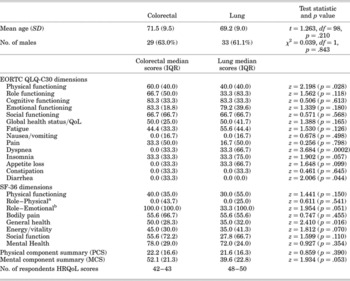
The EORTC QLQ-C30 (EORTC Study Group, 1995) is a HRQoL measure specific to cancer, whereas the SF-36 (Ware & Sherbourne, Reference Ware and Sherbourne1992) is a generic measure. Table 1 shows the individual EORTC QLQ-C30 and SF-36 scales (excluding the EORTC QLQ-C30 Financial Difficulties scale, which is unlikely to relate to prognosis). The SF-36 has been subjected to principal components analysis yielding two summary measures: one for responses representing a physical component summary (PCS) and one for responses representing a mental component summary (MCS; Jenkinson et al., Reference Jenkinson, Layte and Lawrence1997).
Age, sex, and baseline HRQoL scores by cancer diagnosis

aRole limitations due to physical problems.
bRole limitations due to emotional problems.
Analysis
Demographic and clinical differences between diagnostic groups at baseline were tested using chi-square and t tests. HRQoL differences were tested using nonparametric Mann–Whitney U tests and correlations calculated using Spearman's correlation coefficient (Rs) due to considerable skew or kurtosis in many of the HRQoL variables (Siegel & Castellan, Reference Siegel and Castellan1988).
Relationships between baseline variables and survival were investigated through univariate Cox regression analyses. To assess appropriateness for this analysis, the proportional hazards assumption was tested for each variable by assessing whether the Kaplan–Meier survival curves for variable categories were parallel (continuous variable categories were created by dividing the variable at the median; Campbell, Reference Campbell2001).
HRQoL variables associated with survival at p < .1 in the univariate analyses (Hosmer & Lemeshow, Reference Hosmer and Lemeshow2000) were entered into multivariate Cox regression analyses. Separate multivariate analyses were conducted for SF-36 and for EORTC QLQ-C30 variables. Multivariate analyses were first performed using the enter method to assess the resulting model with all identified variables entered, and second using a forward stepwise method whereby the most significant variable is entered into the model first, to assess which variables appeared most important in predicting survival. Significant HRQoL variables were finally tested alongside any significant demographic and clinical variables. Procedures ensured that there were more than 10 cases per variable within any multivariate analysis. SPSS version 13.0 was used, and the variance explained by the resulting models was calculated according to Nagelkerke (Reference Nagelkerke1991).
RESULTS
Patient Sample
Of 242 patients identified, 28 died before contact, 14 were deemed “unsuitable” by their GP, 69 refused, and 31 gave no response. This yielded 54 lung and 46 colorectal cancer patients who took part in the study. Fifty lung and 43 colorectal cancer patients completed the EORTC QLQ-C30 and the SF-36 at baseline. Five years after the baseline interview, 94 patients had died. Surviving cases were censored in the analysis (5 colorectal and 1 lung).
Table 1 shows the baseline sample characteristics. Compared to lung cancer patients, colorectal cancer patients had better EORTC QLQ-C30 physical functioning and lower levels of dyspnea. Lung cancer patients had lower levels of diarrhea, although low prevalence yielded a median of 0 in both groups.
Univariate Cox Regression Analysis
All variables conformed to the proportional hazards assumption, except the EORTC QLQ-C30 Diarrhea scale.
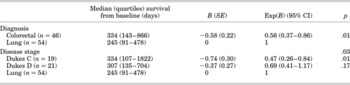
Survival from baseline was considerably skewed, and median and quartile values for days of survival are reported. Colorectal cancer patients had significantly better overall survival from baseline, that is, reduced risk of death, compared to lung cancer patients. However, it was patients with Dukes C, rather than Dukes D, that experienced better survival relative to lung cancer (Table 2). Survival was not significantly longer for non-small-cell lung cancer (243 [81–323]) than small-cell lung cancer (228 [51–276]). There were no age and sex differences.
Univariate Cox regression analyses of diagnosis, disease stage, and survival

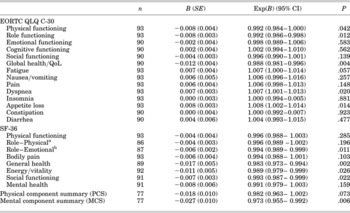
For the EORTC QLQ-C30 (Table 3), high baseline scores (better functioning) on Physical Functioning, Role Functioning and Global Health/QoL were significantly associated with reduced risk of death, whereas high scores (worse symptoms) on Dyspnea and Appetite Loss were related to worse survival. For the SF-36, high baseline scores (better functioning) on Role–Emotional, General Health, Energy/Vitality, and Social Functioning were significantly associated with improved survival. A high mental summary score (MCS) was significantly related to better survival, whereas a high physical summary score (PCS) was not.
Univariate Cox regression models: Individual HRQoL scales and survival

aRole limitations due to physical problems.
bRole limitations due to emotional problems.
Multivariate Cox Regression Analysis
EORTC QLQ-C30 variables related to survival at p < .1 in the univariate analysis were all significantly intercorrelated (Rs range from .356 to .793); likewise, SF-36 individual scales (Rs range from .534 to .784) and PCS and MCS summary scales (Rs = .331, p = .003) were significantly intercorrelated.
When the six EORTC QLQ-C30 variables at p < .1 in the univariate analysis were entered into a multivariate Cox regression model simultaneously, none of the variables showed a significant relationship with survival, that is, no variable remained significant when all the other variables were taken into account. When employing forward stepwise regression, whereby the most significant variable is entered into the model first, Appetite Loss emerged as a significant predictor. Once Appetite Loss was controlled for, none of the other variables remained significant. However, its selection was based on marginal differences in statistical significance between highly intercorrelated variables. Therefore this result is likely to be a function of this particular statistical analysis, rather than demonstrating the importance of loss of appetite relative to other prognostic variables. Prior to entry of Appetite Loss into the model, Global Health/QoL showed a similarly strong relationship with survival in the multivariate analysis.
Likewise, when the six SF-36 individual scales at p < .01 were entered simultaneously into a multivariate model, none of the variables remained a significant predictor of survival. When employing forward stepwise regression, Energy/Vitality emerged as a significant predictor. Again none of the other variables remained significant when this variable was controlled for. However, the selection of Energy/Vitality was again based on marginal statistical differences, for example, with General Health, with which it was strongly correlated. Therefore, this result is again likely to be a function of this statistical analysis and data set.
In contrast, when the SF-36 PCS and MCS were entered into a multivariate model simultaneously, the relationship between the MCS and survival remained significant when physical aspects were controlled for (Table 4).
Multivariate Cox regression model (n = 77)

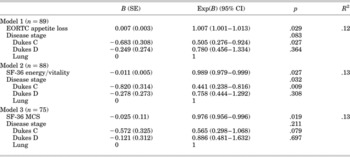
As lung and colorectal cancer patients differed in some of their HRQoL scores, any relationship between such variables and survival may be due to the difference in survival between diagnoses. Significant HRQoL variables were therefore entered into a multivariate Cox regression together with disease stage and diagnosis. Appetite Loss, Energy/Vitality, and MCS all remained significant predictors when disease stage and diagnosis were controlled for (Table 5). Disease stage and diagnosis were no longer significant when MCS was taken into account, although adding stage and diagnosis to MCS increased the variance explained (Tables 4 and 5). The amount of variance accounted for by each model in Table 5 was very similar, regardless of type of HRQoL variable considered (12%–13%).
Multivariate Cox regression models with main HRQoL variables and diagnosis

DISCUSSION
Summary
Colorectal cancer patients had better survival than lung cancer patients, with Dukes C stage rather than Dukes D stage colorectal cancer representing the better survival over lung cancer. For the EORTC QLQ-C30, both the general health and functioning scales (Physical Functioning, Role Functioning, and Global Health/QoL) and symptom scales (Dyspnea and Appetite Loss) significantly predicted survival. These findings correspond with Vigano et al.'s (2000) review of clinical factors and survival where (clinician assessed) functional status, dyspnea, and anorexia emerged as being important, although this review considered cancer patients with median survival of 3 months or less. For the SF-36, Role–Emotional, General Health, Energy/Vitality, and Social Functioning were significantly associated with survival. A high SF-36 MCS was significantly related to better survival whereas, perhaps surprisingly, a high PCS was not.
In the multivariate analysis of HRQoL scales, none of the single scales emerged as a clear independent survival predictor due to considerable intercorrelation between scales. Although forward stepwise regression analysis made the statistical procedure select one variable for each instrument (Appetite Loss for EORTC QLQ-C30 and Energy/Vitality for SF-36), their selection may well be a function of this particular analysis, as other variables were nearly equally strong contenders. This included the EORTC QLQ-C30 Global Health/QoL variable, which has been found to be a strong predictor in previous research (Dancey et al., Reference Dancey, Zee and Osoba1997; Montazeri et al., Reference Montazeri, Milroy and Hole2001; Maisey et al., Reference Maisey, Norman and Watson2002).
In contrast to the single scales, the SF-36 MCS scale retained a clear relationship with survival even when physical HRQoL aspects (PCS) were controlled for. However, when combined with disease stage and diagnosis, the MCS performed no better than Appetite Loss (a single-item symptom measure) or Energy/Vitality (one of the scales contributing to the MCS score) in the amount of variance in survival explained. Thus although the HRQoL variables contributed something over and beyond basic clinical variables, it remains unclear which HRQoL variable was the better predictor and whether the generic or specific HRQoL measure performed better.
Limitations
A limitation of the study may be the representativeness of the sample. Patients were identified through oncology clinics. Many died before contact, the most ill may have been “selected out” by their GPs, and palliative care patients who participate in research probably have longer survival than those who refuse (Grande et al., Reference Grande, Todd and Barclay1997). The results may therefore represent patients with advanced cancer rather than more end-stage palliative patients. The most important predictive variables for these patients may be quite different from those toward the end of life. Nevertheless, the independent contribution of self-reported HRQoL has been demonstrated in previous studies of patients with a median survival of 56–59 days (Tamburini et al., Reference Tamburini, Brunelli and Rosso1996; Llobera et al., Reference Llobera, Esteva and Rifa2000).
A second study limitation was the inability to test for clinical variables beyond diagnosis. More comprehensive clinical measures may again have given more prominence to clinical variables in the survival equation. However, most studies into HRQoL included a more comprehensive range of clinical variables and still concluded that HRQoL was an important contributor to survival (Tamburini et al., Reference Tamburini, Brunelli and Rosso1996; Coates et al., Reference Coates, Porzsolt and Osoba1997; Langendijk et al., Reference Langendijk, Aaronson and de Jong2000; Llobera et al., Reference Llobera, Esteva and Rifa2000; Montazeri et al., Reference Montazeri, Milroy and Hole2001; Maisey et al., Reference Maisey, Norman and Watson2002; Dharma-Wardene et al., Reference Dharma-Wardene, Au and Hanson2004; Efficace et al., Reference Efficace, Bottomley and Coens2005, Reference Efficace, Bottomley and Smit2006; Lis et al., Reference Lis, Gupta and Granick2006).
Finally, the variance explained in survival was small, possibly due to the limited range of variables incorporated, but larger studies with more comprehensive measurement of clinical variables may still leave over 70% of variance in survival unexplained (Toscani et al., Reference Toscani, Brunelli and Miccinesi2005).
Implications
The study limitations clearly point to the need for larger studies with more representative samples, a more comprehensive range of variables, and repeated measurements to assess the predictive importance of variables at different stages. However, the study results also highlight a more fundamental methodological point that needs to be addressed if this field is to progress. The high degree of intercorrelation between HRQoL single scales made it difficult to identify one as the better predictor. Other research confirms the high intercorrelations between subscales of HRQoL measures (Coates et al., Reference Coates, Porzsolt and Osoba1997). Furthermore, HRQoL scales correlate considerably with clinical factors such as performance status and weight loss (Herndon et al., Reference Herndon, Fleishman and Kornblith1999). The high degree of intercorrelation between variables may yield apparently conflicting results between studies into survival that really only represent small differences in how individual multivariate statistical analyses have worked out. Intercorrelation also means there is considerable redundancy in the information used to predict survival.
This suggests a need to develop and/or utilize variables that are as independent of each other as possible to maximize predictive power and produce more consistent results. The development of the SF-36 mental and physical composite scales (MCS and PCS) may represent one such way forward. These were developed from the single SF-36 scales through factor analysis with orthogonal rotation to be as unrelated to each other as possible (Jenkinson et al., Reference Jenkinson, Layte and Lawrence1997) and correspondingly showed the lowest intercorrelations of the predictor variables. The MCS scales therefore represent a psychological component that is as “uncontaminated” by physical aspects as possible and vice versa. In our analysis the MCS retained a significant relationship with survival even when entered alongside physical components (PCS) and alongside diagnosis/stage, whereas diagnosis/stage was no longer significant alongside MCS. Although this specific result may reflect the early palliative stage of this particular patient sample and/or the limited range of clinical variables, the desirability of identifying clear, independent predictor variables remains.
Maltoni and Tassinari (Reference Maltoni and Tassinari2004) call for systematic composite evaluation combining clinicians' survival estimates with performance status, symptoms, and biomedical data through prognostic score instruments as a means of improving prediction and resolving conflicting findings. To this we would add the need to include self-reported HRQoL, where possible, to improve predictive power. However, HRQoL variables need to be systematically investigated to assess where they provide the clearest added, independent contribution. Their value may, for instance, lie in measurement of more general well-being, which may reflect underlying disease that cannot fully be detected through tests or clinician assessment (Maisey et al., Reference Maisey, Norman and Watson2002). We would also add the need to assess all of the component variables of prognostic instruments, both clinical and HRQoL, for their independence of other components and their unique contribution in order to design instruments with maximum predictive power.
In studies to date a large amount of variance in survival remains unexplained (Toscani et al., Reference Toscani, Brunelli and Miccinesi2005), and a more systematic, comprehensive approach is needed to improve this. Although we are probably still unlikely to accurately predict survival for individuals, improved prediction of probabilities can nevertheless provide valuable guidance to clinicians in the difficult art of outlining and planning future options with patients and their families.
Conclusions
Our study confirms that self-reported HRQoL is significantly and independently associated with survival in palliative patients. It also suggests that a generic mental health measure may be an equally good, possibly at times better, predictor of survival compared to self-reported physical health for patients relatively early in their disease trajectory. However, considerable intercorrelations between HRQoL measures yielded unclear results. This suggests that to improve prediction there is a general need to invest in improved variable selection and design to produce a complementary and comprehensive set of independent predictor variables, as well as a need for larger scale studies with representative samples and repeated measurement.
ACKNOWLEDGMENTS
The authors thank all those who contributed to and participated in this study: consultants and hospital administrative staff for recruitment assistance, all participating patients and carers, Malcolm Campbell for statistical advice, and Anna Martin for assistance with recruitment and data collection. The study was funded by the NHS R&D Primary/Secondary Interface Programme and the Directorate of Health and Social Care Midlands and East of England grant RCC11095.