INTRODUCTION
Patients with advanced disease often experience psychological problems as their physical symptoms worsen (McVey, Reference McVey1998; Morasso et al., Reference Morasso, Capelli and Vitebori1999; Gruneir et al., Reference Gruneir, Smith and Hirdes2005). Up to 29% of palliative care patients have been identified as experiencing depression or other mood disorders at some time during the palliative phase (Durkin et al., Reference Durkin, Kearney and O'Siorain2003; Lloyd-Williams et al., Reference Lloyd-Williams, Dennis and Taylor2004; Miovic & Block, Reference Miovic and Block2007; Teunissen et al., Reference Teunissen, de Graeff and Voest2007) and it has been shown with cancer patients in the palliative care stage, that previously mentally healthy individuals become psychologically vulnerable as the disease progresses (Dudgeon et al., Reference Dudgeon, Raubertas and Doerner1995; Mazzocato et al., Reference Mazzocato, Stiefel and de Jonge2000; Akechi et al., Reference Akechi, Okuyama and Ysugawara2004). A clinical diagnosis of depression in terminally ill cancer patients has been significantly associated with a desire for hastened death and can have an adverse effect on their quality of life (Breitbart et al., Reference Breitbart, Rosenfeld and Pessin2000; Tiernan et al., Reference Tiernan, Casey and O'Boyle2002). A recent study showed that among patients in Oregon who requested a physician's aid in dying, one in four had clinical depression (Ganzini et al., Reference Ganzini, Goy and Dobscha2008) and a Swiss study found that in 114 cases of assisted suicide, 27% had been observed by the assessor to be depressed (Bosshard et al., Reference Bosshard, Ulrich and Ziegler2008).
A strong need for help with emotional problems such as fears, sad feelings, and anger has been identified in cancer patients, with this need increasing significantly as health declines (McIlmurray et al., Reference McIlmurray, Thomas and Francis2001) and it has been shown that palliative care patients experiencing emotional problems such as fears, depressed mood, and lack of assertiveness, would have liked more professional help with these problems (Osse et al., Reference Osse, Vernooij-Dassen and Schade2005). Depression and anxiety in palliative care patients has been underdiagnosed, underreported by medical staff, and undertreated (Lloyd-Williams & Payne, Reference Lloyd-Williams and Payne2002; Kelly et al., Reference Kelly, McClement and Chochinov2006; Irwin et al., Reference Irwin, Rao and Bower2008). It has been pointed out that palliative care patients can find it difficult to express intense negative feelings to their medical providers (Mystakidou et al., Reference Mystakidou, Tsilika and Parpa2009). It has also been shown that nurses and doctors may be unwilling to assess and refer palliative patients for psychological treatment (Lawrie et al., Reference Lawrie, Lloyd-Williams and Taylor2004; Little et al., Reference Little, Dionne and Eaton2005). “Natural” sadness may be seen as a normal accompaniment to dying and perceived as difficult to distinguish from depression (Lawrie et al., Reference Lawrie, Lloyd-Williams and Taylor2004; Noorani et al., Reference Noorani and Montagnini2007).
The needs and satisfaction of patients being palliatively treated at home has been studied by investigating next-of-kins' experience of the care provided (Milberg & Strang, Reference Milberg and Strang2000). However it has not been shown whether those dying at home experience greater or less psychological distress than palliative care inpatients. In fact there is little research looking at the psychological distress of palliative care patients being treated at home, and no studies comparing the psychological distress of patients being treated at home with that of inpatients.
Therefore, the purpose of our study was to address this gap in the literature and investigate psychological distress in community and home-based palliative care. The first aim of the study was to identify the prevalence of anxiety and depression in a palliative care sample drawn from both community (home-based) palliative care and inpatient palliative care. The second aim was to compare community patients and inpatients on measures of depression and anxiety. The third aim was to identify which factors might predict anxiety and depression.
METHOD
Participants
Subjects were recruited from patients who had been admitted to an Australian palliative care service either as inpatients or as community patients for home–based palliative care. Exclusion criteria were being <18 years of age, being deemed by the palliative care physician too unwell to participate, having insufficient English literary skills to read and comprehend the project information sheet, and having had a previous admission to either of the palliative care services. Ethics approval for the research was gained from the participating hospital.
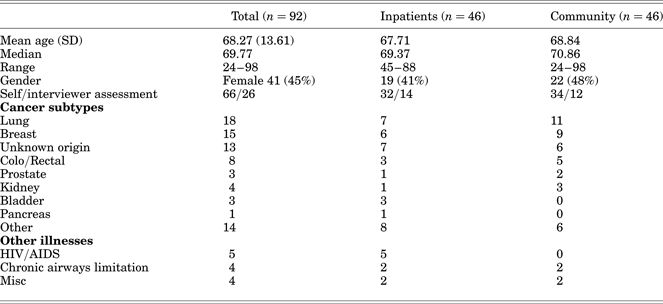
A total of 96 palliative care patients were recruited to participate in the study. Four patients were excluded from the study. Three of these patients did not complete the forms and the other patient was transferred from the ward before being assessed. This left a total of 46 for the inpatient sample and 46 in the community sample (total N = 92). Demographic details are reported in Table 1.
Demographic table type and patient type

Measures
A variety of assessment methods have been used to assess depression and anxiety in palliative care patients (Tremblay & Breitbart, Reference Tremblay and Breitbart2001; Miller et al., Reference Miller, Adams and Miller2006). These include structured and unstructured interviews, anxiety and depression scales, and a single-item questionnaire “Are you depressed?” (Lloyd-Williams et al., Reference Lloyd-Williams, Dennis and Taylor2003). A recent review of studies assessing depression in palliative care cancer patients noted that the diversity in methods limits comparison between research findings (Wasteson et al., Reference Wasteson, Brenne and Higginson2009). Although the structured interview using DSM IV criteria has been identified as the gold standard, it can be burdensome to palliative care patients (Kelly et al., Reference Kelly, McClement and Chochinov2006) and the Hospital Anxiety and Depression Scale (HADS) has been the most commonly used tool.
The HADs is a 14-item self-report questionnaire designed to measure anxiety and depression symptoms in persons with a medical illness (Zigmond & Snaith, Reference Zigmond and Snaith1983). It consists of two sub-scales of anxiety and depression (0–21 points each). The HADs is used in assessment of hospital patients, as it excludes somatic symptoms and concentrates on cognitive symptoms. It has been validated in a number of populations including palliative care populations (Zigmond & Snaith, Reference Zigmond and Snaith1983, Lloyd-Williams et al., Reference Lloyd-Williams, Friedman and Rudd2001; Mitchell et al., Reference Mitchell, Meader and Symonds2010). Subjects rate how they felt during the previous week on a 4-point Likert scale, with higher scores indicating more severe anxiety and depression. The original study by Zigmond and Snaith (Reference Zigmond and Snaith1983) suggested that scores of between 8 and 10 on each subscale (anxiety and depression) are indicative of possible depression or anxiety, and scores >10 are indicative of probable depression or anxiety. Palliative care studies have generally used a cutoff score of 10 on the HADS depression subscale, which consistently shows a prevalence rate of 29% depression (Hotopf et al., Reference Hotopf, Chidgey and Addington-Hall2002). However, some studies with palliative care patients have shown that the total score is more reliable as a measure of psychological distress and it has been recommended that the HADS combined score be used for screening for anxiety and depression in palliative care patients (Le Fevre et al., Reference Le Fevre, Devereux and Smith1999; Lloyd-Williams et al., 2001).
The Karnofsky Performance Status Scale (KPS) was chosen as an objective indicator of functional status. This scale allocates patients according to function into three categories in terms of their ability to work, to undertake normal activities, and to care for themselves. The scale is further subdivided into an 11-point ordinal scale ranging from 0 (dead) to 100 (normal, no complaints, no evidence of disease). The KPS has been validated with cancer populations (Yates et al., Reference Yates, Chalmer and McKegney1980; Schag et al., Reference Schag, Heinrich and Ganz1984).
Procedure
Patients who agreed to participate in the study were interviewed either in their homes (community patients) or on the ward (inpatients). The interview consisted of a functionality assessment using the KPS and administration of the HADS. KPS score was determined by the interviewer after discussion, with patients, about their ability to perform activities of daily living at the time of interview. Patients either completed the HADs by filling out the forms without assistance (self assessment) or were helped by the questions being read aloud to them from a flip chart (interviewer-assisted). Demographic details were obtained from the patient's medical record and confirmed with either the patient or primary carer at the time of interview.
Statistical Analysis
Descriptive statistics were used to report sample characteristics, and independent samples t tests and χ2 analyses were used to compare demographics across groups. Analysis of Covariance (ANCOVA) was used to compare mean HADS scores (total and subscales), and χ2 analyses were used to compare rates of caseness (i.e., probable clinical level of anxiety and depression), between those treated in the community versus inpatients. Finally, multiple regression analysis was used to identify variables that were associated with depression and anxiety. Predictors included demographics (age, gender), functionality (KPS score), socioeconomic status (SES), assessment type (self vs. interviewer-assisted), and service type (community patients vs. inpatients).
RESULTS
Prevalence of Anxiety and Depression in the Whole Sample
The mean (standard deviation) on the depression and anxiety subscales of the HADS were 7.10 (4.11) and 6.51 (4.25), respectively, with a mean total score of 13.61 (7.09). Using the traditional criteria, where scores of 8–10 indicate possible depression and anxiety and scores >10 indicate probable depression and anxiety, 21.7% and 22.8% fell within the possible and probable ranges on the depression scale, respectively. On the anxiety scale, 23.9% and 18.8% fell within the possible and probable ranges, respectively. Using total scores, 28.3% and 20.7% met criteria for “caseness” when cutoff scores of 19 or 20 were used, respectively. The Pearson correlation coefficient between the HADS depression and anxiety scales was 0.44.
Demographic Comparisons Between Community Patients and Inpatients
Community and inpatients were compared on age, gender, KPS scores, proportion of self- versus interviewer-completed interviews, and SES, so that potential confounds could be identified before comparing anxiety and depression between the groups. SES was estimated using socioeconomic indexes for areas (SEIFA) codes published by the Australian Bureau of Statistics (Australian Bureau of Statistics, 2001) which are based on the geographical locations in which each patient resides. Groups did not significantly differ in terms of mean age, t(90) = 0.39, p > 0.05, or gender, χ2(1) = 0.53, p > 0.05. However, they did differ on KPS score, t(90) = 3.69, p < 0.001, with community patients having a significantly higher KPS score (mean = 67.61, SD = 15.08) compared to inpatients (mean = 55.00, SD = 17.61). Likewise, the community patients had higher SES, t(89) = 2.52, p < 0.05. These findings suggest that any differences in psychological distress between the groups are unlikely to be caused by the influence of age or gender, but may be explained, at least in part, by functional status or SES.
A similar proportion of patients required assistance completing the interview from the community (26.1%) and inpatient (30.4%) samples, χ2(1) = 0.21, p > 0.05. These groups (self- completed vs. interviewer-assisted) did not significantly differ on any HADS scale, or by gender (all ps > 0.05). However, as would be expected, assisted patients were older (mean age = 74.48 vs. 65.83 years), t(61) = 2.85, p < 0.01, and had a lower KPS score (means = 50.00 vs. 65.78), t(90) = 4.24, p < 0.001, than unassisted patients.
Symptom Comparisons Between Community Patients and Inpatients
Anxiety and depression in the community patients and inpatients was compared in two ways. First, the groups were compared on mean total and subscale scores on the HADS. KPS score and SES were used as covariates, so that any differences between the groups could not be a result of functionality or SES. Second, the proportion of patients in each HADS category was compared. Groups were first compared using the criteria for no anxiety or depression (<8), possible anxiety or depression (8–10), and probable anxiety or depression (>10), and then using the total score cutoffs of 19 and 20.
Univariate ANCOVA was used to test for differences in anxiety and depression across the two groups, with group (community patients vs. inpatients) as the between-subjects variable, and KPS Score and SES as covariates. Scale scores were used as dependent variables. Groups did not significantly differ on the HADs depression, anxiety, or total scores. Table 2 shows means (standard errors) for each group, along with the test statistics.
Mean scores (standard errors) for community and inpatients on the HADS controlling for KPS and SES, along with test statistics

HADS, Hospital Anxiety and Depression Scale; KPS, Karnofsky Performance Status Scale; SES, socioeconomic status.
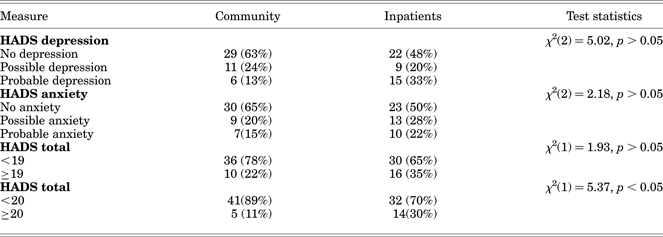
χ2 analyses showed significant differences for the HADS total cutoff of 20 (see Table 3), with the inpatient sample having a lower proportion of patients in the non-clinical range. No significant differences were observed for the depression or anxiety subscales, or for a HADS total cutoff of 19.
Comparisons between the number (proportion) of community patients and inpatients within each HADS category along with the test statistics

HADS, Hospital Anxiety and Depression Scale
Predictors of Psychological Symptoms
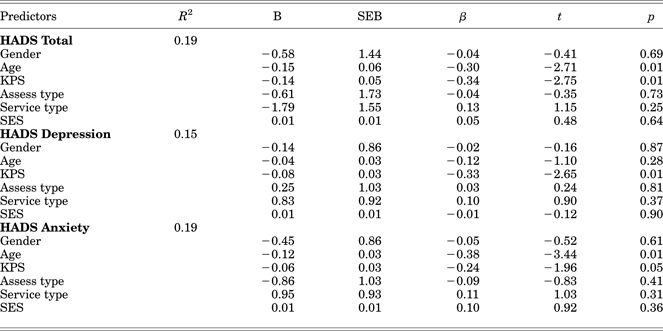
Multiple regression analysis was used to identify predictors of the HADS total and subscale scores in the whole sample (Table 4). Predictors included demographics (age, gender), functionality (KPS score), SES, assessment type (self vs. interviewer-assisted), and service type (community patients vs. inpatients). This model explained a significant proportion of variance in HADS total score, R 2 = 0.19, p < 0.01, with only age and KPS score remaining as significant independent predictors. Younger age and lower KPS scores were associated with higher HADS total scores. When this model was used to predict depression symptoms (R 2 = 0.15, p < 0.05), only KPS score was a unique predictor, with lower scores being associated with more depression. When the model was used to predict anxiety symptoms (R 2 = 0.19, p < 0.05) only age remained a significant predictor, such that younger age was associated with more anxiety. KPS score fell just short of significantly predicting anxiety (p = 0.053). Whereas other studies have shown that patients with some cancer subtypes such as lung cancer and pancreatic cancer may be more prone to psychological illness (Dugan et al., Reference Dugan, McDonald and Passik1998), the total number of patients in each group in this study was too small to carry out subgroup comparisons.
Multiple regression analyses predicting HADS total and subscale scores

HADS, Hospital Anxiety and Depression Scale; KPS, Karnofsky Performance Status Scale; SES, socioeconomic status.
DISCUSSION
Approximately 20% of all the palliative care patients in this study showed clinically meaningful anxiety and depression as measured on the HADS, regardless of the cutoff criteria. This prevalence rate is consistent with previous studies of palliative care patients with cancer (Hotopf et al Reference Hotopf, Chidgey and Addington-Hall2002; O'Connor et al., Reference O'Connor, White and Kristjanson2010) palliative care inpatients (Le Fevre et al., Reference Le Fevre, Devereux and Smith1999), and those with an expected survival of <6 months (Lloyd-Williams et al., Reference Lloyd-Williams, Friedman and Rudd2001). A previous study using the HADS showed 25% of cases were missed so it is possible that the prevalence rates reported here may underestimate the true degree of psychological distress (Le Fevre et al., Reference Le Fevre, Devereux and Smith1999). Although symptoms were measured at only one time, other studies have shown that late-stage palliative care patient scores on a depression scale remain largely stable (Lloyd-Williams & Riddleston, Reference Lloyd-Williams and Riddleston2002; Lloyd-Williams et al., Reference Lloyd-Williams, Shiels. and Taylor2009).
Inpatients and community patients did not significantly differ on severity of depression or anxiety symptoms when level of functioning and SES were controlled for. The groups did not differ in age or gender.
Community patients were higher functioning as measured by the KPS, suggesting that more active palliative patients were able to remain at home and be cared for (or care for themselves) for longer. The lower KPS scores for inpatients suggest that these patients had more advanced illness requiring inpatient care.
Community patients were determined to be of a higher SES, indicating that they may have had more economic resources and possibly more family support allowing them to be cared for at home. The lower SES of the inpatient groups suggests that patients may have been isolated, lived in supported or group housing, and lacked the economic or family support that would have allowed them to remain at home.
The results showed that palliative care patients who are younger are more likely to have symptoms of anxiety. In a study with non-palliative cancer patients, age was not a predictor for anxiety (Stark et al., Reference Stark, Kiely and Smith2002) so it is possible that anxiety increases more in younger patients when they are referred to a palliative care service and faced with the reality of a shortened life.
Lower functioning uniquely predicted depression scores in this study, and just fell short of significantly predicting anxiety. This suggests that patients who are more debilitated by their disease are more likely to experience depression (and probable) anxiety symptoms. This has been shown in other studies (Smith et al., Reference Smith, Gomm and Dickens2003; O'Mahony et al., Reference O'Mahony, Goulet and Kornblith2005).
LIMITATIONS
It has already been demonstrated that psychological distress in palliative care patients can vary according to their type of illness (Clarke et al., Reference Clarke, McLeod and Smith2005). In this study, the majority (93%) were cancer patients. Therefore, the conclusions about prevalence and treatment were limited to cancer, but because of the sample, size no conclusions could be drawn about differences among subtypes of cancer. This study did not look at possible other confounding factors such as marital status, past psychiatric treatment, and current medications.
CONCLUSIONS
Questions are still being raised regarding the possibility that psychological distress in palliative care patients is a predictable and understandable grief response to dying (Eychmueller, Reference Eychmueller2009). The results from this and other studies confirm that there is a significant number of patients who experience greater than normal psychological distress including sadness, anhedonia (the major construct of the HADS), and anxiety, and in this study the prevalence rates indicated that both inpatients and community patients are vulnerable to psychological distress.
For a number of years, there has been a call for greater attention to be paid to the psychological needs of dying patients (Block, Reference Block2000; Robinson, Reference Robinson2005). A recent review demonstrated that good outcomes can be achieved from psychotherapy and medication for palliative care patients identified as being depressed (Lorenz et al., Reference Lorenz, Lynne and Dy2008). The routine use of the HADS for screening palliative care patients has long been recommended (Holtom & Barraclough, 2000) and would identify patients who need further assessment. In particular, younger patients and less functional patients have been shown in this and other studies to be more vulnerable. With this in mind, to assist in alleviating psychological distress, appropriate and equal staff resources should be directed to palliative care inpatients and those being treated at home.
ACKNOWLEDGEMENTS
This research was supported by a Cancer Institute NSW clinical trial research grant. The views expressed herein are those of the authors and are not necessarily those of the Cancer Institute NSW. The authors thank all the participants who took part in and supported this study: the patients, carers, Associate Professor Richard Chye, Director of Palliative Care Service, SESIAHS for his ongoing support, David Webb who developed the research database, and the staff at Sacred Palliative Care Service.