Introduction
In many psychiatric disorders, several substance disorders and in antisocial personality disorder, marital resemblance has been found, meaning that married partners are more similar on some phenotypic traits than would be expected by chance (Merikangas, Reference Merikangas1982). Findings for depressive and anxiety disorders, however, are not unequivocal. For anxiety disorder, some studies found no evidence of increased risk of anxiety disorder in spouses of patients with an anxiety disorder (Eagles et al. Reference Eagles, Walker, Blackwood, Beattie and Restall1987; Low et al. Reference Low, Cui and Merikangas2007), but several other studies found an increased risk (Tambs, Reference Tambs1991; Zimmermann-Tansella & Lattanzi, Reference Zimmermann-Tansella and Lattanzi1991; McLeod, Reference McLeod1995; Galbaud du Fort et al. Reference Galbaud du Fort, Bland, Newman and Boothroyd1998; Dubuis-Stadelmann et al. Reference Dubuis-Stadelmann, Fenton, Ferrero and Preisig2001), with spousal correlations varying between 0.1 and 0.3. Only one study mentioned data on marital resemblance for obsessive–compulsive disease (OCD). Mathews et al. (Reference Mathews, Nievergelt, Azzam, Garrido, Chavira, Wessel, Bagnarello, Reus and Schork2007) conducted a linkage study with OCD and found 19 mating pairs with known OCD status for both spouses. In two of these pairs (10%), both members had OCD or clinically significant OC symptoms, which may be an indication that assortative mating exists for OCD.
For depressive disorders, a review and a meta-analysis were conducted by Mathews & Reus (Reference Mathews and Reus2001). Twelve of 17 studies reported marital resemblance for depression. The results of the meta-analysis supported these findings and indicated that marital resemblance occurs in major depression, with odds ratios for the combined data of 2.38. One of the most extensive studies on spousal correlation for psychiatric disorders in a population-based sample was carried out by Maes et al. (Reference Maes, Neale, Kendler, Hewitt, Silberg, Foley, Meyer, Rutter, Simonoff, Pickles and Eaves1998). Several psychiatric diagnoses were examined, including generalized anxiety disorder, major depressive disorder, panic disorder and phobias. A small degree of assortment with correlations between 0.1 and 0.2 was seen within and across psychiatric diagnoses.
Marital resemblance is probably due to a multifactorial process, including phenotypic assortment, social homogamy and marital interaction (Reynolds et al. Reference Reynolds, Barlow and Pedersen2006). Phenotypic assortment means that partner selection is based directly on the partner's phenotype; there is a preference for a phenotype like one's own, resulting in marital resemblance. A variant of the latter, called secondary phenotypic assortment, encompasses partner selection that occurs on the basis of variables that correlate with the phenotype under study, such as demographic variables or personality characteristics. As in several other studies (Galbaud du Fort et al. Reference Galbaud du Fort, Bland, Newman and Boothroyd1998; Dubuis-Stadelmann et al. Reference Dubuis-Stadelmann, Fenton, Ferrero and Preisig2001), Maes et al. (Reference Maes, Neale, Kendler, Hewitt, Silberg, Foley, Meyer, Rutter, Simonoff, Pickles and Eaves1998) found that only a small amount of the observed marital resemblance for mental illness could be explained by assortment of correlated variables, such as age, religious attendance and education.
Social homogamy refers to the tendency for individuals to have partners with similar social background. Whereas phenotypic assortment refers to the selection of a partner based on the observed phenotype, which may or may not be influenced by genetic factors, social homogamy refers to assortment based on social background (Heath & Eaves, Reference Heath and Eaves1985; Reynolds et al. Reference Reynolds, Barlow and Pedersen2006). Under social homogamy, partner selection takes place within social strata, which are correlated with the phenotype under study. An example of social homogamy was found recently by Reynolds et al. (Reference Reynolds, Barlow and Pedersen2006) for tobacco use, indicating that someone may be socially associated with those among whom tobacco use is common or uncommon due to, for example, social contacts through their family or network of friends.
Marital interaction or shared influences after marriage refers to a process of mutual influences between spouses living together (Penrose, Reference Penrose1944). In addition to the process of initial assortment, spouses may become more similar the longer they are married because of mutual influence between spouses or by sharing the same pathological factors. Contagion is a special case of marital interaction, where illness of one partner is a direct consequence of the breakdown of the other (Maes et al. Reference Maes, Neale, Kendler, Hewitt, Silberg, Foley, Meyer, Rutter, Simonoff, Pickles and Eaves1998).
For twin and family studies examining psychiatric disorders or traits, it is important to know if marital resemblance exists. Non-random mating due to phenotypic assortment will lead to an increase in genetic variance in the offspring generation and to an increase in resemblance among siblings between parents and offspring (Fisher, Reference Fisher1918; Wright, Reference Wright1921; Crow & Felsenstein, Reference Crow and Felsenstein1968), whereas social homogamy and marital interaction do not lead to increased genetic resemblance (Falconer & Mackay, Reference Falconer and Mackay1996).
In the present study we aimed to examine the existence of marital resemblance for OC, anxious and depressive symptoms within a population-based sample of twins, their partners and their parents. Because we included the partners of the twins (Heath & Eaves, Reference Heath and Eaves1985; Reynolds et al. Reference Reynolds, Baker and Pedersen2000), the present study is the first one that may, given sufficiently high correlations, disentangle the causes of spouse similarity in OC, anxious and depressive symptoms. Furthermore, because data from two generations are included (from twins and partners plus parents of twins), data from couples with different lengths of time spent together are available. This allows for the examination of the correlation between length of marriage and similarity in psychiatric symptoms, that is marital interaction. We addressed the following questions:
1. Is there a significant association within and across OC, anxious and depressive symptoms between husbands and wives?
2. Can marital resemblance be explained by phenotypic assortment, social homogamy or both?
3. Is marital resemblance influenced by marital interaction?
4. Does mate selection occur primarily within or across OC, anxious and/or depressive symptoms?
Method
Participants
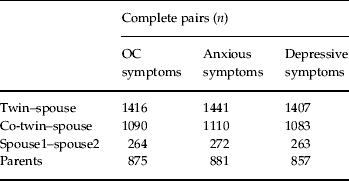
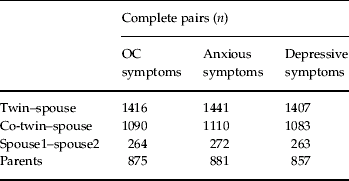
This study is part of an ongoing longitudinal survey study of the Netherlands Twin Register (NTR), which has assessed families with adolescent and adult twins approximately every 2 years since 1991. Each survey, with the exception of the 1995 wave, collected information on personality and psychopathology. Sample selection and response rates are described in detail in Boomsma et al. (Reference Boomsma, Vink, van Beijsterveldt, de Geus, Beem, Mulder, Derks, Riese, Willemsen, Bartels, van den Berg, Kupper, Polderman, Posthuma, Rietveld, Stubbe, Knol, Stroet and van Baal2002, Reference Boomsma, de Geus, Vink, Stubbe, Distel, Hottenga, Posthuma, van Beijsterveldt, Hudziak, Bartels and Willemsen2006). For this study, data from twins, their partners and parents of twins from the 2002 survey were used. We received complete surveys for OC, anxious and depressive symptoms of respectively 4406, 4382 and 4414 twins, 1442, 1439 and 1464 partners of twins, and 2189, 2167 and 2200 parents of twins. Table 1 shows the numbers of complete spouse pairs, that is pairs of which both members filled in a complete survey for the different phenotypes. The mean ages of the subjects at the time of the survey were 32.8 years (s.d.=11.3) for twins, 36.0 years (s.d.=12.0) for their partners and 56.3 years (s.d.=5.9) for the parents of the twins.
Number of complete pairs per relationship for questionnaires on obsessive–compulsive (OC), anxious and depressive symptoms
Measures
OC symptoms were measured by 12 items of the Padua Inventory (Sanavio, Reference Sanavio1988), translated into Dutch, revised and validated by Van Oppen et al. (Reference Van Oppen, Hoekstra and Emmelkamp1995). Items were chosen from each OC subscale of the Padua Inventory Revised. The sensitivity and specificity for the 12 items to detect OCD were 0.74 and 0.72 respectively, when comparing a group of OCD patients with clinical controls (Cath et al. Reference Cath, van Grootheest, Willemsen, Van Oppen and Boomsma2008). The positive and negative predictive values (PPV and NPV) were 53.1% and 86.7% respectively. Cronbach's α of the scale in the current study sample was 0.79. Depression was assessed with the subscale anxious-depressed of the Young Adult Self Report (YASR; Achenbach, Reference Achenbach1997). Good reliability and validity for the anxious-depressed subscale of the American YASR have been reported by Achenbach (Reference Achenbach1997) with a Cronbach's α of 0.91 and a test–retest validity of 0.89, and were supported for the Dutch version (Wiznitzer et al. Reference Wiznitzer, Verhulst, van den Brink, Koeter, van der Ende, Giel and Koot1992; Ferdinand et al. Reference Ferdinand, Verhulst and Wiznitzer1995). Reliability of the scale in the current study sample was 0.86. Anxiety was measured with the Dutch translation of the Spielberger State Trait Anxiety Inventory – trait version (STAI) (Spielberger, Reference Spielberger1983; van der Ploeg, Reference van der Ploeg2000) and showed test–retest reliabilities ranging from 0.73 to 0.92. Cronbach's α of the STAI in the current sample is 0.92. The STAI measures general anxiety and is strongly associated with several DSM-IV anxiety disorders, particularly generalized anxiety disorder (Middeldorp et al. Reference Middeldorp, Cath, van den Berg, Beem, Van Dyck, Boomsma and Canli2006).
Analyses
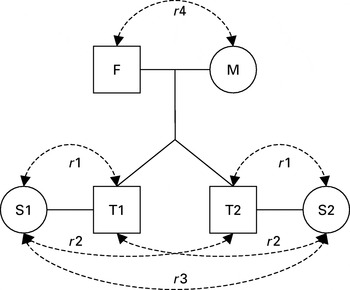
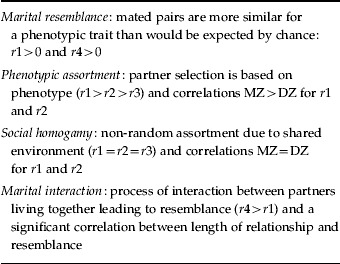
Familial correlations were obtained by maximum-likelihood estimation in Mx (Neale et al. Reference Neale, Boker, Xie and Maes2003). Figure 1 shows the different familial correlations: twin–spouse correlations (r twin–spouse), co-twin–spouse correlations (r co-twin–spouse), spouse1–spouse2 correlations (r spouse1–spouse2) and parent–parent correlations (r parents). The pattern of correlations provides the key information for resolving assortment mechanisms (Table 2). If phenotypic assortment is the exclusive assortment process, the expected pattern of correlations would conform to the following pattern: r twin–spouse>r co-twin–spouse>r spouse1–spouse2 (Reynolds et al. Reference Reynolds, Barlow and Pedersen2006). Furthermore, the magnitudes of r co-twin–spouse and r spouse1–spouse2 would be higher in monozygotic (MZ) kinships than in dizygotic (DZ) kinships if heritable influences were present. If social homogamy is the exclusive assortment process, then r twin–spouse, r co-twin–spouse and r spouse1–spouse2 would all be similar to one another and across zygosity, assuming perfect selection for social background environmental variance and equal magnitudes of social background influences in women and men. If there is imperfect selection, and the magnitude of social background influences for men and women differs, spousal correlation would then be similar to correlations under phenotypic assortment. We would then expect r twin–spouse=r co-twin–spouse>r spouse1–spouse2 (Reynolds et al. Reference Reynolds, Barlow and Pedersen2006). Under social homogamy no MZ–DZ differences in the magnitude of r co-twin–spouse and r spouse1–spouse2 are expected. Thus, when both genetic and shared environmental factors play a role, phenotypic assortment can only be distinguished from social homogamy by the differences in MZ and DZ families for r co-twin–spouse and r spouse1–spouse2 and that r twin–spouse>r co-twin–spouse.
Schematic representation of a family including the correlations. T, twin; S, spouse; F, father; M, mother; r1, twin–spouse correlation; r2, co-twin–spouse correlation; r3, spouse–spouse correlation; r4, parents correlation.

Definitions with expectations of the patterns of correlations

r1, Twin–spouse correlation; r2, co-twin–spouse correlation; r3, spouse–spouse correlation; r4, parents correlation; MZ, monozygotic; DZ, dizygotic.
If marital resemblance is due to marital interaction, we expect r parents to be larger than r twin–spouse, as spouses in the parental generation are in general married longer than spouses in the offspring generation. We calculated correlations between length of relationship and marital resemblance, for twin–spouse pairs and parents in one analysis and within the two generations (i.e. separate analyses for twin–spouse pairs and parents). For this purpose, marital resemblance was defined by the absolute difference in scores on the phenotypes for two partners, closer to zero indicating a larger resemblance. Length of relationship was defined by the length of the present relationship in years.
To study whether marital resemblance occurs primarily within or across OC, anxious and/or depressive symptoms, we examined assortment between OC, anxious and depressive symptoms at once, using the conditional path method (Carey, Reference Carey1986). For this method, the observed matrix of spousal correlations is decomposed into (1) the matrix of correlations within husbands (Rh); (2) the matrix of correlations within wives (Rw); and (3) the matrix of correlations between the disorders of husbands and the disorders of wives (D) (Phillips et al. Reference Phillips, Fulker, Carey and Nagoshi1988; Maes et al. Reference Maes, Neale, Kendler, Hewitt, Silberg, Foley, Meyer, Rutter, Simonoff, Pickles and Eaves1998). The latter matrix is modeled by a conditional path matrix of latent direct assortment effects. As an example, we specify this model in matrix notation as follows (for two traits):
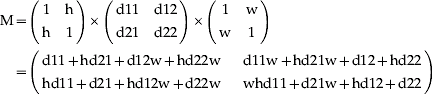
The first matrix contains the correlation between traits in husbands, the third matrix the correlation between traits in their wives. The matrix D can be thought of as the direct assortment effects of the correlations between husbands and wives after the correlations due to assortment for other, correlated variables has been partialed out (Maes et al. Reference Maes, Neale, Kendler, Hewitt, Silberg, Foley, Meyer, Rutter, Simonoff, Pickles and Eaves1998). The diagonal of the resulting matrix M has the within-trait correlations on the diagonal. As can be seen, these are a function of the direct assortment for the first trait (d11), plus assortment for the second trait and assortment across traits, if there is association between traits in husbands and/or wives. We estimated the D matrix and tested whether within and/or across variables were significantly different from zero by comparing the increase in χ2 to the increase in degrees of freedom for the different models. For all analyses the statistical package Mx was used to estimate and test the equality of the correlations (Neal et al. Reference Neale, Boker, Xie and Maes2003).
Results
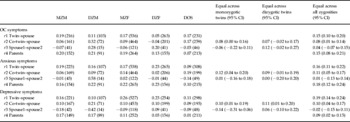
Table 3 shows twin–spouse, co-twin–spouse, spouse1–spouse2 and parental correlations for OC, anxious and depressive symptoms for all zygosity groups. We also present co-twin–spouse and spouse1–spouse2 correlations constrained to be equal for MZ twin and DZ twins, and all correlations constrained to be equal across all zygosity groups. The number of complete twin pairs per relationship is shown in parentheses.
Familial correlations per relationship by zygosity for obsessive-compulsive (OC), anxious and depressive symptoms. The numbers of complete twin pairs per relationship are presented in parentheses

r1, Twin–spouse correlation; r2, co-twin–spouse correlation; r3, spouse–spouse correlation; r4, parents correlation; MZM, monozygotic male; DZM, dizygotic male; MZF, monozygotic female; DZF, dizygotic female; DOS, dizygotic opposite-sex twin pairs; CI, confidence interval.
For OC symptoms, co-twin–spouse and spouse1–spouse2 correlations of MZ families and DZ families show some variety of values across different types of twin pairs, especially when the number of twin pairs is lower (e.g. spouse1–spouse2). Correlations could not be distinguished from each other, making it impossible to discriminate between phenotypic assortment and social homogamy. For all four types of pairings correlations could be constrained to be equal across the five zygosity groups. Spouse similarity is small (r=0.16), but significantly [χ2(1)=32.0, p<0.001] greater than zero. Similarity drops among other pairings, that is r twin–spouse>r co-twin–spouse>r spouse1–spouse2. Such a pattern among the in-laws suggests phenotypic assortment, but confidence intervals overlap around correlations. Thus, correlations do not significantly differ from each other and social homogamy cannot be ruled out. The spouse similarity in parents is 0.15. This is not significantly different [χ2(1)=0.212, p=0.65] from the correlation in the younger generation, which suggests an absence of marital interaction. This is confirmed by the fact that no significant correlation was found across generations (r=−0.02) and within generations (twin–spouse: r=−0.04, parents: r=0.05) between duration of relationship and marital resemblance of OC symptoms.
For anxious symptoms, we find a similar pattern as for OC symptoms. The twin–spouse correlation is 0.16. No MZ and DZ differences are found for co-twin–spouse and spouse1–spouse2 correlations. Although a pattern of r twin–spouse>r co-twin–spouse>r spouse1–spouse2 is seen, confidence intervals overlap for the correlations for the different pairings. r parents almost equals r twin–spouse and no significant correlation between length of relationship and marital resemblance of anxiety was seen across generations (r=−0.01) and within generations (twin–spouse: r=−0.03, parents: r=−0.02).
For depressive symptoms, a twin–spouse correlation of 0.19 was found. MZ families show correlations similar to those of DZ families for co-twin–spouse and spouse1–spouse2 correlations. A pattern of r twin–spouse>r co-twin–spouse>r spouse1–spouse2 is seen, but again there is overlap in the confidence intervals. r parents is significantly lower [χ2(1)=8.79, p<0.01] than r twin–spouse, which would suggest that the longer the relationship, the lower the similarity between partners for depression. However, no significant correlation between duration of the relationship and marital resemblance of depression was found across generations (r=0.01) or within generations (twin–spouse: r=−0.04, parents: r=0.03).
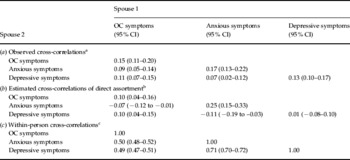
Significant spousal correlations across OC, anxious and depressive symptoms were found for both twin–spouses and parents in the range 0.07–0.11 (Table 4a). The across-symptoms assortment correlations were lower than the within-symptoms assortment correlations. Like the within-symptoms assortment correlations, a pattern of r twin–spouse>r co-twin–spouse>r spouse1–spouse2 is also seen for the across-symptoms correlations with overlapping confidence intervals (data not shown). No differences in correlations were seen for twin–spouses or parents. These results indicate that both within- and cross-assortment processes play a role.
Observed cross-correlations, estimated cross-correlations of direct assortment and within-person cross-correlations for obsessive–compulsive (OC), anxious and depressive symptoms

CI, confidence interval.
a Data for twin-spouses and parents have been pooled.
b Data for twin-spouses and parents have been pooled (D matrix).
c Data for twin-spouses and parents have been pooled, correlations of husband and wives have been constrained to be equal (H or W matrix).
To further explore this hypothesis, all traits were studied at once using the conditional path method. Because the correlations of the twin–spouse sample were not different from those of the parents [χ2(6)=6.47, p=0.37], the results of the joint analysis of the two samples are presented. We tested whether sex differences existed in cross-assortment by testing for the symmetry of matrix D. This test yielded a non-significant result [χ2(6)=6.14, p=0.41], implying that sex is not a factor in the pattern of assortment for these traits. Subsequently, we examined whether the cross-assortment parameters could be constrained at zero without a significant loss of fit, but this was not the case [χ2(3)=19.3, p<0.01]. We then fixed the within-trait assortment correlations to zero, allowing for cross-trait assortment, but this resulted in an even larger increase in χ2 [χ2(3)=39.2, p<0.01]. This multivariate analysis suggests that both within- and cross-assortment for OC, anxious and depressive symptoms exist. Table 4b shows the estimates of the D matrix. As the cross-correlations within a person (Table 4c) are fairly high, we expect the D matrix estimates, which are controlled for cross-correlations within a person, to be different from the observed matrix (Table 4a). This effect can especially be seen in the cross-assortment correlations (off-diagonal). Both cross-correlations with anxious symptoms are negative in the D matrix, the opposite of the observed correlations in Table 4a. The OC depressive symptoms correlation is comparable with the observed correlations. It appears that, after controlling for cross-correlations within a person, partners with anxious symptoms avoid partners with depressive or OC symptoms.
Discussion
This study examined the existence and possible cause of marital resemblance for OC, anxious and depressive symptoms. Several importing findings emerged that are relevant for both future research and clinical practice. First, small but significant within- and cross-marital resemblance exists for OC, anxious and depressive symptoms. Second, as correlations are small, it is difficult to distinguish between social homogamy and phenotypic assortment as the main cause of marital resemblance for OC, anxious and depressive symptoms. Third, no evidence was found for marital interaction. Fourth, both within- and cross-assortment play a role in marital resemblance.
This is the first study to examine marital resemblance for OC symptoms. The degree of correlations between partners for OC symptoms resembles those for depression and anxiety. Our findings for depression support the results of the meta-analysis of Mathews & Reus (Reference Mathews and Reus2001), who found little, but significant, marital resemblance for affective disorders. The finding of marital resemblance for anxiety symptoms in this study confirms various earlier reports in both clinical and population-based studies (Tambs, Reference Tambs1991; Zimmermann-Tansella & Lattanzi, Reference Zimmermann-Tansella and Lattanzi1991; McLeod, Reference McLeod1995; Galbaud du Fort et al. Reference Galbaud du Fort, Bland, Newman and Boothroyd1998; Maes et al. Reference Maes, Neale, Kendler, Hewitt, Silberg, Foley, Meyer, Rutter, Simonoff, Pickles and Eaves1998; Dubuis-Stadelmann et al. Reference Dubuis-Stadelmann, Fenton, Ferrero and Preisig2001), reporting correlations between 0.1 and 0.3 using either diagnostic or dimensional ratings of anxiety. Two studies did not find marital resemblance for anxiety disorders. Eagles et al. (Reference Eagles, Walker, Blackwood, Beattie and Restall1987) assessed anxiety in a population-based sample of elderly couples aged over 65. They found a small, but significant, correlation of 0.07. Recently, Low et al. (Reference Low, Cui and Merikangas2007) did not find spousal concordance for DSM-III anxiety disorders in a mixed patient/community sample (71.3%/29.7%). The latter study is the only study on anxiety disorders that also included patients, whereas all other studies were based on community samples to overcome the problem of selection bias. This selection bias usually causes an over-representation of affected couples in clinical samples (Galbaud du Fort et al. Reference Galbaud du Fort, Bland, Newman and Boothroyd1998).
Besides clear significant assortment within traits, evidence for cross-assortment was also found. The cross-assortment correlations were somewhat smaller than the within-assortment correlations. This could suggest that within-assortment occurs primarily within the various anxious-depressive traits, but by comparing models it appeared that cross-assortment played a significant role as well, confirming the results of Maes et al. (Reference Maes, Neale, Kendler, Hewitt, Silberg, Foley, Meyer, Rutter, Simonoff, Pickles and Eaves1998). The results from direct assortment estimations, which have been controlled for co-morbity, indicate that anxious partners tend to choose anxious partners, but avoid partners with OC behavior or depressive behavior. As this is the first study to report on these assortment estimations, replication of these latter results is needed.
The present study attempted to test whether social homogamy or phenotypic assortment is the underlying factor in resemblance of psychiatric diseases, as we had information on the spouses of identical and fraternal twins. We found roughly the same pattern of correlations for OC, anxious and depressive symptoms. As the correlations are small, with confidence intervals overlapping, we were unable to distinguish between social homogamy and phenotypic assortment processes. With such small correlations, very large numbers of twins and spouses are needed to be able to distinguish between different mechanisms. However, it is also possible that both mechanisms play a role; if this is the case, the observed correlations are simply too small to have reasonable power to distinguish and estimate the magnitude of these different sources.
Nevertheless, there is reason to suspect that phenotypic assortment is a more probable mechanism because shared environmental effects hardly seem to play a role in the occurrence of OC symptoms and OCD (van Grootheest et al. Reference van Grootheest, Cath, Beekman and Boomsma2005), depression (Sullivan et al. Reference Sullivan, Neale and Kendler2000) or anxiety disorders (Hettema et al. Reference Hettema, Neale and Kendler2001). The three existing adult studies on OC symptoms did not find shared environmental factors to be important (Clifford et al. Reference Clifford, Murray and Fulker1984; Jonnal et al. Reference Jonnal, Gardner, Prescott and Kendler2000; van Grootheest et al. Reference van Grootheest, Bartels, Cath, Beekman, Hudziak and Boomsma2007). For depression, no evidence for shared environmental factors was found in a meta-analysis by Sullivan et al. (Reference Sullivan, Neale and Kendler2000). For anxiety disorders, only generalized anxiety disorder showed an uncertain but small role for shared environmental factors. For other anxiety disorders, no role for shared environmental factors was found (Hettema et al. Reference Hettema, Neale and Kendler2001).
We did not find evidence for marital interaction as a cause of husband–wife similarities in any of the phenotypes. Only for depression did we find a difference between the twin–spouse and parents correlations, but this did not seem to be explained by duration of marriage. Although longitudinal data would give the best resolution for examining marital interaction, we expect that marital interaction is not the main source of marital resemblance.
Implications
Our study has implications for both psychiatric twin research and clinical practice. To study genetic and environmental influences on psychiatric disorders, quantitative genetic models are usually fitted to twin data under the assumption that phenotypic assortment is absent. If phenotypic assortment does exist, a bias is seen depending on the model used: a small upward bias of the genetic variance in an AE model (Neale & Cardon, Reference Neale and Cardon1992), that is a model with additive genetic (A) and specific environmental (E) influences on psychiatric disorders, and a downward bias of the genetic variance in an ACE model, that is a model also including shared environmental influences (C). In an AE model the upward bias is small and, depending on the true heritability, amounts to 3% for a marital correlation of 0.2. The downward bias of an ACE model is more substantial. Using a formula to correct C for phenotypic assortment (Martin, Reference Martin and Nance1978), the bias for an ACE model with an estimation of 40% for the proportion of variance explained by A, 20% for C and 40% for E is about 10% for a marital correlation of 0.2. This would mean that, after correction, the proportion of variance explained by A would be 50% and C 10%. In the present study we found only little marital resemblance and even if phenotypic assortment would completely explain this resemblance, the bias in estimates reported in twin studies on psychiatric diagnoses is likely to be very small. Of note, if gene–(shared) environment correlation were present, social homogamy would have consequences for the genetic structure in a population, but as the correlations are small and shared environment does not seem to play a role in the phenotypes of the current research, we expect this not to be a problem.
The spouse correlations we found were not zero, which means that in some couples both partners similarly have anxious, depressed or OC symptoms. It is therefore important to encourage a partner to come along with the patient, not only to have better information on the situation of the patient or to discuss the role of the partner in a treatment plan but also to examine whether there are psychiatric symptoms present in the partner (Low et al. Reference Low, Cui and Merikangas2007).
Limitations
The results of this study should be interpreted in the light of three possible limitations. First, for estimating marital resemblance we use information on partners who were still together. In general, the rate of divorce in subjects without an interviewed partner is higher. Furthermore, psychiatric pathology in divorced pairs is increased (Maes et al. Reference Maes, Neale, Kendler, Hewitt, Silberg, Foley, Meyer, Rutter, Simonoff, Pickles and Eaves1998; Wade & Cairney, Reference Wade and Cairney2000), which gives a bias in the estimation of marital resemblance. In our sample, we found that participants who were divorced at least a year before participation, and had not met a new partner, showed significantly higher rates of depressive (F=98.7, p<0.001) and anxious symptoms (F=89.1, p<0.001) but not of OC symptoms (F=3.6, p=0.06), compared with pairs who were still together.
Second, in the current study symptoms were measured cross-sectionally. Ideally, to study marital resemblance, partners should be followed longitudinally, preferably starting soon after meeting their partner.
Third, although the measurements we used are well-known questionnaires showing satisfying psychometric properties, some limitations regarding these measurements should be mentioned. First, we measured symptoms, not DSM diagnoses. This hampers the usefulness of the current study in clinical practice and in comparability with studies based on DSM diagnosis. Nevertheless, findings from the current study are remarkably similar to those in the study of Maes et al. (Reference Maes, Neale, Kendler, Hewitt, Silberg, Foley, Meyer, Rutter, Simonoff, Pickles and Eaves1998), who used DSM-III-R diagnoses. Second, distributions of the measurements used were skewed, which may cause underestimation of correlations. Derks et al. (Reference Derks, Dolan and Boomsma2004) showed that using a threshold model and estimating polychoric correlations could be a solution, but this has the disadvantage of losing power. We therefore chose to use the raw data. Third, the reliability for cross-sectional assessments of symptoms at one point in time is only moderate. Fourth, high intercorrelations were found for the traits examined, ranging from 0.49 to 0.71. Although OC, anxious and depressive traits show high co-morbidity, the question remains of whether intercorrelations are caused by co-morbidity or by overlapping instruments. Of note, Maes et al. (Reference Maes, Neale, Kendler, Hewitt, Silberg, Foley, Meyer, Rutter, Simonoff, Pickles and Eaves1998) found similar intercorrelations ranging from 0.58 to 0.71 for comparable DSM diagnoses such as major depression and generalized anxiety disorder. This might suggest that co-morbidity could be an important cause of the high intercorrelations we found.
Acknowledgements
We are grateful to the twins, their partners and their parents for taking part in this study. This research was supported by ZonMw (grant 920-03-268) and NWO (grant 400-03-330). The data collection was supported by ‘Genetic basis of anxiety and depression’ (NWO grant 904-61-090); ‘Database Twin register’ (NWO grant 575-25-006); ‘Spinozapremie’ (NWO/SPI 56-464-14192); the Center for Neurogenetics and Cognition Research (CNCR); Center for Medical Systems Biology: Multifactorial Diseases: Common Determinants, Unifying Technologies (NWO Genomics); ‘Twin-family database for behavior genetics and genomics studies’ (NWO grant 480-04-004).
Declaration of Interest
None.