Introduction
The first Canadian detection of Drosophila suzukii (Matsumura) (Diptera: Drosophilidae) was in 2009 in British Columbia, Canada, and in adjacent regions of Oregon State and Washington State, United States of America, within a major fruit-growing region of North America (Walsh et al. Reference Walsh, Bolda, Goodhue, Dreves, Lee and Bruck2011; Thistlewood et al. Reference Thistlewood, Shearer, Steenwyk, Walton and Acheampong2012). It caused serious damage in several crops, notably sweet cherries, Prunus avium (Linnaeus) Linnaeus (Rosaceae), increased pesticide use throughout the region (Beers et al. Reference Beers, Van Steenwyk, Shearer, Coates and Grant2011; Thistlewood et al. Reference Thistlewood, Shearer, Steenwyk, Walton and Acheampong2012), and shortly afterwards was reported globally as an invasive pest of horticultural crops (Asplen et al. Reference Asplen, Anfora, Biondi, Choi, Chu and Daane2015; Haye et al. Reference Haye, Girod, Cuthbertson, Wang, Daane and Hoelmer2016). One response to its arrival was an extensive trapping study in the Okanagan–Columbia Basin within sites grouped into berry, cherry, stone fruit, grapes, non-crop, or non-host, categories (Thistlewood et al. Reference Thistlewood, Gill, Beers, Shearer, Walsh and Rozema2018). The latter provided a framework for exploratory studies of use of crop and non-crop plants in a novel environment, as reported here.
Few studies have reported on wild host plants as reproductive sites of D. suzukii in its original host range in Asia, where it was found primarily in fruits or rarely in flowers (Markow and O’Grady Reference Markow and O’Grady2008; Mitsui et al. Reference Mitsui, Beppu and Kimura2010), and was on occasion a fruit pest (Kanzawa Reference Kanzawa1939). However, it was reported from many drosophilid trap studies as a seasonal migrant across landscapes (e.g., Beppu Reference Beppu2006) or up and down mountains (Mitsui et al. Reference Mitsui, Beppu and Kimura2010). Recent landscape level trap studies of D. suzukii in newly invaded regions inferred a possible role for non-crop host plants of increasing fly populations during seasonal migrations, or conserving them in unfavourable periods, in western (Harris et al. Reference Harris, Hamby, Wilson and Zalom2014; Caprile et al. Reference Caprile, Grant, Hamby, Haviland and Rill2016; Wang et al. Reference Wang, Stewart, Biondi, Chavez, Ingels and Caprile2016; Thistlewood et al. Reference Thistlewood, Gill, Beers, Shearer, Walsh and Rozema2018) and eastern North America (Diepenbrock et al. Reference Diepenbrock, Swoboda-Bhattarai and Burrack2016), and Europe (Arnó et al. Reference Arnó, Solà, Riudavets and Gabarra2016; Tonina et al. Reference Tonina, Mori, Giomi and Battisti2016). Typically, in the autumn post-harvest months, few D. suzukii were trapped except in non-crop or woody areas (Caprile et al. Reference Caprile, Grant, Hamby, Haviland and Rill2016; Rossi-Stacconi et al. Reference Rossi-Stacconi, Kaur, Mazzoni, Ometto, Grassi and Gottardello2016) or in backyards, feral and non-crop sites (Thistlewood et al. Reference Thistlewood, Gill, Beers, Shearer, Walsh and Rozema2018). The timing of appearance of D. suzukii in any year has been related to the proportion of woodland habitat surrounding cultivated fields in winter (Pelton et al. Reference Pelton, Gratton, Isaacs, Van Timmeren, Blanton and Guédot2016), and to the population density of D. suzukii in sites the previous autumn (Thistlewood et al. Reference Thistlewood, Gill, Beers, Shearer, Walsh and Rozema2018). Such trap studies suggest that non-crop hosts may be very important for D. suzukii, as refugia, for their seasonal biology, persistence and invasion success, and can affect nearby cultivated plantings (Klick et al. Reference Klick, Yang, Walton, Dalton, Hagler and Dreves2016), but definitive studies of plant use are few.
Knowledge of the sites of reproduction and of host range of Drosophila Fallén species was long recognised as important for understanding the ecology of the flies. In the 1940s, very little information was available on where “wild” drosophilids reproduced in North America, and reliance upon trap studies was deemed to be insufficient without determining the sites where they reproduced (Carson and Stalker Reference Carson and Stalker1951). Similarly, knowledge of the non-crop plant hosts of D. suzukii in newly invaded regions was identified as a key research direction (Asplen et al. Reference Asplen, Anfora, Biondi, Choi, Chu and Daane2015), particularly when considering area-wide or other management strategies beyond a crop perimeter (Lee et al. Reference Lee, Dreves, Cave, Kawai, Isaacs and Miller2015a, Reference Lee, Dreves, Isaacs, Loeb, Thistlewood and Brewer2015b). Within the Okanagan Basin, area-wide insect management programmes have existed since 1992 and have legal powers to enforce management of host plants on public and private lands. If trap counts reflect host plant use, then the abundance and proximity of non-crop plants will be important in managing D. suzukii. Knowledge of the use of hosts by D. suzukii will aid in realistic consideration or dismissal of management strategies such as vegetation reduction or “sanitation”, extra-crop or peripheral treatment (Iglesias and Liburd Reference Iglesias and Liburd2017; Klick et al. Reference Klick, Yang, Walton, Dalton, Hagler and Dreves2016), mass-trapping or sterile insect technique, proposed by some authors (e.g., Cini et al. Reference Cini, Ioriatti and Anfora2012; Haye et al. Reference Haye, Girod, Cuthbertson, Wang, Daane and Hoelmer2016).
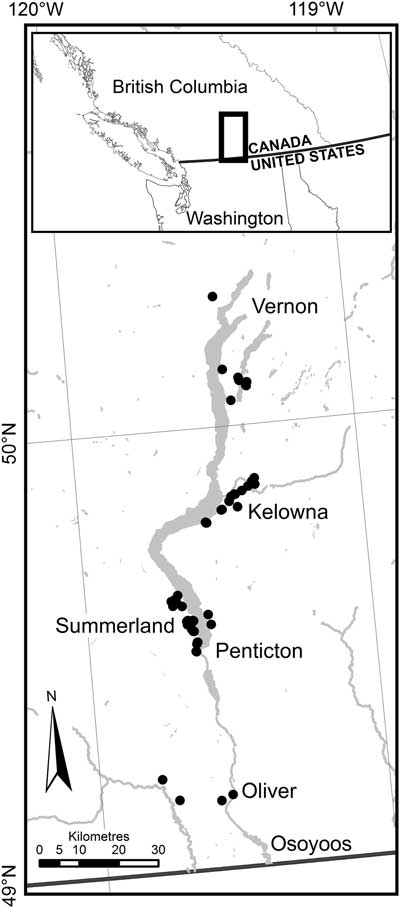
Recent studies have addressed the importance of non-crop plants in the ecology of D. suzukii (Addesso et al. Reference Addesso, Oliver and O’Neal2015; Lee et al. Reference Lee, Dreves, Cave, Kawai, Isaacs and Miller2015a, Reference Lee, Dreves, Isaacs, Loeb, Thistlewood and Brewer2015b; Poyet et al. Reference Poyet, Le Roux, Gibert, Meirland, Prévost, Eslin and Chabrerie2015; Arnó et al. Reference Arnó, Solà, Riudavets and Gabarra2016; Diepenbrock et al. Reference Diepenbrock, Swoboda-Bhattarai and Burrack2016; Kenis et al. Reference Kenis, Tonina, Eschen, van der Sluis, Sancassani and Mori2016; Klick et al. Reference Klick, Yang, Walton, Dalton, Hagler and Dreves2016; Little et al. Reference Little, Chapman, Moreau and Hillier2016). However, little information has been gathered as to the role of non-crop plants in semi-arid environments (Arnó et al. Reference Arnó, Solà, Riudavets and Gabarra2016; Wang et al. Reference Wang, Stewart, Biondi, Chavez, Ingels and Caprile2016) where resources can be relatively restricted in summer, or regions with cold winters, as in the Okanagan Basin, parts of Italy (Tonina et al. Reference Tonina, Mori, Giomi and Battisti2016), and the United States of America (Murray et al. Reference Murray, Aflitto, Shearer and Castagnoli2017). A wide range of temperate fruits are commercially grown in the Okanagan Basin (Fig. 1), within irrigated sites on benches and slopes at lower elevations in the rain shadow of coastal mountains. Irrigated crops are grown in narrow valleys within a landscape of semi-arid sagebrush steppe, and predominantly across two biogeoclimatic zones, characterised by vegetation, climate, geology, and topography, as Bunchgrass Zone or Ponderosa Pine Zone (Meidinger and Pojar Reference Meidinger and Pojar1991; Turner Reference Turner1997).
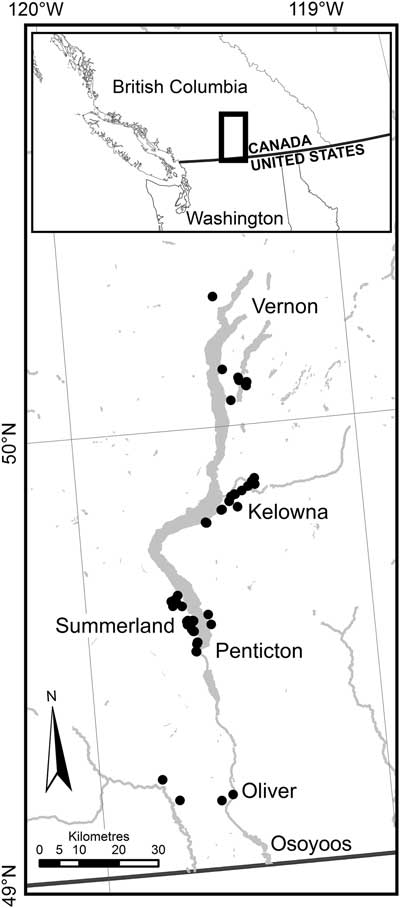
Map of sites from which non-crop fruiting plants were collected in the Okanagan Basin, British Columbia, 2010–2016, n=101. Inset: position within western Canada.
The objectives of our exploratory study were to determine if any non-crop plants were hosts of D. suzukii in the semi-arid landscape of the Okanagan Basin, to assess the relative frequency and timing of wild host use by this species, and to relate these to climate.
Materials and methods
Survey area and site selection
To reduce the number of false negatives, study sites were selected only where D. suzukii was present. Thistlewood et al. (Reference Thistlewood, Gill, Beers, Shearer, Walsh and Rozema2018) monitored 116–382 insect traps in the Okanagan Basin, 2010–2014, in defined habitat groups of cherry, stone fruits, berry, grape, non-crop host plant, non-host plant, and structures or gardens. We examined nearby (within 100 m of a trap catching D. suzukii) non-crop plants during May to December 2010–2014, at 18–57 of those sites per year, and at four to seven sites annually, 2015–2016. Plants were located within or at the periphery of cultivated orchards, vineyards, gardens, roadsides, or on hillsides; but not within 5 m of an insecticide-treated location, except at a small number of sites in 2010. In total, 101 sites were visited across an extent of 150 km (Fig. 1; between 49.154°N to 50.295°N, 119.367°W to 119.785°W), at elevations of 302–583 m, in the manner described below.
Host plant material collection and insect rearing
Host plants, including angiosperms with simple, aggregate, or multiple fruits, such as drupes, berries, and pomes (Simpson Reference Simpson2010), as well as gymnosperms with fleshy tissue surrounding the seed (all hereafter called “fruit”), were marked and identified using reference guides (Lyons and Merilees Reference Lyons and Merilees1996; Turner Reference Turner1997; Parish et al. Reference Parish, Coupe and Lloyd1999; Banerjee et al. Reference Banerjee, Creasey and Gertzen2001; Sept Reference Sept2005; Anonymous 2016; Klinkenberg Reference Klinkenberg2016). Plants were verified at the Royal British Columbia Museum (Victoria, British Columbia, Canada) or at the National Collection of Vascular Plants (Agriculture and Agri-Food Canada, Ottawa, Ontario, Canada), but identification to species level was not always possible.
Initial surveys began in 2010, when little was known of non-crop reproductive hosts of D. suzukii. Prior local experience (Maxwell et al. Reference Maxwell, Thistlewood and Keyghobadi2014) indicated that the widest variety of insects infested fruits when they expressed traits of ripeness, or over a long period in species with a continuous ripening habit, and that losses from wildlife predation or fruit drop increased when ripe. After 2010, we balanced number of fruit taken and collection number over three periods, or more as available: i.e., before ripening, when ripe, and after peak ripening, as estimated from the literature, professional collectors, and observations. The effort per species depended upon frequency of occurrence, rate of predation by birds and wildlife, growing conditions, and infestation likelihood from the literature. Collection effort was reduced across years when fruit of a host species was plentiful, or vice versa.
At each visit, 100 fruit (where available) were picked into rearing units (below), from all parts of a plant, if necessary with a ladder or pole, and any arthropods were removed. They were transferred to the laboratory and underwent a second check to remove external arthropods. Fruit collections occurred between 8 June and 23 November 2010–2016, with 143–473 per year in 2010–2012, and 23–43 annually thereafter. From 2013, we focussed on species difficult to find at optimal times, and to clarify oviposition timing if fruiting over long periods.
For rearing arthropods, we employed a method (Maxwell et al. Reference Maxwell, Thistlewood and Keyghobadi2014), derived from native plant collecting (Banerjee et al. Reference Banerjee, Creasey and Gertzen2001), proven to preserve plant quality and arthropods for a suitable period. Fruit were picked into tissue culture containers (125×65×80 mm, ECO2 Full-gas microbox; Combiness, Belgium), with vents cut in the lid and covered with organza fabric (Fabricland; Penticton, British Columbia, Canada), sealed with Parafilm (Pechiney Plastic Packaging; Wisconsin, United States of America) and placed in controlled environment chambers (Conviron; Winnipeg, Manitoba, Canada) at 24 °C, 16:8 light:dark hours and 44–68% relative humidity for three weeks, with an additional two weeks after emergence of any D. suzukii. Containers were checked twice weekly, and at completion, for any stages of emerged D. suzukii and any predatory arthropods (3–5% of collections) were removed immediately. A few collections that developed fungal or bacterial rots are not discussed. The results of 929 collections, for a total of 94570 fruits, were processed in containers of three to 500 fruit (x=101.7±1.6) per site visit. The mean rearing time was 29.2±0.4 days, or up to 83 days to ensure the emergence of parasitoids (Thistlewood et al. Reference Thistlewood, Gibson, Gillespie and Fitzpatrick2013). In 2010 only, subsets of 1/3 of collected fruit were placed into clear plastic bags (12.7×17.8), at approximately 21 °C, 14:10 light:dark hours, and inspected three times weekly for two weeks.
Data analysis
Various measures of host plant use by D. suzukii have been reported, so we calculated by plant species: the frequency of D. suzukii in all collections (Lee et al. Reference Lee, Dreves, Cave, Kawai, Isaacs and Miller2015a; Arnó et al. Reference Arnó, Solà, Riudavets and Gabarra2016); or within an optimal period defined between first and last calendar dates of positive collections; number of emerged flies (adjusted to mean per 100 fruit) from infested collections only (Arnó et al. Reference Arnó, Solà, Riudavets and Gabarra2016); and geographic occurrence, or number of site-years where D. suzukii was present as a proportion of all site-years surveyed, with all collections within a year pooled by site (Kenis et al. Reference Kenis, Tonina, Eschen, van der Sluis, Sancassani and Mori2016).
To relate plant infestation to local climate, temperature, and precipitation records were accessed from stations operated by Environment and Climate Change Canada across the study region (Fig. 1), i.e., Penticton A (49°27'47.00''N, 119°36'08.00''W, 344.4 m), Summerland CS (49°33'45.20''N, 119°38'55.30''W, 454.2 m), Vernon Auto (50°13'23.90''N, 119°11'36.70''W, 344.4 m), and Osoyoos CS (49°01'41.85''N, 119°26'27.57''W, 282.9 m). We estimated the number of degree days accumulated at each station from 16 July to 12 October (Julian days 197–285) of 2010–2016, being the calendar period during which D. suzukii was present in fruit of non-crop host species. They were processed using a degree-day calculator (Anonymous 2017) with lower and upper thresholds of 5.98 °C and 31.5 °C (Gutierrez et al. Reference Gutierrez, Ponti and Dalton2016).
Results are given throughout as the sample mean and standard error of the mean, x±standard error. When presenting results by month or Julian week across all years, all sites were pooled within species. Analyses were conducted using SAS JMP Version 13.2 (SAS Institute; Cary, North Carolina, United States of America).
Results and discussion
In the following sections, our results are compared with plant species status (host or non-host) as determined by field survey or no-choice laboratory assay, in Japan (Kanzawa Reference Kanzawa1939; Mitsui et al. Reference Mitsui, Beppu and Kimura2010), North America (Lee et al. Reference Lee, Dreves, Cave, Kawai, Isaacs and Miller2015a, Reference Lee, Dreves, Isaacs, Loeb, Thistlewood and Brewer2015b; Little et al. Reference Little, Chapman, Moreau and Hillier2016); and Europe (Grassi et al. Reference Grassi, Giongo and Palmieri2011; Poyet et al. Reference Poyet, Le Roux, Gibert, Meirland, Prévost, Eslin and Chabrerie2015; Arnó et al. Reference Arnó, Solà, Riudavets and Gabarra2016; Kenis et al. Reference Kenis, Tonina, Eschen, van der Sluis, Sancassani and Mori2016; Tonina et al. Reference Tonina, Mori, Giomi and Battisti2016).
Plants from which D. suzukii emerged
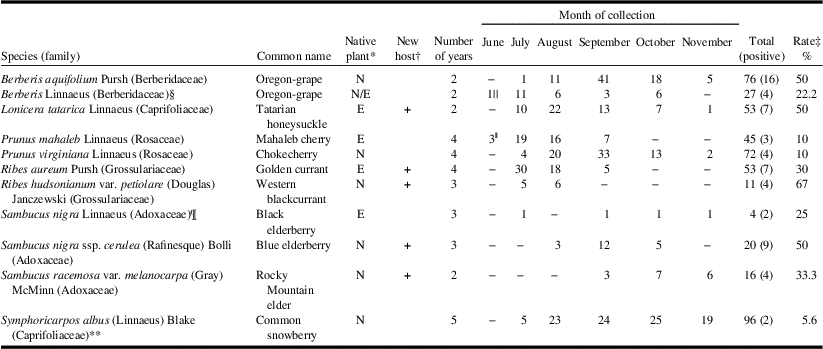
A total of 450 D. suzukii adults were reared out of 62 fruit collections and 9438 fruit, from 10 plant hosts within five families (Table 1). We report five fruiting plant species for the first time as hosts of D. suzukii (Table 1): Tatarian honeysuckle, Lonicera tatarica Linnaeus (Caprifoliaceae); golden currant, Ribes aureum Pursh (Grossulariaceae); western blackcurrant, Ribes hudsonianum var. petiolare (Douglas) Janczewski; blue elderberry, Sambucus nigra ssp. cerulea (Rafinesque) Bolli (Adoxaceae); and Rocky Mountain elder, Sambucus racemosa var. melanocarpa (Gray) McMinn. All are in genera that are important hosts of D. suzukii elsewhere: Sambucus Linnaeus, Lonicera Linnaeus, and Ribes Linnaeus. Sambucus species were important in several prior studies in Europe, as were at least eight Lonicera species, but only one of three Ribes species that were examined in the Okanagan Basin was a host elsewhere.
Common native and exotic fruiting plants from which Drosophila suzukii emerged during 2010–2016, with years and months collected, number of collections reared (number infested), and geographic rate of occurrence as per cent site-years infested.

* Native (N) native to region; exotic (E)=introduced or invasive; (N/E)=genus includes N and E.
† New host record (+) = not previously reported as a plant host of D. suzukii.
‡ Geographic rate of occurrence (site-years) by method of Kenis et al. (Reference Kenis, Tonina, Eschen, van der Sluis, Sancassani and Mori2016).
§ Majority of collections likely B. aquifolium, but Berberis repens, a creeping form, occurs rarely.
|| Unripe green fruit collected in May also.
¶ Three Sambucus species collections deemed to be S. nigra.
** Fifteen, Symphoricarpos Duhamel species collections were deemed to be S. albus.
Five species were confirmed as viable hosts in our region (Table 1), as found elsewhere: Oregon-grape (also known as hollyleaved barberry), Berberis aquifolium Pursh (Berberidaceae); Mahaleb cherry, Prunus mahaleb Linnaeus (Rosaceae); chokecherry, Prunus virginiana Linnaeus; black elderberry, S. nigra Linnaeus; and common snowberry, Symphoricarpos albus (Linnaeus) Blake (Caprifoliaceae). Some plants of Berberis Linnaeus (Table 1) were not identified to species but were likely B. aquifolium, rather than Berberis repens Lindley, a creeping form, uncommon in this region.
A further 85 collections (not shown, Table 1) were from infested sites of known hosts, as positive controls of rearing conditions: sweet cherry, P. avium; peach, Prunus persica (Linnaeus) Batsch; pear, Pyrus communis Linnaeus (Rosaceae); plum, Prunus Linnaeus (Rosaceae) species; table grapes, Vitis Linnaeus (Vitaceae) species; blackberry, Rubus Linnaeus (Rosaceae) species; blueberry, Vaccinium Linnaeus (Ericaceae) species; mulberry, Morus Linnaeus (Moraceae) species; raspberry, Rubus Linnaeus (Rosaceae) species; or tomato, Solanum lycopersicum Linnaeus (Solanaceae).
Plants from which D. suzukii did not emerge
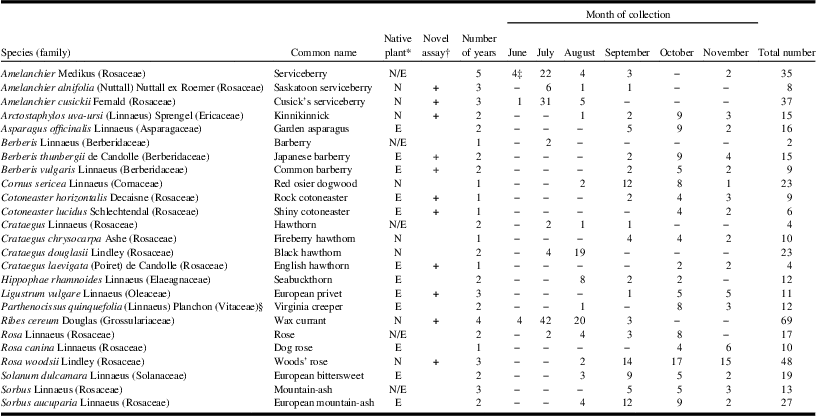
No evidence of D. suzukii was found in 25 plant species, within 10 families of berry-forming or fruiting plants (Table 2). In total, 42 650 fruit did not yield any flies in one to four years of survey per species and in 867 sets of collections. Results are presented for 11 species assayed for the first time: Saskatoon serviceberry, Amelanchier alnifolia (Nuttall) Nuttall ex Roemer; Cusick’s serviceberry, Amelanchier cusickii Fernald; kinnikinnick, Arctostaphylos uva-ursi (Linnaeus) Sprengel (Ericaceae); Japanese barberry, Berberis thunbergii de Candolle; common barberry, Berberis vulgaris Linnaeus; rock cotoneaster, Cotoneaster horizontalis Decaisne (Rosaceae); shiny cotoneaster, Cotoneaster lucidus Schlechtendal; English hawthorn, Crataegus laevigata (Poiret) de Candolle (Rosaceae); European privet, Ligustrum vulgare Linnaeus (Oleaceae); wax currant, Ribes cereum Douglas; and Woods’ rose, Rosa woodsii Lindley (Rosaceae).
Common native and exotic fruiting plants from which Drosophila suzukii did not emerge during 2010–2016, with years and months collected.

* Native (N) native to region; exotic (E)=introduced, invasive, or cultivated variety; (N/E)=genus includes N and E.
† Novel assay (+) = not previously reported as assayed for D. suzukii.
‡ Unripe green fruit collected in May also.
§ One identified only to Parthenocissus Planchaon species.
Some results were expected: black hawthorn, Crataegus douglasii Lindley, was collected without detection, as it was elsewhere. Similarly, at least two non-native Berberis species, B. thunbergii and B. vulgaris, and another Berberis species, were not recorded as field hosts elsewhere, although some Berberis species were reported as hosts in laboratory no-choice tests. Plants of Cotoneaster Medikus, including rock cotoneaster, C. horizontalis, or shiny cotoneaster, C. lucidus, are common in local gardens but not hosts. In other regions, Cotoneaster species varied in status as hosts or non-hosts. Garden asparagus, Asparagus officinalis Linnaeus (Asparagaceae), is an invasive species introduced from Europe that often occurs on sandy soils and grassy slopes in the Okanagan Basin, and is not a host elsewhere.
Some results were surprising: D. suzukii was never detected from serviceberry, Amelanchier Medikus species, despite collections from bushes with positive traps, nor was the native kinnikinnick, A. uva-ursi a host, although both are so common and palatable as to be widely used as food by native peoples (Turner Reference Turner1997; Parish et al. Reference Parish, Coupe and Lloyd1999). Plants identified to the family Amelanchier species (Table 2) are A. alnifolia or A. cusickii in our region, for which negative results were found previously in North America, but two related Amelanchier species were hosts in Europe. Also, serviceberry and wax currant, R. cereum, are early fruiting and ripen before commercial crops, which are heavily attacked by D. suzukii, so we expected to find flies emerging from fruits. Wax currant was examined intensively because it is one of the earliest fruiting species and common on dry rocky slopes or in forests (Turner Reference Turner1997) but it was not a host, in contrast to two other Ribes species in the present study.
Non-host species within the Okanagan Basin, but reported as hosts elsewhere, include Cornus sericea Linnaeus (Cornaceae), Crataegus chrysocarpa Ashe, and introduced seabuckthorn, Hippophae rhamnoides Linnaeus (Elaeagnaceae), Parthenocissus quinquefolia (Linnaeus) Planchon (Vitaceae) was not a host in North America to date but was a host in Europe. A complex of species of wild rose, Rosa Linnaeus species, including R. canina Linnaeus and R. woodsii Lindley, was checked frequently because they are widespread throughout the region, particularly in dry sites (Turner Reference Turner1997), the fruits are ripe from August until winter (Banerjee et al. Reference Banerjee, Creasey and Gertzen2001), and were hosts in some other regions. European bittersweet, Solanum dulcamara Linnaeus, is now very abundant in southern British Columbia (Lyons and Merilees Reference Lyons and Merilees1996) but was not a host, unlike elsewhere. The introduced European mountain-ash, Sorbus aucuparia Linnaeus (Rosaceae), and other Sorbus Linnaeus species, occur frequently in gardens, on slopes, roadsides, or in meadows (Lyons and Merilees Reference Lyons and Merilees1996), with pome fruits ripening during August to October, and D. suzukii was trapped frequently on one or more of the plants examined. In Europe, S. aucuparia was rarely a host in surveys, or not a host in laboratory tests.
In addition to results shown (Table 2), 10 other plants in nine families were examined rarely (< five times each) at times when fruit appeared suitable, without finding D. suzukii: cascara, Rhamnus purshiana de Candolle (Rhamnaceae); cotoneaster, Cotoneaster species (Rosaceae); English yew, Taxus baccata Linnaeus (Taxaceae); European spindletree, Euonymus europaeus Linnaeus (Celastraceae); juniper, Juniperus Linnaeus (Cupressaceae) species; kousa dogwood, Cornus kousa Buerger ex Miquel (Cornaceae); lily, Lilium Linnaeus (Liliaceae) species; Nanking cherry, Prunus tomentosa Thunberg (Rosaceae); Russian olive, Elaeagnus angustifolia Linnaeus (Elaeagnaceae); and squashberry, Viburnum edule (Michaux) Rafinesque (Adoxaceae). Four of these species, and others within the same genera, were reproductive hosts in previous studies from elsewhere.
Frequency of host plant use and infestation
To assess the frequency of host plant infestation by D. suzukii we calculated site-years, a practical measure of geographic rate of occurrence (Kenis et al. Reference Kenis, Tonina, Eschen, van der Sluis, Sancassani and Mori2016). Our results varied from 5.6–67% site-years by plant (rate, Table 1) and were generally lower than the 10–100% observed in Europe (Kenis et al. Reference Kenis, Tonina, Eschen, van der Sluis, Sancassani and Mori2016), or the United States of America (Lee et al. Reference Lee, Dreves, Cave, Kawai, Isaacs and Miller2015a). Results of field surveys in different regions can be contradictory, and comparisons on a numerical basis may not be revealing, owing to differing objectives or intensity (spatially and temporally), as discussed by Lee et al. (Reference Lee, Dreves, Cave, Kawai, Isaacs and Miller2015a), Poyet et al. (Reference Poyet, Le Roux, Gibert, Meirland, Prévost, Eslin and Chabrerie2015), and Kenis et al. (Reference Kenis, Tonina, Eschen, van der Sluis, Sancassani and Mori2016). For example, field surveys for D. suzukii have usually employed one major year of sampling, sometimes with limited follow-up in a second year. Limitations in short-term studies of reproductive hosts may also arise from an unknown relationship between population pressure and infestation rate, and for invasive insects by a possible adaptation over time to new species during colonisation. In the present study, host species were assessed for one to five years (Tables 1 and 3), and non-hosts for one to four years (Table 2), depending upon availability.
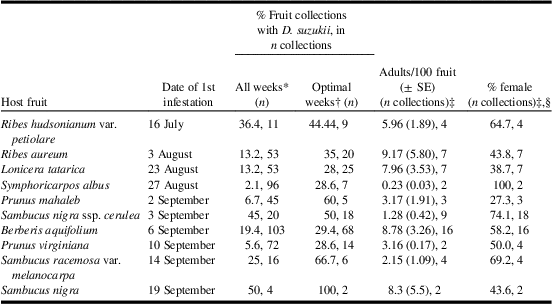
Host plants of Drosophila suzukii in order of date first infested, showing collections infested in all weeks or in optimal weeks only, mean number (±SE) of emerged adults per 100 fruit, and % females of emergent adults.

* From Table 1, for all collections.
† Calculated for collections on or between calendar dates of first and last infestation.
‡ Omitting some collections with partial counts of D. suzukii.
§ Proportion of all adults emerged per host species.
In the Okanagan Basin, two species, B. aquifolium and P. virginiana, were more commonly hosts than elsewhere: B. aquifolium at 50% of site-years, compared with one of three sites elsewhere in North America, and 15% of site-years in Europe. Similarly, P. virginiana was measured at 10% locally and a host in recent field surveys in eastern Canada, but not found at two sites in the United States of America. A third plant, L. tatarica, at 50% of site-years was relatively close to the 75% reported for other Lonicera species in Europe. For the majority of plant hosts in the present study, D. suzukii was found less frequently than elsewhere. Prunus mahaleb (10% site-years) was frequently a host in surveys elsewhere. Sambucus nigra was at 25%, compared with 60% in the United States of America, or 90% in Europe, and was important in a mountainous region similar to the present study area (Tonina et al. Reference Tonina, Mori, Giomi and Battisti2016). Sambucus racemosa var. melanocarpa (33.3%) was less frequent than a related species in Europe, S. racemosa Linnaeus (62%). Symphoricarpus albus was much less common (5.6%) than in the United States of America or European collections. Two plants are novel hosts (R. aureum and S. nigra ssp. cerulea), but both are from families that were important hosts of D. suzukii elsewhere.
Alternative measures of relative presence of D. suzukii were calculated from samples taken across the entire pre-ripening to post-ripening period, as reported in some surveys (Table 3, All weeks). The results were highly variable, e.g., as few as 2.1% of 96 collections of snowberry, S. albus, or 47.4% of 19 collections of blue elderberry, S. nigra ssp. cerulea. If fruits are collected when unsuitable for infestation, that value has little biological meaning, so by examining collections over time we selected from optimal periods only, when infested collections rose to 28–100% by species (Table 3, optimal weeks). The values for site-years and optimal weeks, together, may be useful for pest managers when assessing risk from the natural landscape around a location.
Effects of the semi-arid climate and often poor soils of the Okanagan Basin may explain why some plant species were rarely or never observed as hosts of D. suzukii when it reproduces in them elsewhere. The region has a unique climate in Canada, with hot summers and cold winters, such that the Canadian climate normal (1981–2010) values for Penticton of daily mean temperatures for January, July, and annual mean, were −0.6 °C, 21.0 °C, and 9.5 °C, respectively, with a mean daily minimum temperature of −3.0 °C in January, and mean daily maximum in July of 28.7 °C. Normals for total precipitation were 26.9 mm in January, 28.7 mm in July, and annual mean of 346 mm, but can be much less in other parts of the region. Most studies of plant hosts of D. suzukii have not been from semi-arid regions, so rates of occurrence and of infestation are expected to be higher than in the Okanagan Basin. Such differences were recorded in a few studies: D. suzukii occurred in fewer (41% of 166) sites in Italy, a region with a climate more similar to our study area, than in The Netherlands (69% of 184 sites) with a relatively cool and wet climate (Kenis et al. Reference Kenis, Tonina, Eschen, van der Sluis, Sancassani and Mori2016). From a semi-arid region of northeastern Spain, only 17.6% of non-crop species surveyed were field hosts (Arnó et al. Reference Arnó, Solà, Riudavets and Gabarra2016), similar to the 25.6% found in the present study.
Most of the plant species in which D. suzukii reproduced (Table 1) are common in the landscape in which commercial crops are now grown in the Okanagan Basin (Turner Reference Turner1997; Parish et al. Reference Parish, Coupe and Lloyd1999; Banerjee et al. Reference Banerjee, Creasey and Gertzen2001; Sept Reference Sept2005; Klinkenberg Reference Klinkenberg2016). Many were once important food items for First Nations peoples and early settlers (Turner Reference Turner1997; Banerjee et al. Reference Banerjee, Creasey and Gertzen2001; Sept Reference Sept2005), i.e.: B. aquifolium, P. virginiana, R. aureum, R. hudsonianum, S. nigra ssp. cerulea, S. racemosa var. melanocarpa, and S. albus. Only L. tatarica, S. nigra, and P. mahaleb were not, being recent introductions associated with settlers or agriculture. For example, P. mahaleb was introduced as an orchard rootstock in the early 1900s and is now common throughout the region (Klinkenberg Reference Klinkenberg2016). In the context of pest management and risk to fruit-growers, six of 10 plant hosts supported D. suzukii in ≥ 30% of site-years (Table 1). At the same time, other common plants in the landscape were never found with D. suzukii (Table 2). The results provide guidance for strategies aimed at reducing population levels of D. suzukii via source reduction or vegetation management, by indicating the most likely plants to target. However, such strategies are unproven and are expected to be difficult to implement in this region, due to the frequency of non-crop host plants in the landscape.
The number of emerged D. suzukii varied from 0.23 to 9.17 per 100 fruit by plant species (Table 3). Five hosts were in the range of approximately six to nine flies per 100 fruit, with the remainder being less productive. Higher levels (per 100 fruit) were found in single collections, notably from L. tatarica of 27.0, R. aureum of 42.9, and B. aquifolium of 49.1. Many of the fruits collected in this study were from plants in non-crop situations at orchard or vineyard edges, feral or uncultivated situations, where water is very limited. Consequently, the emergence of D. suzukii was lower than from hosts in cultivated orchards or gardens, where we recorded up to 15.1 flies per individual berry, from cultivated mulberry, Morus species. Very limited data are available for comparison of emergence rates of D. suzukii under field conditions: e.g., Arnó et al. (Reference Arnó, Solà, Riudavets and Gabarra2016) reported 3.2 flies per fruit of P. mahaleb, of 0.2 flies per fruit from one of two collections of S. nigra, and of zero flies from eight fruit of R. canina. Most emergence rates in non-crop plants were measured in laboratory no-choice studies. In such tests of North American non-crop plants, an average of 2.4–38.7 adults emerged from 3–20 fruits per trial (Lee et al. Reference Lee, Dreves, Cave, Kawai, Isaacs and Miller2015a), or 0.3–1.5 adults per berry from boreal fruits and commercial berries (Little et al. Reference Little, Chapman, Moreau and Hillier2016). Common results between the present and laboratory studies, including Poyet et al. (Reference Poyet, Le Roux, Gibert, Meirland, Prévost, Eslin and Chabrerie2015), were that Lonicera species, Sambucus species, and Ribes species, were high in fly emergence and S. albus was low. However, some species differed greatly in relative importance across regions, such as P. mahaleb and B. aquifolium.
The sex ratio of D. suzukii from field-collected plants has rarely been recorded, but we observed 51.1% females in 450 D. suzukii reared from non-crop fruits. The combined annual values for four years (2010–2013) when >30 flies emerged, ranged from 41.9–58.3% female, but by host plant varied from 27.3–74.1% female (Table 3) excluding two females from S. albus. By contrast in a concurrent trap study of 1.8 million D. suzukii captured in the Pacific Northwest region (defined as British Columbia, Washington, and Oregon), the mean proportion of females captured at all types of sites was 53.1% (Thistlewood et al. Reference Thistlewood, Gill, Beers, Shearer, Walsh and Rozema2018), or 2% higher than the general mean reared from non-crop plants. Similarly, the proportion of females trapped in untreated feral, garden, and backyard sites, was 44.3–47.7%, i.e. between 3.4–6.8% lower than the mean proportion of females when reared from non-crop plants.
Seasonal use of host plants
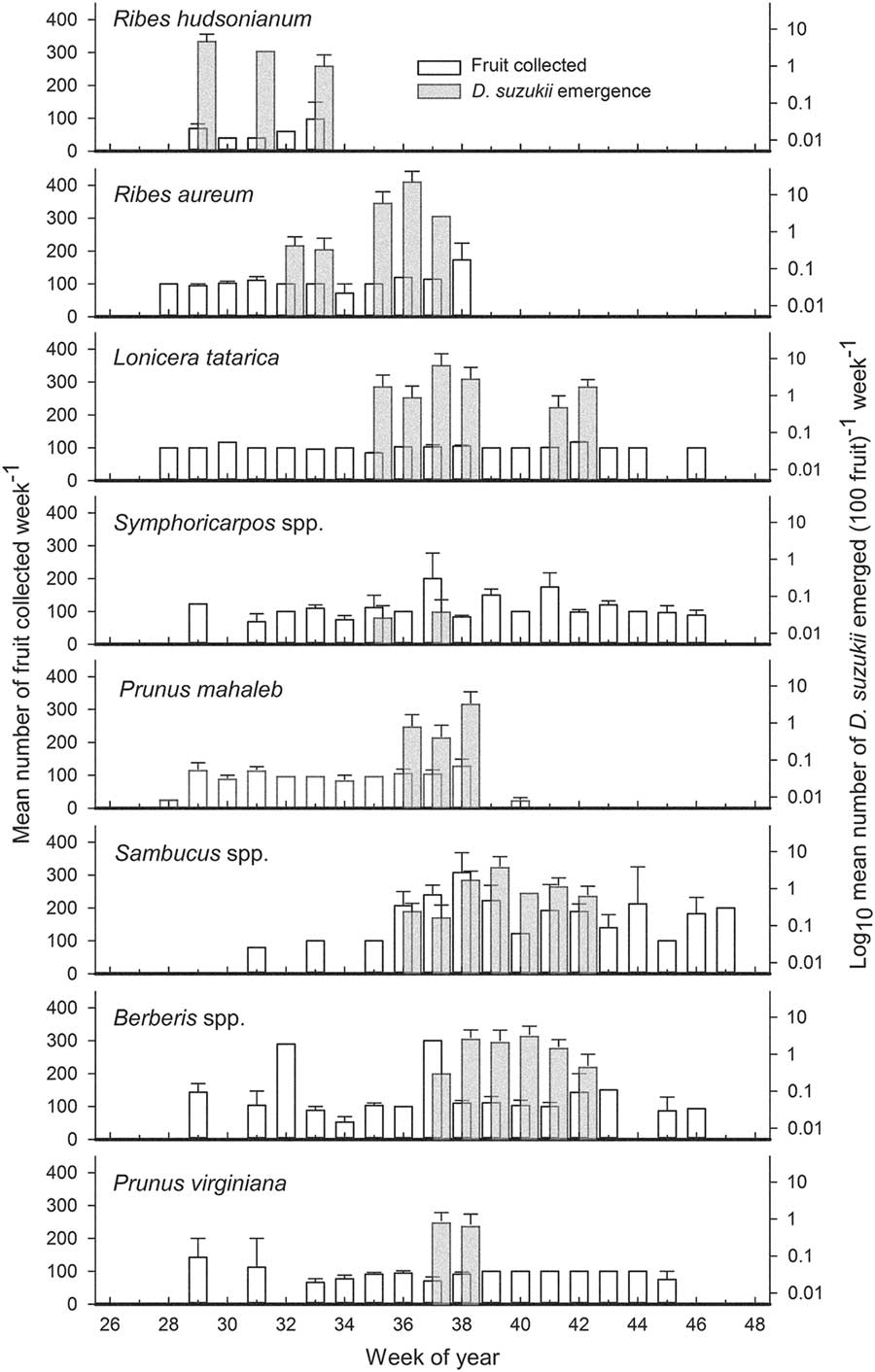
Ten plant host species of D. suzukii were first infested (Table 3, Fig. 2) from 16 July until mid-September 2010–2016, successively each year, and several species were infested until the last positive collections in mid-October (Fig. 2). When possible, we picked during the complete period of fruit presence on a species. The number of fruit available diminished rapidly each week, and for some species, it was impossible to find suitable fruit for assay after the last collections shown. Many fruits were shed by plants after drying and shrivelling, and some were favoured by wildlife, including R. hudsonianum, R. aureum, and P. mahaleb. Others, e.g., S. albus, were of interest because the berries ripen in August but often remain on bushes throughout the winter, providing possible overwintering host sites.
Seasonal use of eight species or families of non-crop host plants, 2010–2016, showing Julian weeks of fruit collection and of mean numbers of Drosophila suzukii adults emerged. Results are grouped from closely related species of Sambucus and Berberis.
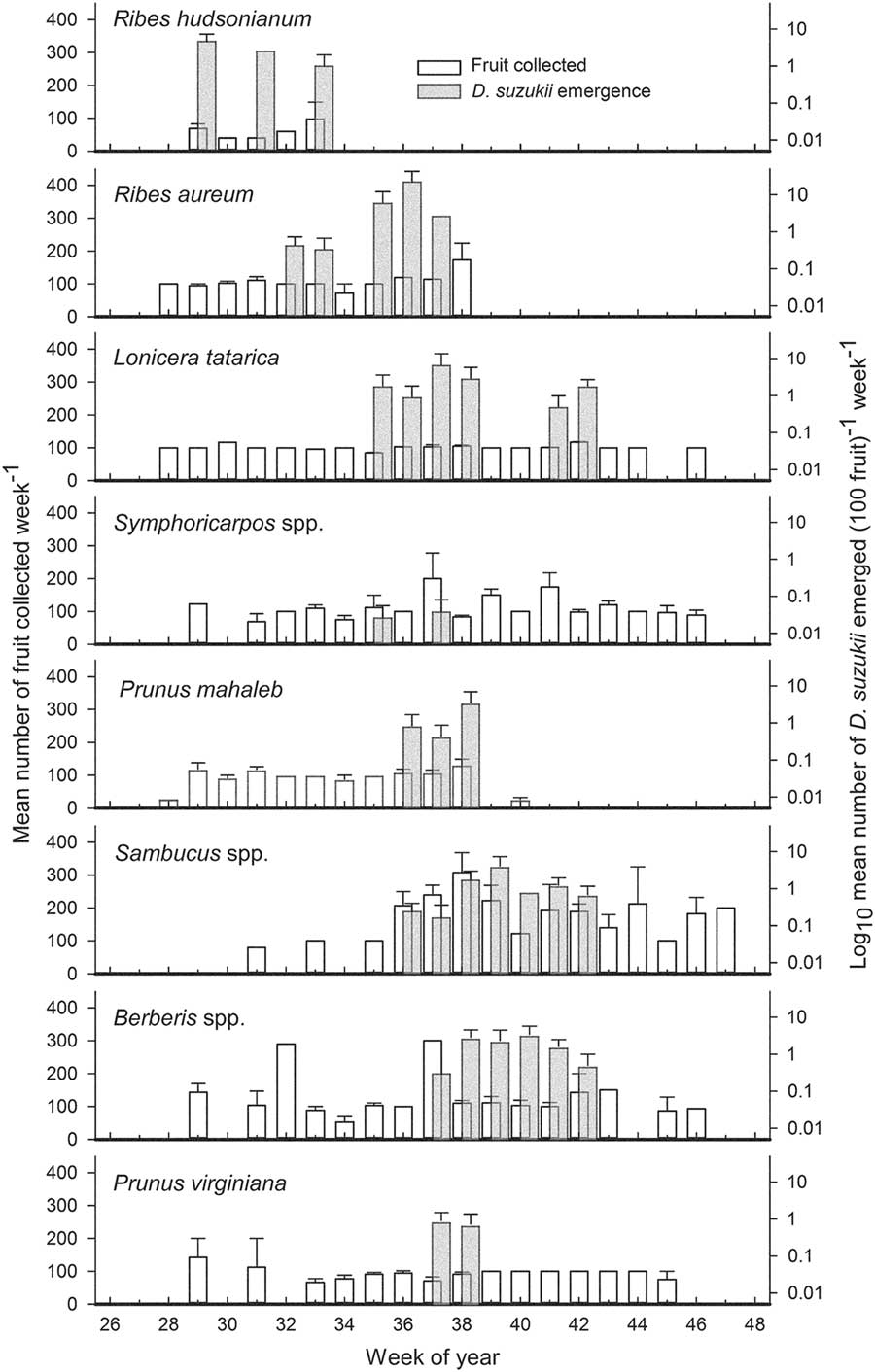
An important finding is that none of the host plants supported D. suzukii in hanging fruit beyond the periods shown (Table 2, Fig. 2), confirming that fruits are not the site of an overwintering stage in the study area. By contrast, in warmer southern German forests, Briem et al. (Reference Briem, Eben, Gross and Vogt2016) showed that mistletoe (Viscum laxum Boissier and Reuter (Santalaceae)) berries can support D. suzukii nutrition and reproduction in the canopy of pine trees in winter, when few other food resources and reproductive sites are available. Results from other fieldwork also shows no evidence of overwintered survival of D. suzukii in hanging fruit in our cold winter region (H.M.A.T., unpublished results). Overwintering in cold winter climates is poorly understood (Thistlewood et al. Reference Thistlewood, Gill, Beers, Shearer, Walsh and Rozema2018), and the limited evidence has led to suggestions that adult flies are the overwintering stage (Asplen et al. Reference Asplen, Anfora, Biondi, Choi, Chu and Daane2015), as in warmer Japan (Kanzawa Reference Kanzawa1939). Our current theory in the Okanagan Basin is that after zero or few detections in winter, overwintered adult D. suzukii begin their annual cycle by developing within a succession of commercial crops, if not insecticide-treated, and then move to non-crop habitats (Thistlewood et al. Reference Thistlewood, Gill, Beers, Shearer, Walsh and Rozema2018). Although trapped subsequently in a few commercial crops, very few have been reared out of the cherries remaining on trees after mid-July (H.M.A.T., unpublished results).
Another important finding is that common non-crop plant hosts are frequently used reproductive sites in the period from mid-July to mid-October (Fig. 2), which is the most likely explanation for the high trap captures observed in non-crop sites in the autumn in the Okanagan–Columbia Basin, at a time when few were caught anywhere else (Thistlewood et al. Reference Thistlewood, Gill, Beers, Shearer, Walsh and Rozema2018). Population modelling of D. suzukii is still in development, but some key parameters have been derived, including lower and upper developmental thresholds of 5.98 °C and 31.5 °C (reviewed by Gutierrez et al. Reference Gutierrez, Ponti and Dalton2016). We examined mean values of observed daily temperatures, 2010–2016, between the observed calendar dates of first to last infested fruit collections (16 July to 12 October), across the extremes of the study region (Fig. 1) in Vernon, Osoyoos, and centrally at Summerland. During this period, mean daily temperatures were between developmental thresholds for 12.6–12.7 weeks across the region and accumulated between 1051.6±17.0 degree days per year (Vernon) to 1217.9±16.1 degree days per year (Osoyoos), on average, from 2010–2016.
Recent estimates of developmental time of D. suzukii from egg to adult are 234 degree days at base 5.98 °C (Gutierrez et al. Reference Gutierrez, Ponti and Dalton2016). After adding 1–3 days each generation for pre-oviposition period (Asplen et al. Reference Asplen, Anfora, Biondi, Choi, Chu and Daane2015), we estimate that at least four generations (Vernon) or five generations (Osoyoos) of D. suzukii could have reproduced successively in non-crop plants in our study area each year. A smaller number of generations is calculated using alternate estimates of developmental time of egg to adult: i.e., 17–25 days under various conditions of temperature and relative humidity (Tochen et al. Reference Tochen, Woltz, Dalton, Lee, Wiman and Walton2016; Tonina et al. Reference Tonina, Mori, Giomi and Battisti2016), or 15–27 days at 20 °C within 33 non-crop species (Poyet et al. Reference Poyet, Le Roux, Gibert, Meirland, Prévost, Eslin and Chabrerie2015), or using a minimum temperature of 11.6 °C for egg-to-adult development in variable cold-winter conditions (Tonina et al. Reference Tonina, Mori, Giomi and Battisti2016). Mean daily temperatures in the infested period were > 20 °C for 35.6±1.3 days (Vernon) to 48.2±3.5 (Osoyoos) on average, and were > 11.6 °C for between 77.4±1.91 days (Vernon) to 84.8±2.03 days (Osoyoos), in 2010–2016.
Using the values above, we calculate that between two to four (northern) or five (central, southern) generations of D. suzukii reproduced successively in non-crop plants (Fig. 2) in the given regions of the study area, each year. Consequently, the number of generations occurring on non-crop plants is at least equivalent to, and likely exceeds, the one to three generations found earlier in the year on sweet cherry (H.M.A.T., unpublished results), the main commercial crop attacked in the region. The relative contribution of the population increase in non-crop plants in autumn may be more important to the ecology of D. suzukii in cold winter regions than in warm winter regions, such as parts of California (United States of America), Hawaii (United States of America), or Asia. There, the fly is a seasonal migrant across a series of crops or landscapes (e.g., Beppu Reference Beppu2006; Mitsui et al. Reference Mitsui, Beppu and Kimura2010), and may exist at any time in many types of habitats. In addition, the degree of movement and interplay between crop and non-crop sites of reproduction, and of landscape-level, i.e., long-distance, dispersal remains unknown, particularly post-harvest, and may be very extensive. Experiments with three other common drosophilids revealed that flies will leave favourable areas and migrate away up to 15 km in 15 hours, and that D. melanogaster Meigen can disperse up to 10 km from a favourable orchard site even when provided abundant resources (Coyne et al. Reference Coyne, Boussy, Prout, Bryant, Jones and Moore1982; Coyne and Milstead Reference Coyne and Milstead1987).
In conclusion, the proven presence of significant populations of flies in insecticide-free habitats of the Okanagan Basin from July to October, often within 100 m of crops, presents an important opportunity for biological control by native (Thistlewood et al. Reference Thistlewood, Gibson, Gillespie and Fitzpatrick2013) or introduced species (Haye et al. Reference Haye, Girod, Cuthbertson, Wang, Daane and Hoelmer2016). The same is likely to be true for dilution of any insecticide resistance arising in populations subject to repeated treatments in commercial crops (Beers et al. Reference Beers, Van Steenwyk, Shearer, Coates and Grant2011; Haye et al. Reference Haye, Girod, Cuthbertson, Wang, Daane and Hoelmer2016). By contrast, management strategies aimed at suppression of populations from non-crop habitats, including mass trapping or cultural control (Haye et al. Reference Haye, Girod, Cuthbertson, Wang, Daane and Hoelmer2016), or sterile insect release (Cini et al. Reference Cini, Ioriatti and Anfora2012), may be difficult and will require area-wide treatment, with large costs. Otherwise, populations of D. suzukii can build up in untreated backyards or feral sites, and move actively or passively elsewhere. Since D. suzukii arrived unexpectedly from Asia, knowledge of its reproductive sites has been gathered from crops, and to a much lesser extent from non-crop plants, but which is vital for understanding the ecology of drosophilid flies (Carson and Stalker Reference Carson and Stalker1951). Using such knowledge of its life history across landscapes, appropriate strategies may be adopted to reduce the risks and environmental costs posed by this invasive insect, rather than the present reliance on insecticide use alone.
Acknowledgements
The authors thank Naomi DeLury, Sukhdeep Brar, and Amanda Chamberlain, for technical assistance; Marco Sanelli (British Columbia Fruit Growers Association, Kelowna, British Columbia), Morgan Roosenmaallen (British Columbia Ministry of Agriculture, Kelowna, British Columbia), Charlotte Leaming and Molly Thurston (British Columbia Tree Fruit Co-Operative, Kelowna, British Columbia), for fruit collections and/or trapping. Bradley Sinclair (Canadian Food Inspection Agency, Ottawa, Ontario) verified the drosophilids; Ken Marr (Royal British Columbia Museum, Victoria, British Columbia) and Paul Catling (Agriculture and Agri-Food Canada, Ottawa, Ontario) verified our plant identifications; Jana Lee (United States Department of Agriculture, Corvallis, Oregon, United States of America) shared a reference list of fruits with D. suzukii; and two anonymous reviewers provided constructive comments. Funding was provided in part by Agriculture and Agri-Food Canada; British Columbia Agriculture, Environment, and Wildlife Fund; British Columbia Cherry Growers Association; British Columbia Investment Agriculture Foundation; British Columbia Ministry of Agriculture; and the Tree Fruit Industry Development Fund of the British Columbia Fruit Growers Association.