Considering our present ecological situation, environmental education is a pertinent tool for addressing environmental change and encouraging sustainable living (Hungerford & Volk, Reference Hungerford and Volk1990; Keen, Reference Keen1991; Newhouse, Reference Newhouse1990; Patrick, Matthews, Ayres, & Tunnicliffe, Reference Patrick, Matthews, Ayres and Tunnicliffe2007). Zoos receive hundreds of millions of visitors each year (Smith, Reference Smith2013; World Aquarium and Zoo Association [WAZA], 2012) and are typically located within densely populated areas (Packer & Ballantyne, Reference Packer and Ballantyne2010). Given these visitation rates and accessible locations, zoos are a valuable resource, ideally positioned to provide conservation and environmental education to large groups of people (Gutierrez de White & Jacobson, Reference Gutierrez de White and Jacobson1994; Hancocks, Reference Hancocks2001; Miller et al., Reference Miller, Conway, Reading, Wemmer, Wildt, Kleiman and Hutchins2004; Patrick et al., Reference Patrick, Matthews, Ayres and Tunnicliffe2007). However, offering conservation education to such a broad range of people with different entering motivations and personal identities does not necessarily mean that they will engage with the messages being provided (Falk, Reference Falk2006; Fraser & Sickler, Reference Fraser and Sickler2008; Morgan & Hodgkinson, Reference Morgan and Hodgkinson1999; Sommer, Reference Sommer1972).
Within their mission statements, zoos around the globe claim to educate their visitors by promoting conservation action and encouraging visitors to actively contribute to environmental action (Patrick et al., Reference Patrick, Matthews, Ayres and Tunnicliffe2007). To determine the validity of these claims, it is important to understand the zoo experience both from the visitor's perspective and in terms of zoos’ ability to engage visitors via the various education communications experienced during zoo visits. In short, it seems necessary to understand what types of communications zoos are using today to ‘talk’ to their visitors and in what ways their visitors ‘listen’.
It is well documented that people visit zoos for different reasons (Dierking, Burtnyk, Buchner, & Falk, Reference Dierking, Burtnyk, Buchner and Falk2002; Falk et al., Reference Falk, Reinhard, Vernon, Bronnenkant, Deans and Heimlich2007; Kellert, Reference Kellert1979; Kohl, Reference Kohl2004; O'Connor, Reference O'Connor2010; Peart, Reference Peart1993; Vernon & Boyle, Reference Vernon and Boyle2008). Falk (Reference Falk2006) proposed that visitors may be: explorers, facilitators, experience seekers, professional hobbyists or spiritual pilgrims. Vernon and Boyle's (Reference Vernon and Boyle2008) research expanded on Falk's identity-related motivations and found that while most visitors gave multiple identity-related reasons for their visit, almost half gave a single, dominant reason. These authors suggested that zoos explore this further to ensure they offer ‘multiple layers of experiences to appeal to the broad array of visitor motivations’ (Vernon & Boyle, Reference Vernon and Boyle2008, p. 9).
Historically, zoos provided visitors with information about animals via a species, or taxonomic sign. Then, during the mid-20th century, to complement the development of naturalistic enclosures, zoos explored the use of interactive educational experiences and basic forms of electronic media, such as push button audio (Anderson, Reference Anderson2003; Peart, Reference Peart1993; Smith & Broad, Reference Smith and Broad2008). This led to the development of immersive exhibits, which enabled visitors to ‘enter’ an enclosure and be surrounded by the plants and animals on display (Anderson, Reference Anderson2003; Coe, Reference Coe1994; Smith & Broad, Reference Smith and Broad2008). Enhanced by soundscapes, lighting, weather effects and sensory stimulation (Larsen, Reference Larsen2002), these holistic environments were designed to motivate visitors into reading signs and learning about the creatures within the exhibit (Anderson, Reference Anderson2003; Coe, Reference Coe1994; Smith & Broad, Reference Smith and Broad2008). Larsen's (Reference Larsen2002) research, however, showed that many visitors did not make the connection between the landscape environment and the animals, highlighting the need for interpretive staff or more effective signage.
More recently, some zoos have invested in purpose-built discovery centres where general visitors, particularly family groups, could touch, observe and ask questions about the animals (White & Marcellini, Reference White and Marcellini1986). Interpretive graphic signs were also created to appeal to family groups, tapping into visitor curiosity, encouraging discussion and free choice learning (Anderson, Reference Anderson2003). Anderson (Reference Anderson2003) discussed two successful models employed for interpretive graphic signs: the first type provided answers for anticipated questions (such as Why does that monkey have a purple bottom?) and the second provided information about a behaviour that could be observed by visitors (such as monkeys grooming each other).
Although interpretive graphics catered for family groups, Wineman, Piper, and Maple (Reference Wineman, Piper and Maple1996) noted the lack of attractions or activities within zoos catering for young and teenage children, concluding that zoos needed to provide opportunities for these age groups to explore and discover. Wagner (Reference Wagner2002) discussed the importance of technology-based education and interpretation, which could appeal to teenage audiences. Wineman et al. (Reference Wineman, Piper and Maple1996), however, contended that zoos should avoid using technology and focus on being a real experience. Whatever one's position on this issue, the exponential rise in popularity and access to smart phones and tablets would seem to provide zoos with additional opportunities to engage in environmental and conservation education with their audiences.
Another means of communication used within zoos is live interpretation, including keeper talks, docents and guided tours. Research suggests face-to-face communication can both entertain and facilitate a personal connection with the animals on display, potentially enhancing conservation messages given by the zoo's presenter (Anderson, Kelling, Pressley-Keough, Bloomsmith, & Maple, Reference Anderson, Kelling, Pressley-Keough, Bloomsmith and Maple2003; Falk et al., Reference Falk, Reinhard, Vernon, Bronnenkant, Deans and Heimlich2007; O'Connor, Reference O'Connor2010; Packer & Ballantyne, Reference Packer and Ballantyne2010; Swanagan, Reference Swanagan2000; Vernon & Boyle, Reference Vernon and Boyle2008; Wagner, Reference Wagner2002). Research also suggests, however, that the quality and value of live interpretation can be influenced by the level of animal activity, the use of drama and theatrical entertainment, and the skills of the presenter (Anderson et al., Reference Anderson, Kelling, Pressley-Keough, Bloomsmith and Maple2003; Hungerford & Volk, Reference Hungerford and Volk1990; Kellert, Reference Kellert2005; Monroe, Reference Monroe2003; O'Connor, Reference O'Connor2010; Swanagan, Reference Swanagan2000). Bramley (Reference Bramley1992) discussed the importance of humour and its ability to relax zoo visitors, giving them an enjoyable experience and facilitating their receptivity to learning. Bramley also posited that visitors who have an enjoyable time will come back more often, giving zoos the opportunity to have a greater, cumulative educational impact.
Thus, research has suggested that the provision of a variety of communications would appeal to a greater proportion of visitors, encouraging them to engage in free choice learning (De Herder & Streiter, Reference De Herder and Streiter2010; Falk, Reference Falk2006; Fraser and Sickler, Reference Fraser and Sickler2008; Kola-Olusanya, Reference Kola-Olusanya2005; Morgan & Hodgkinson, Reference Morgan and Hodgkinson1999; Packer & Ballantyne, Reference Packer and Ballantyne2010; Sommer, Reference Sommer1972). Consequently, in 2005, the World Zoo and Aquarium Conservation Strategy (WAZA, 2005) was produced to provide zoos with a set of guidelines, including recommendations for education. The strategy states that zoos are to provide a ‘range of experiences, materials and resources for the diversity of visitors’ (WAZA, 2005, p. 37).
More than 30 years ago, Van Den Brink (Reference Van Den Brink1981) claimed that despite the development and growth of new and varied educational techniques, the basic biological and taxonomic species sign was the only source of information provided to the majority of zoo visitors. Today, to varying degrees, zoos have a wealth of resources and new technologies to expand the reach of their conservation messages beyond traditional species signs. These could be achieved through interactive and immersive interpretation, feeding demonstrations, keeper talks, docents, guided tours and technology (Anderson, Reference Anderson2003; Serrell, Reference Serrell1981a). Until recently there has been very little research investigating the benefits of offering multiple layers of interpretation to zoo visitors (Weiler & Smith, Reference Weiler and Smith2009). Weiler and Smith's (Reference Weiler and Smith2009) research concluded that ‘no individual interpretive medium performed better in terms of any of the ten indicators of visitor cognitive, affective and behavioural outcomes’ (p. 102). While they were unable to recommend one communication type over another, Weiler and Smith's (2009) research supported the view that the more types of education communications provided to zoo visitors, the greater the impact on visitor learning. So, what types of communication do zoos use today to ‘talk’ to their visitors? Are signs still the predominant medium?
To provide empirical answers to these questions, this research examines the self-reported types of education communications offered at 176 zoos across 50 countries, providing a systematic analysis of the different types currently used to educate general visitors within zoo contexts on a global scale. The study then compares zoos’ self-reported types of education communications against those directly observed within nine case study sites. Additionally, within case studies, this research also examines zoo visitors’ viewing of exhibit signage, historically the most prevalent education medium within zoos. Three research questions are posed in this study:
1. What types of education communications do today's zoos report offering their general visitors?
2. How do zoos’ self-reported types of education communications compare to the communications observed at nine case study sites?
3. To what level do general visitors view exhibit signage?
Method
The research questions examined within this article, which focus on the types of education communication available to general zoo visitors, have been derived within the context of a larger mixed-methods study into zoo education and the processes modern zoos use to understand and improve their educational provision.
Data collection was divided into two phases. The first centred on an online questionnaire administered electronically to zoos around the world, to gather data from a large number of zoos within a relatively short period of time. The second phase involved nine in-depth zoo case studies, facilitating direct observation and documentation within each site. Case study research enabled each zoo to be examined within its own context while also providing the opportunity for face-to-face interviews with zoo staff and zoo visitors. Selected data from both phases have been analysed for this article.
Studying zoo education on a global scale involved an appreciation that each zoo would have different perspectives, objectives, contexts and education implementation processes. To provide the desired accuracy and depth within the data, a mixed methods research approach was used. Utilising both quantitative and qualitative data collection methods can help to offset any weaknesses or limitations associated with single method approaches. Denzin (Reference Denzin1978) and Patton (Reference Patton1990) have identified the combination of quantitative and qualitative methods as fundamental in the process of triangulation: the process of testing consistency and corroborating findings through the use of different methods. This view was extended by Johnson and Onwuegbuzie (Reference Johnson and Onwuegbuzie2004) and Tashakkori and Teddlie (Reference Tashakkori and Teddlie1998), who suggest that using mixed method approaches can work to address any potential weaknesses that may be inherent in a single method. Green, Caracelli, and Graham (Reference Green, Caracelli and Graham1989) have also argued that mixed methods enable expansion and elaboration, provide added depth, richness and detail to a study, and may uncover new insights into participant experiences. McConney et al. (Reference McConney, Rudd and Ayres2002) have noted the increasing trend among researchers and evaluators towards using whatever type of data or method best answers research questions.
Despite the considerable scope of the study, reflected by the participation of 176 zoos across 50 countries, it nevertheless is recognised that participation in both the online survey and case studies was completely voluntary for zoos and their staff. This feature of the study's design means that the findings and their generalisability to all zoos is limited.
Phase 1: Online Questionnaire
The online questionnaire consisted of 62 questions, including 20 open-ended, 29 closed response, 14 rating scale and 4 multiple choice items. The questions were generated using previous research literature that addressed similar issues, while maintaining focus on generating data to answer the research questions within the project. This approach to question development was important for ensuring the alignment, and hence the content-related validity of the instrument used. The questionnaire was organised in three sections that included: (1) general zoo information, activities and mission statement; (2) types of education provision and its development, implementation and evaluation; and (3) zoo visitors and their perceived educational needs and priorities. Section 2 of the questionnaire, zoos’ education provision, forms the focus of this article. Additional aspects of the larger study that address zoos’ roles and priorities and zoos’ use of educational program evaluation, may be found in Roe and McConney (Reference Roe and McConney2014) and Roe, McConney, and Mansfield (Reference Roe, McConney and Mansfield2014a, Reference Roe, McConney and Mansfield2014b), respectively.
Recruitment to participate in the online questionnaire involved direct email contact and contact through various zoo education associations around the world. The contact list of zoos was obtained from the International Zoo Yearbook (Zoological Society of London [ZSL], 2009). A total of 593 zoos open to the public, representing 72 countries, comprised the database. It was not, however, possible to confirm that all email addresses provided in the 2009 Yearbook were correct and it is possible that a number of the 593 zoos were not actually contacted. This is particularly so for zoos in India, Japan and Germany from where 54 (9%) email invitations were returned as undeliverable. For this reason, snowball sampling was also used to contact as many zoos as possible. Nevertheless, the majority of respondents (95%) were those contacted by email using the database provided by the International Zoo Yearbook (ZSL, 2009).
To initiate snowball sampling, several zoo educators were contacted directly by email or telephone and invited to participate in the study. With their support, details of the research project were printed in the International Zoo Educators Newsletter (International Zoo Educators Association [IZE], 2011) stating the IZE's support for the research. All international zoo associations were also contacted, resulting in the Canadian Association of Zoos and Aquariums and the Pan African Association of Zoos and Aquariums emailing their members requesting their participation. The European Association of Zoos and Aquariums also offered its support of the research.
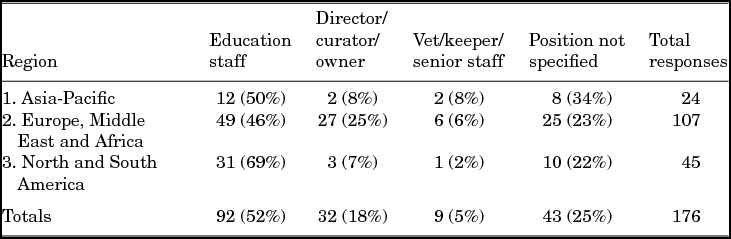
Zoo recruitment spanned 7 months (December 2010–June 2011). The majority of respondents were education directors or coordinators, zoo directors or education personnel; Table 1 provides a summary of respondents’ positions.
Zoo Respondents’ Position With the Zoo (n = 176)

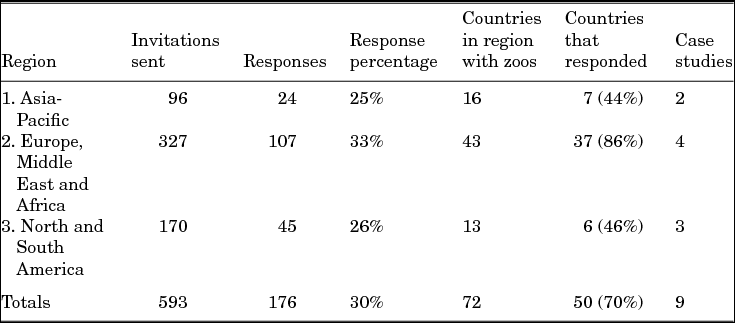
Zoos within the database were placed into one of three regions, depending on their geographical location (Table 2). To provide a point of comparison it was decided that geographical regions best represented the global nature of the study. It is acknowledged that each region spans a considerable diversity of zoos and cultures.
Summary of Invitations Sent, Responses Received and Rates of Participation, by Geographical Region
Phase 2: Nine Case Studies
During the planning phase of the research, three case study sites from each region were proposed. However, given the high number of zoos responding within region 2 and the relatively low number within region 1, two sites were selected from region 1, four from region 2 and three from region 3, providing a total of nine case study sites.
The selection of the case study sites was determined using the following process. All zoos that selected ‘Yes’ or ‘Maybe’ (in the questionnaire) to participating as a case study site were considered eligible (n = 143, or 82% of respondents). Due to visitor interviews being central to data collection for the case studies, a high visitation rate was necessary to provide enough potential participants within a limited time frame. Therefore, all eligible zoos with an annual visitation of 500,000 or more were contacted by email to initiate further discussion. Although this process may have introduced some selection bias into the choice of case study sites, on balance it was more important to maximise the likelihood that sufficient visitor data would be gathered during the week spent at each site. Zoos interested in participating were shortlisted as potential sites. Consideration was then given to: language (if non-English speaking, was an interpreter to be provided by the zoo?); and suitability of the proposed research period for the zoo and its education department. The location of each shortlisted zoo was then considered. Ultimately, the nine zoos visited as case study sites included: six sites that have English as their primary language (a translator was provided for the remaining three); eight sites with visitation in excess of 1,000,000 per annum; three sites that are private and six that are government-funded; and three sites among the ten largest zoos in the world, including both the zoo with the highest visitation and the largest zoo in the world (based on land area and the size of the animal collection).
Each case study visit was limited to 7 days. The data collection process involved an extensive site analysis to place each zoo within its own context. Data collection methods included: contextual observation and an extensive photographic record, both of which were guided by a predetermined checklist; visitor interviews; education staff interviews; and observation of and participation in special tours. The first author conducted all data collection. The data used in this article, in addition to that from the online questionnaire, are derived from direct observation, photographic records, zoo staff, and zoo visitor interviews.
Twenty-eight staff members were interviewed across the nine case study sites. In all cases, the head of education was interviewed and at two sites the zoo directors were also interviewed. The remaining interviewees included area coordinators (such as volunteer, school and curriculum) and general educators — typically, this accounted for all education staff within each case study site. The interview protocol consisted of 18 questions requiring between 30 minutes and 1 hour, depending on the respondents’ level of detail.
Sixty general zoo visitors were interviewed at each of the nine case study sites, resulting in a total of 540 interviews. Clearly, the duration of each site visit limited the number of visitor interviews conducted, and we readily acknowledge that 60 interviews, even though recruited at random during site visits, limits the generalisability of visitors’ responses to all those possible at any zoo. An important purpose in conducting visitor interviews, however, was to gather a rich mix of qualitative and quantitative data that together afforded us deeper (rather than broader) insight into visitors’ views and intentions.
Visitors were recruited deep within each zoo, maximising the likelihood that the respondents had seen at least some of the exhibits prior to being interviewed. Focal sampling, with a continual ask, was employed to interview visitors over 18 years of age. Each zoo visitor interview took approximately 5 minutes. The focus of the visitor interview included pre-visit information, such as why they came to the zoo, participation in activities within the zoo, the importance of zoo activities, behaviour relating to animal visibility and reading signage, educational needs and preferred delivery, and their day's highlight. The section of the visitor interview used for this article focused on visitors’ reading of signage. Visitors were asked how many signs they had read at the animal enclosures, choosing from five scaled options (all, most, half, some, none). With the exception of visitors who reported reading all the signs, visitors were then asked: ‘If you didn't read all or any of the signs, why not?’
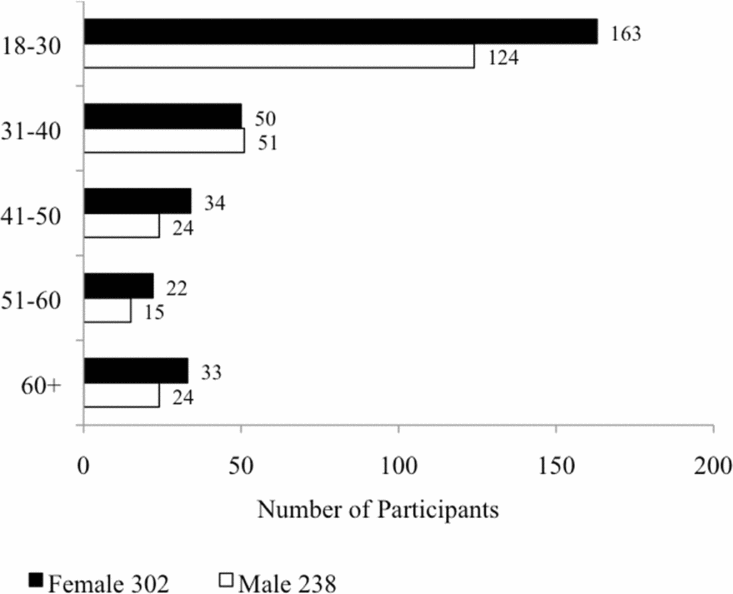
All interviews were overtly voice recorded, which reduced the need for transcribing answers during the interviews, ensured the accuracy of data, and enabled respondents to answer questions in their own words without being limited to a set writing space. The participation rate was very high, above 80%. A summary of participants’ age and gender is shown in Figure 1.
Summary of interviewed visitors’ age and gender (n = 540).
Data Analysis
For both the online questionnaire and case study interviews, quantitative data were analysed using MS Excel, enabling statistical and graphical comparisons to be made. For example, chi square tests were used to determine statistical significance between regions. The qualitative data gathered through the open-ended questions were analysed by first manually coding each response according to its individual characteristics. Using the various codes, the data were then organised into main themes identified in the responses, which in turn led to identification of response patterns or trends. This iterative process was continued until all responses had been examined, coded, categorised and grouped within themes and no new concepts or themes were evident. To ensure consistency, the first author conducted all coding and analyses.
Definition of Terms
Signs (at animal enclosures) refer to taxonomic species information as well as interpretive signage.
Education communications refer to any form of communication offered by zoos to their general visitors for the purpose of education, including but not limited to: taxonomic species signs; interpretive signs; interactive exhibits, modules or signs; verbal presentations, shows and displays; tours and docents; printed material such as maps, brochures or pamphlets; digital media including television screens and cinemas; audio, including soundscapes or recorded messages.
Findings
Questionnaire and case study data have been analysed to answer the three research questions posed in this article. The analysis provides insight into the current types of education communications used within zoos and zoo visitors’ interaction with exhibit signage.
Research Question 1: What Types of Education Communications Do Today's Zoos Report Offering Their General Visitors?
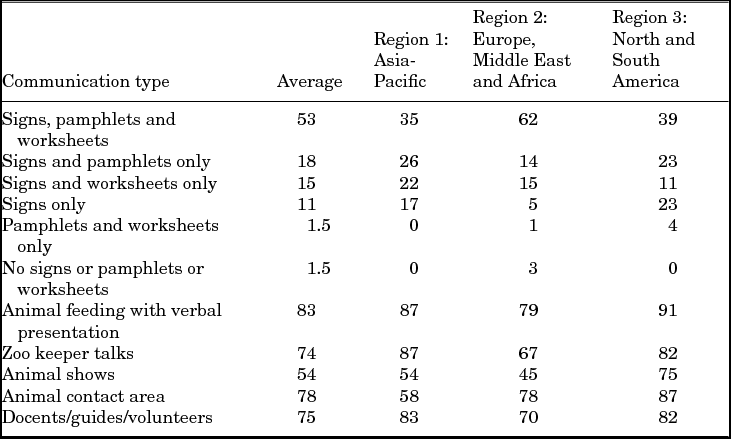
Research question 1 investigates the self-reported types of education communications of zoos; the data are derived from seven questions within the online questionnaire to which 176 zoos responded. The first question focused on printed media, and zoos were asked to select those used within their zoo; multiple selections were permitted and options included: signs at animal enclosures, pamphlets/brochures, and worksheets. Zoos were then provided with a list of educational activities and asked whether or not those activities were available or used within their zoo. The activities listed were: animal feeding demonstrations with verbal presentation, zookeeper talks (other than animal feeding demonstrations), animal shows (such as bird of prey free flight demonstration), animal contact area (where visitors can touch or interact with animals), docents (volunteer tour guides/guides/hostesses). Table 3 summarises zoos’ responses.
Self Reported Types of Education Communications Utilised Within Responding Zoos
Note: N = 176. Values are given as a percentage.
The data show that 97% of the respondents use signs as an education communication within their zoo, 72.5% report using pamphlets and 68.5% use worksheets. Three per cent reported that they do not use signs and 1.5% noted that they do not use any signs, brochures, pamphlets or worksheets.
When analysed regionally, a large proportion (62%) of zoos within region 2 (Europe, Middle East and Africa) use all three: signs, pamphlets and worksheets. By comparison, only 35% of zoos within region 1 (Asia-Pacific) and 39% in region 3 (North and South America) use all three. A greater proportion of zoos within region 1 (26%) and region 3 (23%) use signs and pamphlets only, indicating that fewer zoos within these regions use worksheets as an education communication for the general public. It should be noted, however, that neither of these differences were significant, χ2 = 4.34, df = 4, p > .05; χ2 = 2.09, df = 4, p > .05. A significant difference was found in the number of responding zoos reporting the use of signs only. Twenty-three per cent of the zoos within region 3 use signs only, more than double the average (11%) and nearly five times the percentage of zoos within region 2, χ2 = 10.20, df = 4, p < .05.
On average, more than 95% (172) of the zoos participating in this study (n = 176) offer some kind of person-to-person education for their general visitors, typically in the form of animal feeding with a verbal presentation, keeper talks and also through contact with docents, volunteers or guides (Table 3). More than half (54%) the participating zoos provide their general visitors with an education through animal shows, the greatest proportion being zoos within region 3 (75%). Fifty-eight per cent of responding zoos from region 1 have an animal contact area within their zoo, which is below the 78% average. It should be noted however, that a chi square test concluded that none of these differences were significant (p > .05).
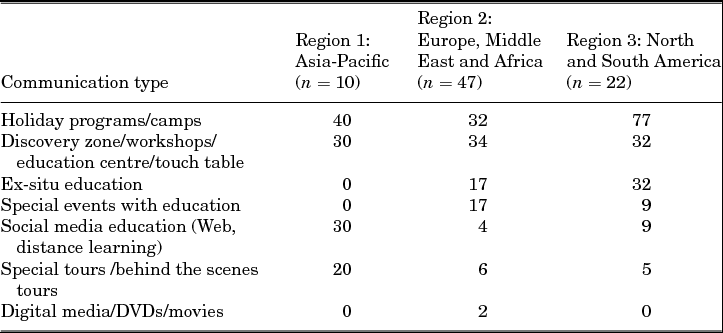
To provide respondents with the opportunity to note education communications used within their zoo that were not specifically listed within the questionnaire, an open item was included. It is acknowledged that the open nature of the question limits the generalisability of the data. Zoos were asked ‘Is there any education available or offered at your zoo other than those listed?’ (other than formal school education programs), with ‘yes’ or ‘no’ options. If ‘yes’ was selected, zoos were asked to ‘specify what other education is available or offered at your zoo’. Table 4 summarises the 123 responses given by 79 zoos.
Summary of Zoos’ Self-Reported ‘Other’ Education Opportunities
Note: n = 79. 79 zoos gave 123 responses. Values are given as a percentage.
Holiday programs and camps were well represented, with around half the respondents (36 zoos) noting these as educational activities within their zoo. It is also interesting to note the low reported usage of digital media within zoos as a means of education (less than 2%). It is acknowledged that while the open nature of the question may have contributed to this result, it is also surprising, given the rise in popularity of smart phones, applications and QR or quick response codes.
Further analysis was conducted regarding the respondents who stated that they used only signs to educate their general visitors. Table 3 indicates that an average of 11% of respondents fall into this category. Of those respondents, 71% listed other education communications within the questionnaire's open item and 29% did not. It should also be noted that 100% of those respondents (the 29%, six zoos) indicated at least one other education communication (Table 3), which indicates that not a single responding zoo depends exclusively on signage to educate their general visitors.
Research Question 2: How Do Zoos’ Self-Reported Education Communications Compare With Those Observed at Nine Case Study Sites?
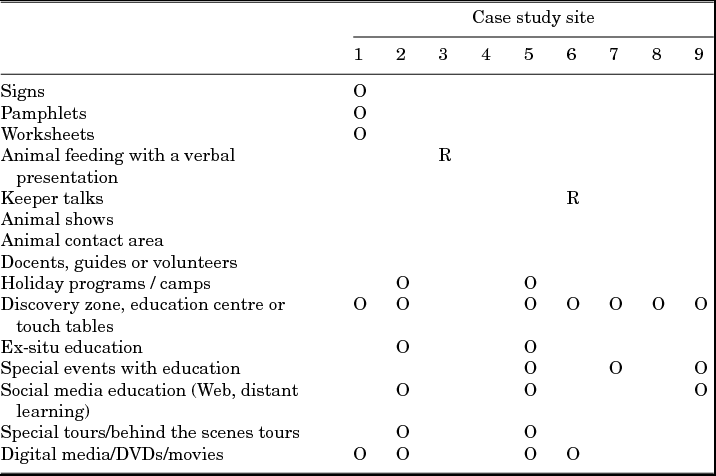
Research question 2 compares zoos’ self-reported education communications with those observed within nine case study sites. Table 5 summarises these data. It should be noted that observations were guided by a checklist and recorded both manually and photographically for consistency. Observations of verbal presentations conducted within zoos (keeper talks, animal shows, or any other talks) were documented and experienced at least twice by the researcher to improve the quality of observations. Information pertaining to volunteer training was derived from guided observation and zoo staff interviews.
Comparison Between Self-Reported and Observed Education Communications at Case Study Sites
Note: (n = 9). Blank = Observation consistent with reporting; R = Reported NOT observed; O= Observed NOT reported.
In Table 5 a high degree of consistency is evident between zoos’ responses to the online survey and observations made during the nine case studies, with respect to the first eight forms of communication (signs; pamphlets; worksheets; animal feeding with verbal presentation; keeper talks; animal shows; contact area; docents, guides and volunteers). All of these education communication types were specifically nominated in the online questionnaire, which could account for the high rate of consistency between the questionnaire data and observations in the field. The data show that case study site 1 did not report using signs, pamphlets or worksheets in responding to the questionnaire; however, all these education communication types were observed during the site visit. Site 1 was a non-English speaking zoo, however, and the online responses to these questions could have been a result of simply misreading the question.
Of the remaining discrepancies between the online survey data and observations made during fieldwork, two sites (case study sites 3 and 6) reported education communications that were not observed. Additional analysis revealed that case study site 3 reported animal feeding with a verbal presentation, but this was not observed. Site 6 reported keeper talks and although there were signs at animal enclosures stating keeper talk times, these were not observed and did not occur during the 7-day site visit.
Further analysis was conducted on the documented observations of person-to-person education within the case study sites. While the online questionnaire indicated that 70% of responding zoos offer person-to-person education, the quality and quantity was observed to vary greatly. For example, three of the case study sites reported providing general visitors with animal shows. There was, however, very limited educational content within the shows’ dialogue; rather, entertainment seemed to be the shows’ focus. Another three case study sites provided shows with a high level of educational content, though the delivery varied greatly. Two of the sites provided an entertaining and articulate presentation, which was delivered at a rate that could be easily understood and followed by the audience. The key educational messages were repeated several times by the presenter and further enhanced by the presence of animals. The other site offered a range of shows and talks full of educational content; however, they were delivered at a very rapid rate and most were difficult to follow due to poor articulation and the presenters being out of breath.
The quality and actuality of keeper talks also varied greatly within the case study sites. Eight of the nine sites indicated that they had keeper talks within the online questionnaire. While some sites had signs indicating talks at a particular time, they did not occur during the 7-day data collection period. Some of the case study sites provided keeper talks that engaged the audience and provided personalised information about the animals on exhibit. Other sites had talks that were less engaging and the keepers were observed to speak very quietly and actively avoid visitor questions.
The quality of visitor interaction was also found to vary greatly between docents or volunteers at different case study sites. During staff interviews, only one site was found to provide docents and volunteers with extensive training. These docents were observed to have extensive knowledge about the animals on display and actively engaged with general visitors. Docents at other sites were friendly and approachable, though they were observed to lack even basic knowledge about the animals or facilities within the zoo. Docents were also observed to act as crowd control rather than interact with visitors at two sites. It was also observed that docents were placed at busy exhibits where the animals were very active rather than at exhibits where animals were resting.
The remaining education communications (programs/camps; discovery zone, education centre, touch tables; ex-situ education; special events with education; social media education; special tours; digital media) were not specifically listed within the questionnaire and were derived from an open item. As such, it is acknowledged that generalisability is limited. However, what is interesting to note is the high number of instances where education communications were not noted within the open questionnaire item yet were observed or experienced during the data collection period (indicated by ticks in Table 5). This highlights two important considerations: (1) the benefits associated with utilising a mixed methods approach, which has demonstrated that the inclusion of case study observation provided the opportunity to triangulate survey responses, provided by the nine zoos in question, which then led to a better representation of what they actually do in terms of visitor education; and (2) that is it more typical for a zoo to omit an education communication rather than include one that was not observed or experienced during data collection at the nine case study sites. Only one case study site (of nine) appeared to have consistently reported all their education provisions as was subsequently observed and documented during case study fieldwork (case study site 4, Table 5).
Research Question 3: To What Level Do General Visitors View Exhibit Signage?
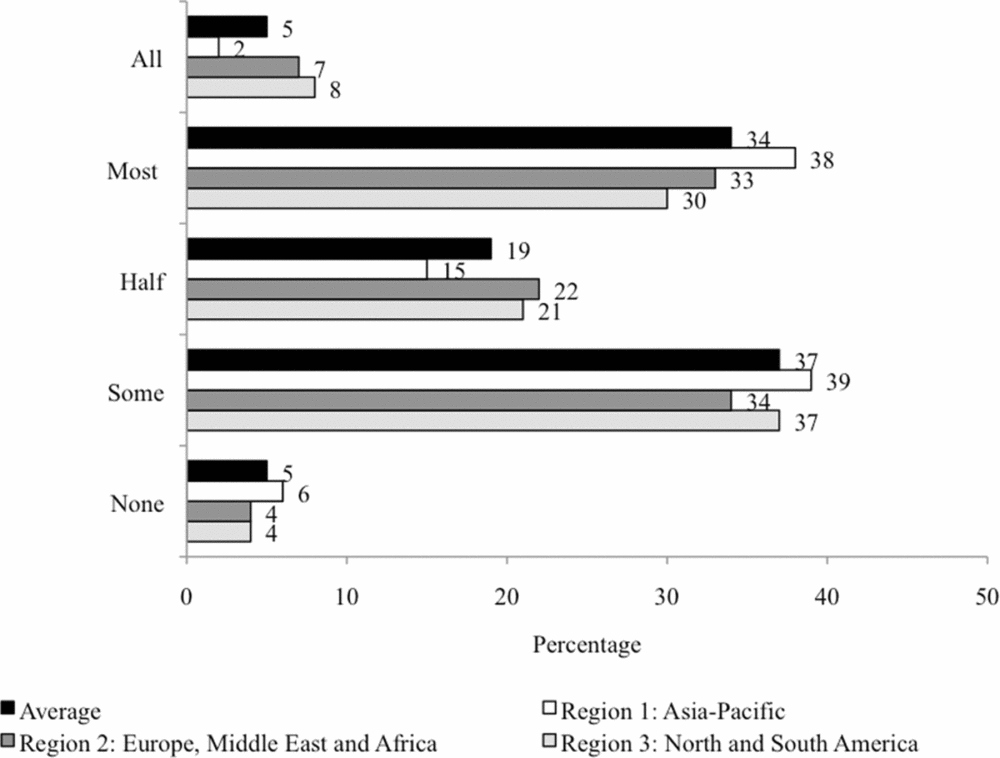
Case study zoo visitors (n = 540) were asked how many signs they had read at the animal exhibits. The question was a closed rank scale with five options (none, some, half, most and all). Figure 2 summarises the data providing the average and regional variations.
The self-reported proportion of exhibit signs read by general zoo visitors (n = 540).
On average, 95% of the participating visitors read at least some of the exhibit signs and 58% read at least half the signs (Figure 2). It is interesting to note that there is little deviation from the average when regional comparisons are made.
During the interview process, many visitors stated that they only read the sign to discover what animal was in the enclosure. Further research is recommended to determine how much of the signs visitors read beyond the animal's common name.
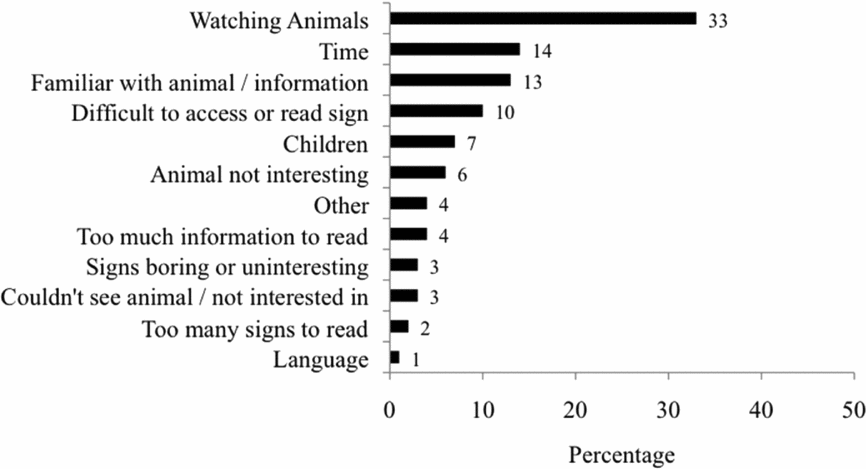
Given the proportion of visitors who reported reading at least some of the signs (95%), the research supports the value of signage being placed at an animal's enclosure in terms of visitor usage. It then becomes important to understand why zoo visitors do not read all the signs. More than half the participating visitors provided a response to an open interview item asking why they had not read all the signs (n = 283). The remaining 257 respondents were either not asked the question, due to stating that they had read most or all of the signage, or had not provided an answer. Figure 3 summarises the responses.
Reasons general zoo visitors gave for not reading all exhibit signage (n = 283).
The main reason zoo visitor gave for not reading all the exhibit signage was that they were watching the animals, accounting for 33% of the comments (Figure 3). This is more than double the next most frequent response, [lack of] time (14%). Seven per cent of the comments related to children being the reason for respondents not reading signs, and while a more specific reason was not given, the data supports the need for additional or alternative communications designed to engage children and families to improve a zoo's educational reach.
Nineteen per cent of responses related to familiarity with the animals or information and the animal not being interesting. Twenty per cent of responses related directly to the signage (difficult to access or read sign; too much information to read, signs boring or uninteresting; too many signs; language) and 14% of the comments related to time. These factors account for 53% of the comments made by zoo visitors as the reason they are not reading exhibit signage. The data shows that zoos must entice visitors to read the signs by providing new information, improving access and readability, accounting for time issues, or providing the information using a different type of communication. This should be investigated further, and signage should be designed to highlight key conservation messages that can be accessed and read quickly and easily.
Additional analysis was conducted through documented observations of the signage at the case study sites. Sign diversity across all sites was typically due to replacement over time rather than a conscious effort to provide variety. As such, the older signs were faded and generally in poor condition, and some were completely unreadable. New signs were typically full colour, large in size, and most observed were textually complicated. One case study site used the same format for all their species signage and while that may sound uninteresting, the design and format were visually appealing, as was evident by the number of visitors observed engaging with the signs. The placement and height of the signs also meant that they could be read even when very crowded. This was in contrast to another case study site that also maintained a particular format for the majority of their species signs, but which were difficult to read due to the small font size, were weathered and faded, and accessible only when visitors were directly in front of the enclosure, meaning that during busy times, visitors even one person back from the front could not read the signs. Another case study site provided signs that only stated the animal's common and scientific name — no other signage or any form of interpretation was present. Many of the visitors interviewed at this site made comment during the interview that they wanted to learn more about the animals and wanted more signage.
Discussion
This article provides an overview of the education communications used today within 176 zoos across 50 countries representing different contexts on a global basis. Through an online questionnaire and case studies, this research offers a broad snapshot of the types of education communications available to general zoo visitors. The research then focuses on the primary communication type, signage, which was reportedly used by 97% of participating zoos. Being the most prevalent form of communication, it was important to establish what proportion of the signs visitors reported reading and their reasons for not reading all the signage during a zoo visit.
In 1981, Van Den Brink claimed that species signs were the only source of information available to the majority of visitors, despite the development and growth of new forms of communication within zoos. The results from this research indicate that while signs are still the most common form of education communication, all of the zoos that participated in this research provided at least two different types of communication to their general visitors. However, can we consider two types sufficient to say that zoos offer multiple layers of education and experience, as recommended by Vernon and Boyle (Reference Vernon and Boyle2008)? Also, the use of person-to-person education, while well represented, was found to vary greatly in quality and educational benefit. Within the literature there is little argument against the potential benefits of person-to-person education within a zoo context. Data obtained from the online questionnaire suggests that three in four zoos use guides, docents and volunteers as education communicators. However, the nine case studies conducted in this research revealed that zoo educators’ ability to engage with their audience, use appropriate knowledge and effectively communicate with their audience was observed to be an exception rather than the rule. Many of the guides, volunteers or docents encountered were observed to lack even basic knowledge of the animals and zoo facilities, with many acting as crowd control rather than educators. As such, it seems that educational opportunities were missed and audiences were not given the chance to engage in free-choice learning. While it is acknowledged that the generalisability of these results to all zoos is limited, it does raise an important concern that should be investigated further, because if this is a widespread issue it needs to be addressed to enable zoos to more effectively communicate with their general visitors.
Zoos’ reporting of education communications via this study's online questionnaire compared to case study observations revealed that it was more typical for a zoo to omit a type of communication used rather than report types of communications that were not observed. Less than one third of participating zoos reported utilising discovery zones, education centres and digital media as education communications within the online questionnaire (Table 4). However, case study data found that seven of the nine case study sites did in fact have some of these educational opportunities available to their general visitors. This raises two important points: (1) that the omission of such education communications by zoos via the open item does not necessarily mean that they do not have them available, and (2) it highlights the benefits associated with the study's use of a mixed method approach, which captured a fuller indication of zoos’ education communications by combining data from both the online questionnaire and case studies. Given that research (Anderson, Reference Anderson2003; Ballantyne, Packer, Hughes, & Dierking, Reference Ballantyne, Packer, Hughes and Dierking2007; Smith & Broad, Reference Smith and Broad2008; White & Marcellini, Reference White and Marcellini1986) supports the educational value of such diverse forms of communication, it would be interesting to investigate whether or not they are utilised more widely within zoos via direct questioning or observation.
Educating visitors within zoos using technology such as videos or computers has historically been a contentious issue, primarily driven by a desire to keep the experience real. Problems have also been noted due to exposure and vandalism. In 2002, Wagner discussed the use of technology in zoos as a growing trend, especially important for potentially engaging the teenage audience; and later, O'Connor (Reference O'Connor2010) reported that interactive technology was both a current and future trend within American Zoological Association zoos. Perdue, Stoinski, and Maple's (Reference Perdue, Stoinski and Maple2012) study found that in the absence of person-to-person education, video was a more effective educational communication than signage alone, and studies report the benefits of linking scientific inquiry and mobile technology within informal learning environments (Bull et al., Reference Bull, Thompson, Searson, Garofalo, Park, Young and Lee2008; Marty et al., Reference Marty, Alemanne, Mandenhall, Maurya, Southerland, Sampson and Schellinger2013). Yet despite this and the popularity of smart phones and the development of mobile applications and quick response codes, which effectively negate issues of both exposure and vandalism, not a single case study site was observed to provide these as ways of interacting with general visitors or provide them with information that could be accessed after their zoo visit.
The evolution of zoos over time has resulted in a continuum of enclosure modernisation, both within the same zoo and across zoos within the same region (Fiby, Reference Fiby2008). Case study observation, guided by a checklist and recorded photographically, revealed enclosures ranged from small concrete pens with steel bars to enclosures with moats and electric fences through to mixed species and immersive exhibits, often within the same case study site. This mix of old and new exhibits has resulted in a variety of taxonomic signage and interpretive material throughout the same zoo that ranged from older faded black and white taxonomic labels to modern full colour graphics. Signage has been reported as the most commonly used education communication type within zoos (Table 3), and 95% of visitors report reading at least some of the signs (Figure 2). However, when analysing the reasons why visitors do not read signs, half the problems cited relate to the signs’ presentation or the time required to read them, considerations discussed by Serrell (Reference Serrell1981b) more than 30 years ago and also by Bramley (Reference Bramley1989).
For zoos and zoo educators, this research had provided a broad baseline of information regarding the education communications used today within 176 zoos around the world, and demonstrated the high level use of signage by both zoos and general zoo visitors. These factors highlight the value and importance of signage within zoos when ‘talking’ to or communicating conservation messages to zoo visitors. Sign design and content has been researched in the past (Serrell, Reference Serrell1981b, Reference Serrell1988), but in more recent times there has been a trend to provide so much information that visitors do not read the signs due to a perceived lack of time. This indicates a discrepancy in communication aims and highlights the need for zoos to revisit their visitors’ needs, in terms of signage. The popularity and low costs associated with incorporating smart phone technology such as QR codes could enable zoos to provide additional information to visitors without the need for expensive graphics. This would also enable visitors to retrieve information at their leisure, even after their zoo visit, thus potentially extending zoos’ educational reach. It is not the authors’ intention to appear pro-technology, simply to raise discussion of a potentially useful communication that may solve current barriers, such as visitors’ perceived lack of time and zoos’ desire to communicate conservation messages.
Within this research it is important to understand the diversity of zoos that participated. Seventy per cent of the countries with zoos listed within the database participated in the online questionnaire and they represent very different social, cultural and economic situations. These conditions result in a unique context for each zoo and have a direct influence on the visitor experience. As such, the reported use of such a diversity of education communications across the different regions should be acknowledged, encouraged and further supported through collaboration and shared knowledge. But how do we measure educational success? If we accept that the provision of multiple types of educational communications provides visitors with the opportunity to engage in free choice and immersive learning, and that person-to-person contact, via keeper talks, docents or animal shows, facilitates a connection between visitors and the animals, then a large proportion of participating zoos are providing an education. Zoos are ‘talking’ to their visitors. However, the value of that education and the quality of the visitor experience were observed to vary so greatly that overarching statements are neither accurate nor informative. To understand and improve a communication's educational potential, further investigation is required to examine each type of communication in more depth. By gaining a comprehensive and multicultural, or global, understanding of a communication's effectiveness in direct relation to visitor learning, it should be possible to provide zoos with priority types of communication for conveying conservation messages to their visitors. With that knowledge, rather than offering the generalised view that more types of communication necessarily mean better communication, zoos will be able to ‘talk’ to visitors in such a way that they are more likely to ‘listen’.
Acknowledgments
Special thanks to all the zoos that participated in this research and to the associations that provided their support, including the International Zoo Educator's Association, the Canadian Association of Zoos and Aquariums, the Pan African Association of Zoos and Aquariums and the European Associations of Zoos and Aquariums. Special thanks also to Chapultepec Zoo, Colchester Zoo, Columbus Zoo and Aquarium, Johannesburg Zoo, Loro Parque, Moscow Zoo, Taronga Zoo, Toronto Zoo and Zoo Negara for their outstanding contribution to this research (these zoos are not listed in site order and written permission was given for acknowledgment).
Author Biographies
Katie Roe is a PhD candidate studying zoo education and evaluation practices. Katie's research investigates how modern zoos design, implement and evaluate their formal and informal education experiences. Katie also examines the visitor's perspective during an informal zoo visit and the extent to which it is consistent with the zoo's desired informal education experience.
Andrew McConney is Associate Professor in Research Methods and Program Evaluation in the School of Education at Murdoch University, Western Australia. His research interests include the evaluation of science, maths and environmental education programs, and the secondary analysis of large-scale datasets to inform educational policy and practice. As part of a research team at Murdoch and Nottingham, Andrew is currently examining the factors associated with students’ science literacy and engagement in science, using retrospective analysis of PISA data.
Caroline F. Mansfield is a Senior Lecturer in Teacher Education in the School of Education, Murdoch University, Western Australia. She lectures in learning processes, teaching, and motivation. Caroline's research broadly focuses on students and teachers in learning contexts, with current national and international projects regarding teacher motivation, instruction, and resilience. Caroline has been project leader of two successful funded projects on teacher resilience and has received awards of excellence for research, teaching and service to the community.