Lung cancer is the second commonest cancer in men and the third commonest in women in Singapore and is a major contributor to cancer mortality (9). One of every five deaths in Singapore is attributable to lung cancer. There is thus great interest in Singapore in introducing new clinical services to facilitate the diagnosis and management of lung cancer.
Endobronchial ultrasound (EBUS) was introduced into Singapore, with the support of funding from the Health Service Development Programme from Singapore Ministry of Health, on a trial basis using our hospital, the Singapore General Hospital as the pilot site. Two new services are provided, namely endobronchial ultrasound transbronchial needle aspiration (EBUS-TBNA) and endobronchial ultrasound transbronchial lung biopsy (EBUS-TBLB). EBUS has been proven in various clinical studies to be an accurate alternative to transthoracic needle aspiration (TTNA) for peripheral lung lesions and transbronchial lung biopsy (TBLB) (with fluoroscopy) in the staging and diagnosis of lung cancer. The procedure is done by means of flexible bronchoscopy under moderate sedation at the endoscopy center in an outpatient setting. EBUS is also known to result in fewer complications while producing better sensitivity and specificity than conventional procedures. At Singapore General Hospital, EBUS-TBLB is used in the diagnosis of lung cancer, whereas EBUS-TBNA is used for staging.
However, there are limited publications on the cost-effectiveness of EBUS. A review of the literature did not identify any economic evaluations relevant to the Singapore setting. Hence, it was considered necessary to perform an economic evaluation to inform further procurement decisions and whether this pilot service should be expanded nationally.
LITERATURE REVIEW
A literature search was conducted using Pubmed (MEDLINE) in January 2009. Search terms include (endobronchial OR endoscopic) AND (ultrasound OR ultrasonography) AND (pulmonary OR lung OR cancer OR diagnosis OR staging) AND (economic OR cost). Endoscopic ultrasound (EUS) is similar to EBUS, except it is performed by means of gastroscopy rather than bronchoscopy.
The literature search identified four similar studies, which reported on the cost-analysis of EUS.
Harewood et al. (Reference Harewood, Wiersema and Edell3) used a cost-minimization approach, to compare the costs of Endoscopic Ultrasound (EUS) Fine Needle Aspiration (FNA), mediastinoscopy (with biopsy), transbronchial needle aspiration (TBNA) biopsy, and CT-guided transthoracic FNA biopsy and Positron emission tomography (PET), in mediastinal staging of nonsmall cell lung cancer. The authors reported that initial EUS FNA biopsy was the most economical strategy (USD 11,490) compared with mediastinoscopy (with biopsy) (USD 13,658), TBNA (USD 11,963), CT-guided FNA biopsy (USD 13,027), and PET (USD 12,887). The total cost of each procedure was calculated as [(cost of procedure without complications) (1-complication rate)] + [(cost of procedure with complications)(complication rate)], However, the EUS FNA remained least costly only if EUS-FNA sensitivity was higher than 76 percent.
In another study based on costs in the United States, Eloubeidi et al. (Reference Eloubeidi, Tamhane and Chen2) demonstrated that, using Monte-Carlo cost analysis, initial EUS-FNA is more cost effective than initial mediastinoscopy when trying to obtain tissue staging of mediastinal lymphadenopathy in nonsmall cell lung cancer patients. It was concluded that if EUS-FNA were performed as an initial modality, there would be an average costs saving of USD 11,033 per patient.
Kramer et al. (Reference Kramer, Putten and Post7) analyzed the cost effectiveness of adding EUS-FNA to the staging algorithm of lung cancer in Holland. EUS-FNA was used as the first-line modality and subsequent mediastinoscopy and/or exploratory thoracotomy were not considered following positive EUS-FNA. Results of the analysis demonstrated that the average staging costs were 2101 Euros per patient using EUS-FNA, as compared to 3,514 Euros per patient without the addition of EUS-FNA.
The Australian Medical Services Advisory Committee (8) also performed an evaluation of introducing EUS-FNA to staging of nonsmall cell lung cancer compared with mediastinoscopy. Their analysis shown that EUS-FNA was associated with average cost savings of AUD2,750 per patient when compared with mediastinoscopy. These savings would enable up to 50 percent of the patients to undergo further tests after EUS-FNA, without incurring additional expenses.
METHODOLOGY
The relationship between the clinical and economic implications of alternative modalities was modeled using data inputs relevant to the Singapore setting. Expert opinions were sought to ensure that the model appropriately reflect medical practice in Singapore.
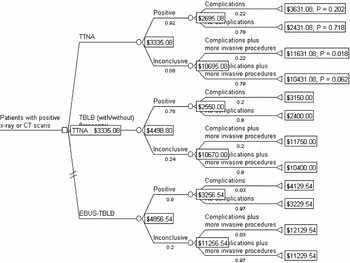
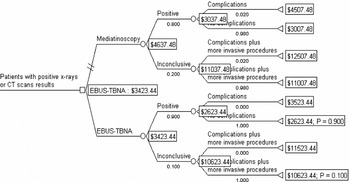
Two decision analytic models (Figures 1 and 2) were constructed to evaluate the cost-effectiveness of EBUS as compared to conventional diagnosis and staging modalities. The models represent the clinical pathways for the diagnosis or staging of patients with suspected lung cancer, following X-rays or CT thorax results. Conventional diagnostic modalities include (i) transthoracic needle aspiration (TTNA) for peripheral lung lesions, (ii) transbronchial lung biopsy (TBLB) (with fluoroscopy), and (iii) other more invasive modalities such as video-assisted thoracoscopic surgery (VATS) or thoracotomy. Conventional staging modalities include (i) mediastinoscopy/mediastinotomy.
Decision tree: diagnosis of lung cancer.

Decision tree: staging of lung cancer.

The algorithm ends when patients were accurately diagnosed or staged. Pretreatment diagnosis and staging were considered as one-off events.
All costs were estimated from the societal perspective; using average full fee-paying bill sizes (without government subsidies) from Singapore General Hospital.
The bills include fees for the facility and manpower (surgeon's time) as well as the consumables incurred. At least 20 patients’ bills were used to compute the average bill sizes for each modality.
Indirect costs were not considered in the current analysis although the authors acknowledged that the introduction of EBUS could be associated with significant indirect cost savings, given that it is a less invasive procedure performed in the out-patient setting. We estimate that one to 3.5 hospital bed days could be saved with the appropriate use of EBUS in place of conventional modalities.
Indirect costs would include (i) loss of income/productivity for younger patients (less than 65 years old), and (ii) need for care-giver postprocedure. The analysis was performed using TreeAge Pro(tm).
ASSUMPTIONS
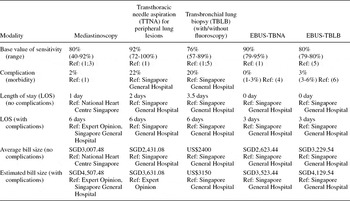
The models are based on a few assumptions: (i) No specific indications for any of the diagnostic or staging modalities exist; hence, it is assumed that an equal proportion of patients will be indicated for each of the modalities available. (ii) In the event that the various diagnostic and staging modalities fail, the costs of further investigative procedures is assumed to be SGD8,000 (SGD1 = US$0.72). This is based on the average cost for VATS or thoracotomy. (iii) The costs of complications were based on the average extended length of hospitalization, with each extended day of hospitalization costing SGD300. For example, estimated bill size for mediastinoscopy with complications (SGD4,507.48) is derived by adding SGD1500 (5 × 300) to SGD3,007.48 (Table 1).
Base Values of Variables for the Chosen Modalities

RESULTS
For the base–case analysis, TTNA was the most economical strategy (SGD3,335 per deterministic diagnosis) for the diagnosis of lung cancer as compared to the other options: TBLB (SGD4,499) and EBUS-TBLB (SGD4,857) (Figure 1). However, there are clinical constraints to the use of TTNA. First, TTNA is suitable only for peripheral lung lesions which are likely to be malignant, while EBUS-TBLB can be performed for lung lesions (both malignant and benign) in both central and peripheral locations. Second, according to American College of Chest Physicians (ACCP) (1), the yield for TTNA decreases as the lesion size is < 2 cm. Third, TTNA is associated with a high complication rate of 22 percent and up to an additional 4 days length of stay. The extended length of stay adversely impact on availability of beds and long waiting times at emergency departments.
On the other hand, EBUS-TBNA resulted in expected cost savings of SGD1,214 per positive staging of lung cancer as compared to mediastinoscopy (Figure 2).
SENSITIVITY ANALYSIS
Sensitivity analysis showed that TTNA remained the least costly option unless almost 100 percent sensitivity can be achieved with EBUS-TBLB. TTNA was also the least costly option, even after we take into account possible higher rates of complication with EBUS-TBLB (Supplementary Figure 1, which is available at www.journals.cambridge.org/thc2010014).
For the staging of lung cancer, sensitivity analysis showed that EBUS-TBNA was less costly than mediastinoscopy, provided the sensitivity of EBUS-TBNA remained above 74 percent. EBUS-TBNA remained more economical than mediastinoscopy at higher probability of complications, provided the sensitivity of EBUS-TBNA is above 82 percent (Supplementary Figure 2, which is available at www.journals.cambridge.org/thc2010014).
CONCLUSION
This analysis has demonstrated that the use of EBUS-TBNA could result in cost savings of SGD1,214 per positive staging of lung cancer as compared to mediastinoscopy. The validity of the model and its conclusion can be further verified as more patients undergo EBUS procedures and outcomes data are collected in the local setting. Whereas TTNA was the most economical strategy (SGD3,335) for the diagnosis of lung cancer as compared to the other options, its main limitation lies in its suitability only for peripheral lung lesions and high complication rate.
CONTACT INFORMATION
Shin Yuh Ang, MBA, BSc, RN (ang.shin.yuh@singhealth.com.sg), Policy Analyst, Centre for Health Services Research, Singapore Health Services Pte Ltd., 226 Outram Road, Block A, #03-01, Singapore, 169039
Rachel Woo Yin Tan, MA, BSc (rachel_tan@jgh.com.sg), Assistant Manager, Corporate Planning, Jurong General Hospital, Block 22, 378 Alexandra Road, Singapore, 159964
Mariko Siyue Koh, MBBS, MRCP (UK), FCCP (mariko.koh.s.y@sgh.com.sg), Consultant, Department of Respiratory and Critical Medicine, Singapore General Hospital, 226 Outram Road, Block A, #03-01, Singapore, 169039
Jeremy Lim, MBBS MPH (jeremy.lim.f.y@singhealth.com.sg), Chair, Advisory Committee, Centre for Health Services Research, Singapore Health Services Pte Ltd., 226 Outram Road, Block A, #03-01, Singapore, 169039
SUPPLEMENTARY MATERIAL
Supplementary Figure 1
Supplementary Figure 2