


1 Introduction
Theta divisors on Jacobian varieties have been studied a lot for their particular properties. If  $C$ is a smooth complex projective curve of genus
 $g\geqslant 2$ and
 $A=JC$ is its Jacobian variety, then Riemann’s theorem says that the theta divisor is a sum
 $$\begin{eqnarray}\unicode[STIX]{x1D6E9}=C+\cdots +C\subset A\end{eqnarray}$$
of  $g-1$ copies of the curve when the latter is embedded in the Jacobian via a suitable translate of the Abel–Jacobi map. Hence, if for
 $d\in \{0,1,\ldots ,g-1\}$ we denote by
 $W_{d}\subset A$ the image of the sum map
 $C^{d}\rightarrow A$ for the above translate of the Abel–Jacobi map, the theta divisor admits the decompositions as a sum
 $$\begin{eqnarray}\unicode[STIX]{x1D6E9}=W_{d}+W_{g-1-d}=-W_{d}-W_{g-1-d}.\end{eqnarray}$$
In this paper we prove the following converse of Riemann’s theorem.
Theorem 1.1. If  $A$ is the Jacobian of a smooth projective curve of genus
 $g\geqslant 2$, then up to translation of the summands the above are the only decompositions of the theta divisor as a sum
 $\unicode[STIX]{x1D6E9}=X+Y$ of subvarieties
 $X,Y\subset A$.
This can be seen as a counterpart to Debarre’s result on subvarieties of minimal cohomology class in Jacobians [Reference DebarreDeb95]. For summands with  $\dim X=1$ it is due to Schreieder [Reference SchreiederSch16] who showed that the existence of a curve summand of the theta divisor characterizes Jacobians among all principally polarized abelian varieties; this seems to be the only case where the result was known. There is another famous example of theta divisors with summands: for any smooth cubic threefold
 $T\subset \mathbb{P}^{4}$ the intermediate Jacobian
 $A=JT$ is a principally polarized abelian fivefold, and Clemens and Griffiths [Reference Clemens and GriffithsCG72] have shown that its theta divisor decomposes as a sum
 $$\begin{eqnarray}\unicode[STIX]{x1D6E9}=S+(-S)=(-S)+S,\end{eqnarray}$$
where  $S\subset A$ is a copy of the Fano surface of the threefold. Again we show the following converse.
Theorem 1.2. If  $A$ is the intermediate Jacobian of a smooth cubic threefold, then up to translation of the summands the above are the only decompositions of the theta divisor as a sum
 $\unicode[STIX]{x1D6E9}=X+Y$ of positive-dimensional subvarieties
 $X,Y\subset A$.
Under the additional assumption that the summands have minimal cohomology class, this is a result of Casalaina-Martin, Popa and Schreieder [Reference Casalaina-Martin, Popa and SchreiederCPS18]; for a further discussion of summands of theta divisors and generic vanishing subschemes we refer to [Reference SchreiederSch17]. Our approach is very different, it provides a general method to detect all summands of a given subvariety without assuming minimality of their cohomology class. We hope that our techniques may be useful for the question of Pareschi and Popa whether there are any other theta divisors with non-trivial summands [Reference SchreiederSch16, Conjecture 19] and for Debarre’s minimal class conjecture [Reference DebarreDeb95].
To find all possible decompositions of a given subvariety  $Z\subset A$ as a sum
 $Z=X+Y$ of subvarieties
 $X,Y\subset A$, we use the theory of perverse sheaves and the decomposition theorem of Beilinson, Bernstein, Deligne and Gabber [Reference Beilinson, Bernstein and DeligneBBD82, Reference de Cataldo and MigliorinidCM09]. Let
 $\text{Perv}(\mathbb{C}_{A})$ be the category of perverse sheaves on the abelian variety. Inside it we have the perverse intersection cohomology sheaves
 $\unicode[STIX]{x1D6FF}_{X},\unicode[STIX]{x1D6FF}_{Y},\unicode[STIX]{x1D6FF}_{Z}\in \text{Perv}(\mathbb{C}_{A})$ on
 $X,Y,Z\subset A$. Since these are simple perverse sheaves, the decomposition theorem for the addition map
 $a:X\times Y{\twoheadrightarrow}Z$ gives an embedding as a direct summand
 $\unicode[STIX]{x1D6FF}_{Z}{\hookrightarrow}\unicode[STIX]{x1D6FF}_{X}\ast \unicode[STIX]{x1D6FF}_{Y}=Ra_{\ast }(\unicode[STIX]{x1D6FF}_{X}\boxtimes \unicode[STIX]{x1D6FF}_{Y})$ in the derived category of constructible sheaves. Here
 $\ast$ denotes the additive convolution of perverse sheaves on
 $A$, which is controlled by the Tannakian formalism of [Reference KrämerKrä14, Reference Krämer and WeissauerKW15b]. For the Tannakian groups of the respective perverse sheaves this gives an epimorphism
 $$\begin{eqnarray}p:\quad G(\unicode[STIX]{x1D6FF}_{X}\oplus \unicode[STIX]{x1D6FF}_{Y}){\twoheadrightarrow}G(\unicode[STIX]{x1D6FF}_{Z}).\end{eqnarray}$$
The key observation of this paper is that in the cases relevant for Theorems 1.1 and 1.2 the map  $p$ induces an isomorphism on Lie algebras, which intuitively means that most information about the unknown summands
 $X,Y$ is determined by
 $Z$: in §2 we will deduce from the results of [Reference KrämerKrä18] that up to isogeny the summands can be read off from characteristic cycles of the perverse sheaves defined by irreducible representations of the group
 $G(\unicode[STIX]{x1D6FF}_{Z})$. For Jacobians of curves these perverse sheaves are the Brill–Noether sheaves introduced by Weissauer in [Reference WeissauerWei06], and in §§3 and 4 we describe their characteristic cycles using the Abel–Jacobi map and the combinatorics of highest weights for the Tannakian groups
 $\mathit{Sp}_{2g-2}(\mathbb{C})$ and
 $\mathit{Sl}_{2g-2}(\mathbb{C})$. For intermediate Jacobians the argument is similar but now the Tannakian group is the exceptional group
 $E_{6}(\mathbb{C})$ [Reference KrämerKrä16a]; this case will be discussed in §5.
2 Reduction to Brill–Noether sheaves
Let  $A$ be a complex abelian variety and
 $Z\subset A$ an irreducible proper closed subvariety. In this section we describe a general method to determine all possible decompositions
 $Z=X+Y$ as a sum of irreducible geometrically non-degenerate subvarieties
 $X,Y\subset A$. For the notion of geometric non-degeneracy we refer to [Reference RanRan80, p. 466].
2.1 Perverse sheaves and the decomposition theorem
The first step is to reformulate the existence of such a decomposition in terms of the perverse intersection cohomology sheaves  $\unicode[STIX]{x1D6FF}_{X},\unicode[STIX]{x1D6FF}_{Y},\unicode[STIX]{x1D6FF}_{Z}\in \text{Perv}(\mathbb{C}_{A})$.
Lemma 2.1. If  $a:X\times Y{\twoheadrightarrow}Z$ denotes the addition map, we have an embedding as a direct summand
 $$\begin{eqnarray}\unicode[STIX]{x1D6FF}_{Z}{\hookrightarrow}Ra_{\ast }(\unicode[STIX]{x1D6FF}_{X}\boxtimes \unicode[STIX]{x1D6FF}_{Y}).\end{eqnarray}$$
Proof. The geometric non-degeneracy of the summands implies by [Reference DebarreDeb05, §8.2] that the sum map  $a:X\times Y{\twoheadrightarrow}Z$ is generically finite, and hence restricts to a finite étale cover over some smooth open dense subset
 $U\subseteq Z$. By adjunction we then have an embedding as a direct summand
 $\mathbb{C}_{U}{\hookrightarrow}a_{\ast }(\mathbb{C}_{X\times Y})|_{U}$, and shifting by
 $\dim Z=\dim X+\dim Y$ to make both sides perverse, we get the desired embedding over the smooth open dense subset
 $U\subseteq Z$. The claim then follows by the decomposition theorem [Reference Beilinson, Bernstein and DeligneBBD82, Reference de Cataldo and MigliorinidCM09].◻
The direct image in the above lemma can be rewritten as  $Ra_{\ast }(\unicode[STIX]{x1D6FF}_{X}\boxtimes \unicode[STIX]{x1D6FF}_{Y})=\unicode[STIX]{x1D6FF}_{X}\ast \unicode[STIX]{x1D6FF}_{Y}$ for the convolution product
 $\ast$ from [Reference KrämerKrä14, Reference Krämer and WeissauerKW15b, Reference KrämerKrä16b]. To fix notations let us briefly recall from loc. cit. the Tannakian description of this convolution product.
2.2 A Tannakian description
The generic vanishing theorem on abelian varieties [Reference Krämer and WeissauerKW15b, Reference SchnellSch15] says that for any perverse sheaf  $P\in \text{Perv}(\mathbb{C}_{A})$, its tensor product with a sufficiently general local system
 $L$ of rank one has no hypercohomology in non-zero degrees, i.e.
 $H^{i}(A,P\otimes L)=0$ for all
 $i\neq 0$. We say that the perverse sheaf is negligible if there is also no hypercohomology in degree zero, i.e. if the following two equivalent conditions hold ([Reference SchnellSch15, Theorem 7.6] and [Reference WeissauerWei16]):
∙
 $H^{0}(A,P\otimes L)=0$ for a sufficiently general local system $L$ of rank one,
∙ each simple perverse subquotient in a Jordan–Hölder series for
$P$ is stable under translations by some positive-dimensional abelian subvariety.



Consider the abelian quotient category  $\text{P}(A)=\text{Perv}(\mathbb{C}_{A})/\text{S}(A)$, where
 $\text{S}(A)$ denotes the Serre subcategory of negligible perverse sheaves. It has been shown in [Reference Krämer and WeissauerKW15b, Reference KrämerKrä14] that this quotient category is a rigid abelian tensor category with respect to the convolution product
 $$\begin{eqnarray}\ast :\quad \text{P}(A)\times \text{P}(A)\rightarrow \text{P}(A),\quad P_{1}\ast P_{2}=Ra_{\ast }(P_{1}\boxtimes P_{2}),\end{eqnarray}$$
where  $a:A\times A\rightarrow A,(x,y)\mapsto x+y$ is the addition map, and that for any
 $P\in \text{P}(A)$ the subcategory
 $$\begin{eqnarray}\langle P\rangle =\Big\{\substack{ \text{smallest rigid abelian tensor} \\ \text{subcategory containing P}}\Big\}\subset \text{P}(A)\end{eqnarray}$$
is a neutral Tannakian category: it admits a faithful exact  $\mathbb{C}$-linear tensor functor
 $\unicode[STIX]{x1D714}$ to the category
 $\text{Vect}(\mathbb{C})$ of finite-dimensional complex vector spaces. Any such fiber functor induces an equivalence
 $$\begin{eqnarray}\unicode[STIX]{x1D714}:\quad \langle P\rangle \stackrel{{\sim}}{\longrightarrow }\text{Rep}(G)\end{eqnarray}$$
with the  $\mathbb{C}$-linear abelian tensor category of complex algebraic representations of some affine algebraic group
 $G=G(P,\unicode[STIX]{x1D714})$. There is no canonical fiber functor; changing the fiber functor will replace the Tannakian group by an isomorphic one. For an explicit choice one can proceed as in [Reference Gabber and LoeserGL96]: any
 $Q\in \text{P}(A)=\text{Perv}(\mathbb{C}_{A})/\text{S}(A)$ has a unique representative
 $Q_{\text{int}}\in \text{Perv}(\mathbb{C}_{A})$ without negligible subobjects or quotients, and if
 $L$ is a sufficiently general local system of rank one, then
 $$\begin{eqnarray}\langle P\rangle \longrightarrow \text{Vect}(\mathbb{C}),\quad Q\mapsto H^{0}(A,Q_{\text{int}}\otimes L)\end{eqnarray}$$
is a fiber functor. Here the notion of general depends on the perverse sheaf  $P\in \text{P}(A)$, but all arguments of this paper can be read in the Tannakian category generated by some fixed perverse sheaf, see §2.4 below. Any fiber functor on this ambient category gives by restriction a consistent choice of fiber functors on all its tensor subcategories. We fix such a consistent choice and simply write
 $G(P)=G(P,\unicode[STIX]{x1D714})$ for any
 $P\in \text{P}(A)$ that occurs in this paper.
Lemma 2.2. For any  $Q\in \langle P\rangle$ we have a natural epimorphism
 $p:G(P){\twoheadrightarrow}G(Q)$.
Proof. By construction we have an embedding  $\langle Q\rangle {\hookrightarrow}\langle P\rangle$ as a full tensor subcategory that is stable under subobjects and quotients, and we have chosen the fiber functors in a compatible way on these categories. So [Reference Deligne and MilneDM82, Corollary 2.9 and Proposoition 2.21] applies.◻
2.3 The ring of clean cycles
Before we come back to our concrete geometric problem, we need to recall a few facts about characteristic cycles. For a closed subvariety  $Z\subset A$ we define its conormal variety
 $\unicode[STIX]{x1D6EC}_{Z}\subset T^{\ast }A$ as the Zariski closure of the conormal bundle to its smooth locus. This is a conic Lagrangian subvariety, and any conic Lagrangian subvariety
 $\unicode[STIX]{x1D6EC}\subset T^{\ast }A$ arises like this. By the Gauss map of
 $\unicode[STIX]{x1D6EC}$ we mean the projection
 $$\begin{eqnarray}\unicode[STIX]{x1D6FE}:\quad \unicode[STIX]{x1D6EC}\subset T^{\ast }A=A\times V{\twoheadrightarrow}V=H^{0}(A,\unicode[STIX]{x1D6FA}_{A}^{1}),\quad (p,v)\mapsto v\end{eqnarray}$$
to the fiber of the trivial cotangent bundle. For dimension reasons this map is generically finite or non-dominant. We denote its generic degree by  $\deg (\unicode[STIX]{x1D6EC})\in \mathbb{N}\cup \{0\}$ and say that
 $\unicode[STIX]{x1D6EC}$ is negligible if
 $\deg (\unicode[STIX]{x1D6EC})=0$. The degree extends additively to the group of conic Lagrangian cycles. Any cycle decomposes uniquely as a sum of a negligible and a clean part, where a cycle is called clean if it has no negligible components. The group
 $$\begin{eqnarray}\mathscr{L}(A)=\{\text{clean conic Lagrangian cycles on }T^{\ast }A\}\end{eqnarray}$$
has a natural ring structure where the product  $\circ$ of clean conic Lagrangian cycles is induced by the correspondence

that comes from the addition on the abelian variety [Reference KrämerKrä18]. By loc. cit. the map that sends a perverse sheaf to the clean part of its characteristic cycle is a ring homomorphism
 $$\begin{eqnarray}\text{cc}:\quad K^{0}(\text{P}(A),\oplus ,\ast )\longrightarrow (\mathscr{L}(A),+,\circ ),\end{eqnarray}$$
where the left-hand side denotes the Grothendieck ring with respect to split exact sequences, with the ring structure given by convolution. We use the lowercase notation  $\text{cc}$ to emphasize that we only look at the clean part of the characteristic cycle, discarding any negligible components, and similarly for the characteristic variety
 $\text{char}(-)=\text{Supp}(\text{cc}(-))$.
For the proof of Theorems 1.1 and 1.2 we also need to control multilinear algebra constructions in the arising  $\mathbb{C}$-linear abelian tensor categories. The Grothendieck ring
 $R$ of any such category is endowed with a family of maps
 $\unicode[STIX]{x1D706}^{n}:R\rightarrow R$ induced by the alternating powers for
 $n\in \mathbb{N}_{0}$, which satisfy the relations
 $$\begin{eqnarray}\unicode[STIX]{x1D706}^{0}(a)=1,\quad \unicode[STIX]{x1D706}^{1}(a)=a,\quad \unicode[STIX]{x1D706}^{n}(a+b)=\mathop{\sum }_{i=0}^{n}\unicode[STIX]{x1D706}^{i}(a)\unicode[STIX]{x1D706}^{n-i}(b)\quad \text{and}\quad \unicode[STIX]{x1D706}^{n}(1)=0\end{eqnarray}$$
for all  $a,b\in R$,
 $n>1$. By [Reference HeinlothHei07, Lemma 4.1] also
 $$\begin{eqnarray}\displaystyle \unicode[STIX]{x1D706}^{n}(ab) & = & \displaystyle P_{n}(\unicode[STIX]{x1D706}^{1}(a),\ldots ,\unicode[STIX]{x1D706}^{n}(a),\unicode[STIX]{x1D706}^{1}(b),\ldots ,\unicode[STIX]{x1D706}^{n}(b)),\nonumber\\ \displaystyle \unicode[STIX]{x1D706}^{m}(\unicode[STIX]{x1D706}^{n}(a)) & = & \displaystyle P_{m,n}(\unicode[STIX]{x1D706}^{1}(a),\ldots ,\unicode[STIX]{x1D706}^{mn}(a)),\nonumber\end{eqnarray}$$
where  $P_{n},P_{m,n}$ are universal polynomials with integer coefficients describing the composition of alternating powers with tensor products, respectively, with alternating powers. A commutative unital ring
 $R$ with maps
 $\unicode[STIX]{x1D706}^{n}:R\rightarrow R$ satisfying all these properties is called a
 $\unicode[STIX]{x1D706}$-ring. It is often more convenient to use the Adams operations, natural ring homomorphisms
 $\unicode[STIX]{x1D6F9}^{n}:R\rightarrow R$, which can be expressed in terms of the
 $\unicode[STIX]{x1D706}$-operations in the same way as the power sum polynomials are in terms of the elementary symmetric ones: we have
 $\unicode[STIX]{x1D6F9}^{n}=f_{n}(\unicode[STIX]{x1D706}^{1},\ldots ,\unicode[STIX]{x1D706}^{n})$, where
 $f_{n}\in \mathbb{Z}[t_{1},\ldots ,t_{n}]$ is defined by
 $$\begin{eqnarray}p_{n}=f_{n}(e_{1},\ldots ,e_{n})\quad \text{for }\left\{\begin{array}{@{}l@{}}p_{n}=\mathop{\sum }_{i=1}^{\infty }x_{i}^{n},\quad \\ e_{n}=\mathop{\sum }_{i_{1}<\cdots <i_{n}}x_{i_{1}}\cdots x_{i_{n}}.\quad \end{array}\right.\end{eqnarray}$$
If  $R$ has no
 $\mathbb{Z}$-torsion, then from the Adams operations we can recover the
 $\unicode[STIX]{x1D706}^{n}$ since the elementary symmetric polynomials are rational polynomials in power sums.
Example 2.3. The ring  $\mathscr{L}(A)$ has no
 $\mathbb{Z}$-torsion. By [Reference KrämerKrä18] it is a
 $\unicode[STIX]{x1D706}$-ring whose Adams operations are
 $$\begin{eqnarray}\unicode[STIX]{x1D6F9}^{n}=[n]_{\ast }:\quad \mathscr{L}(A)\longrightarrow \mathscr{L}(A),\end{eqnarray}$$
the pushforward of cycles under the multiplication map  $[n]:A\times V\rightarrow A\times V,(x,v)\mapsto (nx,v)$, and
 $$\begin{eqnarray}\text{cc}:\quad K^{0}(\text{P}(A),\oplus ,\ast )\longrightarrow (\mathscr{L}(A),+,\circ )\end{eqnarray}$$
is a  $\unicode[STIX]{x1D706}$-ring homomorphism in the sense that
 $\text{cc}(\unicode[STIX]{x1D6F9}^{n}(P))=[n]_{\ast }(\text{cc}(P))$ for all
 $P\in \text{P}(A)$. In what follows we will usually work in suitable finitely generated subrings. For any cycle
 $\unicode[STIX]{x1D6EC}\in \mathscr{L}(A)$, we denote by
 $\langle \unicode[STIX]{x1D6EC}\rangle \subset \mathscr{L}(A)$ the smallest subring that contains this cycle and is stable under taking irreducible components of the support of cycles. By loc. cit. this subring is stable under the Adams operations, and by restriction of the homomorphism
 $\text{cc}$ we get a homomorphism of
 $\unicode[STIX]{x1D706}$-rings
 $$\begin{eqnarray}\text{cc}:\quad K^{0}(\langle P\rangle ,\oplus ,\ast )\longrightarrow \langle \text{cc}(P)\rangle \quad \text{for any }P\in \text{P}(A).\end{eqnarray}$$
2.4 How to see summands on the Tannakian side
Let  $Z=X+Y\subset A$ be a proper subvariety that is a sum of geometrically non-degenerate subvarieties of positive dimension. In the following we assume the summands
 $X,Y$ are fixed, though a priori not known explicitly. We want to reconstruct them from a given
 $P_{Z}\in \text{Perv}(\mathbb{C}_{A})$, which later will be taken to be the intersection cohomology sheaf on a translate of the curve or the Fano surface; see Theorem 2.7. Put
 $$\begin{eqnarray}\unicode[STIX]{x1D6FF}_{XY}=\unicode[STIX]{x1D6FF}_{X}\oplus \unicode[STIX]{x1D6FF}_{Y}\in \text{Perv}(\mathbb{C}_{A}).\end{eqnarray}$$
All that follows will take place in the Tannakian category  $\langle \unicode[STIX]{x1D6FF}_{XY}\oplus P_{Z}\rangle$. We fix a fiber functor
 $\unicode[STIX]{x1D714}$ on this ambient category and thus obtain a consistent choice of fiber functors for all perverse sheaves to be considered below. Lemma 2.1 can then be reformulated as follows.
Lemma 2.4. We have a natural epimorphism  $p:G(\unicode[STIX]{x1D6FF}_{XY}){\twoheadrightarrow}G(\unicode[STIX]{x1D6FF}_{Z})$.
Proof. Lemma 2.1 says that  $\unicode[STIX]{x1D6FF}_{Z}\in \langle \unicode[STIX]{x1D6FF}_{X}\ast \unicode[STIX]{x1D6FF}_{Y}\rangle \subset \langle \unicode[STIX]{x1D6FF}_{XY}\rangle$, so Lemma 2.2 applies since we have chosen the fiber functors on our tensor categories in a consistent way.◻
Note that  $G(\unicode[STIX]{x1D6FF}_{Z})\neq \{1\}$, indeed the stabilizer
 $\text{Stab}(Z)=\{a\in A(\mathbb{C})\mid Z+a=Z\}$ is finite because the sum of geometrically non-degenerate subvarieties is geometrically non-degenerate by [Reference DebarreDeb05, Corollary 8.11]. Applying an isogeny to the abelian variety one reduces to the case where this stabilizer is trivial, and replacing all subvarieties by certain translates we can make their Tannakian groups semisimple [Reference KrämerKrä18, Lemma 5.3.1]. We may therefore assume the following properties:



The last condition seems unreasonably strong but holds in our applications [Reference KrämerKrä16a].
Proposition 2.5. If (i)–(iii) hold, then  $p:G(\unicode[STIX]{x1D6FF}_{XY}){\twoheadrightarrow}G(\unicode[STIX]{x1D6FF}_{Z})$ is an isogeny.
Proof. We must show that the kernel of the epimorphism  $p$ is finite. On Lie algebras this epimorphism splits as the projection to a direct summand. So
 $$\begin{eqnarray}\text{Lie}(G(\unicode[STIX]{x1D6FF}_{XY}))=\mathfrak{g}_{1}\oplus \mathfrak{g}_{2}\quad \text{where }\left\{\begin{array}{@{}l@{}}\mathfrak{g}_{1}=\text{Lie}(G(\unicode[STIX]{x1D6FF}_{Z})),\quad \\ \mathfrak{g}_{2}=\text{Lie}(\ker (p)),\quad \end{array}\right.\end{eqnarray}$$
and we want to show that the second summand in this decomposition is zero. By assumption (i) we know  $\text{Stab}(S)\subseteq \text{Stab}(Z)=\{0\}$ for
 $S=X,Y$, and hence
 $\unicode[STIX]{x1D714}(\unicode[STIX]{x1D6FF}_{S})$ remains an irreducible representation for the connected component of
 $G(\unicode[STIX]{x1D6FF}_{XY})$ [Reference KrämerKrä16b, Corollary 1.6]. As a representation of
 $\text{Lie}(G(\unicode[STIX]{x1D6FF}_{XY}))=\mathfrak{g}_{1}\times \mathfrak{g}_{2}$ then

and we have

Now  $\mathfrak{g}_{2}$ is a semisimple Lie algebra by assumption (ii), so in order to show that it is trivial we only need to see that it is abelian. Hence, it will be enough to show that
 $\dim V_{S,2}=1$ for
 $S=X,Y$ because
 $V_{X,2}\oplus V_{Y,2}\in \text{Rep}(\mathfrak{g}_{2})$ is a faithful representation. To check that both dimensions are one we look at characteristic cycles.
By [Reference KrämerKrä18, §2.3] the decomposition (iv) is mirrored on the level of characteristic cycles up to an isogeny: there exists a natural number  $n\in \mathbb{N}$ such that

of degree  $\deg (\unicode[STIX]{x1D6EC}_{S,i})=\dim (V_{S,i})$. Similarly, the inclusion (v) gives an inequality of effective clean cycles

Here  $\circ$ denotes the product in the ring
 $\mathscr{L}(A)$ of §2.3, and for
 $P\in \text{P}(A)$ we consider as in Example 2.3 the smallest subring
 $\langle \text{cc}(P)\rangle \subset \mathscr{L}(A)$ containing
 $\text{cc}(P)$ and stable under the passage to irreducible components. Note that in (
) the conormal variety  $\unicode[STIX]{x1D6EC}_{nS}\leqslant \text{cc}(\unicode[STIX]{x1D6FF}_{nS})=\unicode[STIX]{x1D6EC}_{S,1}\circ \unicode[STIX]{x1D6EC}_{S,2}$ enters with multiplicity one and is the unique component whose base is a subvariety of dimension
 $\dim (S)$ in
 $A$. So in order to show
 $\deg (\unicode[STIX]{x1D6EC}_{S,2})=1$ we only need to see that
 $\unicode[STIX]{x1D6EC}_{S,2}$ is a sum of conormal varieties to a finite number of points in
 $A$, since then there can be only one such point. In other words, we want to show
 $$\begin{eqnarray}\dim (\unicode[STIX]{x1D70B}(\text{Supp}(\unicode[STIX]{x1D6EC}_{S,2})))=0\quad \text{for the projection }\unicode[STIX]{x1D70B}:\quad T^{\ast }A\rightarrow A.\end{eqnarray}$$
To check this last claim we consider Chern–Mather classes. If  $\unicode[STIX]{x1D6EC}\in \mathscr{L}(A)$ is any clean effective cycle and we put
 $d(\unicode[STIX]{x1D6EC})=\dim (\unicode[STIX]{x1D70B}(\text{Supp}(\unicode[STIX]{x1D6EC})))$, then by [Reference KrämerKrä18, Lemma 3.1.2] we know that
 $$\begin{eqnarray}c_{M,i}(\unicode[STIX]{x1D6EC})\in \text{CH}_{i}(A)\text{ is }\left\{\begin{array}{@{}l@{}}\text{zero for all }i>d(\unicode[STIX]{x1D6EC}),\quad \\ \text{a non-zero effective cycle for all }i\in \{0,1,\ldots ,d(\unicode[STIX]{x1D6EC})\}.\quad \end{array}\right.\end{eqnarray}$$
So we only need to show for the first Chern–Mather class that  $c_{M,1}(\unicode[STIX]{x1D6EC}_{S,2})=0$. As
 $\unicode[STIX]{x1D6EC}_{S,1}\in \langle \text{cc}(\unicode[STIX]{x1D6FF}_{Z})\rangle$, the Gauss map
 $\unicode[STIX]{x1D6FE}:\mathbb{P}\text{Supp}(\unicode[STIX]{x1D6EC}_{S,1})\rightarrow \mathbb{P}V$ is finite by assumption (iii). By [Reference KrämerKrä18, Lemma 3.3.1] we then have

for  $d<\dim A$ and the Pontryagin product
 $\ast$ on the Chow ring. The Pontryagin product of non-zero effective cycles is non-zero effective. Since for
 $d=\dim (S)+1$ the left-hand side in (
) vanishes, all summands on the right-hand side must vanish as well, so we get

Putting everything together we have
 $$\begin{eqnarray}\displaystyle \begin{array}{@{}rclcl@{}}\dim (Z)\ & {\leqslant}\ & d(\unicode[STIX]{x1D6EC}_{X,1}\circ \unicode[STIX]{x1D6EC}_{Y,1})\ & \ & \text{by inequality (vii)}\\ \ & {\leqslant}\ & d(\unicode[STIX]{x1D6EC}_{X,1})+d(\unicode[STIX]{x1D6EC}_{Y,1})\ & \ & \text{by definition of}~\circ \\ \ & {\leqslant}\ & \dim (X)+\dim (Y)-d(\unicode[STIX]{x1D6EC}_{X,2})-d(\unicode[STIX]{x1D6EC}_{Y,2})\ & \ & \text{by inequality (ix)}\\ \ & =\ & \dim (Z)-d(\unicode[STIX]{x1D6EC}_{X,2})-d(\unicode[STIX]{x1D6EC}_{Y,2})\ & \hspace{-30.00005pt}\text{since }\dim (Z)=\ & \dim (X)+\dim (Y),\end{array} & & \displaystyle \nonumber\end{eqnarray}$$
which implies  $d(\unicode[STIX]{x1D6EC}_{X,2})=d(\unicode[STIX]{x1D6EC}_{Y,2})=0$ as required.◻
2.5 Adams operations
Usually the above isogeny is not an isomorphism. However, this is not a big problem since we can view representations of any finite cover of a connected semisimple group  $H$ as virtual representations in the ring
 $R(H)=K^{0}(\text{Rep}(H),\oplus ,\otimes )$.
Lemma 2.6. Let  $p:G{\twoheadrightarrow}H$ be an isogeny of connected reductive groups. If
 $n\in \mathbb{N}$ is sufficiently divisible, then the
 $n$th Adams operation on the representation ring
 $R(G)$ factors as
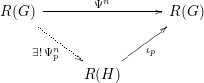
where  $\unicode[STIX]{x1D704}_{p}:R(H){\hookrightarrow}R(G)$ is the embedding of
 $\unicode[STIX]{x1D706}$-rings induced by the isogeny
 $p$.
Proof. If  $T\subset G$ is a maximal torus with character group
 $\mathsf{X}=\text{Hom}(T,\mathbb{G}_{m})$, the character map sending a representation to its weight space decomposition gives an embedding
 $R(G){\hookrightarrow}\mathbb{Z}[\mathsf{X}]$ and
 $\unicode[STIX]{x1D6F9}^{n}$ is induced by the
 $n$th power map of the torus [Reference Bröcker and tom DieckBtD85, Proposition II.7.4]. But any isogeny of tori factors over the
 $n$th power map for
 $n$ dividing the degree of the isogeny.◻
Applying this to the universal cover of the group  $H=G(\unicode[STIX]{x1D6FF}_{Z})$ when this cover is realized by a given
 $P_{Z}\in \text{Perv}(\mathbb{C}_{A})$, we recover the unknown summands
 $X,Y\subset A$ as follows.
Theorem 2.7. Let  $P_{Z}\in \text{Perv}(\mathbb{C}_{A})$ be a perverse sheaf with
 $\unicode[STIX]{x1D6FF}_{Z}\in \langle P_{Z}\rangle$. If the group
 $G(P_{Z})$ is simply connected and moreover assumptions (i)–(iii) hold, then there are simple perverse sheaves
 $\unicode[STIX]{x1D700}_{X},\unicode[STIX]{x1D700}_{Y}\in \langle P_{Z}\rangle$ such that
 $$\begin{eqnarray}\text{cc}(\unicode[STIX]{x1D6FF}_{nX})=[n]_{\ast }\text{cc}(\unicode[STIX]{x1D700}_{X})\quad \text{and}\quad \text{cc}(\unicode[STIX]{x1D6FF}_{nY})=[n]_{\ast }\text{cc}(\unicode[STIX]{x1D700}_{Y})\quad \text{for some }n\in \mathbb{N}.\end{eqnarray}$$
Proof. As before  $\text{Stab}(S)=\{0\}$, and thus
 $\unicode[STIX]{x1D6FF}_{nS}=[n]_{\ast }\unicode[STIX]{x1D6FF}_{S}$ for
 $S=X,Y,Z$ and all
 $n\in \mathbb{N}$. So replacing all perverse sheaves by their direct image under an isogeny we may assume all Tannakian groups to be connected [Reference KrämerKrä16b, Corollary 1.6]. The isogeny
 $p:G(\unicode[STIX]{x1D6FF}_{XY}){\twoheadrightarrow}G(\unicode[STIX]{x1D6FF}_{Z})$ in Proposition 2.5 is then dominated by the universal cover, which in our case is the epimorphism
 $q:G(P_{Z}){\twoheadrightarrow}G(\unicode[STIX]{x1D6FF}_{Z})$ coming from the inclusion
 $\unicode[STIX]{x1D6FF}_{Z}\in \langle P_{Z}\rangle$. Let
 $\unicode[STIX]{x1D711}$ be the unique isogeny making the following diagram commutative.
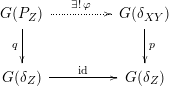
Let  $\unicode[STIX]{x1D704}_{\unicode[STIX]{x1D711}}:\langle \unicode[STIX]{x1D6FF}_{XY}\rangle {\hookrightarrow}\langle P_{Z}\rangle$ be the embedding of tensor categories induced by
 $\unicode[STIX]{x1D711}$ on the level of representation categories. Note that this
 $\unicode[STIX]{x1D704}_{\unicode[STIX]{x1D711}}$ comes from abstract Lie theory and usually it is not the identity on perverse sheaves, even for Jacobians of curves it can happen that for
 $S=X,Y$ the
 $\unicode[STIX]{x1D700}_{S}=\unicode[STIX]{x1D704}_{\unicode[STIX]{x1D711}}(\unicode[STIX]{x1D6FF}_{S})\in \langle P_{Z}\rangle$ satisfy
 $\text{cc}(\unicode[STIX]{x1D700}_{S})\neq \text{cc}(\unicode[STIX]{x1D6FF}_{S})$. But by construction we have a commutative diagram
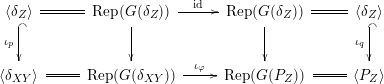
where the outer vertical arrows are the inclusion functors on the level of perverse sheaves, and hence
 $$\begin{eqnarray}\text{cc}(\unicode[STIX]{x1D704}_{q}(\unicode[STIX]{x1D713}))=\text{cc}(\unicode[STIX]{x1D713})=\text{cc}(\unicode[STIX]{x1D704}_{p}(\unicode[STIX]{x1D713}))\quad \text{for all }\unicode[STIX]{x1D713}\in \langle \unicode[STIX]{x1D6FF}_{Z}\rangle .\end{eqnarray}$$
Altogether
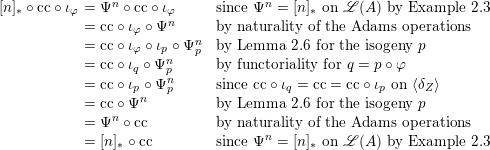 $$\begin{eqnarray}\displaystyle \begin{array}{@{}rcll@{}}[n]_{\ast }\circ \text{cc}\circ \unicode[STIX]{x1D704}_{\unicode[STIX]{x1D711}}\ & =\ & \unicode[STIX]{x1D6F9}^{n}\circ \text{cc}\circ \unicode[STIX]{x1D704}_{\unicode[STIX]{x1D711}} & \text{since }\unicode[STIX]{x1D6F9}^{n}=[n]_{\ast }\text{on }\mathscr{L}(A)\text{ by Example 2.3}\\ \ & =\ & \text{cc}\circ \unicode[STIX]{x1D704}_{\unicode[STIX]{x1D711}}\circ \unicode[STIX]{x1D6F9}^{n} & \text{by naturality of the Adams operations}\\ \ & =\ & \text{cc}\circ \unicode[STIX]{x1D704}_{\unicode[STIX]{x1D711}}\circ \unicode[STIX]{x1D704}_{p}\circ \unicode[STIX]{x1D6F9}_{p}^{n} & \text{by Lemma 2.6 for the isogeny }p\\ \ & =\ & \text{cc}\circ \unicode[STIX]{x1D704}_{q}\circ \unicode[STIX]{x1D6F9}_{p}^{n} & \text{by functoriality for }q=p\circ \unicode[STIX]{x1D711}\\ \ & =\ & \text{cc}\circ \unicode[STIX]{x1D704}_{p}\circ \unicode[STIX]{x1D6F9}_{p}^{n} & \text{since }\text{cc}\circ \unicode[STIX]{x1D704}_{q}=\text{cc}=\text{cc}\circ \unicode[STIX]{x1D704}_{p}\text{ on }\langle \unicode[STIX]{x1D6FF}_{Z}\rangle \\ \ & =\ & \text{cc}\circ \unicode[STIX]{x1D6F9}^{n} & \text{by Lemma 2.6 for the isogeny }p\\ \ & =\ & \unicode[STIX]{x1D6F9}^{n}\circ \text{cc} & \text{by naturality of the Adams operations}\\ \ & =\ & [n]_{\ast }\circ \text{cc} & \text{since }\unicode[STIX]{x1D6F9}^{n}=[n]_{\ast }\text{on }\mathscr{L}(A)\text{ by Example 2.3}\end{array} & & \displaystyle \nonumber\end{eqnarray}$$
and it only remains to plug in the perverse sheaves  $\unicode[STIX]{x1D6FF}_{X},\unicode[STIX]{x1D6FF}_{Y}\in \langle \unicode[STIX]{x1D6FF}_{XY}\rangle$.◻
2.6 Highest weights
The above reduces the classification of all geometrically non-degenerate summands of  $Z\subset A$ to the study of the cycles
 $\text{cc}(\unicode[STIX]{x1D700})$ for the countably many simple perverse sheaves
 $\unicode[STIX]{x1D700}\in \langle P_{Z}\rangle$. If
 $P_{Z}$ is known, this is mainly a computational task using the highest weight theory of the connected reductive group
 $$\begin{eqnarray}G=G(P_{Z}).\end{eqnarray}$$
In the next sections we will carry out the computations for Jacobians, but let us first fix some general notations. Let  $T\subset G$ be a maximal torus with character group
 $\mathsf{X}=\text{Hom}(T,\mathbb{G}_{m})$. Sending a representation to its character gives an isomorphism
 $$\begin{eqnarray}\text{ch}:\quad R(G)\;\stackrel{{\sim}}{\longrightarrow }\;\mathbb{Z}[\mathsf{X}]^{W}\end{eqnarray}$$
from the representation ring to the invariants of the Weyl group  $W=N_{G}(T)/T$ in the character ring. We fix a system
 $\unicode[STIX]{x1D6E5}$ of simple positive roots and denote the corresponding set of dominant weights by
 $\mathsf{X}^{+}\subset \mathsf{X}$. Any Weyl group orbit contains a unique dominant weight, so
 $\mathbb{Z}[\mathsf{X}]^{W}$ has as a
 $\mathbb{Z}$-basis the orbits
 $$\begin{eqnarray}We_{\unicode[STIX]{x1D706}}=\mathop{\sum }_{w\in W}e_{w\unicode[STIX]{x1D706}}\in \mathbb{Z}[\mathsf{X}]^{W}\quad \text{for }\unicode[STIX]{x1D706}\in \mathsf{X}^{+},\end{eqnarray}$$
where  $e_{\unicode[STIX]{x1D707}}\in \mathbb{Z}[\mathsf{X}]$ are the standard basis vectors indexed by
 $\unicode[STIX]{x1D707}\in \mathsf{X}$. On the other hand,
 $R(G)$ has a natural basis consisting of the irreducible representations
 $V_{\unicode[STIX]{x1D706}}\in \text{Rep}(G)$ of highest weight
 $\unicode[STIX]{x1D706}$, where the latter again runs over all dominant weights. The transition between the two bases is given by the Weyl character formula, which computes the multiplicities
 $m_{\unicode[STIX]{x1D706}}(\unicode[STIX]{x1D707})\in \mathbb{N}_{0}$ of the weights in
 $$\begin{eqnarray}\text{ch}(V_{\unicode[STIX]{x1D706}})=\mathop{\sum }_{\unicode[STIX]{x1D707}\in \mathsf{X}^{+}}m_{\unicode[STIX]{x1D706}}(\unicode[STIX]{x1D707})\cdot We_{\unicode[STIX]{x1D707}}.\end{eqnarray}$$
We will only need to know which weights have positive multiplicity. This is easily answered as follows [Reference Goodman and WallachGW09, Corollary 3.2.12], using the dominance order in which  $\unicode[STIX]{x1D707}\preccurlyeq \unicode[STIX]{x1D706}$ iff
 $\unicode[STIX]{x1D706}-\unicode[STIX]{x1D707}$ is a sum of simple positive roots.
Remark 2.8. For  $\unicode[STIX]{x1D706},\unicode[STIX]{x1D707}\in \mathsf{X}^{+}$ one has
 $m_{\unicode[STIX]{x1D706}}(\unicode[STIX]{x1D707})>0$ if and only if
 $\unicode[STIX]{x1D707}\preccurlyeq \unicode[STIX]{x1D706}$.
To any  $\unicode[STIX]{x1D706}\in \mathsf{X}^{+}$ we now attach via our chosen fiber functor
 $\unicode[STIX]{x1D714}:\langle P_{Z}\rangle \stackrel{{\sim}}{\longrightarrow }\text{Rep}(G)$ a simple perverse sheaf
 $\unicode[STIX]{x1D700}_{\unicode[STIX]{x1D706}}\in \langle P_{Z}\rangle$ with
 $\unicode[STIX]{x1D714}(\unicode[STIX]{x1D700}_{\unicode[STIX]{x1D706}})\simeq V_{\unicode[STIX]{x1D706}}$. These form a complete set of representatives for the isomorphism classes of simple perverse sheaves in
 $\langle P_{Z}\rangle$ generalizing the Brill–Noether sheaves from [Reference WeissauerWei06]. To describe their characteristic cycles, let
 $$\begin{eqnarray}\text{cc}:\quad \mathbb{Z}[\mathsf{X}]^{W}\simeq R(G)\simeq \langle P_{Z}\rangle \longrightarrow \langle \text{cc}(P_{Z})\rangle \subset \mathscr{L}(A)\end{eqnarray}$$
be the composite of the clean characteristic cycle with the inverse of  $\text{ch}\circ \unicode[STIX]{x1D714}$. For this composite map we have
 $$\begin{eqnarray}\text{cc}(\unicode[STIX]{x1D700}_{\unicode[STIX]{x1D706}})=\mathop{\sum }_{\unicode[STIX]{x1D707}\in \mathsf{X}^{+}}m_{\unicode[STIX]{x1D706}}(\unicode[STIX]{x1D707})\cdot \text{cc}(\unicode[STIX]{x1D707}),\quad \text{where }\text{cc}(\unicode[STIX]{x1D707})=\text{cc}(We_{\unicode[STIX]{x1D707}}),\end{eqnarray}$$
and hence we know the possible supports in Theorem 2.7 if we can control  $\text{cc}(\unicode[STIX]{x1D707})$ for all dominant weights
 $\unicode[STIX]{x1D707}$. The cases to be considered below are particularly simple because in these cases the monodromy action on a general fiber of the Gauss map coincides with the Weyl group action on weights [Reference KrämerKrä16a, Theorem 9] [Reference KrämerKrä16b, Theorem 2.1].
Remark 2.9. If  $P_{Z}$ is the perverse intersection cohomology sheaf of a curve in its Jacobian or of the Fano surface of a smooth cubic threefold in the intermediate Jacobian, then
 $$\begin{eqnarray}\text{cc}:\quad \mathbb{Z}[\mathsf{X}]^{W}\;\stackrel{{\sim}}{\longrightarrow }\;\langle \text{cc}(P_{Z})\rangle\end{eqnarray}$$
is an isomorphism and all the cycles  $\text{cc}(\unicode[STIX]{x1D707})$ are reduced and irreducible.
Every closed conic Lagrangian subvariety of the cotangent bundle is the conormal variety to its base; we will describe  $\text{cc}(\unicode[STIX]{x1D707})\subset T^{\ast }A$ as a conormal variety in Lemmas 3.3 and 4.3.
3 Brill–Noether sheaves on hyperelliptic Jacobians
Let  $A=JC$ be the Jacobian variety of a smooth curve of genus
 $g>1$. In this section we assume the curve to be hyperelliptic and choose a translate of the Abel–Jacobi map that embeds it as a symmetric subvariety
 $C=-C\subset A$. Then
 $G(\unicode[STIX]{x1D6FF}_{C})$ is the symplectic group of rank
 $n=g-1$ by [Reference Krämer and WeissauerKW15a, Theorem 6.1] [Reference WeissauerWei06], and we have a fiber functor
 $$\begin{eqnarray}\unicode[STIX]{x1D714}:\quad \langle \unicode[STIX]{x1D6FF}_{C}\rangle \;\stackrel{{\sim}}{\longrightarrow }\;\text{Rep}(\mathit{Sp}_{2n}(\mathbb{C}))\end{eqnarray}$$
such that  $\unicode[STIX]{x1D714}(\unicode[STIX]{x1D6FF}_{C})=\mathbb{C}^{2n}$ is the natural representation of the symplectic group.
3.1 Weights for the symplectic group
To fix notations we consider the split form defined by  $\mathit{Sp}_{2n}(\mathbb{C})=\{M\in \mathit{Gl}_{2n}(\mathbb{C})\mid M^{t}\,\unicode[STIX]{x1D6FA}\,M=\unicode[STIX]{x1D6FA}\}$ where

so that the set of diagonal matrices  $T=$
 $\{\!\text{diag}(t_{1},\ldots ,t_{2n})\mid t_{n+i}=t_{i}^{-1}$ for all
 $i\!\}$ is a maximal torus. Sending such a diagonal matrix to its
 $i$th entry defines a character
 $e_{i}\in \mathsf{X}=\text{Hom}(T,\mathbb{G}_{m})$ for
 $1\leqslant i\leqslant n$. These form a basis of
 $\mathsf{X}$ in which we choose
 $$\begin{eqnarray}\displaystyle \unicode[STIX]{x1D6E5} & = & \displaystyle \{e_{i}-e_{i+1}\mid i=1,\ldots ,n-1\}\cup \{2e_{n}\},\nonumber\\ \displaystyle \mathsf{X}^{+} & = & \displaystyle \{\unicode[STIX]{x1D706}\in \mathbb{Z}^{n}\mid \unicode[STIX]{x1D706}_{1}\geqslant \cdots \geqslant \unicode[STIX]{x1D706}_{n}\geqslant 0\}\subset \mathsf{X}=\mathbb{Z}^{n}.\nonumber\end{eqnarray}$$
Another basis of the weight lattice are the fundamental weights  $\unicode[STIX]{x1D71B}_{d}=e_{1}+\cdots +e_{d}$ for
 $1\leqslant d\leqslant n$, which are important since they generate the semigroup of dominant weights. The fundamental representations
 $V_{\unicode[STIX]{x1D71B}_{d}}\in \text{Rep}(\mathit{Sp}_{2n}(\mathbb{C}))$ appear in the alternating powers
 $$\begin{eqnarray}\text{Alt}^{d}(\mathbb{C}^{2n})\simeq \bigoplus _{i=0}^{\lfloor d/2\rfloor }V_{\unicode[STIX]{x1D71B}_{d-2i}}\quad \text{for }d=1,\ldots ,n.\end{eqnarray}$$
On perverse sheaves this is reflected by the geometry of the Abel–Jacobi map.
Example 3.1. For  $d=1,\ldots ,n$ consider the sum map
 $a_{d}:C_{d}=C^{d}/\mathfrak{S}_{d}\longrightarrow A$ for our chosen translate of the curve. In the hyperelliptic case a look at fiber dimensions shows that by the decomposition theorem
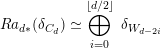 $$\begin{eqnarray}Ra_{d\ast }(\unicode[STIX]{x1D6FF}_{C_{d}})\simeq \bigoplus _{i=0}^{\lfloor d/2\rfloor }\;\unicode[STIX]{x1D6FF}_{W_{d-2i}}\end{eqnarray}$$
and the Brill–Noether sheaves labeled by the fundamental weights are precisely the perverse intersection cohomology sheaves  $\unicode[STIX]{x1D700}_{\unicode[STIX]{x1D71B}_{d}}\simeq \unicode[STIX]{x1D6FF}_{W_{d}}$ [Reference WeissauerWei06, Lemma 20].
Note that the supports in this example are precisely the summands from Theorem 1.1. More generally, for  $\unicode[STIX]{x1D706}\in \mathsf{X}^{+}\subset \mathbb{Z}^{n}$ let us denote by
 $$\begin{eqnarray}\displaystyle d(\unicode[STIX]{x1D706}) & = & \displaystyle \unicode[STIX]{x1D706}_{1}+\cdots +\unicode[STIX]{x1D706}_{n},\nonumber\\ \displaystyle \ell (\unicode[STIX]{x1D706}) & = & \displaystyle \max \{1\leqslant i\leqslant n\mid \unicode[STIX]{x1D706}_{i}>0\}\cup \{0\}\nonumber\end{eqnarray}$$
the degree and length as a partition. We will apply Remark 2.8 as follows.
Lemma 3.2. For any  $\unicode[STIX]{x1D706}\in \mathsf{X}^{+}$ there exists
 $\unicode[STIX]{x1D707}\in \mathsf{X}^{+}$ such that
 $\unicode[STIX]{x1D707}\preccurlyeq \unicode[STIX]{x1D706}$ and
 $\ell (\unicode[STIX]{x1D707})=\min \{d(\unicode[STIX]{x1D706}),n\}$.
Proof. Clearly  $\ell (\unicode[STIX]{x1D706})\leqslant \min \{d(\unicode[STIX]{x1D706}),n\}$. If equality holds, we can take
 $\unicode[STIX]{x1D707}=\unicode[STIX]{x1D706}$. So let us assume strict inequality. In this case we can define
 $i,k$ by
 $1\leqslant i=\max \{j\mid \unicode[STIX]{x1D706}_{j}\geqslant 2\}<k=\ell (\unicode[STIX]{x1D706})+1\leqslant n$; then
 $\unicode[STIX]{x1D708}=\unicode[STIX]{x1D706}-(e_{i}-e_{k})\preccurlyeq \unicode[STIX]{x1D706}$ is a dominant weight with
 $d(\unicode[STIX]{x1D708})=d(\unicode[STIX]{x1D706})$ but
 $\ell (\unicode[STIX]{x1D708})=\ell (\unicode[STIX]{x1D706})+1$, so we are done by ascending induction on the length.◻
3.2 Weyl group orbits and conormal varieties
By Remark 2.9 the irreducible components of characteristic cycles of Brill–Noether sheaves are the conic Lagrangian subvarieties  $\text{cc}(\unicode[STIX]{x1D707})\subset T^{\ast }A$. To describe them, we consider for
 $\unicode[STIX]{x1D707}\in \mathsf{X}^{+}$ the image
 $$\begin{eqnarray}W(\unicode[STIX]{x1D707})=\text{Im}(a_{\unicode[STIX]{x1D707}}:C^{n}\rightarrow A,p\mapsto \unicode[STIX]{x1D707}_{1}p_{1}+\cdots +\unicode[STIX]{x1D707}_{n}p_{n})\subseteq A.\end{eqnarray}$$
Endowed with the reduced subscheme structure this image is geometrically non-degenerate of dimension  $\dim (W(\unicode[STIX]{x1D707}))=\ell (\unicode[STIX]{x1D707})$ by [Reference DebarreDeb05, Corollary 8.11]. Its conormal variety is
 $\text{cc}(\unicode[STIX]{x1D707})$ by the following computation.
Lemma 3.3. We have  $\text{cc}(\unicode[STIX]{x1D707})=\unicode[STIX]{x1D6EC}_{W(\unicode[STIX]{x1D707})}$.
Proof. Since  $\unicode[STIX]{x1D714}(\unicode[STIX]{x1D6FF}_{C})$ is the natural representation of the symplectic group
 $\mathit{Sp}_{2n}(\mathbb{C})$, its highest weight is the fundamental weight
 $\unicode[STIX]{x1D71B}_{1}=e_{1}=(1,0,\ldots ,0)$, whose Weyl group orbit therefore corresponds to the conormal variety
 $$\begin{eqnarray}\text{cc}(\unicode[STIX]{x1D71B}_{1})=\text{cc}(\unicode[STIX]{x1D6FF}_{C})=\unicode[STIX]{x1D6EC}_{C}\end{eqnarray}$$
to the curve. Via the natural identification  $V=H^{0}(C,\unicode[STIX]{x1D714}_{C})$ we regard
 $\mathbb{P}V=|\unicode[STIX]{x1D714}_{C}|$ as the linear series of canonical divisors on the curve, so that
 $$\begin{eqnarray}\mathbb{P}\unicode[STIX]{x1D6EC}_{C}=\{(p,D)\in C\times |\unicode[STIX]{x1D714}_{C}|\mid p\in \text{Supp}(D)\}\end{eqnarray}$$
becomes the incidence variety for the divisors in the canonical linear series. Now let  $u\in V\setminus \{0\}$ be a non-zero global holomorphic differential form. Any canonical divisor is stable under the hyperelliptic involution
 $\unicode[STIX]{x1D704}\in \text{Aut}(C)$, hence
 $$\begin{eqnarray}\text{div}(u)=p_{1}+\cdots +p_{n}+\unicode[STIX]{x1D704}(p_{1})+\cdots +\unicode[STIX]{x1D704}(p_{n})\quad \text{with }p_{1},\ldots ,p_{n}\in C\subset A,\end{eqnarray}$$
and then the group
 $$\begin{eqnarray}\unicode[STIX]{x1D6E4}=\langle a\in A(\mathbb{C})\mid (a,u)\in \unicode[STIX]{x1D6EC}_{C}\rangle\end{eqnarray}$$
is generated by  $p_{1},\ldots ,p_{n}$. On the other hand, for very general
 $u$ we know from [Reference KrämerKrä16b] that
 $\unicode[STIX]{x1D6E4}$ is a free abelian group of rank
 $n$, and hence in loc. cit. we can choose the isomorphism
 $$\begin{eqnarray}p:\quad \mathsf{X}\;\stackrel{{\sim}}{\longrightarrow }\;\unicode[STIX]{x1D6E4}\quad \text{such that }e_{i}\mapsto p_{i},\end{eqnarray}$$
where  $e_{i}\in X$ are the standard basis weights from the previous section. Varying
 $u$ one deduces that for any
 $\unicode[STIX]{x1D707}\in \mathsf{X}^{+}$ the corresponding conic Lagrangian subvariety is given by
 $$\begin{eqnarray}\mathbb{P}\text{cc}(\unicode[STIX]{x1D707})=\text{Im}((a_{\unicode[STIX]{x1D707}},q):C^{n}\rightarrow A\times \mathbb{P}V),\end{eqnarray}$$
where the image on the right-hand side is endowed with the reduced closed subscheme structure and  $q:C^{n}{\twoheadrightarrow}\mathbb{P}V=|\unicode[STIX]{x1D714}_{C}|,D\mapsto D+\unicode[STIX]{x1D704}(D)$ is the map parametrizing canonical divisors as above. So after projecting down from the cotangent bundle to the abelian variety it follows that
 $W(\unicode[STIX]{x1D707})=\text{Im}(\mathbb{P}\text{cc}(\unicode[STIX]{x1D707})\rightarrow A)$. This implies
 $\text{cc}(\unicode[STIX]{x1D707})=\unicode[STIX]{x1D6EC}_{W(\unicode[STIX]{x1D707})}$ because any irreducible Lagrangian cone in the cotangent bundle is the conormal variety to its base.◻
3.3 Characteristic cycles of Brill–Noether sheaves
For hyperelliptic curves the above gives a complete description of the characteristic cycle of Brill–Noether sheaves. In particular, we get the following result.
Proposition 3.4. If  $d=d(\unicode[STIX]{x1D706})\leqslant n$, then
 $\text{Supp}(\unicode[STIX]{x1D700}_{\unicode[STIX]{x1D706}})=p(\text{char}(\unicode[STIX]{x1D700}_{\unicode[STIX]{x1D706}}))=W_{d}$.
Proof. Any dominant weight can be expressed as a non-negative linear combination of the fundamental weights  $\unicode[STIX]{x1D71B}_{i}=e_{1}+\cdots +e_{i}$ with
 $1\leqslant i\leqslant n$. Hence
 $\unicode[STIX]{x1D706}$ can be written as
 $$\begin{eqnarray}\unicode[STIX]{x1D706}=\unicode[STIX]{x1D71B}_{i_{1}}+\cdots +\unicode[STIX]{x1D71B}_{i_{m}}\quad \text{with }1\leqslant i_{1}\leqslant \cdots \leqslant i_{m}\leqslant n.\end{eqnarray}$$
So by representation theory the irreducible representation of highest weight  $\unicode[STIX]{x1D706}$ enters in the tensor product
 $\text{Alt}^{i_{1}}(\mathbb{C}^{2n})\otimes \cdots \otimes \text{Alt}^{i_{m}}(\mathbb{C}^{2n})$ [Reference Goodman and WallachGW09, Theorem 5.5.21], and hence in the
 $d$th tensor power of the natural representation. Geometrically this provides an embedding
 $\unicode[STIX]{x1D700}_{\unicode[STIX]{x1D706}}{\hookrightarrow}(\unicode[STIX]{x1D6FF}_{C})^{\ast d}$ so that
 $\text{Supp}(\unicode[STIX]{x1D700}_{\unicode[STIX]{x1D706}})\subseteq W_{d}$. It remains to show that the conormal variety to the right-hand side is an irreducible component of
 $\text{cc}(\unicode[STIX]{x1D700}_{\unicode[STIX]{x1D706}})$. By assumption
 $d=d(\unicode[STIX]{x1D706})\leqslant n$, so Lemma 3.2 says that
 $$\begin{eqnarray}\unicode[STIX]{x1D707}=(1^{d},0^{n-d})\preccurlyeq \unicode[STIX]{x1D706}.\end{eqnarray}$$
Since  $W(\unicode[STIX]{x1D707})=W_{d}$ by definition, we are done by Remark 2.8 and Lemma 3.3.◻
Note that in the above corollary one has  $\dim (W_{\unicode[STIX]{x1D706}})<\dim (W_{d})$ unless
 $\unicode[STIX]{x1D706}=(1^{d},0^{n-d})$. So in most cases the Weyl group orbit of the highest weight corresponds to a component of the cycle
 $\text{cc}(\unicode[STIX]{x1D706})$ that does not dominate
 $\text{Supp}(\unicode[STIX]{x1D700}_{\unicode[STIX]{x1D706}})$, which means that our proof really needs the combinatorics of weights in Remark 2.8 in a non-trivial way.
Theorem 3.5. For  $\unicode[STIX]{x1D706}\in \mathsf{X}^{+}$ the subvariety
 $S_{\unicode[STIX]{x1D706}}=p(\text{char}(\unicode[STIX]{x1D700}_{\unicode[STIX]{x1D706}}))\subset A$ has
 $\dim S_{\unicode[STIX]{x1D706}}=\min \{d(\unicode[STIX]{x1D706}),g-1\}$; hence, if
 $S_{\unicode[STIX]{x1D706}}$ has dimension
 $d<g-1$, then it follows that
 $S_{\unicode[STIX]{x1D706}}=W_{d}$.
Proof. By Proposition 3.4 we may assume that  $d(\unicode[STIX]{x1D706})>n$. Combining Remark 2.8 with Lemma 3.3 it will suffice to show that in this case there exists a dominant integral weight
 $\unicode[STIX]{x1D707}\preccurlyeq \unicode[STIX]{x1D706}$ with
 $\ell (\unicode[STIX]{x1D707})=n$. But this follows from Lemma 3.2.◻
3.4 Proof of the main theorem for hyperelliptic Jacobians
If  $\unicode[STIX]{x1D6E9}=X+Y$ is a decomposition as a sum of two geometrically non-degenerate subvarieties of positive dimension, then Theorem 2.7 says that there exist
 $n\in \mathbb{N}$ and
 $\unicode[STIX]{x1D706},\unicode[STIX]{x1D707}\in \mathsf{X}^{+}$ such that
 $$\begin{eqnarray}\text{cc}(\unicode[STIX]{x1D6FF}_{nX})=[n]_{\ast }\text{cc}(\unicode[STIX]{x1D700}_{\unicode[STIX]{x1D706}})\quad \text{and}\quad \text{cc}(\unicode[STIX]{x1D6FF}_{nY})=[n]_{\ast }\text{cc}(\unicode[STIX]{x1D700}_{\unicode[STIX]{x1D707}}).\end{eqnarray}$$
Projecting the support of these cycles to the abelian variety we obtain from the last statement in Theorem 3.5 that
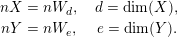 $$\begin{eqnarray}\displaystyle nX & = & \displaystyle nW_{d},\quad d=\dim (X),\nonumber\\ \displaystyle nY & = & \displaystyle nW_{e},\quad \,e=\dim (Y).\nonumber\end{eqnarray}$$
Taking preimages under the isogeny  $[n]:A\longrightarrow A$ we deduce
 $$\begin{eqnarray}W_{d}\subseteq \mathop{\bigcup }_{x\in A[n]}(X-x)\quad \text{and}\quad W_{e}\subseteq \mathop{\bigcup }_{y\in A[n]}(Y-y).\end{eqnarray}$$
By irreducibility then  $X=W_{d}+x$ and
 $Y=W_{e}+y$ for certain
 $x,y\in A[n]$.◻
4 Brill–Noether sheaves on non-hyperelliptic Jacobians
Now let  $A=JC$ be the Jacobian of a smooth non-hyperelliptic curve of genus
 $g>1$. Here the curve cannot be taken to be symmetric but we choose a translate of the Abel–Jacobi map so that for
 $n=g-1$ the divisor
 $W_{n}=-W_{n}\subset A$ becomes symmetric. Then
 $G(\unicode[STIX]{x1D6FF}_{C})\simeq \mathit{Sl}_{2n}(\mathbb{C})$ by [Reference Krämer and WeissauerKW15a, Theorem 6.1] [Reference WeissauerWei06], and we have a fiber functor
 $$\begin{eqnarray}\unicode[STIX]{x1D714}:\quad \langle \unicode[STIX]{x1D6FF}_{C}\rangle \;\stackrel{{\sim}}{\longrightarrow }\;\text{Rep}(\mathit{Sl}_{2n}(\mathbb{C}))\end{eqnarray}$$
such that  $\unicode[STIX]{x1D714}(\unicode[STIX]{x1D6FF}_{C})=\mathbb{C}^{2n}$ is the natural representation of the special linear group.
4.1 Weights for the special linear group
Let  $T\subset \mathit{Sl}_{2n}(\mathbb{C})$ be the maximal torus of diagonal matrices in the special linear group. The characters
 $e_{i}\in \mathsf{X}$ sending a diagonal matrix to its
 $i$th entry generate the character lattice, with the relation
 $e_{1}+\cdots +e_{2n}=0$. So in this case
 $\mathsf{X}=\mathbb{Z}^{2n}/\langle \det \rangle$ for the weight
 $\det =(1,1,\ldots ,1)$ and we choose

The fundamental weights  $\unicode[STIX]{x1D71B}_{d}=e_{1}+\cdots +e_{d}$ for
 $d=1,\ldots ,2n-1$ are a basis of the character lattice and generate the semigroup of dominant weights, but now we have
 $$\begin{eqnarray}V_{\unicode[STIX]{x1D71B}_{d}}\simeq \text{Alt}^{d}(\mathbb{C}^{2n})\simeq \text{Alt}^{2n-d}(\mathbb{C}^{2n})^{\ast }\simeq \text{Hom}(V_{\unicode[STIX]{x1D71B}_{2n-d}},\mathbf{1}).\end{eqnarray}$$
Again this has a geometric interpretation.
Example 4.1. In the non-hyperelliptic case the fundamental weights  $\unicode[STIX]{x1D71B}_{d}\in \mathsf{X}^{+}$ correspond to the perverse sheaves
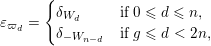 $$\begin{eqnarray}\unicode[STIX]{x1D700}_{\unicode[STIX]{x1D71B}_{d}}=\left\{\begin{array}{@{}ll@{}}\unicode[STIX]{x1D6FF}_{W_{d}}\quad & \text{if }0\leqslant d\leqslant n,\\ \unicode[STIX]{x1D6FF}_{-W_{n-d}}\quad & \text{if }g\leqslant d<2n,\end{array}\right.\end{eqnarray}$$
as one may see via the Riemann–Roch theorem and Serre duality [Reference WeissauerWei06].
With the above example in mind we fix a system of representatives modulo the determinant weight  $\det$ as follows. For
 $\unicode[STIX]{x1D6FC},\unicode[STIX]{x1D6FD}\in \mathbb{N}_{0}^{n}$ put
 $(\unicode[STIX]{x1D6FC}\mid -\unicode[STIX]{x1D6FD})=(\unicode[STIX]{x1D6FC}_{1},\ldots ,\unicode[STIX]{x1D6FC}_{n},-\unicode[STIX]{x1D6FD}_{1},\ldots ,-\unicode[STIX]{x1D6FD}_{n})$. Any
 $\unicode[STIX]{x1D706}\in \mathbb{Z}^{2n}$ satisfies

and the latter are determined uniquely by imposing that at least one entry of  $\unicode[STIX]{x1D706}^{-}$ vanishes. We put
 $$\begin{eqnarray}\displaystyle d^{\pm }(\unicode[STIX]{x1D706}) & =\unicode[STIX]{x1D706}_{1}^{\pm }+\cdots +\unicode[STIX]{x1D706}_{n}^{\pm },\quad d(\unicode[STIX]{x1D706})\, & \displaystyle =d^{+}(\unicode[STIX]{x1D706})+d^{-}(\unicode[STIX]{x1D706}),\nonumber\\ \displaystyle \ell ^{\pm }(\unicode[STIX]{x1D706}) & =\hspace{1.99997pt}|\{i\mid \unicode[STIX]{x1D706}_{i}^{\pm }\neq 0\}|,\quad \ell (\unicode[STIX]{x1D706}) & \displaystyle =\ell ^{+}(\unicode[STIX]{x1D706})+\ell ^{-}(\unicode[STIX]{x1D706}),\nonumber\end{eqnarray}$$
so that in the previous example  $\dim \text{Supp}(\unicode[STIX]{x1D700}_{\unicode[STIX]{x1D71B}_{d}})=d(\unicode[STIX]{x1D71B}_{d})$ without case distinctions.
Lemma 4.2. For any  $\unicode[STIX]{x1D706}\in \mathsf{X}^{+}$ there exists a dominant weight
 $\unicode[STIX]{x1D707}\in \mathsf{X}^{+}$ with the property
 $\unicode[STIX]{x1D707}\preccurlyeq \unicode[STIX]{x1D706}$ such that
 $$\begin{eqnarray}\ell (\unicode[STIX]{x1D707})=\min \{d(\unicode[STIX]{x1D706}),n\}\quad \text{or}\quad \ell (\unicode[STIX]{x1D707})=d(\unicode[STIX]{x1D707})=n-1.\end{eqnarray}$$
Proof. We may clearly assume  $\ell (\unicode[STIX]{x1D706})\neq \min \{d(\unicode[STIX]{x1D706}),n\}$. There are two cases: if
 $\ell (\unicode[STIX]{x1D706})<\min \{d(\unicode[STIX]{x1D706}),n\}$, then as in Lemma 3.2 we successively subtract simple positive roots
 $$\begin{eqnarray}(e_{i}-e_{k}\mid 0)\quad \text{or}\quad (0\mid e_{i}-e_{k})\quad \text{with }1\leqslant i<k\leqslant n\end{eqnarray}$$
to find a dominant integral weight  $\unicode[STIX]{x1D707}\preccurlyeq \unicode[STIX]{x1D706}$ with
 $\ell (\unicode[STIX]{x1D707})=\min \{d(\unicode[STIX]{x1D706}),n\}$. It remains to treat the case where
 $\ell (\unicode[STIX]{x1D706})>\min \{d(\unicode[STIX]{x1D706}),n\}$. In this second case
 $n<\ell (\unicode[STIX]{x1D706})\leqslant d(\unicode[STIX]{x1D706})$, and we successively subtract simple positive roots
 $$\begin{eqnarray}(e_{i}\mid -e_{k})\quad \text{with }1\leqslant i,k\leqslant n\end{eqnarray}$$
until we finally arrive at a dominant integral weight  $\unicode[STIX]{x1D708}\preccurlyeq \unicode[STIX]{x1D706}$ that satisfies one of the following conditions:
∙
$d(\unicode[STIX]{x1D708})\in \{n,n-1\}$;∙
$d(\unicode[STIX]{x1D708})>n$ but $\unicode[STIX]{x1D708}^{-}=0$;∙
$d(\unicode[STIX]{x1D708})>n$ but $\unicode[STIX]{x1D708}^{+}=0$.



Under each of these three conditions an argument as in the first case shows that there exists a dominant integral weight  $\unicode[STIX]{x1D707}\preccurlyeq \unicode[STIX]{x1D708}$ with
 $\ell (\unicode[STIX]{x1D707})=n$ or
 $\ell (\unicode[STIX]{x1D707})=d(\unicode[STIX]{x1D707})=n-1$.◻
4.2 Weyl group orbits and conormal varieties
For  $\unicode[STIX]{x1D707}\in \mathsf{X}^{+}$ consider now the image
 $$\begin{eqnarray}W(\unicode[STIX]{x1D707})=\text{Im}\biggl(a_{\unicode[STIX]{x1D707}}:\;C^{n}\times C^{n}\longrightarrow A,(p,q)\mapsto \mathop{\sum }_{i=1}^{n}(\unicode[STIX]{x1D707}_{i}^{+}\cdot p_{i}-\unicode[STIX]{x1D707}_{i}^{-}\cdot q_{i})\biggr)\subseteq A\end{eqnarray}$$
as a reduced subscheme, which is geometrically non-degenerate with  $\dim (W(\unicode[STIX]{x1D707}))=\min \{\ell (\unicode[STIX]{x1D707}),g\}$ by [Reference DebarreDeb05, Corollary 8.11]. We claim that
 $\text{cc}(\unicode[STIX]{x1D707})$ is its conormal variety whenever possible.
Lemma 4.3. If  $\ell (\unicode[STIX]{x1D707})<g$, then
 $\text{cc}(\unicode[STIX]{x1D707})=\unicode[STIX]{x1D6EC}_{W(\unicode[STIX]{x1D707})}$.
Proof. Since  $\unicode[STIX]{x1D714}(\unicode[STIX]{x1D6FF}_{C})=\mathbb{C}^{2n}$ is the natural representation of the group
 $\mathit{Sl}_{2n}(\mathbb{C})$, its highest weight is the fundamental weight
 $e_{1}=(1,0,\ldots ,0)$, whose Weyl group orbit therefore corresponds to the conormal variety
 $$\begin{eqnarray}\text{cc}(e_{1})=\text{cc}(\unicode[STIX]{x1D6FF}_{C})=\unicode[STIX]{x1D6EC}_{C}\end{eqnarray}$$
of the curve. As in the proof of Lemma 3.3 we get that for  $\unicode[STIX]{x1D707}\in \mathsf{X}^{+}$ the fiber of
 $\text{cc}(\unicode[STIX]{x1D707})\subset A\times V$ over a very general
 $u\in V=H^{0}(C,\unicode[STIX]{x1D6FA}_{C}^{1})$ is
 $$\begin{eqnarray}\{a\in A(\mathbb{C})\mid (a,u)\in \text{Supp}(\text{cc}(\unicode[STIX]{x1D707}))\}=\{a_{\unicode[STIX]{x1D707}}(D)\mid D\in q^{-1}(\text{div}(u))\},\end{eqnarray}$$
where  $q$ is the quotient map to the symmetric power of the curve in the following diagram.
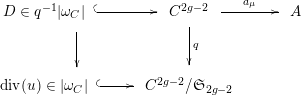
As  $u\in V$ varies, the divisor
 $\text{div}(u)$ runs through the canonical linear series
 $|\unicode[STIX]{x1D714}_{C}|$. So any
 $g-1$ points of this divisor can be moved independently from each other, and it follows that the composite map
 $$\begin{eqnarray}q^{-1}|\unicode[STIX]{x1D714}_{C}|{\hookrightarrow}C^{2g-2}{\twoheadrightarrow}C^{|I|},\quad p\mapsto (p_{i_{1}},p_{i_{2}},\ldots \,)\end{eqnarray}$$
is dominant for any index set  $I\subset \{1,2,\ldots ,2g-2\}$ of cardinality
 $|I|<g$. Hence, for
 $\ell (\unicode[STIX]{x1D707})<g$ we get
 $$\begin{eqnarray}a_{\unicode[STIX]{x1D707}}(q^{-1}|\unicode[STIX]{x1D714}_{C}|)=a_{\unicode[STIX]{x1D707}}(C^{2g-2})=W(\unicode[STIX]{x1D707})\end{eqnarray}$$
as required. ◻
For  $\ell (\unicode[STIX]{x1D707})\geqslant g$ the above proof still shows that the subvariety
 $\text{cc}(\unicode[STIX]{x1D707})\subset T^{\ast }A$ is the conormal variety to the image
 $a_{\unicode[STIX]{x1D707}}(q^{-1}|\unicode[STIX]{x1D714}_{C}|)\subset A$, but it seems unclear how to describe this image in general; for instance, is its dimension always
 $g-1$?
4.3 Characteristic cycles of Brill–Noether sheaves
Although Lemma 4.3 only applies to a certain range of weights, it suffices to prove the main theorem in the non-hyperelliptic case. As before we begin with small degrees.
Proposition 4.4. If  $d(\unicode[STIX]{x1D706})<g$, then
 $\text{Supp}(\unicode[STIX]{x1D700}_{\unicode[STIX]{x1D706}})=W_{d^{+}(\unicode[STIX]{x1D706})}-W_{d^{-}(\unicode[STIX]{x1D706})}$ and in this case the support is a geometrically non-degenerate subvariety of dimension
 $d(\unicode[STIX]{x1D706})$.
Proof. Any dominant weight can be expressed as a non-negative linear combination of the fundamental weights  $\unicode[STIX]{x1D71B}_{i}=e_{1}+\cdots +e_{i}$ with
 $1\leqslant i\leqslant 2n-1$, and hence
 $\unicode[STIX]{x1D706}$ can be written as a sum
 $$\begin{eqnarray}\unicode[STIX]{x1D706}=\unicode[STIX]{x1D71B}_{\unicode[STIX]{x1D707}_{1}}+\cdots +\unicode[STIX]{x1D71B}_{\unicode[STIX]{x1D707}_{m}},\end{eqnarray}$$
with  $\unicode[STIX]{x1D707}_{1},\ldots ,\unicode[STIX]{x1D707}_{m}\in \mathbb{N}_{0}$ not necessarily distinct. With these notations we know from representation theory that the irreducible representation of highest weight
 $\unicode[STIX]{x1D706}$ is a summand in
 $$\begin{eqnarray}\bigotimes _{i=1}^{m}\text{Alt}^{\unicode[STIX]{x1D707}_{i}}(U)\simeq \bigotimes _{\unicode[STIX]{x1D707}_{i}\leqslant n}\text{Alt}^{\unicode[STIX]{x1D707}_{i}}(U)\otimes \bigotimes _{\unicode[STIX]{x1D707}_{i}>n}\text{Alt}^{2n-\unicode[STIX]{x1D707}_{i}}(U^{\ast }),\end{eqnarray}$$
where  $U=\mathbb{C}^{2n}$ denotes the natural representation of
 $\mathit{Sl}_{2n}(\mathbb{C})$ [Reference Goodman and WallachGW09, Theorem 5.5.21]. In our previous notations
∙ the
$\unicode[STIX]{x1D707}_{i}\leqslant n$ are the parts of the transpose partition $(\unicode[STIX]{x1D706}^{+})^{t}$,∙ the
$2n-\unicode[STIX]{x1D707}_{i}$ with $\unicode[STIX]{x1D707}_{i}>n$ are the parts of the transpose partition $(\unicode[STIX]{x1D706}^{-})^{t}$,


and so the respective irreducible representation enters in  $U^{\otimes d^{+}(\unicode[STIX]{x1D706})}\otimes (U^{\ast })^{\otimes d^{-}(\unicode[STIX]{x1D706})}$, where
 $d^{\pm }(\unicode[STIX]{x1D706})$ denotes the degree of
 $\unicode[STIX]{x1D706}^{\pm }$ as above. Translating this back to geometry we get
 $$\begin{eqnarray}\unicode[STIX]{x1D700}_{\unicode[STIX]{x1D706}}{\hookrightarrow}\underbrace{\unicode[STIX]{x1D6FF}_{C}\ast \cdots \ast \unicode[STIX]{x1D6FF}_{C}}_{d^{+}(\unicode[STIX]{x1D706})}\ast \underbrace{\unicode[STIX]{x1D6FF}_{-C}\ast \cdots \ast \unicode[STIX]{x1D6FF}_{-C}}_{d^{-}(\unicode[STIX]{x1D706})}\end{eqnarray}$$
and therefore
 $$\begin{eqnarray}\text{Supp}(\unicode[STIX]{x1D700}_{\unicode[STIX]{x1D706}})\subseteq W_{d^{+}(\unicode[STIX]{x1D706})}-W_{d^{-}(\unicode[STIX]{x1D706})}.\end{eqnarray}$$
It only remains to show that the conormal variety to the right-hand side enters as an irreducible component of the clean cycle  $\text{cc}(\unicode[STIX]{x1D700}_{\unicode[STIX]{x1D706}})$. Since by assumption
 $d(\unicode[STIX]{x1D706})\leqslant n$, Lemma 4.2 shows that
 $$\begin{eqnarray}\unicode[STIX]{x1D707}=(\underbrace{1,\ldots ,1}_{d^{+}(\unicode[STIX]{x1D706})},0,\ldots ,0,\underbrace{-1,\ldots ,-1}_{d^{-}(\unicode[STIX]{x1D706})})\preccurlyeq \unicode[STIX]{x1D706}.\end{eqnarray}$$
Since  $W_{\unicode[STIX]{x1D707}}=W_{d^{+}(\unicode[STIX]{x1D706})}-W_{d^{-}(\unicode[STIX]{x1D706})}$, we are done by Remark 2.8 and Lemma 4.3.◻
Theorem 4.5. For any  $\unicode[STIX]{x1D706}\in \mathsf{X}^{+}$ the image
 $S_{\unicode[STIX]{x1D706}}=p(\text{char}(\unicode[STIX]{x1D700}_{\unicode[STIX]{x1D706}}))\subset A$ has
 $\dim S_{\unicode[STIX]{x1D706}}\geqslant \min \{d(\unicode[STIX]{x1D706}),g-2\}$; hence, if
 $d=\dim S_{\unicode[STIX]{x1D706}}<g-2$, then
 $S_{\unicode[STIX]{x1D706}}=W_{e}-W_{d-e}$ for some
 $e\in \{0,1,\ldots ,d\}$.
Proof. By Proposition 4.4 we may assume that  $d(\unicode[STIX]{x1D706})>n$. Combining Remark 2.8 with Lemma 4.3 it will suffice to show that in this case there exists a dominant integral weight
 $\unicode[STIX]{x1D707}\preccurlyeq \unicode[STIX]{x1D706}$ with
 $\ell (\unicode[STIX]{x1D707})\in \{n,n-1\}$. But this follows from Lemma 4.2.◻
4.4 Proof of the main theorem for non-hyperelliptic Jacobians
Suppose as before that  $\unicode[STIX]{x1D6E9}=X+Y$ is a sum of geometrically non-degenerate subvarieties of positive dimension. Again by Theorem 2.7 there exist
 $n\in \mathbb{N}$ and
 $\unicode[STIX]{x1D706},\unicode[STIX]{x1D707}\in \mathsf{X}^{+}$ such that
 $$\begin{eqnarray}\text{cc}(\unicode[STIX]{x1D6FF}_{nX})=[n]_{\ast }\text{cc}(\unicode[STIX]{x1D700}_{\unicode[STIX]{x1D706}})\quad \text{and}\quad \text{cc}(\unicode[STIX]{x1D6FF}_{nY})=[n]_{\ast }\text{cc}(\unicode[STIX]{x1D700}_{\unicode[STIX]{x1D707}}).\end{eqnarray}$$
If one of the two summands is a curve, we are done by the result of Schreieder [Reference SchreiederSch16], so we assume
 $$\begin{eqnarray}d=\dim X<g-2\quad \text{and}\quad e=\dim Y<g-2.\end{eqnarray}$$
We are then in the range of the last statement in Theorem 4.5. As in §3.4 we deduce
 $$\begin{eqnarray}\displaystyle X & = & \displaystyle W_{a}-W_{d-a}+x\quad \text{with}~x\in A[n],a\in \{0,1,\ldots ,d\},\nonumber\\ \displaystyle Y & = & \displaystyle W_{b}-W_{e-b}\,+\,y\quad \text{with}~y\in A[n],b\in \{0,1,\ldots ,e\}.\nonumber\end{eqnarray}$$
It remains to show that either  $a=b=0$ or
 $d-a=e-b=0$. Putting
 $z=x+y$ we know from the above decompositions that the theta divisor can be written as a difference
 $$\begin{eqnarray}W_{g-1}=W_{c}-W_{g-1-c}+z\quad \text{with }c=a+b\in \{0,1,\ldots ,g-1\},\end{eqnarray}$$
and we must show  $c\in \{0,g-1\}$. But this follows immediately from the bijection between components of characteristic cycles and Weyl group orbits of dominant weights in Remark 2.9, since for
 $c\notin \{0,g-1\}$ the weights
 $\unicode[STIX]{x1D71B}_{g-1}$ and
 $\unicode[STIX]{x1D71B}_{c}+\unicode[STIX]{x1D71B}_{g-1+c}$ are in different Weyl group orbits. For a more direct geometric argument, note that the identity
 $W_{g-1}=W_{c}-W_{g-1-c}+z$ implies by [Reference MartensMar67, Lemma 1c] or by [Reference SchreiederSch16, Lemma 17] that
 $$\begin{eqnarray}W_{c}=z-W_{c},\end{eqnarray}$$
so  $c\in \{0,g-1\}$ by Martens’ theorem for non-hyperelliptic curves.◻
5 Intermediate Jacobians of cubic threefolds
Let us finally consider the case of intermediate Jacobian  $A=JT$, where
 $T\subset \mathbb{P}^{4}$ is a smooth cubic threefold. Let
 $S\subset A$ be the Fano surface of lines on the threefold, embedded in the intermediate Jacobian via a translate of the Albanese map so that
 $G(\unicode[STIX]{x1D6FF}_{S})$ is the simply connected group
 $E_{6}(\mathbb{C})$ as in [Reference KrämerKrä16a]. We have a fiber functor
 $$\begin{eqnarray}\unicode[STIX]{x1D714}:\quad \langle \unicode[STIX]{x1D6FF}_{S}\rangle \;\stackrel{{\sim}}{\longrightarrow }\;\text{Rep}(E_{6}(\mathbb{C}))\end{eqnarray}$$
such that  $\unicode[STIX]{x1D714}(\unicode[STIX]{x1D6FF}_{S})$ is one of the two irreducible representations of dimension
 $27$.
5.1 Weights for the group $E_{6}(\mathbb{C})$

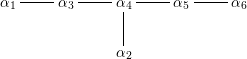
We follow the conventions of Bourbaki [Reference BourbakiBou09] and label the simple positive roots by  $\unicode[STIX]{x1D6FC}_{1},\ldots ,\unicode[STIX]{x1D6FC}_{6}$ as in the following Dynkin diagram.
Example 5.1. As mentioned above, the simply connected group  $E_{6}(\mathbb{C})$ has two irreducible representations of dimension
 $27$, these are dual to each other and have highest weights
 $\unicode[STIX]{x1D71B}_{1}$ and
 $\unicode[STIX]{x1D71B}_{6}$. Next there is a unique irreducible representation of dimension
 $78$, which is the adjoint representation with highest weight
 $\unicode[STIX]{x1D71B}_{2}$. Possibly after replacing the embedding
 $S\subset A$ by its negative we have
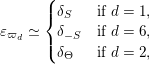
see [Reference KrämerKrä16a]. We do not know a good geometric description for the remaining cases  $d=3,4,5$, but the above already suffices for our purpose.
Lemma 5.2. Any  $\unicode[STIX]{x1D706}\in \mathsf{X}^{+}$ satisfies
 $\unicode[STIX]{x1D707}\preccurlyeq \unicode[STIX]{x1D706}$ for some
 $\unicode[STIX]{x1D707}\in \{\unicode[STIX]{x1D71B}_{1},\unicode[STIX]{x1D71B}_{2},\unicode[STIX]{x1D71B}_{6}\}$.
Proof. Any dominant weight can be written in a unique way as a non-negative integral linear combination
 $$\begin{eqnarray}\unicode[STIX]{x1D706}=a_{1}\unicode[STIX]{x1D71B}_{1}+\cdots +a_{6}\unicode[STIX]{x1D71B}_{6}\quad \text{with }a_{1},\ldots ,a_{6}\in \mathbb{N}_{0}.\end{eqnarray}$$
Writing the fundamental weights as rational linear combinations of  $\unicode[STIX]{x1D6FC}_{1},\ldots ,\unicode[STIX]{x1D6FC}_{6}$ as in [Reference BourbakiBou09], one sees that
 $\unicode[STIX]{x1D71B}_{3}\succcurlyeq \unicode[STIX]{x1D71B}_{6}$,
 $\unicode[STIX]{x1D71B}_{4}\succcurlyeq \unicode[STIX]{x1D71B}_{2}$, and
 $\unicode[STIX]{x1D71B}_{5}\succcurlyeq \unicode[STIX]{x1D71B}_{1}$. We successively apply these dominance relations until we arrive at
 $$\begin{eqnarray}\unicode[STIX]{x1D708}=b_{1}\unicode[STIX]{x1D71B}_{1}+b_{2}\unicode[STIX]{x1D71B}_{2}+b_{6}\unicode[STIX]{x1D71B}_{6}\preccurlyeq \unicode[STIX]{x1D706}\quad \text{with}~\left\{\begin{array}{@{}l@{}}b_{1}=a_{1}+a_{5},\quad \\ b_{2}=a_{2}+a_{4},\quad \\ b_{6}=a_{3}+a_{6}.\quad \end{array}\right.\end{eqnarray}$$
Using the relations  $\unicode[STIX]{x1D71B}_{2}\succcurlyeq 0$ and
 $\unicode[STIX]{x1D71B}_{1}+\unicode[STIX]{x1D71B}_{6}\succcurlyeq 0$, we can then further reduce to the dominant integral weight
 $$\begin{eqnarray}\unicode[STIX]{x1D707}=c_{1}\unicode[STIX]{x1D71B}_{1}+c_{2}\unicode[STIX]{x1D71B}_{2}+c_{6}\unicode[STIX]{x1D71B}_{6}\preccurlyeq \unicode[STIX]{x1D708}\quad \text{where }(c_{1},c_{2},c_{3})=\left\{\begin{array}{@{}l@{}}(0,1,0)\quad \\ \text{or}\;(k,0,0)\quad \\ \text{or}\;(0,0,k)\quad \end{array}\right.\end{eqnarray}$$
for some  $k\in \mathbb{N}$. In the last two situations we can furthermore reduce to the case
 $k=1$ by the dominance relations
 $2\unicode[STIX]{x1D71B}_{1}\succcurlyeq \unicode[STIX]{x1D71B}_{6}$,
 $3\unicode[STIX]{x1D71B}_{1}\succcurlyeq \unicode[STIX]{x1D71B}_{2}$,
 $2\unicode[STIX]{x1D71B}_{6}\succcurlyeq \unicode[STIX]{x1D71B}_{1}$ and
 $3\unicode[STIX]{x1D71B}_{6}\succcurlyeq \unicode[STIX]{x1D71B}_{2}$.◻
5.2 Proof of the main theorem for intermediate Jacobians
Let  $\unicode[STIX]{x1D6E9}=X+Y$ be a decomposition as a sum of two geometrically non-degenerate subvarieties of positive dimension. Theorem 2.7 says that there exist dominant integral weights
 $\unicode[STIX]{x1D706},\unicode[STIX]{x1D707}\in \mathsf{X}^{+}$ such that
 $$\begin{eqnarray}\text{cc}(\unicode[STIX]{x1D6FF}_{nX})=[n]_{\ast }\text{cc}(\unicode[STIX]{x1D700}_{\unicode[STIX]{x1D706}})\quad \text{and}\quad \text{cc}(\unicode[STIX]{x1D6FF}_{nY})=[n]_{\ast }\text{cc}(\unicode[STIX]{x1D700}_{\unicode[STIX]{x1D707}}).\end{eqnarray}$$
Remark 2.8 and Lemma 5.2 then imply the following:
∙
$\dim X\geqslant 2$, with equality only if $nX=\pm nS$;∙
$\dim Y\geqslant 2$, with equality only if $nY=\pm nS$.


In fact we must have equality in both cases since  $\dim X+\dim Y=\dim \unicode[STIX]{x1D6E9}=4$. Taking preimages under
 $[n]:A\rightarrow A$ we obtain by irreducibility that
 $$\begin{eqnarray}X=\pm S+x\quad \text{and}\quad Y=\pm S+y\end{eqnarray}$$
for some torsion points  $x,y\in A[n]$. A look at weights or a direct geometric argument shows that the two signs must be opposite to each other, so Theorem 1.2 follows.◻
Acknowledgements
This paper originated in a question posed by Stefan Schreieder. I would like to thank him and Mihnea Popa for their useful comments and the referee for a careful reading of the manuscript.


