Introduction
Many children are born each year having been exposed prenatally to antiepileptic drugs (AEDs). Between 0.3% and 0.5% of pregnancies are estimated to be to women with epilepsy (Epilepsy Guidelines Group, 2004; Harden et al., Reference Harden, Meador, Pennell, Hauser, Gronseth, Wiebe and Le Guen2009), and it is generally recommended that pharmacotherapy be continued during pregnancy to prevent the potentially serious consequences of uncontrolled seizures. AED use during pregnancy is also an issue for the increasing number of women who are being prescribed AEDs for other conditions such as pain and psychiatric disorders (Mackey, Reference Mackey2010). In order for women and their physicians to make well-informed decisions about AED use during pregnancy, it is vital to understand the impact of prenatal AED exposure, both in terms of birth outcomes as well as longer term developmental effects.
The establishment of several large international pregnancy registers in the last decade has greatly improved our understanding of immediate birth outcomes following prenatal AED exposure. We now know that some AEDs increase the risk of congenital malformations, and that the risk appears to be higher when treatment involves high doses of sodium valproate (VPA) or polytherapy (Tomson et al., Reference Tomson, Battino, French, Harden, Holmes, Morrow and Gordon2007; Vajda et al., Reference Vajda, Hitchcock, Graham, O’Brien, Lander and Eadie2007). There are fewer studies on the longer term effects of prenatal AED exposure on children’s development, yet this is an area of significant interest and concern. Early studies were difficult to interpret due to methodological challenges including small sample sizes, recruitment methods which were open to bias, inadequate control of potentially confounding variables, and lack of standardized protocols. Retrospective ascertainment of drug and medical data in many studies was a further source of potential error. It is, however, becoming increasingly evident that prenatal AED exposure has the potential to affect neurodevelopmental outcomes even in the absence of congenital malformations (Meador, Baker, Cohen, Gaily, & Westerveld, Reference Meador, Baker, Cohen, Gaily and Westerveld2007).
Several recent studies have provided evidence that prenatal exposure to VPA may be associated with increased risk of cognitive impairment. Meador and colleagues (Reference Meador, Baker, Browning, Clayton-Smith, Combs-Cantrell, Cohen and Loring2009) assessed intellectual abilities of prospectively recruited 3-year-olds with the Bayley Scales of Infant Development—second edition or the Differential Ability Scales. Fifty-three of the children they assessed were VPA-exposed, and the authors reported that standardized “IQ” scores in this group were lower than those of children exposed to other AEDs. Studies involving older children suggest that verbal abilities may be particularly vulnerable. In their retrospective study, Adab, Kini et al. (Reference Adab, Tudur Smith, Vinten, Williamson and Winterbottom2004) assessed the intellectual abilities of older children (aged 6 to 16 years) using the third edition of the Wechsler Intelligence Scale for Children (WISC-III), and found that Verbal IQ scores of VPA-exposed children (n = 41) were poorer than those of unexposed children. Similar results were reported by Gaily and colleagues (Reference Gaily, Kantola-Sorsa, Hiilesmaa, Isoaho, Matila, Kotila and Granstrom2004), whose prospective study included a small group (n = 13) of VPA-exposed children aged five to nine years. They reported that Verbal IQ, as measured by the Wechsler Preschool and Primary Scale of Intelligence (WPPSI) or Wechsler Intelligence Scale for Children – revised edition (WISC-R), was impaired relative to unexposed controls. In all three studies the relationship between VPA exposure and outcomes was dose-dependent.
There is also evidence that polytherapy during pregnancy may increase the risk of adverse cognitive outcomes for exposed children. A 2004 Cochrane review concluded that exposure to polytherapy was consistently associated with poorer cognitive outcomes in younger children, although results in older children were less consistent (Adab, Tudur Smith, Vinten, Williamson, & Winterbottom, Reference Adab, Tudur Smith, Vinten, Williamson and Winterbottom2004). Gaily and colleagues (Reference Gaily, Kantola-Sorsa, Hiilesmaa, Isoaho, Matila, Kotila and Granstrom2004) reported that Verbal IQ scores of 30 polytherapy-exposed children were worse than those of unexposed children, suggesting that, like VPA, polytherapy may differentially affect verbal abilities. In comparison, Adab, Kini et al. (Reference Adab, Tudur Smith, Vinten, Williamson and Winterbottom2004) did not find a significant effect of polytherapy exposure on children’s IQ scores.
Some of the inconsistency in findings may result from differences in polytherapy drug regimens, making comparisons between studies difficult. It may be that the particular types or combinations of drugs taken in polytherapy are more important in determining outcomes than polytherapy per se. Since VPA forms part of many polytherapy regimens, it is possible that poorer outcomes reported in groups of polytherapy-exposed children may reflect the significant number of VPA-exposed children in many of these groups. In support of this idea, a recent report suggested that relative risk of birth defects amongst polytherapy-exposed children may only be elevated when VPA forms part of the polytherapy regimen (Vajda et al., Reference Vajda, Hitchcock, Graham, O’Brien, Lander and Eadie2010). It is not known whether this also applies to cognitive outcomes.
Studies to date have been limited by retrospective study designs (Adab, Kini, et al., Reference Adab, Kini, Vinten, Ayres, Baker, Clayton-Smith and Chadwick2004), failure to control for potentially confounding variables such as maternal IQ (Gaily et al., Reference Gaily, Kantola-Sorsa, Hiilesmaa, Isoaho, Matila, Kotila and Granstrom2004; Kantola-Sorsa, Gaily, Isoaho, & Korkman, Reference Kantola-Sorsa, Gaily, Isoaho and Korkman2007) or have been limited to young children in whom measurement of intellectual skills can be unreliable (Meador et al., Reference Meador, Baker, Browning, Clayton-Smith, Combs-Cantrell, Cohen and Loring2009), and there is a need for further research in this area. In particular, reports of impaired Verbal IQ in children exposed to VPA and polytherapy require more investigation, both to verify the finding and to better understand the cognitive basis for it. In older versions of the WISC, Verbal IQ scores were contributed to by measures which placed substantial demands on working memory (Keith, Fine, Taub, Reynolds, & Kranzler, Reference Keith, Fine, Taub, Reynolds and Kranzler2006), making it unclear whether the Verbal IQ deficits reported in previous studies reflect a weakness in language skills, verbal intellectual abilities (i.e., higher level verbally based skills such as verbal abstract reasoning) or working memory (i.e., the capacity to hold and manipulate information over brief periods of time), or some combination of these skills. Clarification of the specific impairments in affected children is important for their ongoing care and education. It is also important that we better understand the nature of and mechanisms underlying poor long-term outcomes in exposed children.
Studies of children exposed prenatally to substances such as ethanol and nicotine suggest that exposure to neurotoxic substances in utero have the potential to affect attention and working memory (Burden, Jacobson, Sokol, & Jacobson, Reference Burden, Jacobson, Sokol and Jacobson2005; Fried & Watkinson, Reference Fried and Watkinson2001), but there have been very few studies examining these abilities in AED-exposed children. One recent report suggested that working memory performance may be impaired in VPA-exposed children (Kantola-Sorsa et al., Reference Kantola-Sorsa, Gaily, Isoaho and Korkman2007); however, the finding needs to be interpreted with caution as their analysis did not distinguish between VPA used as monotherapy or in polytherapy, and only eight children exposed to VPA monotherapy were included in the sample.
The primary objective of this study was to evaluate the effects of prenatal exposure to VPA or polytherapy on children’s cognitive abilities. In particular, we aimed to determine whether we could replicate previous reports of a verbal intellectual deficit, and whether working memory abilities were also impaired. We examined a range of potentially confounding factors to determine whether any effects could be explained by maternal, pregnancy, or demographic factors. We also aimed to evaluate whether any impairments in children exposed to polytherapy could be explained by the inclusion of VPA in the polytherapy regimen, and to determine whether any observed relationships between drug exposure and outcomes were dose-dependent.
Methods
Participants
Women with epilepsy and their children were recruited through the Australian Pregnancy Register for Women with Epilepsy and Allied Disorders (APR). Recruitment methodology for the APR has been described in some detail in previously published reports (Vajda, Lander, et al., Reference Vajda, Lander, O’Brien, Hitchcock, Graham, Solinas and Cook2004; Vajda, O’Brien, Hitchcock, Graham, & Lander, Reference Vajda, O’Brien, Hitchcock, Graham and Lander2003). Children prenatally exposed to VPA or polytherapy were eligible for the current study, while children who at 1 year of age were diagnosed with major birth defects or those with a diagnosis of epilepsy were excluded. From November 2007 to October 2009, 80 children aged 6 to 8 years were invited to participate in the study. This age range encompassed the majority of school-aged children (school entry in Australia is typically in the year children turn 6) born to women on the APR since its inception. Mothers of eight children declined to participate. Reasons given for nonparticipation included concerns about the child’s ability or willingness to participate (38%), maternal illness (25%), time commitment (25%), and lack of interest (13%). Mothers of two children were deceased, and mothers of a further 10 children expressed interest but were not seen because an appointment was unable to be scheduled during the study period. Of the remaining 59 children, 1 child (exposed to VPA) was excluded due to the detection of birth malformations after 1 year of age, and another (exposed to VPA, clonazepam, and carbamazepine) had been diagnosed with epilepsy and was also excluded. Cognitive outcomes for the remaining 57 children are presented.
Procedures
The current study formed part of a larger ongoing Australian study investigating the impact of prenatal AED exposure on cognition and behavior. Women enrolled on the APR were telephoned and information/consent forms were sent to those who expressed interest. Children completed a fixed-order battery of neuropsychological tests, and mothers underwent a brief intellectual assessment. All assessments were administered by a qualified psychologist who was blinded to drug exposure. Mothers were also asked to complete a questionnaire providing additional information about their family and child. Information on maternal epilepsy, pregnancy and medical history was prospectively collected by the APR. The study was approved by the ethics review boards of the coordinating institutions (Monash University and Royal Children’s Hospital, Australia), and conformed to the guidelines of the Helsinki Declaration. Informed written consent was obtained from all women.
Measures
Prospectively obtained information
Prospective information was collected on AED use during pregnancy (including drug type, dose, and dates of any changes) and maternal epilepsy history (including seizure type and seizure frequency during pregnancy). With mothers’ permission this information was verified by the treating physician and medical files were reviewed. Women also provided information prospectively on their medical history; health during pregnancy; and use of tobacco, alcohol, tea/coffee, and other drugs during pregnancy. Information regarding each child’s date of birth, gender, perinatal complications, length of gestation, and birth weight was collected at the time of birth. One year after birth information on children’s initial development and breastfeeding history was collected. Prospective information was not available for two children; their mothers provided information on maternal epilepsy, pregnancy, and medical history retrospectively.
Wechsler Intelligence Scale for Children—Fourth Edition
Children were administered the Wechsler Intelligence Scale for Children—Fourth Edition – Australian Standardisation (WISC-IV; Wechsler, Reference Wechsler2003). Unlike previous versions, it provides four indices (described below) which better reflect the current theory of cognition and have been found to better delineate cognitive strengths and weaknesses in some clinical populations (Dickerson Mayes & Calhoun, Reference Dickerson Mayes and Calhoun2006; Keith et al., Reference Keith, Fine, Taub, Reynolds and Kranzler2006).
Verbal comprehension
This score is based on children’s performance on oral tasks requiring them to define words, make links between concepts, and answer questions about social practices. It measures verbal concept formation, verbal reasoning, and acquired knowledge.
Perceptual organization
This score is derived from children’s performance on visually based tasks requiring them to replicate pictures using blocks, make conceptual links between pictures, and to analyze visual patterns. It measures perceptual and fluid reasoning, spatial processing, and visual-motor integration.
Working memory
Children repeat sequences of digits or letters read to them by the examiner, in the same order as presented, the reverse order, or ascending order. It is a measure of short-term memory and working memory abilities.
Processing Speed
This score is calculated from timed tasks which require children to quickly copy written symbols, or to identify matching symbols from a group. It is a measure of ability to quickly scan, sequence, and discriminate simple visual information, and also of graphomotor skills.
The primary outcome measures in the current study were the four index scores (M = 100, SD = 15) and a summary Full-Scale IQ score (M = 100, SD = 15). One VPA-exposed child had been given the WPPSI 16 months before participating in the study. With maternal consent, his test scores were obtained from the psychologist and the WPPSI Full-Scale IQ, Verbal Comprehension, and Perceptual Reasoning scores were used as a substitute for WISC-IV scores in the current analyses. Another child who had been exposed to VPA and clonazepam was unable to complete the assessment as he had severe developmental delay and had not yet begun to talk; his Full-Scale IQ and index scores were imputed at 3 standard deviations below the test mean.
Wechsler Abbreviated Score of Intelligence
Maternal intellectual ability was evaluated using the two-subtest version of the Wechsler Abbreviated Score of Intelligence (WASI; The Psychological Corporation, 1999). This short screen of intellectual ability takes around 15 min to administer and yields an estimated Full-Scale IQ score (M = 100, SD = 15).
Background Information Questionnaire
Mothers completed a questionnaire about their family demographics and child’s medical and developmental history. Family socioeconomic status (SES), as measured by the highest maternal or paternal occupational level, was rated according to the ANU4 Scale (Jones & McMillan, Reference Jones and McMillan2001). On this scale, the mean SES score in the Australian population is 47 (SD = 22.5).
Data Analysis
Groups were compared with respect to background characteristics using analysis of variance (ANOVA, continuous variables) and χ2 (categorical variables) analyses. Frequencies of Extremely Low (FSIQ < 70) and Borderline (FSIQ 70–79) IQ were calculated. One-sample t-tests were performed to determine whether group means differed from published age-standardized WISC-IV means. Multivariate analysis of covariance (MANCOVA) was used to determine whether VPA or polytherapy exposure uniquely contributed to test scores after controlling for potentially confounding factors, and to examine group differences. Significant MANCOVA findings were investigated using analysis of covariance (ANCOVA) analysis that used the same covariates. Covariates were selected by examining correlations between the demographic and medical variables listed in Table 1 and the outcome measures; variables that correlated significantly with one or more outcome variables were entered as covariates. For the purpose of these analyses, dichotomous variables were created for VPA exposure; polytherapy exposure; generalized epilepsy onset; seizure(s) during pregnancy (any, convulsive, and nonconvulsive); tobacco, alcohol, coffee/tea, and marijuana use during pregnancy; first trimester folic acid consumption; prematurity (gestational age < 37 weeks); breastfeeding; and child’s gender. To examine relationships between dose and outcomes, standardized dose scores for each drug were calculated using the following procedure: (i) for each child, the mean dose of each drug was calculated by trimester, and then over the whole pregnancy; (ii) drug dose scores were standardized relative to the mean dose taken by all women in the sample according to the formula [(observed mean dose – mean dose all women)/SD dose all women]; (iii) a total standardized dose score for each child was calculated by summing the standardized dose scores. The relationship between dose and outcome scores was examined using the Pearson correlation statistic, and relative risk estimates were calculated based on the proportion of children with below average IQ (<80) who were exposed to VPA doses above or below a range of cutoff values.
Sample characteristics

SES = socioeconomic status.
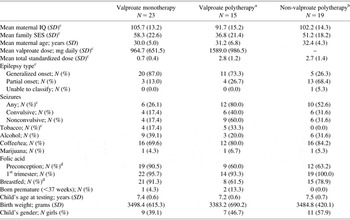
aIn addition to VPA, children in the VPA polytherapy group were exposed to the following: lamotrigine (6 children), clonazepam (2 children), levetiracetam (1 child), carbamazepine (1 child), tiagabine (1 child), clonazepam + carbamazepine (2 children), lamotrigine + ethosuximide (1 child) and lamotrigine + clonazepam (1 child).
bChildren in the non-VPA polytherapy group were exposed to: carbamazepine + lamotrigine (5 children), carbamazepine + clonazepam (4 children), carbamazepine + phenytoin (3 children), carbamazepine + vigabatrin (1 child), lamotrigine + phenytoin (1 child), lamotrigine + topiramate (1 child), clonazepam + phenytoin (1 child), lamotrigine + phenytoin + vigabatrin (1 child), lamotrigine + clobazam + phenobarbitone (1 child), and carbamazepine + clonazepam + vigabatrin + gabapentin (1 child).
cStatistically significant group difference, p < .05.
dData on preconception folic acid were missing for two VPA monotherapy mothers, and on breastfeeding for three VPA polytherapy mothers.
Results
Sample Characteristics
Twenty-three of the 57 AED-exposed children were exposed to VPA monotherapy, 15 to polytherapy with VPA (VPA polytherapy), and 19 to polytherapy without VPA (non-VPA polytherapy). There was no significant difference in the proportion of eligible invited children who participated in the VPA monotherapy (77%), VPA polytherapy (79%), and non-VPA polytherapy (70%) groups, χ2 = 0.51, p = .775. A comparison of the VPA monotherapy and VPA polytherapy groups showed that mean VPA dose was significantly higher in the polytherapy group than the monotherapy group, F(1,36) = 5.55, p = .024. Total standardized dose was higher in both polytherapy-exposed groups compared to the VPA monotherapy group, F(2,54) = 27.06, p < .001, but there was no significant difference in total standardized dose between the VPA polytherapy or non-VPA polytherapy groups. Background characteristics of the sample are presented in Table 1. There were several significant differences between the groups. Maternal IQ was significantly lower in the VPA polytherapy compared to the VPA monotherapy (p = .004) and non-VPA polytherapy (p = .033) groups. The VPA polytherapy group also had lower SES scores than the VPA monotherapy group (p = .004) but not the non-VPA polytherapy group (p = .061). Mothers who took VPA (monotherapy or polytherapy) were more likely to have a generalized form of epilepsy than mothers who took non-VPA polytherapy (p ≤ .001). Seizures during pregnancy were more common in the VPA polytherapy group than the VPA monotherapy group (p = .001), and mothers who took VPA polytherapy were more likely to smoke tobacco than mothers who took non-VPA polytherapy (p = .006). Two children exposed to VPA polytherapy and one child exposed to VPA monotherapy were born premature; all three of these children had Full-Scale IQ scores in the Average range (90–109), and there was no significant correlation between prematurity and performance on any of the outcome measures. No significant group differences were found with respect to maternal age; tobacco, alcohol, tea/coffee, or marijuana consumption; folic acid use; or breastfeeding. The groups were also equivalent in terms of children’s gender, birth weight, and age at testing.
Rates of Intellectual Delay
Full-Scale IQ scores of four children exposed to VPA polytherapy (4/15; 26.7%) and one child exposed to VPA monotherapy (1/23; 4.3%) fell in the Extremely Low range. A further eight children obtained Full-Scale IQ scores in the Borderline range; three were exposed to VPA monotherapy (3/23; 13.0%), two to VPA polytherapy (2/15; 13.3%), and three to non-VPA polytherapy (3/19; 15.8%).
WISC-IV Performance
Mean Full-Scale IQ scores in the VPA monotherapy (M = 94.3, SD = 13.1), VPA polytherapy (M = 81.0, SD = 17.5), and non-VPA polytherapy (M = 93.8, SD = 10.6) groups fell significantly below the test mean, p < .05 (see Table 2). The pattern of performance was similar across all groups, with scores on the Verbal Comprehension index falling significantly below the expected level, p ≤ .013, while Perceptual Reasoning index scores did not statistically differ from the test mean, p ≥ .127. Working Memory index scores fell below the expected level for all groups, p ≤ .031, while only the VPA polytherapy group demonstrated significantly impaired scores on the Processing Speed index, p = .005.
Mean (SD) WISC-IV index scores

WISC-IV = Wechsler Intelligence Scale for Children—Fourth Edition – Australian Standardisation.
aSignificantly below standardized test mean, p < .05.
Impact of Valproate and Polytherapy
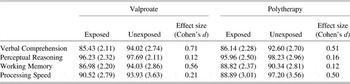
A MANCOVA was performed to evaluate the contributions of VPA and polytherapy to WISC-IV index scores. Maternal IQ, SES, marijuana use, and convulsive seizure(s) correlated significantly with one or more index score, and were entered as covariates in the model. There were significant main effects of VPA exposure, F(4,44) = 3.78, p = .010, η2p = 0.26, and polytherapy exposure, F(4,44) = 2.89, p = .033, η2p = 0.21. Univariate between-subjects analyses indicated that exposure to VPA negatively influenced children’s Verbal Comprehension, F(1,47) = 11.78, p = .001, η2p = 0.20, and Working Memory, F(1,47) = 4.73, p = .035, η2p = 0.09, but not Processing Speed scores. Children exposed to polytherapy performed worse than children exposed to monotherapy on the Verbal Comprehension index, F(1,47) = 8.78, p = .005, η2p = 0.16, and Processing Speed index, F(1,47) = 4.35, p = .042, η2p = 0.09, but there was no significant effect of polytherapy on Working Memory. Neither VPA nor polytherapy significantly influenced Perceptual Reasoning scores. Examination of the univariate estimated marginal means produced by this model (Table 3) indicated that, after controlling for maternal IQ, SES, marijuana use, and convulsive seizure(s), VPA exposure was associated with a mean decrease in Verbal Comprehension scores of 8.6 points, and a mean decrease in Working Memory scores of 7.1 points. In comparison, polytherapy exposure resulted in a mean reduction of Verbal Comprehension scores by 6.5 points, and Processing Speed scores by 8.3 points.
Estimated marginal mean (standard error) IQ scores of children exposed or unexposed to valproate and polytherapy, after controlling for SES, maternal IQ, convulsive seizure(s), and marijuana use

SES = socioeconomic status.
A second MANCOVA using drug group (VPA monotherapy, VPA polytherapy, or non-VPA polytherapy) rather than VPA and polytherapy as a factor in the analysis showed that, after controlling for maternal IQ, SES, marijuana use, and convulsive seizure(s), the main effect of drug group did not reach significance, F(8,90) = 2.00, p = .055, η2p = 0.15.
Impact of Dose
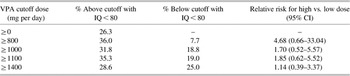
There was a significant negative correlation between mean VPA dose and Verbal Comprehension scores, r = −.265, p = .046. Negative but nonsignificant correlations existed between VPA dose and Working Memory (r = −.154, p = .258), Perceptual Reasoning (r = −.226, p = .091), Processing Speed (r = −.017, p = .899) and Full-Scale IQ (r = −.247, p = .064) scores. There were no significant correlations between total standardized dose (including or excluding VPA) and any of the WISC-IV index scores. Previous studies have suggested that there may be a threshold dose of VPA above which the risks associated with VPA significantly increase, with estimates ranging from 800 to 1400 mg per day (Adab, Kini, et al., Reference Adab, Kini, Vinten, Ayres, Baker, Clayton-Smith and Chadwick2004; Meador et al., Reference Meador, Baker, Browning, Clayton-Smith, Combs-Cantrell, Cohen and Loring2009; Vajda & Eadie, Reference Vajda and Eadie2005; Vajda, O’Brien, et al., Reference Vajda, O’Brien, Hitchcock, Graham, Cook and Lander2004). To examine whether such a threshold effect was evident in our data, we compared the relative risk of intellectual impairment (Full-Scale IQ < 80) for children exposed to doses above or below a range of cutoffs suggested by previous studies (800, 1000, 1100, and 1400 mg daily). Children unexposed to VPA were not included in this analysis. Relative risk estimates are provided in Table 4. Results were suggestive of an increase in risk associated with higher compared to lower doses, although none of the estimates reached statistical significance. When a cutoff dose of 800 mg was used, intellectual impairment was 4.7 times more likely to occur in children exposed to high (≥800 mg) compared to low (<800 mg) doses of VPA. In comparison, risk increases were relatively modest (relative risk = 1.1–1.9) when higher cutoffs were used.
VPA dose and relative risk of below average IQ

VPA = sodium valproate; CI = confidence interval.
Discussion
This study aimed to evaluate the cognitive abilities of children prenatally exposed to VPA or polytherapy. Specifically, we aimed to replicate previous findings of reduced verbal intellectual abilities in VPA- or polytherapy-exposed children, and to evaluate whether working memory abilities are also affected. Research to date has not included large enough numbers of children to distinguish between the effects of VPA and polytherapy on these skill domains. Furthermore, in contrast to recent studies, our cognitive outcomes data are based on a group without major malformations.
Similar to previous studies (Dean et al., Reference Dean, Hailey, Moore, Lloyd, Turnpenny and Little2002; Eriksson et al., Reference Eriksson, Viinikainen, Mönkkönen, Äikiä, Nieminen, Heinonen and Kalviainen2005), there were elevated rates of intellectual delay in our sample, with Full-Scale IQ scores of 22 children (22.8%) falling in the Extremely Low or Borderline range. This is over two and a half times the expected population rate of 8.9 percent. Comparison of mean scores suggested a moderate effect size (around 6 IQ points) in the VPA monotherapy and non-VPA polytherapy groups and a large effect size (around 20 IQ points) in the VPA polytherapy group. These findings indicate that there is likely to be a clinically significant impact for many of these children, with potential implications for their academic performance; ability to function adaptively at home, school, and in the community; and longer-term outcomes (Ceci & Williams, Reference Ceci and Williams1997; Cook, Greenberg, & Kusche, Reference Cook, Greenberg and Kusche1994; Dickerson Mayes, Calhoun, Bixler, & Zimmerman, Reference Dickerson Mayes, Calhoun, Bixler and Zimmerman2009).
As we expected, verbal abilities appeared to be differentially affected. Examination of mean WISC-IV index scores revealed a similar pattern of performance across the sample, with all three groups demonstrating Verbal Comprehension scores significantly below the test mean, while Perceptual Reasoning scores were relatively normal. Our analyses suggested that both VPA exposure and polytherapy exposure had a significant negative effect on Verbal Comprehension scores, even after controlling for maternal IQ, SES, marijuana use, and convulsive seizures during pregnancy.
Working Memory index scores also fell significantly below the expected level in all three groups. Analyses confirmed that exposure to VPA had a significant negative effect on Working Memory scores after controlling for potentially confounding factors, however there we found no significant effect of polytherapy exposure. In contrast, polytherapy had a significant impact on Processing Speed scores, while VPA did not.
This is the third study to find reduced verbal intellectual abilities in school-aged children exposed prenatally to VPA. When viewed in conjunction with reports that speech delay is more common in VPA-exposed children than in those exposed to other AEDs or unexposed controls (Dean et al., Reference Dean, Hailey, Moore, Lloyd, Turnpenny and Little2002), there is increasing evidence that verbal abilities are particularly vulnerable to the neurotoxic effects of VPA. The results of our study also suggest that prenatal VPA exposure may have a detrimental impact on more fundamental cognitive processes such as working memory. This finding is consistent with a previous report of impaired working memory in a much smaller sample of VPA-exposed children (Kantola-Sorsa et al., Reference Kantola-Sorsa, Gaily, Isoaho and Korkman2007), and with reports of impaired attention and working memory in children exposed prenatally to other neurotoxic substances (Burden et al., Reference Burden, Jacobson, Sokol and Jacobson2005; Fried & Watkinson, Reference Fried and Watkinson2001).
Research suggests that deficits in working memory can predispose children to difficulties with language comprehension and vocabulary acquisition (Gathercole, Reference Gathercole1999). It is possible that such deficits also underlie the reduced verbal skills detected in VPA-exposed children. Longitudinal research is needed to further investigate this possibility. Identification of the specific underlying cognitive deficits associated with VPA exposure is important, as it will assist in determining the most appropriate remediation strategies for these children. For example, in addition to speech pathology, classroom strategies to support short-term memory or working memory deficits may be effective. Furthermore, delineating the cognitive strengths and weaknesses of VPA-exposed children is an essential precursor to indentifying factors which confer vulnerability to the effects of VPA, and to understanding the underlying mechanisms involved.
While there is increasing evidence that prenatal VPA exposure may be harmful to cognitive development, there have been conflicting reports regarding the effects of polytherapy exposure on cognition (Adab, Kini, et al., Reference Adab, Kini, Vinten, Ayres, Baker, Clayton-Smith and Chadwick2004; Gaily et al., Reference Gaily, Kantola-Sorsa, Hiilesmaa, Isoaho, Matila, Kotila and Granstrom2004), possibly reflecting the variable nature of the drug types and doses taken by this group of women. Our results suggest that polytherapy had a modest effect on verbal intellectual abilities after controlling for the impact of VPA and other potentially confounding factors. In addition, we found a negative effect of polytherapy on Processing Speed scores. This was an unexpected finding, which may reflect a weakness in mental processing speed or fine motor skills, and deserves further investigation.
The significant differences between our drug exposure groups with respect to maternal IQ and SES highlight the importance of controlling for sociodemographic factors. Because epilepsy type and severity influence the types and doses of AED prescribed, and also impact on social outcomes, in an observational study such as ours group differences are to be expected. In women taking polytherapy, which is often necessary for more severe or drug-resistant forms of epilepsy, control of potentially confounding factors is especially important. Without adequate control of such factors, poorer scores in polytherapy-exposed children may mistakenly be attributed to drug exposure when in fact sociodemographic differences are implicated. This is highlighted by the finding that in our multivariate analysis, differences between the drug groups were not significant after controlling for maternal IQ, SES, marijuana use, and seizures. Future research with larger group sizes may tease out these effects in more detail. Similar group differences to those found in our study have been reported previously (Eriksson et al., Reference Eriksson, Viinikainen, Mönkkönen, Äikiä, Nieminen, Heinonen and Kalviainen2005; Gaily et al., Reference Gaily, Kantola-Sorsa, Hiilesmaa, Isoaho, Matila, Kotila and Granstrom2004); however, factors such as maternal IQ and socioeconomic status have not been adequately controlled in all past studies (Adab, Tudur Smith, et al., Reference Adab, Tudur Smith, Vinten, Williamson and Winterbottom2004). This may be another reason for the inconsistency of previous findings.
The risks associated with VPA exposure appear to increase with dose. We found a significant correlation of VPA dose with Verbal Comprehension scores, similar to the dose–response relationship reported in previous studies (Adab, Kini, et al., Reference Adab, Kini, Vinten, Ayres, Baker, Clayton-Smith and Chadwick2004; Gaily et al., Reference Gaily, Kantola-Sorsa, Hiilesmaa, Isoaho, Matila, Kotila and Granstrom2004; Meador et al., Reference Meador, Baker, Browning, Clayton-Smith, Combs-Cantrell, Cohen and Loring2009). Relative risk estimates suggested that doses of VPA exceeding 800 mg per day were associated with a four- to five-fold increase in risk of intellectual impairment compared to doses below 800 mg. A threshold dose of 800 mg corresponds with that reported in a previous study of cognitive outcomes (Adab, Kini, et al., Reference Adab, Kini, Vinten, Ayres, Baker, Clayton-Smith and Chadwick2004), but is lower than the doses that have been suggested by studies of major malformations (Vajda & Eadie, Reference Vajda and Eadie2005; Vajda, O’Brien, et al., Reference Vajda, O’Brien, Hitchcock, Graham, Cook and Lander2004). It is possible that intellectual abilities may be impacted at lower doses than are necessary to cause major malformations. This finding should be viewed as preliminary and needs to be verified in larger samples.
The dose–response relationship between VPA and outcomes may have impacted on our findings with regards to polytherapy. Because the mean dose of VPA was higher in the VPA polytherapy group compared to the VPA monotherapy group, it is possible that high-dose VPA exposure rather than polytherapy was responsible for the poorer outcomes in the VPA polytherapy group. This is supported by the finding that total standardized dose did not correlate significantly with any outcome measures. As argued by Vajda and colleagues (Reference Vajda, Hitchcock, Graham, O’Brien, Lander and Eadie2010), the inclusion of VPA in many polytherapy regimens may bias findings with regards to the impact of polytherapy, due to the greater teratogenicity of VPA in comparison to other AEDs. It is possible that reduced scores in groups of polytherapy-exposed children may be a reflection of the high proportion of these children who were exposed to VPA. The specific drugs, drug doses, or combinations of drugs within a polytherapy regimen may be more important determinants of outcomes than polytherapy itself. Further research with significantly increased sample sizes is needed to investigate the impact of specific drug combinations on outcomes.
Strengths of this study included its prospective design and measurement of numerous background variables including maternal medical, pregnancy, and epilepsy history; maternal IQ; and family demographic factors. Recruitment through an independent national register was likely to result in a more representative sample than studies that recruited participants through specialist clinics or regional hospitals. Another advantage over previous studies was the exclusion of children with major birth defects or epilepsy. These conditions are known risk factors for cognitive impairment, and inclusion of children with birth defects and epilepsy in previous studies (Adab, Kini, et al., Reference Adab, Kini, Vinten, Ayres, Baker, Clayton-Smith and Chadwick2004; Dean et al., Reference Dean, Hailey, Moore, Lloyd, Turnpenny and Little2002; Gaily et al., Reference Gaily, Kantola-Sorsa, Hiilesmaa, Isoaho, Matila, Kotila and Granstrom2004; Meador et al., Reference Meador, Baker, Browning, Clayton-Smith, Combs-Cantrell, Cohen and Loring2009) may have biased results.
A limitation of our study was the lack of an unexposed control group. Finding an appropriate control group in this population is problematic, as healthy controls are not appropriate and outcomes in groups of unexposed children of women with epilepsy may be confounded by less severe epilepsy. By using a well-validated, up-to-date test with representative Australian normative data, we were able to make meaningful comparisons of ability relative to same-age children. As with any voluntary study, there was a potential for bias. It is possible, for example, that women with concerns about their children’s development were more likely to participate. However, our low nonparticipation rate, and the fact that many women chose not to participate because they were concerned about their child’s willingness or ability to cope with testing, suggest this is unlikely. Finally, although our study contained more VPA-exposed children than many previous studies, our sample size remained small. The results need to be verified in larger prospective samples.
Conclusions
The results of this study add to a growing amount of evidence that prenatal exposure to high doses of VPA is associated with increased risk of verbal intellectual impairment, and suggest that more fundamental cognitive processes such as attention and working memory may also be affected. Our finding that polytherapy exposure impacted negatively on verbal abilities and psychomotor speed needs to be interpreted cautiously due to the significantly higher mean VPA dose in our polytherapy compared to our monotherapy group. Increased effort is needed to improve early identification of at-risk children, and to better characterize the cognitive difficulties of affected children to develop effective interventions. Research is also needed to explore the mechanisms conferring vulnerability to the effects of VPA exposure, and to better understand implications for women taking VPA for other conditions such as chronic pain and psychiatric disorders. Finally, although there is increasing evidence that VPA is associated with increased risk of cognitive impairment, it is also important to recognize that over half of the children in our sample achieved scores which placed them in the average range or above. Any decision to change drug treatment requires careful balancing of the risks associated with prenatal AED exposure against the dangers posed by inadequate seizure or disease control.
Acknowledgments
This research was supported by grants from the Australian Research Council (LP0669648), Apex Foundation and Pearson Plc. The sponsors of the study had no role in study design, data collection, data analysis, data interpretation, the writing of the report, or in the decision to submit the paper for publication. The corresponding author had full access to all the data in the study and had final responsibility for the decision to submit for publication. Caroline Nadebaum and Sarah Barton were supported by Australian Postgraduate Award scholarships, and Amanda Wood was supported by a NHMRC postdoctoral fellowship grant (251755) and Postdoctoral Research Funding from Australian Rotary Health. The authors also thank Katherine Lee from the Murdoch Childrens Research Institute for her statistical advice. The study would not have been possible without the efforts of Janet Graham and Alison Hitchcock from the Australian Pregnancy Register for Women with Epilepsy and Allied Disorders, whose work in identifying and liaising with the participants has been invaluable. The Australian Pregnancy Register is grateful for financial support for its operations from the pharmaceutical industry, including Sanofi-Synthelabo, UCB Pharma, Janssen Cilag, Novartis, and Pfizer, as well as past support from Glaxo. It also gratefully acknowledges the support of the Epilepsy Society of Australia, The Victorian Epilepsy Foundation, and Epilepsy Australia. We also thank all of the families who gave so generously of their time to participate in this research. The information in this manuscript and the manuscript itself has never been published either electronically or in print.