Introduction
Individuals with schizophrenia demonstrate deficits across a wide range of neurocognitive domains as well as severe and persistent impairments in daily life functioning (Heinrichs & Zakzanis, Reference Heinrichs and Zakzanis1998; Green et al. Reference Green, Kern, Braff and Mintz2000). Numerous studies support both prospective and cross-sectional associations between neurocognitive and functional impairments in persons with schizophrenia (Addington et al. Reference Addington, McCleary and Munroe-Blum1998; Harvey et al. Reference Harvey, Parrella, White, Mohs and Davis1999; Gold, Reference Gold2004; Green et al. Reference Green, Kern and Heaton2004). Early visual perception is one of several neurocognitive functions consistently found to be impaired in schizophrenia (Green et al. Reference Green, Nuechterlein and Mintz1994 a, Reference Green, Nuechterlein and Mintzb, Reference Green, Kern and Heaton2004; Rassovsky et al. Reference Rassovsky, Green, Nuechterlein, Breitmeyer and Mintz2004). Basic perceptual processes lie at the intersection of biological and behavioral processes. As such, performance deficits on measures of visual perception can serve, on one hand, as ways to probe the biological bases of schizophrenia and, on the other hand, as a starting point for examining the pathways to poor functional outcome (Butler et al. Reference Butler, DeSanti, Maddox, Harkavy-Friedman, Amador, Goetz, Javitt and Gorman2003, Reference Butler, Silverstein and Dakin2008; Sergi et al. Reference Sergi, Rassovsky, Nuechterlein and Green2006).
Studies designed to assess the earliest components of visual information processing in schizophrenia often employ visual masking procedures (Saccuzzo & Schubert, Reference Saccuzzo and Schubert1981; Schuck & Lee, Reference Schuck and Lee1989; Green et al. Reference Green, Nuechterlein and Mintz1994 a, Reference Green, Nuechterlein and Mintzb). In these paradigms, the subject's ability to process one stimulus (target) is reduced by another stimulus (mask) presented shortly before or after the target. Schizophrenia patients consistently demonstrate performance deficits on these procedures, requiring longer time intervals between target and mask to identify the target (Braff et al. Reference Braff, Saccuzzo, Geyer, Steinhauer, Gruzelier and Zubin1991; Rund, Reference Rund1993; Cadenhead et al. Reference Cadenhead, Serper and Braff1998). These deficits have been demonstrated in remitted schizophrenia patients (Green et al. Reference Green, Nuechterlein, Breitmeyer and Mintz1999), as well as in their unaffected siblings (Green et al. Reference Green, Nuechterlein and Breitmeyer1997, Reference Green, Nuechterlein, Breitmeyer and Mintz2006; Keri et al. Reference Keri, Kelemen, Benedek and Janka2001), suggesting they may reflect vulnerability to schizophrenia and a potential trait marker of the disorder (Balogh & Merritt, Reference Balogh and Merritt1985).
In integrative models of outcome, early visual processing deficits have been conceptualized as the beginning of a cascade that has an impact on functionally relevant, higher-level cognitive processes and ultimately leads to functional deficits in schizophrenia. Recent studies of outcome have begun to identify the relevant variables that might be part of this cascade and the linking processes leading to functional impairment. One potential construct is social cognition. Social cognition has been defined as the ability to construct representations about others, oneself, and relations between others and oneself (Adolphs, Reference Adolphs2001). Studies of social cognition in schizophrenia indicate that patients demonstrate deficits in a variety of domains including social perception, emotion perception, attributional bias and theory of mind (Penn et al. Reference Penn, Corrigan, Bentall, Racenstein and Newman1997; Pinkham et al. Reference Pinkham, Penn, Perkins and Lieberman2003). Based on findings, suggesting a connection between early visual processes and social perceptual deficits in schizophrenia (Sergi & Green, Reference Sergi and Green2002), we examined the role of social perception in this cascade (Sergi et al. Reference Sergi, Rassovsky, Nuechterlein and Green2006). Using structural equation modeling (sem), we found that a direct significant relationship between early visual processes and functional outcome was mediated by social perception.
Although the aforementioned model provided a good fit for the data, the total variance explained by early visual processes and social perception in functional outcome was modest (18%). Therefore, to further elucidate the factors that contribute to functional outcome, it is necessary to examine additional potential candidates. Early studies of visual masking in schizophrenia reported correlations between performance deficits on backward masking procedures and negative, but not positive symptoms (Green & Walker, Reference Green and Walker1986; Slaghuis & Bakker, Reference Slaghuis and Bakker1995). Since these early reports, negative symptoms, like neurocognitive deficits, have consistently demonstrated associations with poor functioning (Breier et al. Reference Breier, Schreiber, Dyer and Pickar1991; Fenton & McGlashan, Reference Fenton and McGlashan1994; Rocca et al. Reference Rocca, Montemagni, Castagna, Giugiario, Scalese and Bogetto2009). Additionally, negative symptoms have been shown to constitute a distinctive domain that is separable from other types of symptoms, as well as neurocognitive and social cognitive deficits (Blanchard & Cohen, Reference Blanchard and Cohen2006; Sergi et al. Reference Sergi, Rassovsky, Widmark, Reist, Erhart, Braff, Marder and Green2007). The few studies that have considered negative symptoms within integrative, multivariate models of outcome suggest that they significantly increase the explanatory power of these models. For example, using path analysis, several studies have found that negative symptoms directly accounted for variance in outcome independently of neurocognition, suggesting that negative symptoms might have an impact on functioning through a pathway that is separate from a putative cascade of neurocognitive impairments (Bowie et al. Reference Bowie, Reichenberg, Patterson, Heaton and Harvey2006, Reference Bowie, Leung, Reichenberg, McClure, Patterson, Heaton and Harvey2008). Another study, however, has reported that negative symptoms mediated the relationship between pre-morbid (but not post-morbid) intellectual functioning and functional outcome, suggesting that negative symptoms may not be entirely independent from neurocognition (Brill et al. Reference Brill, Levine, Reichenberg, Lubin, Weiser and Rabinowitz2009). Unfortunately, these studies did not directly test for mediation effects (Baron & Kenny, Reference Baron and Kenny1986; Mackinnon et al. Reference Mackinnon, Warsi and Dwyer1995).
Negative symptoms are a multifaceted construct that is comprised of separable sub-domains, including two moderately correlated factors reflecting diminished expression (comprised of items from the affective flattening and alogia subscales) and diminished experience (comprised of items from the avolition/apathy and anhedonia/asociality subscales) (Blanchard & Cohen, Reference Blanchard and Cohen2006). Although items reflecting diminished experience have sometimes shown stronger relations to social functioning than those reflecting diminished expression (Sayers et al. Reference Sayers, Curran and Mueser1996; Orsel et al. Reference Orsel, Akdemir and Dag2004), very few studies have evaluated differential correlates of these negatives symptom sub-domains. Further consideration of these structurally distinct aspects of negative symptoms could improve the precision of models of outcome.
In the present study, we utilized sem to better understand the contribution of negative symptoms to a model of functional outcome. We had three primary objectives: (1) to systematically examine whether negative symptoms mediate the relationship between early visual processing and functional outcome, or if they predict outcome independently of visual processing; (2) to test whether the addition of negative symptoms enhances the amount of variance explained in outcome, as compared with our previous model (Sergi et al. Reference Sergi, Rassovsky, Nuechterlein and Green2006); and (3) to examine the relative contribution of the expression-related and experience-related components of negative symptoms to the overall model. The larger sample size in the present study, which included the data reported previously (Sergi et al. Reference Sergi, Rassovsky, Nuechterlein and Green2006), was sufficient to use sem to examine the contribution of these additional variables. In each step, we have examined model fit, as well as the type of relationships (direct or indirect) among the various measures.
Method
Participants
Participants were part of the project ‘Early Visual Processing in Schizophrenia’ (Green et al. Reference Green, Nuechterlein and Mintz1994 a, Reference Green, Nuechterlein and Mintzb). All schizophrenia patients were out-patients recruited through out-patient clinics at the VA Greater Los Angeles Healthcare System and through presentations in the community. All participants gave written informed consent after receiving a full explanation of the research according to procedures approved by the Institutional Review Boards of UCLA and the VA Greater Los Angeles Healthcare System.
Participants were administered the Structured Clinical Interview for DSM-IV, patient edition (SCID-P; First et al. Reference First, Spitzer, Gibbon and Williams1997) and met DSM-IV diagnostic criteria for schizophrenia (APA, 1994). All interviewers were trained to administer the SCID-P by the Diagnostic Core of the Mental Illness Research, Education, and Clinical Center Treatment Unit, and were required to obtain a κ of 0.75 for key psychotic and mood items before proceeding to interview participants independently. Patients were excluded if they had an identifiable neurological condition, any signs of mental retardation, or met criteria for substance dependence in the previous 6 months.
The present study included 174 schizophrenic patients (83% male). The mean age of the sample was 44.5 years (s.d.=9.89, range=23–61) and mean education was 12.9 years (s.d.=1.72, range=7–18). The sample had a mean illness chronicity of 21.1 years (s.d.=11.2, range=3–46). The patients were clinically stable out-patients. Of the patients, 80% were taking one or more atypical antipsychotic medications, and 18% were taking at least one typical antipsychotic medication. Patients' mean score for thinking disturbance cluster (hallucinations, unusual thought content, and conceptual disorganization) on the Brief Psychiatric Rating Scale (BPRS; Overall & Gorham, Reference Overall and Gorham1962) was 2.56 (s.d.=1.86, range=1–6). Their mean BPRS score for the withdrawal/retardation cluster (blunted affect, emotional withdrawal, and motor retardation) was 1.94 (s.d.=1.15, range=1–6).
Measures
Early visual processing
A specially designed computerized system with a high refresh rate was used to administer the masking procedures (Green et al. Reference Green, Nuechterlein and Breitmeyer2002, Reference Green, Nuechterlein, Breitmeyer, Tsuang and Mintz2003; Rassovsky et al. Reference Rassovsky, Green, Nuechterlein, Breitmeyer and Mintz2004, Reference Rassovsky, Green, Nuechterlein, Breitmeyer and Mintz2005). The tasks were programmed using e-prime software (Psychology Software Tools Inc., USA) and were administered on a Dell Pentium computer with a 17 inch (43 cm) Sony Multiscan 200PS monitor, driven at 160 Hz with a refresh rate of 6.25 ms. Stimuli were presented as dark on a light background. Background luminance, measured with a hand-held meter with diffuser against the screen, was lux=89.
The target stimulus was a square with a gap on one of three sides (up, down, or left) that could appear in any one of four locations (upper left, upper right, lower left, lower right) on the computer screen. It was presented for 12.5 ms. The masking stimulus was a cluster of squares that covered all possible target locations. The mask was shown for 25 ms. An initial psychophysical procedure determined the target threshold for each subject (Wetherill & Levitt, Reference Wetherill and Levitt1965). The duration of the target was set at two screen sweeps (13.3 ms) and was held constant throughout the procedures. During this thresholding procedure, the contrast of the target (i.e. the gray scale value) was systematically increased or decreased based on the subject's performance to achieve performance of 84% performance accuracy. This contrast level was used for all subsequent masking procedures. For the masking conditions, 12 trials were presented for each stimulus onset asynchrony (SOA; the interval between the onset of the target and the onset of the mask), counterbalancing the three targets and four locations.
The following masking conditions were selected because they yield monotonic masking functions and are similar to the masking procedures most commonly used in studies of visual perception in schizophrenia.
Target location with a high-energy mask
In this condition, participants did not need to identify the target; instead they merely indicated which one of the four locations the target appeared. The energy of the mask was twice that of the target (four screen sweeps for the mask, two for the target). The term ‘energy’ here refers to duration time intensity of the target. The SOAs were spaced in 12.5 ms increments from −75 to +75 ms. In all, 12 SOAs were included.
Target identification with a high-energy mask
In this condition, participants identified the location of the gap in the target (up, down, or side). The energy of the mask was twice the energy of the target. This condition included six forward and six backward masking intervals, ranging from −75 ms to+75 ms. The SOAs were spaced in 12.5 ms increments from −75 to +75 ms, with additional intervals at −112.5 and +112.5 ms (total of 14 SOAs).
Participants' masking scores were averaged across SOAs, separately for forward and backward masking. This yielded four summary scores: target location forward condition, target location backward condition, target identification forward condition, and target identification backward condition.
Social perception
The Half Profile of Nonverbal Sensitivity (PONS), which consists of the first 110 scenes of the full instrument (Rosenthal et al. Reference Rosenthal, Hall, DiMatteo, Rogers and Archer1979), was used to assess social perception (Ambady et al. Reference Ambady, Hallahan and Rosenthal1995). The internal consistency of the PONS ranges from 0.86 to 0.92 and its median test–retest reliability is 0.69 (Ambady et al. Reference Ambady, Hallahan and Rosenthal1995). Scenes of this videotape-based measure last 2 s and contain the facial expressions, voice intonations and/or bodily gestures of a Caucasian female. That is, each scene contains one, two or three of these social cues. After watching each scene, the participant was asked to select from two labels (e.g. saying a prayer; talking to a lost child) the label that best described a situation that would give rise to the social cue(s) observed. As in prior studies that have used the PONS to assess social perception in persons with schizophrenia (Monti & Fingeret, Reference Monti and Fingeret1987; Toomey et al. Reference Toomey, Schuldberg, Corrigan and Green2002), the administration procedure was modified to reduce the measure's demands on sustained attention and reading comprehension. Prior to each scene, the videotape was paused as the experimenter read the two possible labels aloud and the participant read the labels silently from a 4 inch×6 inch (10 cm×15 cm) index card. To ensure that the participants understood the task, a practice sample of five scenes was randomly selected from the second 110 items of the PONS and administered prior to the scored scenes.
Negative symptoms
The Scale for the Assessment of Negative Symptoms (SANS) was used to evaluate negative symptoms during the preceding month (Andreasen, Reference Andreasen1984). This interview-based rating scale contains anchored items that lead to global ratings of five negative symptoms: affective flattening, alogia, anhedonia/asociality, avolition/apathy, and inattention. SANS items and global ratings range from 0 (not at all) to 5 (severe). The inattention scale was not included in the current analyses, given findings suggesting that this scale is not conceptually related to the negative symptom complex (Blanchard & Cohen, Reference Blanchard and Cohen2006).
Functional outcome
The independent living skills, social functioning, and work functioning subscales of the Role Functioning Scale (RFS) were used to assess functional status (McPheeters, Reference McPheeters1984; Goodman et al. Reference Goodman, Sewell, Cooley and Leavitt1993). The RFS subscale ratings range from 1 (severely impaired functioning) to 7 (optimal functioning). Each RFS subscale provides anchored descriptions for all seven levels of functioning that capture both the quantity and quality of the functioning in that domain.
Data analysis
Pearson bivariate correlations (two-tailed) were calculated to examine zero-order correlations among the variables. The underlying structure of the SANS global scales was examined using exploratory factor analysis. The sem technique was then used to examine the models hypothesized to explain the relationships among the latent variables and indicators or measured variables (Bentler, Reference Bentler1996). The latent variable ‘early visual processing’ was indexed with four indicators: forward masking for target location, backward masking for target location, forward masking for target identification, and backward masking for target identification. ‘Social perception’ was indexed with the total score on the Half-PONS. ‘Negative symptoms’ was a latent variable indexed by the four global scales (affective flattening, alogia, anhedonia/asociality, and avolition/apathy) from the SANS. ‘Functional status’ was a latent variable with three indicators: scores on the independent living skills, social functioning, and work functioning subscales of the RFS.
The hypothesized models were estimated with the Structural Equation Package EQS (Bentler, Reference Bentler1996). This software reports many of the indices that have been described in the literature for evaluating model fit [e.g. Bentler–Bonett normed fit index, Bentler–Bonett non-normed fit index, comparative fit index (CFI), Bollen fit index, McDonald fit index, Lisrel goodness of fit index (GFI), Lisrel adjusted GFI, root mean-square residual (RMR), standardized RMR, and root mean-square error of approximation (RMSEA)]. As the fit indices were consistent in ranking the candidate models, we report in this paper the three commonly reported indices, the χ2 and the CFI, and the RMSEA. A good fitting model is typically indicated by a non-significant χ2. However, because the χ2 is very sensitive to sample size, it often rejects good-fitting models (Ullman, Reference Ullman, Tabachnick and Fidell2001). Therefore, the CFI and the RMSEA were also included (Bentler, Reference Bentler1990). CFI values >0.90 and RMSEA values <0.1 typically indicate good model fit (Hu & Bentler, Reference Hu and Bentler1999). The issue of missing data was addressed by first analysing the data with listwise deletion and repeating the analyses using pairwise deletion and maximum-likelihood expectation-maximization (Jamshidian & Bentler, Reference Jamshidian and Bentler1999). As the pattern of results from the three methods for handling missing data was virtually identical, only the results obtained by using the maximum-likelihood expectation-maximization method are reported here.
Results
Preliminary analyses
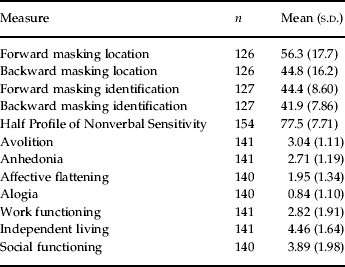
The means and standard deviations of the measures used in the study are displayed in Table 1. The patients' performance on measures of visual masking and the rating scales was comparable with our earlier studies (Rassovsky et al. Reference Rassovsky, Green, Nuechterlein, Breitmeyer and Mintz2005; Sergi et al. Reference Sergi, Rassovsky, Nuechterlein and Green2006). The patients' scores on the subscales of the RFS were slightly higher than those reported previously for a group of non-veteran urban schizophrenia out-patients (Brekke et al. Reference Brekke, Kay, Kee and Green2005).
Performance on measures used in the study

s.d., Standard deviation.
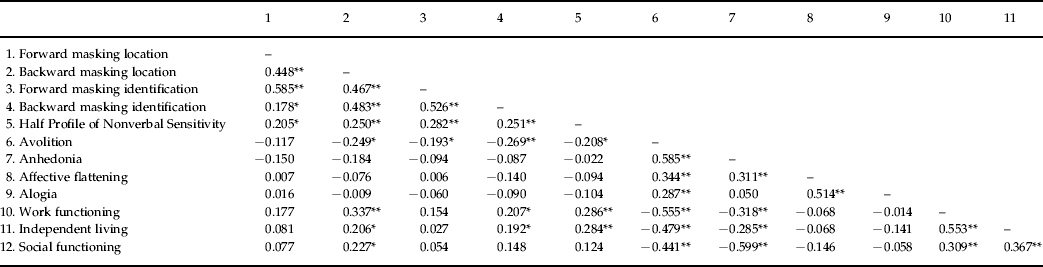
Pearson bivariate correlations (two-tailed) for the study variables are reported in Table 2. As can be seen in Table 2, there were significant zero-order correlations among the measures of visual masking, as well as among the measures of functional status. Although there were significant correlations among the various global scores of the SANS (except between anhedonia and alogia), the pattern of correlations was stronger within experience-related global scales (avolition and anhedonia) and expression-related global scales (affective flattening and alogia) than across these domains. Furthermore, experience-related global scales, but not expression-related global scales, significantly correlated with functional status. The measure of social perception (PONS) did not significantly correlate with social functioning, but did correlate with the other measures of functional status (work functioning and independent living).
Zero-order correlations among the study variables

* p<0.05, ** p<0.01.
Structural equation models
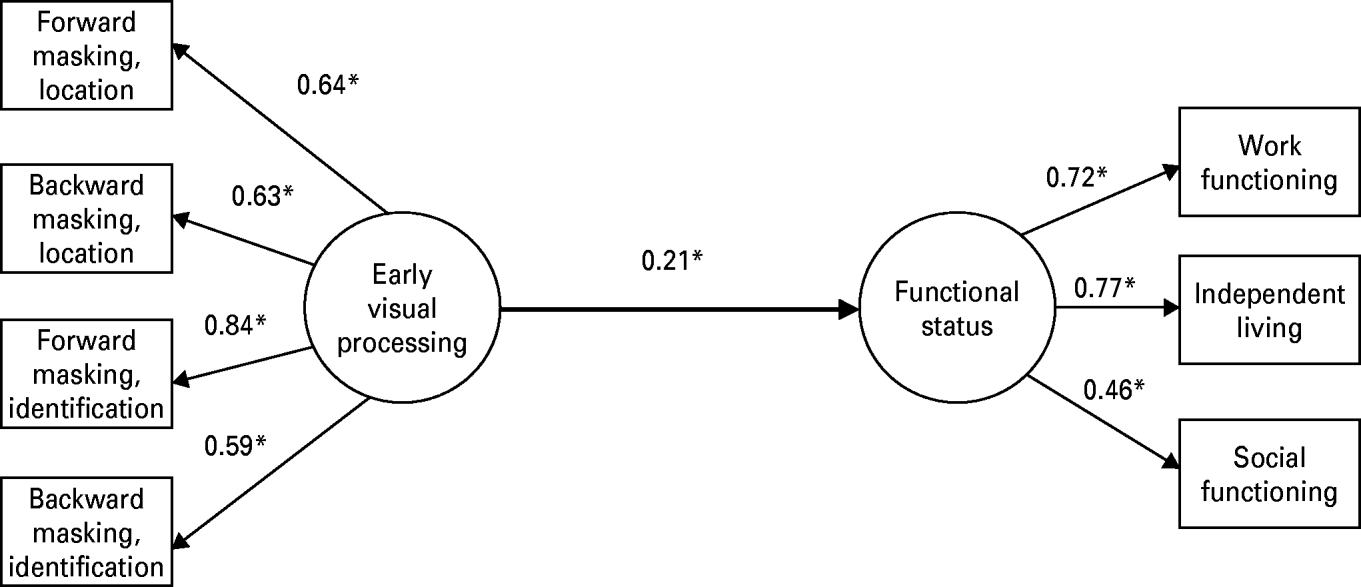
The models were estimated using maximum-likelihood solution (Bentler, Reference Bentler1996). The basic model, hypothesizing a direct relationship between early visual processing and functional outcome, was tested first. The independence model, testing whether or not the observed data fit the expected data, was rejected (χ2=325.6, df=21, n=174, p<0.01). (The χ2 for the independence model should always be significant, indicating that there is a relationship among the variables.) All indicators had moderate-to-high loadings on their respective latent variables, and all were significant at the 0.05 level. The basic model provided a moderate fit for the data (χ2=53.93, df=13, n=174, p<0.01, CFI=0.87, RMSEA=0.14) (see Fig. 1). Importantly, the latent variable early visual processing had a significant direct effect on functional status (standardized coefficient=0.21, p<0.05).
Basic model. Circles represent latent variables, and rectangles represent measured variables. Values are standardized path coefficients. χ2=53.93, df=13, n=174, p<0.01, comparative fit index=0.87, root mean-square error of approximation=0.14. * p<0.05.

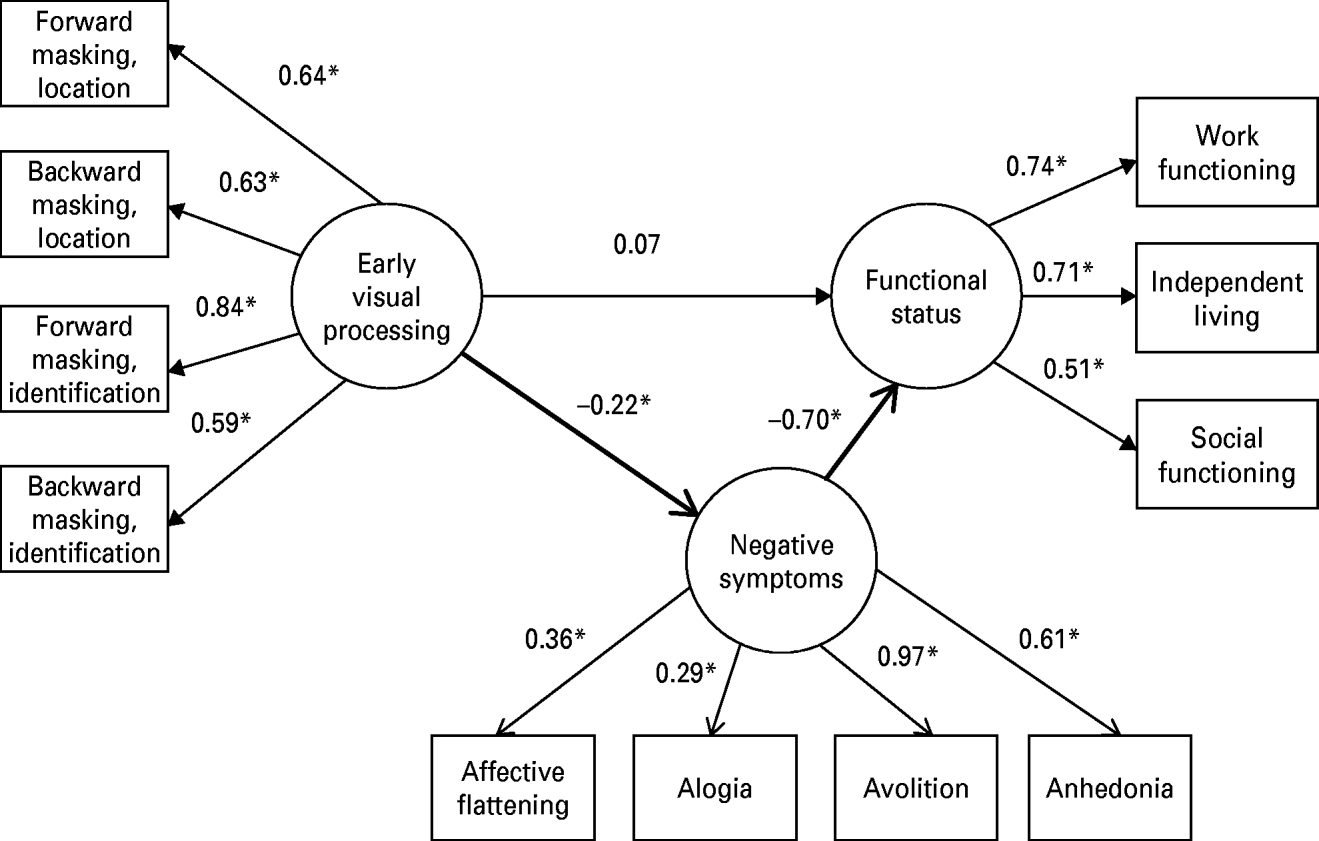
In the mediation model, both the direct path from early visual processing to functional status and the indirect path through negative symptoms were evaluated. The independence model was again readily rejected (χ2=624.6, df=55, n=174, p<0.01). All indicators were significantly related to their respective latent variables, and the mediation model provided a moderate fit for the data (χ2=167.3, df=41, n=174, p<0.01, CFI=0.78, RMSEA=0.13) (see Fig. 2). The negative symptoms measure was significantly predicted by early visual processing (standardized coefficient=−0.22, p<0.05), as well as being predictive of functional status (standardized coefficient=−0.70, p<0.05). The direct path from early visual processing to functional status was substantially reduced in the mediation model and was no longer significant (standardized coefficient=0.07, n.s.). Additionally, the indirect path between early visual processing and functional status was significant (standardized coefficient for indirect effect=0.16, p<0.05), confirming the mediating effect of negative symptoms.
Mediation model. Circles represent latent variables, and rectangles represent measured variables. Values are standardized path coefficients. χ2=167.3, df=41, n=174, p<0.01, comparative fit index=0.78, root mean-square error of approximation=0.13. * p<0.05.

In the next set of analyses, we sought to examine the nature of contribution, if any, of negative symptoms to our previously tested model (Sergi et al. Reference Sergi, Rassovsky, Nuechterlein and Green2006). Retesting this original model with the expanded dataset, we again found a good model fit, in which social perception mediated the relationship between visual processing and functional status (χ2=54.53, df=18, n=174, p<0.01, CFI=0.89, RMSEA=0.11). Although the path coefficients were somewhat smaller than in our original report, the pattern of associations was virtually identical. Early visual processes and social perception accounted for 12% of the variance in functional status. We then examined whether adding the latent measure of negative symptoms would explain additional variance in functional status. The nested models were compared using χ2 difference and multivariate Lagrange multiplier (analogous to forward stepwise regression) tests. Although the comparison between the two nested models indicated significant improvement (χ2 difference=49.79, df=2, n=174, p<0.001), the resulting model provided only modest fit for the data (χ2=174.4, df=50, n=174, p<0.01, CFI=0.79, RMSEA=0.12). Notably, there was no significant association between social perception and negative symptoms (standardized coefficient=−0.13, n.s.).
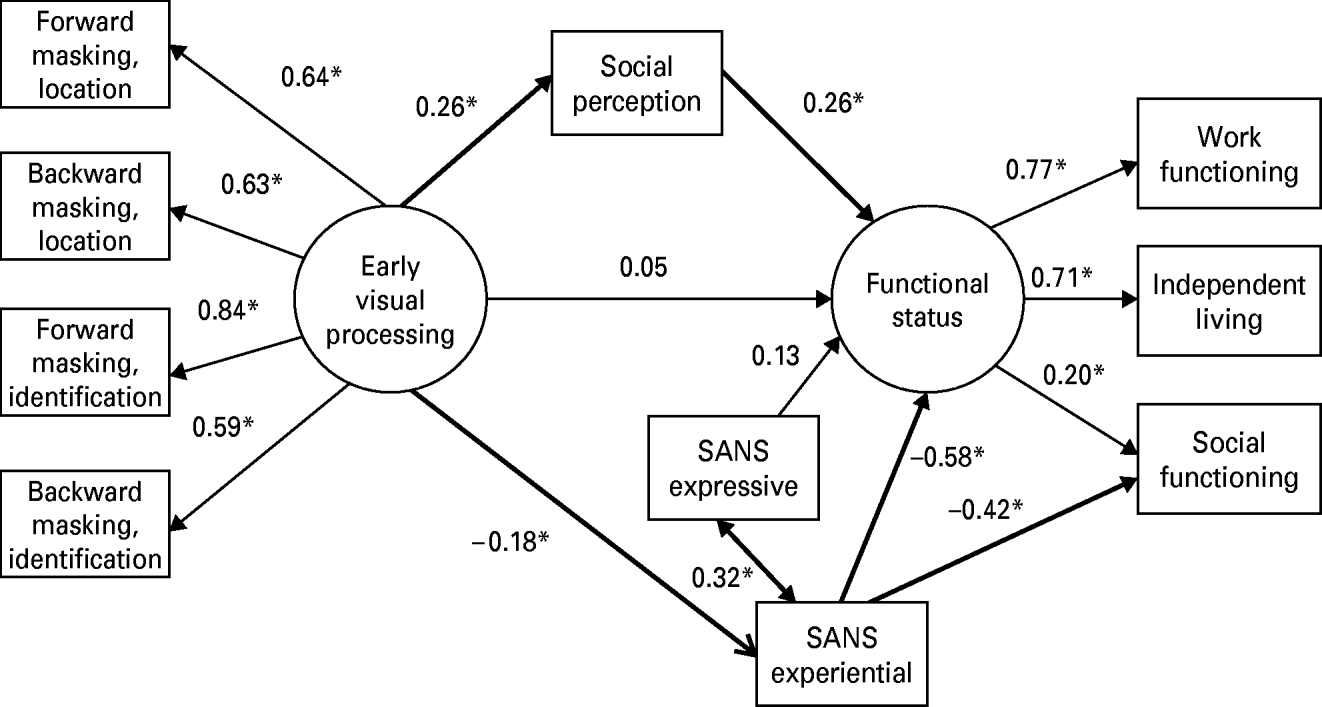
Based on previous studies (Sayers et al. Reference Sayers, Curran and Mueser1996; Orsel et al. Reference Orsel, Akdemir and Dag2004; Blanchard & Cohen, Reference Blanchard and Cohen2006), as well as correlations and exploratory factor analysis of the SANS, we separated negative symptoms into experiential (avolition and anhedonia) and expressive components (affective flattening and alogia). Global scores were then averaged for each of the two components (to reduce the number of parameters) and entered into the model. Repeating the aforementioned analyses, we found a significant improvement in model fit when the experiential component of negative symptoms was connected to early visual processing (standardized coefficient=−0.18, p<0.05) and functional status (standardized coefficient=−0.58, p<0.05). The Lagrange multiplier test also indicated unique variance between experiential negative symptoms and social functioning (standardized coefficient=−0.42, p<0.05). While the covariance between the experiential and the expressive components was significant (standardized coefficient=0.32, p<0.05), the path from the expressive component of negative symptoms to functional status was not significant (standardized coefficient=0.13, n.s.). The resulting model provided a very good fit for the data (χ2=61.13, df=30, n=174, p<0.01, CFI=0.93, RMSEA=0.08). Again, there were no significant associations between social perception and either expressive negative symptoms (standardized coefficient=−0.10, n.s.) or experiential negative symptoms (standardized coefficient=−0.03, n.s.), suggesting separate pathways through social perception and negative symptoms to outcome.
For completeness, we have also examined the contribution of positive symptoms to functional status. Specifically, we tested whether adding the thinking disturbance cluster (a summary score of hallucinations, unusual thought content, and conceptual disorganization) from the BPRS would improve model fit. However, this variable did not improve model fit and was not significantly predictive of functional status (standardized coefficient=−0.15, n.s.). Finally, the Wald test (analogous to backward deletion in stepwise regression) suggested removing the non-significant direct paths from early visual processing and expressive negative symptoms to functional status, without compromising model fit. Overall, early visual processes, social cognition and negative symptoms accounted for 41% of the variance in functional status. The full model is presented in Fig. 3 (the non-significant direct paths from early visual processing and expressive negative symptoms to functional status are retained in Fig. 3 for illustrative purposes).
Full model. Circles represent latent variables, and rectangles represent measured variables. Values are standardized path coefficients. χ2=61.13, df=30, n=174, p<0.01, comparative fit index=0.93, root mean-square error of approximation=0.08. * p<0.05. SANS, Scale for the Assessment of Negative Symptoms.

Discussion
Early visual processing deficits have consistently been demonstrated in schizophrenia (Green et al. Reference Green, Nuechterlein and Mintz1994 a, Reference Green, Nuechterlein and Mintzb; Rassovsky et al. Reference Rassovsky, Green, Nuechterlein, Breitmeyer and Mintz2004). These deficits are likely to be the beginning of a cascade leading to functional difficulties among schizophrenia patients. In a previous study, we showed that a direct significant relationship between early visual processes and functional outcome was mediated by a measure of social perception (Sergi et al. Reference Sergi, Rassovsky, Nuechterlein and Green2006). The present study expanded this model by incorporating measures of negative symptoms and examining their separate contribution in explaining functional outcome. Using the sem approach, we found that, similar to social perception reported previously, negative symptoms mediated the relationship between the visual processing and outcome, and inclusion of negative symptoms significantly improved the model. In contrast, inclusion of positive symptoms did not contribute significantly to the model. For negative symptoms, it was the experience-related component, rather than the expression-related component, that significantly predicted functioning. This finding is consistent with recent studies of negative symptoms in schizophrenia, suggesting that the experience-related aspects of negative symptoms constitute a distinctive, clinically important aspect of schizophrenia (Blanchard & Cohen, Reference Blanchard and Cohen2006; Horan et al. Reference Horan, Kring and Blanchard2006; Gard et al. Reference Gard, Kring, Gard, Horan and Green2007).
The present study attempts to begin identifying potential variables that could be part of the cascade leading to functional deficits in schizophrenia. Social perception and negative symptoms are two such candidates that have been repeatedly associated with visual perceptual deficits and functional impairment in schizophrenia (Green & Walker, Reference Green and Walker1986; Sergi & Green, Reference Sergi and Green2002; Kee et al. Reference Kee, Green, Mintz and Brekke2003; Bowie et al. Reference Bowie, Reichenberg, Patterson, Heaton and Harvey2006). Social perception consists, to a large extent, of fast visual identification of socially relevant cues (e.g. facial expressions and/or bodily gestures). It is therefore possible that early visual perceptual deficits, as indexed by masking tasks, impose limits on the amount of visual information that can be processed at a given time, which in turn could reduce one's ability to process socially relevant visual information and result in failures to identify briefly available social cues.
Beck and colleagues (Rector et al. Reference Rector, Beck and Stolar2005; Beck et al. Reference Beck, Rector, Stolar and Grant2009) have proposed that neurocognitive deficits contribute to discouraging life circumstances, engendering negative attitudes, self-beliefs and expectancies. These attitudes, in turn, contribute to the decreased motivation, interest and engagement in productive or enjoyable activities that manifest clinically as negative symptoms. Ultimately, these negative expectancies and diminished levels of interest and motivation lead to poor real-world functioning. Consistent with this formulation, studies have suggested indirect pathways from neurocognition through dysfunctional attitudes and negative symptoms to functional outcome (Grant & Beck, Reference Grant and Beck2009; Horan et al. Reference Horan, Rassovsky, Kern, Lee, Wynn and Greenin press). Hence, early visual processing deficits could set in motion a cascade leading to other, higher-order deficits, development of negative attitudes and symptoms, and, ultimately, to functional impairment.
While suggestive of two possible pathways (one through social cognition and the other through negative symptoms) from visual perception to outcome, the results should be interpreted with caution. First, the models are based on cross-sectional data, which limits the causal claims that can be made regarding the connections among the variables. Second, we employed visual masking procedures to index early visual processing. Visual masking, even when it comes from a fairly comprehensive battery of masking tasks, is but one of many measures that index visual perception. The possible limit of early vision as the sole predictor of outcome is also suggested by the relatively modest amount of variance in outcome explained by this measure. Thus, it will be informative to examine other tasks that index early visual and other perceptual impairments in schizophrenia (Javitt, Reference Javitt2009). Similarly, the PONS taps mostly non-verbal social perceptual processes, thereby limiting the conclusions that can be drawn regarding the overall construct of social cognition. Thus, adding measures that assess other domains of social cognition would provide a broader assessment of this construct (Adolphs, Reference Adolphs2001). Third, given the predominantly male sample, we could not adequately examine gender differences that could potentially have an impact on the relevant variables. Fourth, it is possible that the unique contribution of the experiential component of negative symptoms to functional status could partly be due to similarity in content between the SANS and the RFS. Although some of this measurement overlap was partialled out by the separate path between experiential negative symptoms and social functioning, it was not possible to fully remove the contribution of the measurement component to their common variance. Future efforts are needed to construct novel scales of negative symptoms that minimize reliance on items of adaptive functioning.
Finally, the sem approaches depend on the theories and empirical findings that guide the selection of variables and therefore cannot be viewed as the final point of investigation. By allowing a simultaneous test of the relationships among measured variables and their respective latent constructs, as well as the direct and indirect interconnections among these constructs, sem provides a context for understanding the complex nature of functional impairment in schizophrenia and offers potential avenues for future study. The identification of key variables and their role within the model will help to reveal the pathways leading to functional impairment in schizophrenia and suggest relevant targets for clinical intervention.
Acknowledgements
This research was supported by National Institute of Mental Health (NIMH) grants MH-43292 and MH-65707 to M.F.G., and by the Department of Veterans Affairs, VISN 22 Mental Illness Research, Education, and Clinical Center. Additional statistical support was provided by Gerhard Hellemann, Ph.D.
Declaration of Interest
None.