The personal attributes of politicians are an important component in determining the outcomes of elections and the nature of representation in democracies. To voters, personal attributes can serve as an informational shortcut about specific benefits and behavior that can be expected from politicians once they are in office. For example, an increased presence of women in legislatures is correlated with an increase in public spending on issues like childcare and education (e.g., Bratton and Ray Reference Bratton and Ray2002). Other studies have found that politicians from minority groups do better at serving the interests of their communities (e.g., Banducci, Donovan and Karp Reference Banducci, Donovan and Karp2004), and that politicians with local ties tend to be more likely than non-locals to focus on the needs of their hometowns (e.g., Carozzi and Repetto Reference Carozzi and Repetto2016). Party leaders seeking to win elections thus also take the attributes of potential candidates seriously, in part because the right combination of attributes may help optimize the party’s mobilization efforts, and in part because nominated candidates reflect the collective goals and priorities of the party itself.
Yet, despite the important role that personal attributes play in elections and representation, relatively few studies have rigorously investigated which particular attributes—including gender, age, ethnicity, local ties, occupation, and prior experience—are most relevant in shaping voters’ preferences over politicians. Part of the challenge in investigating this question is that politicians possess more than one attribute that might appeal to voters, in addition to having a party affiliation (which conveys additional information) and articulating various policy positions. This problem is compounded by the fact that many attributes are correlated with each other, making it difficult to isolate which particular attributes matter the most. For example, although a substantial amount of research finds that candidates tend to receive more votes in their hometowns (e.g., Hirano Reference Hirano2006; Fiva and Smith Reference Fiva and Smith2017), it is not clear whether this reflects voters’ preferences for a local candidate per se, or the mobilizational advantages that local candidates have in their hometowns. Existing research using observational data is usually unable to disentangle the attributes of interest from other attributes possessed by a given candidate.
Furthermore, we know relatively little about whether voters hold preferences for distinct types of representation under different electoral system contexts. Conventional wisdom is that electoral systems can shape the nature of representation by enhancing or downplaying the relative salience of politicians’ personal attributes to voters (e.g., Carey and Shugart Reference Carey and Shugart1995; Shugart, Valdini and Suominen Reference Shugart, Valdini and Suominen2005). Perhaps the most consistent finding is that proportional representation (PR) electoral systems tend to elect more women and ethnic minorities than variations of single-member district (SMD) systems (e.g., Rule and Zimmerman Reference Rule and Zimmerman1994). In addition, systems that structure vote choice around candidates rather than parties are assumed to increase the salience of the personal vote,Footnote 1 such that candidates with strong “personal-vote-earning attributes” (PVEAs)—local ties, prior experience, name recognition or celebrity status, or a family relationship to a previous politician—are more likely to get elected (e.g., Tavits Reference Tavits2010; Smith Reference Smith2018).Footnote 2
Given these observational patterns, it is often taken for granted that the types of politicians that emerge in a democracy can, at least in part, be engineered through electoral system design. However, observational data of actual politicians across different democracies are not helpful for drawing inferences about how voters’ preferences for different attributes are conditioned by electoral systems, because numerous other confounding variables may be present.
Aware of this limitation, a few studies have taken advantage of mixed-member systems to examine observational differences in politicians’ attributes under different electoral rules while holding country-specific determinants constant (e.g., Moser and Scheiner Reference Moser and Scheiner2012). Nevertheless, as long as our inferences are based on observational data, we still lack clear evidence for whether these differences stem from voters’ differentiated preferences for distinct types of representation, or from the roles that parties and electoral institutions play in translating voters’ preferences into representational outcomes. Moreover, most previous research has focused only on gender or ethnicity, leaving other important attributes of a politician’s background, in particular those related to the personal vote, underexplored.
In this study, we address these issues with a conjoint survey experiment in Japan. A growing number of studies have used conjoint analysis to evaluate voters’ preferences for the attributes and policy positions of politicians (e.g., Franchino and Zucchini Reference Franchino and Zucchini2015; Carnes and Lupu Reference Carnes and Lupu2016). We aim to contribute to this budding literature by including attributes in our analysis that are relevant to the personal vote, such as local ties, prior experience, dynastic ties, and celebrity status. Including these PVEAs in hypothetical politician profiles—detached from the other qualities and character traits possessed by actual politicians—allows us to examine an important question that is underexplored in the existing literature: how much do voters value these attributes per se, abstracting from the individuals who might possess them?
The case of Japan provides a useful institutional setting to examine whether preferences vary when voters consider politicians who are elected under different rules. Japan’s parliament (Diet) consists of two chambers, each of which uses a mixed-member majoritarian electoral system. The different electoral rules are intended to provide different types of representation to voters—namely, locally oriented representation in geographically small nominal-vote districts, versus broadly oriented representation in large districts using variants of list-based PR. We randomly assign our respondents to be primed with information on the electoral contexts of Japan’s system, and investigate whether distinct preferences for certain types of members of parliament (MPs) emerge depending on the context that is primed.Footnote 3
The results reveal that Japanese voters have strong preferences for and against certain attributes of politicians. In contrast to the observed attributes of actual politicians, voters do not prefer older politicians or celebrities, and are indifferent with regard to dynastic ties and gender. Moreover, we find consistent patterns in voters’ preferences regardless of the priming of different representational contexts, while the observed attributes do vary across these contexts. These findings suggest that the observed differences in politicians’ attributes under different electoral rules do not necessarily come from voters’ preferences for distinct types of representation in these contexts. Rather, factors such as parties’ recruitment strategies, the availability of different types of politicians, or the ways in which electoral rules enhance the vote-earning value of name recognition, likely play a greater role in determining the nature of representation in Japan.
Case setting and observational data
Japan is a useful setting for our experiment, as the personal attributes of politicians have often been viewed as playing an important role in elections (e.g., Hirano Reference Hirano2006; Scheiner Reference Scheiner2006), and the mixed-member systems of the Diet provide important intra-country variation. We first explain these two contextual backgrounds, and then use observational data from elections in 2013 and 2014 (held prior to the timing of our survey experiment) to describe differences in the attributes of actual candidates and MPs in each chamber of the Diet.
Parties and the personal attributes of politicians
In the dominant Liberal Democratic Party (LDP), candidate selection has traditionally been decentralized to local party branches, with heavy influence of local elites. Roughly a third of all LDP candidates have a background in local politics, and a similar fraction are “legacy” candidates who are related to the previous incumbent by blood or marriage (Smith Reference Smith2018).Footnote 4 The name recognition enjoyed by such candidates is believed to help them perform well in elections, but they also benefit from established ties to constituents and interest groups. Former national bureaucrats (viewed positively by party leaders for their expertise) were traditionally equally common, but have declined in prominence since the 1990s (by 2014, less than 20 percent of candidates). Around 70 percent of LDP candidates run in the prefectures of their birth.
Until 2017, the main opposition to the LDP was the Democratic Party of Japan (DPJ), which was formed in 1996 by defectors from the LDP and other parties and expanded through a series of party mergers over time.Footnote 5 As a result, the backgrounds and personal attributes of DPJ candidates have been more diverse than those of LDP candidates. Like the LDP, about a third of the DPJ’s candidates have served in local politics, but former national bureaucrats and members of political dynasties have been less common (13 and 17 percent, respectively, in 2014), and the party has been slightly more active in recruiting and nominating women (in 2014, 15 percent of candidates in the DPJ compared to 12 percent in the LDP).
Two other small parties have consistently contested national elections. Komeito, in coalition with the LDP since 1999, is a religious party affiliated with the Buddhist organization Soka Gakkai. Nearly all Komeito candidates are members of Soka Gakkai, and are often former employees of the party or the religious organization. More than 90 percent of Komeito candidates are male, and only about half run in the area of their birth. The Japanese Communist Party (JCP) is a small leftist party that is the oldest party in Japan. About a fifth of JCP candidates have local political experience, and a quarter are women. The party recruits many of its candidates from among party employees, activists, union leaders, and left-wing lawyers. Dynasties, celebrities, and other types of candidates with high name recognition are rare in both of these small parties.
The current electoral system for the House of Representatives (lower chamber, henceforth HR) has been in use since 1996. Previously, members of the HR were elected entirely under the “hyper-personalistic” (Shugart Reference Shugart2001) single non-transferable vote (SNTV) system in multi-member districts. Under SNTV, intraparty competition within the larger parties, especially the LDP, undermined the value of party label for earning votes. Under the new mixed-member system, intraparty competition has been eliminated, and elections have become relatively more party-centered than in the past (Reed, Scheiner and Thies Reference Reed, Scheiner and Thies2012). Overall, however, voters still regard politicians’ personal attributes as an important factor in choosing a candidate, regardless of which party they support.Footnote 6 Intraparty competition is still a feature in the mixed-member system of the House of Councillors (the upper chamber, henceforth HC).
The mixed-member systems of the diet
For the HR, 295 members are elected by a first-past-the-post (FPTP) system in SMDs contained within 47 prefectures. Another set of 176 members are elected through a closed-list proportional representation (CLPR) system in one of eleven regional districts that overlap with the SMDs.Footnote 7 Voters cast their ballots in the SMD tier by physically writing out the name of a candidate. In the CLPR tier, voters instead write the name of a party. Candidates may be dual-listed in both tiers; if a dual-listed candidate loses the SMD contest, he or she might still be elected through the party’s PR list. The media have sometimes (pejoratively) dubbed these MPs “zombies,” since they “died” in the SMD but were “brought back to life” in PR.
The mixed-member system for the HC combines 146 seats in districts that are geographically coterminous with the 47 prefectures, and 96 seats filled through an open-list proportional representation (OLPR) contest in a single, nationwide contest.Footnote 8 In the prefecture-based races, members are elected through SNTV with the number of seats ranging from one to five.Footnote 9 Voters cast their ballot for a single candidate, as in the SMD tier of the HR, and seats are allocated in descending order of vote share. In the OLPR tier, voters can choose to write the name of a candidate or a party. Seats are allocated first to parties, then to candidates on those parties’ lists in descending order of preference votes until all party seats are filled. The dual-listing provision is not used in the HC.
Japan’s mixed-member bicameral parliament thus features four electoral systems (FPTP, SNTV, CLPR, OLPR) with districts of four different geographical sizes: sub-prefectural area (FPTP in HR), entire prefecture (SNTV in HC), regions made up of multiple prefectures (CLPR in HR), and the entire country (OLPR in HC). Furthermore, voters have different targets of choice: a candidate (FPTP, SNTV), a party (CLPR), or either a candidate or a party (OLPR). In our experimental design, we prime respondents with these distinct variations in the electoral rules.
Observed attributes of politicians
Existing theories would predict that the observed attributes of politicians should vary across Japan’s four electoral contexts (e.g., Shugart, Valdini and Suominen Reference Shugart, Valdini and Suominen2005; Moser and Scheiner Reference Moser and Scheiner2012). Specifically, we should expect to observe more women in the OLPR and CLPR tiers, and more politicians with strong PVEAs—such as prior experience, celebrity status, or dynastic ties—where vote choice is structured around candidates (FPTP, SNTV, and OLPR) rather than parties (CLPR). Moreover, the importance of these attributes should increase with intraparty competition under SNTV and OLPR, which increases the informational demands on voters, and in turn heightens the salience of personal attributes and name recognition as heuristic devices.
To examine these predictions, we collected information on the personal attributes of the 433 candidates who ran in the 2013 HC election and the 1191 candidates who ran in the 2014 HR election (the two elections immediately preceding the timing of our experiment in 2015).Footnote 10 For space reasons, here we report just a few notable patterns in the observed attributes of candidates and winners across the institutional contexts.Footnote 11
We first consider gender. Overall, women represent less than a quarter of all candidates and winners across institutional contexts. However, women are more prevalent among MPs in the PR tiers of each chamber than among MPs elected in the smaller districts (although the difference is not statistically significant for the HC); and between SNTV and SMD, the proportion of women is larger for SNTV. These patterns are consistent with theoretical expectations. It is also notable that women are more common among “zombies” than SMD winners. With regard to age, of note is that Japanese candidates and politicians tend to be on the older side. Only about 10–20 percent are less than 40 years old. Between tiers, PR tends to feature older candidates and winners, particularly in the HC. If we consider age as a proxy for prior experience, which is an important PVEA, then this pattern would not be consistent with expectations. But it might be due to the fact that terms are longer in the HC and re-election rates are higher in PR systems. This attribute exemplifies the difficulty of untangling the relevance of personal attributes across electoral systems based only on observational data.
We next consider two common background careers: local assembly members (including in municipal and prefectural assemblies), and national bureaucrats. Politicians with local assembly experience—an important measure of local ties as well as experience—are significantly more prevalent in the district tiers of each chamber than in the larger PR tiers. This is consistent with expectations. The exception is that local politicians appear as candidates (though not winners) in the HC at roughly the same rate (about 20 percent each) across tiers. Former bureaucrats are more common among candidates and winners in the SMD tier than the PR tier in the HR. If we consider experience as a bureaucrat to be a relevant PVEA, then this finding is also consistent with expectations. But there are no apparent patterns across tiers in the HC.
Finally, we consider differences in the observational data regarding dynastic ties and celebrity status, two attributes that are likely to increase name recognition, which is important for mobilizing support in candidate-centered elections (under SNTV, in particular). While dynastic family ties might matter most in local districts, celebrity status may be most helpful in mobilizing votes from larger constituencies (i.e., OLPR, CLPR). We collected information on whether each politician was related to a previously elected local politician, national-level politician (who never served in cabinet), or former cabinet minister. Overall, such political legacies are much more prevalent in the district tier of the HR (19 percent of candidates and 35 percent of winners, compared to 6–7 percent for either group in PR). Again, this is consistent with theoretical expectations. In the HC, legacies appear as candidates at equivalent rates (about 10 percent) across tiers but are more likely to appear in the district tier among winners (31 percent, compared to just 7 percent for PR). We define a celebrity as any candidate with a high profile from a previous career in television, movies, music, comedy, sports, news, and so on (in Japan often described generally as a “talent”). The observational data show that such candidates are most common in the OLPR tier of the HC (10 percent of winners), where their national name recognition is presumably an electoral asset; however, the difference across tiers is not statistically significant.
Identification problems
The patterns in the observational data appear to provide support for theoretical expectations regarding the relationship between electoral systems and politicians’ personal attributes. However, such observational data are limited in important ways for understanding the actual preferences of voters for different attributes in candidates and MPs.
First, every politician has multiple attributes, and usually runs with a party label that also represents a number of substantive policy concerns of voters (Horiuchi, Smith and Yamamoto Reference Horiuchi, Smith and Yamamoto2018). The sheer number of attributes that are highly correlated with one another makes it virtually impossible to identify the effects of those individual attributes from the observational data alone. For example, although incumbents tend to do well in elections, it is often not clear how much of the incumbency advantage is due to personal attributes (such as experience) versus other factors (e.g., Carson, Engstrom and Roberts Reference Carson, Engstrom and Roberts2007).
The fact that many attributes of interest to voters may be correlated makes it a challenge for researchers, let alone party actors involved in candidate selection, to determine what kinds of attributes voters actually prefer. In our observational data, for example, age and prior incumbency are highly correlated, as are local birth and local political experience. Candidates and MPs from the LDP are more often dynastic than in other parties, but they also tend to be older and are more likely to be born in the district they represent. Similarly, the membership of the DPJ and JCP includes more women. These party differences make it difficult to determine whether voters valued the personal attribute (e.g., gender or dynastic ties), or whether they supported the party, and the party’s candidate just happened to have these attributes.Footnote 12
An additional problem with observational data is that the attributes of politicians are in part a reflection of which eligible citizens attempt to run for office and who among them are selected by parties. The nature of political life or the structure of political opportunity may be more suited to certain socio-demographic backgrounds than others (e.g., Iversen and Rosenbluth Reference Iversen and Rosenbluth2010). As a result, even if we observe that certain attributes are common among elected politicians in particular contexts, it could be because voters preferred candidates with those attributes, or because voters lacked the choice of candidates with alternative attributes.
A third issue with many of these attributes is the likely correlation with increased name recognition, which helps to win election in candidate-centered systems, and may help secure higher list positions in party-centered systems. As a result, it is unclear whether voters value these attributes in and of themselves, or are influenced by the heuristic shortcut of a familiar name. Consider dynastic ties. The name recognition inherent in this attribute may be electorally valuable in candidate-centered elections, but voters may also care about other qualities signaled by dynastic ties in the abstract, such as familiarity with politics or a stable connection to the community, which are related to the kind of representation that might be expected from such a politician. A related, but converse, argument might be made for celebrity status: voters might choose celebrities simply because of the familiar name, or because celebrity status signals something additional, such as an “outsider” perspective.
In sum, the existing literature has not yet thoroughly explored the multidimensional preferences of voters for politicians’ personal attributes, nor do we have a good understanding of which attributes are most preferred by voters in Japan. Moreover, despite strong theoretical reasons to expect variation in attributes across electoral contexts, and the observational evidence presented here and in previous empirical studies, the existing literature has produced relatively scant empirical evidence of the mechanisms behind this variation. The observed variation could stem from voters holding differentiated preferences for politicians’ attributes depending on their understanding of the electoral institutions in use and the kind of representation they desire in those contexts. Alternatively, it could stem from the ways in which other factors, such as party recruitment strategies or heuristic shortcuts in voting, shape stable voter preferences into divergent representational outcomes.
Survey design
We aim to answer the following two questions: first, which attributes of politicians are most preferred by Japanese voters? Second, do voters prefer different types of politicians depending on their understanding of the representational contexts generated by electoral rules?
Before explaining our experimental design, it is important to note that our design is not intended to serve as a realistic simulation of the actual conditions and processes of voting under the different electoral contexts that exist in Japan. Rather, it is specifically designed to activate respondents’ factual understanding of the electoral rules and investigate how such activation affects the way they evaluate politicians’ attributes in different representational contexts. In this regard, it is also important to note that we did not put our experiment in the context of any specific election that happened in the real world. This is advantageous for measuring respondents’ preferences for politicians’ attributes per se, without inadvertently encouraging them to associate the hypothetical politicians presented in our experiments with any actual politicians.
Random assignment of respondents to groups
Our sample of respondents consists of 2,200 citizens of eligible voting age (20 and older).Footnote 13 We randomly assigned respondents to one of four groups: the first group was exposed to explanatory information about the SMD tier of HR elections (the size of the district, how votes are cast, and how seats are allocated), and then to information about the PR tier; the second group was exposed to the same set of information but in the reverse order; the third group was exposed to information about the SNTV tier of HC elections, and then to information about the PR tier; and the fourth group was exposed to the same set of information but in the reverse order.Footnote 14 We prepared two groups of respondents for each chamber (HR or HC) to avoid any potential ordering effect. After the information was presented, each respondent undertook five conjoint tasks, making the total number of tasks per respondent ten overall.
Randomized attributes and levels
In each of the ten conjoint tasks, respondents compared two hypothetical politicians and answered the following question: “Which of the following two persons do you think is more desirable as a [ ] member of the [ ]? Even if you are not entirely sure, please indicate which of the two you would prefer.”Footnote 15 The phrases within the square brackets corresponded to the electoral tier and chamber. Note that we emphasized the words associated with the electoral system so that respondents would be sufficiently primed with the information.
Each hypothetical politician’s profile featured nine attributes.Footnote 16 The order of these attributes was randomized for each respondent to avoid any possible order effect.Footnote 17 The “levels” (specific attributes) were also randomly assigned for each profile. The randomization of attributes allows us to make causal inferences about which of these attributes are more relevant in respondents’ choice of politicians, and which specific levels on those attributes are more positively or negatively evaluated. Specifically, our design follows the approach proposed by Hainmueller, Hopkins and Yamamoto (Reference Hainmueller, Hopkins and Yamamoto2014), whose fully randomized conjoint analysis non-parametrically identifies the average marginal component effect (AMCE) for each of the attribute levels on the probability of choosing a profile.Footnote 18
Party has five levels corresponding to the four main parties discussed earlier, along with “Independent.”Footnote 19 Including party labels along with the other personal attributes in our profiles allows us to evaluate the relative value of party for Japanese voters when evaluating politicians. The other attributes in the profiles are composed of relevant personal attributes for the Japanese context, which we will discuss in the next section. Hometown indicates whether the politician was born “Inside” or “Outside” the respondent’s prefecture of residence.Footnote 20 Highest educational attainment, Prior occupation, and Parental political background also include levels that relate to a politician’s local ties and prior experience. Two additional attributes are more directly relevant to Experience in politics: whether the person is a current or former member of the House of [Representatives/Councillors] and Number of previous terms. Finally, we include two demographic attributes: Age and Gender. As these attributes in the real world are correlated with others, such as experience, it is important to add them in our conjoint analysis.
Theoretical expectations
Existing research suggests that voters might view some personal attributes more favorably than others. For example, a considerable amount of survey research has investigated voters’ attitudes toward female candidates (e.g., Dolan Reference Dolan2010; Aguilar, Cunow and Desposato Reference Aguilar, Cunow and Desposato2015). Although results across different contexts are mixed, voters are often less informed about women than men as candidates, and may rely on negative stereotypes of how women will perform in office (e.g., Huddy and Terkildsen Reference Huddy and Terkildsen1993; Sanbonmatsu Reference Sanbonmatsu2002). As a result, women often must be more qualified and work harder in order to reach the same level of support from voters and parties (e.g., Anzia and Berry Reference Anzia and Berry2011).
At first glance, one might presume that Japanese voters have strongly unfavorable attitudes toward female politicians, because Japan ranks last among the Organization for Economic Co-operation and Development countries in gender representation.Footnote 21 However, it is not clear whether this stems from voters’ negative attitudes toward women in politics, or institutional and structural barriers to recruitment (e.g., Iversen and Rosenbluth Reference Iversen and Rosenbluth2010). It may also be possible that gender cues matter less (or more) once bundled together with other relevant attributes and indicators of quality, such as political experience.
Experience as an attribute of “quality” is often measured by incumbency or prior service in local assemblies (e.g., Jacobson Reference Jacobson1989). Although a large part of the incumbency advantage is due to name recognition and the deterrence of high-quality challengers (e.g., Carson, Engstrom and Roberts Reference Carson, Engstrom and Roberts2007; Hall and Snyder Reference Hall and Snyder2015), voters may also prefer incumbents for the experience that they bring to representing the needs of the district or area. In other words, voters might value incumbency or length of service in the abstract, setting aside evaluations of the actual individuals who are incumbents. In the context of Japanese politics, in addition to the number of previous terms in office, political experience or “quality” in general could be measured by the types of prior occupations held, such as prior service in the national bureaucracy (Scheiner Reference Scheiner2006), or even by age (given seniority rules in Japanese politics).
To the extent that voters value local ties, politicians who were born in the voters’ district or region, or who have served in local elective office, might be preferred over “outsiders” (e.g., Tavits Reference Tavits2010; Campbell and Cowley Reference Campbell and Cowley2014). In the context of Japanese politics, local ties could be measured by the place of birth, dynastic family ties, or to some extent by education (e.g., a graduate of a local public university). Local assembly experience has been also used in previous studies as a key measure of both local orientation and the personal vote.
Voters in Japan may therefore be expected to exhibit some baseline preferences for or against politicians based on gender or several of these indicators of experience and local ties. The conjoint nature of our experiment will in part reveal which particular attributes are most important. But the institutional variation present in Japan might also produce different degrees of relevance or value for these attributes. Given the relationship between PR and gender representation, for example, we might expect to observe more favorable attitudes toward hypothetical female politicians under OLPR and CLPR than SNTV or FPTP.Footnote 22 We might also expect that the perceived value of some personal attributes, such as local ties, prior political experience, or a dynastic family relationship to a previous politician, should be higher where voters are primed to consider politicians representing them in contexts where elections are candidate-centered (FPTP, SNTV, and OLPR) rather than party-centered (CLPR). Moreover, where electoral districts are geographically smaller, such as SMDs in the HR and prefectural SNTV districts in the HC, we might expect stronger demand among voters for a politician with local ties to that district.
Finally, with regard to the relevance of personal attributes of politicians vis-à-vis their party affiliation, in the context of Japanese politics, we might expect voters in general to prefer politicians with no party affiliation. This is because the majority of voters in Japan do not support any party.Footnote 23 Yet, between different electoral system contexts, party-affiliated politicians might be more preferred under CLPR and OLPR, compared to FPTP and SNTV, where politicians’ personal attributes, in particular local ties, should be more relevant to the kind of representation a voter might expect from a politician.
Results
We first show pooled results using all 2,200 respondents. We then show how the estimated effects differ by the priming of different electoral system contexts.
Overall results
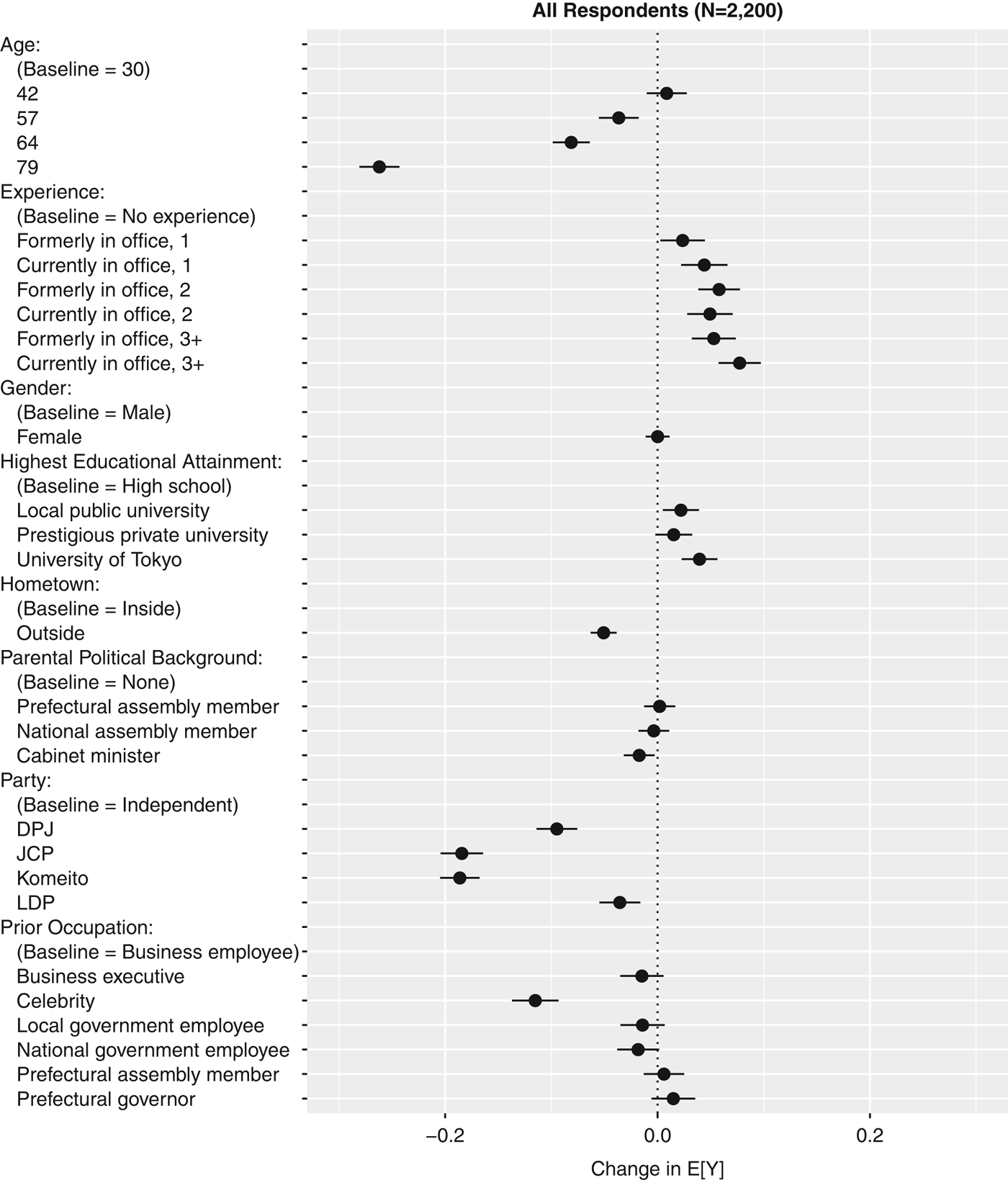
Figure 1 shows our estimated AMCEs for the pooled sample, where the solid circles represent the point estimates and the horizontal bars represent the 95 percent confidence intervals robust to clustering at the respondent level. One of the most remarkable patterns is that, as expected, voters on average strongly prefer independent politicians unaffiliated with any political party over party-affiliated politicians. Compared to the baseline level of Party (“Independent”), the effects of party labels (“DPJ,” “JCP,” “Komeito,” and “LDP”) are all negative and statistically significant. The effects of “JCP” and “Komeito” are particularly large and negative. Although these parties enjoy strong support from their core supporters, neither is popular with the general electorate.
Average effects of hypothetical politicians’ attributes on respondents’ preference Note: Solid circles represent the estimated average marginal component effects of each attribute level on the probability of choosing a hypothetical politician containing that attribute level, compared against a politician with the baseline level for the same attribute. Horizontal bars represent 95 percent confidence intervals robust to clustering at the respondent level. DPJ=Democratic Party of Japan; JCP=Japanese Communist Party; LDP=Liberal Democratic Party.

Moving beyond party label, which personal attributes do voters care most about? Although gender representation is comparatively low in Japan, the results of our analysis indicate that gender is, on average, irrelevant when voters consider the desirability of a hypothetical politician. Compared to the baseline category (“Male”), the effect of “Female” is almost zero and not at all significant. In contrast, voters appear to have strong preferences regarding age. Compared to the baseline level of Age (“30”), the effect of “42” is not statistically significant, but the effects of “57”, “64”, and “79” are all negative and statistically significant. The effect of “79” is particularly large. These results are not necessarily consistent with the observed attributes of actual politicians reported in the earlier section.
Although younger politicians are generally more preferred, this does not imply that experience is irrelevant. The effects for the various levels of Experience show that politicians who formerly or currently hold office are more positively assessed by voters than the baseline level of “No experience.” The effects tend to be larger for “Formerly in office” than for “Currently in office” and larger as the number of past victories increases. This seemingly contradictory result—that voters prefer younger but experienced politicians—demonstrates the effectiveness of decomposing the relevance of personal attributes through conjoint analysis.
These results may explain, for example, the growing popularity of Shinjiro Koizumi, the son of former prime minister Junichiro Koizumi. Although he was only 36 years old at the time of our experiment, he had already won election four times. We need to be cautious, however, in making such an interpretation. He may be popular not because he is young and experienced but because he is a son of a former prime minister. Dynastic politicians are often able to enter politics at a younger age, bypassing traditional stepping stones to office such as local assembly experience. The estimated effects of Parental Political Background should help to further decompose the effects of these attributes. Compared to the baseline category of “None,” the effects of “Minister,” “National assembly member,” and “Prefectural assembly member” are all small. The effect of “Minister” is negative and barely significant at the 5 percent level, but the effects of the other two levels are almost zero and insignificant. Contrary to the empirical evidence of a vote advantage for members of Japanese dynasties (Smith Reference Smith2018), these results suggest that, in the abstract, dynastic ties are not necessarily of inherent value to voters.
What if a politician is a celebrity? Celebrity politicians are increasingly common in Japanese politics, and some have even taken key leadership roles in parties. Although political parties are active in nominating such celebrity candidates, the effect of “Celebrity” for Prior Occupation, compared to the baseline level of “Business employee,” is negative and statistically significant. The effect is also quite large. Other prior occupations seem to be irrelevant for Japanese voters. Specifically, compared to the baseline level of “Business employee,” the effects of “Business executive,” “Local government employee,” “National government employee,” “Prefectural assembly member,” and “Prefectural governor” are all small and statistically insignificant.
We included two other attributes that are related to politicians’ “localness.” The effect of “Local public university” for Highest Educational Attainment is positive compared to the baseline level of “High school.” The effect, however, is small and barely significant. The effects of “Prestigious private university” and “University of Tokyo” are also positive compared to the baseline, and the effect of “University of Tokyo” is large and statistically significant. Japanese voters appear to consider university graduates as more desirable, but going to a local university is not particularly relevant, at least on average.
Finally, for Hometown, the effect of “Outside” as compared to the baseline of “Inside” is negative and significant. Even when provided with information about other attributes, such as the politicians’ age, experience, and party affiliation, voters still prefer politicians who are locals.
Effects by priming of electoral context
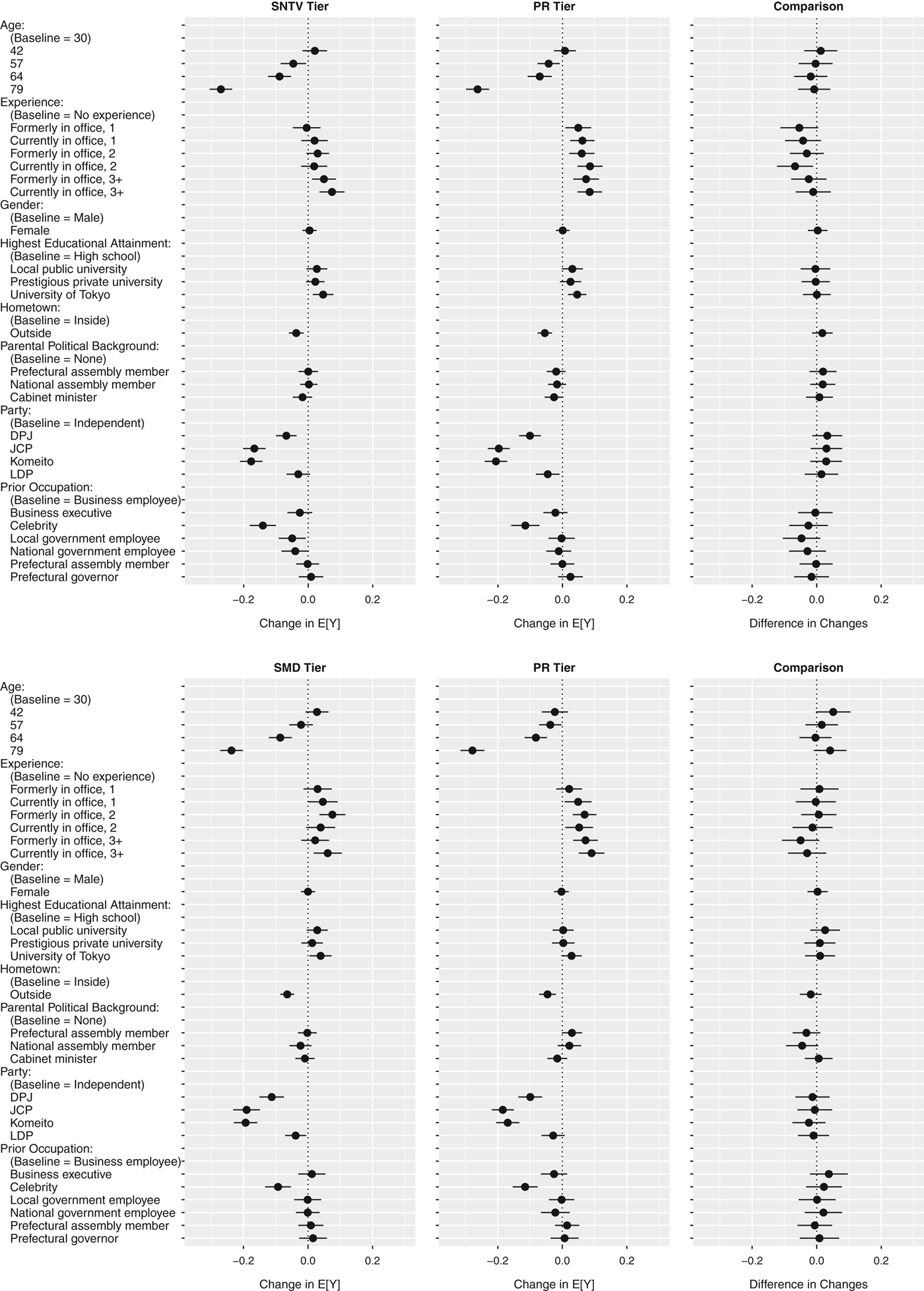
Figure 2 shows the results of our tests when divided into separate groups by priming treatment. The top set of panels compares SNTV versus PR in the HC; the bottom set compares SMD versus PR in the HR. In each set, the far-right panel shows the point estimates of the differences in AMCEs for each attribute level between the two experimental (electoral tier) conditions, along with their 95 percent confidence intervals. Since each respondent was given both sets of information in 5×2 conjoint exercises, this figure compares the difference in attitudes within respondents.
Effects of politicians’ attributes on respondents’ preference, by priming conditions Note: Top panels give the results for the House of Councillors (single non-transferable vote (SNTV) versus proportional representation (PR) priming); bottom panels give the results for the House of Representatives (single-member district (SMD) versus PR priming). The third panel for each shows the difference in the estimated average marginal component effects. DPJ=Democratic Party of Japan, JCP=Japanese Communist Party, LDP=Liberal Democratic Party.

The results are unambiguous: all four of the leftmost panels are very similar to the results shown in Figure 1. In addition, the difference between the priming conditions is statistically significant for only one out of 56 comparisons. Given the large number of hypotheses being tested in this analysis, we interpret our single statistically significant estimate not as evidence of a true difference between the two conditions, but as stochastic noise. We also separately compared the results with respondents pooled across chambers (HR versus HC) and pooled across tier types (small district versus PR); again, we found no statistically significant difference for either of these comparisons.Footnote 24
We conducted several additional robustness checks to verify that this null finding indeed reflects an absence of a priming effect, rather than a problem with the experiment design or sample.Footnote 25 First, we estimated the difference between the priming conditions using only the respondents who passed a set of manipulation checks (a knowledge test of the electoral rules we primed) placed immediately after the conjoint tasks in the survey. The results were virtually identical, with none of the 56 comparisons indicating a statistically significant difference between the conditions. This indicates that the lack of difference across the conditions is not due to respondents failing to understand the priming information. Similarly, to see if our result stems from lack of engagement with the survey among respondents, we ran the same analysis on the subsample of respondents who passed a set of screener questions included toward the end of the survey, and found equivalent results, with only two out of the 56 differences estimated to be statistically significant. Finally, we investigated the possibility that those who participate in elections may have distinct and context-contingent preferences, whereas the general voting-age population, which includes non-voters, may not. We find no evidence for this: our null result is replicated when we analyze the subsample of respondents who reported that they had always or almost always voted in past elections. In sum, our analyses consistently show that there is no difference between the experimental conditions using the electoral system priming in any of the AMCEs.Footnote 26
Discussion
The results of our conjoint experiment illustrate that Japanese voters have strong preferences for particular types of politicians. Importantly, despite the fact that there are many elderly, celebrity, dynastic, and male politicians in Japan, voters do not appear to prefer older politicians or celebrities, and are indifferent with regard to dynastic family ties and gender. Furthermore, the clear lack of difference in the AMCEs between the experimental conditions of our survey suggests that voters prefer the same types of politicians even when asked to consider the kind of representation they desire under different electoral system contexts. This stands in contrast to the patterns in observed attributes described earlier, as well as the theoretical expectations. These discrepancies might be thought of as “representational gaps” between voters’ preferences and the actual attributes of politicians. Yet, caution is warranted in interpreting such gaps.
First, the discrepancies do not necessarily imply that voters’ preferences are insufficiently reflected in real-world electoral processes in Japan. For example, voters may not care about politicians’ gender per se according to our estimates of AMCEs, despite the fact that most Japanese politicians are male. This may be because voters evaluate the attributes of politicians differently depending on the gender of those politicians. More generally, gender—or any other attribute for that matter—might interact in important ways with other attributes, and such interactions may be one source of the ostensible inconsistency between voters’ preferences and the observed attributes of politicians.
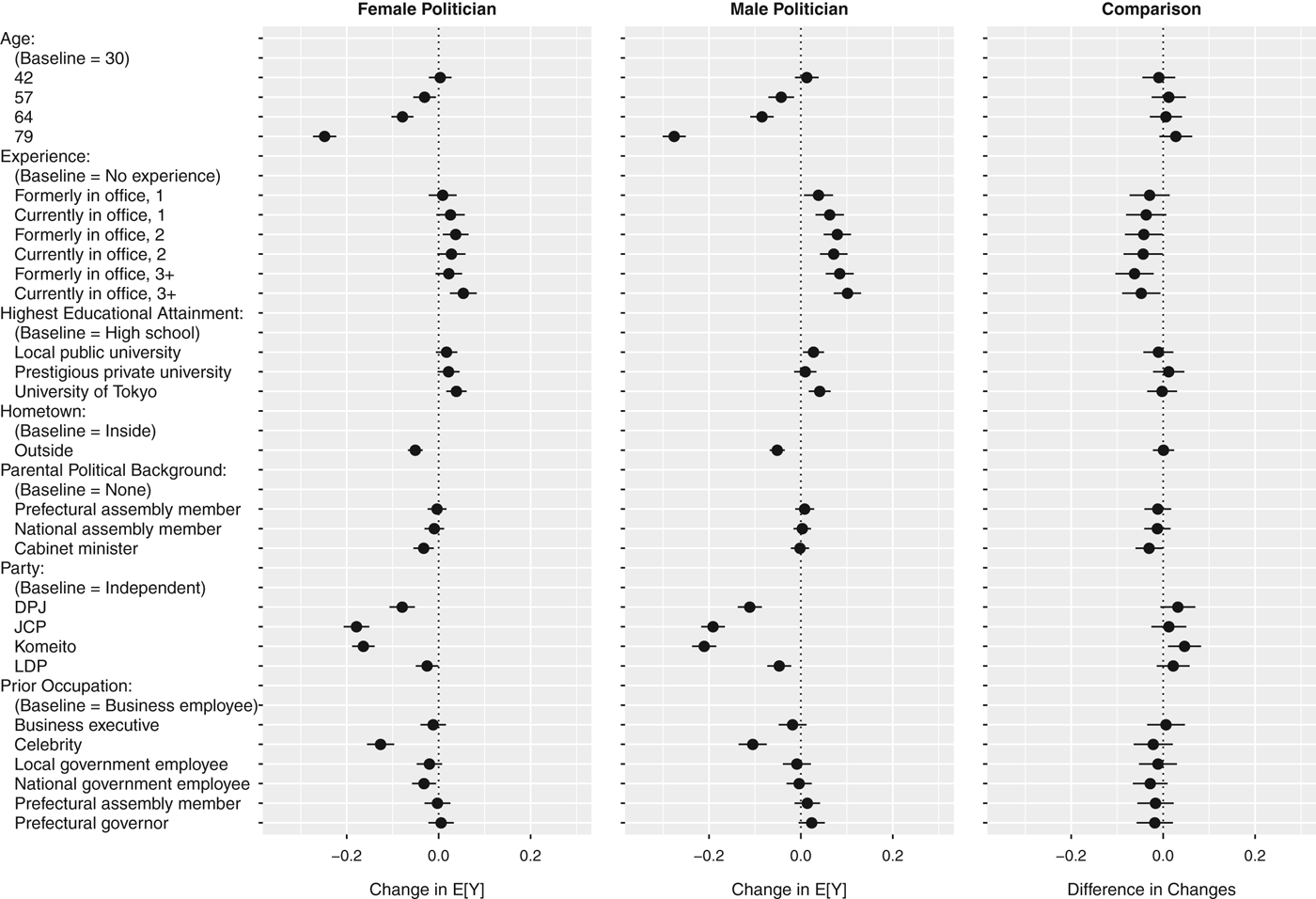
To investigate this possibility, we estimate the average component interaction effects (ACIEs) as proposed by Hainmueller, Hopkins and Yamamoto (Reference Hainmueller, Hopkins and Yamamoto2014). Among many possible interactions, we focus on gender because it is increasingly relevant to parties’ candidate recruitment strategies, even as female politicians remain comparatively underrepresented. The results presented in Figure 3 provide a hint as to how a politician’s gender might condition voter preferences for different attributes. The rightmost panel shows the ACIEs with respect to gender and each of the other attributes, along with their 95 percent confidence intervals. The key result is that hypothetical male politicians get a significantly larger “boost” from political experience than their female counterparts. That is, the positive effect of having been in office for two or more terms as opposed to no experience in office is significantly smaller for a female politician than a male politician.
Average effects of hypothetical politicians’ attributes on respondents’ preference, given the hypothetical politician’s gender Note: Solid circles in the left and middle panels represent the estimated average marginal component effects of a hypothetical politicians’ attributes other than gender, conditional on whether the politician is female (left) or male (middle). The rightmost panel shows the average component interaction effects with respect to gender and each of the other attributes. Horizontal bars represent 95 percent confidence intervals robust to clustering at the respondent level. DPJ=Democratic Party of Japan, JCP=Japanese Communist Party, LDP=Liberal Democratic Party.

This may partly explain why women continue to be underrepresented in Japan. Female candidates may win when they are first-timers, particularly when they are young (and depending on their party’s popularity). But at subsequent stages of re-election and promotion, our analysis of ACIEs suggests that women with experience might not reap the same amount of support as men with experience. Japan is known to be a country with a particularly tough environment for working women. This so-called “bamboo ceiling,” which exists not only in business environments but also in politics, may be partly reinforced by voters themselves.
Although Figure 3 is suggestive of an important interaction effect, it is unlikely that such interactive effects of attributes can account for all of the ostensible gaps between voters’ preferences and the actual attributes of politicians. In fact, the estimates of other ACIEs do not provide clear cues as to why voters do not prefer elderly and celebrity politicians, or why parental political background is irrelevant.Footnote 27 Rather, the gap between the experimental results and the observational data for the latter two of these variables could be more related to name recognition, which is associated with these attributes in the real world but abstracted out in our experiment. Our survey asked respondents to evaluate hypothetical politicians with a dynastic background or celebrity past, which may signal certain qualities in the abstract—such as “insider” or “outsider” perspectives, respectively. However, our results suggest that voters may not value these potential qualities in and of themselves, and are instead probably drawn to the name recognition these types of politicians tend to enjoy in real-world elections. This explanation would also account for the higher observed prevalence of these types in the electoral contexts (SNTV, SMD, and OLPR) where name recognition can be an important heuristic for voters when choosing between candidates.
Voters’ preferences may also be conditional on what types of politicians are currently in parliament. For example, voters may prefer younger representatives when there are “too many” older ones. Voter preferences for politicians’ attributes are unlikely to be fixed. Rather, they may be temporal and contextual. A range of informational contexts, such as the way in which the media portray certain types of politicians at any given time, might also affect voters’ preferences. Our results might thus be interpreted as being contingent on the types of politicians currently in parliament, and the political context at the time we fielded the survey. Finally, party choices in nomination are ultimately constrained by the availability of would-be candidates who seek or accept the nomination.
In sum, although our experimental results point to clear patterns in the attributes that Japanese voters would prefer in the abstract in their elected representatives, the attributes of the politicians who actually emerge and contest elections are likely to be affected by a number of additional factors, including the candidate recruitment processes of parties, the availability of different types of candidates, and the cognitive process of voting under different electoral rules. The lack of any priming effect of the electoral rules at least suggests that voters do not hold differentiated preferences for different types of politicians depending on their understanding of the structure of the electoral system, a potential mechanism behind the observational patterns which has not previously been tested.
Conclusion
We have investigated the multidimensional preferences of Japanese voters regarding politicians’ personal attributes via a fully randomized conjoint experiment. Our results reveal that the types of politicians voters would prefer are not necessarily the same as the types of politicians who actually represent them in parliament. Furthermore, these preferences are consistent regardless of whether voters consider the different representational contexts in Japan’s mixed-member bicameral Diet, in contrast to the substantial differences in the observed attributes among the actual candidates and MPs in these contexts. These findings suggest that factors beyond voters’ preferences are likely to play a greater role in determining the nature of representation in Japan.
Investigating the various alternative pathways through which representative democracies can aim to reflect voters’ diverse preferences is a promising direction of future research. As we have demonstrated, an effective research design for pursuing these questions is to combine the empirical analysis of observational data of actual politicians with the experimental analysis of voters’ preferences for hypothetical politicians. It should be particularly fruitful to replicate similar research in other democracies with different historical, cultural, and electoral contexts. Another avenue for future research might be to investigate how specific contextual events—such as a high-profile scandal involving a celebrity politician, or the selection of a female politician as party leader—affect the salience of these attributes for voters relative to other attributes. The accumulation of such comparative evidence will be crucial to expanding our understanding of the factors that shape voters’ preferences for politicians, and whether these preferences are effectively represented in modern democracies.
Supplementary Material
To view supplementary material for this article, please visit https://doi.org/10.1017/psrm.2018.26
Acknowledgments
We thank Ben Ansell, Simon Chauchard, Yoshikuni Ono, Ethan Scheiner, Mike Tomz, anonymous referees, and participants of workshops and conferences for helpful comments; Ashley Kekona for research assistance; Sean Westwood for writing a PHP script embedded in our experiment; and the Reischauer Institute of Japanese Studies at Harvard University and the Dean of Faculty at Dartmouth College for financial support. The replication package is available at PRSM's Dataverse, https://doi.org/10.7910/DVN/KCIADO.