Introduction
Red Bull Stratos was a commercial test program designed to take a test parachutist, protected by a full-pressure suit, by stratospheric balloon to high altitudes where he would egress a pressurized capsule, free fall, and parachute to the ground. The test program included three manned jumps to 71,615 ft (21,828 m), 97,221 ft (29,610 m), and 127,582 ft (38,969 m). Given the flight profile of the mission, the major medical threats to the test parachutist were ebullism, hypoxia, decompression sickness, barotrauma, negative Gz (-Gz, or toe-to-head) rotational acceleration exposure, and trauma.Reference Blue, Law and Norton1 Ebullism, characterized by diffuse alveolar damage, tissue edema, and hemorrhagic lung, occurs above Armstrong's line (63,000 ft, or 19,202 m) where the ambient pressure equals water vapor pressure at body temperature. A field treatment protocol was specifically developed for this project to treat ebullism and involves the use of high-frequency percussive ventilation (HFPV) to maintain oxygenation and recruit undamaged alveoli.Reference Blue, Law and Norton1, Reference Murray, Pilmanis and Blue2 Hypoxia can develop as a result of, or independent of, ebullism (for example, due to failure of the life support system below Armstrong's line).Reference Reinhart3 A rapid decompression could result in decompression sickness or barotraumas such as pneumothorax; the former risk is mitigated by a prebreathe protocol and treated with hyperbaric oxygen, while the latter requires a high index of suspicion and prompt intervention before cardiopulmonary sequelae develop.Reference Vann and Gerth4 A high-rate flat spin could expose the test parachutist to -Gz acceleration that forces blood towards the head, potentially resulting in cardiovascular compromise, blood flow stagnation, ateriovenous pressure gradient loss, hypoxia, and intracranial hemorrhage or edema.Reference Reinhart3, Reference Pattarini, Blue and Aikens5–Reference Fraser7 A wide range of injuries with varying severity could occur if the test parachutist became incapacitated during free fall and/or had an off-nominal landing, potentially necessitating trauma life support in the field.Reference Blue, Law and Norton1, Reference Westman, Rosen, Berggren and Bjornstig8
Given these medical threats and the uniqueness of the operation, a comprehensive plan was needed to ensure prompt response to any medical contingencies. The purpose of this article is to report the medical team's experience with emergency medical support and crew recovery for the three manned balloon flights in Roswell, New Mexico (USA) in 2012. The operational plan, including specific treatment protocols needed to support each flight phase, was incorporated into a project Medical Support Plan that has been documented in previous publications.Reference Blue, Law and Norton1, Reference Murray, Pilmanis and Blue2, Reference Pattarini, Blue and Aikens5 This report will instead focus on discussing the procedures and efforts involved in the field support activities of the emergency medical response teams involved in project support. While many of the challenges faced were unique to the mission, the operational experience could be applicable to a number of similar extreme sports and adventure events requiring emergency medical support and contingency planning.
Methods
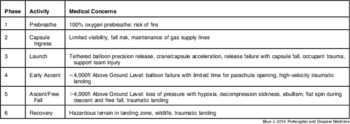
The planning stage involved designation of the distinct phases of flight from an Emergency Medical Service (EMS) standpoint and identification of risks associated with each one. Six phases were examined: (1) a prebreathe period before flight; (2) capsule entry; (3) launch; (4) early ascent; (5) ascent through landing; and (6) crew recovery (Table 1). Early ascent, between ground and up to 4,000 ft (1,219 m) above ground level (AGL), was considered separately from the remainder of the ascent phase because such low altitudes would limit the test parachutist's ability to egress and parachute away from the vehicle in case of malfunction.Reference Blue, Law and Norton1, Reference Westman, Rosen, Berggren and Bjornstig8 A balloon failure leading to an occupied capsule and ground impact could result in significant injury to the parachutist or any civilian unfortunate enough to be within the impact path.Reference Blue, Law and Norton1 Each of the flight phases was considered separately, with medical support efforts tailored to anticipate and prepare for contingencies specific to the activities of the phase. Communication flows and contact information for personnel and definitive medical care facilities took into account both the phase of activity and the resultant limitations where communication network coverage was unpredictable or less than ideal.
Distinct Flight Phases and Associated Medical Concerns

Results
Personnel
The core medical team consisted of the Medical Director in the Mission Control Center (MCC), five emergency physicians, two internal medicine physicians, a paramedic, a ventilator engineer who provided training to the field medical personnel, and a physiologist. The core team was augmented by two local Fire Chiefs, with paramedic-level training, and a medical response helicopter crew of one flight nurse and one flight paramedic. One of the emergency physicians (call sign “Air Doc”) was assigned to perform the preflight physical on the test parachutist and deploy on a chase helicopter that followed the balloon-capsule after launch. Two other emergency physicians were embedded with the Fire Chiefs located at strategic locations identified for optimal ground medical support. The team paramedic was embedded with the camera recovery crew who deployed downrange towards the landing zone. All of the medical personnel were briefed on the Medical Support Plan, usage of HFPV, and specialized protocols on pressure suit removal, ebullism treatment, and management of -Gz exposure.
The balloon flights launched from an airfield in Roswell, a small desert town remote from any major urban area, with a Fire and EMS system that is proportionate to this type of area. Within Roswell itself, there is a regional hospital with 26 beds and basic emergency, surgical, and radiological services. Beyond Roswell, two American College of Surgeons Level I Trauma Centers were designated as definitive medical care facilities, the closest being in Lubbock, Texas USA, with a straight-line distance of approximately 150 mi (240 km). The closest hyperbaric chamber facility is located in San Antonio, Texas USA, a distance of approximately 510 mi (821 km).
Equipment
The Air Doc carried a jump bag that contained supplies needed to establish a definitive airway or vascular access, control hemorrhage, and immobilize spinal or extremity injuries. The jump bag included oxygen, a portable high-frequency percussive transporter ventilator (TXP-2 Compact Military Transporter Ventilator, Percussionaire; Sandpoint, Idaho USA), defibrillator, medications for rapid sequence intubation and advanced cardiac life support, two liters of normal saline, personal protective equipment, and splinting materials. To support the emergency physicians on the ground, the Roswell Fire Department provided two sport utility vehicles equipped with advanced life support supplies, including airway equipment and backboards. A ventilator unit and portable liquid oxygen accompanied the standard medical equipment in each vehicle. These vehicles were termed “Forward Rig” and “Tail Rig” for deployment purposes. Finally, the team paramedic, embedded with the forward deployed camera recovery crew, carried a search and rescue response pack, including trauma life support and immobilization equipment, vascular access, hemorrhage control kit, and rescue and extraction gear.
Procedures
The preflight phase began one to two hours prior to launch and continued a 100% oxygen prebreathe protocol for the test parachutist. As this prebreathe protocol had the inherent risk of oxygen-fueled fire, procedures were established to mitigate the risk, including integrated fire-retardant equipment, the prohibition of any open flame or smoking materials near the trailer, the maintenance of adequate ventilation, and supervision by a team physician. The local airport fire rescue unit was on standby at all times.
The second phase of preflight began when the test parachutist prepared to enter the capsule. The test parachutist walked approximately 65 ft (20 m) from the trailer to a lift that raised him approximately 10 ft (3 m) above the ground, where he then stepped from the lift platform into the suspended capsule. The test parachutist had limited peripheral visibility due to the constraints of the helmet. Any fall risk was mitigated by attendants who rode the lift with the test parachutist, managed his gas supply lines, and guided him up the steps of the capsule. Additionally, the Air Doc remained in the immediate vicinity of the capsule to respond to any potential mishaps.
Phase three referred to the launch, and risks were inherent to the balloon launch technique. The capsule was suspended from the modified boom of a mobile crane and the rigging was clamped in place by an electronically controlled device. During launch, the balloon was tethered away from the capsule and released when directed by the launch controller. The crane then had to quickly accelerate to place the capsule directly below the rising balloon to eliminate a pendulum effect. Once the capsule was directly below the balloon, the electronic clamp was released and the capsule was free to lift away from the ground, a maneuver that required precision. Any failure at this crucial time could result in injury or death on the flight line, as there was a high potential for the capsule to fall from the boom of the now moving crane. This would likely injure the test parachutist as the interior of the capsule was not designed for occupant crash protection, and the single lap belt used to restrain the test parachutist could lead to spinal and abdominal trauma, as well as potential head impact against capsular components. The Air Doc and suit engineer were staged within 100 yards (90 m) of the flight line, ready to respond to a failed launch. The medical helicopter was positioned at the airfield a safe distance away, prepared to transport the test parachutist to a predesignated trauma center if necessary. Additionally, both ground support units were available in the immediate area to quickly respond to any incident.
During phase four, or early ascent from the ground to 4,000 ft (1,21 9 m) AGL, the Air Doc and suit engineer relocated to a chase helicopter that followed the balloon, while all ground teams remained in the vicinity of the airfield, maintaining visual contact with the capsule at all times. The most significant medical concern in this phase was trauma from a balloon failure resulting in the test parachutist landing relatively unprotected in the capsule, with little to no time for deployment of the capsule parachute, and insufficient time for the parachutist to egress from the capsule for a landing under his own parachute. Given the large balloon size and the low wind speed tolerance, the threat of such a low-altitude abort scenario was particularly concerning during the third manned flight. For this reason, a detailed plan was developed to specify procedures and personnel responsibilities for crew recovery and assessment, triage, scene control, communication, and transport. If a low-altitude abort were to occur, the ground teams would be able to rapidly arrive on scene or respond to any injuries in the general public resulting from the falling capsule.
Once the capsule cleared 4,000 ft (1,219 m) AGL, the ground teams were released from the airfield and deployed to the landing area. Phase five encompassed the remainder of the ascent, egress, free fall, parachute deployment, and landing. Although these were operationally unique stages, from an EMS standpoint, this phase represented the time period when the test parachutist was able to egress the capsule and safely parachute away from the capsule in the event of failure. According to operational protocol, the loss of all communication with the capsule would initiate a contingency plan due to the assumption that the test parachutist was incapacitated: the capsule would be returned to the ground as quickly as possible to allow an EMS team to assess and treat the parachutist. The major medical concerns in this phase included hypoxia, ebullism, and decompression sickness, though no medical interventions would be possible until the test parachutist landed on the ground. Thus, the only actions for the EMS team during this phase would be gathering as much information as possible about the condition of the parachutist and the last known altitude and environmental parameters, activating the medical helicopter, and alerting potential receiving hospitals.
The sixth phase, crew recovery, was divided into personnel staging, crew location, medical evaluation, and crew transport. Prior to the flight, the area of the landing zone, as predicted by the project's meteorologist and skydiving consultant, had been scouted using aerial photographs, helicopter flyovers, and terrain evaluations by ground. A hazard analysis was generated with input from the local fire and rescue department and law enforcement. The landing area for the first and third flights was a flat rocky desert terrain with sparse low scrub brush one to three feet (<1 m) tall. Landing hazards included microwave transmission towers, power lines, oilfield equipment, a heavily traveled highway, off-road vehicles, and wildlife including rattlesnakes. The off-highway areas were sometimes accessible by oilfield roads and track ranch trails; therefore, all vehicles deployed to the landing area were equipped with four-wheel drive. By the time the test parachutist egressed the capsule at float altitude, the EMS ground teams, initially staged at the airport and subsequently forward deployed, had arrived to their designated positions within the predicted landing area. Since the capsule's exact location was relayed to mission control as the test parachutist egressed the capsule, the test parachutist's location could be predicted to within a 10 mi (16 km) radius, allowing real-time adjustment of the positions of the field teams. Once ground units acquired visual contact, they converged to the final landing area.
After the test parachutist egressed the capsule, the fleet of chase helicopters arrived in the landing area but remained in an idle state to facilitate rapid movement to the final landing site once the test parachutist was safely on the ground. Smoke canisters were deployed to aid the test parachutist in locating the landing zone and identifying relative wind speed. In the event of a loss of radio contact with the test parachutist during free fall, the crew recovery team had multiple means to locate the test parachutist, including Global Positioning System (GPS) devices, a mobile tracking station equipped with infrared and optical telescopic cameras, and ground spotters to increase the accuracy of the location via triangulation.
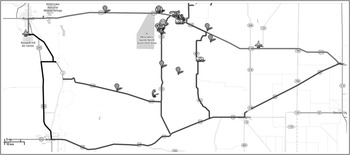
Initial assessment of the test parachutist by the field medical teams began while he was still under the parachute canopy. First, the appearance of the parachute provided clues to possible injury. Visualization of the drogue parachute, designed to automatically deploy in the case of significant radial acceleration, would suggest a flat spin during free fall and the potential exposure to high -Gz acceleration. The color of the parachute would indicate whether the main parachute was used or if the reserve parachute was required: an automatically deployed reserve parachute could suggest pilot incapacitation, and body position while under canopy could indicate the presence of injury or loss of consciousness. If the reserve parachute was identified, the medical helicopter would be deployed immediately to the scene. Medical teams coordinated carefully with ground videography and long-range optical tracking assets to maintain communication, live video feeds, and integration of operations for improved situational awareness. Field medical personnel had live, streaming video and infrared feeds of the parachutist throughout free fall and descent under canopy to identify from the video images any onset of spin, deployment of the stabilizing drogue, or body positioning during free fall or under canopy. Medical Back Room personnel communicated with the Medical Director in MCC and were responsible for relaying mission-critical information and updating an online Internet map with pre-identified color-coded roads and medical staging points based on the expected path of the balloon, anticipated landing zones as predicted by the meteorologist, and real-time GPS positioning of the parachutist and all mobile response teams; this information was transmitted to ground teams in real time (Figure 1).
Interactive team mapping. An interactive map program was utilized to provide pre-identified roads and medical staging points based upon predicted balloon tracking paths, as well as the location of mission-related camera and recovery teams. As mission information was relayed, ground positions and Global Positioning System (GPS) coordinates of the capsule and recovery assets were transmitted in real time.

Once the test parachutist was on the ground, the medical assessment focused on neurologic and respiratory function followed by standard trauma assessment. In the event of test parachutist illness or injury, the medical helicopter, activated as soon as a medical contingency was apparent, would retrieve the test parachutist from the landing zone and transport him to one of the preselected trauma centers based on the weather and landing location. The Air Doc would accompany the test parachutist to continue HFPV if needed and serve as the medical representative. In a separate helicopter, the landing zone coordinator would become the incident commander and relay critical information to MCC. For normal operations, the Air Doc and suit engineer returned with the test parachutist in the original chase helicopter to the Roswell airfield.
Discussion
The Red Bull Stratos project required significant planning and preparation from the medical perspective to mitigate the risks to the test parachutist and ensure timely emergency medical support and crew recovery. The experiences in the first and second manned balloon flights helped refine the procedures and communications for the third balloon flight, train the medical team on field operations, and identify any deficiencies in the Medical Support Plan.
Several constraints influenced the concept of operations. First, the remoteness of the landing area limited accessibility by ground vehicle, requiring helicopters to be the primary means of test parachutist transport, both under normal conditions and in any medical contingency. Initial plans had included fixed-wing aeromedical transport in the case of a medical contingency, but the necessity of flying an injured test parachutist by helicopter to an airfield where a fixed-wing aircraft could land and take off eliminated any potential time savings and increased the level of operational complexity. As long as the medical helicopter launched with a full tank of fuel, the two preselected Level I Trauma Centers were within flight range. Hence, the medical helicopter was staged in Roswell and would be activated only if the test parachutist required medical transport to a definitive care facility.
A second constraint was limited cellular phone coverage in the landing area, making communications between the ground teams and MCC difficult. The only reliable means to communicate was via low-bandwidth texts from and to the Medical Back Room and MCC to maintain situational awareness. For the field teams, it was essential to know when key milestones had occurred, such as when the balloon cleared the critical altitude of 4,000 ft (1,219 m) AGL. Text messaging was generally found to be reliable, and whenever a sender was completely out of range, the cellular network would automatically batch the messages and send/receive them when coverage was re-established. Establishing predefined medical waypoints and color-coded roadways that bounded the expected flight path facilitated communications between the Medical Back Room and the field vehicles. Additionally, the trajectory and landing zone for the second manned balloon flight fell west of the city into hilly terrain that occasionally restricted cellular coverage. For the first and third flights, the trajectory was eastward where there was relatively good cellular coverage. Ground scouting of the expected landing zones prior to the launches was critical to identify areas of poor cell phone coverage. Future efforts to improve communications for similar operations could include the investigation of technologies that can provide two-way satellite communications with GPS and text messaging capability.
The final constraint was the availability of EMS resources to the medical response team. The Roswell Fire Department has several fire stations with full-time firefighters who also respond as medical first responders, while advanced life support ambulance service is provided to the region by a private company on a contract basis. The medical team preferred to involve the Fire Chiefs given their intimate knowledge of the city and surrounding areas and ability to coordinate with incident command if needed. The Fire Chiefs agreed to support operations provided that the medical team did not require the utilization of excessive resources from their already stretched system. The solution was to have the two ground physicians embed with the Fire Chiefs in noncritical ground vehicles to enable an enhanced emergency response while keeping the local ambulances and fire vehicles in normal service within the response areas.
Limitations
This study is limited by the fact that it is highly specific to the activities unique to this mission and the resources available as described above. Even similar activities or related extreme sports taking place in differing environments, terrain, or settings may have drastically altered requirements than those presented here. In addition, as there were no significant medical issues or catastrophic events during the test program, many of the medical team preparations and protocols put into place were theoretical in nature and never fully tested in an operational environment.
Conclusions
While many of these arrangements were unique to the mission and the resources available to the mission medical team, the issues faced are likely similar to the ones that other extreme sport or commercial space ventures will encounter. These experiences demonstrated that a complex concept of operations could be planned and implemented by a small medical team despite geographical, communications, and resource limitations, and could benefit future commercial programs. A robust EMS and crew recovery plan is necessary to ensure crew wellbeing and provide prehospital medical support as needed in any such extreme endeavor.
Acknowledgments
The authors would like to thank the generous support provided by the Percussionaire Corporation, PHI Inc. Air Medical Transport, Roswell Fire Department, and the entirety of the Red Bull Stratos team, particularly Colonel Joe Kittinger USAF (Ret), Art Thompson, Mike Todd, and the Sage Cheshire Aerospace team. The authors are indebted to the University of Texas Medical Branch and Baylor College of Medicine for their support of the scientific and medical endeavors of the program. The authors also acknowledge the assistance of Jeffrey P. Sutton, MD, PhD, and the support of the National Space Biomedical Research Institute through NASA cooperative agreement NCC 9-58 and the Space Medicine Clinical Research Training Program.