I. INTRODUCTION
The prevailed term “organic–inorganic hybrid materials” is used in myriad aspects in the diverse fields in academic research and industry. The hybrid materials have originally been classified as classes I and II, Reference Sanchez and Ribot1 depending on the interaction between organic and inorganic moieties; i.e., class II is based on the covalent bonds between organic and inorganic parts whereas class I is not. The development of hybrid materials has been encouraged by the progress of sol–gel process, which does not require high temperature to fabricate inorganic materials, and other synthetic approaches in liquid media. Reference Sanchez, Belleville, Popall and Nicole2,Reference Sanchez, Boissiere, Cassaignon, Chaneac, Durupthy, Faustini, Grosso, Laberty-Robert, Nicole, Portehault, Ribot, Rozes and Sassoye3
As an important member of organic–inorganic hybrids, organopolysiloxanes (so-called silicones) are well known to form a unique class of materials for their physicochemical stability and broad applicability. Sol–gel hybrids called organically modified silicas (ORMOSILs) or organically modified ceramics (ORMOCERs) typically prepared from organically modified alkoxysilanes such as organotrialkoxysilanes (RSi(OR′)3) and bis(trialkoxysilyl)-modified organometallic compounds represented as bridged alkoxysilanes ((R′O)3Si–R–Si(OR′)3), have been particularly important from the early times of sol–gel research. Reference Sanchez, Belleville, Popall and Nicole2–Reference Corriu and Leclercq6 These organically modified alkoxysilanes are widely available in the market, and regarded as the useful precursors for obtaining desired class II organic–inorganic hybrid materials. In addition to class I hybrids entrapping organic molecules in the silica gel/glass matrix, Reference Avnir7–Reference Matsui and Sakka11 various class II hybrid materials have been reported using these precursors (often in combination with tetraalkoxysilanes (Si(OR)4)) for optical, sensing, coating, and biological applications. Reference Sanchez, Belleville, Popall and Nicole2–Reference Corriu and Leclercq6,Reference Ogoshi and Chujo8 As a part of the so-called preceramic polymers, Reference Colombo, Mera, Riedel and Sorarù12 these hybrid materials have also been important as the precursor of ceramics materials such as silicon (oxy)carbides and (oxy)nitrides, which show high thermal and mechanical stabilities by increasing connectivity of the silica networks with heteroatoms (C and N). Reference Schmidt and Wolter4,Reference Pantano, Singh and Zhang13–Reference Kamiya and Sakka15 The polymer-derived ceramics with hierarchical pore structures are obtained from these hybrid precursors by replication, sacrificial templating, and forming processes. Reference Colombo, Mera, Riedel and Sorarù12,Reference Studart, Gonzenbach, Tervoort and Gauckler16,Reference Colombo:17
Among the family of these hybrid materials based on organopolysiloxanes, silsesquioxanes possess the compositional formula of RSiO1.5, and can be obtained “solely” from organotrialkoxysilanes or bridged alkoxysilanes. Reference Kanamori and Nakanishi18 As aforementioned, organically modified polysiloxane materials have developed for long in the sol–gel field and the silicone science and industry, and the so-called “T resins” composed only of the tribranched network (three siloxane bonds on each silicon) have been recognized as typical silsesquioxanes for their unique structures and properties. Reference Baney, Itoh, Sakakibara and Suzuki19,Reference Brook20 Recent interests in application of silsesquioxanes include low dielectric constant films Reference Volksen, Miller and Dubois21 and composites with organic semiconductors Reference Kamino and Bender22 for electronics, ionic liquids, Reference Tanaka, Ishiguro and Chujo23,Reference Tanaka and Chujo24 electrolytes for lithium batteries, Reference Chinnam and Wunder25 hydrophobic and amphiphobic surfaces, Reference Chu and Seeger26 gas/liquid-phase separations, Reference Kanamori and Nakanishi18,Reference Castricum, Paradis, Mittelmeijer-Hazeleger, Kreiter, Vente and ten Elshof27 water desalination, Reference Xu, Wang, Kanezashi, Yoshioka and Tsuru28,Reference Chua, Lin, Kleitz, Zhao and Smart29 nanocomposites with polymers for multiple functionalities, Reference Kuo and Chang30 cosmetics, optical materials, Reference Lebeau and Innocenzi31 by taking advantages of their high physicochemical, thermal, and mechanical stabilities, variable porosity, and tunable affinity with various organic polymers for compositing.
The major purpose to obtain organic–inorganic hybrid materials lies in the exploration of new functional materials through synergetic combinations of organic and inorganic moieties. Among diverse kinds of hybrid materials, those combined with covalent bonds between the organic and inorganic moieties (class II) in general show better physicochemical stability and controllability in microstructures and physical properties. Silsesquioxanes from the above-mentioned precursors have been in the important part of the research of hybrid materials for this reason. Periodic mesoporous silsesquioxane materials from bridged alkoxysilanes, for example, have been systematically studied due to their easy controllability of structures and functions. Reference Fujita and Inagaki32–Reference Van Der Voort, Esquivel, De Canck, Goethals, Van Driessche and Romero-Salguero35
We have been continuing material research of silsesquioxanes from the major view points of “sol–gel”, “porous materials”, and “monolithic form”. Reference Kanamori and Nakanishi18 Monolithic porous materials are easy to handle and those with controlled and accessible pores are applied to separation media for high-performance liquid chromatography (HPLC). Reference Nakanishi36–Reference Nakanishi, Unger, Tanaka and Machtejevas38 Through careful controls over chemical composition and surface functionality, various kinds of inorganic, organic, and their hybrid materials have been developed for different applications. In this review article, preparation and applications of silsesquioxane and related porous materials from organotrialkoxysilanes are overviewed (please note that some other examples from bridged alkoxysilanes Reference Hasegawa, Kanamori, Nakanishi and Hanada39–Reference Hasegawa, Kanamori, Nakanishi and Hanada41 are not discussed in this study). Special emphasis is placed on the unique mechanical properties and surface reactivity in the monolithic porous silsesquioxanes.
II. REACTIONS AND PORE FORMATIONS IN ORGANOTRIALKOXYSILANE-DERIVED SOL–GEL SYSTEMS
Gelation through hydrolysis and polycondensation of bridged alkoxysilanes proceeds without noticeable problems except for cyclization in acidic media. Reference Shea and Loy42 The high controllability in sol–gel process makes these precursors ideal for preparation of structured materials. Mesoporous materials and aerogels have therefore been extensively investigated for these 20 years as mentioned earlier. Reference Fujita and Inagaki32–Reference Van Der Voort, Esquivel, De Canck, Goethals, Van Driessche and Romero-Salguero35,Reference Shea and Loy42 In contrast, due to several problems in the course of the reactions as mentioned below, it is exceedingly difficult to obtain and control the porosity in monolithic gels from organotrialkoxysilanes. There has not been a lot of research on the material design using organotrialkoxysilanes as the sole precursor for this reason.
Since trialkoxysilanes with different substituent groups such as methyl and vinyl show different steric and inductive effects, Reference Loy, Baugher, Baugher, Schneider and Rahimian43 reaction kinetics and geometric properties of the condensates are not similar to the typical silica system from tetraalkoxysilanes. Reference Brinker and Scherer44 In particular, two factors, cyclization and phase separation as detailed later, seriously influence the characteristics of the condensates, which are more or less detrimental in forming monolithic gels through a uniform network structure. In some special cases where organic substituent groups can attractively interact through hydrogen bonding or hydrophobic interaction, mesostructures can be induced by self-assembly of these substituent groups. Reference Che, Liu, Osuna, Sakamoto, Terasaki and Tatsumi45,Reference Shimojima and Kuroda46 However, in alkoxysilanes with simple, small hydrophobic groups, such as methyltrialkoxysilane and vinyltrialkoxysilane, careful controls over fundamental sol–gel parameters such as pH, water concentration, and additives lead to monolithic gel formations by effectively avoiding undesired cyclization and phase separation.
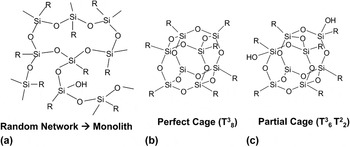
The formation of random networks [Fig. 1(a)] is predominantly required to obtain monolithic gels. Reference Brinker and Scherer47 However, it is well known that the formation of random networks and polyhedral/cage species called polyhedral oligomeric silsesquioxanes (POSS), Reference Baney, Itoh, Sakakibara and Suzuki19,Reference Cordes, Lickiss and Rataboul48 which give negative effects in the three-dimensional network formation, are competitive. The similar cyclization occurs in tetraalkoxysilane-derived silica sol–gel systems and other silicate solutions Reference Brinker and Scherer44,Reference Ng, Thompson, Sanchez, Macosko and McCormick49,Reference Mora-Fonz, Catlow and Lewis50 ; however, the cyclic species have a less chance to take part in the network in the case of silsesquioxane systems because of the decreased functionality (siloxane formation ability) in organotrialkoxysilanes. The perfect cage structures represented by T8 [8-membered cage solely consisting of the T (trifunctional) unit, Fig. 1(b)] no more leave the connectivity to the network and segregate from the solution as crystals. (Note that isolated POSS cages bearing reactive functional groups are used for building blocks in tailoring porous polymerized materials. Reference Zhang, Babonneau, Bonhomme, Laine, Soles, Hristov and Yee51–Reference Lin, Ou, Zhang, Dong and Zou53 ) Although other imperfect cage species [an example is shown in Fig. 1(c)] leave the chance to be included in the network, these species give a negative influence in the mechanical stability of the resultant gels and phase separation behavior of the hydrophobic networks.
Typical molecular-level structure of silsesquioxanes derived from trialkoxysilanes: (a) random network structure necessary for the monolith formation, (b) perfect cage structure, and (c) partial cage structure.

The pH condition in the solution gives a significant effect in the formation of condensates with different structures. The acidic condition allows homogeneous hydrolysis (the alkoxy groups in each alkoxysilane molecule are hydrolyzed in a step-by-step manner) and generally leads to less-branched networks and cyclic species, Reference Dong, Lee, Thomas, Zhang, Reidy and Mueller54 showing a limited use in the preparation of macroporous monolith as given in detail below. By contrast, hydrolysis of organotrialkoxysilanes in the basic media is slow as far as the pH is not very high, and fast, uncontrolled polycondensation follows once the alkoxy group is hydrolyzed, resulting in a heterogeneous network structure with a broad distribution of particulate size. In an acid-base two-step process where acid-catalyzed hydrolysis and base-catalyzed polycondensation are combined, homogeneously hydrolyzed species such as RSi(OH)3 undergo enhanced polycondensation, successfully leading to a more homogeneous random network structure. Reference Dong, Zhang, Lee, Mueller and Reidy55 The acid-base two-step process thus offers opportunities for extended controls over porosity at least in organotrialkoxysilanes with a hydrophobic substituent group.
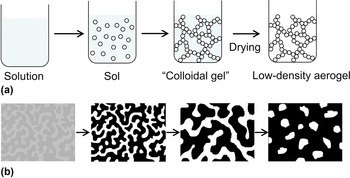
Another important issue is phase separation. Reference Nakanishi36 Although the situation is rather complex because the formation of cyclic species and phase separation are closely related each other, varying the amount of water and addition of co-solvent and/or surfactant are effective in the control of phase separation. A rational design of the porous morphology in these silsesquioxane materials becomes possible when these issues in the course of the reaction are adequately controlled by a careful tuning of the reaction parameters. Under the condition where macroscopic phase separation is suppressed, aggregation of colloids formed in an adequate pH condition provides interstices with several tens of nanometers. Transparent aerogels with preserved mesopores can be obtained when porosity and drying conditions are optimized [Fig. 2(a)]. By contrast, macropores in the micrometer scale can be tailored as the co-continuous structure as a result of moderate development of macroscopic phase separation [Fig. 2(b)]. In practice, we have shown in a methylsilsesquioxane system an extended control of pore size over a wide size range from 50 nm to several micrometers. Reference Kanamori, Kodera, Hayase, Nakanishi and Hanada56 Such wide controllability is crucial for different applications such as separation media, catalyst supports, and thermal insulators.
Examples of multiphase structural formations in the sol–gel system. (a) Aggregation of colloids leads to a gel, which can be converted to an aerogel after an adequate drying process (usually supercritical drying). Note that nanometer-sized colloids are exaggerated in the figure. (b) Structural formation via spinodal decomposition, which can be induced during concurrent sol–gel transition to yield a gel with controlled macropores in the micrometer scale.

In the next section, several examples of monolithic porous silsesquioxane materials are introduced.
III. MONOLITHIC POROUS MATERIALS OBTAINED FROM ORGANOTRIALKOXYSILANES
A. Hydrogen silsesquioxane
Trifunctional alkoxysilanes with the smallest substituent group is trialkoxysilane (HSi(OR)3). Strictly speaking, since hydrogen is not classified as an organic substituent, the derived material called hydrogen silsesquioxane (or hydridosilsesquioxane, denoted as HSQ) is an inorganic compound. The hydrogen in the Si–H group has the character of negatively polarized hydride, because of the higher electronegativity compared to silicon. The hydride character in hydrosilane compounds such as triethylsilane (HSi(C2H5)3) and polymethylhydrosiloxane (PMHS) has been used as the efficient and chemoselective reducing/hydrogenation agents through hydrosilylation in organic synthesis. Reference Riant, Mostefaï and Courmarcel57–Reference Addis, Das, Junge and Beller59 In other cases, the hydrosilylation between silicone materials bearing hydrosilyl and vinyl groups is the basis of room temperature vulcanization to industrial silicone rubbers. Reference Brook20 The high reactivity of Si–H groups may find more applications if these groups are solidified as a porous material.
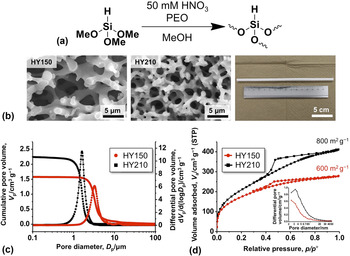
We have developed hierarchically porous HSQ monoliths with well-defined macropores and mesopores. Reference Moitra, Kanamori, Shimada, Takeda, Ikuhara, Gao and Nakanishi60 In a trimethoxysilane (HTMS)-derived sol–gel system, since the substituent hydrogen is small and possibly forming hydrogen bonding with silanols, Reference Xie, Henderson, Dag, Wang, Lofgreen, Kübel, Scherer, Brodersen, Gu and Ozin61 there are no such problems as cyclization and phase separation as mentioned above. The system therefore shows similar behavior to tetraalkoxysilane-derived silica systems, in which monolithic transparent gels are readily obtained. In fact, SBA-15-type mesoporous microparticles were reported in an acid-catalyzed system with Pluronic P123 (poly(ethylene oxide)-block-poly(propylene oxide)-block-poly(ethylene oxide), denoted as EO20PO20EO20, where EO and PO show ethylene oxide and propylene oxide units, respectively), Reference Xie, Henderson, Dag, Wang, Lofgreen, Kübel, Scherer, Brodersen, Gu and Ozin61 the condition of which is similar to that of SBA-15 mesoporous silica. Reference Zhao, Feng, Huo, Melosh, Fredrickson, Chmelka and Stucky62 In other cases, sol–gel materials containing Si–H groups have been investigated for a unique precursor to silicon oxycarbide/oxynitride, Reference Corriu and Leclercq6,Reference Sorarù, D’Andrea, Campostrini, Babonneau and Mariotto63,Reference Kleebe and Blum64 and silicon-silica composites Reference Xie, Henderson, Dag, Wang, Lofgreen, Kübel, Scherer, Brodersen, Gu and Ozin61,Reference Hessel, Henderson and Veinot65 via thermal treatment. We took a strategy that is similar to silica systems Reference Nakanishi36 to obtain hierarchically porous monolithic HSQ materials through sol–gel accompanied by phase separation. Figure 3(a) shows the reaction scheme. HTMS is reacted in diluted acidic aqueous media to prevent the hydrolysis of the Si–H groups, under the presence of poly(ethylene oxide) (PEO) to induce phase separation during sol–gel transition. Methanol is used as the solvent to control the reaction kinetics. Similar to silica, PEO interacts with the HTMS-derived condensates presumably through the hydrogen bond, rendering the condensates more hydrophobic. The size of macropores in the co-continuous structure is thus controlled by varying the concentration of PEO [Figs. 3(b) and 3(c)]. In addition, mesopores are formed in the gelling phase and integrated in the macropore skeletons. High specific surface area [the Brunauer-Emmett-Teller (BET) surface area is <800 m2 g−1, Fig. 3(d)] is obtained as the result. It is important to note that there are no Q species in 29Si solid-state nuclear magnetic resonance (NMR) spectra [Fig. 4(c)], evidencing the total preservation of the Si–H group, while Q species can be recognized if reacted in a more acidic condition. Reference Xie, Henderson, Dag, Wang, Lofgreen, Kübel, Scherer, Brodersen, Gu and Ozin61
(a) A reaction scheme for the HSQ monoliths with controlled macropores. (b) Typical macroporous co-continuous structures and appearance of a rod-shaped HSQ monolith (starting compositions: HTMS 2.1 mL, 50 mM nitric acid 2.5 mL, methanol 2.5 mL and PEO (M n = 35,000) 150 mg (HY150) and 210 mg (HY210)). (c) Macropore distributions of the two samples characterized by mercury intrusion porosimetry. (d) Nitrogen adsorption–desorption isotherms and the Barrett-Joyner-Halenda (BJH) mesopore size distributions of the two samples.

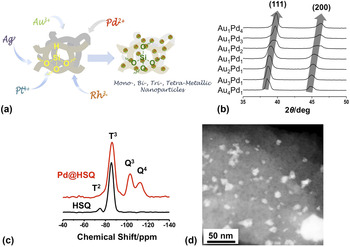
(a) A cartoon showing the reduction of noble metal ions in the macroporous HSQ, resulting in the (alloy) nanoparticle formation in the monolith. (b) XRD patterns of Au–Pd alloy embedded monoliths with different Au/Pd ratios. The gradual change in the diffraction angles suggests the formation of alloys. (c) 29Si single pulse solid-state NMR spectra of the original HSQ and Pd@HSQ. (d) A TEM image of the Pd nanoparticles embedded in the HSQ.

The reductive Si–H groups on the pore surface can be used for reduction of noble metal ions (such as Ag+, Reference Dag, Henderson, Wang, Lofgreen, Petrov, Brodersen and Ozin66 Pd2+, Rh3+, Au3+, and Pt4+) in aqueous solution to obtain monolith-supported metal nanoparticles in a facile way [Fig. 4(a)]. Kinetics of the reduction reaction can be controlled by the water concentration in the solution and reaction temperature. Optimization of the reduction kinetics yields metal alloy nanoparticles as well as monometallic ones, Reference Moitra, Kanamori, Ikuhara, Gao, Yang, Hasegawa, Takeda, Shimada and Nakanishi67 according to the reaction as follows (represented as a bimetallic system).
 $${\rm{M}}_{\rm{1}}^{{\rm{x}} + } + {\rm{M}}_{\rm{2}}^{{\rm{y}} + } + ({\rm{x}} + {\rm{y}}){\rm{H}} - {\rm{Si}}{{\rm{O}}_{1.5}} + ({\rm{x}} + {\rm{y}}){{\rm{H}}_2}{\rm{O}} \to {{\rm{M}}_1}(0) - {{\rm{M}}_2}(0) + ({\rm{x}} + {\rm{y}}){\rm{HO}} - {\rm{Si}}{{\rm{O}}_{1.5}} + {{({\rm{x}} + {\rm{y}})} \mathord{\left/ {\vphantom {{({\rm{x}} + {\rm{y}})} {2{{\rm{H}}_2}}}} \right. \kern-\nulldelimiterspace} {2{{\rm{H}}_2}}} + ({\rm{x}} + {\rm{y}}){{\rm{H}}^ + }\quad .$$
The formation of bi-, tri-, and tetrametallic alloy nanoparticles has been confirmed by x-ray diffraction (XRD) [Fig. 4(b)], elemental mapping of energy-dispersive x-ray spectroscopy, and other characterization techniques. The Si–H moiety is oxidized into Si-OH and yields Q species in 29Si NMR spectra [Fig. 4(c), in the case of monometallic Pd]. Although the reduction occurs both in macropores and mesopores, most of the nanoparticles are physically confined in the mesopores because most of the surface area originates from mesopores. Larger nanoparticles [>20 nm, Fig. 4(d)] are also formed within the mesoporous matrix possibly by destroying the matrix. This method is considered to be advantageous especially in forming metal alloy nanoparticles for the following reason. Reduction of metal ions requires electron transfer from the Si–H groups on the pore surface. The metal ions with higher oxidation state need more electrons, and the electron transfer is accomplished by contacting with corresponding number of the Si–H moiety, which is highly condensed and immobilized on the solid pore surface. The repetitive electron transfer to the metal ions thus occurs efficiently on the pore surface of the HSQ materials to form alloy nanoparticles with homogeneous element distributions, which is distinguishable from the reduction relying on the Brownian motion in sparse homogeneous media.
The monolith-supported metal (alloy) nanoparticles (denoted as metal@HSQ) have been applied as the catalyst for a cross-coupling reaction Reference Moitra, Matsushima, Kamei, Kanamori, Ikuhara, Gao, Takeda, Zhu, Nakanishi and Shimada68 and reduction of 4-nitrophenol to 4-aminophenol. Reference Moitra, Kanamori, Ikuhara, Gao, Yang, Hasegawa, Takeda, Shimada and Nakanishi67 The Pd@HSQ monolith shows high conversions (∼100 %) in the Mizoroki–Heck reaction between aryl halides and acrylic acid esters, and alloy@HSQ monoliths are also effective in the reduction of 4-nitrophenol. These monolithic catalysts are easy to be recovered from the reaction solution, and show good reusability. In addition, catalytic reactions can be performed in a continuous flow reaction system by using the monoliths as the column-shaped flow-through reactor, which can be combined with other elements like a separation column to design a reaction-purification system in a desired scale.
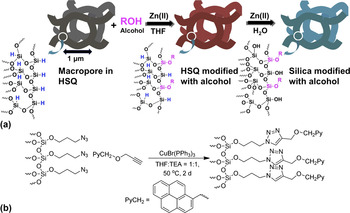
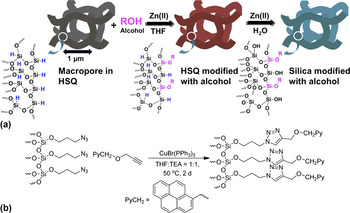
It is found that the surface Si–H groups can also undergo dehydrogenative reaction with various alcohols under the presence of Lewis acid [Fig. 5(a)] in anhydrous media. Reference Moitra, Kamei, Kanamori, Nakanishi, Takeda and Shimada69 The surface-functionalized HSQ can be converted to silica by an additional treatment with the Lewis acid in water, because the coupling of Si–H and Si–OH derived from Si–H is also promoted under the presence of water. As an instance, when the HSQ monolith is reacted with azidopropanol, the surface is functionalized with the azide group, which can be further reacted with alkynes by the Cu-catalyzed azide-alkyne cycloaddition (CuAAC) reaction [Fig. 5(b)], showing the capability of multistep functionalization. Since the immobilized alkoxy groups can be removed by a treatment with aqueous acid, the alcohol can be recycled. Functionalization of the silica surface is an important technique due to wide possible applications especially to separation and catalysis, and variety of reaction methodologies have been developed using reactive silane compounds such as halosilanes, alkoxysilanes, allylsilanes, Reference Shimada, Aoki, Shinoda, Nakamura, Tokunaga, Inagaki and Hayashi70 and vinylsilanes. Reference Park and Jun71 This system using simple alcohols may be another unique candidate for a flexible method to functionalized silica.
(a) Reaction of the HSQ pore surface with alcohols under the presence of a Lewis acid (zinc(II) 2-ethylhexanoate in this case). The dehydrogenative addition of an alcohol in anhydrous solvent is followed by oxidation-condensation of Si–H species in aqueous solvent. (b) An example of two-step modification of the HSQ pore surface; the addition of azidopropanol is followed by the CuAAC click reaction.
B. Methylsilsesquioxane
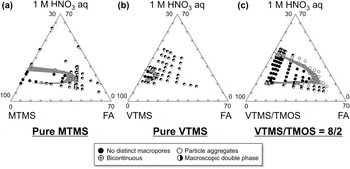
Apart from trialkoxysilanes (HSi(OR)3) detailed in the previous section, the chemistry of hydrolysis and polycondensation of many trifunctional alkoxysilanes suffers from cyclization and phase separation as aforementioned. Not many reports on the preparation of monolithic gels are therefore found. According to Loy et al. Reference Loy, Baugher, Baugher, Schneider and Rahimian43 and Dong et al., Reference Dong, Brook and Brennan72 monolithic gels can be obtained in the one-step process under strongly acidic or basic conditions. Although it is difficult to obtain monolithic gels at low alkoxysilane concentrations, well-defined macropores can be formed by adequately controlling phase separation in a rather limited starting compositional region. In the ternary system consisting of methyltrimethoxysilane (MTMS), 1 M nitric acid, and polar solvents such as formamide (FA) or methanol, macroporous morphology changes as the result of phase separation as shown in Fig. 6. Reference Kanamori and Nakanishi18,Reference Kanamori, Yonezawa, Nakanishi, Hirao and Jinnai73,Reference Nakanishi and Kanamori74 In this system, phase separation tendency becomes higher as the fraction of water and methanol becomes higher. With the lower water/MTMS ratio (typically <1.5), the phase separation tendency becomes higher due to the hydrophobic unreacted alkoxy groups remained in the condensates. Conversely, with the higher water/MTMS ratio (>2.5), only macroscopic double phase resulted from high phase separation tendency is observed. Well-defined co-continuous macroporous structure can be obtained in the moderate water concentration regions, and the solvent can be used for finely tuning the phase separation tendency.
Relationship between macroscopic morphology and starting composition in (a) MTMS, (b) VTMS, and (c) VTMS–TMOS sol–gel systems with FA and 1 M nitric acid.

The macroporous monoliths thus obtained show the Type I isotherm of nitrogen adsorption–desorption, which demonstrates the presence of micropores in the macropore skeletons. The typical BET surface area is 300–400 m2 g−1. Although the origin of these micropores is not clear, it is highly possible that micropores come from interstices in the less branched polysiloxane networks developed in the strongly acidic condition with a rather limited amount of water.
These macroporous MSQ monoliths in capillary have been applied to separation media for HPLC, Reference Kanamori, Yonezawa, Nakanishi, Hirao and Jinnai73 and it is found that polar and nonpolar compounds can be successfully separated in the normal- and reversed-phase modes, Reference Kanamori, Nakanishi and Hanada75 respectively, by using an identical MSQ capillary column. Since the MSQ surface shows amphiphilic property due to the abundant methyl groups and a small amount of silanol groups on the pore surface, polar and nonpolar molecules show moderate retention in an adequately designed mobile phase. Although the micropores are not considered to play a crucial role in the separation, the micropore surface may be more or less hydrophobic and contributes strong retention of the nonpolar solutes such as alkylbenzenes in the reverse-phase mode. Reference Kanamori, Nakanishi and Hanada75 The theoretical plate number N therefore becomes larger in the normal-phase mode, showing a high value (N ∼100,000 m−1) Reference Kanamori, Yonezawa, Nakanishi, Hirao and Jinnai73 capable for commercial uses, though the loading capacity may be rather low because of the absence of mesopores.
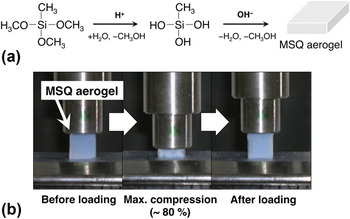
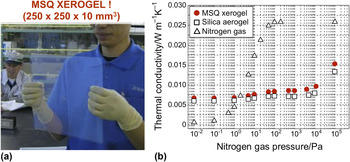
The acid-base two-step process is more advantageous for controlling phase separation and monolithic gel formation in extended starting compositions. Unlike the above-mentioned acid one-step process, monolithic gels can be obtained even when the concentration of MTMS is reduced, making the two-step process an attractive platform for obtaining low-density aerogels [Fig. 7(a)]. Under the presence of adequate surfactant to suppress the macroscopic phase separation, transparent aerogels can be prepared. Reference Kanamori, Aizawa, Nakanishi and Hanada76–Reference Kanamori, Nakanishi and Hanada78 The following kinds of surfactant are effective in suppressing phase separation; cationic surfactant like n-hexadecyltrimethylammonium salts (bromide salt is denoted as CTAB and chloride CTAC) Reference Hayase, Kanamori and Nakanishi79 and nonionic block copolymers like poly(ethylene oxide)-block-poly(propylene oxide)-block-poly(ethylene oxide). Reference Kurahashi, Kanamori, Takeda, Kaji and Nakanishi80 It can be deduced that these cationic surfactants make the hydrophobic MSQ condensates more hydrophilic enough to prevent macroscopic phase separation in the aqueous media through the weak hydrophobic interaction. The ability of making MSQ condensates hydrophilic decreases with the decreasing alkyl chain length. In the case of block copolymers, since the physicochemical properties including hydrophilic–lipophilic balance (HLB) of block polymers vary with the molecular weight and the EO/PO ratio, the controllability of phase separation in the system is changed. Transparent low-density aerogels can be obtained in a system containing a large amount of solvent (where alkoxysilane is diluted) and with strongly suppressed phase separation in the both cases. The obtained transparent MSQ aerogels show reversible compression-reexpansion (“spring-back”) behavior against compressive deformation because of the elastic nature of the MSQ network [Fig. 7(b)]. This implies that the drying gel also behaves in the similar way upon evaporation of the pore liquid, in which compressive force is applied onto the drying gel due to the surface tension of the solvent. In fact, aerogel-like low-density transparent xerogels are successfully obtained by carefully evaporating the pore liquid with low surface tension such as hexane [an example of a large-area panel is shown in Fig. 8(a)]. Aerogels are well known for their exceptional low thermal conductivity (typically ∼15 mW m−1 K−1) Reference Hüsing and Schubert81,Reference Pierre and Pajonk82 and increasingly expected to be used as the high-performance thermal insulators, Reference Koebel, Rigacci and Achard83 whereas the requirement of supercritical drying and difficult handling keep aerogels away from practical uses in an industrial scale. We also confirmed the low thermal conductivity of the MSQ xerogel [Fig. 8(b)]. When these critical problems are solved to allow mass production of aerogels/xerogels, extended applications such as transparent window insulators in buildings will become reality.
(a) A reaction scheme for MSQ aerogels/xerogels in an acid-base two-step sol–gel system under the presence of surfactant. (b) The typical “spring-back” behavior observed during uniaxial compression on an optimized MSQ aerogel sample.

(a) An example of a successfully obtained MSQ “xerogel” tile with large area by ambient pressure drying. (b) Thermal conductivity of a MSQ xerogel, a standard silica aerogel, and nitrogen gas (filled in the measurement space) versus pressure measured by the guarded hot plate method.

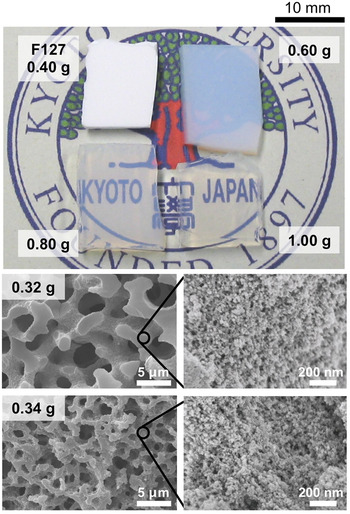
By using the acid-base two-step reaction under the varied concentration of surfactant, macroporous monolithic MSQ gels can be prepared by adequately controlling the phase separation Reference Kanamori, Kodera, Hayase, Nakanishi and Hanada56 like in the previous example in the acid one-step process. It is worth mentioning that tailoring of mesoporosity in the macropore skeletons to make hierarchically porous materials, in fact, is not possible with the acid one-step process: The design of hierarchical porosity has become possible only with the acid-base two step process. In addition, total porosity would be more extensively controlled by changing the amount of solvent (water). In an example shown in Fig. 9, appearance of the resultant MSQ gel becomes opaque with decreasing amount of surfactant Pluronic F127 (EO106PO70EO106) because of the reduced suppression of phase separation. Well-defined co-continuous macropores are obtained in an adequate concentration range of F127. Nitrogen adsorption–desorption measurements reveal the presence of mesopores in the macropore skeletons. The mesopores can be attributed to the interstices of colloidal MSQ (∼10 nm), which composes the macropore skeletons in the phase-separated structure, formed in the solution with increasing pH due to hydrolysis of urea. Since the hierarchically porous MSQ materials have never been reported so far and the hierarchical porosity is essential for liquid-phase separations, separation function as a monolithic HPLC column is worth being investigated. The MSQ surface enables separation of both polar and nonpolar substances as mentioned above, and the alkaline resistivity is higher compared to the standard silica gel. Reference Dong, Brook and Brennan72 The hierarchically porous MSQ is therefore expected to be a multifunctional robust separation media that can be used even in an aqueous basic condition.
MSQ gels prepared with different amounts of Pluronic F127 in the acid-base two-step system. The resultant gel becomes more transparent with increasing amount of F127, due to more effective suppression of phase separation. At appropriate F127 concentrations, hierarchically porous MSQ gels with well-defined co-continuous macropores and mesopores in the skeletons are obtained. Starting composition: MTMS 5 mL, 5 mM acetic acid 6 mL, urea 0.5 g, and F127.

Another pH swing method to realize the acid-base two-step process uses acid scavengers such as propylene oxide (PO). Reference Itoh, Tabata, Kokitsu, Okazaki, Imizu and Tada84,Reference Gash, Tillotson, Satcher, Poco, Hrubesh and Simpson85 When PO is added after the hydrolysis of MTMS in a system containing methanol, HCl aq, and ammonium chloride, ring-opening reaction of PO occurs through a combination of protonation of PO oxygen and nucleophilic attack of the chloride ions. The solution pH thus increases rapidly, and monolithic MSQ gels with controlled phase separation tendency can be obtained. Reference Guo, Li, Yang, Kanamori, Zhu and Nakanishi86,Reference Guo, Yu, Yang, Kanamori, Zhu and Nakanishi87 Although the aforementioned method using urea requires temperature higher than 60 °C to allow the hydrolysis of urea, the process using PO ensures rapid pH swing at room temperature or lower, which may extend the applicability and controllability of the porous structures in sol–gel systems.
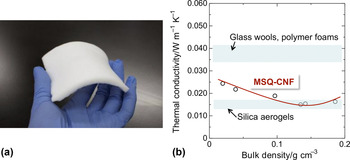
In fact, the mechanical property of the MSQ aerogels/xerogels has been highly improved in regard to compression; the mechanical property against other types of forces such as tension and shear remains comparable to the standard silica aerogels. In particular, bending flexibility is the next important property for much easier preparation and handling of aerogels/xerogels. One good strategy to achieve this goal is to use nanofibrous materials such as bionanofibers, carbon nanotube and synthetic polymer nanofibers as a strengthening support for the low-density gels. Reference Cai, Liu, Feng, Kimura, Wada, Kuga and Zhang88–Reference Boday, Muriithi, Stover and Loy90 We have also tested cellulose nanofibers (CNFs) to improve the mechanical property of MSQ aerogels. Reference Hayase, Kanamori, Abe, Yano, Maeno, Kaji and Nakanishi91 At a low concentration of CNF in water (we used 0.18 w/w % in water), MSQ–CNF composite aerogels have been successfully prepared without significant aggregation of CNFs. The CNFs are uniformly dispersed in the aerogels and do not disturb the formation of the original siloxane networks, which can be confirmed by micrographs and spectroscopic analyses such as NMR and infrared spectroscopy (IR). The lowest density of the MSQ–CNF aerogels reaches 0.02 g cm−3, which is lower than the density achievable with pure MSQ aerogels (0.04 g cm−3), because the CNF support reduces shrinkage during drying. The low-density MSQ–CNF aerogel is bendable as shown in Fig. 10(a). In addition, as thermal conductivity shows the similar trend to standard silica aerogels and MSQ aerogels/xerogels [Fig. 10(b)], the combination of bendability and low thermal conductivity may open the way to practical high-performance thermal insulators.
(a) The MSQ–CNF composite aerogel with the lowest bulk density (0.02 g cm−3), showing bendability. (b) Relationship between bulk density and thermal conductivity of MSQ–CNF composite aerogels. Typical value ranges of other insulating materials are also shown.

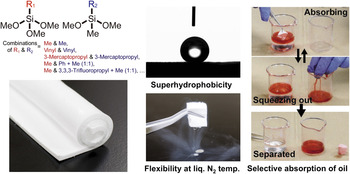
Co-condensation of MTMS with dialkoxysilanes such as dimethyldimethoxysilane (DMDMS) in the two-step process yields fluffy porous gels with higher flexibility. Reference Hayase, Kanamori and Nakanishi92 In the DMDMS–MTMS system, hydrophobicity of the network increases with increasing ratio of DMDMS, and it becomes difficult to confine the pore size smaller. In other words, while only macroporous materials can be obtained even under the presence of adequate surfactant when DMDMS/MTMS ratio becomes high (such as 2/3 in molar ratio), unique low-density porous gels with high flexibility (compressibility and bendability) and low modulus can be obtained. We coined the name of “marshmallow-like” gels for their flexibility and opaque appearance (materials and properties summarized in Fig. 11). According to the 29Si solid-state NMR results, the resultant network mainly consists of T3 and D2, indicating that DMDMS is effectively incorporated. Since the pore surface of the marshmallow-like gels derived from DMDMS and MTMS is covered with methyl groups just as silicone resins/rubbers and there are micrometer-scale roughness on the material surface, the marshmallow-like gels show superhydrophobicity with contact angle of >150°, while the affinity to nonpolar liquids is high. Reference Hayase, Kanamori, Fukuchi, Kaji and Nakanishi94 The marshmallow-like gels therefore selectively absorb oil from oil–water two-phase mixtures, making it a suitable material for easy cleanup of wastewater and environmental water. In addition, since the glass transition temperature of the loosely crosslinked marshmallow-like gel is as low as that of poly(dimethylsiloxane) (PDMS), the flexibility is kept even under the liquid nitrogen temperature. Furthermore, the marshmallow-like gels can also be prepared from alkoxysilanes with different functional groups such as vinylmethyldimethoxysilane–vinyltrimethoxysilane (VMDMS–VTMS), in which case the vinyl groups on the pore surface are available for post surface treatment with, for example, thiols and hydrosilanes by the thiol-ene and hydrosilylation reactions, respectively. Those modified with a perfluoroalkylthiol compound show superoleophobicity in addition to superhydrophobicity, Reference Hayase, Kanamori, Hasegawa, Maeno, Kaji and Nakanishi93 and promising for uses as antifouling materials. There has been a lot of research on the formation of elastomeric polysiloxane (silicone)-based hybrids by the sol–gel approaches, Reference Wen and Wilkes95 and some porous materials are known to show flexibility upon compression. Reference Novak, Auerbach and Verrier96–Reference Mackenzie, Bescher and Sakka98 Incorporation of difunctional polysiloxane chains to reduce crosslinking density to achieve high flexibility seems to be a standard but trailed tactic; however, there are still opportunities to design a new synthetic system for unprecedented materials.
Precursors and multifunctionality of the marshmallow-like gels. Superhydrophobicity and low-temperature flexibility are consequent properties derived from PDMS-like crosslinked networks. The pore surface of vinyl-functionalized marshmallow gels can be derivatized by, for example, the thiol-ene reaction to give superamphiphobicity. See the text and Ref. Reference Hayase, Kanamori, Hasegawa, Maeno, Kaji and Nakanishi93 for details.

C. Vinylsilsesquioxane
The next smallest organic substituent on trialkoxysilane may be ethyl and vinyl groups. As far as we know, there has been no report on porous vinylsilsesquioxane materials derived solely from vinylsilane precursors, whereas vinyl groups can be used as the reactive site for further modification of obtained porous materials possibly by hydrosilylation with hydrosilane compounds. The vinyl functionality on the pore surface has also been considered as active sites that chemically adsorb bromine for an environmental purpose. Reference Frenkel-Mullerad and Avnir99 However, it is easy to recognize that the formation of monolithic vinylsilsesquioxane gels based on the random network is more difficult because of the higher hydrophobicity and steric hindrance. Extension of the above-mentioned acid one-step process to VTMS resulted in the enhanced phase separation. Vinylsilsesquioxane (VSQ) monoliths with macroporous structure have been obtained only in a limited starting compositional region [Fig. 6(b)] in the VTMS-1 M nitric acid-FA system. Reference Itagaki, Nakanishi and Hirao100 The compositional region where co-continuous macropores are obtained is found to shift to the more VTMS-rich region. Replacing a part of VTMS with tetramethoxysilane (TMOS) increases the “average polarity” of the network, rendering the network more compatible with the polar solvent system. In the system with VTMS/TMOS = 8/2, the starting compositional region where co-continuous macropores are obtained is extended to the similar region with MTMS system [Fig. 6(c)].
Trialkoxysilanes with longer or more bulky substituent groups such as propyltrialkoxysilane, allyltrialkoxysilane, and phenyltrialkoxysilane would be considerably difficult or virtually impossible to form a monolithic silsesquioxane gel, though there are several reports on the mesostructured nonmonolithic materials formed through the self-assembly of alkyl chains and a solid-phase sol–gel reaction. Reference Shimojima and Kuroda46,Reference Shimojima and Kuroda101 In other cases, it may be more advantageous to use the nonhydrolytic sol–gel (NHSG) routes Reference Kuroda, Shimojima, Kawahara, Wakabayashi, Tamura, Asakura and Kitahara102,Reference Hay, Porter and Raval103 to obtain hydrophobic monolithic porous materials, because the problem of phase separation should be minimized in nonaqueous media. In fact, unique silsesquioxane materials such as aminopropylsilsesquioxane porous monoliths, Reference Mutin and Vioux104 methyl-, ethyl-, and phenylsilsesquioxane microparticles, Reference Liu, Wang, Li, Liu, He and Li105 carboranyl-substituted silsesquioxanes (POSS), Reference Arkhireeva, Hay and Manzano106 methyl-, vinyl-, and phenylsilsesquioxane microparticles Reference González-Campo, Juárez-Pérez, Viñas, Boury, Sillanpää, Kivekäs and Núñez107 are already reported.
IV. CONCLUSIONS
Several examples of monolithic porous silsesquioxane materials derived from trialkoxysilanes have been overviewed. Silsesquioxanes are well-known materials for their oligomeric cage/ladder species, silicone resin powders/emulsions, and mesoporous and aerogel materials of bridged silsesquioxanes derived from bridged bis(trialkoxysilyl) compounds. However, the monolithic form of silsesquioxanes based on the random network derived solely from trialkoxysilanes is not common. We have been focusing on the monolithic porous silsesquioxane materials because several unique possibilities are promising such as flexible and tough mechanical properties and functionality and reactivity of the pore surface. Functionality/reactivity can also be well achieved in the case of bridged polysilsesquioxanes; however, the bridging organic functional groups are mainly buried inside the polysiloxane network. Hence, the functionality in the bridging moiety may give a limited contribution to the reactivity. In those derived from trialkoxysilanes, on the other hand, the functional groups are located on the pore surface as well as inside the network, allowing a higher reactivity and accessibility. The high reactivity has been used for reduction of noble metal ions and reaction with alcohols as shown in the HSQ material. In addition, unique mechanical properties can be designed as demonstrated in the MSQ aerogel/xerogel and marshmallow-like gel derived from a co-precursor system. Hydrophobicity is another important property in the case of silsesquioxanes derived from trialkoxysilanes with hydrophobic substituent including MTMS. This is in contrast with the fact that many silsesquioxanes derived from bridged alkoxysilanes are hydrophilic due to the abundant silanol groups on the surface. We hope that the progress in the chemistry of (organo)trialkoxysilanes will further drive silsesquioxanes into attractive materials with multiple functionalities.
ACKNOWLEDGMENTS
The author is grateful for all co-workers who have contributed to the works reviewed in the present article (most of the names appear in the reference list). Financial supports such as Grants-in-Aid for Scientific Research (administrated by Japan Society for the Promotion of Science and Ministry of Education, Culture, Sports, Science and Technology, Japan) and Advanced Low Carbon Technology Research and Development Program (ALCA, by Japan Science and Technology Agency) are also acknowledged.