During the 1970s opposition to civil nuclear energy became a mass movement in countries around the world, including Austria, Denmark, France, Italy, Japan, the Netherlands, Spain, Sweden, Switzerland, the United Kingdom, the United States and West Germany, among others. Almost everywhere new nuclear facilities were proposed, protesters united against what they regarded as technocratic intrusions into local communities, harbingers of a security-obsessed ‘nuclear state’ and/or threats to the health of entire populations. As this range of motivations suggests, the interests of different constituencies (left and right, rural and urban, ‘militant’ and ‘non-violent’) did not always align completely, but they were remarkably similar across sites – especially in France and West Germany, where protests were closely interrelated. As with feminism, human rights and other ‘new social movements’ of the era, anti-nuclear activism linked disparate local struggles within global networks, enabling information, practices and even activists themselves to circulate widely across national borders.Footnote 1 Anti-nuclear protests developed in parallel to, and in tandem with, one another at sites around the world, forging a movement that was by most definitions eminently ‘transnational’. Yet, as Padraic Kenney reminds us, this term is often overused: ‘one should ask whether the concept of “transnational” actually adds something to the way we see events’.Footnote 2 What did it really mean for individuals to take part in a transnational movement at this time? How did grassroots activists participate in cross-border protest and (why) did transnational connections actually matter?
This article argues that transnational connections made a difference by changing the way grassroots protest functioned – though not always in the ways activists wanted or expected. Indeed, protesters usually ignored the complexity that transnational connections introduced, emphasising a limited, ‘arithmetic’ form of transnationalism in which foreign comrades were grouped by nationality and lined up to show the strength and diversity of protest. As with today's ‘Twitter revolutions’ and ‘Facebook protests’, anti-nuclear activists (and the media) also frequently exaggerated the importance of relatively superficial cross-border ties. After all, for most people concerned with stopping ‘their’ local power station, international solidarity was distinctly secondary in importance. The challenge for the historian of protest is thus to examine seriously the transnational contacts and networks that grassroots activists developed while remaining sensitive to their great variations and often limited character.
This article applies insights from different approaches to transnational history in order to analyse cross-border ties within the anti-nuclear movement.Footnote 3 Many histories of the post-1945 period have examined protest from ‘1968’ to human rights, environmentalism and other ‘new social movements’ using the tools and sources of intellectual, diplomatic and organisational history.Footnote 4 Such research has helpfully illustrated the extent and limits of transnational connections, shown how ideas change through transfer and argued consistently that non-state actors affected international relations. However, such studies give disproportionate attention to institutionalised forms of protest and prominent figures, a focus that becomes particularly problematic when magnified and narrowed through the lens of the media.Footnote 5 A smaller but significant portion of the literature on protest has examined transnational ties from the perspective of social history, highlighting transnational influences in everyday life, the cross-border agency of non-élite actors and the importance of global imaginings.Footnote 6 Like these studies, this article approaches the transnational dimensions of the anti-nuclear movement by closely examining relationships amongst its individual participants and local components. As such it draws on oral history interviews in addition to police reports, mainstream media and protest ephemera from regional and activist archives.Footnote 7
This article is divided into three sections, each addressing different forms of transnational agency that were broadly accessible, but which required increasing levels of cross-border mobility. The first, ‘thinking transnationally’, examines how activists deployed information and ideas from abroad in order to change protest at home, often without themselves setting foot in a foreign country. A second section, ‘acting transnationally’, analyses how activists put transnational elements (such as foreign demonstrators and transnational spaces) to practical use, thereby changing the forms and meanings of protest. The final section, ‘being transnational’, explores the biographies of several transnational intermediaries and shows how exceptionally intense cross-border ties affected their identities. Taken together, these sections illustrate a range of possibilities for transnational engagement that were available to movement participants of all kinds, including those who protested casually, sporadically or outside of organised groups.
Forms of transnational thinking, acting and being can be traced as far back as the nation state itself (if not further). Indeed, scholarship on ‘national indifference’ has repeatedly shown ways in which individuals defied or actively resisted categorisation by states and nationalist movements in the late nineteenth and early twentieth centuries.Footnote 8 After the Second World War, transnationalism took on different form and new significance as a result of the tensions between a rigid, international system of relatively homogenous nation states on the one hand and increasing opportunities to cross borders as a consequence of ‘globalisation’ on the other.Footnote 9 In the 1970s global integration processes began accelerating dramatically, making that decade in some sense ‘the beginnings of our modernity’, as Hartmut Kaelble has described it.Footnote 10 Indeed, contemporaries felt themselves to be entering post-modernity, or perhaps a post-Fordist, post-industrial world in which the pace and scale of change were suddenly increasing.Footnote 11 The growth of environmentalism was but one symptom of this, and its highly visible anti-nuclear wing benefitted from a peculiar constellation of developments.Footnote 12
Nuclear energy itself was hardly new, but earlier protests against power stations had remained largely confined to affected communities defending their material interests, only occasionally joined by pacifists or nature protectionists making more general arguments about the implications of nuclear technology.Footnote 13 In the 1970s, by contrast, the simultaneous construction of power stations at many different sites allowed informal networks to emerge that linked place-based solidarities into a broader popular movement.Footnote 14 Traditional actors and newly politicised groups jointly redefined nuclear energy as a symbol of the ills of contemporary society: farmers and environmentalists worried about uncontrollable industrialisation, pacifists and anarchists feared a militarised police state, housewives and feminists discussed consequences for health and childbearing, hippies and unorthodox communists opposed consumer capitalism at its bleeding edge.Footnote 15 In the atmosphere of that decade, transnational contact among all these groups became itself part of a political programme, as anti-nuclear and other so-called ‘new social movements’ questioned the boundaries between global and local, personal and political. Like the nationally indifferent populations of earlier periods, participants in these movements challenged national categories, moving between spaces and identities in order to preserve their autonomy from states and ‘politics’.
Within 1970s Western Europe, ties between grassroots anti-nuclear activists in France and West Germany were particularly strong, and, given the weight of past history, particularly striking. Protests against nuclear facilities along the Franco-German border were amongst the first to take place in Europe and served as a model for anti-nuclear activism around the world.Footnote 16 However, connections between anti-nuclear and other ‘new social movement’ activists in these two countries extended well beyond the border region, linking geographically dispersed protest sites (including Brokdorf, Gorleben and Kalkar in West Germany as well as La Hague, Malville and Plogoff in France). Activism enabled numerous ‘improbable encounters’, including domestic cross-class and translocal interactions that were as important and as complicated as transnational ones.Footnote 17 Despite this, transnational protest was significant because of the way it exploited differences between languages, national histories, protest traditions and legal jurisdictions.Footnote 18 Although French and German protesters occasionally presented themselves as part of a ‘European’ movement, their networks were neither fully contained within (Western) Europe, nor the beneficiaries of direct assistance from its official institutions.Footnote 19 Though chronologically and geographically specific, connections between French and West German activists in the 1970s illustrate some of the possibilities and pitfalls of transnational protest more generally.Footnote 20
Thinking Transnationally
The most accessible forms of transnational engagement involved drawing information and ideas from abroad, without necessarily requiring foreign travel or contacts. For many activists foreign countries were most important as ‘outside’ space, governed by rules and shaped by traditions which were unfamiliar – and which therefore did not place the same limits on their creativity. Thinking transnationally therefore involved extrapolating from, decontextualising and recontextualising limited information that could be used as a foil to rethink local anti-nuclear protest – and often to reconceive it in terms of a broader political issue.
The information most widely circulated among anti-nuclear activists pertained to knowledge about – and arguments against – nuclear technology. Technical information of varying quality and quantity moved across borders through multiple channels, including within the scientific community, via mainstream media and directly between activists. Anti-nuclear brochures and books regularly referred to an ‘international’ stock of scientific knowledge (and ‘counter-expertise’) to support activists’ claims about the dangers of nuclear technology.Footnote 21 However, thinking transnationally involved much more than simply gathering information from different sources. Often it involved reading multiple sets of partial information in a complementary fashion in order to identify inconsistencies, discrepancies and gaps that could be used to one's own argumentative advantage – or to pit opponents against one another. When a nuclear power station along the Franco-German border in Fessenheim began operations in 1977, French and West German activists both demanded detailed emergency plans from their respective governments. French authorities initially refused, citing military secrecy, but felt compelled to act when partial disclosures in Germany ‘accentuate[d] again the gap on the French side between the population and the authorities’.Footnote 22 The French government's ensuing information campaign was roundly mocked by French activists, who went on hunger strike to demand further information. They were supported by comrades across the border, who purloined a more complete copy of West German plans, which they then published with extensive critical commentary and in French translation.Footnote 23 While these activists profited from Fessenheim's borderland location, analogous processes occurred over greater distances, with opponents of similar nuclear facilities (e.g. waste treatment centres in La Hague and GorlebenFootnote 24) picking and choosing from foreign sources to further their own arguments. If higher safety standards or more careful regulations existed abroad, it could be argued that local authorities were not doing enough. Likewise, security shortcomings anywhere in the world represented dangers that might be repeated at home. Thinking transnationally about nuclear technology involved creatively comparing distinct sources of information rather than merely accumulating them.
Ideas about protest strategy also circulated transnationally.Footnote 25 The key strategy during this period was the site occupation, which had potential precedents in many countries but no single point of origin. However, like recent movements including ‘Occupy Wall Street’, occupations of nuclear facility construction sites in the years 1974–1977 were part of a wave of interrelated protests whose protagonists referred to one another and transformed their strategy into a distinctive, immediately recognisable marker of mutual affinity and shared struggle.Footnote 26 Of course not all participants consciously imported foreign experiences, but ‘active transnational’Footnote 27 participants helped move ideas from place to place, often innovating as they did so.
By far the best-known site occupation in Europe took place on 23 February 1975, when a crowd of 28,000 marched onto the construction site of a nuclear power station in Wyhl, on the German side of the border in the Upper Rhine Valley. Protesters hastily erected a wooden ‘friendship house’ to anchor their claim to the space, hosting information sessions and cultural events there in the months that followed. The phenomenal success of this protest owed much to experiences only ten kilometres away on the French side of the border in Marckolsheim, where members of the local community had occupied the site of a chemical plant since September 1974.Footnote 28 There activists had been encouraged by well-known protests on the Larzac plateau, in southern France, where farmers opposing the expansion of a military base had held mass rallies in 1973 and 1974 and had encouraged squatters to build illegally on government land. Opponents of the Marckolsheim lead processing plant invited speakers from the Larzac struggle, built the first ‘friendship house’ (which was then expressly copied in Wyhl) and trained participants in non-violent resistance tactics that they subsequently deployed across the border. Both on the Larzac and in Marckolsheim frustration with French centralism, reinforced by specific regional identities, helped push reluctant protesters to undertake illegal civil disobedience.Footnote 29 Thus, what might have seemed like a distinctly French protest nevertheless also served as a ‘dress rehearsal’ for the occupation across the border in Wyhl, where it bore even greater fruit.Footnote 30
This transnational circulation of the site occupation strategy was not confined to the border area. Wyhl established a ‘legend’ to which activists in France, West Germany and elsewhere referred as they occupied (or, more often, attempted to occupy) sites from Braud-et-Saint-Louis to Brokdorf, Cattenom and Kalkar, Gravelines and Grohnde and beyond.Footnote 31 In mid-1975 two non-violent activists from the United States came to study Wyhl as a model and brought ideas back to those organising against the Seabrook nuclear power station in New Hampshire in 1976–1977.Footnote 32 In April 1977, during an attempt to temporarily and symbolically take over the Seabrook construction site, 1,400 people were arrested, attracting national and international attention.Footnote 33 Seabrook protesters borrowed certain ideas from Wyhl but realised their site occupation differently. Instead of guiding one enormous crowd onto the site, they organised many small affinity groups that were capable of acting independently. When West Germans initiated another major site occupation on 3 May 1980 in Gorleben, some non-violent participants referred specifically to the Seabrook affinity group model.Footnote 34 At the same time, Gorleben squatters expanded the ‘friendship house’ idea into an ‘anti-nuclear village’, building huts, towers, communal kitchens, showers and toilet facilities. In this space close to the East German border, they mocked state power by declaring the independence of their ‘Free Republic of Wendland’, even issuing their own ‘passports’ and setting up a checkpoint at the perimeter.Footnote 35 Some of these strategic ‘improvements’ were partly inspired by tactics used elsewhere within the movement's extended networks, such as the towers that Japanese farmers built in protest against Narita airport and the passports to the self-declared ‘Freetown’ of Christiania in Copenhagen. The Gorleben protest thus represented the (provisionalFootnote 36) culmination of a transnational learning process, in which German activists elaborated an increasingly sophisticated strategy in tandem with French and other foreign activists, combining elements of different (and often indeterminate) origin in creative ways. Constant reinterpretation and transnational discussion allowed activists to up the ante with each new protest.
Protest strategies changed as a result of transnational thinking, not only because activists consciously adapted foreign models to suit local needs, but also because they usually acted with limited understanding of them. In this pre-internet age, the greater the geographic, cultural and linguistic distance from a given protest, the fewer people had access to detailed information about it.Footnote 37 Interested factions each selectively transported their own interpretations of foreign protest to local audiences, decontextualising and recontextualising information to suit their needs. This was most apparent with regard to the competition between ‘militant’ and ‘non-violent’ protesters, whose debates (across national borders) divided the anti-nuclear movement for much of the late 1970s. For example, the occupation of Wyhl became a legend in France, West Germany and beyond, but its non-violent credentials were frequently embellished by pacifists who ignored the gentle force that had been employed.Footnote 38 Militant activists likewise took liberties with translated truths. After police and protesters clashed repeatedly in 1976–77 at the future site of the Brokdorf nuclear power plant in northern Germany, militant French activists glorified the struggle there with reports and photos attesting to the Germans’ heroic defiance of authority.Footnote 39 In 1980 the roles were reversed, as German radicals looked on in awe at the pitched battles against nuclear power in the French village of Plogoff. Demonstrators in this poor seaside town had never consciously adopted a ‘militant’ strategy, nor did they necessarily conceive of their own actions as ‘violent’.Footnote 40 Nevertheless, when Hamburg-based activists translated the brochure ‘Plogoff-la-Révolte’ (written by local journalists) into German, they gave it a new title referring to the ‘guerrilla tactics’ of Plogoff.Footnote 41 With less knowledge of the local terrain, foreign activists were free to imagine Wyhl, Brokdorf and Plogoff in terms of their own desires, and information carriers used their contact with ‘authentic’ foreign demonstrators to bolster their own claims.Footnote 42
Transnational protest was also subject to less deliberate distortions introduced by miscommunication.Footnote 43 Distortions could pile up as information crossed borders, such as when German participants travelling to an ‘international’ demonstration in Malville (France) in 1977 were told to meet in ‘Polerien’, a town they would have struggled to find on any map. They may yet have found their way to Poleyrieu, but the designated meeting point was actually twelve kilometres away in Morestel, where Swiss demonstrators were expected to smooth communication by translating.Footnote 44 For anti-nuclear protesters in the 1970s, language itself presented a frequent obstacle to effective transnational action. Even over very short distances, much was lost – and gained – in translation. The French and German editions of the Marckolsheim squatters’ newspaper are rife with misunderstandings over whether, for example, the site occupation had depended on first raising consciousness about environmental problems (as the German version argued) or whether the occupation itself had created that consciousness (as in the French version).Footnote 45 In other cases, activists engaged in what might be termed ‘value-added translation’: one Alsatian regionalist remembers that ‘we never “translated” our texts. . . .We always took advantage of the second language to say something else, so as not to waste space’.Footnote 46 Thinking transnationally seldom meant working with clearly communicated, comprehensive knowledge of foreign facts. More often, it was about taking additional, albeit distorted, information from abroad and acting on whatever one (mis-) understood to be useful from it.
Thinking transnationally based on limited information could nevertheless be an asset, especially when it allowed activists to identify and express solidarity with one another. It is often remarked that demonstrators in 1968 considered themselves to be part of a global movement in spite of very real differences between Paris and Prague, East and West Germany, Hungary, Italy, Japan, Mexico, Northern Ireland, Poland and the United States (not to mention China, Cuba and Vietnam).Footnote 47 Nuclear energy opponents also saw themselves as engaged in a common struggle, though the contours of protest varied widely depending on, for example, the openness of political systems, receptiveness of political parties or degree of repression faced.Footnote 48 Identification was often expressed in declarations of solidarity, which, though overwhelmingly rhetorical, could reshape protest. In the wake of violently repressed demonstrations against Brokdorf nuclear power station in 1976, the local citizens’ initiative produced a list of more than 110 working groups, thirty-eight political party associations and twenty-nine local trade union branches that had sent telegrams of solidarity, including some from Denmark, France, Ireland, the Netherlands and Switzerland. This exhaustive list served to show opponents that a broader movement regarded Brokdorf as important, even if many of the offers of ‘personal, material and financial assistance’ that activists there received were probably never realised. At the same time, messages from abroad helped transform understandings so that activists in Brokdorf regarded their own struggle as ‘no longer just about the power station, [but] about nuclear politics in West Germany and abroad’.Footnote 49 For a movement that was so focused on local struggles at specific sites, giving and receiving solidarity across great distances constituted a means of changing ‘not in my backyard’ attitudes.
Thinking transnationally constitutes the most accessible form of cross-border protest. Thinking one's way into this or that particular foreign context can allow activists – even those unable to travel abroad – to escape familiar limits.Footnote 50 At the level of thought, transnational protest works precisely because many details get lost in translation.Footnote 51 As activists selectively re-contextualise information, tap into and contribute to transnational learning processes and give and receive solidarity, they change how protest functions and what it means. Thinking beyond one's own context could enable anti-nuclear protesters to act differently at home and, in some cases, to make protest action cross borders as well.
Acting Transnationally
Protest practices changed significantly when they involved people and spaces outside one's own national context – and therefore beyond the control of one's state opponents.Footnote 52 ‘Acting transnationally’ could take different forms, but it was at its most effective when used to deconstruct power or to open a second front to challenge states ‘from outside’ in addition to ‘from below’. However, the misunderstandings endemic to transnational phenomena could be greatly magnified when action in an unfamiliar environment was at stake.
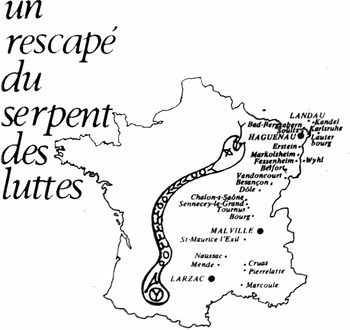
During the 1970s tens of thousands of anti-nuclear protesters acted transnationally by attending demonstrations in neighbouring countries. Translocal and transnational networks ensured that large numbers of warm bodies could be moved around in order to stand up, be counted and fill photographs at protests across Western Europe. In 1977 entire busloads of protesters came from Paris, Hamburg and Freiburg to Malville (20,000–60,000 total demonstrators), as well as from Malville, Amsterdam and West Berlin to Kalkar (up to 50,000 demonstrators), for ‘international’ demonstrations.Footnote 53 These were primarily performances of solidarity, the most immediate advantage of which was increasing protest turnout – and therefore visibility. They were also acts of ‘pilgrimage’, in which outsiders who sympathised with broader goals might visit and themselves experience the seemingly authentic places where people were ‘directly affected’.Footnote 54 Occasionally, disparate demonstrations were connected transnationally through an anti-nuclear version of ‘revolutionary tourism’.Footnote 55 In 1977 the editors of the French environmentalist newspaper La Gueule Ouverte/Combat Non-Violent (GO/CNV) promoted a summer-long programme of protests that moved from the Franco-German border in Alsace southward through towns linked to military facilities (Landau, Haguenau and Belfort), civil nuclear sites (Fessenheim, Chalon-sur-Saône, St-Maurice-l’Exil) and environmentally damaging projects (Marckolsheim, Naussac) before arriving at major demonstrations in Malville and on the Larzac (see Figure 1).
The 1977 ‘Snake of struggles’

Although (or perhaps because) most of this route was in France, activists ascribed special importance to its transnational elements. The opening salvo along the border was significant because the protesters regarded borders as ‘the symbol of nationalism, of wars, they want to ignore the borders’. They thus made a point of trying to cross the border without showing their passports.Footnote 56 Only a few dozen people travelled the entire route, but foreign protesters were the object of disproportionate attention – even as observers tended to reduce them to their nationality. As one commentator observed:
It's one thing to demonstrate in your own area against ‘your’ power station and for ‘your bicycle routes’, it's another thing to participate in a month-long march. . . .The number of marchers is less important than the symbol: to show that ecology is a totality. That you can't fight against a dam in Naussac and forget the Pluton missiles in Belfort. . . .Better [still]: the participation of Germans and Italians will give an international dimension that the local revolts lack. . . .It's Germany with its neo-Nazi money that invests in the nuclear bomb in Brazil, it's EDF [Électricité de France] that sells nuclear weapons to [South] Africa and Iran. The enemies of humanity have the same face on five continents.Footnote 57
Based on this understanding, the meaning of transnational protest was derived from the diversity of its participants, each of whom took responsibility for opposing a particular (national) fragment of the larger issue.
Coding demonstrators by nationality in this manner was a way of showing how far support reached, but it also limited protest by marking certain participants as ‘foreign’. This could play into the hands of opponents seeking to divide protesters. For example, prior to the demonstration on 31 July 1977 in Creys-Malville, French organisers celebrated the expected participation of thousands of demonstrators from West Germany, Switzerland, Italy and beyond as evidence of the protest's ‘international’ character. Meanwhile, French authorities likened the protest to a ‘second German invasion’ – in a region which had been terrorised by Klaus Barbie (the ‘butcher of Lyon’) during the Second World War.Footnote 58 French police singled out German protesters for harassment, even raiding the campsite where foreigners were staying just hours before the march. The protest organisers themselves inadvertently facilitated such discrimination by sending foreigners to a single camp in the hope that they might better ‘self-organise’ among their compatriots. Even after the demonstration, authorities targeted Germans, arresting them in disproportionate numbers.Footnote 59 For their part, the West German government and conservative press were happy to reinforce this nationally coded interpretation, publicly lamenting ‘that West German violence was exported to France’ in order to beat their domestic opponents with the same stick.Footnote 60 Thus although demonstrating abroad was one of the most accessible forms of acting transnationally, it was limited in what it could achieve, especially when its value was measured in terms of the number and nationalities of participants.
Because demonstrating abroad entails action in an unfamiliar environment, it can be far more adversely affected by misunderstandings than thinking transnationally. At the aforementioned demonstration in Malville, clashes of understanding contributed to real and dangerous physical clashes. In Malville, both the authorities and many anti-nuclear activists expected a showdown at the demonstration, but foreigners (and inexperienced protesters from elsewhere in France) did not always understand the gravity of the situation. To make matters worse, many West Germans pursued strategies that may have worked at home but proved disastrous in this foreign context: the ‘defensive’ helmets and gas masks West Germans wore were a rarity in France, where police perceived them as an ‘offensive’ threat justifying violent repression. Similarly, picking up smoking tear gas canisters to throw them away from the crowd might have worked in West Germany, but not with the exploding variety that French police used (which cost a man from Bremen his hand). More dangerous still were the dozens of stun grenades police launched into the crowd, which could be lethal at close range.Footnote 61 These weapons were ultimately responsible for the death of thirty-one-year-old physics teacher Vital Michalon as well as the maiming of three people (hundreds of others suffered lighter wounds). Transnational misunderstandings related to the different ‘choreographies’Footnote 62 of protest in France and West Germany were not primarily responsible for the violence in Malville, but they greatly contributed to the reigning atmosphere of confusion that made it so difficult to contain.Footnote 63
Acting transnationally could also take other forms and serve other purposes, such as giving activists an outside position from which to challenge opponents.Footnote 64 National borders mark the territorial limits of power, beyond which any particular state is (theoretically) powerless.Footnote 65 Protest action in border regions such as Alsace demonstrated this in a particularly dramatic way. There, environmental activists launched Radio Verte Fessenheim (RVF) in June 1977 as a trilingual pirate radio programme (in French, German and the local dialect). Mireille Caselli (a Frenchwoman who worked with RVF in Freiburg) remembers that the group learned to ‘play with the border’ by broadcasting illegally from one country into the other, ‘since the French police didn't have the right to act here and vice versa. We really used the border, to shelter ourselves’.Footnote 66 This was, of course, only possible as long as cooperation ‘from below’ amongst activists outpaced cooperation ‘from above’ amongst authorities. In September 1977 RVF was forced to rethink its strategy after a French helicopter supported by German police came close to locating their sole transmitter during a broadcast. However, RVF continued operating by employing principles of ‘decentralised’ action, scattering short-range transmitters in homes throughout the region.Footnote 67 By shifting action from one side of the border to the other, activists could escape control from both.
National borders define the limits of state power, but physically crossing them usually entails direct exposure to it. Alsatian environmentalists might have evaded the French authorities by printing publications in Germany, but French customs agents nevertheless confiscated them when activists brought them across the Rhine.Footnote 68 Even along the highly permeable Franco-German border, activists were sometimes refused entry. Prior to the first anti-nuclear protest in Fessenheim (Alsace) in 1971, French border guards were advised to search the vehicles of German and Swiss activists for drugs, ‘the verifications possibly lasting long enough to reach the scheduled end of the demonstration at 17:30’.Footnote 69 When West German anti-nuclear activists held a major demonstration in Kalkar in the midst of the so-called ‘German Autumn’ of 1977, protesters throughout the country were delayed by numerous police checkpoints. Hundreds of foreign protesters, however, remained blocked at the Swiss, French or Dutch borders and never made it into the country.Footnote 70 Even in permissive Western Europe, protesters could not take freedom of movement for granted.
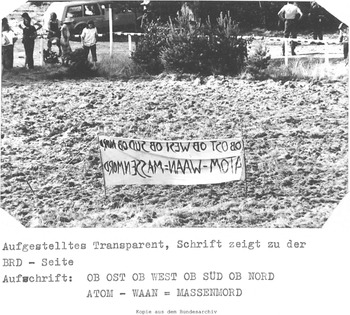
This was, of course, all the more true for protest along the Cold War border that divided Western and Eastern Europe. Nevertheless, West German activists in Gorleben showed that they could ‘play’ even with this heavily militarised border. Until the demise of the German Democratic Republic (GDR), the nuclear waste site in Gorleben was located less than twenty kilometres from the East German border – on three sides.Footnote 71 Naturally, West German anti-nuclear activists could not travel freely across the border (to say nothing of their practically immobilised GDR counterparts). Nevertheless, protesters used transnational gestures to attract attention. The aforementioned ‘passports’ of the Free Republic of Wendland were one of the tamer examples.Footnote 72 On at least two occasions, activists ‘occupied’ the border itself, taking over small stretches of land within GDR territory but not yet behind border defences.Footnote 73 A group of about sixty activists (including children and seniors) did so for a single day in 1982 in order to demonstrate to a West German audience that they would have nowhere to flee in the event of a disaster.Footnote 74 A year later, another group of twenty-five to thirty activists set up tents and declared their own ‘autonomous sector’ about fifteen metres into GDR territory, where they remained for a week. Though they told GDR troops upon leaving that ‘we wish you had understood our demands and would take them up for your state’, the prospects of this were unrealistic; in any case, their banners were turned to face West Germany (see Figure 2).Footnote 75 In this sense, these were acts of unilateral transnationalism that relied less on building transnational contact ‘from below’ than on antagonising state opponents by operating ‘from outside’. By inserting themselves into the interstices of sovereignty, protesters could mock the very notion of state power.
‘Whether East, West, South or North, Nuclear Insanity = Mass Murder’

While the potential to attack authorities ‘from outside’ was perhaps most dramatic in borderlands, creative transnational action did not have to take place in such regions. Indeed, following the collapse of the GDR, the cross-border protests with which Gorleben has been most closely associated usually took place nowhere near national borders. The so-called ‘Castor’ transports, which from 1995 to 2011 brought highly radioactive German nuclear waste back from the French reprocessing facility in La Hague for storage in Gorleben, were regular occasions for mass protests at sites across France and Germany. These occurred predominantly in towns and cities near the transports’ start and finish, with the primary aim of slowing shipments down as much as possible. The last such waste transport was met with small protests in France and much larger ones in Germany that resulted in record delays, making a train journey of 1200 kilometres take 126 hours.Footnote 76 By protesting in both countries, French and German anti-nuclear activists communicated the message that nuclear waste was universally unwanted: ‘not here, not anywhere’.Footnote 77
Nor was this message confined to a European context. In 1977 Japanese activists invited European and American nuclear energy opponents to their conference in Izu-Nagaoka and covered most of the travel costs. Japan thus became a site for grassroots networking with (and amongst) Europeans, including for several local activists without vast financial resources, such as Didier Anger (a schoolteacher from near La Hague), Lore Haag (an electrician's wife from near Wyhl) and Chantal François (a farmer's wife from Malville). Didier in particular maintained close ties with his former hosts, inviting some of them to Cherbourg the following year.Footnote 78 In 1980 and 1981 he also coordinated protests with them against both the departure and arrival of Japanese nuclear waste in La Hague, much like the protests that later developed with Gorleben. Despite the greater distance involved, these protests got off to an earlier and, in Didier's view, better start:
My contacts with Japan. . .went a bit faster than with Germany. . . .We were always opposed to the arrival [of nuclear waste] and not necessarily its return. . . .Sometimes that provoked some difficulties with our German friends. . . .Their demonstrations usually take place on the other side of the border, and we’re sometimes on the rails, but it's more to attract attention than to block [the return of waste to Germany] really. We would have liked blockades that went in the opposite direction, like we had with Japan.Footnote 79
In instances like these, acting transnationally depended less on moving large numbers of protesters from place to place or exploiting the border as an exceptional, transnational space and more on communicating a shared message that criticised opponents from both inside and outside a given national context.Footnote 80
Like thinking transnationally, acting transnationally during this period changed protest in significant ways. If the former involved using the world abroad as a resource for local creativity, the latter took advantage of the symbolism afforded by integrating cross-border elements into protest. However, acting transnationally involved confronting complex foreign realities, not merely working with projections and the imagination. This could greatly diminish the dividends, especially when activists overemphasised national identities. Celebrating diversity at ‘international’ demonstrations could easily be inverted into the kind of divide-and-conquer tactics the French authorities used in Malville. Not everyone was able to cross borders for protest, but not everyone had to. Grasping or even merely reaching for the outside was often enough to permit protesters to elaborate their critique beyond the control of state opponents. For a small number of activists, thinking and acting transnationally also became a way of life.
Being Transnational
Activists whose commitments encompassed ‘being transnational’ represented a minority within the anti-nuclear movement of the 1970s (as they almost certainly still do in protest movements today). In many histories of protest, transnational figures are typically conceived as leading ‘ambassadors’ of national movements: Rudi Dutschke's visits to the United States and France, Daniel Cohn-Bendit's travels between Paris and Frankfurt and Petra Kelly's connections in Brussels, the USA and Australia are thus commonly taken as confirmations of these leaders’ incontestably transnational engagement and identities.Footnote 81 Away from the media spotlight, however, the most transnationally implicated activists were often not well-known leaders able to project domestic fame onto an international stage, but rather people working behind the scenes, at the intersections – or even margins – of multiple cultures.Footnote 82 Intermediaries such as these were vital to the anti-nuclear movement's ability to function across borders, and worked to draw optimum advantage from transnational protest while minimising the confusion and misunderstandings intrinsic to it. Accordingly, these individuals experienced the positive as well as negative aspects of border-crossing much more acutely than the movement as a whole. The biographies of several grassroots activists reveal how cross-border protest fit into the identities and life histories of those with particularly strong, long-term transnational commitments.Footnote 83
Activists with pre-existing ‘transnational’ identities were natural intermediaries among grassroots activists. In the Franco-German context, this applied most obviously to Alsatians, some of whom looked back on a long tradition of ‘national indifference’ and opposition to French and German claims on their region.Footnote 84 Indeed, regionalism experienced a revival throughout France during the 1970s, often mutually reinforcing environmentalist struggles.Footnote 85 Jean-Jacques Rettig (b. 1939) is one Alsatian who embraced a transnational identity that he also put to use for anti-nuclear protest. As he explains it, the history of his region and of his family (including generations of men conscripted into opposing armies) propelled him to internationalism, pacifism, opposition to nuclear weapons and, ultimately, to an environmentalist defence of his home against nuclear energy.Footnote 86 During the 1970s Jean-Jacques was an anchor of protest on both sides of the Rhine, helping to organise site occupations in Marckolsheim (France) and Wyhl (Germany). He consistently opposed nuclear energy in both countries, participating in one of the first protests against France's facility in Fessenheim, but not shying away from confronting German officials on their own territory. Speaking at a local hearing in Baden, he elicited thunderous applause from German anti-nuclear protesters after introducing himself as ‘the only Alsatian to speak so far’, drawing on his identity to link post-war reconciliation at the grassroots with shared opposition to nuclear energy.Footnote 87 For Jean-Jacques, environmental activism flowed directly from his existing transnational identity and profited from it.Footnote 88
Not everyone found transnational identities so easy to embrace. Like Jean-Jacques, Ginette Hess Skandrani (b. 1938) is an anti-nuclear activist from Alsace, with family on both the French and German sides of the border. Although she is proud of her Alsatian roots, she often felt excluded in her native Haut-Rhin (one of France's most conservative départements) – especially after marrying a Tunisian immigrant during the Algerian War in 1957. Attracted to both French and German culture, she says she felt the need to choose between them in her youth, and opted for France. During the 1970s, however, anti-nuclear activism allowed her to find greater acceptance in Alsace and to rediscover Germany: having travelled to protests across the country, she says ‘I know the geography of Germany by its nuclear power stations’. According to Ginette, living in a border region was ‘a tremendous [sacré] advantage’ for protesters, not least because they could create international incidents merely by blocking traffic over the Rhine. She notes that ‘with the Germans and the Swiss, and the fact that we worked across borders and mastered French, German and Alsatian, we managed to play all of them – to make fun of power in fact’. However, even in the anti-nuclear movement, she felt misunderstood by both French and German activists, who accused her of being a German ‘collaborator’ or trampled on Alsatian historical sensitivities, respectively. She eventually decided to leave Alsace in 1983 and move to Paris, where she continues to be involved in environmentalist and anti-imperialist activism.Footnote 89 Ginette used her Alsatian background creatively in anti-nuclear protest, but ultimately felt more at home in activism than in Alsace.
Transnational identities were, of course, not exclusive to borderland residents such as Ginette and Jean-Jacques. Bernadette Ridard (b. 1947 in Issoudun, central France) is transnational almost by default, having grown up in a military family: by the age of thirty, she had lived in Paris, Grenoble, France's African colonies, the French-occupied zone of Germany, Canada, Malaysia and Britain, among others. Bernadette recalls that ‘when you move all the time, you don't really belong to anything’. Activism ultimately provided an anchor in her peripatetic lifestyle: after working with the Peace Pledge Union and Greenpeace in London, she moved to Brussels with War Resisters’ International before arriving in Hamburg in 1976, just as the first anti-nuclear protests took place in nearby Brokdorf. As she puts it, activism enabled her to ‘meet lots of people very quickly’ and to integrate herself in each new environment. In Hamburg, where she continues to live today, she used her language skills and connections with the French anti-militarist journal Combat Non-Violent while working with the anarcho-pacifist German journal Graswurzelrevolution, and drew on knowledge of Chiswick women's shelter while working with the city's first Frauenhaus. Her opposition to nuclear power was thus linked across issues and borders, as part of a broader ‘framework. . .of calling into question society’ that also encompassed peace, feminism and other so-called ‘new social movements’ of the era.Footnote 90 Protest on all these interrelated issues was something that helped Bernadette find a way to belong in spite of her fragmented, transnational identity.
For other kinds of protesters, it was more typical for activism to come first and for transnational connections to follow. This was most apparent for ‘professional’ activists in organised groups who worked with international contacts, including conventional parties, trade unions and NGOs, as well as the radical left cadre groups of the period.Footnote 91 However, it was also true for others who rejected hierarchy and cultivated less formal ties across borders. Wolfgang Hertle (b. 1946) first became politicised by conscientious objection in the 1960s but was dissatisfied with the protest traditions he found in post-war West Germany: ‘we knew very little about what was there before us in Germany, and the little that we knew didn't seem very attractive. We therefore looked more abroad’.Footnote 92 Wolfgang founded the journal Graswurzelrevolution in order to share information about direct action protests around the world with German-speaking activists. As a student of French and Political Science based in Hamburg, Wolfgang reported extensively on protests against the Larzac military camp, which also became the subject of his doctoral thesis.Footnote 93 When plans for a nuclear waste site in Gorleben were announced in 1979, Wolfgang intensified cooperation with a friend on the Larzac plateau, Hervé Ott. Because Hervé, a French protestant, had studied theology in Germany, he was able to welcome German-speaking guests on the Larzac, which developed into an international hub of activism. Hervé set up a centre, le Cun du Larzac, to channel these connections toward non-violence, inviting French and foreign activists to meetings, workshops and extended stays for direct action training.Footnote 94 Wolfgang then created the Kurve Wustrow, which he hoped would likewise function as a ‘training centre. . .in a conflict that is on the one hand centrally important for society and which on the other hand will also continue for a long time. . . .That was inspired by the Larzac and I thought, yes, that would fit well [in Gorleben]’.Footnote 95 Over the course of many years, Wolfgang and Hervé regularly publicised news about both struggles, invited one another to speak to local audiences and arranged joint ‘Franco-German encounters’.Footnote 96 Wolfgang has remained mostly in Germany, but his political convictions pushed him to look abroad and to become a transnational intermediary.
Some intermediaries consciously chose to think, act and ultimately move across borders, but not necessarily out of a desire to strengthen activism. This was the case for both Conny Baade and Mireille Caselli, although they moved in opposite directions. Conny (b. 1948) grew up in post-war West Germany but always felt alienated from the country due to its recent history. Like Wolfgang and other West Germans, she looked for alternative perspectives elsewhere.Footnote 97 When, as a student at the University of Freiburg, the opportunity arose to study abroad for a year in southern France, Conny happily accepted: hadn't France had the Popular Front while Germany descended into Nazism? Conny now rejects this view as naïve, but at that time France seemed like a foil to Germany, and subsequent anti-nuclear activism strengthened the impression. After returning to Freiburg in the mid-1970s, Conny joined the anti-nuclear protests in Wyhl, where she applied her prior experience abroad by translating between French and German. Working closely with French activists, she says, ‘led me to be more starry-eyed towards France. . . .They didn't have any prohibitions within themselves and weren't always driven by this feeling of guilt. And that was very attractive.’ By the end of the decade, Conny found life in West Germany ‘cramped’ between the ‘decidedly reactionary’ politics of the rural area where she taught school and the ‘stupid, dogmatic’ attitudes of friends in Freiburg's left-alternative scene: ‘and afterward, that was for me something that had to do with Germany, and I didn't know all that much else. I only knew France, where I had also lived for a while.’Footnote 98 In some senses, France may have been as valuable for being non-German as it was for being specifically ‘French’.Footnote 99 In 1981 Conny moved to southern France permanently. For her, being transnational was about embracing life abroad in response to the alienation she felt at home.
If Conny felt pushed away from Germany, Mireille was drawn toward it. Born in 1948 in Joigny (some 450 kilometres from the German border), she decided at the age of twelve that she wanted to live in Germany. She learned German in school from native speakers on teaching exchanges and ultimately went a similar route herself, finding a permanent university job teaching French in Freiburg. However, she soon abandoned this successful, bourgeois life in order to join Freiburg's left-alternative scene, which flourished as protest took off in Wyhl: ‘the movement, what was happening politically, was very important because I was living a life that didn't correspond to my ideas or needs. . . .And all of a sudden, I needed to explode all that.’ She quit her job and moved into a rural commune, earning enough from unemployment benefits ‘to allow, in the groups I was in, several people to live in the manner that we lived’. She soon put the language skills that she had learned through state-sanctioned cooperation to use for protest against the state,Footnote 100 translating regularly for RVF and at the 1977 demonstration in Malville. When interviewed in her native language, she frequently switched to German; discussing past involvement in mixed French and German protest groups, she was hesitant to count herself amongst the ‘French’ participants.Footnote 101 Within and outside of activism, Mireille has embraced a ‘Franco-German’ identity, but one that is skewed towards the German side.
As the stories here indicate, grassroots intermediaries came in many different forms, and transnational activism intersected with their personal and political identities in contradictory ways. Sometimes, protest capitalised on existing transnational identities in a relatively unproblematic manner, as in the case of Jean-Jacques. However, for others, like Ginette and Bernadette, such identities created difficulties that activism partially helped address. Protest itself could also be the crucible that forged transnational identities. Wolfgang, for example, looked beyond West Germany in search of political alternatives. So too did Conny, albeit for less explicitly activist reasons: like Mireille, she found life abroad more attractive, and cross-border political engagement reinforced personal migration choices. Each of these stories represents an exceptional outcome, but one which emerged from common forms of thinking and acting transnationally.
Conclusion
Transnational engagement – from the border-crossing of businessmen and musicians to the activities of criminals and drug smugglers – was open to individuals in post-1945 Western Europe on many different levels. For grassroots anti-nuclear activists in the 1970s that engagement frequently took the forms of transnational thinking, acting and being discussed above. The first of these entailed not only the ‘transfer’ of intellectual resources, but also an active process of de- and recontextualisation which supplied creative ferment to activism. ‘Thinking transnationally’ involved interacting less with foreign realities than with one's imagining of them, and was thus accessible to anyone but subject to misunderstandings. Indeed, it derived much of its potential precisely from activists’ unfamiliarity with foreign contexts. ‘Acting transnationally’ was an option for those who could travel abroad and therefore directly access foreign spaces. Most often, that meant participating in demonstrations, which led to transnational encounters that were frequent and intense, if also short-lived. However, it might also mean playing with – or even exploiting – borders in order to mock (and escape from) state opponents, or simply demonstrating at home in tandem with friends far away. ‘Being transnational’ affected the identities of those who served as cross-border intermediaries, for better and for worse. Very few of the hundreds of thousands who participated in anti-nuclear protest understood themselves in terms of the kinds of hybridised, post-national identities now associated with globalisation. Nevertheless, activists in the 1970s often behaved with indifference toward national categories, alternately ignoring and exploiting the boundaries of the nation state as they saw fit. Even if they did not live in an era of de-territorialised and virtual protest, they were pioneers in creatively using the neither-here-nor-there indeterminacy of cross-border processes to think beyond, act in defiance of, and become something more than what any particular national context would permit.
Particularly when it comes to movements such as environmentalism, which flourished in an era of accelerating globalisation, many historians are quick to turn to the usual suspects – NGOs, supranational institutions, intellectual guides and mobile leaders – for answers about transnational protest. Indeed, some conclude quite logically that in the pre-internet era only people with exceptional financial resources, language skills and mobility were even capable of participating meaningfully in cross-border protest.Footnote 102 However, differentiating amongst forms of transnational engagement helps us see just how much was possible for grassroots activists at the time – as well as how complex transnational communication remains today. Cross-border cooperation among anti-nuclear activists in the 1970s depended as much on grassroots intermediaries at the local level as it did on the semi-professional leaders of well-known (inter-) national organisations like the Bundesverband Bürgerinitiativen Umweltschutz and Friends of the Earth. At multiple levels, ‘active transnationals’ helped bridge national contexts, but this does not imply that other activists had narrow horizons or were merely passive recipients of impulses emanating from abroad or above. Farmers, schoolteachers, housewives, hippies and others all engaged in transnational protest according to the opportunities presented to them – or seized by them.
That is not to say that transnational protest was universally positive, nor that it always functioned as intended. Transnational communication is plagued by misunderstandings, but it was usually less important for activists to understand protest in foreign countries than to reinterpret it creatively for themselves. However, when protesters lacking sufficient information acted in one space on the basis of assumptions derived from another, contextual mismatches could be problematic. Like other transnational phenomena, cross-border protest is rife with contradictions and unintended consequences. Transnational coalitions celebrated diversity, but they could amount to less than the sum of their parts when activists reduced foreign allies to their nationalities. Activists themselves may have aspired to ignore borders, but they also exploited them in ways which reified them and which could accentuate perceived national differences. Protesters were perhaps ultimately most effective when they focused less on overcoming differences than on undermining and deconstructing power.