Background
Breast cancer is the most frequently diagnosed cancer in women globally. The World Health Organization (WHO) reported an approximate annual increment of 2·1 million new cases of diagnosed breast cancer worldwide. 1 The increased prevalence of female breast cancer cases has been attributed to modern lifestyle, and the incidence rate is reported to increase with advancing age, frequently affecting women aged over 40 years. Reference Ellis, Woods and Estève2–Reference Thakkar, McCarthy and Villano4
Breast cancer is a significant cause of morbidity and mortality among women and is also the most common cancer-causing death among women. 5,Reference Thomas, Kidwell and Oppong6 Statistically, breast cancer mortality rates differ on the basis of race, ethnicity and geographical location. Although there is inadequate national statistics and information about the disease in Ghana, Ohene-Yeboah & Adjei Reference Ohene-Yeboah and Adjei7 reported that breast cancer is the second leading cause of cancer mortality.
Mastectomy is a breast cancer treatment option requiring a surgical procedure to remove one or both breasts. Reference Zurrida, Bassi and Arnone8,Reference Takuwa, Tsuji and Yotsumoto9 The procedure has been described as either modified radical involving the removal of the entire breast tissue along with the axillary contents, extended radical mastectomy with intrapleural en bloc resection of internal mammary lymph node by sternal splitting, or radical in which the entire breast, axillary lymph nodes, pectoralis major and minor muscles behind the breast are removed. Reference Habermann, Abbott and Parsons10 However, for women, the mastectomy also produces physical changes to the patient’s body which presents challenges to their sexual identity, appearance, body image, confidence and personal esteem. Reference Hopwood and Hopwood11,Reference Jetha, Gul and Lalani12
In the Ghanaian setting, as may be the case in some sub-Saharan African countries, a myriad of economic, cultural norms and religious engagements, including superstitious beliefs shape how female patients respond to life after mastectomy, which may be different from the rest of the world. Reference Asobayire and Barley13 Understanding how mastectomy affects their psychosocial life would be very crucial in the management and rehabilitation process after mastectomy. Reference Scheel, Molina and Anderson14 Therefore, this study was undertaken with the aim of assessing the psychosocial impact of mastectomy on female breast cancer patients in a Ghanaian setting.
Material and Methods
The study investigated the psychosocial impact on a cohort of consenting post-mastectomy female breast cancer patients reporting for adjuvant chemotherapy, post-operative radiotherapy treatment at a radiotherapy and oncology treatment centre in Ghana. A cross-sectional study design was used in this hospital-based breast cancer study. Ethical approval and permission to carry out the research study were sought and granted by the Ethics and Protocol Review Committee of the study institution and the management of the study site, respectively (Ethics identification number: SBAHS-RD./10515989/AA/5A/2017-2018).
The minimally required sample size (80) for the study was determined using the sample size calculation formula (for cross-sectional studies/surveys) proposed by Charan & Biswas.Reference Charan and Biswas 15 Due to lack of a fixed appointment schedule at the centre, a non-probability, convenient sampling was used for participant selection, over a 5-month period -January to May 2018. The recruitment was done while patients awaited treatment (adjuvant chemotherapy, post-operative radiotherapy), simulation or case reviews following their mastectomy procedures. Informed consent was sought from all participants. Prior to their approval to participate in the study, participants were given information sheets and consent forms to inform them about what was required of them by one of the researchers after introducing herself and speaking to them about the research project. The entire procedure for the study was also explained to them, and patients could ask questions for any further clarifications. No participant was coerced into participation. Assurance was given to participants concerning the confidentiality and anonymity of information provided in the study. Particularly, they were informed that their identities would not be included in the study or any publication. Moreover, they were assured their collected data would be saved on a computer and secured with a password. Consent forms were made available in the English language and with translations into local dialects as and when necessary. Participants were also given the free will to decline their involvement at any stage during data collection. Those who consented were given questionnaires to complete or helped to complete where necessary. They were asked to comment on only the effect of the mastectomy upon their lives.
A self-designed, five-sectioned, semi-structured questionnaire (Appendix 1) comprising close- and open-ended questions was used in this study. The questionnaire was designed following a review of relevant literature in the subject area. The questionnaire addressed indices such as patient demographics, psychological and emotional factors, quality of life (QoL), social factors and ways to improve their well-being. The preliminary questionnaire was later validated and tested for reliability. The content validity of the questionnaire was tested by a senior radiotherapist and a radiation oncologist at the study site who also rated the importance of each item on the questionnaire for the intended objective. A nominal scale of 0 (important) to 1 (important) was used to score each question. Questions which scored 0 were considered irrelevant and were removed from the questionnaire. After the expert validation of the questionnaire, a pilot study test was undertaken among five patients to further assess the tool’s validity. It also solicited for the patients’ point of view and understanding of the questions. They were also asked to provide suggestions to make the questionnaire much better. A test–retest reliability analysis test was conducted to assess the reliability of the questionnaire. The data obtained for the first and second questionnaires during the test–retest analysis were analysed with the Cohen’s unweighted Kappa statistic to test the agreement between scores obtained. A reliability score/coefficient of 0·79 was observed to suggest a moderate reliability which was suitable for the study.
Statistical methods
Data from the closed-ended questions were directly entered into a Microsoft Excel 2013 spreadsheet. The responses to the open-ended questions were first grouped into common themes and their frequencies were assigned. Subsequently, all the data were organised, visually inspected for errors, cleaned in a Microsoft Excel 2013 spreadsheet and exported to IBM SPSS version 22 for statistical analysis by a statistician. Descriptive statistics were generated in the form of frequencies, percentages, means and standard deviations. Spearman’s rank correlation was used to establish relationships since the data demonstrated a non-normal distribution. Independent t-tests were also used for comparisons owing to the unpaired nature of the data, and p-values < 0·05 were considered as indications for statistically significant differences.
Results
Demographics
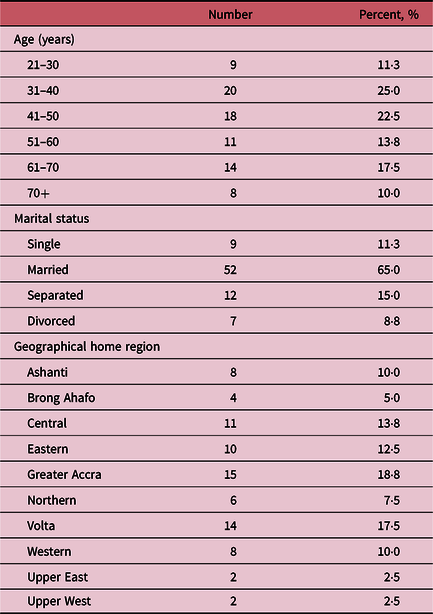
Table 1 shows the age distribution and marital status of the 80 post-mastectomy breast cancer patients. The mean age of the population (range: 21–70 years) was 48·6 years (SD = 15·4). The most prevalent age groups were 31–40 years (25%) and 41–50 (22·5%). Further details of the demographics are presented in Table 1.
Age and marital status of patients

Psychological and emotional impacts of mastectomy
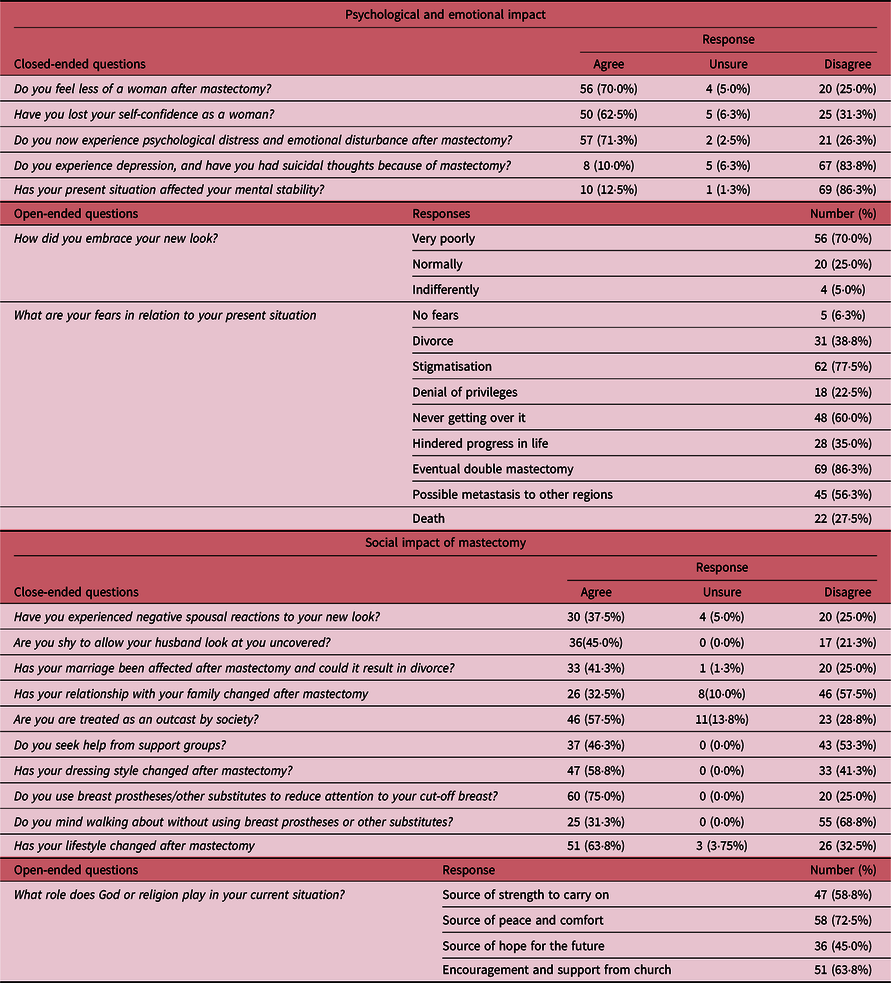
All the 80 patients identified psychological distress and emotional disturbance as major problems for female breast cancer patients who had undergone mastectomy (Table 2). Some of the patients felt that they had lost their self-esteem as women (50, 62·5%), felt less feminine (56, 70·0%), and experienced psychological distress and emotional disturbance (57, 71·3%).
Psychological, emotional and social impact of mastectomy on participants

Further to addressing their new looks, all the patients responded to the question ‘What are your fears in relation to your present situation?’ Possible metastasis to other regions (45, 56·3%), inability to get over mastectomy (48, 60·0%), stigmatisation (62, 77·5%) and eventual double mastectomy (69, 86·3%) were the patients’ greatest expressions of fear. Comparatively, a smaller number of them feared that mastectomy would result in eventual divorce (31, 38·8%) or death (22, 27·5%). Further details of psychological and emotional impact of mastectomy are presented in Table 2.
Social impact of mastectomy
Patients experienced negative spousal reactions (30, 37·5%), expressed shyness when their spouses looked at their mastectomy scars (36, 45·0%) and confirmed that their marriages had adversely been affected (33, 41·3%), although approximately 21·3% to 25·0% of them disagreed. From Table 2, many responded that their belief in God or association with religion was a source of strength or coping strategy (47, 58·8%), and their source of peace and comfort (58, 72·5%). Many (51, 63·8%) also stated that God or religion provided encouragement and also received support from church members. Further details of social impact of mastectomy are presented in Table 2.
Post-mastectomy improvement strategies
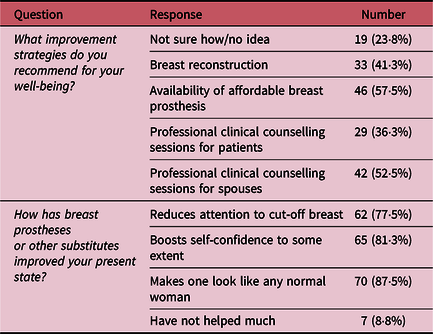
The well-being of breast cancer patients is important to their recovery following mastectomy. In answering the question: ‘What improvement strategies do you recommend for your well-being?’, patients recommended availability of affordable breast prosthesis (46, 57·5%) and breast reconstruction (33, 41·3%) as listed in Table 3. The patients explained that breast prostheses or other substitutes reduced attention to the absence of their real breast (62, 77·5%), boosted their self-confidence and self-esteem to some extent (65, 81·3%), and improved their feminine appearance (70, 87·5%). On the contrary, only a few (7, 8·8%) indicated that breast prostheses or other substitutes had no meaningful impact on their well-being. Other suggested improvement strategies included counselling sessions for affected patients (36·3%) and their spouses (52·5%). Only 19 (23·8%) had no ideas to improving their well-being after undergoing mastectomy.
Post-mastectomy improvement strategies

Patients’ demographics and psychosocial impact
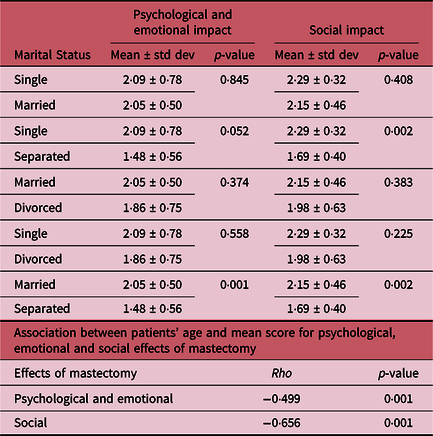
With respect to the psychological and emotional impacts experienced by the patients due to mastectomy, there was no significant difference (p > 0·05) between single and married women, married and divorced women, and single and divorced women as shown in Table 4. A statistically significant difference however, existed between married and separated women (p = 0·001). There were also significant differences between single and separated, and married and separated women (p = 0·002) after mastectomy. The results of the statistical associations show statistically significant negative correlations between patients’ age and psychological and emotional effects (Rho = −0·499, p = 0·001), and between patients’ age and social impact (Rho = −0·656, p = 0·001). Further details of the patients’ demographics and psychosocial impact are presented in Table 4.
Marital status, association between age and mean scores for psychological and emotional impact

Discussion
Psychological and emotional impacts of mastectomy
Studies 16–Reference Ganz19 suggest that one psychological impact of mastectomy is loss of femininity and sexual attractiveness. In this study, 70% of the patients admitted that they felt less feminine after mastectomy and 63% further stated that they had lost their self-confidence as women. These findings are consistent with the literature, where Jetha, Gul & Lalani Reference Jetha, Gul and Lalani12 reported that almost all the breast cancer patients who had mastectomy lamented of distorted body image and expressed feelings of weirdness, incompleteness and loss of femininity. Korcan & Gursoy Reference Koçan and Gürsoy20 also reported that mastectomy can adversely affect a woman’s feeling of femininity and self-confidence.
Our study reported that 71% of the patients agreed to experiencing psychological distress and emotional disturbance due to mastectomy. This shows that mastectomy causes further psychological trauma to the already existing case of breast cancer. The need to find in-depth solutions to promote a sound and practical psychotherapeutic treatment for affected women has been suggested by Arroyo & Lopez. Reference Arroyo and López21 Lyons Reference Lyons22 also reported that breast cancer patients experienced negative psychological effects, such as bad feelings, fears, as well as moderate to high levels of anxiety and psychological distress.
It has been reported in the literature that depression and anxiety are the most common psychological effects or impacts of breast cancer and mastectomy. Reference Heidari and Ghodusi23-Reference Moussas, Papadopoulou, Christodoulaki and Karkanias25 In a Korean study, Kim et al. Reference Kim, Kim and Kim26 also reported higher incidence of depression in the breast cancer patients with mastectomy. Die Reference Die27 observed that depression is highly prevalent in breast cancer patients with mastectomy, presenting a primary risk for suicidal ideas and intentions, if severe. On the contrary, the results of our study showed that only a few (10%) of the patients agreed to experiencing depression and having suicidal thoughts due to mastectomy, while many (84%) disagreed. A reason for this could be attributed to Ghanaian sociocultural values which frown on suicidal tendencies. Other possible reasons are old age and hence no need for child breastfeeding, as well as separated and divorced marriages which cared less about spousal concerns for their surgical scars.
Social impact of mastectomy
Social support such as happy and stable relationships, good and strong marriages, family and friends assistances are very important for enhancing QoL of most women. Reference Koçan and Gürsoy20,Reference Ng, Ang and Tran24 In general, improving patients’ QoL is a primary goal of all breast cancer treatment options. An effective strategy of improving QoL, social well-being, and family dynamics in breast cancer patients is via involvement of the patient’s family in the treatment regimes as well as seeking their support before, during and after the treatment. Reference Elshami, Alaloul and Khader28
The results of this study also established that mastectomy had negative impacts on the patients’ marital relations with their spouses. In particular, 38% of the patients answered yes to the question ‘Have you experienced negative spousal reactions to your new look?’, while 45% of them stated that they felt shy to see their spouses look at them uncovered. Also, 41% of the breast cancer patients confirmed that their marriages had been negatively impacted after mastectomy and consequently expressed fear of divorce. This finding is consistent with the study by Elshami et al., Reference Elshami, Alaloul and Khader28 where 95% of breast cancer patients worried about getting divorced as a result of their illness. Similarly, Koçan and Gürsoy Reference Koçan and Gürsoy20 reported that some breast cancer patients suffered difficult relations with their husbands after mastectomy and abstained from social interactions. In answering the question ‘Has your lifestyle changed after mastectomy’, about 63·8% of patients agreed. These findings demonstrate a common index of marital insecurity.
Body image and dressing style
The findings of this study related to the body image and dressing style, and the use of prostheses by the breast cancer patients. In particular, 59% of the patients accepted that their body image and dressing style had changed. The findings of this study are further supported by the work of Koçan and Gürsoy Reference Koçan and Gürsoy20 which reported that breast cancer survivors who had undergone mastectomy expressed negative statements about their body image or appearances, felt part of themselves missing, were inclined to wearing loose-fitting clothing that altered their dressing style due to lack of breast and tried to cover their surgical incisions.
Religion and faith
The question: ‘What role does God or religion play in your current situation?’ was posed to the patients. In particular, 59% answered that God was their source of strength to carry on in life, while 73% said God was their source of peace and comfort. Botwe et al. Reference Botwe, Antwi and Arthur29 had reported that in Ghana supernatural beliefs greatly influence a patient’s willingness to receive health care. In a similar study, Koçan and Gürsoy Reference Koçan and Gürsoy20 reported that some breast cancer patients with mastectomy expressed that they regarded their situation as the will of God and turned to God as a source of strength and acceptance. The findings of this study are further supported by Davis et al. Reference Davis, Nyamathi, Abuatiq, Fike and Wilson30 who also reported that the participants in their study indicated unequivocally that their faith in God formed the primary support for their continued survivorship.
Improvement strategies
External breast prostheses or other substitutes were identified as one of the main well-being improvement strategies. In support of the findings of this study, Shrestha Reference Shrestha31 reported that most women regarded their appearances as deformed, irregular, non-proportional, and ugly after mastectomy, and had resorted to breast prostheses to hide their loss of breast. In a related Pakistani study on women’s experiences with external body prostheses, Jetha, Gul, and Lalani Reference Jetha, Gul and Lalani12 reported that 15 women aged 35 to 61 years (mean age: 45 years) who underwent mastectomy perceived their breasts as a sign of feminine identity and therefore resorted to using external breast prostheses to restore symmetry.
Breast reconstruction and the availability of affordable breast prosthesis were recommended by many of the patients as main well-being improvement strategies in this study. The findings are consistent with the literature which reported that breast reconstruction showed an increase in positive body image and satisfaction of patients. Reference Diji, Moses and Asante32 Koçan and Gürsoy Reference Koçan and Gürsoy20 also suggested that breast reconstruction options should be discussed as an improvement strategy in the treatment process, either before mastectomy or soon thereafter. In Ghana, breast reconstruction is not common and the few available options are very expensive beyond the financial means of the average Ghanaian. These challenges are affecting the usage of breast reconstructions in Ghana.
The findings of this study showed that counselling sessions for both affected breast cancer patients and their spouses were other effective improvement strategies for coping with mastectomy. In Ghana, the stigmatisation associated with mastectomy does not come from just the spouses, but other family members so they would also need to be counselled. This assertion is supported by Elshami et al. Reference Elshami, Alaloul and Khader28 who reported that assessing and addressing the social well-being and family dynamics among breast cancer patients was needful to enhance the provision of a holistic medical care.
Patients demographics and psychosocial impact
Statistically, significant differences were found between married women and separated women after mastectomy (p = 0·001) in the psychological and emotional impacts (mean score = 2·050), and between single and separated (p = 0·02), and married and separated women (p = 0·02) after mastectomy with respect to social impact. Diji et al. Reference Diji, Moses and Asante32 have indicated that married female with mastectomy, in particular, experience psychosocial effects compared with divorced females because they fear that their husbands may leave them. Comparatively, these results are similar to the findings of Elshami et al. Reference Elshami, Alaloul and Khader28 who reported a mean score of 2·46 in the overall pyschosocial impact on family dynamics (marital status) in about 49·2% of the populations. The present study also established statistically significant negative correlations between age and psychological and emotional effects (Rho = −0·499, p = 0·001), and between age and social impact (Rho = −0·656, p = 0·001) of all the groups of breast cancer patients after mastectomy.
Study limitations
Although this study has several strengths, in the data collection process, some patients felt it was not necessary to share their private and sensitive issues with the authors, so they declined to participate. This prevented the use of very large sample size (> what was used) which could have provided more reliable results with greater precision, although the number used was statically acceptable based on power calculator analysis indicated in the method. Also, a qualitative study using interviews or focus groups would have provided a wealth of information to strengthen the findings as to how women manage in Ghana with the issues outlined in this study.
Clinical implication
The study found that breast cancer patients who undergo mastectomy experienced various forms of psychosocial and emotional effects including psychological distress and suicidal thoughts. It was also found that professional counselling of both patients and their spouses by clinical psychologists was necessary to provide marital security. For some patients, the involvement of religious beliefs in their treatment could help in their care. This is because some participants indicated that, in the midst of the mastectomy, God was their source of strength, peace, comfort, hope for the future, encouragement and a means of support through church brethren.
Conclusion
The study found that breast cancer patients who undergo mastectomy experienced various forms of psychosocial and emotional effects including psychological distress, loss of self-confidence, loss of feminine identity, mental instability, stigmatisation, suicidal thoughts, fear of divorce, possible metastasis and death, among several others. The study further showed negative marital relations and spousal reactions, fear of a possible divorce, and abstention from social interactions were some social impacts of mastectomy experienced by breast cancer patients. Breast reconstruction and the availability of affordable breast prosthesis or other substitutes were identified and recommended as well-being improvement strategies which boosted self-confidence and body image, restored some degree of feminine identity, and reduced attention to their removed breast. Professional counselling of both patients and their spouses and family members by clinical psychologists was necessary to provide marital security and reduce the psychosocial impact of mastectomy on females. Some participants indicated that God was their source of strength, peace, comfort, hope for the future, encouragement and a means of support through church brethren. A qualitative study using interviews or focus groups could also provide a wealth of information as to how women manage in Ghana with the findings identified in this study.
Acknowledgements
We express our deepest appreciation to all patients who participated in this study. We also thank all the staff who supported this study.
Conflict of Interest
None declared.
Data Availability Statement
The data that support the findings of this study are available from the corresponding author upon reasonable request.
Appendix 1 Questionnaire