Introduction
Despite fears that parasite taxonomy is facing a crisis as its workforce may be shrinking (Brooks and Hoberg, Reference Brooks and Hoberg2001; Pearson et al., Reference Pearson, Hamilton and Erwin2011; Cribb, Reference Cribb2016), the number of new parasite species discovered and described per year has been rising steadily for decades (Cribb et al., Reference Cribb, Bott, Bray, McNamara, Miller, Nolan and Cutmore2014; Poulin, Reference Poulin2014; Poulin and Presswell, Reference Poulin and Presswell2016). This growing effort to characterize and catalogue parasite biodiversity could achieve even more if it were allocated across geographical regions in direct proportion to their likely richness in new parasite species. Indeed, Jorge and Poulin (Reference Jorge and Poulin2018) recently demonstrated that the geographical distribution of new parasite species reports does not even come close to reflecting the global distribution of host diversity. Generally speaking, known hot spots of vertebrate host diversity are not receiving greater attention, and often receive less attention, than other areas in the search for new helminth species. The number of parasite species discovered in the past several decades from the tropical areas with the highest diversity of vertebrates is disproportionately low (Jorge and Poulin, Reference Jorge and Poulin2018). This spatial disconnects between the likely foci of parasite diversity and the actual targets of parasite discovery efforts can only impede the completion of the global parasite species inventory.
The discovery of new parasite species may also be proceeding at suboptimal rates for other reasons. In particular, inconsistencies in the search effort across the parasite taxa and over time may result in inefficiencies in the global species discovery endeavour. First, there is evidence that among the major groups of helminths (Cestoda, Trematoda, Nematoda and Acanthocephala) parasitizing vertebrates, there tend to be positive correlations between the species richness of one group and that of other groups across host species (Poulin and Morand, Reference Poulin and Morand2004). For example, a bird or mammal species harbouring several species of parasitic trematodes is generally also likely to harbour several cestode species (Poulin and Morand, Reference Poulin and Morand2004). Admittedly, this tendency is not universal; it is just a general statistical pattern. The same overall pattern of covariation in species richness across parasite taxa has also been reported for ectoparasites of mammals (Krasnov et al., Reference Krasnov, Mouillot, Khokhlova, Shenbrot and Poulin2005). Similarly, spatial covariance across regions in the species richness of different free-living higher taxa is also a well-documented pattern, resulting from intrinsic differences in rates of colonization, speciation and/or extinction among localities (Gaston, Reference Gaston, Hochberg, Clobert and Barbault1996; Heino, Reference Heino2002; Wolters et al., Reference Wolters, Bengtsson and Zaitsev2006). As a consequence, all else being equal, geographical areas occupied by hosts that harbour rich faunas of one parasite taxon should also yield many new species of other parasite taxa. Therefore, if parasite species discovery from surveys of wild hosts is regularly maximized by the simultaneous recovery and description of all parasite species, we should expect a good match between the geographical distribution of new parasite species reports from one group of parasites and that for other parasite groups. This large-scale covariance in species discovery across parasite taxa has not been tested before.
Second, there is evidence that the search for new parasite species, far from being an organized and systematic enterprise, is strongly influenced by idiosyncrasies due to the waxing and waning of individual careers. For example, a single active taxonomist can account for the description of a large number of new parasite species from a particular region during his or her career (e.g. Beveridge and Jones, Reference Beveridge and Jones2002; Cribb, Reference Cribb2004). However, before and after the active research period of that individual, parasite discovery rates in that region may be much lower. These temporal discontinuities in research effort create inefficiencies in the use of taxonomic expertise and resources, and thwart all efforts to extrapolate regional parasite biodiversity from patterns of rising cumulative numbers of known species over time (Poulin and Morand, Reference Poulin and Morand2004). High temporal variation in rates of species discovery per geographical region can thus greatly slow down the completion of our global inventory of parasite diversity. The extent of these temporal fluctuations in the parasite search effort has yet to be quantified on a global scale.
Here, we use data on the geographical coordinates where all new helminth species (acanthocephalans, cestodes, trematodes and nematodes) described from their vertebrate definitive hosts in the last five decades have been found, to test two hypotheses. First, based on the documented covariance in species richness of these four taxa among host species, we hypothesize that global maps of the geographical distribution of new parasite species reports should be spatially congruent across these helminth higher taxa. We honestly did not expect this hypothesis to be supported. Second, we hypothesize that the global geographical distribution of new helminth species reports will change significantly over time, i.e. across the last few decades, as an inevitable consequence of the impact of regionally highly active researchers with limited career spans. Our findings highlight inefficiencies and shortcomings in the current taxonomic effort to complete an inventory of global parasite biodiversity, for which we propose a possible solution.
Methods
Data compilation
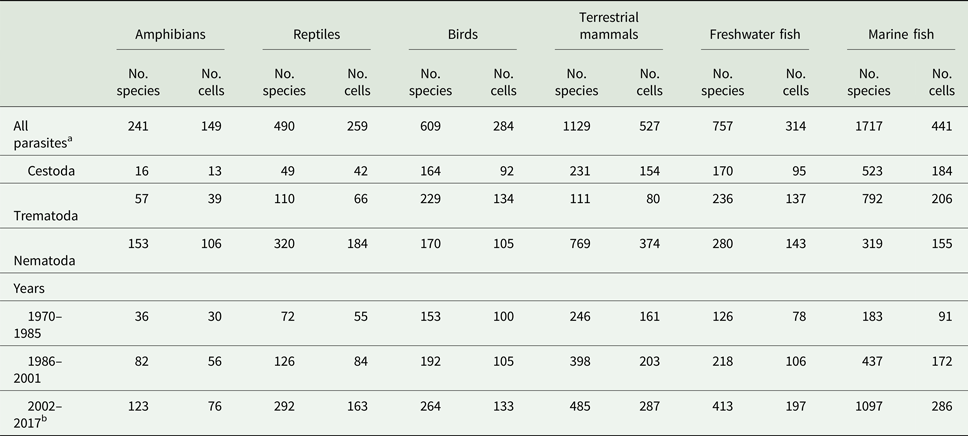
Data on the spatial distribution of helminth species discovery were compiled from species description records from the ISI Web of Science™ for the period of 1970–2017, as described in Jorge and Poulin (Reference Jorge and Poulin2018). The search was restricted to acanthocephalan, cestode, trematode (Digenea only) and nematode parasites of vertebrates. The search keywords used were: [(‘new species’ OR ‘n sp’ OR ‘nov sp’ OR ‘new gen*’ OR ‘sp n’ OR ‘sp nov’ OR ‘n gen*’ OR ‘gen n’ OR redescript*) AND (nematod* OR roundworm OR trematod* OR fluke OR digenea* OR cestod* OR tapeworm OR acanthocephal*)]. A total of 7724 entries were retrieved up to 29 November 2017 (last day of the search). After retaining only genuine species descriptions, the final dataset includes descriptions of 4943 helminth species collected from 4889 articles (Table 1). This also includes records of species redescriptions whenever the original description was made prior to 1970 and if the redescription was based on new material (amendments were not considered). This search obviously did not capture all helminth species described during that period; nevertheless, it provides a large, unbiased and representative sample of helminth species descriptions and the locations where the species were discovered.
Global numbers of parasite species analysed, and number of cells occupied for each data subset and for different vertebrate host groups

a Including acanthocephalans.
b Up to 29 November 2017.
For each species description, we recorded the following: (i) helminth species name, (ii) higher taxon, (iii) description type (i.e. new or redescription), (iv) host species, (v) host higher taxon, (vi) locality where the species was discovered, (vii) its latitude and longitude, and (vii) the full reference. If geographical coordinates were not given in the original article, they were obtained from Google Earth v. 7.3.0. The full dataset is available from http://www.otago.ac.nz/parasitegroup/downloads.html.
First, to test for congruence (or dissimilarity) in patterns of spatial distribution in the discovery of parasite species among the higher helminth taxa, the data were subdivided by parasite taxon and by vertebrate group for the entire survey period (i.e. 1970–2017). Acanthocephalans were not included in this analysis, given the small number of described species in comparison to other taxa. Second, to identify spatial shifts in efforts to discover helminth species over time, the data were separated into three subsets corresponding to three temporal intervals of 16 years (1970–1985, 1986–2001, 2002–2017). This was done separately for six vertebrate host groups (mammals, birds, reptiles, amphibians, freshwater fish, marine fish) but with pooling of all helminth species.
Statistical analysis
All analyses were performed in the R statistical computing environment (R Core Team, 2017). Prior to analysis, parasite point location data (based on latitude and longitude) were converted to a spatial points data frame using the sp package (function Spatial Points Data Frame) (Pebesma and Bivand, Reference Pebesma and Bivand2005). To generate global maps of parasite discoveries for each data subset, data on the geographic locations of species discovery were transformed into presence–absence matrices with a global grid of 2° resolution, using the function lets.presab of the R package letsR (Vilela and Villalobos, Reference Vilela and Villalobos2015). While spatial congruence may be influenced by the resolution (Grenyer et al., Reference Grenyer, Orme, Jackson, Thomas, Davies, Davies, Jones, Olson, Ridgely, Rasmussen, Ding, Bennett, Blackburn, Gaston, Gittleman and Owens2006), the chosen resolution has proven to be a good compromise between scale and the ability to characterize spatial patterns for parasites at a global scale (see Jorge and Poulin, Reference Jorge and Poulin2018). To explore congruence (or dissimilarity) in patterns of spatial distribution across years and across helminth taxa, we computed correlation coefficients among grid cells (i.e. number of species discovered per grid cell in one subset correlated with another subset), separately for all the six vertebrate groups. Prior to statistical analysis, joint absences (double zeros, i.e. grid cells where no helminth species has been found for either of the subsets being correlated) were excluded from the analysis, since they artificially contribute to the similarity between variables (Legendre and Legendre, Reference Legendre and Legendre1998; Zuur et al., Reference Zuur, Leno and Elphick2010). Given the nature of our data (count data), analyses were performed without data transformation because the transformation of count data has proven to perform poorly (O'Hara and Kotze, Reference O'Hara and Kotze2010). We first computed Spearman's rank correlation coefficients (R function cor.test), ignoring spatial autocorrelation (SAC). However, helminth species discovery in our different subsets is likely to be spatially autocorrelated, i.e. locations close to each other are more likely to have comparable values than expected by chance. Such patterns can to some degree be driven by sampling biases, e.g. due to opportunistic sampling. Statistically, this lack of independence means that each sampling location (each 2° grid cell) does not represent a full degree of freedom, which may increase type I error rates (falsely rejecting the null hypothesis of no effect) (Dormann et al., Reference Dormann, McPherson, Araujo, Bivand, Bolliger, Carl, Davies, Hirzel, Jetz, Kissling, Kühn, Ohlemüller, Peres-Neto, Reineking, Schröder, Schurr and Wilson2007).
To account for this and explicitly consider the spatial information when determining the degree of association in the distribution of species discoveries between years or between helminth taxa, we used spatial generalized linear mixed models (GLMM), fitting the structure of the variance-covariance-matrix to the data as described in Dormann et al. (Reference Dormann, McPherson, Araujo, Bivand, Bolliger, Carl, Davies, Hirzel, Jetz, Kissling, Kühn, Ohlemüller, Peres-Neto, Reineking, Schröder, Schurr and Wilson2007). While we were not interested in testing the biological cause-and-effect relationship between our data subsets, these spatial models can eliminate or at least decrease SAC (Dormann et al., Reference Dormann, McPherson, Araujo, Bivand, Bolliger, Carl, Davies, Hirzel, Jetz, Kissling, Kühn, Ohlemüller, Peres-Neto, Reineking, Schröder, Schurr and Wilson2007), allowing for a more reliable estimate of the degree of association. For associations between temporal subsets, the older subset was used as a predictor, and the more recent one as the response variable. For associations between helminth taxa, since we did not expect species discoveries in any given taxon to ‘predict’ the distribution of discoveries in other taxa, GLMMs were performed among all possible combinations of taxa as predictors and response variables. The GLMM models were performed with the function glmmPQL (MASS package; Venables and Ripley, Reference Venables and Ripley2002) implementing a spherical correlation structure, and fitting a quasi-Poisson distribution to account for overdispersion in the data (i.e. variance greater than the mean). SAC in model residuals was evaluated with Moran's I computed across neighbourhoods, and with correlograms. To ensure that all areas had neighbours, we estimated spatial weight matrices with indices of points belonging to the 3 nearest neighbouring cells with the spdep package (Bivand et al., Reference Bivand, Hauke and Kossowski2013; Bivand and Piras, Reference Bivand and Piras2015). Moran's I correlograms were generated with the ncf package (Bjørnstad, Reference Bjørnstad2013) and subsequently plotting Moran's I for 20 distance classes.
Results
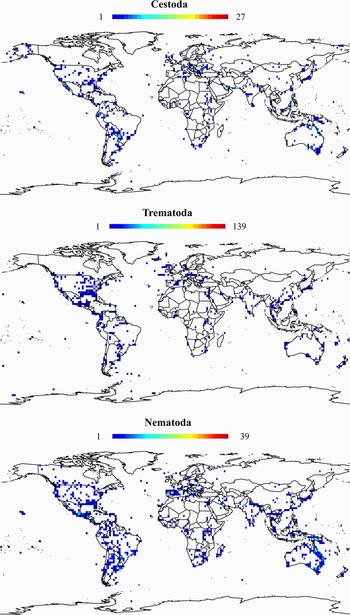
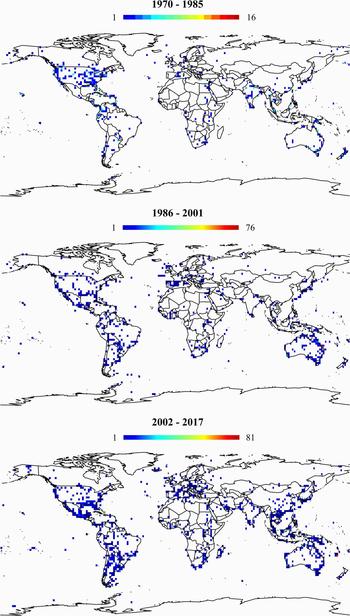
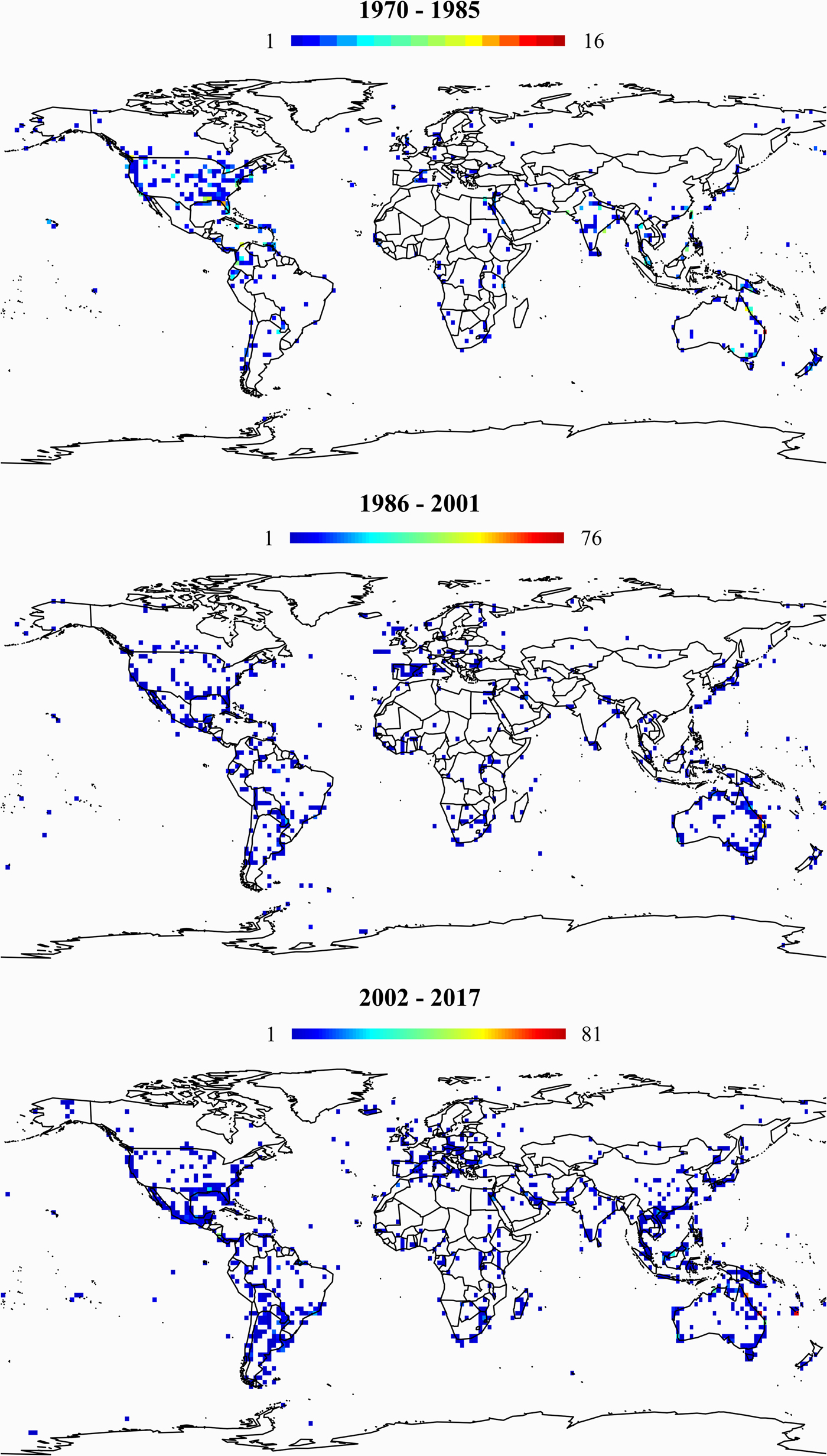
In the almost five decades covered by our search, nematodes were the most frequently discovered helminth taxon of vertebrates, except for birds and marine fish where trematodes were the most common parasite group (Table 1). In all cases, there was an increase in the number of species descriptions from the oldest (1970–1985) to most recent (2002–2017) year range. Global maps of species descriptions per helminth taxon and per year range, pooled across all vertebrate hosts, are shown in Figs 1 and 2, respectively. While, overall, nematodes are the most spatially widespread parasites (occupying 800 grid cells, vs. 512 and 509 for cestodes and trematodes, respectively), trematodes present the highest numbers of species descriptions per grid cell (Fig. 1).
Global species discovery maps for the three helminth taxa, Cestoda, Trematoda and Nematoda, parasites of amphibians, reptiles, birds, terrestrial mammals, freshwater and marine fish considered in our study for the period of 1970–2017. All maps have 2° of resolution. Colour gradients scale linearly with the number of species per cell; note the different scales in each map.

Global species discovery maps for three time intervals of 16 years (1970–1985, 1986–2001, 2002–2017), obtained by pooling all parasite species (Cestoda, Trematoda, Nematoda and Acanthocephala) of amphibians, reptiles, birds, terrestrial mammals, freshwater and marine fish, considered in our study. All maps have 2° of resolution. Colour gradients scale linearly with the number of species per cell; note the different scales in each map.
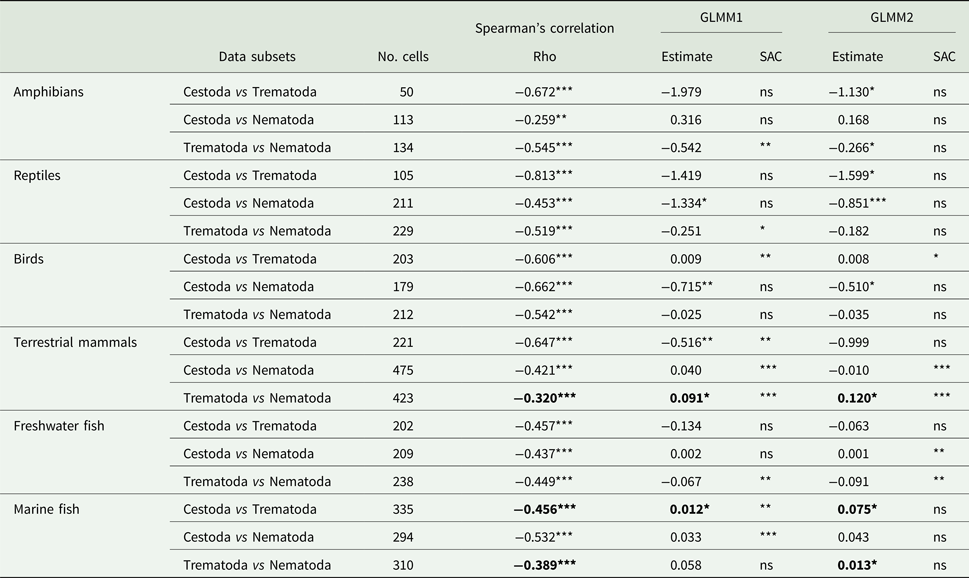
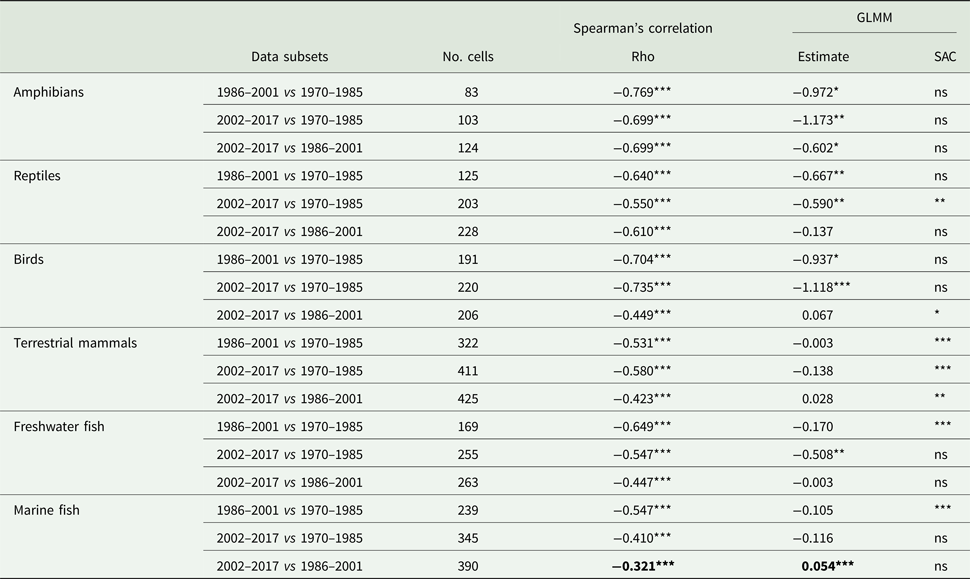
Overall, we found no convincing evidence that parasite species discovery rates show the same geographic distribution across different helminth taxa or across different time periods. Only moderate to strong positive associations would support congruence between taxa or time periods. The values of Spearman's correlation coefficients (which ignore SAC) indicate a moderate to strong negative association among the geographical distributions of new parasite species reports in different helminth higher taxa (−0.259 to −0.813), and among the geographical distributions of new parasite species reports from different time periods (−0.321 to −0.769) (Tables 2 and 3). However, the spatial GLMM estimates were comparatively lower, showing in some cases associations in the opposite direction, though only four of the latter estimates were significant (three for associations between helminth taxa, and one for associations across different time periods; Tables 2 and 3). It is worth noting that in these cases we detected heteroscedasticity in the model residuals. Overall, based on the more conservative GLMMs that account for SAC in the data, associations between the geographical distributions of parasite species discoveries among taxa or time periods were generally non-significant, and when significant they were weak and neither consistently positive nor negative.
The degree of spatial association in parasite species discovery among higher helminth taxa for different vertebrate host groups, based on the Spearman's correlations and spatial GLMMs; significance of SAC in the model residuals is based on the global Moran's I test

In GLMM1, the response and predictor variables are the taxa before and after the ‘vs’, respectively; in GLMM2, the roles are reversed. Discrepancies in the sign of the association between the Spearman's and GLMM estimates (when significant) are highlighted in bold.
*P < 0.05; **P < 0.01; ***P < 0.001; ns, P > 0.10
The degree of spatial association in parasite species discovery among time periods for different vertebrate host groups, based on the Spearman's correlations and spatial GLMMs; significance of SAC in the model residuals is based on the global Moran's I test

In the GLMM, the older time period served as a predictor, and the more recent one was the response variable. Discrepancies in the sign of the association between the Spearman's and GLMM estimates (when significant) are highlighted in bold.
*P < 0.05; **P < 0.01; ***P < 0.001; ns, P > 0.10
While accounting for SAC using the spatial GLMM models, in several cases significant autocorrelation still remained in the model's residuals as estimated with Moran's I (SAC in Tables 2 and 3) and correlograms (not shown). However, autocorrelation is generally much lower than if non-spatial models were used (data not shown).
Discussion
Achieving an inventory of global parasite biodiversity, or more realistically estimating total parasite biodiversity, requires not only a sustained taxonomic effort but also one that is reasonably allocated across geographical areas. Similarly, global public health and conservation initiatives require reliable data on the spatial distribution of parasites (Jones et al., Reference Jones, Patel, Levy, Storeygard, Balk, Gittleman and Daszak2008; Smith, Reference Smith2009; Stephens et al., Reference Stephens, Altizer, Smith, Aguirre, Brown, Budischak, Byers, Dallas, Davies, Drake, Ezenwa, Farrell, Gittleman, Han, Huang, Hutchinson, Johnson, Nunn, Onstad, Park, Vazquez-Prokopec, Schmidt and Poulin2016). There have been earlier analyses of the biogeography of helminth parasite diversity, but always limited to one taxon or region (e.g. Quiroz-Martinez and Salgado-Maldonado, Reference Quiroz-Martinez and Salgado-Maldonado2013; Cribb et al., Reference Cribb, Bray, Diaz, Huston, Kudlai, Martin, Yong and Cutmore2016). Here, we expand this to all major helminth groups on a global scale. Our results show that the geographical distributions of parasite species discoveries from the past five decades are not spatially congruent among higher taxa of helminth parasites, and are also inconsistent over time. These findings provide empirical evidence that can help guide future discovery efforts.
We begin with a word of caution regarding our analyses. Even when using a spatial model, in some cases we were unable to completely remove SAC. Having said that, in the absence of a perfect model, doing something to reduce the probability of type I errors is still better than doing nothing (Keitt et al., Reference Keitt, Bjørnstad, Dixson and Citron-Pousty2002). The clear discrepancies between the Spearman's rank correlation coefficients and spatial GLMM estimates are in part due to the nature of the estimates. The latter are used here solely to conservatively evaluate the degree of association between two distributions of parasite discoveries, and not to infer causality. The fact that they are consistently weak and often not significant should be taken as solid evidence that both across helminth taxa and over time, distributions of parasite species discoveries are spatially incongruent.
The spatial covariance of local species richness among higher taxa of free-living organisms is a widespread pattern (Gaston, Reference Gaston, Hochberg, Clobert and Barbault1996; Heino, Reference Heino2002; Wolters et al., Reference Wolters, Bengtsson and Zaitsev2006), though not a universal one (Prendergast and Eversham, Reference Prendergast and Eversham1997). Our results indicate no such covariance between the global distributions of new species discoveries among higher taxa of helminth parasites. The mismatch between the geographical distributions of new parasite species reports among different helminth groups suggests a lack of coordination among researchers working on different parasite taxa. If large number of new trematode species are described from one geographical area, it seems plausible that this area should also harbour a relatively diverse fauna of cestodes or nematodes and vice versa. For instance, our data indicate that although many nematodes have been described from Madagascar in the past several decades, no trematode has been described from that large island (see Fig. 1). Where there are many nematodes, there must also be at least a few trematodes. A likely (and probably very common) scenario is that when multiple helminth taxa are recovered from a sample of vertebrate hosts, new species belonging to the higher group for which the researchers have expertise get described, whereas other potentially new species from other taxa are set aside indefinitely, and possibly never described.
There have been some notable exceptions, i.e. a few coordinated efforts to characterize all parasite taxa recovered from host surveys, leading to the roughly simultaneous publication of multiple new species descriptions from several helminth taxa from the same host species and locality (e.g. see syntheses of such coordinated studies in Justine et al., Reference Justine, Beveridge, Boxshall, Bray, Moravec and Whittington2010, Reference Justine, Beveridge, Boxshall, Bray, Miller, Moravec, Trilles and Whittington2012). At a time when the sacrifice of vertebrates for taxonomic purposes is becoming increasingly questionable from ethical and conservation perspectives (Waeber et al., Reference Waeber, Gardner, Lourenço and Wilmé2017), such coordinated efforts are to be encouraged in order to maximize taxonomic gains per host killed. Our recommendation is therefore that teams of taxonomists with expertise spanning multiple parasite taxa should always be involved in prospective surveys of parasites from wild hosts. Alternatively, specimens recovered from host surveys that fall outside the expertise of the researchers conducting the surveys should systematically be sent to experts on other taxonomic groups, and not shelved indefinitely.
Our other key result is that the rates of regional species discovery vary significantly over time. For any given helminth taxon, new species descriptions in different regions peak during different decades, with no consistency across regions. This temporal pattern suggests that active taxonomists can have a disproportionate impact on species discovery in the region where they focus their activities and that this impact ends with their retirement (see Beveridge and Jones, Reference Beveridge and Jones2002). For instance, parasite species discovery and taxonomy have intensified in Mexico in recent decades (Fig. 2), mostly due to the efforts of a small group of taxonomists working on the parasites of freshwater fish (Aguilar-Aguilar et al., Reference Aguilar-Aguilar, Salgado-Maldonado, Contreras-Medina and Martinez-Aquino2008; Pérez-Ponce de León and Choudhury, Reference Pérez-Ponce de León and Choudhury2010). As another example, the many published descriptions of new trematode species from Great Barrier Reef fishes over the last 20–25 years are almost entirely due to the productive career of Dr Tom Cribb, with no guarantee that research on these parasites in this geographical area will continue when he ceases his taxonomic activities (Cribb et al., Reference Cribb, Bott, Bray, McNamara, Miller, Nolan and Cutmore2014).
If, after accounting for SAC, there remained strong and consistently negative associations between the geographic distributions of parasite discoveries across different time periods, this could be good news. It could indicate that taxonomic efforts shift from one area to another over time, thereby extending the geographical coverage of research. This is not the case, however, as indicated by the GLMM results. Instead, we observe a patchy and idiosyncratic approach to the global species discovery that is inefficient in many ways. The obvious way forward would be to disconnect, at least partially, the particular taxonomic expertise and research efforts of individual taxonomists from where they live. Here again, coordinated efforts would provide a solution. International teams of experts covering all taxonomic groups should be involved in all prospective surveys; after all parasites are recovered from a host sample, they can be passed on to the appropriate experts for processing and description, wherever these experts are located. This is already happening, of course, but not to a sufficiently broad extent. This approach would maximize the knowledge extracted from the death of large numbers of sampled hosts since all new parasite taxa could be systematically described, not just those for which local expertise is available. The taxonomist working alone or with a few students on a single taxon from one region, while putting aside parasites of other taxa collected from the same hosts, is not the model approach for the future.
Coordinated teams of taxonomists covering multiple higher taxa can produce descriptions of dozens of new species from a single large sample of hosts (e.g. see summaries in Justine et al., Reference Justine, Beveridge, Boxshall, Bray, Moravec and Whittington2010, Reference Justine, Beveridge, Boxshall, Bray, Miller, Moravec, Trilles and Whittington2012). Alternatively, a public database of specimens found and preserved by field workers in one area, but awaiting description by willing and qualified taxonomists from other parts of the world, would also be a step forward. These approaches would also ensure that species discovery efforts are spatially matched across higher parasite taxa, and less erratic over time. They would also maximize efficiency and minimize the number of animals sacrificed for parasite recovery. As part of the ongoing program to estimate global parasite biodiversity and complete a full species inventory (Poulin and Morand, Reference Poulin and Morand2004; Dobson et al., Reference Dobson, Lafferty, Kuris, Hechinger and Jetz2008; Poulin, Reference Poulin2014), a coordinated approach could only prove beneficial.
Acknowledgements
We thank the Otago Ecological Parasitology Group for comments on an earlier draft.
Financial support
This work was funded by a University of Otago Research Grant to R. Poulin.
Conflict of interest
The authors declare no conflict of interest.
Ethical standards
Not applicable.