

Introduction
The Giant Nuthatch Sitta magna is a globally ‘Endangered’ species with an estimated population of 1,000–2,499 individuals. Its world range is confined to south-western China, eastern Myanmar and northern Thailand where it is resident in mixed coniferous and broadleaved forest, at montane elevations between c.1,200 and 3,400 m (Round Reference Round1983, Harrap and Quinn Reference Harrap and Quinn1996, Matthysen Reference Matthysen1998, Bezuijen et al. Reference Bezuijen, Eaton, Gidean and Rheindt2010, Harrap Reference Harrap, Christie, Elliott and del Hoyo2008, BirdLife International 2020). Unquantified, ongoing land use change in montane habitats due to shifting cultivation, logging and frequent fires is considered a major threat to the species which has disappeared from several former localities in both Thailand and Myanmar (Bezuijen et al. Reference Bezuijen, Eaton, Gidean and Rheindt2010, Techachoochert et al. Reference Techachoochert, Gale, Khudamrongsawat and Round2018, Htike et al. Reference Htike, Round, Savini, Tantipisanuh and Gale2021).
Giant Nuthatch appears to be restricted to drier and more open hill evergreen forest, in which pines Pinus spp., oaks and chestnuts (Fam. Fagaceae) predominate (Round Reference Round1983, Reference Round1988, Matthysen Reference Matthysen1998) and is usually absent from denser, closed canopy moist evergreen forest that dominates montane areas (Khamcha et al. Reference Khamcha, Angkaew, Pierce and Galein press). Within its preferred habitat Giant Nuthatch preferentially forages on pine trees, Pinus kesiya Royle ex Gordon in Thailand, and P. yunnanensis Franch. in China (Round Reference Round1988, Harrap Reference Harrap, Christie, Elliott and del Hoyo2008, Charonthong and Sritasuwan Reference Charonthong and Sritasuwan2009, Han et al. Reference Han, Deng, Han, Yan, Li, Li and Zhang2011, Deng et al. Reference Deng, Han, Yan and Li2012). However, most observations are anecdotal and quantifiable data on habitat associations and the abundance of the species which are essential for its conservation are lacking (although see Htike et al. Reference Htike, Round, Savini, Tantipisanuh and Gale2021).
In this study, we assessed the density of the Giant Nuthatch on the mountain of Doi Chiang Dao, Chiang Mai Province, northern Thailand, our principal study site, presently Chiang Dao Wildlife Sanctuary, where Giant Nuthatch was first reported by Meyer de Schauensee (Reference Meyer de Schauensee1934). The continued preponderance of Giant Nuthatch sightings during recent years led to Doi Chiang Dao being recognized as an Important Bird Area (IBA; Birdlife International 2021). To quantify habitat associations and estimate the density of Giant Nuthatch, we conducted distance sampling and vegetation surveys. In addition, we also investigated the breeding home range size of a pair of Giant Nuthatches and made observations on feeding behaviour, both during structured surveys and opportunistically.
Methods
Study area
Chiang Dao Wildlife Sanctuary covers an area of approximately 521 km2 and is centred on the mountain of Doi Chiang Dao (BirdLife International 2021). The habitat changes from mixed deciduous forest at the base of the mountain, to dry evergreen forest and hill evergreen forest with increasing altitude. The very highest elevations that rise to 2,275 m are covered with secondary grassland, with patches of hill evergreen forest (BirdLife International 2021). The largest areas of evergreen forest in the sanctuary are found from 1,000 m to 1,550 m, and may be broadly subdivided into evergreen forest in which Pinus kesiya is common, and evergreen forest without pines (Maxwell Reference Maxwell1998).
The study area was located at the Khun Huai Mae Kok Forest Protection Unit (also known colloquially as “Den Ya Khad”), a substation of Chiang Dao Wildlife Sanctuary, and a field site of the Doi Chiang Dao Wildlife Research Station, situated at approximately 1,500 m elevation (19°22’N 98°50’E). Based on a recent satellite-based classification, the habitat around this forest protection unit was comprised of mostly evergreen forest, with patches of pine plantation mixed with a few large native broad-leaved trees, and pine-dominated areas where mature native pines P. kesiya typically occur in association with broad-leaved trees in open lower montane forest (Khamcha et al. Reference Khamcha, Angkaew, Pierce and Galein press).
Distance sampling surveys
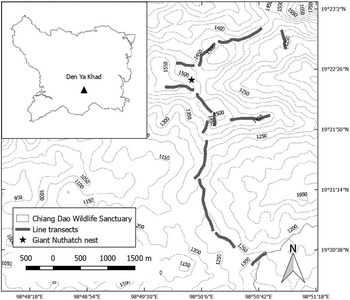
Line-transect sampling was conducted in the open oak-pine mixed forest habitat. The terrain was steeply rugged, and we placed thirteen line transects of length 200–950 m along forest interior roads and previously existing trails at 1,241–1,568 m elevation, covering a total distance of 6.2 km (Figure 1). Transects were placed at least 100 m apart to ensure independence. The shortest transect (0.2 km) was placed in a pine plantation patch adjacent to native forest.
Location of Den Ya Khad substation of Chiang Dao Wildlife Sanctuary, northern Thailand, location of nest and the thirteen line transects placed along the inner road and ridge.

Distance sampling was conducted from November 2014 to December 2015. Giant Nuthatches detected by direct observation or call were recorded, including the number of individuals, activity, and location of the birds. Observations were made with 10x42 Vixen binoculars and a Garmin 60CSx handheld GPS. Distance and angle of each sighting from the observer were measured using a rangefinder and compass in order to calculate the perpendicular distance from a transect (Buckland et al. Reference Buckland, Anderson, Burnham, Laake, Borchers and Thomas2001). Surveys were repeated 9–10 times for each transect (MacKenzie and Bailey Reference MacKenzie and Bailey2004) from sunrise to approximately 10h00.
Vegetation surveys
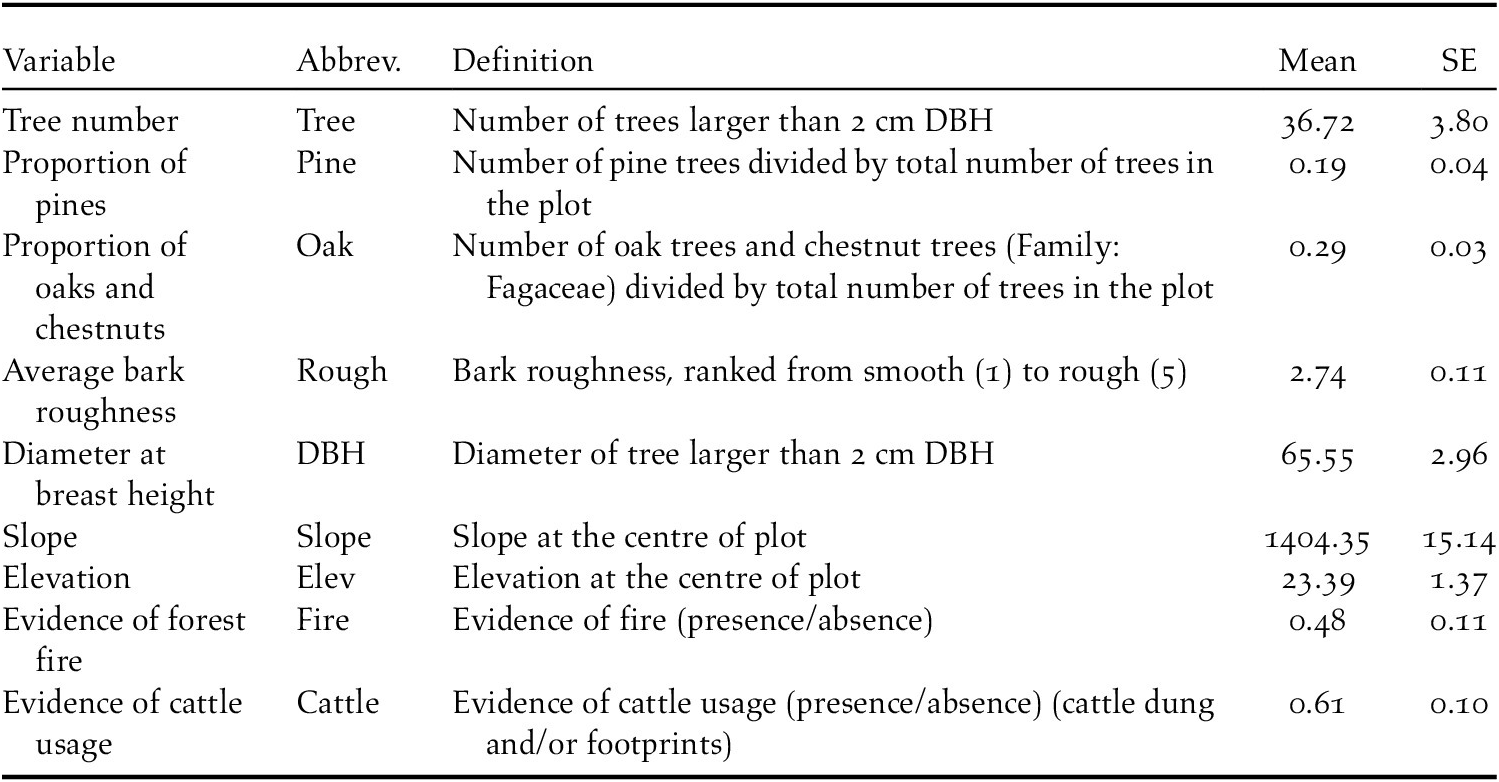
A total of 46 circular plots (12.62 m radius = area 0.05 ha) were established at 100 m intervals along the line transects to study the plant community (following Reynolds et al. Reference Reynolds, Scott and Nussbaum1980). Plots in the steepest areas (slope > 40°) were omitted. The plot centres were marked with ribbon. The plots were divided into quarters to facilitate stem-counting using a measuring tape stretched from the plot centre to its margin. The GPS location and habitat characteristics of each point (Table 1) were recorded: elevation, slope, evidence of fire, and evidence of cattle usage. All trees >2 cm diameter at breast height (DBH) within the area were counted (Sutherland Reference Sutherland1996), assigned to species, DBH measured, and assessed for bark roughness, ranked from 1 (smooth) to 5 (rough).
Habitat variables, abbreviations, definitions, means, and standard errors (SE) based on samples from 46 circular 0.05-hectare plots sampled along 13 transects in Chiang Dao Wildlife Sanctuary.

Radio telemetry
A pair of Giant Nuthatches was found nesting in a cavity in a Premna latifolia Roxb. tree (DBH = 35.42 cm) at about 4.5 m from the ground on 20 February 2016. We captured the adult pair using targeted mist-netting in front of the nest cavity at around 07h00. The female nuthatch was captured, and the radio transmitter attached, on 21 Feb 2016, as she emerged from the nest at dawn, undisturbed, during her egg-laying period. The male nuthatch was captured on 22 March, six days after the eggs had hatched. Morphometrics and weights of both birds were recorded.
We used very high frequency (VHF) transmitters, Holohil model BD-2 transmitter weight 1.4 g, approximately 3.5% of the weight of Giant Nuthatch, with a battery life span of seven weeks. The radio was attached using backpack harness technique with eyelash glue, a non-allergenic latex-based adhesive ( Withey et al. Reference Withey, Bloxton, Marzluff, Millspaugh and Marzluff2001, Whitworth et al. Reference Whitworth, Newman, Mundkur and Harris2007). We now think there is some risk of the harness getting loose and caught on vegetation. A glue-on attachment (e.g. Stanton Reference Stanton2013) would be a lower risk option. We did not track either bird for the first two days following attachment, in order to allow the birds to become accustomed to the transmitter.
We used the homing method by following the signal until the bird was detected by sight and its precise location recorded without disturbing it. This method reduced errors from signal bounce and gave more accurate locations in steep terrain than triangulation (Kenward Reference Kenward2000). Tracking, using a handheld receiver and antenna, began when the birds left the nest cavity and continued until they returned to their overnight roosts at about 18h00. Successive locations were separated by >1 h to ensure behaviourally independent samples and minimize disturbance (Harris et al. Reference Harris, Cresswell, Forde, Trewhella, Woollard and Wray1990). Time, behaviour, tree species, and position on tree were recorded.
Feeding ecology
Observations of Giant Nuthatches were conducted from January 2015 to April 2016. Whenever an individual was encountered, either during unstructured searches, during line-transects surveys or nest-watches, its behaviour was recorded, together with details of the tree species in which it was observed, and its position on the tree. Tree species were classified as either pine, oak, or other broadleaved species. The position of the bird on a tree was classified as trunk, branch, or twig.
The available vegetation in the area was assessed using the above vegetation plots. A minimum convex polygon that encompassed all records, both from opportunistic and line transect observations, was drawn. Thirty-one circular vegetation plots within this polygon were selected in order to estimate the proportions of pines, oaks, and other broadleaved trees.
Data analysis
Density estimation
In order to investigate the relationship between Giant Nuthatch density and habitat characteristics, we used a hierarchical distance sampling model (Royle et al. Reference Royle, Dawson and Bates2004). All key functions (uniform, half-normal, hazard and exponential) were examined to select the model with the lowest AIC value. AICc is not estimable with this approach, however AIC provides an unbiased estimate of model support (MacKenzie and Bailey Reference MacKenzie and Bailey2004). The number of survey occasions at each transect are taken into account in each model run (Buckland et al. Reference Buckland, Anderson, Burnham, Laake, Borchers and Thomas2001). Nine predictor variables included number of trees, DBH, proportion of pine trees, proportion of oak trees, average bark roughness, slope, elevation, evidence of forest fire, and evidence of cattle disturbance (Table 1). Continuous variables were standardised by dividing their value by twice their standard deviation (Gelman Reference Gelman2008). We also tested correlations among habitat variables to avoid multicollinearity using Spearman’s correlation coefficient: variables that were highly correlated (correlation coefficient ≥0.6) were not included in the same models.
The model with the most support was selected based on the lowest Akaike’s Information Criterion (AIC) and models with a ΔAIC <2 were considered to have similar levels of support (Burnham and Anderson Reference Burnham and Anderson2002). Density estimates and detection probabilities of the best model were back-transformed (Fiske and Chandler Reference Fiske and Chandler2011). The coefficient of variation (CV) of the density estimates and their associated 95% confidence intervals were also obtained. All data were analysed using the “unmarked” package (Fiske and Chandler Reference Fiske and Chandler2011) in program R 3.4.0 (R Development Core Team 2008).
Home range size
We defined home range as the area occupied by an animal during a specific time period (Kenward Reference Kenward2000). We estimated the home-range size of each Giant Nuthatch using the kernel home range (Worton Reference Worton1989) which quantifies used and non-used points, and also measures the amount of use throughout an animal’s range. This estimator is a widely used non-parametric home range estimator giving a probability density of the animal at any point (Marzluff et al. Reference Marzluff, Knick, Millspaugh, Millspaugh and Marzluff2001). Here, we used the area encompassing 95% of utilization as the home range and 50% to represent the core area (Millspaugh et al. Reference Millspaugh, Nielson, McDonald, Marzluff, Gitzen, Rittenhouse, Hubbard and Sheriff2006). We performed the analysis of kernel home ranges using R 3.4.0 with the “adehabitatHR” package (R Development Core Team 2008, Calenge Reference Calenge2011).
Results
Density estimates
All transects were surveyed repeatedly from November 2014 to December 2015 covering a total observation distance of 57.78 km. We had 28 nuthatch detections, both visual and aural. The detection per unit effort was equal to 0.48 detection/km. The species was detected on eight of 13 transects at elevations ranging from 1,306 to 1,568 m. Although we had too few detections to assess differences in monthly detection rates statistically, the highest encounter rate occurred during November to March (0.8 detections/km) and no detections occurred in June. All of the visual detections (15 detections) during the transect surveys were of Giant Nuthatches on pine trees.
The half-normal key function was the best-supported model based on AIC. The estimated density of Giant Nuthatch was 3.94 ± 1.22 (2.15–7.22, 95% CI) individuals/km2 with a detection probability of 38.1% and an effective strip width of 98 m.
Habitat association
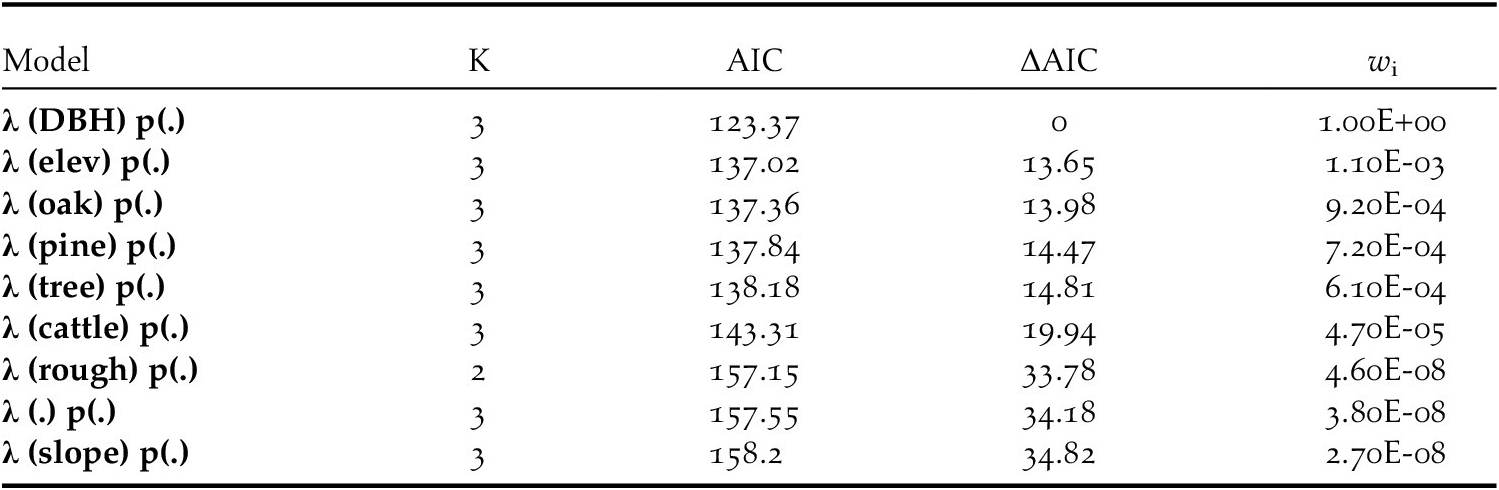
We generated hierarchical distance sampling models, each with a single variable, to investigate Giant Nuthatch density and habitat characteristics (Table 2). Tree DBH had the greatest model support, with the second-best model, elevation, having almost no support (ΔAIC = 13.65), indicating that the density of Giant Nuthatch was strongly positively associated with large mature trees (β DBH = 1.26, 95% CI = 0.770–1.74).
Ranking of hierarchical distance sampling models using the shape parameter of a half-normal detection function to explain Giant Nuthatch density (λ) and the probability of detection (p) in Chiang Dao Wildlife Sanctuary, November 2014–December 2015, showing number of parameters (K), Akaike’s Information Criterion (AIC), delta AIC (ΔAIC), and AIC weights (w i). Variables are defined in Table 1.

Home range size
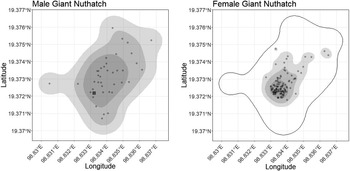
The female Giant Nuthatch of the nesting pair was followed for 27 days throughout incubation and into the nestling period, until 30 March when her signal was lost. The male nuthatch was followed from 24 March until 5 April, when, following a stationary signal, it was found dead due to unknown causes in a recent wildfire area. The number of radio-tracking locations, excluding the nest, was 124 female locations and 39 male locations. The home-range estimates using the 95% fixed kernel utilization distribution were 7.79 ha for the female and 32.01 ha for the male, equivalent to 4.1 male home ranges/km2 (Fig. 2).
Home range boundaries of a nesting male and female Giant Nuthatch using 95% (light grey), 80% (grey) and 50% (dark grey) kernel utilization distributions, relocation records (dots), and nest site (square).

Feeding ecology
Giant Nuthatches were detected visually 91 times during January 2015−April 2016. This included 76 opportunistic detections, and 15 detections during line transect surveys. Most observations were on Pinus kesiya (79 detections, 86.8% of observations; Table 3); on oaks eight times (8.8%) and other broadleaved trees three times (3.3%). A Giant Nuthatch was once (1.1%) observed on the ground, for at least 20 seconds. Giant Nuthatches showed a significant preference for foraging on pines (χ2 = 172.98, P < 0.01).
Giant Nuthatch use (number and proportion of detections) of different tree species/substrate types compared to the availability, number and proportion of different tree species, from 31 circular-plots within the study area

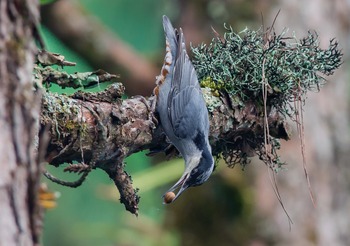
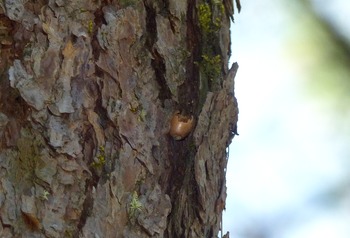
Giant Nuthatches mostly foraged on the trunks (21 of 40 detections; 52.5%) and larger branches (15 detections; 37.5%) of trees, with only four detections on twigs (10%). They chipped at the bark, apparently searching for invertebrates underneath. Of 15 occasions when a Giant Nuthatch was seen handling a food item, it was observed perched 14 times on a pine and once on an oak. On all six occasions when seen eating caterpillars (all taken from pines), the caterpillar was removed from the bark and hit on the tree before being swallowed. On four occasions a Giant Nuthatch was seen perching on a pinecone, probing inside it, apparently eating pine seeds. On two occasions, a Giant Nuthatch was observed consuming “nuts” (either a Castanopsis nut or a Lithocarpus acorn; Figure 3), once on an oak tree and once on a pine tree. In both cases, the nut was placed in a fissure in the bark to immobilize it and then hammered open before the nut contents (the cotyledons) were consumed (Figure 4). On two further occasions, we saw a Giant Nuthatch storing nuts in the fissured bark of pine trunks, and once saw a Giant Nuthatch retrieve and then consume a stored nut from a fissure in the bark of a pine tree.
Giant Nuthatch photographed on the branch of a pine tree while holding a nut from a broadleaved tree in its bill. (Photo: Natthaphat Chotjuckdikul).

The left-over nutshell placed in the bark on a pine after a Giant Nuthatch hammered had removed and consumed the cotyledonous part (Photo: Philip Round).

Discussion
Our density estimate, 3.94 individuals/km2, was about twice that obtained from a survey of 12 localities, (1.96 individuals/km2), in a more disturbed northern Thai upland mosaic landscape which included agricultural and non-forest areas (Techachoochert et al. Reference Techachoochert, Gale, Khudamrongsawat and Round2018). The high density of Giant Nuthatches in the Chiang Dao study area was presumably because it was a protected area with a relatively low level of human activity, in which cover of native forest was as high as 83% (Iamsiri and Gale Reference Iamsiri and Gale2008). A recent detailed vegetation map of Chiang Dao Wildlife Sanctuary by Khamcha et al. (in press) shows that the remaining suitable habitat of Giant Nuthatch in Chiang Dao Wildlife Sanctuary is approximately 21 km2 considering forest type, elevation, and habitat patch size. Therefore, the estimated population size of Giant Nuthatch in the wildlife sanctuary was 83 (95% CI = 45–152) individuals, notably similar to Khamcha et al.’s estimate of 53–115 individuals.
The best model obtained from the hierarchical distance sampling (Table 2) showed a positive relationship between Giant Nuthatch density and DBH strongly suggesting that Giant Nuthatches preferred large, mature trees. The second-best model, elevation had essentially no support (ΔAIC = 13.65). This was not surprising since all our sampling was carried out across a relatively narrow elevational band, all of which lay within the expected/previously known elevational range in which Giant Nuthatch occurs.
The preference for larger diameter trees was consistent with the findings of a recent study in the southern Shan State of Myanmar (Htike et al. Reference Htike, Round, Savini, Tantipisanuh and Gale2021) and another broad-scale study in Thailand (Khamcha et al. Reference Khamcha, Angkaew, Pierce and Galein press). Larger trees generally have deeper bark which supports greater insect abundance and diversity (Dickson Reference Dickson2012), which may be why larger trees were preferred. Mature trees were also, in all probability, a source of either acorns or pine seeds.
On approximately 87% of occasions, Giant Nuthatches were detected on pine trees, which constituted only 22% of trees in the study area (Table 3). This preference for pines was consistent with the anecdotal observations of other authors ( Han et al. Reference Han, Deng, Han, Yan, Li, Li and Zhang2011, Deng et al. Reference Deng, Han, Yan and Li2012), and with the Giant Nuthatch feeding ecology studies of Charonthong (Reference Charonthong2010), also made in Chiang Dao Wildlife Sanctuary, in which 77% of Giant Nuthatch observations were in pines, in areas where the availability of pines was near 20%. Giant Nuthatches in China foraged on Pinus yunnanensis for about 98% of their foraging time (Deng et al. Reference Deng, Han, Yan and Li2012), although the availability of this pine was not reported. A preference for pine was, however, less clear in a recent study in Myanmar (Htike et al. Reference Htike, Round, Savini, Tantipisanuh and Gale2021). For our study we can only currently speculate as to why pine received relatively little support in our abundance model and also limited support in Htike et al. (Reference Htike, Round, Savini, Tantipisanuh and Gale2021). Part of the issue may be due to the scale of our vegetation sampling (and that of Htike et al. Reference Htike, Round, Savini, Tantipisanuh and Gale2021) relative to the size of the Giant Nuthatch home range we estimated here (c.30 ha). There is particularly compelling evidence from Khamcha et al. (in press) who found that the number of pine trees at the plot level (c.12.6 m radius) was not associated with Giant Nuthatch abundance, while pine cover at a 300 m radius scale was strongly associated with their abundance. Therefore, we suggest future habitat studies of this species focus at a broader scale, particularly given their potentially large home range.
Giant Nuthatch was considered by Pasquet et al. (Reference Pasquet, Barker, Martens, Tillier, Cruaud and Cibois2014) to be a conifer seed-eating specialist although he provided no authority to substantiate this assumption. The preference for large pines might equally be related to invertebrate food availability (according with our observations of nuthatches consuming caterpillars from pines). Corsican Nuthatch S. whiteheadi on the island of Corsica similarly preferred to feed on older Corsican pines rather than younger trees. The thick, deeply fissured bark of older Corsican pines was thought to offer more potential caches for hoarding seeds, and to support more arthropods than the bark of younger trees (Thibault et al. Reference Thibault, Prodon and Villard2006).
The Giant Nuthatch primarily clambered around tree trunks and along large branches in the manner of most nuthatch species, apparently looking for insects hidden in or underneath bark (Harrap and Quinn Reference Harrap and Quinn1996, Robson Reference Robson2000), and rarely used smaller branches and twigs. Charonthong (Reference Charonthong2010) reported that Giant Nuthatch more frequently foraged on tree trunks (62% of observations) than branches (38% of observations), the two categories they considered. Htike et al. (Reference Htike, Round, Savini, Tantipisanuh and Gale2021) also found that Giant Nuthatch foraged on trunks and large diameter (>15 cm) branches about 50% and 28% of the time, respectively.
Notwithstanding a preference for foraging on pines, broadleaved trees as a component of the preferred forest type may be important in providing both acorns as food, and cavities in which to nest. In addition to the nest we reported in a broadleaved tree, four previous nests were found in Fagaceae or other unidentified broadleaved tree species (Round Reference Round1983, Charonthong and Sritasuwan Reference Charonthong and Sritasuwan2009). In China, all five nests were found in only one of the broadleaved tree species present in the study area, Alnus nepalensis D.Don (Han et al. Reference Han, Deng, Han, Yan, Li, Li and Zhang2011) and the one recent nest in Myanmar was in Castanopsis indica (Htike Reference Htike2020) also a member of the Fagaceae.
Implications for conservation
Stands of mature trees in the relatively open mixed pine-oak montane forest association at elevations between roughly 1,100 to 1,800 m (Techachoochert et al. Reference Techachoochert, Gale, Khudamrongsawat and Round2018) were likely the key habitat for Giant Nuthatch in the relatively confined region of north-west Thailand in which the species occurs. This open mixed pine-oak habitat is patchy and restricted within a mosaic landscape of upland agricultural areas and a closed canopy, moister, more species-rich hill evergreen forest association that is likely unsuitable for Giant Nuthatch (Khamcha et al. Reference Khamcha, Angkaew, Pierce and Galein press). The relative dryness of the habitat preferred by Giant Nuthatch renders it fire-prone, at risk from both wildfires and deliberate burning, fuelwood collection and perhaps further opportunistic, illegal encroachment for agricultural use, especially outside the boundaries of protected areas. We recommend that the authorities protect old-stand forest from logging, agricultural expansion or other development, and additionally prohibit the still pervasive collection of resinous wood kindling from the trunks of mature pines, which makes them more vulnerable, causing them to eventually topple due to the effects of annual dry season forest fires (Savage Reference Savage1994, Techachoochert et al. Reference Techachoochert, Gale, Khudamrongsawat and Round2018). Outside existing protected areas, such protection might best be implemented through establishment of community forests, including perhaps financial incentivisation of sustainable management practices (Putz and Romero Reference Putz and Romero2014).
More broadly, with the data presented here and recent work in both Myanmar and China, there are now four studies available which may allow for more precise estimation of the entire global Giant Nuthatch population once suitably detailed forest cover maps are developed. A more detailed analysis of the distribution of different forest associations using remote sensing to identify the open pine-oak association forest type across the range of the species has been undertaken for Thailand (Khamcha et al. Reference Khamcha, Angkaew, Pierce and Galein press) and is ongoing or planned for both Myanmar and China. Combined with further population surveys our preliminary Thailand population estimate for Giant Nuthatch (964 individuals; Techachoochert et al. Reference Techachoochert, Gale, Khudamrongsawat and Round2018) could be refined. Our present data suggest that habitat of mixed quality (encompassing both mature forest and older secondary growth) may have densities of approximately 1 pair per km2 (Han et al. Reference Han, Deng, Han, Yan, Li, Li and Zhang2011, Techachoochert et al. Reference Techachoochert, Gale, Khudamrongsawat and Round2018); while small, well protected higher quality sites (mostly old-growth forest) may support significantly higher densities (2–6.5 pairs per km2; this study; Htike et al. Reference Htike, Round, Savini, Tantipisanuh and Gale2021; Khamcha et al. Reference Khamcha, Angkaew, Pierce and Galein press).
Further detailed ecological studies of Giant Nuthatch should be conducted, particularly to study the effects of dry-season fires upon the dynamics of the open montane forest association on which the species depends. The possible role of plantations of Pinus kesiya, which is widely planted in upland forestry, in augmenting habitat for Giant Nuthatch should also be investigated.
Acknowledgements
We thank the Chiang Dao Research Station team, all rangers, and other staff for support during the fieldwork and the many friends and co-workers who assisted, especially Daniel Comte, Sontaya Manawatthana, Andrew Pierce, Amphapat Toonin, and Chanakarn Sripong. Dusit Ngoprasert gave valued advice during data analysis. We also thank to Tomasz Wesolowski for his constructive comments on a previous draft. We also thank Narong Mahannop, the Director of Forest and Plant Conservation Research Office, Department of National Parks, Wildlife, and Plant Conservation for his kind advice and assistance. The research would not have been completed without funding from The Rufford Small Grants for Nature Conservation (16834–1) and funding from the Development and Promotion of Science and Technology Talents Project.