INTRODUCTION
The fraction of nitrogen (N) in the diets used by livestock is only 0·05–0·30 of the nitrogen (N) in their feed for production of milk, meat, eggs or offspring, and thus the majority (0·70–0·95) is excreted via faeces and urine (Oenema et al. Reference Oenema, Bannink, Sommer, Velthof, Follett and Hatfield2001). Therefore, animal manure can be an important source of N and other nutrients for crop production if stored and managed appropriately. Appropriate management encompasses not only manure storage methods, but also the feed ration used for animals, because the N content in manure is influenced by dietary N and fibre contents. Sorensen & Fernandez (Reference Sorensen and Fernandez2003) found that N in pig manure is influenced by fibre type, fibre content and interactions between fibre type and protein content in the ration. Le et al. (Reference Le, Aarnink and Jongbloed2009) found that reducing the dietary crude protein level decreased total N and ammonium-N (NH4-N) concentrations in manure and consequently ammonia (NH3) emissions from pig manure. In Vietnam, types of pig food vary between and within farms. Traditional feeds, cooked rice, rice bran or maize with vegetables (high fibre content) are all used by small- and medium-scale farmers, while commercial feed (low-fibre) is commonly used in large-scale farms (Vu et al. Reference Vu, Tran and Dang2007). Different feeds can result in different manure volume and composition (Bhatta et al. Reference Bhatta, Enishi, Takusari, Higuchi, Nonaka and Kurihara2008; Vu et al. Reference Vu, Prapaspongsa, Poulsen and Jorgensen2009), which in turn may affect N losses during manure storage and treatment and N use efficiency after application to crops (Petersen & Sorensen Reference Petersen and Sorensen2008).
Nitrogen losses during storage can range from 0·2 to 0·7 of manure N (Martins & Dewes Reference Martins and Dewes1992; Eghball et al. Reference Eghball, Power, Gilley and Doran1997; Sommer Reference Sommer2001). The losses are mainly caused by leaching and NH3 volatilization, which are highly dependent on storage methods. Thomsen (Reference Thomsen2000) found that for manure stored aerobically (composted) with heat evolution, 0·46 of its initial N was lost, while if stored anaerobically less than 0·18 of the initial N was lost. Therefore, N losses in the form of NH3 emissions from solid manure and slurry can be significantly reduced by covering these during storage (Oenema et al. Reference Oenema, Bannink, Sommer, Velthof, Follett and Hatfield2001; Hansen et al. Reference Hansen, Henriksen and Sommer2006).
In pig farms in Vietnam, the three main manure types are slurry (a mixture of urine, faeces and water); solid manure (faeces and bedding scraped off the floor) and liquid manure (a combination of urine, faeces remaining after scraping and cleaning water). Manure management can be divided into four categories: no treatment with direct disposal to fields or fishponds; composting (with or without cover); slurry storage without treatment (with or without cover) and anaerobic digestion for biogas production. Slurry is used for biogas production; it is applied to fields or fishponds either after storage without treatment or directly from collection in the animal house. Solid manure is normally composted after being mixed with one or more ingredients such as straw and other plant residues to improve the composting process, as well as ash, lime or superphosphate (to control odour and pathogens and because these are applied to the fields as soil amendments or fertilizers anyway). Furthermore, superphosphate will have an acidifying effect on the manure and it can be hypothesized that this will reduce the N losses during composting, and hence enhance the compost fertilizer value. Lime, on the other hand, will increase pH and thus enhance ammonia volatilization.
Based on in-depth interviews at 54 pig farms in Thai Binh and Bac Giang provinces in Northern Vietnam, Vu et al. (Reference Vu, Tran and Dang2007) found that the proportion of total manure applied to crops was only 0·5 and 0·35, respectively, in these provinces, while 0·19 of the total manure produced was discharged into public sewage systems, rivers and lakes. The large proportion of manure discharged to the environment indicates that farmers lack understanding about manure quality and how to manage it in an efficient and environmentally sustainable way.
The objectives of the present study were to determine: (1) changes in N content during the storage of slurry with or without covering; (2) changes in N content during composting of solid manure with different additives; and (3) the influence of feed type on nutrient content in manure and losses during storage or composting.
MATERIALS AND METHODS
Experimental background
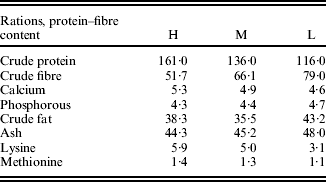
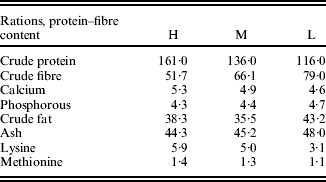
The experiments were carried out at the National Institute of Animal Sciences, Thuy Phuong, Tu Liem, Hanoi, Vietnam (21°04′N, 105°46′E, 10 m asl) from January to April 2008. Twelve castrated Landrace–Yorkshire pigs were raised individually in conventional pens, defined as a semi-open housing system. The pigs (four per treatment) were fed one of three different feed types (Table 1): low protein and high fibre content (L); medium protein and medium fibre content (M); or high protein and low fibre content (H).
Composition of the experimental rations (g/kg of DM)
Slurry storage experiment
The slurry storage experiment was carried out as a factorial design with two factors: three feed types and two storage methods. Three replications were used throughout. The faeces and urine were collected separately for pigs on the different feed types for 10 days and mixed to a slurry composed of urine, faeces and 20 litres of water, which was used for cleaning each pen. The slurry was then stored in containers with a tight PVC cover (C) or left uncovered (U) for a period of 3 months. The two storage treatments were applied for each of the three feed types, with three replicates per treatment, giving a total of 18 plastic containers. These containers were identical in shape, 0·63 m deep with diameters of 0·41 m at the bottom and 0·51 m at the top. The containers were filled to 0·18 m from the top (approximately 75 litres).
Composting experiment
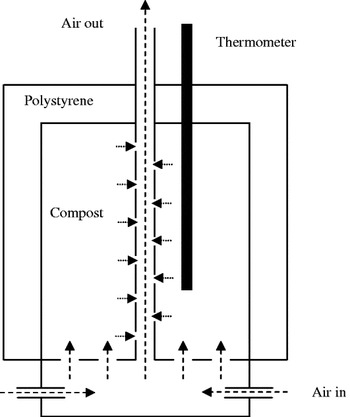
The composting experiment used a factorial design including the three feed types, three composting methods and all with three replications. The solid faeces fraction from the pigs fed different feed types was collected separately for 10 days. Mature rice straw was chopped into pieces 20–30 mm in length. Solid pig manure and straw were homogeneously mixed at a rate of 0·50 pig manure to 0·50 straw by volume (20:1 w/w) and placed in insulated boxes (10 kg solid pig manure and 0·5 kg straw/box) in order to maintain self-heating of the composting process, even with such a relatively small quantity of material. The boxes were made from polystyrene and were identical in shape, with wall thickness 0·10 m, length 0·28 m, width 0·28 m and depth 0·44 m. The compost was placed on a perforated plate to allow aeration and a plastic tube (0·03 m in diameter) perforated with holes was placed vertically in the middle of the box to ensure ventilation (Fig. 1). Air in the compost was exchanged as a result of natural flow created by self-heating of the compost.
Design of composting box used in experiments.

Three composting treatments were applied: (1) Straw=pig manure and straw (0·05 wet w/w), (2) Lime=pig manure, straw and calcium carbonate (CaCO3; 0·02 wet w/w) and (3) SSP=pig manure, straw and single superphosphate (Ca(H2PO4)2; 0·05 wet w/w). The three composting treatments were applied for each of the three pig feed types, with three replicates per treatment, giving a total of 27 boxes. During composting, from 4 February to 22 April 2008, the temperature in each box and in the ambient air was measured manually with thermometers every day at 09.00 h.
Sampling
For the slurry storage experiment, samples were collected on day 0 of the storage period and then on days 30, 60 and 90. The slurry in the containers was stirred to produce a homogeneous mass before sampling. In the composting experiment, sampling was carried out on day 0, then again after the temperature in all treatments had peaked (day 38) and finally when composting was terminated (day 80). The samples were stored in a freezer at −4°C until chemical analysis.
Analysis
Dry matter (DM) was determined by drying at 105°C for 24 h, and ash content by incinerating at 600°C for 5 h. The pH of the samples mixed with distilled water (1:4 v/v) was measured by pH meter. Total N was measured by the Kjeldahl method and NH4-N by distillation of samples extracted by dilute hydrochloric acid (HCl; 0·05 N). For the determination of total phosphorus (P) and potassium (K), samples were digested by sulphuric acid (H2SO4) and nitric acid (HNO3; 1:1 v/v), while for plant-available P and K, samples were extracted by dilute HCl (0·05 N). The P content was then measured by the Vanado-modybdophosphoric acid method (Jasko 7800 spectrophotometer, Japan; Kovar Reference Kovar, Peter, Combs, Hoskins, Jarman, Kovar, Watson, Wolf and Wolf2003) and the K content by flame photometry (Corning 410, UK).
Total carbon (C) in fresh and composted manure was calculated based on the following equation:

where C is total carbon (g/kg), A is ash content (g/kg) and 0·58 is a conversion factor for g carbon/g of ash-free DM (loss on ignition; Schulte & Hopkins Reference Schulte, Hopkins, Magdoff, Tabatabai and Hanlon1996).
Calculations
The total loss of DM (F DM) during composting was calculated by

where Q start and Q end are the initial and final mass of manure (kg) and DMstart and DMend are initial and final DM concentration (g/kg).
Losses of the other elements (F X) were calculated by

where X start and X end are the initial and final concentrations (g/kg manure) of element X (ash, C, total-N, NH4-N, P and K).
The losses of DM (F DM) calculated by the mass balance equation (eqn 2) were compared with DM losses calculated using the principle of conservation, the non-volatile elements of either P or ash (eqn 4) according to Sommer & Dahl (Reference Sommer and Dahl1999):

where P start and P end are the initial and final concentration of P (or ash) (g/kg of compost).
Statistical analysis
For the effect of feed type and the storage method or feed type and composting additive at each sampling time on nutrient content in slurry or compost after storage, the following model was used:

where μ is the overall mean, R i is the effect of feed type, S j is the effect of storage methods or effect of composting additives, T k is the sampling time (R×S)ij, (R×T)ij, (S × T)ij and (R×S×T)ijk are interaction effects between feed types, storage methods and storage time or between feed types, composting additives and storage time and ε ijk is the effect of random error. The data were analysed by one-way ANOVA (proc glm; SAS Institute 1988) and multiway ANOVA (proc mixed; SAS Institute 1988).
RESULTS
Slurry storage experiment
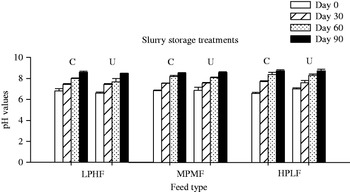
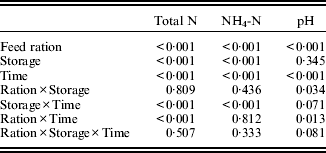
The pH value in slurry was significantly affected by feed type and time (Table 2), although most markedly by time, as pH increased from day 0 to day 90 in all treatments (Fig. 2). The high-protein feed type resulted in slightly higher pH in slurry than the medium- and low-protein feed types (except for high-protein low-fibre, covered, at day 0), but the differences were only occasionally significant during storage.
pH values in the covered (C) and uncovered (U) slurries at different sampling times; for the three different feed types (low-protein high-fibre (LPHF), medium-protein medium-fibre (MPMF) and high-protein low-fibre (HPLF)); T-bars represent s.e.d., n=3.

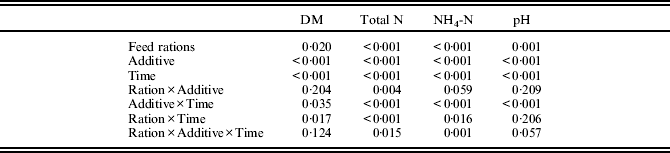
Effects of pig feed ration, slurry storage method and time on total N, NH4-N and pH in slurry (P-values), n=72
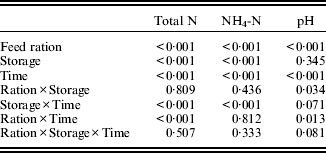
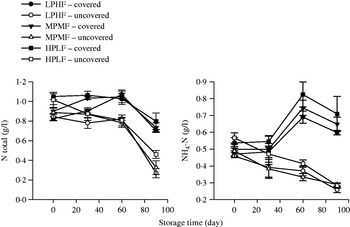
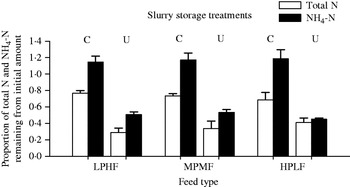
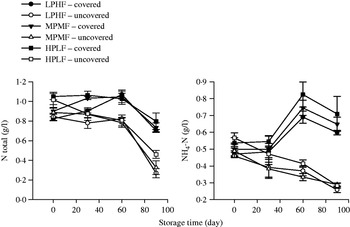
Total N was significantly affected by feed type (low-, medium- and high-protein types), storage method (covered and uncovered) and time, as well as by the interaction between storage method×time and feed type×time (Table 2). At initial time (day 0), total N was significantly higher in slurry from pigs fed the high-protein diet than for those on the low- and medium-protein diets, but the effect of feed type on total N declined over time. By days 30, 60 and 90, the total N in covered slurry was significantly higher than in uncovered (Fig. 3). When total N was expressed in proportion of initial amount, it was markedly different between covered and uncovered, with 0·70–0·75 of the initial amount remaining in covered but only 0·30–0·40 in uncovered (Fig. 4) at the final sampling (day 90).
Total N (left) and NH4-N (right) concentrations in the covered and uncovered slurries during the storage period for the three different feed types (LPHF, MPMF and HPLF); T-bars represent s.e.d., n=3.
Total N and NH4-N remaining as a proportion of initial amount in covered (C) and uncovered (UC) slurries after storage (day 90 compared with day 0) for the three different feed types (LPHF, MPMF and HPLF). T-bars represent s.e.d., n=3.

NH4-N was significantly affected by the feed type, the storage method, time, as well as by the interaction between storage method×time (Table 2). NH4-N markedly increased in covered and decreased in uncovered over time (Fig. 3). After storage for 90 days, the amount of NH4-N remaining in slurry was markedly different between covered and uncovered treatments, constituting 0·40–0·50 of the initial amount in uncovered but 1·15–1·20 times the initial amount in the covered (Fig. 4). The increase in NH4-N content in covered slurry showed that N mineralization had occurred in that slurry over time. It probably also occurred in the uncovered treatment, but part of the NH4-N mineralized was lost through volatilization. The initial NH4-N content in slurry from pigs fed the high-protein diet was markedly higher than for the low-protein diet, but on subsequent sampling occasions (days 30, 60 and 90) it was only slightly higher than for the medium- and low-protein diets (Fig. 3).
Composting experiment
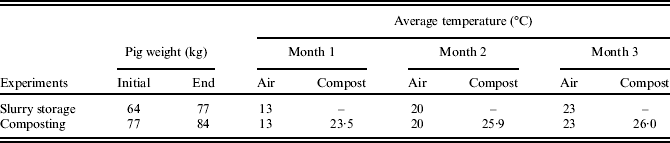
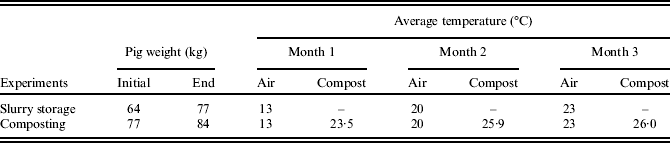
The temperature rapidly increased in all composting treatments except for the high-protein low fibre – SSP (see below) and reached a peak (32–38°C) in 5–8 days, corresponding to c. 20–25°C higher than the ambient temperature. The temperature decreased after 10–15 days to slightly higher than ambient temperature, where it remained for the rest of the period (Table 3).
Pig weights and average ambient air and compost temperatures (average of all compost additives) during slurry storage and composting experiments for a period of 3 months
DM losses during composting (day 0–day 80) were estimated by the change in initial and final weight of materials (eqn 2) and then checked by mass balance conservation of ash or P total (eqn 4, data not shown). The DM losses were quite similar for these different ways of calculation and thus the DM losses calculated by weight were used for all calculations in the present study.
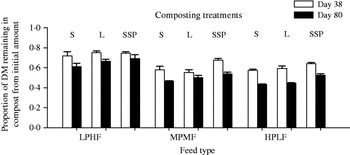
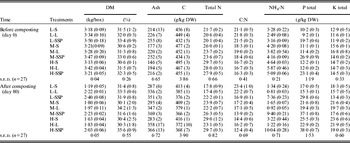
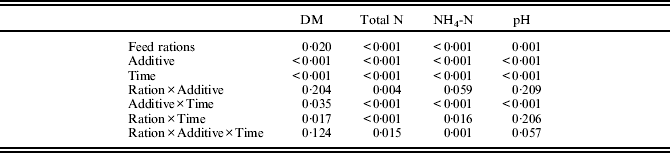
The DM losses were significantly affected by time, additive and feed type, as well as by the interaction between additive and time as well as feed type and time (Table 4), although most markedly by time, as DM decreased during the composting period to 0·55–0·70 of initial DM in all treatments (Fig. 5). DM for the SSP treatment was significantly higher than for the straw and lime treatments, while DM for the low-protein diet was slightly higher than for medium- and high-protein diets (Table 5).
DM remaining in compost as a proportion of initial amount after 38 and 80 days for the different feed types (LPHF, MPMF and HPLF) and additives (S=manure+straw; L=manure+straw+CaCO3; and SSP=manure+straw+single-superphosphate). T-bars represent s.e.d., n=3.

Effects of feed rations, composting additive and time on DM, total N, NH4-N and pH in compost (P-values), n=81
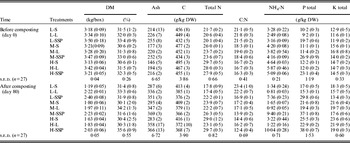
Nutrient content in manure before and after composting for the different rations (L=low-protein high-fibre; M=medium-protein medium-fibre; and H=high-protein low-fibre) and additives (S=manure+straw; L=manure+straw+CaCO3; and SSP=manure+straw+single-superphosphate). [s.e.d. in brackets (n=3)]
The high-protein low-fibre – SSP treatment showed a very distinct temperature pattern, increasing very slowly from the ambient and not reaching a peak until day 35. This slow increase in temperature in the high-protein low-fibre – SSP treatment was probably caused by a combination of low pH in the SSP treatment and slightly higher water content in the high-protein ration, although this was observed visually and was not clearly indicated in the DM data (Table 5).
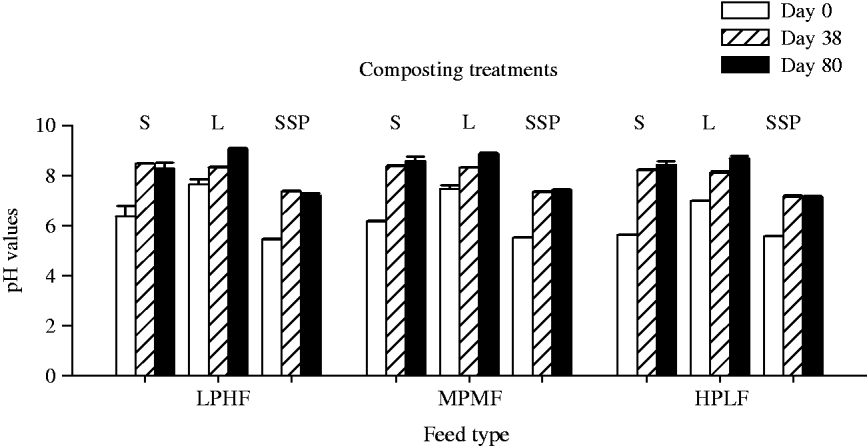
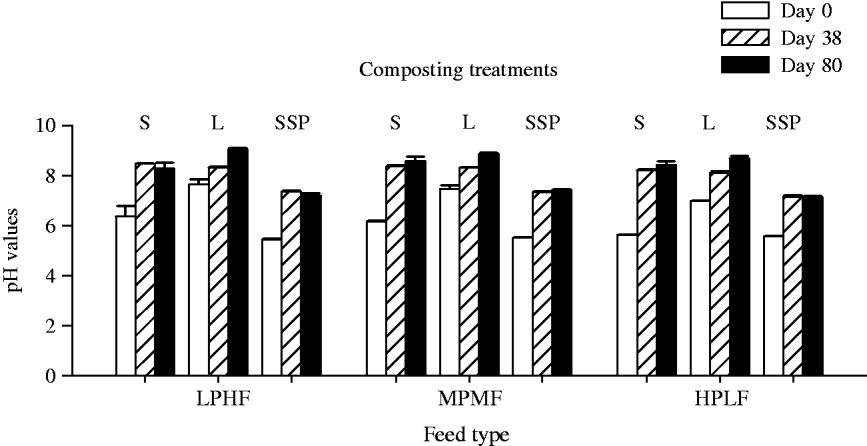
The pH value of composts was significantly affected by additive, time and feed ration, as well as by interaction between additive and time (Table 4). The initial pH values were significantly different between additives: c. 6 in straw, 5·5 in SSP and 7–7·5 in lime. The pH increased markedly from day 0 to day 38 in all treatments and then continuously increased in lime, while it increased only slightly in straw and SSP for the rest of period (Fig. 6). After composting (at day 80) the pH in lime (8·6–9·0) and straw (8·2–8·5) was significantly higher than that in SSP (7·0–7·4).
pH values in composts at different sampling times during composting for the different feed types (LPHF, MPMF and HPLF) and additives (S=manure+straw; L=manure+straw+CaCO3; and SSP=manure+straw+single-superphosphate). T-bars represent s.e.d., n=3.
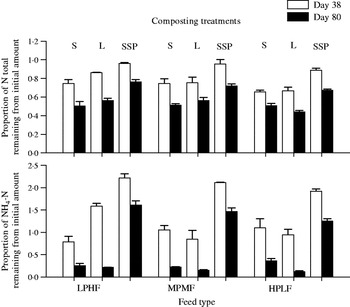
Both total N and NH4-N in composts were significantly affected by feed type, additive and time, as well as by interactions between additive×time, feed type×time and feed type×additive (Table 4). At initial time (day 0), N content was significantly affected by feed type, with N content (both total N and NH4-N) highest for the high-protein diet and lowest for the low-protein diet (Table 5), but this effect decreased slightly over time. The effect of additive was significant at samplings on day 38 and day 80, with the N content in SSP significantly higher than in straw and lime. After composting (day 80), the total N expressed as a proportion of initial amount was highest in SSP (0·65–0·75 of initial N), while in lime and straw it was only 0·45–0·55 of initial N (Fig. 7).
Total N and NH4-N content as a proportion of initial amount at 38 and 80 days of composting for the different feed types (LPHF, MPMF and HPLF) and additives (S=manure+straw; L=manure+straw+CaCO3; and SSP=manure+straw+single-superphosphate). T-bars represent s.e.d., n=3.

The NH4-N remaining from the initial amount was significantly different between additive treatments and sampling occasions. The amount of NH4-N remaining on day 38 was quite high in all treatments, but was double the initial amount in the SSP treatment. This increase in NH4-N in composts was the result of low N volatilization and high N mineralization during composting. From day 38 to day 80, NH4-N decreased in all treatments and at day 80 the NH4-N content expressed relative to initial amount was significantly different between additives: 0·22–0·36 of initial content for straw, 0·11–0·22 for lime and 1·25–1·60 times the initial content for SSP (Fig. 7).
The concentration of ash, C, P and K in the composts (Table 5) depended on the type as well as on the amount of additive. Ash, P and K were significantly different between additives, with the highest ash and P obtained in SSP, followed by straw and the lowest in lime. For C content, in contrast, the highest content was in straw, followed by lime and the lowest in SSP. Only K content in compost was significantly affected by the feed type, the highest K being obtained in composted manure from pigs fed the high-protein diet, followed by medium and the lowest for the low-protein diet.
The ratios of available P:total P and of available K:total K appeared unchanged over time and were not significantly affected by the feed type or additive. Available P constituted 0·78–0·86 of total P and available K constituted 0·90–0·93 of total K during composting (data not shown).
The C:N ratio in composts was significantly affected by the feed type at the start of composting, being lowest for the high-protein diet and highest for the low-protein diet. During composting, the C:N was not only affected by the feed type, but also by the additive, being significantly lower with the SSP additive (due to the lower N losses) compared with straw and lime (Table 5).
DISCUSSION
Influence of feed types on N content in manure
Pig feed type, especially dietary protein content, influences the composition of pig manure. Le et al. (Reference Le, Aarnink and Jongbloed2009) found that reducing dietary crude protein from 0·15 to 0·12 significantly decreased manure pH, total N and NH4-N concentrations and NH3 emissions from pig manure. This finding was confirmed by Canh et al. (Reference Canh, Aarnink, Schutte, Sutton, Langhout and Verstegen1998). This is consistent with Portejoie et al. (Reference Portejoie, Dourmad, Martinez and Lebreton2004), who showed that total NH4-N content in the slurry decreased from 4·32 g N/kg to 3·13 and 1·92 g N/kg when dietary crude protein was reduced from 0·20 to 0·16 and 0·12, respectively.
In the present study, the initial N content and the pH in slurry and solid manure were significantly different between rations (Fig. 3 and Table 5). The initial N content in slurry from the high-protein diet was higher than for the medium- and low-protein diets because of higher dietary crude protein (Table 1). However, differences in N excretion between pigs fed diets with different protein contents are mainly expressed in urine (Vu et al. Reference Vu, Prapaspongsa, Poulsen and Jorgensen2009), and urinary N is easily lost as gaseous emissions because urine contains large amounts of urea, which is a precursor for NH3 (Sommer et al. Reference Sommer, Jensen, Clausen and Sogaard2006). Therefore, the manures for the different feed types differed in N content at day 0, but due to emissions this difference was less pronounced after storage and composting.
Changes in N content during the storage of slurry
The amount of manure collected in the feeding experiment was limited, since the number of pigs in the controlled feed-excretion experiment was naturally limited. As a result, the storage experiments were carried out on a relatively small scale. However, the small scale of slurry storage (c. 75 litres) was actually quite similar to the storage conditions of typical small farms in Northern Vietnam. The advantage of the relatively small scale was that storage conditions could be easily standardized for all treatments, and the amount and properties of pig slurry could be measured precisely at the beginning and end of the experiment.
Previous studies have shown that covering slurry stores reduces N losses. For example, a solid cover on pilot-scale stored slurry reduced NH3 emissions by 30% in a study by Amon et al. (Reference Amon, Kryvoruchko, Frohlich, Amon, Pollinger, Mosenbacher and Hausleitner2007), while Portejoie et al. (Reference Portejoie, Martinez, Guiziou and Coste2003) showed that a covering of oil, plastic film, perforated polystyrene, peat or zeolites reduced NH3 emissions during storage by 74–100%.
The present study demonstrated that slurry covering is also efficient under Vietnamese conditions (Figs 3 and 4) as N volatilization from the slurry stored in containers and covered with PVC was negligible during the first 2 months of storage. However, after 3 months of storage, c. 0·20 of the total N was lost, possibly as a result of opening the covers for sampling and of the higher temperature during the third month of storage (Table 3). During the initial 2 months of storage the NH4-N concentration in the covered container increased by 0·50, indicating that significant amounts of organic N were being mineralized during this period (Sommer et al. Reference Sommer, Petersen, Sørensen, Poulsen and Møller2007), but thereafter no further increase in NH4-N was observed.
The total N content in uncovered slurry declined gradually during the 3-month storage period. Losses of NH4-N from uncovered slurry reduce its N use efficiency as a fertilizer, because NH4-N is readily available for plant uptake. The uncovered slurry in the present study was not covered with a surface crust, in which coupled nitrification–denitrification can take place (Sommer et al. Reference Sommer, Petersen and Sogaard2000). Therefore, it can be assumed that little N was lost due to denitrification and most due to NH3 volatilization. Ammonia losses are highly dependent on slurry pH, temperature and air exchange across the slurry surface (Sommer Reference Sommer1997; Van der Stelt et al. Reference Van Der Stelt, Temminghoff, Van Vliet and Van Riemsdijk2007). The pH increased up to 8·5 in both uncovered and covered stored slurry in the present study and thus the high losses of NH3 from uncovered slurry were the result of high pH, exposure to the open air and high temperatures during storage.
Changes in N during composting of solid manure with different additives
The scale of the manure composting experiment (10 kg manure/reactor) was significantly smaller than that used even in small-scale farms in Vietnam, but the scale was due to the small amounts of solid manure collected in the feeding experiment. Even though composting reactors were carefully insulated, the composting process may have differed somewhat from farm scale compost heaps (e.g. reduced self-heating and hence somewhat lower temperature profile); therefore, the quality of the composted manure could be affected.
Nitrogen volatilization during composting is highly dependent on temperature and pH in the compost, which thus affects the N content in the end product. Despite careful insulation, the peak temperatures of 32–38°C recorded in the present composting treatments were low compared to the 60–70°C reported for other studies with full-scale compost heaps (Petersen et al. Reference Petersen, Lind and Sommer1998; Sommer & Dahl Reference Sommer and Dahl1999), probably because of the small amount of compost material in each box (c. 10 kg) and the low initial ambient temperature (10°C). However, the peak temperatures found in the present study were also lower than those reported by Thomsen (Reference Thomsen2000) for small amounts of manure (6·6–7·7 kg). The reasons for this are unknown, but a possible explanation may be the lack of forced aeration.
The different additives did not affect the temperature, but the changes in N content during composting were significantly different between additives, probably as a result of pH changes. Total N losses were lowest for the SSP additive (0·25–0·35), mainly because the pH increased least in this treatment, from 5·5 (at initial) to c. 7·0 (day 38). Total N losses in straw and lime were quite similar (0·45–0·55), although pH in lime was higher than in straw until day 38. The lower N losses from SSP compost due to the lower pH support previous findings (DeLaune et al. Reference Delaune, Moore, Daniel and Lemunyon2004; Kai et al. Reference Kai, Pedersen, Jensen, Hansen and Sommer2008).
The changes in NH4-N content in solid manure with different additives not only show that NH3 was lost through volatilization but also that NH4+ increases through mineralization and is reduced through immobilization during composting. For straw and lime, NH4-N made up 0·16 of total N content initially and 0·21–0·23 at day 38, but decreased to only 0·05–0·09 of total N at day 80 (Table 5 and Fig. 7). This means that N mineralization in the straw and lime treatments from day 0 to day 38 was equal to or slightly higher than N volatilization, but most of the NH4-N was either volatilized or immobilized at later stages of composting (from day 38 to day 80). Similar changes in inorganic N were reported by Thomsen (Reference Thomsen2000) for aerobically stored sheep manure. In SSP, NH4-N constituted 0·17 of total N initially, 0·38 at day 38 and 0·34 at day 80. The higher N mineralization in SSP (particularly from day 0 to day 38) compared with straw and lime could possibly have been caused by the low pH, as has also been observed by Fangueiro et al. (Reference Fangueiro, Cabral, Vasconcelos, Ribeiro, Coutinho, Grignani, Acutis, Zavattaro, Bechini, Bertora, Marino Gallina and Sacco2009).
Practical implications
Before the results of the present study are scaled up, there is a need for farm-scale storage and composting trials to validate the results and to determine the practical value of slurries and composts and their effect on crop production. However, if the results of the study can be validated this should have implications for practical manure management on Vietnamese farms.
Pig diets with different protein and fibre contents will give rise to significant differences in manure N composition and thus in potential N losses during storage. Efficient pig manure management must therefore encompass appropriate manure storage, especially for manures with high N concentrations.
Some of the manure management practices commonly used by Vietnamese farmers (composting and addition of lime) will result in significant N losses and hence in poor-quality manure with a very low content of plant-available nutrients. The present results indicate that farmers should be given the following advice on appropriate storage and composting:
• Slurry storage tanks should always be carefully covered to prevent gaseous N losses.
• Composting will always result in some nutrient losses, but these can be minimized by composting with superphosphate, which lowers the pH in the initial phase and produces a high content of plant-available NH4-N. However, this additive should only be used where crop P demand is higher than the P content in compost, in order to avoid P overload in the soil.
This study was funded by the Council for Development Research (RUF) – Danish Ministry of Foreign Affair via the SUSANE research project (Sustainable, sanitary and efficient management of animal manure for plant nutrition – Project No. J.nr.104. Dan.8.L.722).