Introduction
Lepidorhombus boscii (Risso, 1810) and Lepidorhombus whiffiagonis (Walbaum, 1792) belong to the family Scophthalmidae, that are widespread mostly in the eastern Atlantic, Mediterranean and Black Sea areas (Nielsen, Reference Nielsen, Whitehead, Bauchot, Hureau, Nielsen and Tortonese1986). In the Mediterranean Sea they are most common in the central and western part, and in the Adriatic Sea in the central and southern part. Both species are benthic, live on soft bottoms and are characterized by a flat body shape and eyes on the left flank (Nielsen, Reference Nielsen, Whitehead, Bauchot, Hureau, Nielsen and Tortonese1986). Lepidorhombus boscii and L. whiffiagonis inhabit depths from 30–500 metres (Sanchez et al., Reference Sanchez, Perez and Landa1998). They feed mainly on fish, cephalopods and crustaceans (Morte et al., Reference Morte, Redon and Sanz Brau1999). In the eastern Adriatic Sea the species are captured by mixed bottom trawl fisheries mainly as a bycatch, together with other demersal species (Šantić et al., Reference Šantić, Stagličić, Pallaoro, Markov and Jardas2013).
The average annual catch of megrims in the Mediterranean Sea in the last 10 years was 166.21 tons and in the Adriatic Sea 52 tons (Eurostat, 2021). Despite their abundance, little is known about the biology of these species in the Adriatic Sea (Šantić et al., Reference Šantić, Stagličić, Pallaoro, Markov and Jardas2013). The most commonly studied characteristics are age and growth (e.g. Castilho et al., Reference Castilho, Dinis and Erzini1993; Santos, Reference Santos1994; Landa & Piñeiro, Reference Landa and Piñeiro2000; Cengiz et al., Reference Cengiz, Ozekinci, Ismen and Oztekin2013), reproduction (Santos, Reference Santos1994) and diet (Vassilopoulou, Reference Vassilopoulou2006) of both species in the Aegean Sea and Portuguese waters. Šantić et al. (Reference Šantić, Stagličić, Pallaoro, Markov and Jardas2013) investigated age and growth of L. whiffiagonis in the eastern part of the central Adriatic.
Otoliths morphology and morphometry are a helpful tool for identification of fish species (Tuset et al., Reference Tuset, Lombarte and Assis2008; Bani et al., Reference Bani, Poursaeid and Tuset2013) and age determination (Mendoza, Reference Mendoza2006; Škeljo et al., Reference Škeljo, Brčić, Vuletin and Ferri2015). Furthermore, they are associated with ontogenetic changes (Capoccioni et al., Reference Capoccioni, Costa, Aguzzi, Menesatti, Lombarte and Ciccotti2011) and spatial temporal migration (Smith & Kwak, Reference Smith and Kwak2014), but also have a major impact on fishery science and management (Vasconcelos et al., Reference Vasconcelos, Vieira, Sequeira, Gonzales, Kaufmann and Serrano Gordo2018). The morphological variability is influenced by exogenous factors such as depth (Lombarte & Lleonart, Reference Lombarte and Lleonart1993), water temperature (Lombarte & Lleonart, Reference Lombarte and Lleonart1993), salinity (Capoccioni et al., Reference Capoccioni, Costa, Aguzzi, Menesatti, Lombarte and Ciccotti2011) and food supply (Gagliano & McCormick, Reference Gagliano and Mccormick2004). Age determination is a basic step for understanding the biology and dynamics of fish populations and age is a useful input for a number of fisheries models (Rodríguez Mendoza, Reference Rodríguez Mendoza2006; Vasconcelos et al., Reference Vasconcelos, Vieira, Sequeira, Gonzales, Kaufmann and Serrano Gordo2018). It was shown that the morphological and morphometric characteristics of otoliths can be correlated with age, and respectively the age of fish can be estimated from these characteristics (Rodríguez Mendoza, Reference Rodríguez Mendoza2006). The most commonly used morphometric characteristics are otolith length, width and mass. Estimation of age based on selected otolith parameters allows the processing of large amounts of data in a relatively short time (Fossen et al., Reference Fossen, Albert and Nilssen2003). On the other hand, standard otolith ring reading is a time-consuming (Pilling et al., Reference Pilling, Grandcourt and Kirkwood2003) and relatively expensive method that depends on the skill and experience of the person reading them. An advantage of otolith shape analysis is that if the discrimination between species is statistically significant, it can be more advantageous as a monitoring tool, because of its relatively low cost, easy preparation procedures (Christensen et al., Reference Christensen, Rigéta, Balslev Backea, Sahac, Johansenc and Hedeholma2018) and most importantly for improving accuracy and precision in determining age. Otolith shape analyses have been successfully applied to a number of species (Capoccioni et al., Reference Capoccioni, Costa, Aguzzi, Menesatti, Lombarte and Ciccotti2011; Škeljo & Ferri, Reference Škeljo and Ferri2012; Ferri et al., Reference Ferri, Bartulin and Škeljo2018).
The objectives of this study were to: (i) describe otolith morphology and morphometry, (ii) determine the relationships between total body length and otolith dimensions, and (iii) to analyse and compare the otolith shape of two species of megrims, L. boscii and L. whiffiagonis.
Materials and methods
Analysed specimens of Lepidorhombus boscii and Lepidorhombus whiffiagonis were procured from the local fishmarket on multiple occasions in March 2018, and belong to the catches taken by bottom trawls in the central eastern Adriatic Sea during that period. For each specimen total body length (Lt) was measured to the nearest millimetre and total body weight (W) to the nearest gram, and the sagittal otolith pairs were extracted, cleaned and stored dry for further analysis.
High contrast otolith images were taken with an Olympus DP-25 digital camera mounted on an Olympus SZX10 stereo microscope. The unpolished sagittal otolith was placed on a black background oriented with the dorsal side up and sulcus facing upwards. Otolith length (Olt) and width (Ow) were measured to the nearest 0.001 mm using Olympus cell^A Imaging Software. Otolith length was defined as the longest axis between anterior and posterior otolith edge and width as the distance from dorsal to ventral edge taken perpendicular to the length through the otolith focus. Sagittal otoliths were described according to Tuset et al. (Reference Tuset, Lombarte and Assis2008). Relationships between fish total length and different otolith measures were described using a simple linear regression model.
The contours of each otolith were analysed using the ‘ShapeR’ package (Libungan & Pálsson, Reference Libungan and Pálsson2015) in the R environment (R Core Team, 2020). The analysis was performed following the procedure described by Libungan & Pálsson (Reference Libungan and Pálsson2015). Otolith outlines were automatically extracted from the images by the intensity thresholding (bright otolith against a dark background), and smoothed in order to eliminate pixel noise by calculating a weighted moving average over three successive coordinate points. The size and position of the otolith outlines were standardized to allow for shape comparisons (the outlines were automatically positioned horizontally along the longest otolith axis, aligned to a common centre, and the area was set equal in all). Finally, the outlines were transformed into 64 independent Wavelet shape coefficients (WSCs). The WSCs were standardized with fish length in order to adjust for allometric relationships; 11 WSCs which showed significant (P < 0.05) interaction with fish length were automatically omitted, and the remaining 53 standardized WSCs were used in subsequent analysis. To visualize the shape differences between left and right otoliths of L. boscii and L. whiffiagonis, average otolith shapes for each of four groups (group 1: right otolith shape of L. boscii; group 2: left otolith shape of of L. boscii; group 3: right otolith shape of L. whiffiagonis; and group 4: left otolith shape of L. whiffiagonis) were plotted by means of the reproduced outlines of the averaged normalized WSCs.
ANOVA-like permutation test (Libungan & Pálsson, Reference Libungan and Pálsson2015) with 1000 iterations was used to test the hypothesis that otolith shape differed between the groups.
In order to estimate how the shape of the otolith can be used to predict its group of origin, we applied a linear discriminant analysis (LDA) on the WSCs, using the MASS package (Venables & Ripley, Reference Venables and Ripley2002). LDA is a parametric constrained ordination procedure that fits a linear combination of coefficients so as to maximize the ratio of variability between a priori groups (Venables & Ripley Reference Venables and Ripley2002). A cross-validation procedure was used to estimate classification success. This method omits observations one at a time, calculates the classification function using the remaining data, and then classifies the omitted observations. LDA was also used to visualize and compare otolith shape between the groups graphically, by projecting individuals along the first two discriminant axes.
Results
A total of 162 specimens of Lepidorhombus boscii were analysed. Length range was from 15.00 to 27.40 cm (19.99 ± 3.07 cm). Weight range was from 14–150 g (60.79 ± 31.00 g). A total of 45 specimens of species Lepidorhombus whiffiagonis were analysed. Length range was from 12.90–29.30 cm (20.13 ± 4.06 cm) and the weight range was 14–180 g (62.68 ± 39.84 g). Out of the 162 specimens of L. boscii, 23 were males, 67 were females and for 72 specimens sex was not determined. Of the 45 individuals of L. whiffiagonis, two were males, 18 were females, and for 25 sex was not determined. Because of the large number of specimens of undetermined sex, all further analyses refer to the total sample for each species.
Otolith morphological analysis
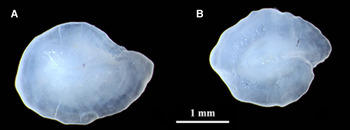
The left otolith of the species L. boscii has an elliptical to oval shape (Figure 1A). The rostrum is directed upwards (dorsal side/upper part of otolith), the size of the rostrum varies, antirostrum is either lacking or poorly defined. The posterior region (left part of the otolith) is askew to the dorsal part. The right otolith of L. boscii is also elliptical to oval. The anterior region (right part of otolith) is slightly convex in the upper part. The shape of the rostrum varies, but turned to ventral side (lower part of otolith). The antirostrum is lacking or it is poorly defined. The posterior region is slightly convex and askew to the ventral side (Figure 1B).
Left (A) and right otolith (B) of Lepidorhombus boscii.

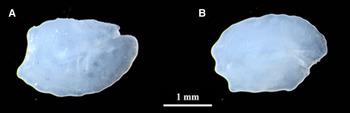
The left otolith of L. whiffiagonis has an elliptical to oval shape (Figure 2A). The anterior region (right part of otolith) is askew; rostrum is small, wide, round or pointy, directed upwards to the dorsal side (upper part of otolith). The antirostrum is either lacking or poorly defined. The posterior region (left part of otolith) is askew. The right otolith of the L. whiffiagonis is also elliptical to oval. The anterior region is generally askew to the ventral side (lower part of otolith). The rostrum is small but wide and directed towards to the ventral side. The antirostrum is lacking or it is poorly defined. The posterior region is askew to the ventral side (Figure 2B).
Left (A) and right otolith (B) of Lepidorhombus whiffiagonis.

Otolith shape analysis
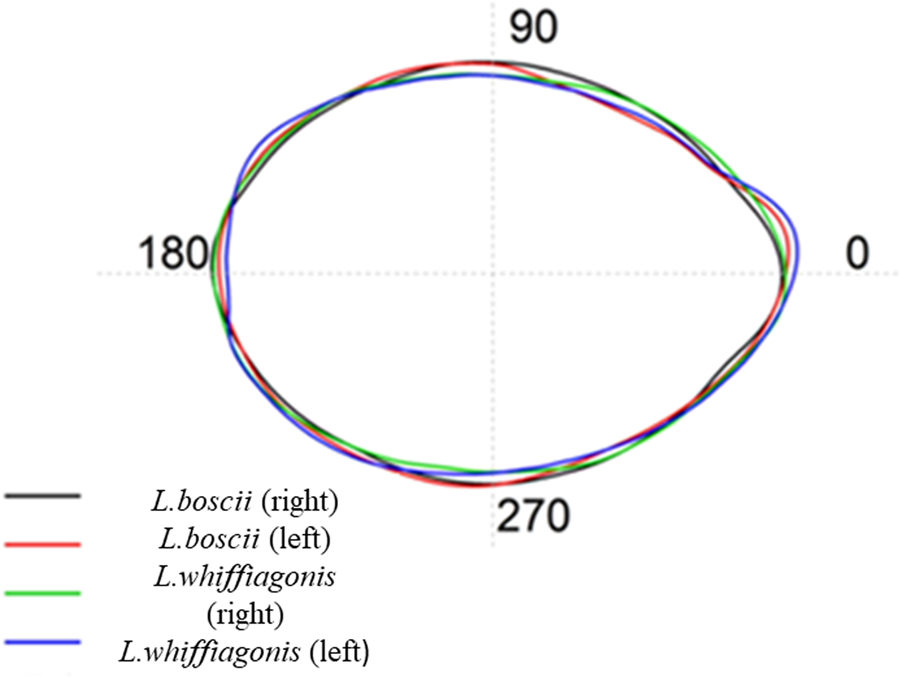
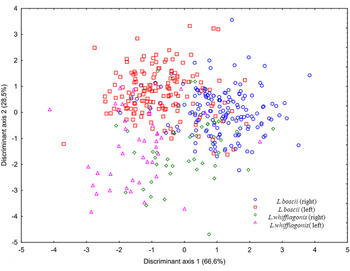
The average otolith shape was determined for the four analysed groups (left and right otoliths of L. boscii and L. whiffiagonis). For both species, the left otolith has more pronounced rostrum (shown in red and blue colours on Figure 3), compared with the right otolith. ANOVA-like permutation test showed a significant difference in otolith shape between the four analysed groups (P < 0.001). According to the LDA, the first discriminant axis explained 66.6% of the variation among groups and the second 28.5% (Figure 4). The left and right otoliths of both species were well separated along the first discriminant axis, while the two species were mainly separated along the second axis. The overall classification score of LDA was 79.5%, with higher scores obtained for L. boscii (highest for the left otolith, 84.9%) compared with L. whiffiagonis (lowest for the right otolith, 58.5%) (Table 1).
The average otolith shape for the four analysed groups (L. boscii (left) – left otolith of Lepidorhombus boscii, L. boscii (right) – right otolith of Lepidorhombus boscii, L.whiffiagonis (left) – left otolith of Lepidorhombus whiffiagonis and L.whiffiagonis (right) – right otolith of Lepidorhombus whiffiagonis).

Linear discriminant analysis for the left and right otoliths of Lepidorhombus boscii and Lepidorhombus whiffiagonis based on the otolith shapes.

Classification of otoliths (values are expressed in percentage and by number of otoliths)

Otolith morphometric analysis
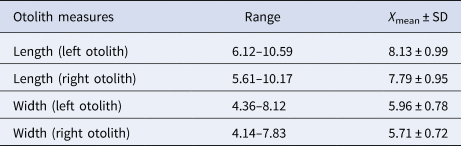
The morphometry of the left and right otoliths was analysed on a total sample of L. boscii. The length of the left and right otoliths as well as their width were significantly different (t-test, P < 0.05). The ranges of length and width with mean values and standard deviations are shown in Table 2.
Range and mean values (± SD) of otolith length and width of Lepidorhombus boscii (otolith length and width are expressed in millimetres)

SD, standard deviation.
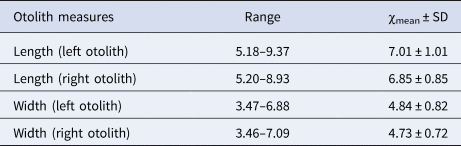
The length of the left and right otoliths and the width of the left and right otoliths of L. whiffiagonis were significantly different (t-test, P < 0.05). The ranges of length and width with mean values and standard deviations are shown in Table 3.
Range and mean values (± SD) of otolith length and width of Lepidorhombus whiffiagonis (otolith length and width are expressed in millimetres)

SD, standard deviation.
Relationship between total body length and otolith dimensions
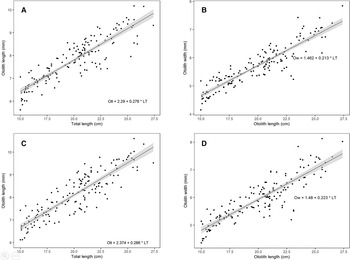
The relationship between total body length and otolith dimensions for L. boscii is shown in Figure 5. All tested otolith dimensions showed strong linear relationship with fish size, explaining between 76.5% (left otolith width) and 82.4% (right otolith length) of the variation in fish length.
Relationship between otolith length and width and total length of Lepidorhombus boscii (A – relationship between right otolith length and total length, B – relationship between right otolith width and total length, C – relationship between left otolith length and total length, D – relationship between left otolith width and total length).

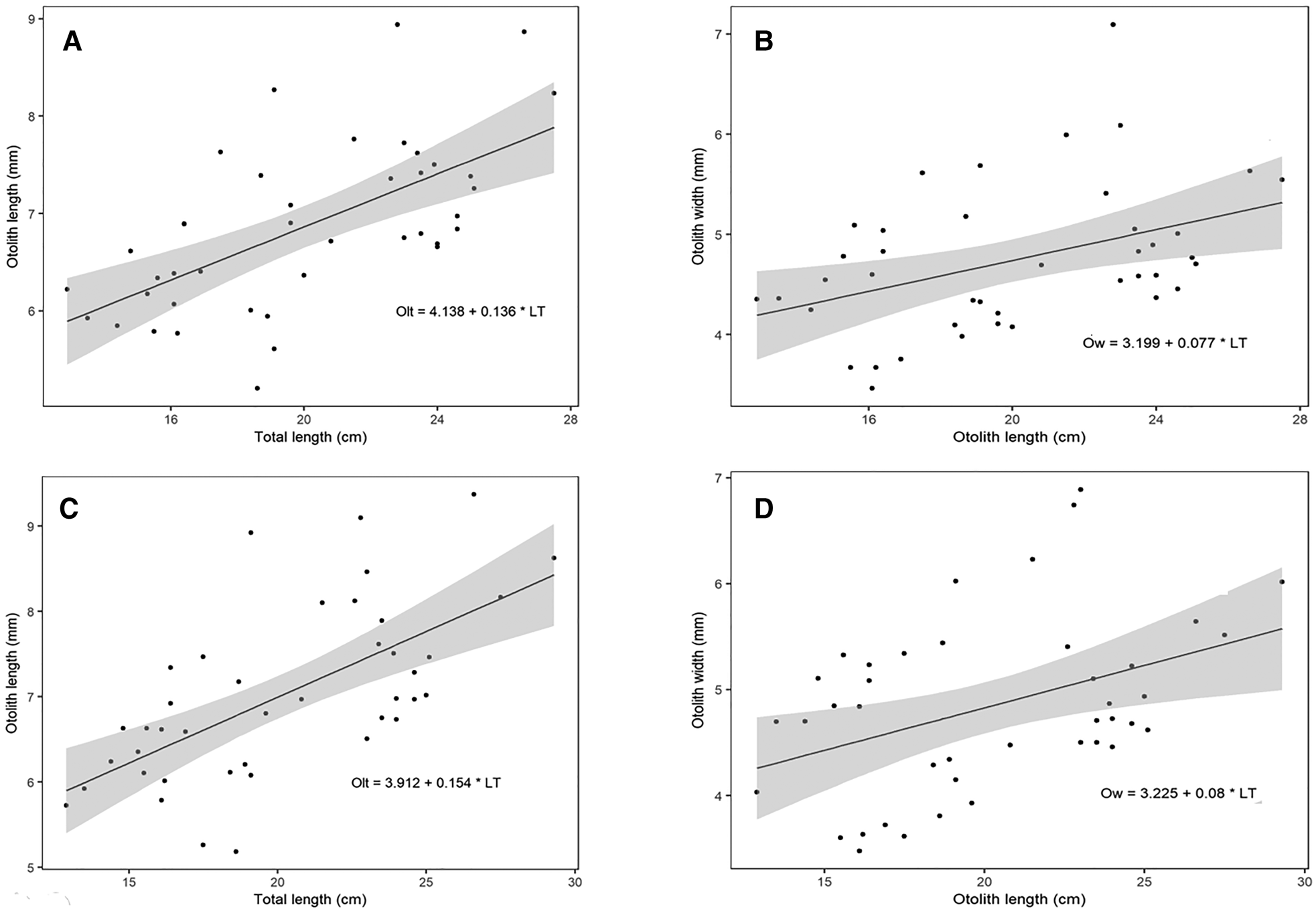
The relationship between total body length and otolith dimensions for L. whiffiagonis is shown in Figure 6. Otolith length showed stronger linear relationship with fish size than did otolith length, but in general all relationships were much weaker than those observed for L. boscii. Otolith length explained 37.5–39.7% of the variation in fish length, and otolith width only 14.7–15.1%.
Relationship between otolith length and width and total length of Lepidorhombus whiffiagonis (A – relationship between right otolith length and total length, B – relationship between right otolith width and total length, C – relationship between left otolith length and total length, D – relationship between left otolith width and total length).

The analysis of otolith morphometric parameters vs total fish length is shown in Tables 4 and 5.
Regression parameters of the relationship between otolith dimensions and the total body length of Lepidorhombus boscii

TL, total body length; Olt, otolith length; Ow, otolith weight; N, number of samples, a (intercept) and b (slope), regression coefficients; SE, standard error; R 2, coefficient of determination; P, level of significance.
Regression parameters of the relationship between otolith dimensions and the total body length of Lepidorhombus whiffiagonis

TL, total body length; Olt, otolith length; Ow, otolith weight; N, number of samples, a (intercept) and b (slope), regression coefficients; SE, standard error; R 2, coefficient of determination; P, level of significance.
Discussion
This is the first study providing a detailed description and analysis of L. boscii and L. whiffiagonis otoliths in the Adriatic Sea. The otolith morphology generally corresponded to the otoliths of Lepidorhombus spp. from the central eastern Atlantic (Tuset et al., Reference Tuset, Lombarte and Assis2008). The results of linear discriminant analysis on the otolith Wavelet shape coefficients showed that a reasonably high level of separation can be obtained between all four analysed groups, i.e. combinations of left/right otolith and species. Visual inspection of the average shape outlines showed that the left otoliths of both species have better expressed rostrum, which can be used to distinguish between left and right otoliths. The difference between the species is mostly expressed in L. boscii having relatively wider otoliths and overall rounder shape compared with L. whiffiagonis. The linear discriminant analysis classification success was higher for L. boscii, but this could be due to the larger sample compared with L. whiffiagonis, where only 45 individuals were analysed. Overall, otolith outline analysis indicates that variations in otolith shape described by Wavelet shape coefficients could be used as informative characters for identification of the two analysed species. The ability to identify adult specimens of Lepidorhombus spp. using classical morphometric shape indices (circularity and rectangularity) has already been confirmed (Tuset et al., Reference Tuset, Lombarte and Assis2008). However, classical shape indices lose much information about the real otolith shape, mainly because the ideal geometric form of the shape indices does not necessarily imply the real description of the object, so the otoliths clearly distinctive from the naked eye can have similar values of shape indices (Tuset et al., Reference Tuset, Otero-Ferrer, Siliprandi, Manjabacas, Marti-Puig and Lombarte2021). For this reason, classical shape indices are not recommended any more for works related to the identification of fish species, and the Wavelet analysis, as used in this study, is considered a more appropriate and overall better method (Tuset et al., Reference Tuset, Otero-Ferrer, Siliprandi, Manjabacas, Marti-Puig and Lombarte2021).
The suitability of otolith dimensions for estimating fish length differed between the investigated species, with much stronger linear relationships found for L. boscii compared with L. whiffiagonis for all otolith measures, most likely due to the lower sample size of the latter. The usefulness of specific otolith measures differed between the species as well, with both otolith length and otolith width being approximately equally useful for L. boscii, while otolith length showed noticeably better results than otolith width for L. whiffiagonis. It is known that different otolith measures can be appropriate for estimating fish size, even for closely related species (Waessle et al., Reference Waessle, Lasta and Favero2003), or between different sizes of fish of the same species (Hunt, Reference Hunt1992). In our case, fish length ranges of the two analysed species were comparable, and are most likely not the cause of different otolith measures being the best estimators of fish length. However, we cannot discount the possibility that this apparent species-specific difference is actually an artefact of the overall poor model fit to the L. whiffiagonis data.
Otoliths are among the most widely used structures in feeding studies of predatory fishes (Hyslop, Reference Hyslop1980), seabirds (Duffy & Jackson, Reference Duffy and Jackson1986) and marine mammals (Pierce & Boyle, Reference Pierce and Boyle1991). Adequate fish prey identification from otoliths is essential in feeding studies and our research on variations in otolith morphology and shape of L. boscii and L. whiffiagonis could help as a reference aid in such studies. Besides their use in prey species determination, otoliths can be used to estimate prey size (e.g. body length) via the established relationships between otolith measurements and fish length; the present study provides such predictive equations for L. boscii and L. whiffiagonis. However, when considering application of the presented results it should be kept in mind that otolith features undergoing digestion are often eroded (Smale et al., Reference Smale, Watson and Hecht1995) and calculating prey size from digested otoliths will likely underestimate the original prey size.
Financial support
'This research received no specific grant from any funding agency, commercial or not-for-profit sectors'.