The Fontan procedure has become the definitive surgical repair for patients with functionally univentricular hearts. Patients with anomalies of systemic venous connection in the presence of atrial isomerism were associated, in the past, with a worse prognosis.Reference Nakata, Fujimoto and Hirose 1 – Reference Bartz, Driscoll and Dearani 3 On the other hand, a variety of modifications of the original Fontan operation has been associated with a dramatic improvement in the outcome of these patients.Reference Nakata, Fujimoto and Hirose 1 – Reference Bartz, Driscoll and Dearani 3 Nonetheless, certain forms of functionally univentricular hearts associated with heterotaxy have complex anomalies of systemic venous drainage, which turns the Fontan procedure into an even more challenging course of action. In our patients, either the atrial connection of the inferior caval vein and the hepatic vein were widely separated or there were two separated atrial connections of the right and left hepatic veins.
We used a new cavopulmonary anastomosis technique for these patients consisting of two extracardiac conduits, one for each separated systemic vein. Both the short- and mid-term outcomes in these patients were excellent. To the best of our knowledge, this technique has never been reported in the literature.
Patients
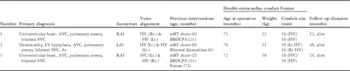
There were three male patients born with functionally univentricular hearts – two with right atrial isomerism and one with left atrial isomerism. The median age at Fontan completion was 72 months (range from 70 to 73), and the median body weight was 20.3 kg (range from 18.0 to 22.0).
The anomalous systemic venous drainage was diagnosed preoperatively by cardiac catheterisation or by direct visualisation during surgery. Two patients had a widely separated connection of the inferior caval vein and hepatic vein to the atrial mass, and one patient had two widely separated connections of the right and left hepatic veins to the atrial mass, with azygous continuation of the inferior caval vein.
Other cardiac malformations that were shared by all three patients included pulmonary atresia, atrioventricular canal defect, and bilateral superior caval veins. Dextrocardia was present in one patient.
Each patient had undergone two surgeries previously, including a modified Blalock–Taussig shunt, and then a bilateral bidirectional cavopulmonary connection or a Kawashima procedure; one patient underwent a third operation in which the Fontan was partially completed as the accessory venous drainage was not initially noted by his primary surgeon.
The patient profiles are shown in Table 1.
Patient profiles.

AVC=atrioventricular canal defect; Az=azygous continuation of the IVC; BBDCPA=bilateral bidirectional cavopulmonary anastomosis; HV=hepatic vein; IVC=inferior caval vein; LAI=left atrial isomerism; Lt=left; LV=left ventricle; mBT=modified Blalock–Taussig; RAI=right atrial isomerism; Rt=right; SVC=superior caval vein
Surgical technique
Total cavopulmonary connection was performed through median sternotomy using normothermic cardiopulmonary bypass on a perfused, beating, and vented heart. Venous drainage was achieved by direct cannulation of the bilateral superior caval vein along with each of the inferior systemic veins. Cannulation of the inferior veins was performed as distal as possible.
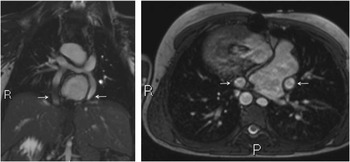
Initially, two GoreTex grafts (16 mm), one for each vein, were sutured end-to-side to the inferior aspect of the right and left pulmonary arteries. Subsequently, the two inferior systemic veins were detached from their atrial connections and were anastomosed to their respective GoreTex tube grafts. This was achieved by placing a clamp on the atrium at the junction with the inferior systemic vein, placing a tourniquet distally on the vein and cutting in between. The atrial stamp was closed and the vein was anastomosed to the conduit. From our experience, there was always enough space for these manoeuvres. The right-sided conduit was positioned lateral to the atrial mass, and the left-sided conduit was positioned posterior to the ventricular mass. This positioning of the tube grafts was inverted in the patient with dextrocardia (Fig 1). No polytetrafluoroethylene reinforcement was used and no fenestration was created.
Patient #2 MRI in sagittal and axial views demonstrating the position of the two extracardiac conduits (arrows).

Results
There was no mortality and no major postoperative complications. None of the patients have yet required re-operations with a mean follow-up of 40.3 months (range from 21 to 52).
According to echocardiographic and MRI studies, the haemodynamic outcomes in these patients demonstrate optimal laminar flow within the conduits, which do not appear to compromise the pulmonary venous return.
Postoperatively, the patients were treated with anticoagulation therapy for 6 months and are currently on therapy with diuretics and aspirin. No thromboembolic events have occurred this far.
Discussion
Historically, heterotaxy syndromes had been associated with increased morbidity and mortality.Reference Nakata, Fujimoto and Hirose 1 – Reference Bartz, Driscoll and Dearani 3 The presence of complex systemic venous connections is certainly a compromising factor. Nonetheless, the technical variations and the modifications of the original Fontan procedure that have been established in recent years have dramatically improved the outcome of these patients.Reference Nakata, Fujimoto and Hirose 1 – Reference Bartz, Driscoll and Dearani 3
The cavopulmonary anastomosis in patients with separate venous drainage is still a challenging task for the cardiac surgeon. The distance between the connection of the inferior systemic veins to the atrial mass is an important factor in planning the technique for ultimate total cavopulmonary connection. En bloc resection and anastomosis to a single extracardiac conduit or incorporation into an intra-atrial lateral tunnel can be performed when the orifices of the two inferior systemic veins are contiguous or close to one another. When, however, the connections of the veins to the atrial mass are widely separated, the surgeon has to choose between the use of an extracardiac conduit for one vein and a lateral tunnel for the other or the inclusion of an intra-extracardiac conduit that drains both.Reference Nakata, Fujimoto and Hirose 1 , Reference Lee, Lee, Chang, Bae and Noh 4 , Reference Sughimoto, Aoki, Naito and Fujiwara 5 The modification we have performed offers a third possibility for Fontan completion in the case of widely separated inferior venous connections, in which we use two extracardiac conduits.
Regarding the postoperative complications, our double extracardiac conduit modification decreases atrial manipulation, which might confer the advantage of reducing the incidence of postoperative arrhythmic complication, which have not yet occurred in our three patients.Reference Kim, Kim, Lim, Lee and Lee 6 – Reference Miyazaki, Sakaguchi and Ohuchi 8
Furthermore, the use of four venous cannulae allows us to operate upon a beating heart and avoid cross-clamping the aorta and hypothermia. These are important considerations in reducing postoperative complications and improving ventricular systolic function.Reference Lee, Lee, Chang, Bae and Noh 4 , Reference Miyazaki, Sakaguchi and Ohuchi 8 We believe that the configuration of the two conduits along with the anticoagulation therapy help reduce the thromboembolic risk. In addition, the double extracardiac conduit technique has the potential to optimise laminar and symmetrical systemic venous flow to the pulmonary arteries without compromising pulmonary venous return, which could also decrease the formation arteriovenous malformations. This technique offers an excellent alternative for Fontan completion in patients with widely separated connections of the inferior systemic veins to the atrial mass.
Acknowledgements
None.
Financial Support
This research received no specific grant from any funding agency or from commercial or not-for-profit sectors.
Conflicts of Interest
None.