I. Introduction
On June 27, 2018, Anthony Kennedy announced his retirement from the US Supreme Court, giving President Trump the opportunity to make his second appointment to the Court. While not completely unexpected, Kennedy’s announcement still sent shock waves through Washington, DC. Yet even as the media speculated about whom Trump might select to replace Kennedy, interest groups on both sides mobilized immediately either to support or to oppose the forthcoming nominee. Indeed, some groups had mobilized before Kennedy’s resignation. As the New York Times reported, “even before [Kennedy] announced his retirement, Judicial Crisis Network, a conservative advocacy group, had reserved more than two dozen internet domain names—one for each candidate on President Trump’s list of potential Supreme Court nominees. The idea, said Carrie Severino, the group’s chief counsel, was to create a website template: ‘ConfirmBlank.com’” (Stolberg and Martin Reference Stolberg and Martin2018). Liberal groups, meanwhile, launched their own website (savescotus.indivisible.org) in the brief interim between Kennedy’s announcement and Trump’s nomination of Brett Kavanaugh, stating that “senators need to immediately feel the pressure to protect our rights and oppose Trump’s extreme nominee” (Schor Reference Schor2018).
In the present climate surrounding the politics of Supreme Court confirmations, this immediate mobilization is unsurprising. Yet from the perspective of (say) 50 years ago, the extent of interest group participation in Supreme Court appointment politics seems astounding. How exactly did we get here?
In this article, we provide a series of answers to that question. Using an original database of newspaper reportage, we construct a systematic, historically oriented portrait of group participation in Supreme Court nomination politics from 1930 to 2017, a period that covers 52 nominees. With this new and expansive data set, we document changes in the following items:
-
• the levels of mobilization, including the extent of mobilization in support of as well against a nominee
-
• the types and identities of interest groups that mobilize (i.e., the “ecology” of groups)
-
• the size and composition of liberal and conservative ecologies of groups over time
-
• the tactics employed by the groups
-
• the timing of group participation during the nomination process
-
• the predictors of overall group mobilization levels
The result is not only the most detailed picture of interest group involvement in Supreme Court nominations over an extended period of time but also (to the best of our knowledge) the most complete portrait of interest group participation in any repeatedly occurring political event in American history.
To put it mildly, the data reveal a sizable increase in interest group activity over time. From 1930 to 1970, there was relatively little mobilization, with many nominations seeing zero interest group activity. After 1970, and in particular after Robert Bork’s nomination in 1987, mobilization became routine and of a sizable magnitude for most nominees. We also see changes in the type of mobilization. Early on, most mobilization was done in opposition to a nominee; now mobilization occurs in roughly equal numbers on both sides. We also find that the calculus of interest groups appears to have changed significantly over time, with a shift from “opportunistic mobilization” based solely on a nominee’s qualifications for the high court to a routine mobilization that is now equally influenced by the ideological extremity of the nominee.
In addition, the data reveal significant shifts in both the types of groups that routinely mobilize and the tactics employed by mobilized groups. Whereas the earlier period was dominated by labor unions, “core” civil rights groups, and groups affiliated with the “old right,” the modern period is dominated by public interest/citizen groups and “identity” groups. In some sense, the classic “blue-black alliance” on the left was replaced by a “rainbow alliance.” On the right, we see a shift from old right groups to modern conservative interest groups, focused on policy areas like gun rights and cultural issues such as abortion and gay rights. We also find a universal shift among all types of groups from more traditional “inside” tactics to the heavy use of “outside/grassroots” mobilization tactics. Thus, the overall density and scope of mobilization has changed significantly over the 9-decade period we study.
Taken together, our results illustrate how the interest group environment in Supreme Court nominations moved from a relatively sparse ecology characterized by occasional, generally opportunistic mobilization of a relatively closed form to a dense ecology characterized by routine, intense, highly ideological, and very visible contention. In a nutshell, the politics moved from the textbook pluralism of Herring (Reference Herring1929), Truman (Reference Truman1951), Key (Reference Key1955), and Dahl (Reference Dahl1961) to something quite different: what we call “hyperpluralism.”Footnote 1 While our focus is on the context of Supreme Court nominations, we believe this article contributes significantly to our understanding of the changing roles and influence of interest groups in American politics more broadly.
II. Interest Groups and Supreme Court Nominations
Interest group involvement in Supreme Court nominations is not a new phenomenon. The Grange, an agricultural lobby, played a role in the wild nomination of railroad attorney Stanley Matthews in 1881 (Ainsworth and Maltese Reference Ainsworth and Anthony Maltese1996). During the political donnybrook sparked by Woodrow Wilson’s nomination of Louis Brandeis in 1916, individuals connected to railroad commissions, newspapers, manufacturers, and unions participated actively, although typically as individuals rather than formal representatives of organizations per se. Herbert Hoover’s 1930 nominee, John J. Parker, famously sparked opposition by the American Federation of Labor (AFL) and the fledgling National Association for the Advancement of Colored People (NAACP), leading to Parker’s rejection by the Senate (Watson Reference Watson1963; Goings Reference Goings1990). But many other nominations in this period failed to ignite group interest. For example, Danelski’s (Reference Danelski1964) detailed case study of Pierce Butler’s confirmation in 1922 reveals very little group involvement, despite a degree of controversy. These examples suggest long-standing although intermittent involvement of interest groups in Supreme Court nomination politics. But the seemingly routine mobilization of groups in most recent nominations points to an expansion or even transformation of their role.
What does the political science literature on Supreme Court nominations tell us about the role of interest groups? One set of articles by Caldeira and Wright (and coauthors) used fine-grained data on interest group activity to study the linkages between mobilization and senatorial voting on Supreme Court nominees. Caldeira and Wright (Reference Caldeira and Wright1998) combine survey data of groups with newspaper reporting to examine mobilization and tactics in the nominations of Robert Bork, David Souter, and Clarence Thomas. Caldeira, Hojnacki, and Wright (Reference Caldeira, Hojnacki and Wright2000) extend this invaluable work to the nominations of William Rehnquist and Anthony Kennedy. These studies find that lobbying by groups (in both directions) appears to have influenced senatorial voting on these nominees.Footnote 2 And, relatedly, Austen-Smith and Wright (Reference Austen-Smith and Wright1994) show that the lobbying patterns during the Bork nomination are consistent with the theory of “counteractive lobbying.”
A few additional papers have examined interest group activities beyond the direct lobbying of senators. O’Connor, Yannus, and Patterson (Reference O’Connor, Yannus, Mancillas Patterson, Cigler and Loomis2007) examine several tactics of interest groups during the three nominations under President George W. Bush (Roberts, Miers, and Alito), including position taking, advertising, and mailing. Closely related is Vining (Reference Vining2011), who, for those same nominations, examines how interest groups used email solicitations to mobilize supporters. In addition, Gibson and Caldeira (Reference Gibson and Caldeira2009) study the relationship between exposure to interest group advertisements during the Alito nomination and the public’s views on his nomination. Finally, there are many case studies of particular nominations that provide highly illuminating accounts of interest group strategies.Footnote 3
These micro-oriented studies are essential for gaining an in-depth understanding of one or a few nominations or for the close study of group tactics at one point in time. However, they cannot gauge changes over a longer period. The only longitudinal analysis of interest group activities has come in the form of (relatively perfunctory) analyses of participation before the Judiciary Committee during nominee hearings (Maltese Reference Maltese1995, 90–91; Epstein and Segal Reference Epstein and Segal2005, 96; Farganis and Wedeking Reference Farganis and Wedeking2014, 102).Footnote 4 While important, as we discuss below, participating in hearings is only one of the many types of tactics that interest groups employ during nominations. Moreover, we show that the bulk of activity tends to occur before hearings take place. Hence, participation in the hearings offers a partial picture at best of actual group mobilization and tactics.Footnote 5
Thus, for Supreme Court nominations we know little about changes in mobilization practices over time, changes in the ecology of groups over time, and changes in tactics over time. We also do not know whether any such changes are similar to those seen in the broader interest group environment or whether group participation in Supreme Court nominations has been qualitatively different in important ways.Footnote 6 This article provides the first answers to these questions.
III. Data and Analysis
To answer these questions, we require a data source that is relatively consistent and reliable over time. While the survey-based approach employed in studies such as Walker (Reference Walker1991) and Caldeira and Wright (Reference Caldeira and Wright1998) might be first-best in theory, it obviously cannot be backdated. Accordingly, we follow the lead of other scholars and use newspaper coverage to measure interest group mobilization over time (see Burstein [Reference Burstein2014] for a recent and excellent example).
Specifically, we conduct a content analysis and coding of all articles in the New York Times and the Los Angeles Times covering specific Supreme Court nominations from 1930 to 2017.Footnote 7 Using ProQuest’s historical newspaper electronic archive, we first identified every story from each paper that discussed a nominee, with a nomination defined as the period between the announcement of a new nominee and the final disposition of the nomination (i.e., when a nomination officially ended in either confirmation or defeat/withdrawal).Footnote 8 All told, the data reveal that interest group mobilization occurred for 39 of the 52 nominations in our time period.Footnote 9 Among these 39 nominees, we uncovered mobilization by 336 unique interest groups.Footnote 10
We then coded the relevant stories in detail, identifying each group, its indicated position relative to the nominee, the tactics reportedly used by the group or its actions (discussed in detail later on), and the timing of the action. We used the articles to identify the total number of stories with interest group mentions, the number of stories mentioning each group, and each unique group mentioned in at least one story. In many instances the two papers’ coverage overlapped; this occurred, for example, if they both reported that a particular group engaged in a particular tactic on the same day. Wherever appropriate, according to the quantity of interest, we accounted for this duplication by treating such dual-reported actions as a single event.Footnote 11
For each group identified by the newspaper coverage, we classify it into categories, as described below. We also compile organizational profiles of each group, mostly from internet searches but also the scholarly literature. Note that some stories reporting interest group activity did not specify the identity of the groups (e.g., “environmental groups” or “antiabortion groups”). These stories contribute to the counts of stories reporting interest group activity and to counts of different types of tactics but do not contribute to the counts of interest groups themselves, which are based on an identification of specific groups.
As we show, the data offer a rich and unique lens into interest group mobilization over a time span of nearly a century. At the same time, the data have important limitations. First, unlike Caldeira and Wright (Reference Caldeira and Wright1998), we cannot see whether and how groups target specific senators or media markets; thus, we cannot extend their analysis to the entire period of study. Second, the data are dependent on the New York Times and Los Angeles Times sufficiently covering each nominee to capture the breadth and depth of interest group involvement in nominations, as well as the types of tactics employed. We acknowledge that the coverage will surely miss some groups who participated. However, the goal of our analysis is to capture the broader temporal trends in mobilization (as opposed to, say, precisely estimating the causal effect of interest groups on senatorial voting), and we are confident the reporting suffices on this dimension. (In the appendix we further discuss and present evidence for the validity of the coverage.)Footnote 12
A. Levels of Mobilization
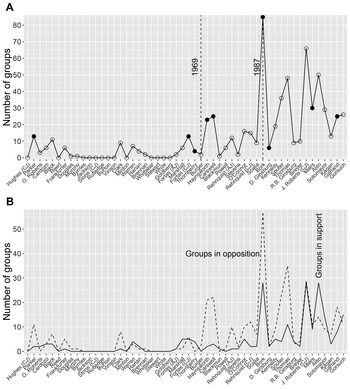
We begin our analysis by examining levels of mobilization. For each nominee, we first calculated the number of unique groups mentioned by the newspapers as participating in the confirmation process. Figure 1A displays these data; note that, to make the graph more readable, the horizontal axis displays each nomination separately and is thus not perfectly scaled to time.Footnote 13 The filled circles denote unsuccessful nominees, while the open circles denote confirmed nominees.
A, Interest group mobilization over time; points display the number of unique groups mobilizing for each nominee; filled circles denote unsuccessful nominees, while the open circles denote confirmed nominees. Vertical dashed lines at the Burger (1969) and Bork (1987) nominations demarcate what we contend are three distinct eras. B, Interest group mobilization, support and opposition; dotted line depicts mobilization by groups opposed to the nominee, while the solid line depicts mobilization by groups supporting the nominee.

Figure 1A reveals a clear change over time. The number of groups that mobilized in the 29 nominations from Charles Evans Hughes to Warren Burger (1930–69) was typically low; indeed, nearly half (13) of these nominations witnessed no mobilization, with the mean level at 3.1 groups in this period. The nomination of Clement Haynsworth (1969) marked a shift, with higher levels of mobilization subsequent to his controversial nomination. From 1969 to 1986, the year in which William Rehnquist was promoted to chief justice and Antonin Scalia was appointed, the mean number of groups that mobilized was 9.8. The nomination of Robert Bork occurred in 1987; figure 1A shows that the level of mobilization during the Bork nomination was—and remains—unprecedented, with more than 80 groups taking part. Since the Bork nomination, the levels of mobilization have fluctuated, with the nominations of Clarence Thomas, John Roberts, and Samuel Alito triggering a large number of groups. The mean number of groups in the 1987 to 2017 period was 32.4 (28.3 if Bork is excluded).Footnote 14
Mobilization, of course, occurs on both sides of a nomination fight. Figure 1B disaggregates the data into the number of groups who mobilize in support of the nominee and the number who mobilize in opposition. The graph shows that until very recently, mobilization against a nominee was typically larger than mobilization in support of a nominee. Indeed, the latter is a relatively recent phenomenon and hardly existed until the Bork nomination. Since then, supportive mobilization has become more common; moreover, the ratio of supportive to opposing mobilization has virtually equalized in the past few nominations. This equalization may reflect a growing sophistication of the president in organizing what are virtually political campaigns on behalf of a Supreme Court nominee.Footnote 15
B. Who Participates: One-Shotters, Repeat Players, and the Changing Nature of the Groups
While figures 1 and A-4 establish the increase in aggregate mobilization, it is also of interest whether the types of groups that participate in Supreme Court nominations have changed. Given the broader changes in nomination politics over this time, we would expect the composition of groups to change as well.
First, our data reveal an important pattern in the overall distribution of mobilization by different interest groups. For each group in our data set, we calculated the number of nominations in which they participated. Figure 2 depicts the distribution of these rates of participation—the horizontal axis depicts the number of nominations they participated in, while the vertical axis depicts the aggregate number of groups for each level of participation. The graph shows that the majority of groups (236, to be exact) are “one-shotters”—they mobilize in one and only one nomination. Conversely, there are a smaller number of “repeat players”—groups who have mobilized across multiple nominations.Footnote 16
Frequency of mobilization across interest groups. The horizontal axis depicts the number of nominations participated in, while the vertical axis depicts the aggregate number of groups for each level of participation.

The repeat player groups are of greater interest for our longitudinal analysis. Table 1 shows who these groups are. The top panel depicts the 10 most frequently appearing groups (in descending order) that mobilized across our entire time period, while the next three panels break down the data into the three time periods indicated in figure 1: Hughes (1930) to Burger (1969), Haynsworth (1969) to Scalia (1986), and Bork (1987) to Gorsuch (2017). The number of nominations in which each group mobilized in the respective time period are shown in final column of table 1. Looking first at the entire period, table 1 reveals that the most frequent participants are liberal groups such as the NAACP, the National Abortion Rights Action League (NARAL), and People for the American Way, as well as the AFL-CIO federation of unions.Footnote 17
The 10 Most Active Groups, First across the Entire Time Period, Then in Each Era

Note.—Groups appear in descending order of total mobilization; final column depicts the number of nominees the groups mobilized for. The nature of mobilized groups has shifted dramatically, from industrial unions, core civil rights groups, and old right groups to public sector unions, the Christian right, lifestyle activists, new-style liberal groups, and staged pro-administration front groups.
Perhaps more illuminating, however, is the transformation in the types of groups seen in the bottom three panels of table 1. The three most frequently appearing groups in the early period were the American Bar Association; the AFL-CIO, a core industrial union; and the Liberty Lobby, a conservative anticommunistic bulwark of what we label the “old right.” In the middle period, extremely prominent groups were the Leadership Conference on Civil Rights (LCCR), the NAACP, and the National Organization of Women (NOW). Finally, the third period sees the rise of the aforementioned liberal groups that focus on social issues and identity politics.
How might we characterize interest groups more systematically? Scholars have attempted to organize the interest group system using a number of different typologies, each presenting its own advantages and difficulties. Most divide the interest group universe on the basis of the policy areas in which groups operate or the constituencies they represent (see, e.g., Walker Reference Walker1991; Baumgartner et al. Reference Baumgartner, Berry, Hojnacki, Kimball and Leech2009). We began with a fine-grained classification scheme that would allow us to better discriminate between the types of groups who participate in Supreme Court nominations. Categories in this scheme include, for example, groups involved in environmental and health politics, as well as abortion and gay rights groups. (The complete taxonomy can be seen in table A-2. To construct the taxonomy, we hewed closely to prior studies of interest groups, including Walker [Reference Walker1991], Wright [Reference Wright1996], Goldstein [Reference Goldstein1999], Baumgartner et al. [Reference Baumgartner, Berry, Hojnacki, Kimball and Leech2009], Schlozman [Reference Schlozman, Maisel and Berry2010], and Heaney et al. [Reference Heaney, Masket, Miller and Strolovitch2012].)
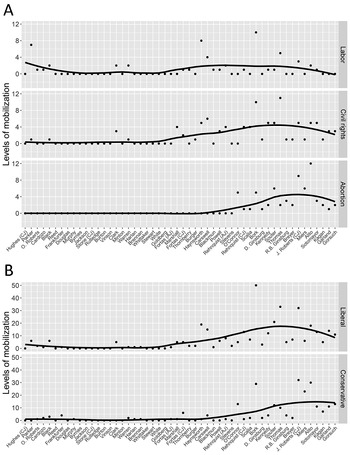
Figure 3 presents a more systematic look at this change by graphically indicating the shifting mobilization of particular types of groups. Figure 3A shows, for each nominee, the number of labor, civil rights, and abortion groups that mobilized—these are the types of groups that have been most active in nomination politics. Also shown is the fit from nonparametric loess lines (i.e., locally estimated scatterplot smoothing). As can be seen, labor groups have been active over the entire period, but their mobilization rates have declined in the past 2 decades. Civil rights groups also have a long history of involvement, although their prime period of involvement was from the 1960s to the 1980s. Finally, the sizable rise of abortion groups is indicative of the transformation in groups now active in nomination politics. Taken together, the three loess lines show sequential “peaks” in mobilization for labor, civil rights, and abortion groups.
Shifting composition of interest groups. A, Number of groups mobilized in three (overlapping) categories: labor, civil rights, and abortion. B, Liberal and conservative mobilization more broadly. The lines are locally estimated scatterplot smoothing (loess) lines.

In addition to characterizing groups by their policy mobilizations or favored industry, we can characterize many groups by their ideological polarity. For example, active abortion groups include liberal organizations such as NOW and NARAL and conservative groups like the National Right to Life Committee. Figure 3B depicts the trends in mobilization by liberal and conservative groups; note the scale of the vertical axis is different from figure 3A . The figure reveals a general increase in participation over time on both sides. But in the last period conservative mobilization has often outpaced liberal mobilization (which has trended downward in recent years), a pattern consistent with the increased emphasis in the conservative legal movement on the importance of judicial selection (Teles Reference Teles2008).
Moving from the specific to the general, it is also useful to categorize groups by their broader purposes. For every interest group that appears in our data, we placed them in the following categories: corporations/businesses, state/local groups, occupational groups, identity groups, public interest/citizen groups, and a residual category (“other”). Although professional and occupational groups have always outnumbered other organized interests in the larger pressure group universe, citizen groups now represent a larger proportion of national lobbying organizations in existence than ever before (Walker Reference Walker1991). According to Walker, citizen groups emerged at roughly twice the rate of occupational groups in the 2 decades following 1965. Walker attributes this rise to a number of causes, including the growth of a large, educated middle class, the emergence of new sources of political patronage willing to subsidize political organizations, and the steady expansion of the power and responsibility of the federal government (39). We refer to this distribution of different types of groups as the “interest group ecology.”
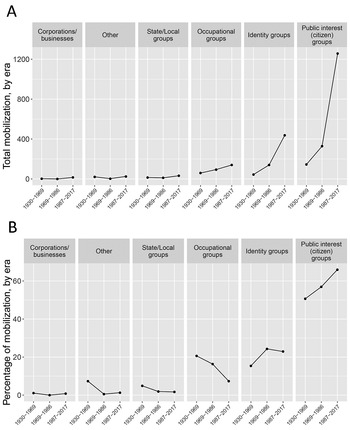
Do we see similar patterns in confirmation mobilization? Figure 4 examines the shift in the ecology over time. Each graph breaks down mobilization by group type and by era; the horizontal axis features the three eras of mobilization. In figure 4A the vertical axis depicts the total amount of mobilization in each period for a given class of groups. For example, in the 1930–69 period, occupational groups mobilized a total of 56 times. Changes in figure 4A also reflect the larger secular increase in mobilization over time. To account for this, the vertical axis in figure 4B depicts the total amount of mobilization for a given class/era pair, divided by the total amount of all mobilization in that era. Accordingly, the percentages are “normalized” by era.
Changes in interest group ecology over time

Figure 4 shows that the patterns seen in Walker’s analysis of the interest group community at large also hold with respect to Supreme Court nominations. In particular, the figure reveals the striking increase in mobilization by identity and public interest/citizen groups; in the 1987–2017 period, these classes of groups combined accounted for about 90% of all mobilization. But while corporations and associations representing groups of businesses actively lobby the Supreme Court through the filing of amicus briefs, we find very little involvement by these groups in the confirmation process. Although unions and labor organizations have long been active in the process, groups on the business side have only recently entered the fray. The US Chamber of Commerce, for example, did not issue its first statement formally supporting or opposing a nominee until 1991 (during the Thomas nomination). Given this ecology, it is perhaps not surprising that in the modern period confirmation hearings tend to focus heavily on hot-button social issues like abortion rights.
Finally, one additional recent trend worth noting is the rise of “dark money” groups, such as the conservative groups Judicial Crisis Network and Americans for Prosperity (both of which appear in our data). Enabled by the Supreme Court’s decision in Citizens United (558 U.S. 310 [2010]), these groups raise large amounts of money from wealthy individuals who can now remain anonymous legally (Mayer Reference Mayer2017). The Judicial Crisis Network, for example, focuses on expensive media campaigns using paid advertisements in the states of key senators. And while conservative groups moved first to embrace dark money following Citizens United, the battle has now been joined by liberal groups, who spent millions in dark money in an (unsuccessful) effort to defeat the nomination of Brett Kavanaugh (Lee Reference Lee2018).
C. Interest Groups’ Choice of Tactics and Timing
Choice of Tactics. In addition to changes in the distribution of groups over time, changes in technology and politics over our period of study likely meant significant changes in the types of tactics that interest groups employed when mobilizing. Scholarly accounts of interest group lobbying tactics generally differentiate between inside advocacy, involving direct personal access and contact with legislators, and outside advocacy, usually defined as a strategy by interest groups to mobilize citizens outside the policy-making community to put pressure on public officials inside the policy-making community. For example, inside advocacy would include contacting a member of Congress personally, testifying in a congressional hearing, or contributing to a member’s campaign. Outside advocacy would include speaking with the press or running an advertising campaign. Finally, although it is similar in spirit to outside advocacy, we can also distinguish grassroots advocacy, in which groups directly mobilize the public to participate, for example, via a demonstration or letter-writing campaign.
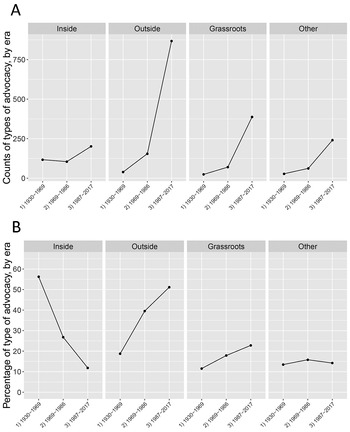
For every interest group action covered in the reportage, we coded the type of tactic the newspaper reported, as well as whether the tactic was best described as inside, outside, or grassroots advocacy (or a residual category of “other”).Footnote 18 Figure 5 depicts the breakdown of tactics over time; figure 5A depicts raw counts of each type, while figure 5B normalizes the counts by the total amount of advocacy in each period.
Changes in interest group tactics over time. A, the Y-axis depicts the total amount of mobilization in each period for a given class of groups. B, the Y-axis depicts the total amount of mobilization for a given class/era pair, divided by the total amount of all mobilization in that era.

Figure 5 shows a dramatic change in the choice of tactics over time. In the 1930–69 period, interest groups relied mainly on inside advocacy, which accounts for about 60% of the tactics employed in this time frame. The two most common inside lobbying tactics were sending a letter to members of Congress and testifying before the Judiciary Committee in formal hearings on the nomination; these two activities constituted about 40% of all activity in the early period. While outside advocacy accounted for only 19% of the lobbying activity in this time period, contact with the press was the third most prevalent tactic, constituting 14% of overall activity.
The ratio of inside lobbying to outside lobbying reversed in the period from Haynsworth (1969) to Scalia (1986). During this period, outside advocacy accounted for 40% of the tactics employed by interest groups, while grassroots activities constituted 18%. Contact with the press was the most prevalent lobbying tactic utilized by interest groups (32%), while testifying before Congress remained the second most utilized tactic (19%).
Finally, the most recent period shows the shift from inside tactics to outside and grassroots tactics is nearly wholesale. From 1987 to 2017, outside lobbying accounted for 51% of the tactics employed, with direct press contact representing the most used tactic, constituting 36% of all activity. In this period, grassroots lobbying constituted 23% of all tactics, with inside advocacy constituting only 12%.
It is possible that the shift from inside to outside tactics is simply due to the changing composition of groups over time (discussed above). Figure 6 examines this possibility. It focuses on the three most prominent classes of groups: identity groups, occupational groups, and public interest (citizen) groups. Each panel shows the distribution of advocacy (inside/grassroots/advocacy) for a given class in a given time period. (Note the vertical axes vary in each panel.) The figure shows a very similar pattern for each type of group. In the early period, inside tactics are predominantly used. The middle period sees a rough mix of all three. Finally, in the 1987–2017 period, outside and grassroots tactics predominate. It is thus clear that there has been a secular change in tactics driven by factors common to all groups, such as changes in the costs or benefits of mobilizing using outside tactics and grassroots campaigns.
Changes in advocacy over time, by class of groups. Y-axes (which differ across the panels) depict the distribution of the total count of tactics (inside, grassroots, or outside) chosen by the given group type/era combination indicated at the top of each panel.

The Timing of Mobilization
Another strategic choice interest groups must make is when to mobilize. Liberal groups, for example, famously mobilized against Bork immediately after his nomination, rather than waiting to lobby closer to the Senate’s vote (Pertschuk and Schaetzel Reference Pertschuk and Schaetzel1989). For each activity mentioned in the New York Times and Los Angeles Times, we coded the date of the activity in reference to the nominee’s timeline, dividing activities as occurring in three periods: before, during, or after the Judiciary Committee hearings on the nominee.
Figure 7 depicts the timing of mobilization in two ways. Figure 7A breaks down mobilization for each nominee. For each stacked bar, the darker portion depicts the proportion of mobilization that occurs in the prehearing period, the middle gray bar depicts mobilization during the hearing, and the lighter bar shows mobilization after the period. Figure 7B aggregates the data by grouping mobilization into the three periods and showing the timing within each period.
Changes in the timing of mobilization of interest groups over time. A, Mobilization for each nominee. For each stacked bar, the darker portion depicts the proportion of mobilization that occurs in the prehearing period, the middle gray bar depicts mobilization during the hearing, and the lighter bar shows mobilization after the hearing. B, Timing of mobilization grouped into the three periods.

The figure shows that until recently, there was little differentiation in the timing of mobilization. In some cases, such as the controversial nomination of Fortas to become chief justice in 1968, most of the mobilization occurred during the hearings. In others, such as the Haynsworth nomination, mobilization occurred after the hearing. A very different picture emerges from the later period. Beginning with the nomination of Justice O’Connor in 1981, the bulk of mobilization occurred before the hearing. In the 1987–2017 period, 76% of mobilization occurred before the hearing, compared to 44% in the earlier two periods.
D. What Predicts Mobilization?
Taken together, the tactics and timing data reveal three notable trends. First, over the 80-year period, we observe a shift from inside lobbying to outside lobbying. Second, we observe a steady increase in the prevalence of grassroots lobbying tactics. This may reflect in part the technological advances that occurred over time. Third, groups have shifted toward immediate mobilization rather than waiting for hearings to commence.
What explains these shifts? In addition to changes in technology, we suspect they are attributable to the larger shifts in confirmation politics. Confirmation hearings during the earliest period represented important opportunities for senators to learn about the nominee and form or solidify their views. As such, the timing of interest group mobilization was focused primarily on the hearing itself as the principal venue to lobby Congress and spread the groups’ messages.
As the battles over Supreme Court nominations have become more ideologically driven and reminiscent of political campaigns, the hearings have more closely approximated a staged performance and taken on less significance as a result.Footnote 19 The new groups that entered politics during the 1970s and then became engaged in nomination politics took a different approach. They began to treat a nomination as a campaign, waged from the moment a vacancy emerged on the Court. The hearings remained a centerpiece for this campaign, but the bulk of the action occurred in the run-up to that increasingly staged moment of political theater. Thus, in the latter period interest group mobilization has primarily taken place before the confirmation hearing and largely revolved around framing the nominee through calculated messaging disseminated in the popular press.
For the final component of our analysis, we can leverage the implications of the patterns from our descriptive analyses to predict overall mobilization on nominees, as well as how mobilization changed over time. We can also leverage the theoretical foundation laid by studies of roll call voting on Supreme Court nominees, in particular the model developed in Cameron, Cover, and Segal (Reference Cameron, Cover and Segal1990). That model, as well as much subsequent work (see, e.g., Epstein et al. Reference Epstein, Lindstadt, Segal and Westerland2006; Cameron et al. Reference Cameron, Kastellec and Park2013), shows that senators are more likely to oppose nominees who are more ideologically distant, as well as those lacking in legal qualifications, or “quality.” We use these variables to uncover whether interest group mobilization displays similar tendencies.
In particular, the relatively sparse mobilization in the early period in our data set implies opportunistic mobilization. Given the reduced focus on ideology in the overall nomination and confirmation process, it seems plausible that the legal qualifications (which, in turn, are related to whether a scandal emerged for a nominee) of a nominee were a main driver of mobilization. In contrast, as ideology came to dominate the confirmation process, we saw above how both the ecology and timing of mobilization changed. This shift, in turn, implies a movement toward the ideology of the nominee increasingly driving mobilization.
Do the data support this account? To test it, we return to the counts of mobilization shown in figure 1. As our main dependent variable, we use the overall number of unique groups that mobilize per nomination. Because the theoretical expectations may apply equally as well to mobilization in opposition to a nominee (particularly with respect to quality), we also employ that measure as a dependent variable; in the interests of space, we present those regressions in the appendix (see Sec. A.2).
The nature of the data makes estimation somewhat tricky. The number of groups is a count variable and also exhibits overdispersion; thus, a negative binomial specification is appropriate. The data, of course, are also dynamic. However, the time series is “irregular,” as nominations occur at irregular points in time. While there are existing models for dynamic count data (see, e.g., Brandt et al. Reference Brandt, Williams, Fordham and Pollins2000), they are not designed for such irregular data. Accordingly, we adopt the following strategy. To account for autocorrelation, we include the following predictors in every model.Footnote 20 First, we create a time indicator that takes the value 1 in 1930 and then adds 1 for every subsequent year. Next, time difference captures the number of years between the current nomination and the previous nomination (nominations in which the prior nomination occurred in the same calendar year take the value 0). Next, we include lagged total groups, which take the level of mobilization in the previous nomination. Finally, to account for the irregularity of nominations, we include the interaction of lagged total groups and time difference, which we call lag × time difference.
Our two main predictors of interest are ideological extremity and quality. The former is based on the NOMINATE-Scaled Perceptions (NSP) scores developed by Cameron and Park (Reference Cameron and Park2009); the scores indicate the perceived ideology of each nominee at the time of nomination, scaled into NOMINATE space. As with NOMINATE, more negative scores indicate more liberal nominees, while positive scores indicate more conservative nominees. To capture extremity, we take the absolute value of this measure, such that higher scores mean a more extreme nominee.Footnote 21 For quality, we employ the standard measure based on content analysis of newspaper editorials first developed in Segal and Cover (Reference Segal and Cover1989) and Cameron et al. (Reference Cameron, Cover and Segal1990).
In addition to these predictors, it is important to account for the number of interest groups in existence at each nomination. While there exist several studies that track the interest group environment at various points in time (see, e.g., Schlozman Reference Schlozman, Maisel and Berry2010; Bevan et al. Reference Bevan, Baumgartner, Johnson and McCarthy2013), none appears to go back as far as 1930. As a proxy, we instead use the total number of amicus briefs filed in a given year with the Supreme Court, which should closely parallel the number of active interest groups.Footnote 22 We normalize this variable by taking the log of amicus briefs for each year.
Before turning to the results, given both the structure of the data and the need to employ this number of predictors, combined with the fact that we have only about 50 observations over an 80-year period to work with, a bit of caution is warranted at the outset. We are pushing the data to their limits, and thus our causal conclusions can only be suggestive.
E. Regression Results
Table 2 presents four regression models, in which the dependent variable is the total number of groups that mobilized for each nomination. (Because the amount of mobilization during the Bork nomination is such an outlier, we exclude this observation from all the regression models.) Model 1 examines the entire sample of nominees. We find that total mobilization significantly decreases as a nominee’s quality increases and that mobilization increases as the nominee becomes more extreme. However, the coefficient on extremity is measured imprecisely. (We also find that, accounting for time, higher levels of amicus briefs are not associated with higher mobilization.)
Negative Binomial Models of Mobilization

Note.—In each model, the dependent variable is the overall number of groups mobilizing in each nomination. Standard errors in parentheses.
+
 .
*
 .
Of course, pooling the nominees together may mask the predicted changes in mobilization over time. To measure changes over time, we first break down the data into two periods: before and after 1970. We use this cut point for both theoretical and practical reasons. Theoretically, this corresponds to the break between the first and second eras we identified above. Practically, it allows for enough observations (21) in the post period to run a regression model. Model 2 in table 2 includes the same predictors as model 1 but is run only on the pre-1970 nominees. It shows that compared to model 1, the coefficient on quality is of larger magnitude, while the coefficient on extremity is smaller and is measured with even greater uncertainty. These results are consistent with quality being a better predictor of mobilization in the early period. Model 3 uses only the nominees in the post-1970 period. Quality remains a significant predictor, but of perhaps more interest is that the coefficient on extremity is both significant and of comparable magnitude.
Finally, model 4 allows for a more flexible examination of changes over time by including the interactive terms extremity × time and quality × time (along with the respective main effects). Owing to the number of interaction terms in what is a nonlinear model, the coefficients on the key predictors are not readily interpretable. Accordingly, we turn to a simulation/graphical approach. First, we simulate the coefficients from model 4 to generate 1,000 draws of each coefficient.Footnote 23 Then, for every year, we generate the predicted number of groups expected to mobilize, varying (in turn) the quality and extremity of a nominee.
We present the results in figure 8. Beginning with figure 8A , we first simulate the predicted level of mobilization by dividing quality into “low” and “high” levels. Specifically, we fix all the other predictors at their mean levels in the data. We then set low and high quality at the 25th and 75th percentiles of the quality measure in the data. Finally, for both conditions, we calculate the predicted level of mobilization, using the simulated coefficients from model 4 (including the constant). Using simulations, rather than just the coefficients from the model, allows us to generate uncertainty estimates. In the interest of graphical clarity, we just present the mean prediction for every year; we return to uncertainty shortly.
Predicted mobilization by high and low levels of quality and ideological extremity: A, quality levels; B, extremity levels; C, quality differences; D, extremity differences. Right plots show the difference between the two lines in the respective left plots; the shaded areas depict 90% confidence intervals.

Figure 8A presents the predicted level of mobilization over time, for both low-quality and high-quality nominees. In line with the overall trend in mobilization, we see that mobilization has increased for all types of nominees. Of interest, however, is that predicted mobilization has always been higher for low-quality nominees. Figure 8C depicts the difference between the high- and low-quality predictions, along with the 90% confidence interval of the difference (so as to approximate a one-tailed test). The figure shows that early on the difference in mobilization across quality was statistically significant, but it no longer is. Overall, while low quality has generally predicted overall mobilization levels, the relationship between the two has become noisier over time.
Next, figures 8B and 8D present parallel analyses for ideological extremity. Here we fix quality at its mean level in the database and then set low and high extremity at the 25th and 75th percentiles of the extremity measure in the data. Figure 8B shows a different pattern for ideology than for quality. Early on, ideological extremity was not a significant predictor of mobilization, with no differences across high- and low-extremity nominees. Over time, however, the predicted mobilization for more extreme nominees has increased substantially, relative to the slower growth seen for low-extremity nominees. As of 2005, the predicted mobilization for a high-extremity nominee was 34 groups, compared to 16 for a low-extremity nominee—a substantively significant difference. Finally, figure 8D depicts the difference across the two types and the 90% confidence interval of the difference. The confidence intervals are fairly wide in the later period but still exclude 0.Footnote 24
As noted earlier, the data are sufficiently limited and the models are sufficiently saturated that our conclusions are necessarily tentative. Nevertheless, we believe the regression results, combined with the data, on the change in tactics discussed above at least suggest the following interpretation. Before the mid-1980s, there were groups that opposed nominees made by presidents of both parties. But it appears that these groups mobilized opportunistically: intense mobilization occurred only when the groups could exploit an adverse shock to the nominee’s perceived quality—for example, in response to a scandal. As time went on, this changed. While quality still may play a role in mobilization decisions, ideology is now as important or even more important. Groups ideologically hostile to the nominee now almost invariably mobilize.Footnote 25 And, in turn, groups who support the nominee have also joined the fray, giving us the rough parity in mobilization seen in figure 1.
IV. Discussion and Conclusion
The prominent role of interest groups in contemporary Supreme Court nomination politics is now obvious to even casual observers of the confirmation process. In this article we document a sea change in these interest group politics, showing that this prominence was not always so and indeed transpired largely in the 1970s and 1980s. Our focus on the same regularly recurring event over 9 decades lets us trace changes in the numbers of participants, their identities, their tactics, and their propensity to mobilize. In this section, we first summarize what happened, then briefly—and speculatively—turn to why it happened, and with what consequences.
A. What Happened
In a nutshell, from the 1930s through the 1960s the interest group world of Supreme Court nominations was characterized as follows:
-
• a small number of active groups, often labor unions and civil rights groups on the liberal side and old right groups on the other side
-
• infrequent mobilization, often sparked opportunistically by scandals and low-quality nominees
-
• somewhat restrained inside-oriented tactics, focused on the hearings
This world is of a piece with that described by Pendleton Herring, V. O. Key, David Truman, and Robert Dahl in other settings. We call this the era of textbook pluralism.
By the early 1970s, the era of textbook pluralism was drawing to a close. In the decade and a half that followed, mobilization became more frequent, involving larger numbers of groups, with liberal groups often dominating the mobilizers. By about the mid-1980s, a new world was in place. It was characterized as follows:
-
• a much larger number of active groups, often oriented around identity or public interest
-
• routine mobilization for almost every nomination, sparked particularly by ideologically extreme nominees
-
• rough parity in liberal and conservative groups
-
• extremely vigorous outside-oriented tactics, organized as a political campaign lasting from the vacancy until the confirmation vote
The heightened scale, intensity, pace, and ferocity of the new world of appointment politics is textbook pluralism on steroids. It suggests a new appellation: “hyperpluralism.”
Two questions immediately present themselves: First, why? Why did textbook pluralism end, why did hyperpluralism emerge, and why did it take the form that it did? Second, so what? What difference does the shift from textbook pluralism to hyperpluralism actually make? Is it all dramatics without substance, or are there genuine consequences? Answering these questions lies well beyond the scope of this article. Still, we offer some observations and conjectures if only to lay down markers for future work.
B. Why Did the Transition Occur?
In her study of lower-court appointment politics, Scherer (Reference Scherer2005) chronicles interest group politics that are in some ways similar to those we document, although in some ways different. She reveals a transition from humdrum patronage politics before the late 1960s to the current fiery politicization of lower-court appointments sparked by issue activists. Today’s appointment activists, she argues, favor a take-no-prisoners politics, and senators (and the president) cater to them.
Her account raises several puzzles: Where did the issue activists come from, why are they so fixated on judicial appointments, and why are senators and presidents so beholden to them? She offers provocative answers, some of which are echoed in recent scholarship, for example, on the rise of the conservative legal movement (Teles Reference Teles2008; Southworth Reference Southworth2009). First, the issue activists responded to landmark judicial decisions of the 1960s and 1970s, either opposing offensive decisions or supporting attractive ones. Second, activism around judicial nominations afforded the enthusiasts a means to undermine offensive judicial decisions (from the viewpoint of opponents) or bolster precious favorable ones (from the other viewpoint). Third, the party reforms of the 1970s drove nonideological party professionals from the field and essentially turned over those organizations to the issue activists (see, e.g., Shafer Reference Shafer1988; Rosenfeld Reference Rosenfeld2017). At present, the activists command organizational and financial resources essential for successful campaigns, hence the eager compliance of the president and senators with the diktats of the issue activists. Finally, Scherer notes that the process is self-reinforcing: “Party-polarized nominations … in turn engage in party-polarizing voting on the bench” (Reference Scherer2005, 11).
Thus, in many important respects, the trends we find with respect to Supreme Court nominations parallel those seen in lower-court nominations. Bell (Reference Bell2002) and Steigerwalt (Reference Steigerwalt2010), for example, trace the rise of contentious politics in lower-court confirmations to the Reagan administration, an emergence that slightly lags the growth of groups in the 1970s but not by much. In addition, both scholars note a shift from “formal” interest group tactics, such as testifying before the Judiciary Committee, to “informal” tactics, such as mobilizing public opinion—this shift is directly analogous to the shift from inside tactics to outside/grassroots tactics that we document. Similarly, in their study of interest group participation in lower-court hearings before the Judiciary Committee from 1945 to 1992, Flemming, MacLeod, and Talbert (Reference Flemming, MacLeod and Talbert1998) find that citizen groups became more likely over time to participate than professional groups. Finally, it is notable that the introduction of the “nuclear option” for judicial nominations (i.e., eliminating the 60-vote threshold for confirmations) was exercised first for lower-court nominees in 2013, before being adopted for Supreme Court nominees 4 years later.
But there are important differences in contemporary interest group politics between Supreme Court nominations and lower-court nominations. For example, as we showed, interest group activism around Supreme Court nominees now resembles a political campaign, with immediate mobilization no matter who the nominee is. In contrast, mobilization for lower-court nominees remains conditional; instead of opposing all nominees, interest groups pick and choose their battles in an effort to block the most objectionable nominees; this effort, in turn, produces a high likelihood of delaying a nomination to death in the Senate (Scherer, Bartels, and Steigerwalt Reference Scherer, Bartels and Steigerwalt2008; Steigerwalt Reference Steigerwalt2010). We believe this divergence, in turn, can be traced to the differing public salience of lower-court nominations versus Supreme Court nominations; the former go largely unnoticed by the public (in part because they are so numerous), while the latter are now high-salience events (in part because they are relatively rare).
Still, Scherer’s overall story, in combination with the broader reconsideration of the nexus between political parties and interest groups in the study of American politics (Bawn et al. Reference Bawn, Cohen, Karol, Masket, Noel and Zaller2012), provides a framework for understanding the transition from the world of textbook pluralism to today’s hyperpluralism. Future work might well scrutinize this account, tightening the theoretical linkages, investigating the empirical implications in more detail, and tying the changes to larger movements in American politics and society.
C. What Difference Does Hyperpluralism Make?
The interest group transformation in appointment politics almost surely has real consequences. We suggest impacts in four areas: (1) presidential selection of nominees, (2) increased contentiousness and polarization in confirmation voting in the Senate, (3) increased ideological polarization on the Court itself, and (4) increased danger of conflict between the Court and other branches. Needless to say, our brief discussion can only be suggestive.
Nominee Selection
Before about the mid-1970s, presidential selection of Supreme Court nominees was often a strikingly haphazard and often purely tactical process (Nemacheck Reference Nemacheck2008). But the selection process changed rather dramatically subsequently. First, as shown in memoirs, case studies, and journalistic accounts, the selection process became more painstaking, systematic, and considered (see, e.g., Yalof Reference Yalof2001; Greenburg Reference Greenburg2007). Second, the new process produced a new kind of nominee. The chosen were notably more “judicial”—experienced, professional jurists and graduates of elite law schools, rather than elected politicians with heterogeneous backgrounds (Cameron et al. Reference Cameron, Kastellec and Mattioli2019). Third, the nominees’ putative ideologies and subsequent behavior on the bench adhered more closely to presidential ideology and associated party agendas (Cameron and Park Reference Cameron and Park2009).
At the time we write, the penetration of the presidential selection process by organized interests—particularly the Federalist Society—has engendered widespread comment (Toobin Reference Toobin2017). More generally, systematically connecting the dots between the interest group transformation and altered presidential selection procedures and choices would be a fascinating, if considerable, historical task. But the links seem quite apparent, once one looks.
Contention in the Senate
Many scholars have noted the rise of contentiousness and polarization in confirmation voting in the Senate (see, e.g., Epstein et al. Reference Epstein, Lindstadt, Segal and Westerland2006; Cameron et al. Reference Cameron, Kastellec and Park2013). In a word, a process that once frequently culminated in a simple voice vote now routinely ends with hotly contested, polarized votes. At the simplest level, interest group participation in hearings correlates with contentious votes (Segal et al. Reference Segal, Cameron and Cover1992). More subtly, interest group brawls over nominees may contribute to an altered confirmation dynamic, one with mobilized partisan opinion, interest group “scoring” of votes, and voting polarized along party lines. Here the shift from inside to outside tactics is surely important, as it implies a changed relationship between interest groups and senators. The world of inside tactics is consistent with lobbying as information about the nominee (Hall and Deardorff Reference Hall and Deardorff2006), whereas the world of outside tactics implies a more adversarial approach in which groups are mobilizing public opinion in an attempt to “force” senators to vote one way or the other (Caldeira and Wright Reference Caldeira and Wright1998). Finally, the overall rise in contentiousness has spilled over into public opinion about Supreme Court nominees; support and opposition for nominees now routinely divide along partisan lines (Kastellec et al. Reference Kastellec, Lax, Malecki and Phillips2015).
A Polarized Court
The fact that Congress has become extremely polarized is well known. Less noticed is that the Supreme Court has as well. Using an axiomatic measure of polarization, Clark (Reference Clark2009) shows increasing levels of polarization on the Court over time, at least if one measures ideology with standard voting scores.
Suppose, as we suggest and in line with Scherer’s account, interest groups alter presidential agendas so the president dutifully delivers conforming nominees (Cameron et al. Reference Cameron, Kastellec and Park2013). If this is true, it is easy to see that the US Supreme Court is likely to become extremely polarized ideologically. To an even greater extent than at present, the Court will be stripped of moderates and dominated by two extreme and relatively homogeneous blocs. The relative sizes of the blocs would reflect party control of the presidency. If this scenario is at all realistic, the Court will increasingly resemble Congress and most state legislatures.
What are the policy effects of such polarization? Imagine a Court with an empty center and two ideologically disparate blocs. Under almost any theory of Supreme Court decision making, a Court stripped bare of moderates and composed of two extreme blocs will likely produce extreme opinions. But the content of those opinions may be extremely volatile, particularly if dominance alternates between the blocks according to the vagaries of departures and party control of the presidency (Graber Reference Graber2012).
Constitutional Crisis?
A final sequela of hyperpluralism may follow. Suppose one party retains control of the presidency for an extended period. Or fortuitous timing may simply bless one party with an abundance of appointments to the high court. If so, the organized judicial interests intertwined with the party will pressure the president to make extreme appointments. As a result, one of the extreme blocs may dominate the Court and via lifetime appointments may continue to do so for an extended period. Under such a circumstance, judicial self-restraint could stay the hand of the “boss bloc.” But self-restraint might prove too weak a reed, and judicial policy could lurch to one of the poles so favored by organized interests and issue enthusiasts.
As an empirical proposition, extremes rarely dominate American electoral politics for long (Stokes and Iversen Reference Stokes and Iversen1962; Wlezien Reference Wlezien1995). So, the accidents of nomination politics might yield one-block dominance of the Court, but the presidential and congressional pendulums would surely swing back eventually. Such a configuration opens the door to a really bruising confrontation between a Court stuck at one extreme and the other branches temporarily resident at the other. We do not predict a Lincoln-Taney—or FDR-Hughes—style constitutional crisis. But it is a logical possibility in an age of consistently polarized appointments.
Even if many of these conclusions are speculative, the transition from the world of textbook pluralism to today’s world of hyperpluralism is certainly consequential on many dimensions. It matters not just for the sound and fury of the process. Rather, it signifies something: changes in who is selected, who is confirmed, and what the Supreme Court is likely to do. More generally, the origins and consequences of hyperpluralism in nomination politics may well carry lessons—perhaps rather disturbing ones—for American politics as a whole.