




No CrossRef data available.
Article contents
Ancient Rhetoric and Greek Mathematics: A Response to a Modern Historiographical Dilemma
Published online by Cambridge University Press: 01 September 2003
Abstract
Argument
In this article, I compare Sabetai Unguru’s and Wilbur Knorr’s views on the historiography of ancient Greek mathematics. Although they share the same concern for avoiding anachronisms, they take very different stands on the role mathematical readings should have in the interpretation of ancient mathematics. While Unguru refuses any intrusion of mathematical practice into history, Knorr believes this practice to be a key tool for understanding the ancient tradition of geometry. Thus modern historians have to find their way between these opposing views while avoiding an unsatisfactory compromise. One approach to this, I propose, is to take ancient rhetoric into account. I illustrate this proposal by showing how rhetorical categories can help us to analyze mathematical texts. I finally show that such an approach accommodates Knorr’s concern about ancient mathematical practice as well as the standards for modern historical research set by Unguru 25 years ago.
Information
- Type
- Articles
- Information
- Copyright
- 2003 Cambridge University Press
Introduction
The title of the present paper indicates that this work concerns the relationship between ancient rhetoric and ancient Greek mathematics. Such a title obviously raises a simple question: Is there such a relationship? The usual appreciation of ancient science and philosophy is at odds with such an idea. This appreciation is rooted in the pregnant categorization that ranks rhetoric and science at very different levels. While the philosophical tradition has criticized rhetoric as it was initially practiced (by fifth-century BC Sophists in particular), it has attributed to mathematics a close affinity to science in general. As far as sophistry and rhetoric are concerned, the locus classicus is Plato’s Gorgias, in which the initial discussion with Gorgias brings Socrates to make a sharp distinction between mere cookery (sophistry) and the true knowledge of the art of speaking. As for mathematics, it appears in the Republic as an intermediary stage necessary in the education of the best rulers of the City, again by opposition to the practitioners of a debased political oratory trained by the Sophists. These initial distinctions were further elaborated, particularly by Aristotle, and became usual standards in modern historiography.1
Those views are reflected in Marrou’s famous history of education in Antiquity (Marrou 1948), in which a sharp (but artificial) contrast is made between “Platonic” and “Isocratean” education.
The idea of bringing together mathematics and rhetoric is not foreign to historians of pre-modern mathematics. Indeed, Giovanna Cifoletti’s recent studies on sixteenth-century French mathematicians have shown that the rise of algebra as a full discipline included in the mathematical curriculum during this period is deeply correlated to the way in which knowledge was reorganized in the frame of the humanist Encyclopaedia.2
By the sixteenth century, this word had kept its original Greek meaning of enkuklos paideia, the “general” or “common” knowledge on which basic education (paideia) is rooted (for Cifoletti’s studies, see Cifoletti 1992 and Cifoletti 1995).
The development of late sixteenth-century mathematics also explains why so much attention was given to Greek texts that spoke about problems and analysis, namely the texts of Pappus, Diophantus, and Proclus. Indeed, problem, with the traditional meaning it had from medieval algebra, was progressively understood through, and finally confounded with, the rhetorical notion of quaestio. As for the Greek notion of analysis, the way it was understood in the sixteenth century was dependent partly on the aforementioned texts, and partly on the way it was progressively confounded with the rhetorical ars inveniendi and with symbolic algebra.3
This confusion appears most clearly at the end of this period, in Viète’s Introduction in the art of analysis (1591).
Consequently, the study of this intricate process logically requires that we deepen our historical understanding of what ancient Greek analysis was in order to delineate the innovations and modifications that have created the modern understanding of it.4
Such was probably the purpose of Michael Mahoney when he wrote his famous article about ancient Greek analysis (Mahoney 1968). He had to understand ancient analysis in order to clarify the nature of the “reconstruction” of ancient Geometry undertaken by modern geometers like Pierre de Fermat. This was already Jacob Klein’s project (Klein [1968] 1992, 154 ff.).
I myself have devoted a detailed study to this question in the context of Late Antiquity (Bernard 2003a). I have shown that a difficult passage of Pappus’ Mathematical Collection can be better understood if one takes into account the techniques developed by orators and dialecticians that had become dominant in Late Antiquity. I am also preparing two other case studies: the first treats Eutocius’ commentary on Archimedes; the second examines Proclus’ commentary on Euclid.
My present purpose is not to dwell on these particular studies but rather to show how recent trends in the history of mathematics point toward ancient rhetoric. This objective parallels the general theme of the international workshop in Tel-Aviv in May 2001 organized by Leo Corry and Sabetai Unguru, which focused on recent trends in the history of mathematics.5
The general title was “History of Mathematics in the Last 25 Years: New Departures, New Questions, New Ideas.”
In the first part of this study, I will discuss the nature of the “dilemma” to which I have alluded. The issue at stake is the role that has been given (or denied) to mathematical practice in historical interpretations of Greek mathematics. I will illustrate this point by comparing the opposing views of Unguru and Knorr on this subject. In the second part, I will focus on the specific details of the controversy in order to show that the main question is the nature of ancient analysis. This will afford me the opportunity to list certain important questions related to this issue. In the third and concluding part, I will more fully develop how the recourse to ancient rhetoric could partly “solve” the previously described dilemma. Specifically, I will emphasize the reasons that make the choice of rhetoric as a historical context for Greek mathematics relevant and important for modern historians.
I
In a 1984 article on the recent history of Greek mathematics, Len Berggren remarks that interest in this field lies in the fact that “it is an area where there is still controversy over some of the main features and where issues of considerable historical importance are still unsettled” (Berggren 1984, 395).
This judgment has been true until now. Indeed, there are still debates about the correct understanding of quite basic features of Greek mathematics such as its synthetic or analytical character. The Tel-Aviv workshop actually reflected this atmosphere since many talks explicitly referred to Unguru’s strong contribution to this debate – specifically, the 1975 article On the Need to Rewrite the History of Greek Mathematics (Unguru 1975). More recently, Michael Fried and Sabetai Unguru have published the important study they were preparing on Apollonius’ Conics (Fried and Unguru 2001). The book presents itself as an explicit illustration of the 1975 thesis and eventuates from other articles Unguru has published in the past 25 years. It also presents itself as the counterpart of Zeuthen’s famous book about Apollonius’ work (Zeuthen 1886).6
“The purpose of this book, then, is to present a new interpretation of the Conica, an alternative to Zeuthen’s reading of the text” (Fried and Unguru 2001, 1).
Let us summarize Unguru’s statements about the way most of the history of Greek mathematics has been written. He argues that it has been spoiled, so to speak, by an abusive and illegitimate use of algebra or algebraic transcriptions of Greek mathematical works. Following Jacob Klein and Michael Mahoney (among others), Unguru says that the use of algebra in historical interpretations is not just a matter of external form that would leave the content of what is interpreted untouched. It also entails a basic misunderstanding of ancient methods because modern notation and conceptualization inherently carry a modern “intentionality” which is foreign to the ancient thought. The notion of “intentionality” is borrowed from Klein who follows Husserl on this point. To illustrate this general view, Unguru directs heavy attacks against the concept of “geometrical algebra,” first invented by Tannery and then adopted and extensively used by Zeuthen in his commentary on Apollonius. Unguru also argues in his study of Apollonius’ Conics that this idea of geometrical algebra, although it appeared in historiography in the nineteenth century, has its roots in the works of sixteenth- and seventeenth-century algebraists (Fried and Unguru 2001, 20ff). The idea of an art that the Greeks would have used but concealed in cloudy formulations leads us back at least to Descartes’ Regulæ.7
It actually leads us back to Vieta. Cf. Klein’s close scrutiny of this idea in (Klein [1968] 1992, 153, 170, 272, n.245).
Faced with an ancient mathematical text, the modern interpreter has an initial choice. First is the mathematical approach. It consists of two steps: (1) try to find out how s/he would do it (solve the problem, prove the proposition, perform the construction, etc.) and then (2) attempt to understand the ancient procedure in light of his/her answer to step (1). Instead of this pre-eminently mathematical approach, however, the modern interpreter can refuse to decipher the text by appealing to modern methods, using for its understanding only ancient methods available to the text’s author. This is the historical approach. Needless to repeat, the spoils of interpretation differ according to the two approaches followed. (Fried and Unguru 2001, 406)8
The quotation goes on: “The longstanding traditional approach has been the mathematical and we have encountered in this book numerous instances of it. Zeuthen is one such illustrious instance. Toomer is another. This is obvious when reading Apollonius and Toomer on Apollonius side by side, as his edition cum translation makes it easily possible.”
Let us contrast these views with those of Wilbur Knorr. Knorr is another major historian of Greek mathematics. Not only has he made an impressively large contribution in the past decades to the field of the history of Greek mathematics, he has also repeatedly proposed new and enlightening views about the chronology and the very nature of the Greek mathematical tradition. One obvious example can be found in his study on the evolution of Euclid’s Elements (Knorr 1975). Another can be seen in the emphasis he has put on the study of the late commentators for themselves (Knorr 1989, first chapters). The interesting fact about Knorr’s methodology is that his basic belief about Greek mathematics is diametrically opposed to Unguru’s. Namely, Knorr has taken up Viète’s and Descartes’ idea of a hidden art by which the Ancients made their discoveries, although the synthetic mode of exposition that is found most often in the texts testifies only indirectly about what this way of discovery was. This idea has become the major concept on which Knorr has built his principal work on the ancient tradition of geometric problems (Knorr [1986] 1993), as can be seen from the following passage taken from the first chapter:
[T]he essential mathematical aspects of the different technical contributions will provide the principal instrument for revealing their historical relations. A difficulty here is that the ancient writers (especially those in the later editorial tradition) preferred synthetic mode of exposition in their formal treatments of geometry. … To mathematicians of the seventeenth century, indeed, even to some of the ancients, this format was notorious for obscuring the essential line of thought. … But when the discovery of solutions for geometric problems was at issue, the ancients exploited an alternative method: that of analysis. … [T]he analysis of a problem exposes in a natural and well motivated way the rationale behind each step of the construction. By contrast, when only the synthesis is given, these steps often appear arbitrary and without clear motivation until much later in the proof. Thus, in my accounts I will prefer analytic presentations to synthetic ones. In cases where only the synthesis is extant, I will fashion the analysis corresponding to it. … My intent is not to paraphrase or otherwise reproduce what is already available in the extant primary literature, but rather to bring forward the essential, usually simple, geometric idea underlying each result and thus to provide an appropriate introduction for further investigation of that literature. (Ibid., 9; Knorr's emphasis)
It becomes obvious from this set of quotations that confronted with such opposite views, modern historians of mathematics face a true dilemma: should they use their own mathematical practice as a key tool for the understanding of ancient mathematical texts, or should they avoid it, on the contrary, as the worst (historical) sin they could commit?
In exploring this dilemma, I will refrain from resorting to any modern historians other than Unguru and Knorr. There are three reasons for this. First of all, Unguru and Knorr represent the extreme ends of the historiographical landscape concerning Greek mathematics and are therefore in some way representative of it. Secondly, they express their methodological claims very clearly. Lastly, I myself have been strongly influenced and inspired by both. One could object that focusing as I do on extreme and polemical positions implies getting involved in a tiring, old-fashioned, and therefore unproductive fray. But I cannot agree with this because if we leave aside the most polemical overtones of the conflicts that Knorr’s and Unguru’s positions have entailed, we must insist that there still remains a real dilemma. The polemic is not the core, but rather the most external manifestation of a deeper and real historical problem. Indeed, Unguru and Knorr both have successfully demonstrated, at least in my opinion, that they have made valuable contributions to the historical study of Greek mathematics. Their respective points of view on Greek mathematics are both possible and enlightening points of view. On the other hand, these views clearly seem incompatible. My view is that the study of rhetoric in Antiquity provides some possible keys to solve this dilemma in a way that does not seem like an unsatisfactory compromise. To understand this, we have to enter a little further into Knorr’s and Unguru’s arguments.
II
Taken on a large scale, the picture I have described above is faithful. Unguru dismisses any mathematical reading in historical studies as historically baseless since, he says, it is from the outset a source of anachronism. Knorr, on the contrary, rejects any attempt to avoid a mathematical involvement in historical interpretations of mathematical texts, for he deems the essential lines of development of Greek geometry must be judged from the inside.
Let us enter into the details of this controversy. The target of Unguru’s attacks centers on the question of algebra. The reason for this rejection is that, for Unguru, algebra and algebraic methods stand at the core of modern mathematical thinking.9
In this respect, he follows the analyses of Jacob Klein and Edmund Husserl before him, as we have said before.
Cf. (Knorr 1986, 9) quoted above (emphasis added).
[M]odern scholars have judged the method [commented on by Pappus] to have merit, not as an actual construction of the solution, but as an approximation procedure. Their discussion invariably adopts an algebraic mode; rather than paraphrase them, I will present a geometric version that may better capture the heuristic base of the method. The key, in my conception of it, lies in its affiliation with the method of Eratosthenes. (Knorr 1989, 64)11
This is the passage I have commented upon in my own study on Pappus (Bernard 2003a).
While I shall continue to use the term “geometric algebra,” I will never mean by it anything other than “Book-II-type-geometry.” (Knorr 1975, 11)
In summary, while taking into consideration the non-algebraic form to be given to his speculations, Knorr allows himself to propose reconstructed analyses (in the Greek sense) in order to show the way in which mathematical results were found, not just demonstrated, by Greek mathematicians. At the same time, he carefully avoids, as much as he can, giving any algebraic expression to these speculations. Now, insofar as he makes such a reconstruction, he is to some extent in line with the Cartesian idea that the Ancients must have had some kind of very simple art by which they found their results. Here, he strays from Viète and Descartes, who share the belief that the Ancients hid this art afterwards within cloudy formulations. The following quotation is the famous passage in which Descartes, speaking about the “true mathematics” of which we find remains in Pappus and Diophantus, explains why the Ancients hid their art by a certain injurious cunning (pernicioso quadam astutia):
For they perhaps feared, just as many inventors have been found to have done in the case of their discoveries, that because the true mathematics was easy and simple it would become cheapened in becoming popularised, and they preferred to exhibit to us in its place as the results of their art certain sterile truths, very acutely demonstrated by deduction, so that we might admire those, instead of teaching us the art itself, which would have quite subverted our admiration.12
Rule IV AT X 376, Klein’s translation (Klein [1968] 1992, 272). Emphasis added on the ideas “adopted” by Knorr.
It seems to me hard to deny that Knorr makes a valid point here since the idea of a different, yet correlated, way to that of demonstration is just the point that Archimedes makes in his famous Ephodos that Heiberg retrieved in a palimpsest. Archimedes speaks about a tropos, a way of doing things, by which you can eventually find certain results but not demonstrate them – although this tropos may also appear useful for demonstrations:
[C]ertain things first appeared to me mechanically and had to be demonstrated by geometry afterwards because their investigation by the same way [tropos] is without demonstration. For it is easier, when we have previously acquired, by this way [tropos], some knowledge [gnôsin] of the questions, to supply the demonstration than it is to find it without any previous knowledge [medenos egnosmenou]. This is a reason why, in the case of the theorems that the volume of a cone and a pyramid are one-third of the volumes of the cylinder and prism respectively having the same base and equal height, the proofs of which Eudoxus was the first to discover, no small share of the credit should be given to Democritus, who was the first to state the fact though without proof.13
Translation Heath revised. The Greek text is based on Heiberg’s partly conjectured version of the text. Since the palimpsest is now being examined with modern techniques by Reviel Netz and others (Netz et al. 2001/2), we should obtain in a short while a better reading of this section.
It is clear, to be sure, that the feasibility of an interpretation not based on modern presuppositions must always be limited; even if we succeed in ridding ourselves completely of present-day scientific terminology, it remains immensely difficult to leave that medium of ordinary intentionality which corresponds to our way of thinking, a mode essentially established in the last four centuries. On the other hand, the ancient mode of thinking and conceiving is, after all, not totally “strange” or closed to us. Rather, the relation of our concepts to those of the ancients if oddly “ruptured” … we must always keep in mind the difference in the circumstances surrounding our own science and that of the Greeks. (Klein [1968] 1992, 118)14
Quoted by Unguru and Rowe in Unguru 1981, 43–4.
The debate concerning the ancient “way of discovery” in mathematics is obviously related to the historical questions surrounding ancient analysis. In this respect, an interesting touchstone is the series of modern commentaries made on Archimedes’ famous 4th proposition of Book II of his treatise Sphere and Cylinder. It is the following proposition that is stated as a problem: to cut a given sphere in two segments that have a given ratio to one another (fig. 1).
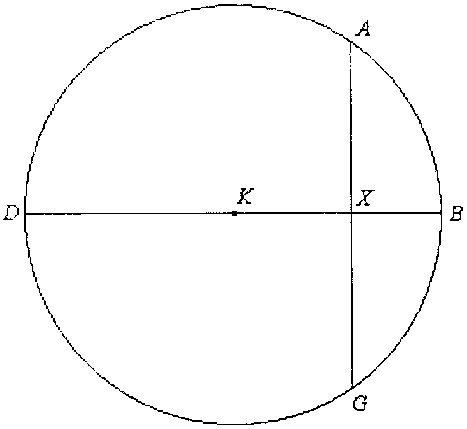
Fig. 1. Archimedes, Sphere and Cylinder
II.4
This proposition is famous among historians of Greek mathematics because it belongs to one of the rare texts of early Hellenistic Antiquity in which one finds explicit and complex analyses of difficult problems like the one we have just cited. Therefore, it is usually chosen as the example par excellence of Greek ancient mathematical analysis.15
The analysis of the problem is actually known to us through Eutocius’ reconstitution of it on the basis of “an old text” (Arch. III 130.29) that he declares to have retrieved. In Archimedes’ text as we have it, there is only an allusion to the solution of the problem and a reference to “the end [of the text]” (for a detailed analysis and synthesis of it, see Arch. I 192.5). But the end of the treatise does not actually contain them. The reconstitution of Eutocius is precisely meant to prove that the text he retrieved is indeed the missing end promised by Archimedes (Arch. III 150.23ff). Those questions are discussed, among others, in Reviel Netz’s detailed study of an important part of this text (Netz 1999). Here I follow Netz in his judgment that the basis on which Eutocius worked out his reconstitution is indeed due to Archimedes, or at least to some competent mathematician contemporary to Archimedes (ibid., 24ff). Eutocius also quotes two other solutions of the above-mentioned problem by Dionysodorus and Diocles, both of whom belong to the early Hellenistic period (Arch. III 152.27ff).
To summarize, Mahoney claims that analysis has usually been considered as a philosophical and/or logical problem, so little attention has been paid to it as a historical problem. Moreover, he insists that the logical interpretation of it (analysis as “reverse or backward inference”) obscures the fact that to Greek mathematicians, it served as a “body of techniques” that was available to them for their problem-solving activity. Thus, Mahoney is naturally led to give concrete examples of how ancient analysis was used (and not just considered or presented). Hence, the aforementioned passage about Archimedes.
Cf. the fifth chapter of his study about the tradition of geometrical problems (Knorr [1986] 1993), which is devoted to Archimedes’ techniques (“Archimedes: the Perfect Eudoxean Geometer”).
Archimedes’ treatment of this problem is a nice example of how the process of generalizing stimulates the field of geometric studies by raising new questions for solution not posed in the special problems initially. (Knorr [1986] 1993, 173)
A few lines later, Mahoney speaks about “an algebra-like manipulation of line lengths.”
Cf. note 122 in Unguru 1975, in which these questions are discussed in detail.
It is not surprising then to see that Knorr has inserted a long note (Knorr [1986] 1993, 203–4, n.94) after his reconstructed analysis of the construction of the rectangular heptagon.20
Knorr has finished the work Tropfke had begun before him (Knorr [1986] 1993, 178 and 203, n.90 to 93).
[C]ertainly, the ancient geometry never had access to the special advantages afforded by algebraic notations and conceptions in the full modern sense. (Ibid.)
[O]f course, it is in the strict sense fallacious to argue that these ancient techniques [the techniques of “auxiliary diagrams” in Knorr’s description] are a form of algebra because they serve the same function of separating quantitative relations from their special contexts. (Ibid.; Knorr’s emphasis)
Despite these two major concessions to Unguru, Knorr maintains that the term “geometrical algebra” remains useful in “alerting us to the fact” that, in some cases, diagrams fulfill a very special function in mathematical reasoning. Namely, they serve as auxiliaries to other propositions, and as such their interest lies in that they exhibit “quantitative relations” that can be used in “ostensibly unrelated diagrams” (ibid.).
For example, in the case of proposition II.4 in Archimedes’ Sphere and Cylinder, the primary analysis of the problem leads Archimedes to a new problem which can be, and is, stated in a more general form than the one concerning the cutting of a sphere in a given proportion: the new problem is to cut a given length ZD at X so that the first segment ZX is to a given length F as a given area E is to the square on the other segment XD (fig. 2).

Fig. 2. The problem to which Sphere and Cylinder II.4 is reduced.
In this form, the problem is more general than the one corresponding to the cutting of the sphere, and in particular, it has in this form a diorismos that the initial one did not have: the cube on E and F must not be greater than the cube constructed on the third of ZD and the square on the two-thirds of it. The analysis of the problem is done through the intersection of two conic sections, a hyperbola and a parabola, and this technique can be, and actually was extended by Archimedes’ followers to the other problems Knorr speaks about.21
A more detailed examination of this general problem is found in Netz 1999. I myself am preparing an analysis of this text from the point of view of ancient rhetoric.
Thus, if we dig into the detail of the controversy about what could or should be called the “algebra” of Greek mathematicians, we finally arrive at the question of what Mahoney calls the “technique” of analysis of Greek mathematicians. More generally, what was the exact nature of the tropos Archimedes speaks about, i.e., the way of discovering or “inventing” (heurein) things? Are we allowed to speculate about this, as Knorr extensively does? And specifically, are we allowed to reconstruct the analysis that would correspond to the extant synthesis? And if so, what kind of rules, in the sense of rules of historical interpretation, shall we follow in this endeavor?
Another thorny question that is hidden in these first problems is that of Classical versus Late Antiquity. It is a fact that most of the explicit testimonies about analysis in the extant mathematical literature must be traced back to Late Antiquity – with the notable exceptions of some of Archimedes’ works and Euclid’s Data. Eutocius, Pappus, the anonymous scholiast to Elements XIII, and Hero, speak about analysis, and much of what we know about the “treasury of analysis [topos analuomenos],” according to Pappus’ expression, is known from these late sources. These authors obviously had a special interest in such questions. On the other hand, and beyond the aforementioned “notable exceptions,” one can generally intuit that ancient analysis is deeply rooted in the early Hellenistic period.22
This actually is Knorr’s basic hypothesis. Cf note 15.
It is not surprising, then, that Unguru and Knorr take very opposite stands on this question. While Unguru insists that the scholium to XIII.1 was interpolated some 400 years at least after the classical period, Knorr, on the contrary, claims that the synthetic and formal mode of exposition was favored by writers of the “late editorial tradition” and suggests that the Ancients followed rather the analytic mode, and he explains why they may have done so:
[T]his would doubtless owe to the appropriateness of exposing learners to the use of this method in preparation for their own research efforts later. It also has advantages for exegesis, seeing that the analysis of a problem exposes in a natural and well motivated way the rationale behind each step of the construction. (Knorr [1986] 1993, 9)
I myself have no clear answers to all the questions I have mentioned. While I must admit I share Knorr’s belief that the techniques of analysis have their roots in Classical Antiquity, I cannot share his implicit idea that the synthetic mode of exposition is an offspring of the later editorial tradition, nor that the interest for analysis is an exclusive feature of the classical tradition, because the textual evidence obviously speaks against these ideas. In any case, we will not be able to solve these dilemmas as long as we lack a sufficiently coherent view of the duality represented by Classical “versus” Late Antiquity. The absence of a clear vision of the situation is reflected by the words themselves that we use, since the adjective “classical” itself would have no meaning if there had not been a period where the “classical” character as such of certain texts had not been slowly forged – and this period extends throughout the Hellenistic times at least. There is also this misleading notion of “decline” which has been imported from the political to the scientific historiography and which has to be further cleared.23
This question is at the center of Netz’s recent study on Archimedes and Eutocius (Netz 1999, 13, 43ff). He has generalized this approach by introducing the notion of deuteronomic texts (Netz 1998). I discuss this generalization in a forthcoming article (Bernard 2003b).
To conclude my commentary on the dilemma concerning the opposing views of Unguru and Knorr, I think that we have found the crossroad: it is the question of analysis and the historical methods that should be used to reveal the nature of the underlying techniques. At this point, the attacks delivered by Unguru against mathematical technê find their limits, but likewise his claim that we should not use modern algebra to explore this question must remain our guideline – all the more so since modern algebra was developed precisely for the purpose of clarifying the nature of ancient analysis. What, then, is the way to explore ancient analysis without indulging in anachronism? From another point of view, which context should be chosen to elucidate the way of invention of the Ancients? The following section should suggest some answers to these questions.
III
To step out of the dilemmas described and analyzed in the previous sections, we have to return to the question of context. This question obviously lies at the core of Unguru’s main claim: Unguru wants modern historians of mathematics to avoid any recourse to modern mathematics in their interpretations. According to him, they must use instead only “Greek” tools. Correspondingly, he urges them to set Greek mathematics back into its “own” cultural context. As Unguru himself points out (Unguru 1975, 78, n.21), scholars like Árpád Szabó and Jacob Klein, both of whom Unguru utilizes extensively, have already adopted this cautious attitude. Jacob Klein, for example, is a very subtle minded and sharp analyst of Platonic, Peripatetic, and Neoplatonist philosophy. His study of Diophantus’ arithmetical work, for example, is grounded on the basic hypothesis that this work has to be set back into the context of the history of Platonism. More precisely, he claims that Diophantus’ work has to be seen as the “theoretical logistic” that is implicit in Plato and that later Neoplatonists could not adopt for reasons pertaining to their own philosophical bias. Thus, Diophantus would, so to speak, fill a gap in the philosophical landscape defined by Plato’s philosophy. Thus, for Klein, philosophy and its history play essential roles in the history of science. This belief can be discerned in many passages, for example in the following one:
Neoplatonic mathematics is governed by a fundamental distinction which is, indeed, inherent in Greek science in general, but is here more strongly formulated. According to this distinction, one branch of mathematics participates in the contemplation of that which is in no way subject to change. … The other branch of mathematics, on the other hand, has for its object the treatment and manipulation of size or counting. (Klein [1968] 1992, 10; emphasis added)24
This is the first sentence of ch.2.
the character of ancient mathematics, in which philosophical presuppositions and metaphysical commitments played a much more fundamental and decisive role than they play in modern mathematics. (Unguru 1975, 86)
Aristotle’s ontological view of mathematika, especially of the “pure” numbers, soon comes to influence the development of mathematical science itself. … The “arithmetical” books of Euclid (VII, VIII, IX) directly mirror this ontological transformation. (Klein [1968] 1992, 110–1; emphasis added)
It is again interesting to compare the previously quoted views to Knorr’s since Knorr was profoundly opposed to Klein’s and Szabó’s perspective. This can already be witnessed in his study of Euclid’s Elements (Knorr 1975, 3–4), and after the polemical exchanges he had during the period around the 1981 Pisa Conference, he made his position very clear in different texts. For example, in the introduction and first chapter of his 1986 text, he strongly refutes the widespread idea that one has to look for “motivations” or “explanations” for the development of Greek mathematics in Greek philosophy:
This aspect of the commentators [i.e. their philosophical commitment to metamathematical issues] helps us to understand an emphasis commonly, but, I believe, mistakenly made in discussions about the ancient geometry. One seems typically to assume that metamathematical concerns were the effective motivating force underlying the efforts of geometers, for instance, that the hallmark of their tradition was their organization of geometric findings into tight structures of deductive reasoning, as if their primary ambition was the production of treatises like the Elements of Euclid and the Conics of Apollonius. But this surely cannot be correct. The writing of textbooks is the end of mathematical research only in the sense that death is the end of life: it is the last term in a sequence, but not the purposive element which explains why one engages in the activity of progressing through the steps in this sequence. (Knorr [1986] 1993, 7)
[T]he most exciting aspect of [the ancient textual material], in my view, is that a closer examination reveals the general lines of a coherent development, and that the extant record, despite its incomplete state, actually makes sense as the remnant of an extraordinary movement in thought whose basic outline is discernible. If the reader … comes to appreciate the unsatisfactory state of current scholarship and to perceive the possibility of achieving a coherent view of this movement, then my effort shall have attained its principal objective. (Ibid., 11–12; emphasis added)
When Knorr resorted to the notion of problem to create his own reconstruction of the ancient tradition of Greek geometry, he was not aware of the fact that he was actually resorting to a central concept of ancient rhetoric.25
Knorr only refers to Aristotle’s Topics as a possible context for the explanation of problêmata and protaseis in “debating contexts” (Knorr [1986] 1993, 374, n.60).
One good example of misunderstanding entailed by the aforementioned Platonic view is the usual translation of the Greek word meletê into the Latin word declamatio (hence declamation in English). But meletê and declamatio are very different concepts, since meletê properly is the task that engages a speaker or sophist whose pupils have come to hear (akouein) speak. The emphasis is not put on the fact of “impressing” audiences that would be considered “passive lumps,” according to M. Heath’s clever remarks (Heath 1995, 5), but of displaying his skill as a speaker in front of an audience that is considered able to judge the performance and to learn something from it. Thus, the emphasis is put on learning rather than persuasion (Bernard 2003a, §1.2).
Now, how can one concretely use the categories of ancient rhetorical practice in order to study ancient mathematical texts? To illustrate this point, I will come back to a case I have studied with much care: Pappus of Alexandria. Many historians tend to consider his Collection as characteristic of Late Antiquity, a period regarded as generally decadent. From this perspective, late antique authors are thought to have cared less for creative invention than for classification and inventory of the past “classical” texts.27
For modern defenders of this point of view, see Wilbur Knorr (Knorr 1989, 225ff); Alexander Jones (Jones 1986, 1); Reviel Netz (Netz 1998). I discuss and contest it in a forthcoming article (Bernard 2003b). The following analysis of Pappus is excerpted from this discussion.
This passage is more fully discussed in Knorr 1989, ch.4; Cuomo 2000, 145ff.; and Bernard 2003a.
See Cuomo’s detailed discussion of this passage (Cuomo 2000, 145ff).
Those wishing to discriminate [diakrinein] more precisely [technikôteron] between the [things] sought in geometry, my dear Pandrosion … (Coll. Math. I 30.3–4)
We know the protagonists of this antique debate through Proclus’ report (In Eucl. 77.15–78.13).
For an extended discussion and justification of this interpretation, see Bernard 2003a.
Now, is the construction proposed by Pandrosion’s pupil an original one? Wilbur Knorr has shown, quite convincingly in my eyes, that it may be a clever variation on the construction of Eratosthenes’ mesolabe or “mean-taker” (Knorr 1989, 64–68). Eratosthenes’ device was well known in Pappus’ time: this is attested in particular by the description Pappus gives of it a few pages later (Coll. Math. I 56.18–58.22).32
See also the more detailed account found in Eutocius, Arch. III 88–96.
See Alexander Jones (Jones 1986, 83, line 3) and his commentary on topos (ibid., 378–9). Alexander Jones deems the usual translation “treasury of analysis” to be “too coloured to render the bland Greek word.” From another point of view, the classical translation has for itself the authority of usage as familiar to Commandino or Newton as to those in Antiquity, in which it belonged to the traditional vocabulary of rhetoric. Newton, in one letter to David Gregory (May 1684) deems indeed locus resolutus (i.e., Commandino’s translation) to be equivalent to penus Analytica or “treasury of analysis.”
The passage of Pappus I have discussed is of course a very isolated case. Nevertheless, I hold that it reveals powerful means to interpret other Greek mathematical texts, not only belonging to the same period (Eutocius, Proclus) but also of earlier periods. In other words, I claim that this kind of reading has a high degree of generality and can thus be applied to many other texts, but I cannot fully discuss and justify this claim here since it requires more detailed case studies.
Let us then come back to the thorny question I have mentioned concerning Greek analysis. It seems fitting to me to explore the field of ancient rhetoric in order to get not only the objective information that is often lacking in solely mathematical texts, but also a relevant point of view. By “relevant,” I mean, in perfect accordance to Unguru’s criteria, “non anachronistic.” As is well known, rhetorical practice is one of the most deep-seated phenomena pertaining to ancient Greek culture – and by that I am not only referring to something pregnant in the Greek and Roman ancient world, but also to something that lasted from the birth of ancient Greek civilization to the expiration of Greek pagan culture.34
On the “permanency” of ancient paideia in Greek culture, see the enlightening studies of Peter Brown (Brown 1992) and Robert Kaster (Kaster 1988).
I must insist on an important point here. To make it clear, let us begin with a simple question: what is the core of ancient rhetorical practice? The first and foremost answer is: practice itself. Otherwise stated, a central key for understanding ancient rhetoric is that it is oriented toward an accomplishment (a performance), which is the so-called “declamation” or meletê.35
See note 26.
See Isocrates’ Antidosis 178ff in which he himself quotes an important passage of one of his earlier works, Against the Sophists, §15–18.
If we keep in mind the essential function of the rhetorical exercise that I have quickly sketched,37
The portrait of ancient rhetoric I draw here is of course very rough. A more faithful presentation must take into account the subtleties of the historical development of ancient rhetoric that lasted all throughout Greek history (including Late Antiquity). But those details are only understandable once some basic and stable features of ancient rhetoric have been understood (for more detailed accounts, see Bernard 2003a; Marrou 1948; and Porter 1997).
For an example, see my analysis of a difficult passage of Pappus in Bernard 2003a, §2.2.
[t]here is no historical advantage whatever growing out of the gratuitous assumption that the men of old played tricks on us by systematically hiding their line of thought. (Unguru 1979, 562)
Conclusion
To conclude, we can now understand why and how the study of rhetoric appears as a kind of natural outcome of the dilemma that the extreme positions of Unguru and Knorr represent for the modern historian. To summarize, the reasons are the following: mathematical texts, in Antiquity, were not just a kind of ossified depository of classical knowledge. In the framework of rhetorical practice, classical texts in general were used to support a very specific kind of practice. Problems in the most general sense, i.e., “challenging questions,” could be found in ancient texts – they often consisted of excerpts (epitomai) that were then considered problems insofar as they entailed some kind of challenge, or hypotheseis insofar as they supported the subsequent task (meletê) of dealing with the initial challenge. However, not only the problems, but also their “solutions,” in the sense of the “work of answering” that the challenge implied, relied on classical texts. In this respect, the latter were considered a treasury of topoi, i.e., of elements that could nurture invention (heuresis) provided they were properly organized (cf. the notions of lexis and taxis). Traditionally, the strength of such a practice relied on the fact that it had to be exposed to a public of listeners or readers, so that they may learn, by the concrete example provided by skilled practitioners, how to practice themselves. Learning (not convincing) is the most essential scope of ancient rhetorical practice, at least in the Greek context. Now it had been long recognized by ancient rhetoricians that mathematics was the field par excellence in which students could devote themselves exclusively to learning. This rhetorical tradition was by far not forgotten in Late Antiquity. The purpose of late authors like Pappus, Eutocius, or even Proclus was to illustrate, each in his own way and by various degrees, how one could or should practice mathematics, on the basis of ancient texts. This point of view was fully coherent with ancient rhetorical practice and expressed a feature of mathematical texts that was present but less explicit in texts of the early Hellenistic period. This situation finally explains why, when one sets out to explore ancient mathematical practice, just as Knorr and Unguru have done each in his own way, one is naturally led to take ancient rhetorical practice into account. Surely, the form of ancient mathematical texts has to be carefully respected and studied: this is Unguru’s claim. But since this form is particularly well adapted to a certain kind of practice based on ancient rhetoric, this study cannot exclude practice, which is Knorr’s claim. Those two claims appear to contradict each other only insofar as we lack a clear idea of the context in which ancient mathematical texts were elaborated: this is, in a sense, Klein’s claim.
Acknowledgments
This article is the result of a talk on Pappus I gave in May 2001 in the frame of a workshop organized by Leo Corry and Sabetai Unguru in Tel-Aviv on the recent trends in history of mathematics. More generally my work on Pappus was supported from the outset by the Cohn Institute at Tel Aviv University and especially by Sabetai Unguru who encouraged me throughout my work. Giovanna Cifoletti allowed me to present a first version of the present article in a workshop organized in November 2001 at the EHESS (Paris). I would like to therefore thank the organizers and participants of both workshops for their useful remarks, and especially Orna Harari-Eshel for her comments on the first version of the talk. Moreover, much of the discussion on recent historiography has been inspired by long and fruitful discussions I had on this subject with Michael Fried. The final version was greatly improved thanks to the thoughtful suggestions of Reviel Netz, Bernard Vitrac, Giovanna Cifoletti and an anonymous referee. I am also grateful to Anya Soriya who corrected the English of the successive versions.
References
Ancient sources
Coll. Math. Pappi Alexandrini collectionis quæ supersunt. Edition and Latin translation of Friedrich Hultsch. 3 vol. Berlin:Weidmann. 1876-1878. Coll. Math. 39.3 = page 39, line 3.
Arch. Archimedes: Opera omnia, cum commentariis Eutocii. Edition and Latin translation of Johan Heiberg. Leipzig: Teubner. 1910-1915. Arch. III 67.3 = volume III, page 67, line 3.
In Eucl. Proclus diadochi in Primum Euclidis Elementorum Librum commentarii. Edition of Godfried Friedlein. Leipzig: Teubner. 1873 (reprint Georg Olms 1967). In Eucl. 54.5 = page 54, line 5.
Modern References
Berggren, J. L.1984. “History of Greek Mathematics: A Survey of Recent Research.” Historia Mathematica 11:394-410.Google Scholar
Bernard, A.2003a. “Sophistic Aspects of Pappus’s Collection.” Archive for History of Exact Sciences 57::93-150.Google Scholar
Bernard, A.2003b. “Comment définir la nature des textes mathématiques de l‘antiquité grecque tardive?” Revue d‘histoire des mathématiques.Google Scholar
Brown, P.1992. Power and Persuasion in Late Antiquity: Towards a Christian Empire. Madison, Wis.: University of Wisconsin Press.
Cifoletti, G.1992. “Mathematics and Rhetoric, Peletier, Gosselin and the Making of the French Algebraic Tradition.” Ph.D. thesis, Princeton University. To be published.
Cifoletti, G.1995. “La question de l’algèbre. Mathématiques et rhétorique des hommes de droit dans la France du 16e siècle.” Annales EHSS (1995):1385-1416.Google Scholar
Cuomo, S.2000. Pappus of Alexandria and the Mathematics of Late Antiquity. Cambridge: Cambridge University Press.
Fried, M.and S. Unguru. 2001. Apollonius of Perga’s ‘Conica’, Text, Context, Subtext. Leiden: Brill.
Heath, M.1995. Hermogenes’ On Issues: Strategies of Argument in Later Greek Rhetoric. Oxford: Clarendon Press.
Jones, A.1986. Pappus: Book 7 of the Collection. Edition, English translation, commentary. 2 vol. Berlin, New York: Springer Verlag.
Kaster, R. A.1988. Guardians of Language: the Grammarian and Society in Late Antiquity. Berkeley: University of California Press.
Klein, J.[1968] 1992. Greek Mathematical Thought and the Origin of Algebra. Translated by Eva Brann. New York: Dover.
Knorr, W. R.1975. The Evolution of the Euclidean Elements, Dordrecht, Boston: Reidel.
Knorr, W. R.[1986] 1993. The ancient tradition of geometric problems. New York: Dover.
Knorr, W. R.1989. Textual studies in ancient and medieval geometry. Basel: Birkhaüser.
Lloyd, G. E. R.[1996] 1999. Adversaries and Authorities. Cambridge/New York: Cambridge University Press.
Mahoney, M.1968. “Another Look at Greek Mathematical Analysis.“ Archive for History of Exact Sciences 5:319-348.Google Scholar
Marrou, H. I.1948. Histoire de l’éducation dans l’Antiquité. Paris: Seuil.
Netz, R.1998. “Deuteronomic Texts: Late Antiquity and the History of Mathematics.” Revue d’histoire des mathématiques 4:261-288.Google Scholar
Netz, R.1999. “Archimedes Transformed: The Case of a Result Stating a Maximum for a Cubic Equation.” Archive for the History of Exact Sciences 54:1-47.Google Scholar
Netz, R.K. Saito, and N. Tchernetska2001/2. “A new reading of Method Proposition 14: preliminary evidence from the Archimedes palimpsest.” SCIAMVS 2 (2001):9-29and SCIAMVS 3 (2002):109-125.
Porter, S. E.1997. Handbook of Classical Rhetoric in the Hellenistic Period, 330 B.C.–A.D. 400. Edited by S. E. Porter. Leiden: Brill.
Unguru, S. 1975. “On the need to rewrite the history of Greek mathematics.” Archive for the History of Exact Sciences 15:67-114.Google Scholar
Unguru, S.1979. “History of Ancient Mathematics: Some Reflections on the State of the Art.” Isis 70:555-565.Google Scholar
Unguru, S.and D. Rowe. 1981. “Does the Quadratic Equation Have Greek Roots?” Libertas Mathematica, vol.1.Google Scholar
Zeuthen, H. G.[1886] 1966. Die Lehre von den Kegelschnitten im Altertum. Hildesheim: Olms.
Fig. 1. Archimedes, Sphere and Cylinder

Fig. 2. The problem to which Sphere and Cylinder II.4 is reduced.
 You have
Access
- 10
- Cited by