INTRODUCTION
The protozoan parasites of the genus Bonamia (Haplosporidia) are intra-haemocytic parasites of several oyster species mainly of the Ostrea genus. In Europe, Bonamia ostreae infects the native flat oyster Ostrea edulis causing mass mortalities in natural beds associated with important economic losses (Meuriot and Grizel, Reference Meuriot and Grizel1984). Other representative of the genus, Bonamia exitiosa, was firstly observed in several areas of the Southern hemisphere. In New Zealand, B. exitiosa was described to infect Ostrea chilensis haemocytes (Hine et al. Reference Hine, Cochennec-Laureau and Berthe2001) and in Australia this parasite was detected in the oyster Ostrea angasi (Corbeil et al. Reference Corbeil, Arzul, Robert, Berthe, Besnard-Cochennec and Crane2006). Bonamia exitiosa has been described as the causative agent of devastated mortality events in these areas (Doonan et al. Reference Doonan, Cranfield and Jones1994; Cranfield et al. Reference Cranfield, Dunn, Doonan and Michael2005). This parasite is included in the list of exotic notifiable diseases of the Directive 2006/088/EC and in the Aquatic Animal Health Code (OIE, 2013). However, the notification of B. exitiosa in O. edulis from Spain (Abollo et al. Reference Abollo, Ramilo, Casas, Comesaña, Cao, Carballal and Villalba2008) and its detection in Crassostrea ariakensis from North Carolina (Burreson et al. Reference Burreson, Stokes, Carnegie and Bishop2004) support the apparent worldwide distribution of this parasite.
Bonamia exitiosa has been observed infecting Ostrea stentina oysters from Tunisia (Hill et al. Reference Hill, Carnegie, Aloui-Bejaoui, El Gharsalli, White, Stokes and Burreson2010; Carnegie et al, Reference Carnegie, Hill, Stokes and Burreson2014) and O. edulis from different European countries including Spain (Abollo et al. Reference Abollo, Ramilo, Casas, Comesaña, Cao, Carballal and Villalba2008, Carrasco et al. Reference Carrasco, Villalba, Andree, Engelsma, Lacuesta, Ramilo, Gairín and Furones2012), Italy (Narcisi et al. Reference Narcisi, Arzul, Cargini, Mosca, Calzetta, Traversa, Robert, Joly, Chollet, Renault and Tiscar2010), France (Arzul et al. Reference Arzul, Omnes, Robert, Chollet, Joly, Miossec, Franand and Garcia C.2010) and the UK (Lonshaw et al. Reference Lonshaw, Stone, Wood, Green and White2013) questioning its impact on native flat oyster populations.
Some difficulties have been found in classifying some of the representatives of the Bonamia group. In some cases, the species affiliation remains still unresolved and the classification attains to genus level such as Bonamia spp. infecting O. chilensis from Chile (Campalans et al. Reference Campalans, Rojas and Gonzalez2000; Lohrmann et al. Reference Lohrmann, Hine and Campalans2009).
Molecular information based on functional genes might offer very valuable information to clarify the taxonomic classification of the group. However these genes are scarce in protozoans. Recent advances in sequencing methodologies such as Next Generation Sequencing (NGS) have allowed the annotation of an important number of genes of the protozoan Mikrocytos mackini (Burki et al. Reference Burki, Corradi, Sierra, Pawlowski, Meyer, Abbott and Keeling2013). The inclusion of these functional genes in phylogenomics analyses clarified the phylogenetic position of this organism among rhizarian. Regarding B. ostreae, two actin genes and the HSP90 gene are the unique functional genes described to date and also placed Bonamia representatives among haplosporidians (López-Flores et al. Reference López-Flores, Suárez-Santiago, Longet, Saulnier, Chollet and Arzul2007, Prado-Alvarez et al. Reference Prado-Alvarez, Chollet, Couraleau, Morga and Arzul2013). Actin genes are highly conserved, broadly distributed and are widely used in phylogenetic studies of protozoans (Leander and Keeling, Reference Leander and Keeling2004; López-Flores et al. Reference López-Flores, Suárez-Santiago, Longet, Saulnier, Chollet and Arzul2007; Burki et al. Reference Burki, Kudryavtsev, Matz, Aglyamova, Bulman, Fiers, Keeling and Pawlowski2010). However, the reconstruction of the evolution of haplosporidians has been a complicated task due to the lack of enough genomic information. The difficulty in culturing many of these organisms, such as B. exitiosa, hampers the obtaining of proper genomic material.
Amplification of actin gene was attempted on genomic material from B. exitiosa infected oysters and also from purified parasites without success. In the present work we applied Whole-Genome Amplification (WGA), a genomic approach especially effective when the amount of DNA is limited. The process consists of the amplification of the entire genome based on primer extension yielding a high quality DNA suitable for genotyping, hybridization, cloning and sequencing. This method allowed us to characterize the actin gene of B. exitiosa using for first time pure genomic material extracted from purified parasites. The phylogenetic position of Bonamia sp. infected oysters was also studied using the new actin gene described.
MATERIALS AND METHODS
Bonamia exitiosa purification
Heart imprints of O. edulis oysters collected from Corsica (France) in August of 2009 were visualized by light microscopy for Bonamia sp. detection. Following the criteria of Robert et al. (Reference Robert, Garcia, Chollet, López-Flores, Ferrand, Joly and Arzul2009), the most infected oysters were selected for parasite purification (Mialhe et al. Reference Mialhe, Bachère, Chagot and Grizel1988). Bonamia exitiosa infection was confirmed by histological analysis performed on infected oysters sections. The parasite was also sequenced in oysters found positive by restriction fragment length polymorphism (RFLP) analysis with Hae II and Bgl1 on O. edulis genomic DNA. Parasites were counted on Malassez chamber. A total of 7 × 10⁶ parasites were obtained from four heavy infected oysters. Cells were centrifuged and saved frozen on 96% ethanol.
Gill tissues collection
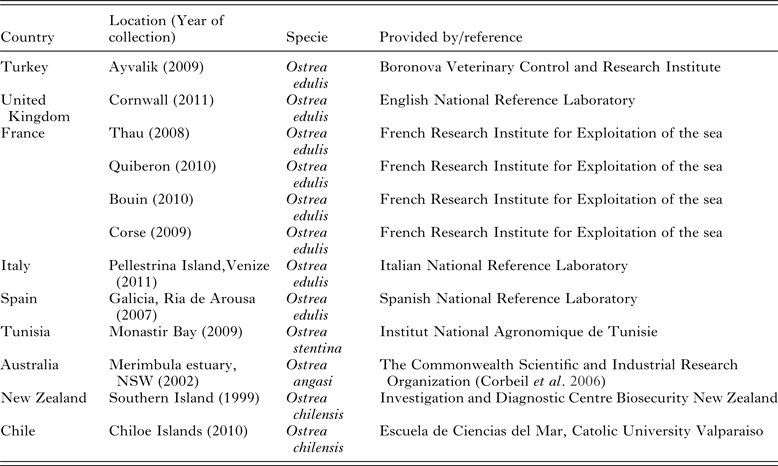
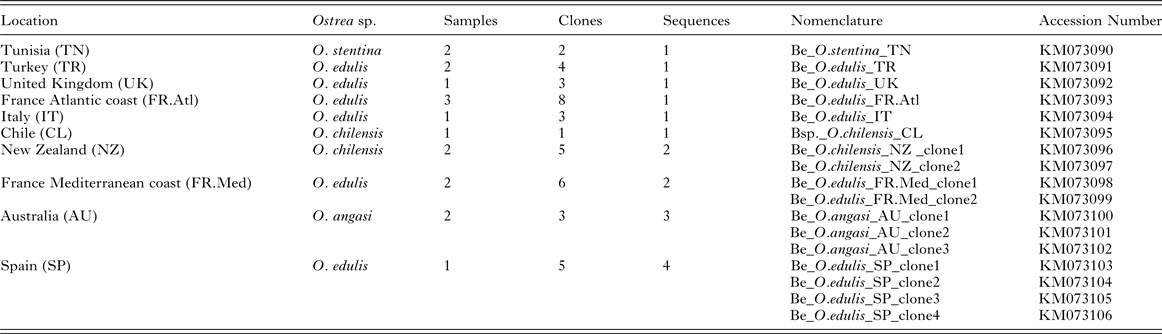
Small pieces of gill tissues of O. edulis from Turkey, the UK, France, Italy and Spain; O. stentina from Tunisia, O. angasi from Australia and O. chilensis from New Zealand and Chile were analysed (Table 1) and maintained in 96% ethanol at 4 °C for further molecular analysis.
Table showing the origin of the oyster samples analysed

Genomic DNA extraction from gills and Bonamia sp. infection detection
Genomic DNA was extracted from gill tissue (25 mg) using the QIAamp DNA Mini Kit (Qiagen). DNA from gill tissues were adjusted to 100 ng µL−1 and used as a template to detect Bonamia sp. infection by polymerase chain reaction (PCR) using BO/BOAS primers according to Cochennec-Laureau et al. (Reference Cochennec-Laureau, Le Roux, Berthe and Gerard2000). Posterior RFLP analysis with Hae II and Bgl1 (Hine et al. Reference Hine, Cochennec-Laureau and Berthe2001; Cochennec-Laureau et al. Reference Cochennec-Laureau, Reece, Berthe and Hine2003) were assayed on positive amplicons to confirm B. ostreae or B. exitiosa infection.
Amplification of B. exitiosa genomic DNA using WGA method
Genomic DNA was extracted from purified parasites (7 × 10⁶ cells) using the QIAamp DNA Mini Kit (Qiagen). DNA was adjusted to 10 ng µL−1 and was amplified using the Illustra GenomePhi V2 Amplification Kit (GE Healthcare), a method based on isothermal strand displacement. Briefly, DNA (10 ng) and sample buffer containing random hexamers primers were heat-denatured at 95 °C for 3 min and cooled on ice. A master-mix containing Phi29 DNA polymerase, additional random hexamers, nucleotides, salts and buffers were added to the mix and isothermal amplification was performed at 30 °C for 1·5 h. After amplification, the enzyme was inactivated at 65 °C for 10 min and the obtained DNA was cooled on ice and quantified.
Actin gene extension from amplified genomic DNA from B. exitiosa
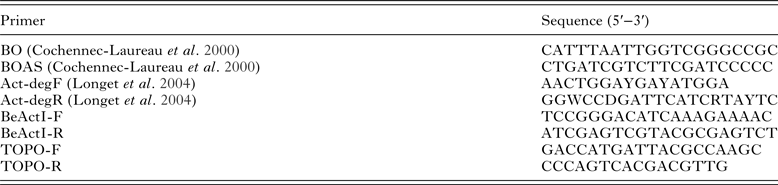
Degenerate primers for actin amplification in Rhizopods (Longet et al. Reference Longet, Burki, Flakowski, Berney, Polet, Fahrni and Pawlowski2004) were tested in Whole-Genome amplified DNA of B. exitiosa purified cells (Table 2). The reaction was carried out in a volume of 50 µL with 2 mm of each dNTP, 2·5 units of Taq polymerase (New England Biolabs) using 300 ng of amplified DNA as template. Thermal cycling was 94 °C for 5 min, 40 cycles of 94 °C for 1 min of denaturing, 55 °C for 1 min of annealing and 72 °C for 2 min of extension, followed by 10 min of final extension at 72 °C. Bonamia ostreae DNA from infected oysters and distilled water were used as positive and negative controls, respectively.
List of primers used in the study

Amplification of actin gene from gills of Bonamia sp. infected oysters
Specific primers (BeActI-F/BeActI-R, Table 2) for B. exitiosa actin amplification were designed in a region with low similarity to B. ostreae actin sequences. These primers amplified a product of 220 pairs of bases and were used to detect B. exitosa actin on genomic DNA from gills of Bonamia sp. infected oysters (Table 1). PCR reactions were performed in a volume of 25 µL containing 2 mm nucleotides, 1·5 units of Taq polymerase (New England Biolabs) and 100 ng of genomic material. Thermal cycling was 94 °C for 5 min, 30 cycles of 94 °C for 1 min of denaturing, 60 °C for 1 min of annealing and 72 °C for 2 min of extension, followed by 10 min of final extension at 72 °C.
Cloning and sequence analysis
PCR products obtained from the amplification of B. exitosa actin in Whole-Genome amplified DNA from B. exitosa (867 pb) and DNA from Bonamia sp. infected oysters (220 pb) were directly cloned and transformed on Top 10F competent bacteria using TOPO TA Cloning kit (Invitrogen). Clones of the expected size were selected and plasmid DNA were sequenced from both ends with TOPO-F and TOPO-R primers (Table 2) using the BigDye terminator Cycle Sequencing Ready Reaction Kit and a 3100 Avant Genetic analyser ABI Prism sequencer (Applied Biosystem). Raw chromatograms were analysed using Chromas 231 software (Technelysium). Sequence assembly, translation, multiple sequence alignment and searches of homology were performed using ExPaSy tools (http://us.expasy.org/tools), ClustalW2 (http://www.ebi.ac.uk/Tools/clustalw2/index.html) and GenBank databases using Blast algorithm (http://ncbi.nlm.nih.gov/blast/).
Phylogenetic analysis
Nucleotide and amino acid sequences used to construct phylogenetic trees and pairwise analysis were downloaded from the GenBank database or were obtained from this study (Amino acid sequences: BoAct1-1 (CAL69233.1), BoAct1-2 (CAL69234.1), BoAct1-14 (CAL69228.1), BoAct2-26 (CAL69235.1), BoAct2-34 (CAL69230.1), BoAct2-45 (CAL69236.1); Nucleotide sequences: B. ostreae actin 1 (AM410919.1), B. ostreae actin 2 (AM410922.1), Haplosporidium nelsoni (AY450412.1), Minchinia tapetis (AY450418.1), Minchinia teredinis (AY450421.1), Haplosporidium costale (AY450407.1), Minchinia teredinis (AY450420.1), Haplosporidium louisiana (AY450409.1), Minchinia chitonis (AY450415.1), Urosporidium crescens (AY450422.1), Allogromia sp. actin 1 (AJ132370.1), Reticulomyxa filosa actin 1 (AJ132374.1), Ammonia sp. actin 1 (AJ132372.1), Allogromia sp. actin 2 (AJ132371.1), Reticulomyxa filosa actin 2 (AJ132375.1) and Ammonia sp. actin 2 (AJ132373.1)). Multiple sequence alignments were performed using Clustal W (Thompson et al. Reference Thompson, Gibson, Plewniak, Jeanmougin and Higgins1997). Distance matrixes and phylogenetic trees were conducted using the Neighbour-Joining method under MEGA5 software (Tamura et al. Reference Tamura, Peterson, Peterson, Stecher, Nei and Kumar2011). Statistical confidence of the inferred phylogenetic relationships was assessed by bootstraps of 1000 and 10 000 replicates.
RESULTS
Amplification of genomic DNA from B. exitiosa purified parasites by WGA
An initial DNA extraction procedure on a sample of purified parasites containing 7 × 10⁶ cells yielded a genomic DNA sample with a concentration of 0·143 µg µL−1 and 260/280 ratio of 2·14. A subsample of 10 ng of genomic DNA was amplified using the Illustra GenomiPhi V2 Amplification Kit (GE Healthcare) by the method of isothermal strand displacement. After 1·5 h of incubation, the Whole-Genome amplified DNA was more than 5-fold higher concentrated obtaining a final concentration of 0·745 µg µL−1. The obtained genomic DNA had proper quality with an A260/A280 ratio of 1·68 and a size higher than 50 kb with minimum smearing after verification on an agarose gel (0·6%).
Characterization of B. exitiosa actin gene
Degenerate primers previously designed to amplify actin gene (Longet et al. Reference Longet, Burki, Flakowski, Berney, Polet, Fahrni and Pawlowski2004) were tested in Whole-Genome amplified DNA sample from B. exitiosa purified parasites (Table 2). The reaction yielded an amplification product of 867 nucleotides that encoded for a 289 amino acid sequence (Fig. 1). Four clones from one PCR product were forward and reverse sequenced and analysed. No introns were detected in the sequence. Among the three substitutions found in 1 of the 4 clone's analysis, one at position 62 corresponded to a non-synonymous change where the consensus codon GAA (Guanine-Adenine-Adenine) appeared replaced by GTA (Guanine-Thymine-Adenine) coding for Valine instead of Glutamic Acid. Maximum identity value, using Blast tools, reached 89% of homology with B. ostreae actin gene-1. The amplified fragment comprised a fraction of the characteristic actin domain including the corresponding binding sites for ATP (Adenosine Triphosphate) (Fig. 1, in grey) and the barbed-end binding proteins gelsolin and profiling motives (Fig. 1, underlined). The new B. exitiosa actin gene was named BeAct and deposited on the GenBank database with the accession number KM073107.
Nucleotide sequence and deduced amino acid sequence of Bonamia exitiosa actin (BeAct) Identical bases found in the alignment of the 4 clones are indicated with dots. Residues involved in ATP binding are indicated in grey. Residues involved in gelsolin and profiling recognition are underlined.

Multiple alignment performed on BeAct amino acid sequence with B. ostreae actin sequences (BoAct1 and BoAct2) revealed the position of 211 conserved residues among the 7 actin sequences analysed (Fig. 2). The sequence was highly conserved up to residue 121. BeAct sequence had 26 distinctive positions (Fig. 2, underlined), 44 identities with BoAct1 and 6 identities with BoAct2 (Fig. 2, in grey). Compared with BoAct1, one deletion and one insertion were found in BeAct at position 1 and 290, respectively. Amino acid residue at position 158 showed identity only with one sequence of BoAct1.
Multiple alignment of actin amino acid sequence of Bonamia exitiosa with the two actin genes of Bonamia ostreae. Distinctive residues found in Bonamia exitiosa actin (BeAct) are underlined and the coincidences with each of B. ostreae actin genes are marked in grey. Squared amino acid show the location of the specific primers (BeActI-F and BeActI-R) and dot lines show the length of the amplified fragment.

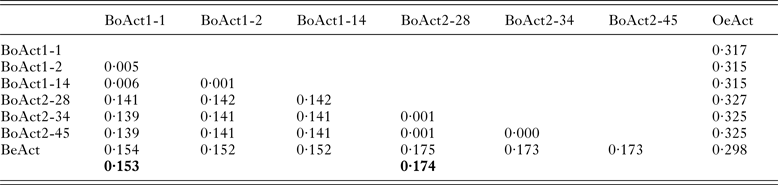
Pairwise distance matrix between B. exitiosa and B. ostreae actin sequences were conducted using Maximum Composite Likelihood model (Table 3). The analysis involved 8 nucleotide sequences composing a final dataset of 614 positions. Results showed less evolutionary divergence between BeAct and BoAct1 (average distance of 0·153) than between BeAct and BoAct2 (average distance of 0·174). Evolutionary divergence among BeAct and each of BoAct sequences were higher than the distance between BoAct1 and BoAct2 (0·140). Ostrea edulis actin was also included in the analysis showing fewer differences (0·298) with B. exitiosa than with B. ostreae sequences (0·315 with BoAct1 and 0·325 with BoAct2).
Pairwise distance between Bonamia exitiosa, Bonamia ostreae and Ostrea edulis actin sequences (Maximum Composite Likelihood model)

Phylogenetic analyses based on B. exitiosa actin gene
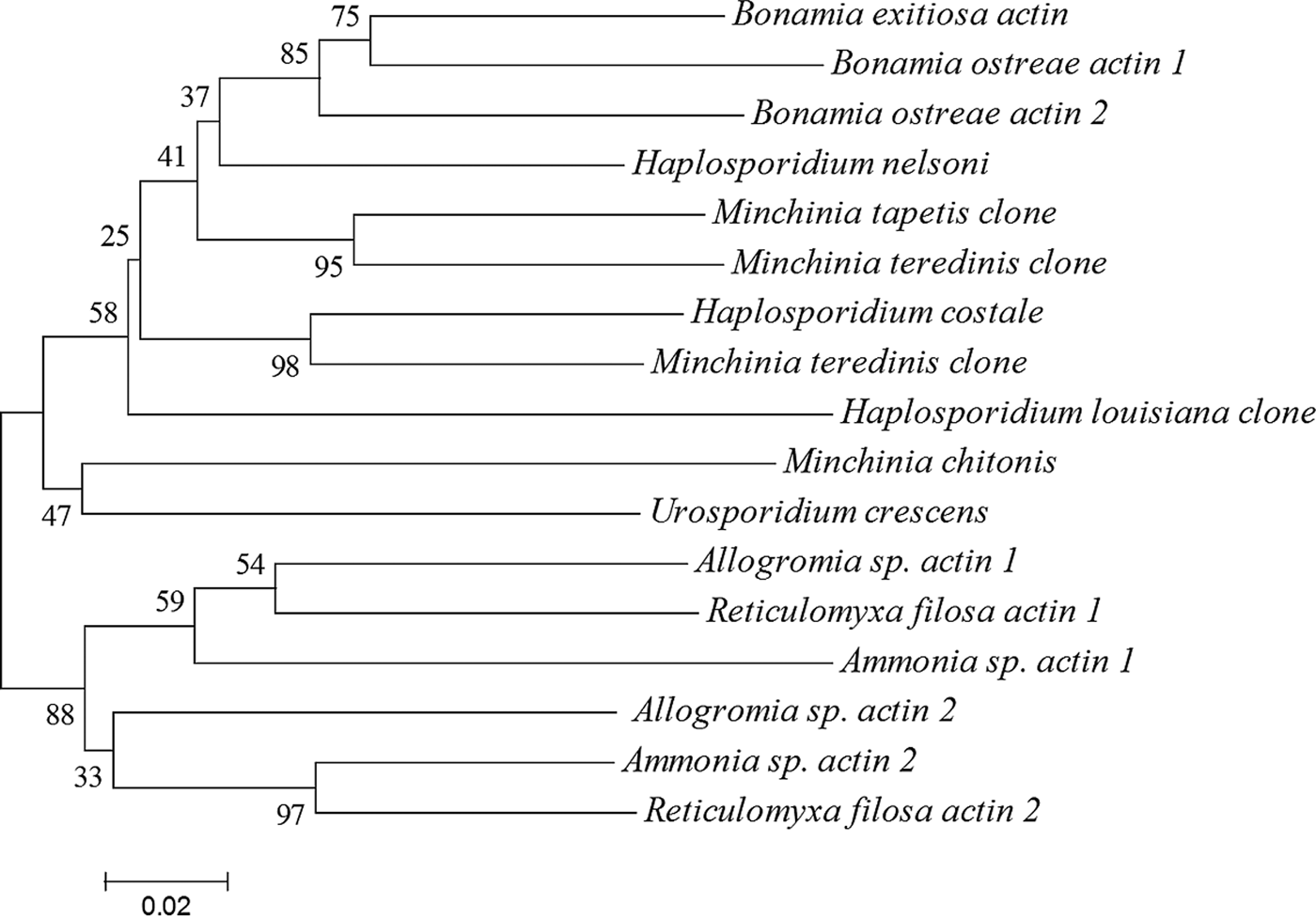
The Neighbour-Joining method was used to infer the phylogenetic relationship of B. exitiosa actin among haplosporidian representatives (Fig. 3). The analysis involved 17 nucleotide sequences considering representatives of the genus Bonamia, Minchinia, Haplosporidium and Urosporidum. Allogromia sp., Reticulomyxa filosa and Ammonia sp. were considered as outgroup. After removal of all ambiguous positions the final data set had a total of 427 informative positions. The percentage of replicate trees in which the associated taxa clustered together is shown next to the branches. Bonamia exitiosa actin grouped with B. ostreae actin gene-1 with a bootstrap value of 75%. Haplosporidum nelsoni resolved in the same clusters as Bonamia representatives. In sister clades grouped Minchinia and Haplosporidium representatives and Urosporidium crescens.
Neighbour-Joining tree of the nucleotide sequences showing the phylogenetic relationships among actin sequences from haplosporidian representatives. Bootstrap of 10 000 repetitions.

Molecular and phylogenetic characterization of actin sequences obtained from Bonamia sp. infected oysters
Primers BeActI-F/BeActI-R (Table 2) were designed on B. exitiosa actin sequence to amplify the most divergent region compared with B. ostreae actin genes. The specific primers yielded a product of 220 nucleotides in genomic DNA obtained from gill tissues of Bonamia sp. infected oysters. Several oyster species from different locations were analysed to amplify B. exitiosa actin (Table 1). Bonamia exitiosa infection was previously confirmed by studying the RFLP on PCR products obtained using BO-BOAS primers and sequencing (Cochennec et al. Reference Cochennec-Laureau, Le Roux, Berthe and Gerard2000; Hine et al. Reference Hine, Cochennec-Laureau and Berthe2001). Table 4 summarizes the total number of actin sequences obtained after analysis of 40 different clones. A single actin sequence was obtained in O. stentina from Tunisia, O. edulis from Turkey, the UK, France-Atlantic coast and Italy and O. chilensis from Chile after the analysis of 2, 4, 3, 8, 3 and 1 clones, respectively. Two different actin sequences were obtained in O. chilensis from New Zealand and O. edulis from France-Mediterranean coast in 5 and 6 clones, respectively. Three actin sequences were obtained in 3 clones of O. angasi samples from Australia and four different actin sequences were obtained in the analysis of 5 clones in one O. edulis sample from Spain. These sequences were deposited on the GenBank database (Table 4).
Summary of clones analysed and the actin sequences per oyster sample with the corresponding accession number

Multiple nucleotide alignment analysis including 18 different actin sequences obtained from Bonamia sp. infected oysters revealed 100% identity between the actin sequence from B. exitiosa purified parasites and sequences from O. chilensis from New Zealand (clone 1), O. angasi from Australia (clone 3), O. edulis from France (Atlantic and Mediterranean coasts, clone 2), the UK, Italy and Turkey and O. stentina from Tunisia (Fig. 4A). Among the 17 mismatches found in the alignment, 6 were specific to Chilean and Spanish clones. Bonamia exitiosa actin sequence from O. chilensis from New Zealand (clone 2) and O. angasi from Australia (clone 2) shared one different nucleotide compared with the other sequences. Remaining discrepancies were found in sequences from O. angasi oysters from Australia (clone 1) and O. edulis from France-Mediterranean coast (clone 1). These residues resulted in 12 non-synonymous positions in the deduced amino acid sequences. Among them, 7 were observed in sequences obtained in O. edulis from Spain and O. chilensis from Chile.
(A) Multiple alignment of actin nucleotide sequence obtained in Bonamia sp. infected oysters including Bonamia extiosa actin sequence obtained from purified parasites. Distinctive residues compared with the consensus sequence are marked in grey and non-synonymous changes with arrows. (B) Phylogenetic tree between nucleotide actin sequences obtained in Bonamia sp. infected oysters and B. ostreae actin genes and other haplosporidian representatives inferred by Neighbour-Joining. Bootstrap of 1000 repetitions.

The evolutionary relationship between actin sequences from different samples was inferred by the Neighbour-Joining method (Fig. 4B). The tree is drawn to scale according to the evolutionary distance (substitutions per site). The analysis involved 23 nucleotide sequences. The final dataset consisted in 217 positions after removing non-informative gaps and missing data. Actin sequences of infected O. chilensis from New Zealand, O. angasi from Australia and O. edulis from Turkey, Tunisia, France (Atlantic and Mediterranean coasts), the UK and Italy grouped with B. exitiosa actin sequence with a bootstrap value of 96%. The four different sequences obtained in infected O. edulis from Spain and O. chilensis from Chilean sample resolved in different branches close to the group containing B. exitiosa actin sequence from purified parasites. Bonamia ostreae actin sequences grouped in two different sister taxa into Bonamia genus clade, being B. ostreae actin gene-1 closer to B. exitiosa clade.
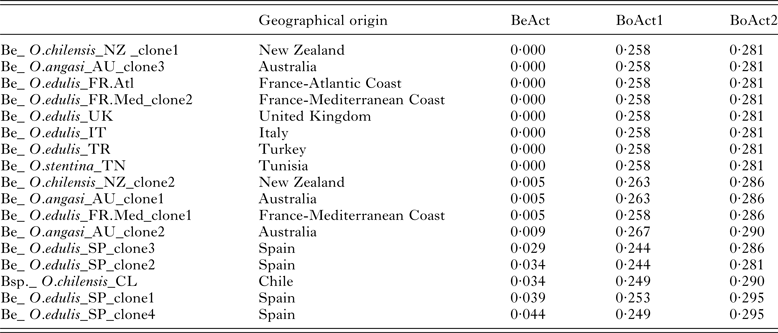
The pairwise distance of BeAct, BoAct1 and BoAct2 compared with sequences obtained in infected oysters from different origins is shown in Table 5. No difference was observed among actin sequences obtained in O. chilensis from New Zealand (clone 1), O. angasi from Australia (clone 3) and O. edulis from Tunisia, Turkey, UK, Italy and France (Atlantic coast and Mediterranean coast clone 2). Low dissimilarity, up to 0·009, were obtained with actin sequences from infected O. chilensis from New Zealand (clone 2), O. angasi from Australia (clones 1 and 2) and O. edulis from France-Mediterranean coast (clone 1). The highest divergence was observed between BeAct and the Spanish and Chilean sequences. Overall divergence of BoAct2 was higher than BoAct1. Actin sequences obtained on infected O. angasi from Australia (clone 2) and those obtained on infected O. edulis from Spain (clones 1 and 4) were the most divergent to BoAct1 and BoAct2, respectively.
Pairwise distance between Bonamia exitiosa actin (BeAct), Bonamia ostreae actin gene-1 (BoAct1) and B. ostreae actin gene-2 (BoAct2) and actin sequences obtained in Bonamia sp. infected oysters from different geographical origin (Maximum Composite Likelihood model)

DISCUSSION
Bonamia exitiosa was firstly detected in the Southern Hemisphere causing important mortalities in cultured oysters (Doonan et al. Reference Doonan, Cranfield and Jones1994; Cranfield et al. Reference Cranfield, Dunn, Doonan and Michael2005). This parasite was recently detected in European waters however the magnitude of its effect and the reason of its presence in native oyster O. edulis are still unknown. Several difficulties have been found in the classification of some representatives of the genus Bonamia leading in some cases to unresolved categorizations. In this sense, beyond morphological descriptions through histological studies, the genomic characterization has become an indispensable tool to completely catalogue these species (Hill et al. Reference Hill, Carnegie, Aloui-Bejaoui, El Gharsalli, White, Stokes and Burreson2010). Genomic information offers valuable data that allows homology searching in public databases and also inferring the phylogenetic evolution of a group. However, in some cases, as occurs in unculturable protozoans, the obtaining of genomic material becomes an arduous challenge.
In this study, we have amplified 6-folds the concentration of the initial genomic DNA obtained from B. exitiosa purified parasites using WGA by isothermal strand displacement with the GenomiPhi V2 DNA Amplification Kit. Among the methods of WGA described to date, the multiple displacement amplification technique was described to be better in genome coverage (Spits et al. Reference Spits, Le Caignec, De Rycke, Van Haute, Van Steirteghem, Liebaers and Sermon2006; Nelson Reference Nelson2014). Moreover, the GenomiPhi V2 DNA Amplification Kit had higher success rate and higher concentration of high molecular weight DNA compared with similar methods (Bouzid et al. Reference Bouzid, Heavens, Elwin, Chalmers, Hadfield, Hunter and Tyler2010). WGA has been recently applied in human pathogens obtaining satisfactory results (Carret et al. Reference Carret, Horrocks, Konfortov, Winzeler, Qureshi, Newbold and Ivens2005; Morrison et al. Reference Morrison, Mccormack, Sweeney, Likeufack, Truc, Turner, Tait and Macleod2007; McLean et al. Reference McLean, Lombardo, Ziegler, Novotny, Yee-Greenbaum, Badger, Tesler, Nurk, Lesin, Brami, Hall, Edlund, Allen, Durkin, Reed, Torriani, Nealson, Pevzner, Friedman, Venter and Lasken2013; Seth-Smith et al. Reference Seth-Smith, Harris, Skilton, Radebe, Golparian, Shipitsyna, Duy, Scott, Cutcliffe, O'Neill, Parmar, Pitt, Baker, Ison, Marsh, Jalal, Lewis, Unemo, Clarke, Parkhill and Thomson2013). However, to our knowledge this is the first time that this method was tested in a marine mollusc parasite. Using the amplified genomic material as a template and the degenerate primers previously designed by Longet et al. (Reference Longet, Burki, Flakowski, Berney, Polet, Fahrni and Pawlowski2004) we succeeded in the amplification of actin in B. exitiosa. This achievement might be related to the use of purified and uncontaminated cells. Since the amplification is unspecific, high relative concentration of exogenous DNA, such as bacteria or host cells in our case, could favour the generation of undesirable products (Pan et al. Reference Pan, Urban, Palejev, Schulz, Grubert, Hu, Snyder and Weissman2008).
We obtained a fragment of 867 nucleotides that corresponded to the characteristic actin domain found in actin-related proteins (Schutt et al. Reference Schutt, Myslik, Rozycki, Goonesekere and Lindberg1993; Sheterline et al. Reference Sheterline, Clayton, Sparrow and Sheterline1995). Conserved binding sites were found in the amplified fragment including ATP binding sites and gelsolin and profilin binding sites involved in capping the barbed end of actin polymers and their regulation (Korn et al. Reference Korn, Carlier and Pantaloni1987; Schafer and Cooper, Reference Schafer and Cooper1995).
Actin is generally encoded by a multi-gene family in Eukaryotes (Fairbrother et al. Reference Fairbrother, Hopwood, Lockley and Bardsley1998; Fyrberg et al. Reference Fyrberg, Kindle, Davidson and Kindle1980; Schwartz and Rotblum, Reference Schwartz and Rotblum1981). The number of actin genes is highly variable in protozoan and increases in multicellular organisms (Sehring et al. Reference Sehring, Mansfeld, Reiner, Wagner, Plattner and Kissmehl2007). Multiple paralogous genes were characterized in several haplosporidians including H. louisiana, M. chitonis, M. teredinis and M. tapetis (Reece et al. Reference Reece, Siddall, Stokes and Burreson2004). However, other representatives of the group such as H. costale and H. nelsoni as well as U. crescens have a single actin gene described to date. Regarding Bonamia genus, two actin genes were described in B. ostreae (López-Flores et al. Reference López-Flores, Suárez-Santiago, Longet, Saulnier, Chollet and Arzul2007) and sequence analysis presented herein might suggest that B. exitiosa possesses one actin gene. However further works are required to conclude about the number of actin genes present in B. exitiosa genome.
High variability was found regarding the number of introns in actin genes of Haplosporidia (Reece et al. Reference Reece, Siddall, Stokes and Burreson2004). Bonamia exitiosa, together with H. nelsoni and U. crescens, could be included in the group of species with an unique actin gene and not introns. Intronless sequences were described to be orthologous (Reece et al. Reference Reece, Siddall, Stokes and Burreson2004). It was hypothesized that the increase in the number of introns could explain the emergence of multiple genes in haplosporidians (López-Flores et al. Reference López-Flores, Suárez-Santiago, Longet, Saulnier, Chollet and Arzul2007).
Comparison of amino acid sequence showed that B. exitiosa actin was more similar to B. ostreae actin gene-1. Both sequences shared 21% of the amino acid residues and also the 3′ end of the fragment amplified by the degenerate primers. The evolutionary divergence between sequences estimated by pairwise distance revealed that the number of base substitutions per site among sequences was lower between B. exitiosa actin and B. ostreae actin gene-1 than between B. exitiosa actin and B. ostreae actin gene-2, confirming results obtained by multiple alignment analysis. The actin sequence of the host, O. edulis, was also included in the analysis and confirmed that the sequence that we obtained did not correspond to the host. The divergence between the deduced amino acid sequences of B. exitosa actin and B. ostreae actin gene-1 was lower than the divergence observed between B. ostreae actin genes (López-Flores et al. Reference López-Flores, Suárez-Santiago, Longet, Saulnier, Chollet and Arzul2007). Divergence between species and within species can be similar at protein level, as was previously described in Dinoflagellates (Kim et al. Reference Kim, Bachvaroff, Hand and Delwiche2011). The percentage of amino acid divergence between actin isoforms in protozoans was described to be very variable reaching 16–18% in foraminiferans and 40% in the ciliate Paramecium tetraurelia (Wesseling et al. Reference Wesseling, Smits and Schoenmakers1988; Keeling Reference Keeling2001; López-Flores et al. Reference López-Flores, Suárez-Santiago, Longet, Saulnier, Chollet and Arzul2007; Sehring et al. Reference Sehring, Mansfeld, Reiner, Wagner, Plattner and Kissmehl2007).
Bonamia genus was described to belong to haplosporidian group among Cercozoa (Carnegie et al. Reference Carnegie, Barber, Culloty, Figueras and Distel2000; Cochennec-Laureau et al. Reference Cochennec-Laureau, Le Roux, Berthe and Gerard2000; Cavalier-Smith Reference Cavalier-Smith2002; Cavalier-Smith and Chao, Reference Cavalier-Smith and Chao2003; Prado-Alvarez et al. Reference Prado-Alvarez, Chollet, Couraleau, Morga and Arzul2013). The phylogenetic relationship among haplosporidians has been previously ascertained using ribosomal DNA and actin genes (Carnegie et al. Reference Carnegie, Barber, Culloty, Figueras and Distel2000, Reference Carnegie, Burreson, Hine, Stokes, Audemard, Bishop and Peterson2006; Reece et al. Reference Reece, Siddall, Stokes and Burreson2004; López-Flores et al. Reference López-Flores, Suárez-Santiago, Longet, Saulnier, Chollet and Arzul2007; Carrasco et al. Reference Carrasco, Villalba, Andree, Engelsma, Lacuesta, Ramilo, Gairín and Furones2012). Regarding Bonamia representatives, phylogenetic analysis based on ribosomal DNA placed B. exitiosa and B. roughleyi (B. roughleyi nomen dubitum, Carnegie et al. Reference Carnegie, Hill, Stokes and Burreson2014) in a sister group to B. ostreae and B. perspora (Cochennec-Laureau et al. Reference Cochennec-Laureau, Reece, Berthe and Hine2003; Carnegie et al. Reference Carnegie, Burreson, Hine, Stokes, Audemard, Bishop and Peterson2006; Abollo et al. Reference Abollo, Ramilo, Casas, Comesaña, Cao, Carballal and Villalba2008). The topology of our phylogenetic tree based on actin sequences including the novel B. exitiosa actin was in concordance with these previous analyses. Bonamia exitiosa grouped within the clade of Bonamia genus closer to B. ostreae actin gene-1 and in a sister branch to B. ostreae actin gene-2 suggesting that B. exitiosa have evolved after the differentiation of B. ostreae actin paralogs.
The actin sequence obtained in purified B. exitiosa parasites perfectly aligned with the currently considered B. exitiosa infected samples from New Zealand, Australia, the UK, Italy, France-Mediterranean coast and Tunisia (Hine et al. Reference Hine, Cochennec-Laureau and Berthe2001; Corbeil et al. Reference Corbeil, Arzul, Robert, Berthe, Besnard-Cochennec and Crane2006; Arzul et al. Reference Arzul, Aranguren, Arcangeli, Chesslet, Engelsma, Figueras, Garcia, Geoghegan, Magnabosco and Stone2011). Sequences obtained in Bonamia sp. infected oysters from France-Atlantic coast and Turkey were also included in the same group, concluding that these uncategorized parasites might be indeed considered B. exitiosa.
The phylogenetic study based on actin sequences supported the inclusion of all the samples in a sister clade to B. ostreae sequences with a strong bootstrap support. Molecular analysis comparisons based on nucleotide alignment and pairwise distances among actin sequences revealed that samples from O. chilensis from Chile and O. edulis from Spain were the most divergent compared with B. exitiosa actin sequence. These samples shared 6 of the 17 mismatches found in the multiple alignment and resolved in separated branches within the strongly supported cluster where actin sequence from B. exitiosa purified parasites was included. Previous phylogenetic studies based on SSU rDNA placed the Chilean and the Spanish samples in the same group as B. exitiosa (Hill et al. Reference Hill, Carnegie, Aloui-Bejaoui, El Gharsalli, White, Stokes and Burreson2010; Carrasco et al. Reference Carrasco, Villalba, Andree, Engelsma, Lacuesta, Ramilo, Gairín and Furones2012). However, the analysis of ITS1-5, 8-ITS2 sequences placed the Chilean clone in a separate branch inside the group of Bonamia sp. representatives (Hill et al. Reference Hill, Carnegie, Aloui-Bejaoui, El Gharsalli, White, Stokes and Burreson2010). Our phylogenetic analyses based on the actin gene supported this topology, suggesting a closer relationship between Chilean and Spanish samples. Based on our analysis, we do not have enough support to conclude that Chilean samples were infected with B. exitiosa. Therefore, the affiliation of this sample remains uncertain and further investigation would be necessary to clarify its position among Bonamia representatives.
The NGS methods have recently been applied to the protozoan M. mackini obtaining novel information that clarified the phylogenetic position of this organism (Burki et al. Reference Burki, Corradi, Sierra, Pawlowski, Meyer, Abbott and Keeling2013). However, the impossibility to obtain proper genomic material could limit the use and potential of the NGS in some organisms such as unculturable protozoans. In this sense, the WGA method allows the obtaining of reliable NGS results from limited starting material, reducing also the percentage of undesirable products and enhancing the efficiency of the technique. Some technologies combining both methods have been applied to Eukaryotes and Prokaryotes (Pamp et al. Reference Pamp, Harrington, Quake, Relman and Blainey2012; Young et al. Reference Young, Jex, Li, Liu, Yand, Xiong, Li, Cantacessi, Hall, Xu, Chen, Wu, Zerlotini, Oliveira, Hofmann, Zhang, Fang, Kang, Campbell, Loukas, Ranganathan, Rollinson, Rinaldi, Brindley, Yang, Wang, Wang and Gasser2012; Korfhage et al. Reference Korfhage, Fisch, Fricke, Baedker and Loeffert2013). Data presented in this work demonstrated the successful use of the WGA technique in the unculturable protozoa B. exitiosa which might facilitate the application of new promising methodologies in these organisms.
Using Whole-Genome amplified genomic DNA we characterized for first time the actin gene on B. exitiosa, increasing the genomic data available in this specie. These new data allow us examining the phylogenetic affiliation of Bonamia sp. representatives and clarified their uncertain classification. To our knowledge this is the first time that WGA methodology is applied in a haplosporidian. This technique might also allow the developing of necessary and specific diagnostic tools to discriminate between B. ostreae and B. exitiosa parasites.
FINANCIAL SUPPORT
The Région of Poitou Charentes and IFREMER supported this research and MPA's Postdoctoral Fellowship (note: there are no grant numbers associated with this support).