Introduction
In the last decade, phylogenetic analyses of partial 28S ribosomal DNA (rDNA) fragments have been used as a fundamental instrument for a better genus allocation, and to assess interrelationships of dactylogyrid parasites infecting mainly Neotropical siluriforms (Mendoza-Palmero et al., Reference Mendoza-Palmero, Blasco-Costa and Scholz2015, Reference Mendoza-Palmero, Rossin, Irigoitia and Scholz2020; Acosta et al., Reference Acosta, Fraceschini, Zago, Scholz and Silva2017, Reference Acosta, Mendoza-Palmero, Silva and Scholz2019; Franceschini et al., Reference Franceschini, Zago, Müller, Francisco, Takemoto and Silva2018, Reference Franceschini, Acosta, Zago, Müller and da Silva2020), as well as other dactylogyrid parasites of characiform, gymnotiform and perciform freshwater fishes (Mendoza-Palmero et al., Reference Mendoza-Palmero, Blasco-Costa, Hernández-Mena and de León2017; Moreira et al., Reference Moreira, Luque and Šimková2019; Zago et al., Reference Zago, Yamada, Yamada, Franceschini, Bongiovani and da Silva2020, Reference Zago, Franceschini, Abdallah, Müller, Azevedo and da Silva2021).
Cosmetocleithrum Kritsky, Thatcher & Boeger, Reference Kritsky, Thatcher and Boeger1986 (Dactylogyridae) represents a group of gill parasites of Neotropical catfishes strictly associated with fish species of the Doradidae, Auchenipteridae and Pimelodidae (all Siluriformes). Species of this genus are mainly characterized by the presence of a dorsal bar with two submedial ribbon-like projections arising from the anterodorsal surface of the bar (Kritsky et al., Reference Kritsky, Thatcher and Boeger1986). Other morphological elements of the haptor (such as anchors, hooks and ventral bars) are quite conservative between species, whereas the morphology of the copulatory complex (male copulatory organ and accessory piece) is highly variable. To date, 22 species have been described as members of Cosmetocleithrum mainly parasitizing doradids (14 species), seven on auchenipterids and only one has been recorded on pimelodids (Cohen et al., Reference Cohen, Justo, Gen and Boeger2020; Yamada et al., Reference Yamada, Yamada and da Silva2020; Feronato et al., Reference Feronato, Razzolini, Murrieta Morey and Boeger2022).
Despite the fact that Cosmetocleithrum is one of the richest dactylogyrid genera infecting Neotropical siluriforms, only C. bulbocirrus Kritsky, Thatcher & Boeger, Reference Kritsky, Thatcher and Boeger1986, C. bifurcum Mendoza-Franco, Mendoza-Palmero & Scholz, Reference Mendoza-Franco, Mendoza-Palmero and Scholz2016 and C. falsinulatum Feronato, Razzolini, Morey & Boeger, Reference Feronato, Razzolini, Murrieta Morey and Boeger2022 (all parasites of doradids) have been analysed in recent phylogenetic studies (Mendoza-Palmero et al., Reference Mendoza-Palmero, Blasco-Costa and Scholz2015, Reference Mendoza-Palmero, Rossin, Irigoitia and Scholz2020; Acosta et al., Reference Acosta, Fraceschini, Zago, Scholz and Silva2017, Reference Acosta, Mendoza-Palmero, Silva and Scholz2019; Franceschini et al., Reference Franceschini, Zago, Müller, Francisco, Takemoto and Silva2018; Zago et al., Reference Zago, Yamada, Yamada, Franceschini, Bongiovani and da Silva2020, Reference Zago, Franceschini, Abdallah, Müller, Azevedo and da Silva2021; Feronato et al., Reference Feronato, Razzolini, Murrieta Morey and Boeger2022). In some of these studies, dactylogyrid parasites of Neotropical catfishes have appeared repeatedly in two main clades, even when other parasite groups infecting characids and cichlids were considered (Zago et al., Reference Zago, Yamada, Yamada, Franceschini, Bongiovani and da Silva2020, Reference Zago, Franceschini, Abdallah, Müller, Azevedo and da Silva2021). Moreover, Cosmetocleithrum has been resolved (with variable nodal support) either as a part of a major clade including parasites of pimelodids (Acosta et al., Reference Acosta, Scholz, Blasco-Costa, Alves and Silva2018; Zago et al., Reference Zago, Franceschini, Abdallah, Müller, Azevedo and da Silva2021), or closely related to loricariids (Zago et al., Reference Zago, Yamada, Yamada, Franceschini, Bongiovani and da Silva2020).
Considering that only three species of Cosmetocleithrum spp. (of a total of 22 currently described) have been included in recent phylogenetic studies, the aim of this study is to assess the phylogenetic relationships of species of Cosmetocleithrum, parasites of Neotropical doradid and auchenipterid catfishes, using partial sequences of the 28S ribosomal RNA (rRNA) gene, and to evaluate the phylogenetic position of Cosmetocleithrum in respect to other dactylogyrid parasites infecting Neotropical freshwater fishes.
Materials and methods
Specimen collection and processing
Specimens of Oxydoras niger (Valenciennes) (host field codes: PI 797, PI 1028) (Doradidae) and Trachelyopterus sp. (PI 950) (Auchenipteridae) were captured by local fishermen in the surroundings of Iquitos (03°45′51″S, 73°14′50″W), Peru, in 2011 and 2018. Dactylogyrids were removed from the gills, fixed with hot water (c. 80°C) and stored in vials with 96% ethanol. For molecular characterization, parasites were cut in half with fine needles; since the haptoral armament in species of Cosmetocleithrum is rather similar, the anterior part containing the copulatory complex was used for morphological identification. The posterior part was placed in a sterilized Eppendorf tube and used for molecular characterization. For each isolate, the anterior part was placed on a slide with a drop of Proteinase K (SERVA, Heidelberg, Germany), covered with a coverslip, heated on a hot plate and checked regularly using an optical microscope (Olympus BX51, Tokyo, Japan) until the copulatory complex was clearly visible (more Proteinase K was added when needed). Once the specimens were identified, slides were labelled, and edges of coverslip were sealed with transparent nail polish. Specimens were then photographed, additional nail polish was added and slides were deposited in the Helminthological Collection of the Institute of Parasitology, Biology Centre of the Czech Academy of Sciences, České Budějovice, Czech Republic as molecular vouchers (hologenophores M-766–772) (see Pleijel et al., Reference Pleijel, Jondelius, Norlinder, Nygren, Oxelman, Schander, Sundberg and Thollesson2008 for terminology). Fish names follow Froese & Pauly (Reference Froese and Pauly2022).
Molecular characterization and phylogenetic analyses
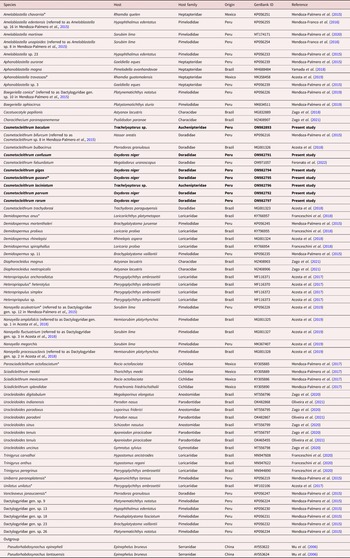
Procedures of DNA extraction, gene amplification and sequencing followed those of Mendoza-Palmero et al. (Reference Mendoza-Palmero, Blasco-Costa and Scholz2015). A total of seven partial sequences of the 28S rRNA gene (1424–1473 bp long) were newly generated in the present study, corresponding to seven species of Cosmetocleithrum, including the type species C. gussevi Kritsky, Thatcher & Boeger, Reference Kritsky, Thatcher and Boeger1986. Details of all species included in the analyses are provided in table 1.
Parasite species used in the phylogenetic analysis. Species newly sequenced in this study are in bold.

*Type species of each genus.
To the phylogenetiassessc relationships of species of Cosmetocleithrum and their position in relation to other dactylogyrid parasites of Neotropical freshwater fishes, the newly generated sequences (present study) along with 57 previously published sequences of the 28S rDNA fragment (918–1575 bp long) representing 48 species of dactylogyrids of siluriforms, and 16 species of non-catfish hosts, were subjected to phylogenetic analyses (see table 1). Sequences of two species of the Diplectanidae were used as outgroup (table 1 and fig. 1).
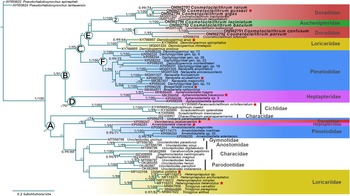
Phylogenetic relationships of Cosmetocleithrum spp. and other dactylogyrid parasites from the Neotropical region, estimated by ML using partial sequences of the 28S rRNA gene. Species of the Diplectanidae were used as outgroup. GenBank sequence ID precedes species name. Newly generated sequences of species are in bold. Type species of selected genera are marked by a red star. Posterior probabilities (BI) and bootstrap values (ML) are given above the nodes (posterior probabilities <0.90 and bootstrap values <60 are not shown).

Sequences were aligned using default parameters of MAFFT implemented in Geneious v.7.1.3 (Kearse et al., Reference Kearse, Moir and Wilson2012). The extremes of the alignment were trimmed, resulting in 914 nucleotide positions for analyses. Phylogenetic analyses were run under maximum likelihood (ML) and Bayesian inference (BI) methods, applying the model of nucleotide evolution GTR+Γ+I, estimated using MEGA 7 (Kumar et al., Reference Kumar, Stecher and Tamura2016). ML analyses were performed with RAxML v.8 (Guindon & Gascuel, Reference Guindon and Gascuel2003); model parameters and bootstrap support values (1000 resamples) were estimated with RAxML. BI trees were generated using MrBayes v.3.2 (Ronquist et al., Reference Ronquist, Teslenko and van der Mark2012), running two independent Markov Chain Monte Carlo runs of four chains for 107 generations and sampling tree topologies every 103 generations. ‘Burn-in’ was set to the first 25,000 generations. MrBayes and RAxML analyses were carried out on the computational platform CIPRES (Miller et al., Reference Miller, Pfeiffer and Schwartz2010). Phylogenetic trees were visualized in FigTree v.1.3.1 (Raumbaut, Reference Raumbaut2009).
Results
A total of 64 species representing 17 genera (along with those identified as Dactylogyridae gen. spp.) of the Dactylogyridae infecting 36 fish host species from the Neotropical region, including two species of the Diplectanidae used as outgroup, were subjected to phylogenetic analyses (see table 1 and fig. 1). In this study, 11 species of Cosmetocleithrum (including the type species C. gussevi) were included in the analyses. Tree topology from ML and BI analyses was consistent; therefore, only results of the ML analysis are shown (fig. 1). The 28S rDNA data resolved two major lineages of dactylogyrid parasites of Neotropical freshwater fishes labelled as A and B (fig. 1). Clade A is composed of the genus Characithecium Mendoza-Franco, Reina & Torchin, 2009 (parasites of characids), forming the earliest branching group of the clade, composing a lineage together with Unibarra Suriano & Incorvaia, Reference Suriano and Incorvaia1995, Vancleaveus Kritsky, Thatcher & Boeger, Reference Kritsky, Thatcher and Boeger1986 and Ameloblastella Kritsky, Mendoza-Franco & Scholz, 2000 (parasites of pimelodids, doradids and heptapterids). This group forms a sister clade to the genus Urocleidoides Mizelle & Price, 1964 (parasites of gymnotids, anostomids and parodontids), Cacatuocotyle Boeger, Domingues & Kritsky, 1997, Diaphorocleidus Jogunoori, Kritsky & Venkatanarasaiah, 2004 (both parasites of characids), Unilatus Mizelle & Kritsky, 1967, Heteropriapulus (Jogunoori, Kritsky & Venkatanarasaiah, 2004) and Trinigyrus Hanek, Molnar & Fernando, 1974 (all parasites of loricariids). Clade B is divided in two main subclades, C and D. In the subclade C, Cosmethocleithrum appears as an evolutionary recent group, but weakly supported group, sister to a well-supported clade of Demidospermus Suriano, 1983 (parasites of loricariids); both genera form the lineage E (fig. 1). These two genus-level lineages are sister to a larger lineage F (all parasites exclusively of pimelodids) consisting of Demidospermus sp. 11, D. mortenthaleri Mendoza-Palmero, Scholz, Mendoza-Franco & Kuchta, 2012, Nanayella Acosta, Mendoza-Palmero, Scholz & Silva, 2019, Boegeriella (Mendoza-Palmero, Mendoza-Franco, Acosta & Scholz, Reference Mendoza-Palmero, Mendoza-Franco, Acosta and Scholz2019) and several unidentified species of the Dactylogyridae. Finally, subclade D is composed of species of Aphanoblastella Kritsky, Mendoza-Franco & Scholz, 2000 (parasites of heptapterids), and the sister group formed by Parasciadicleithrum Mendoza-Palmero, Blasco-Costa, Hernández-Mena & Pérez-Ponce de León, Reference Mendoza-Palmero, Blasco-Costa, Hernández-Mena and de León2017 and Sciadicleithrum Kritsky, Thatcher & Boeger, 1989 (both parasites of cichlids).
Results from both analyses showed that Cosmetocleithrum is composed of two well-defined and well-supported lineages (labelled as 1 and 2 in fig. 1). In lineage 1 (parasites of doradids, fig. 1), C. bulbocirrus Kritsky, Thatcher & Boeger, Reference Kritsky, Thatcher and Boeger1986 formed the earliest branching species of the lineage 1, sister to C. confusum Kritsky, Thatcher & Boeger, Reference Kritsky, Thatcher and Boeger1986, C. parvum Kritsky, Thatcher & Boeger, Reference Kritsky, Thatcher and Boeger1986 and C. bifurcum Mendoza-Franco, Mendoza-Palmero & Scholz, Reference Mendoza-Franco, Mendoza-Palmero and Scholz2016. Lineage 2 (fig. 1) is composed of two well-defined groups: the ‘doradid group’ and the ‘auchenipterid group’. The ‘doradid group’ includes C. rarum Kritsky, Thatcher & Boeger, Reference Kritsky, Thatcher and Boeger1986, C. gussevi (type species), C. gigas Murrieta, Zumaeta & Sánchez, 2019, C. trachydorasi (Acosta, Scholz, Blasco-Costa, Alves, & Silva, Reference Acosta, Scholz, Blasco-Costa, Alves and Silva2018) and C. falsunilatum Feronato, Razzolini, Morey & Boeger, Reference Feronato, Razzolini, Murrieta Morey and Boeger2022. The ‘auchenipterid group’ is composed of the species C. laciniatum Yamada, Yamada, Silva & Anjos, 2017 and C. baculum Yamada, Yamada & Silva, Reference Yamada, Yamada and da Silva2020.
Discussion
In this study, interrelationships of species of Cosmetocleithrum, for which sequence are available (including its type species), were evaluated based on the analysis of seven novel partial sequences of the 28S rRNA gene, including species of selected genera parasitizing siluriform and non-siluriform hosts. The phylogenetic analyses performed herein suggested that Cosmetocleithrum is composed of two well-defined lineages of parasites from doradid and auchenipterid catfishes, which are clustered together with Demidospermus spp. parasites of loricariids (clade E), including parasites of pimelodids closely related to the recently erected Boegeriella and Nanayella, and those unidentified species of Dactylogyridae gen. spp. (clade F). Our results are consistent with previous phylogenetic studies (based on 28S rDNA fragments) where dactylogyrid parasites of Neotropical catfishes formed two well-defined major clades (Acosta et al., Reference Acosta, Scholz, Blasco-Costa, Alves and Silva2018; Franceschini et al., Reference Franceschini, Zago, Müller, Francisco, Takemoto and Silva2018; Zago et al., Reference Zago, Franceschini, Abdallah, Müller, Azevedo and da Silva2021), with Cosmetocleithrum comprising a lineage closely related to Demidospermus spp.
Recently, Cohen et al. (Reference Cohen, Justo, Gen and Boeger2020, p. 3) mentioned, ‘[t]he morphological variability of known species of Cosmetocleithrum may suggest that the genus contains several subordinate clades’. Our results, based on molecular information, partially confirm that prediction, although only 11 species of the genus were analysed in this study. Cohen et al. (Reference Cohen, Justo, Gen and Boeger2020) also mentioned that known species of Cosmetocleithrum could be grouped in two morphological categories: (i) species that resemble C. gussevi (type species), having non-articulated bars and accessory piece distally bifid (often resembling a hook) – that is, C. parvum, C. rarum, C. sobrinus, C. longivaginatum, C. striatuli, C. laciniatum, C. phryctophallus, C. gigas, C. berecae and C. nunani; and (ii) those species with articulated bars and variably shaped accessory piece – that is, C. confusum, C. bulbocirrus, C. tortum and C. bifurcum (see Cohen et al., Reference Cohen, Justo, Gen and Boeger2020).
The phylogenetic position of the species analysed in this study only partially corresponds to the morphological categories mentioned above. Most species of the subclade 1 (clade E, fig. 1) correspond to category (ii) of Cohen et al. (Reference Cohen, Justo, Gen and Boeger2020), except for the position of C. parvum (category (i) according to Cohen et al., Reference Cohen, Justo, Gen and Boeger2020). In contrast, subclade 2 (clade E, fig. 1) partially corresponds to the category (i). However, Cohen et al. (Reference Cohen, Justo, Gen and Boeger2020) did not mention if C. trachydorasi belonged to any of these categories, but the morphology of haptoral elements and accessory piece of C. trachydorasi indicates that this species corresponds to category (i) (see Acosta et al., Reference Acosta, Scholz, Blasco-Costa, Alves and Silva2018 for more details). The position of C. gussevi within subclade 2, and the morphological characteristics shared by species circumscribed in category (i) – that is, non-articulated bars and accessory piece distally bifid, as defined by Cohen et al. (Reference Cohen, Justo, Gen and Boeger2020) – could be considered to amend the diagnosis of Cometocleithrum in order to distinguish this group of species from those of category (ii), which could represent different genera.
In their study, Cohen et al. (Reference Cohen, Justo, Gen and Boeger2020) questioned the validity of Paracosmetocleithrum Acosta, Scholz, Blasco-Costa, Alves & Silva, Reference Acosta, Scholz, Blasco-Costa, Alves and Silva2018, and based on the morphological evaluation of the type-material, they synonymized Paracosmetocleithrum with Cosmetocleithrum, transferring its only member to Cosmetocleithrum as C. trachydorasi. In our study, based on the analysis of partial 28S rDNA fragments, the position of C. trachydorasi within the subclade 2 (fig. 1) clearly indicates that the taxonomic action of Cohen et al. (Reference Cohen, Justo, Gen and Boeger2020) is well supported.
Cosmetocleithrum was originally proposed for dactylogyrid parasites of doradid catfishes possessing gonads in tandem, copulatory complex comprising a variably coiled cirrus with counterclockwise rings, elaborate accessory piece, vagina sinistral and dorsal bar with two submedial projections arising from anterodorsal surface of the bar (Kritsky et al., Reference Kritsky, Thatcher and Boeger1986). In the last decade, as many as 15 species of Cosmetocleithrum have been described, and some novel morphological characteristics have been added to the generic diagnosis. For instance, C. bifurcum (member of the ‘doradid group’) and C. baculum (member of the ‘auchenipterid group’) possess two types of hooks, whereas all hook pairs are similar in the rest of species. Moreover, C. tortum Mendoza-Franco, Mendoza-Palmero & Scholz, Reference Mendoza-Franco, Mendoza-Palmero and Scholz2016 (not analysed in this study) possesses dextral vagina, whereas for all known species of the genus the vaginal aperture is present on the left margin of the body. Regarding the shape of the accessory piece and number of rings of the Male Copulatory Organ (MCO), these characteristics are highly variable between species, with the exception of C. falsinulatum (member of the ‘doradid’ group) having a unique cork-screw-like MCO morphology (see Feronato et al., Reference Feronato, Razzolini, Murrieta Morey and Boeger2022).
Our study provides two fundamental suggestions for future studies on Cosmetocleithrum spp. First, the molecular characterization of 11 species of the genus remains to be carried out – that is, C. akuanduba Soares, Neto & Domingues, 2018, C. berecae Cohen, Justo, Gen & Boeger, Reference Cohen, Justo, Gen and Boeger2020, C. galeatum Yamada, Yamada & Silva, Reference Yamada, Yamada and da Silva2020, C. leandroi Soares, Neto & Domingues, 2018, C. longivaginatum Suriano & Incorvaia, Reference Suriano and Incorvaia1995 (the only species infecting pimelodids), C. nunani, C. phryctophallus, C. sobrinus Kritsky, Thatcher & Boeger Reference Kritsky, Thatcher and Boeger1986, C. spathulatum Yamada, Yamada & de Silva, Reference Yamada, Yamada and da Silva2020, C. striatuli Abdallah, Azevedo & Luque, 2012 and C. tortum, in order to evaluate whether the inclusion of these species may support subclades 1 and 2 obtained in this study. Secondly, the search for synapomorphies to characterize taxonomic groups within Cosmetocleithrum is essential, but at the same time this task appears challenging, since the morphology of haptoral elements of Cosmetocleithrum spp. is quite conservative, and that of the copulatory complex is highly variable between species as previously mentioned.
Acknowledgements
Two anonymous reviewers provided valuable comments and suggestions that significantly improved the manuscript. The authors are indebted to Roman Kuchta (Institute of Parasitology, České Budějovice, Czech Republic) and Alain de Chambrier (Museum of Natural History, Geneva, Switzerland) for their help during fish examination in Iquitos, Peru. The authors thank Jan Brabec (Institute of Parasitology, České Budějovice, Czech Republic) for revising an early draft of the manuscript. Martin Mortenthaler, Aurora Ramírez and staff of Acuario Río Momón (Iquitos, Peru) kindly helped us during fieldwork.
Financial support
This study was supported by the Institute of Parasitology, BC CAS (RVO: 60077344).
Conflicts of interest
None.
Ethical standards
The authors assert that all procedures contributing to this work comply with the ethical standards of the relevant national and institutional guides on the care and use of animals.