1. Introduction
Genetically modified (GM) crops' capacity to reduce pesticide use should have led consumers to prefer the GM over the conventional varieties, since the latter require higher use of pesticides, for (at least) two reasons. Firstly, lower input use reduces production cost and may reduce output price (Moschini et al., Reference Moschini, Lapan and Sobolevsky2000). Secondly, lower or no use of pesticides reduces health risks (Phipps and Park, Reference Phipps and Park2002; Hamilton et al., Reference Hamilton, Sunding and Zilberman2003). Since consumers assign higher importance to reducing health hazards than they do to improving health benefits (Tversky and Kahneman, Reference Tversky and Kahneman1974), food products with lower pesticide levels should have been evaluated higher than those with improved nutritional value. Yet empirical evidences suggest the opposite, i.e., claiming that the GM product reduces health risks by reducing pesticide use has actually led to buyers demanding less of the GM products (Chern et al., Reference Chern, Rickertsen, Tsuboi and Fu2002; Krishna and Qaim, Reference Krishna and Qaim2008; Huffman, Reference Huffman2010).
A possible explanation for this observation is based on the accessibility approach (Chakravarti and Janiszewski, Reference Chakravarti and Janiszewski2004; Weber and Johnson, Reference Weber, Johnson, Slovic and Lichtenstein2005) wherein information on risk increases its accessibility and its usage in subsequent judgments. The information regarding less use of pesticides therefore gives rise to an association of the product with risk, so that regardless of the valence of the message, consumers avoid the product (Tybout et al., Reference Tybout, Calder and Sternthal1981).
However, the accessibility argument fails to explain costly advertising (e.g., by Monsanto) of GM crops' role in reducing pesticide use on Roundup Ready varieties (Charry, Reference Charry1997; Hall, Reference Hall1999) and that of the Whole Foods Market, which advertises itself as selling low-pesticide produce only.Footnote 1
In this paper, we offer an alternative explanation for consumer resistance to GM based on multi-attribute information's effect on consumers' perceptions and choices. We argue that information on reduced pesticide use in GM crops primes at least two attributes simultaneously – health, and contribution (damage) to the environment – and in addition may attract attention to price, a third attribute. The provision of multi-attribute information is similar to positioning on multiple attributes that can result in consumers' averaging of attributes' qualities (Anderson, Reference Anderson1965). Such averaging may yield less desirable evaluations compared to perceptions when positioning primes a single attribute only (Weaver et al., Reference Weaver, Garcia and Schwarz2012).
Recent studies suggest that under certain conditions, providing information on a second attribute is likely to result in subtractive rather than weighted summing of attribute values (Chernev and Gal, Reference Chernev and Gal2010; Chernev, Reference Chernev2011b; Brough and Chernev, Reference Brough and Chernev2012). While these studies analyzed multi-attribute information's effect on aggregate measures such as overall evaluation or intention to buy, the effect of information on the process of forming these evaluations remains unexplored.
There are three additional explanations for the decline in demand after exposure to multi-attribute information. First, additional information may reveal to some consumers that the product does not fit their needs (Sun, Reference Sun2011). Second, information on a product's attributes may cause incongruity between the product and the category positioning, i.e., the product does not match with the category (Meyers-Levy and Tybout, Reference Meyers-Levy and Tybout1989). Third, additional information on health hazards increases the likelihood of changing the structure of the choice rule, i.e., shifting from a choice based on a single attribute to one based on multiple attributes (Heiman and Lowengart, Reference Heiman and Lowengart2011).
This paper explores the effect of information on multiple attributes of GM products on consumers' perceptions of GM products' attributes and subsequent choices. We depart from previous literature in two aspects. Firstly, we explore multi-attribute information's effect on perceptions (evaluation) rather than measuring its effect using an aggregate measure such as reservation price (Weaver et al., Reference Weaver, Garcia and Schwarz2012) or calorie estimation bias (Chernev and Gal, Reference Chernev and Gal2010). Secondly, we focus on GM products' health and environment dimensions, which are both credence attributes, while previous studies mostly focused on experience or search attributes (Nelson, Reference Nelson1974). Using an experimental survey design that allows us to isolate the effects of various types of information, we empirically analyze information's effect on consumers' perceptions of GM regarding water input (saving) and healthfulness of three GM products: canola oil, cotton, and tomatoes.
2. The effect of conflicting and multi-attribute information on perceptions (and choices)
Previous studies on information updating have mostly used the Bayesian framework as their normative baseline (Boyer and Kihlstrom, Reference Boyer and Kihlstrom1984; Viscusi, Reference Viscusi1985; Just et al., Reference Just, Wolf and Zilberman2006) to which other judgment rules are compared (Hertwig and Todd, Reference Hertwig and Todd2000). Deviating from the Bayesian updating norm is attributed to selective memory, wrong assessment of new information, low confidence in the new information, overconfidence, complexity of information (Hogarth and Einhorn, Reference Hogarth and Einhorn1992), and allocating insufficient cognitive resources to the judgment task (Alba and Hutchinson, Reference Alba and Hutchinson2000).
Kahneman and Tversky (Reference Kahneman and Tversky1972) argued that individuals overweight new information (‘base rate neglect’), as they perceive that the new information more accurately represents the situation they are required to judge. They termed this bias of judgment the representativeness heuristic. If, however, the new information is perceived as unreliable, irrelevant (Berger, Reference Berger1997), or as having a low probability of occurrence (Venkateasan, Reference Venkateasan, Ward and Robertson1973), then the prior belief (base) is likely to be overweighted, a phenomenon termed conservatism.
It is widely agreed that consumers tend to hold unfavorable strong prior beliefs about GM products that are so negative that they account for the decline in the demand for US-produced soybeans (Galbraith, Reference Galbraith2013), and motivated the EU requirement for GM labelling (1997) about which Carter and Gruère (Reference Carter and Gruère2003) write ‘mandatory labeling acts as an import barrier and diverts trade …’, thereby reducing demand for GM food products.
Given the unfavorable prior perceptions, new information on how GM crops contribute to human health or the environment is likely to change consumers' prior perceptions only if the information is perceived as reliable and relevant. On the other hand, negative new information that is consistent with the unfavorable priors is expected to be more easily integrated, resulting in having a greater impact on perceptions and choices than that of the positive new information (Rousu et al., Reference Rousu, Huffman, Shogren and Tegene2004).
In contrast to previous arguments, recent reports and articles in the popular media suggest that GM crops contribute to the environment by reducing pesticide usage and carbon emissions, and health by improving the nutritional values of food (Clive, Reference Clive2012; Storr, Reference Storr2013), thereby increasing the impact of academic findings on this matter (Huang et al., Reference Huang, Rozelle, Pray and Wang2002; Qaim and Zilberman, Reference Qaim and Zilberman2003). A larger volume of these positive publications increases the weight that consumers assign to new information, and in turn increases the likelihood of GM product acceptance, including a higher assessment of health and environment attributes.
Counter to the expected change in perception after exposure to information on GM products' contribution to the environment and health, claims that GM food is tastier are not likely to change consumers' rating of the taste attribute significantly for two reasons. First, taste is perceptually related to the production process and ingredients, and when consumers dislike the process, they rate the product as less tasty (Wansink, Reference Wansink2005). Secondly, GM food products are likely to activate the ‘ick factor’ (an expression used in the blogosphere describing bloggers' revulsion for GM food productsFootnote 2 ), which is likely to deflate consumers' perceptions of tastiness. Following the aforementioned discussion, hypotheses (1a) and 1b are proposed:
Hypothesis 1a
Information on GM products' capacity to contribute to the environment or health is likely to increase consumers' perceptions of the primed attribute.
Hypothesis 1b
Information on tastier GM products is likely to be rejected.
In the next subsection we analyze whether or not priming a single attribute, health or the environment, has a negative effect across attribute perceptions regarding environment and health, respectively. Previous studies found that health claims change the perceptions of both health and taste attributes (Roininen et al., Reference Roininen, Lahteenmaki and Tuorila1999; Chandon and Wansink, Reference Chandon and Wansink2007; Schuldt and Schwarz, Reference Schuldt and Schwarz2010). One explanation for the correlation between changes in product attributes' perceptions after exposure to information is the halo effect, which is defined as consumers making inferences from observable attributes such as taste, to unobservable traits such as health (Asch, Reference Asch1946; Nisbett and Wilson, Reference Nisbett and Wilson1977; Eagly et al., Reference Eagly, Ashmore, Makhijani and Longo1991; Bagozzi, Reference Bagozzi1996; Kayande et al., Reference Kayande, Roberts, Lilien and Fong2007). The halo effect has been used to explain the following: consumers' perceptions of low-calorie food being healthier and vice versa (Zuckerman and Chaiken, Reference Zuckerman and Chaiken1988); that healthier food is less tasty (Bell, Reference Bell1982); and that environment, health and taste attribute perceptions are positively correlated (Ginsberg and Bloom, Reference Ginsberg and Bloom2004; Wan-Chen Lee and Wansink, Reference Wan-Chen Lee and Wansink2011). Another explanation for the aforementioned consumer perceptions is based on evolution arguments that established a positive correlation between healthfulness and tastiness in most food categories (Nestle, Reference Nestle2002).
With respect to GM inputs and products, cross-attribute relationships are less documented. The likelihood of employing heuristic judgment processes, such as deducting from an observable attribute(s) on unobservable attribute quality, increases in low-involvement choice tasks (Tversky and Kahneman, Reference Tversky and Kahneman1974) such as those of frequently purchased, undifferentiated commodities (Brock and Brannon, Reference Brock and Brannon1992; Wansink, Reference Wansink2005). Therefore it is expected that in GM-free food products, a high correlation between observable and non-observable attributes will be observed.
The consumption of GM food products is far more controversial than that of other frequently purchased food categories. GM products are perceived as hazardous mainly to the environment and less so to humans, yet risky (Huffman et al., Reference Huffman, Shogren, Rousu and Tegene2003; Rousu et al., Reference Rousu, Huffman, Shogren and Tegene2007). Individuals use a more demanding choice strategy when they have sufficient motivation. Motivation may be increased when consumers are exposed to new information incongruent with prior beliefs. While incongruity increases attention and cognitive resources – which are allocated to resolving the cognitive conflict, thereby resulting in stronger memorizing and higher accessibility – incongruity also increases uncertainty (Noseworthy and Trudel, Reference Noseworthy and Trudel2011). Health hazards and uncertainty are likely to change the choice mechanism to a systematic one (Chaiken, Reference Chaiken1980; Zuckerman and Chaiken, Reference Zuckerman and Chaiken1988) that considers the tradeoff between attributes (Heiman and Lowengart, Reference Heiman and Lowengart2008). Under a complex systematic choice process, consumers are expected to analyze separately the production of environment and health. This would result in a situation wherein updated perceptions of one product attribute are not likely to affect perceptions of other attributes, consistent with (Weber and Johnson, Reference Weber, Johnson, Slovic and Lichtenstein2005). We therefore hypothesize that:
Hypothesis 2
Priming GM products as being more beneficial to health or to the environment or being tastier is not likely to affect perceptions of other attributes.
Providing consumers with information on two or more attributes (e.g., the GM product contributes both to health and the environment) is similar to positioning on two attributes. Previous literature distinguishes between the cases of negatively and positively correlated attributes. Bilateral marketing is based on the idea that the marketer highlights two attributes, at one of which the product excels, and the other in which the product is not strong, but consumers assign lower importance weighting thereto in their choice (e.g., high quality and price in the top-end segment). Negative correlation between the (benefits of the) two attributes that are advertised simultaneously is a necessary condition for successful bilateral marketing (Pechmann, Reference Pechmann1992). If, on the other hand, there is a positive correlation between health and the environment, then averaging (Anderson, Reference Anderson1965) or subtracting perceptual effects are likely to occur (Chernev and Gal, Reference Chernev and Gal2010; Chernev, Reference Chernev2011a, Reference Chernev2011b; Brough and Chernev, Reference Brough and Chernev2012). In addition, consumers' preferences for (evaluation of) a product are highest when incongruity levels are moderate (Meyers-Levy and Tybout, Reference Meyers-Levy and Tybout1989). However, if the risk associated with a purchase is high, then a higher level of congruity is favored (Campbell and Goodstein, Reference Campbell and Goodstein2001). Following the aforementioned discussion, hypothesis (3) is proposed:
Hypothesis 3
If health and environment attributes are positively correlated, then consumers' ratings of GM food attributes will be less favorable after exposure to information on two or more attributes, regardless of the message's valence.
In addition to a downshift in perception, provision of information on more than one attribute may reduce demand, as some consumers now reveal that the product fits their needs less relative to the situation of having information on one attribute (Jin, Reference Jin2005). Consumers' heterogeneity with respect to the importance weights they assign to different attributes results in situations wherein a (monopolistic) seller may find it more profitable not to advertise (disclose information on) all attributes, even if the realized quality of each attribute is higher than prior perceptions thereof (Sun, Reference Sun2011). Information disclosure and heterogeneity of consumers' preferences may thus reduce demand beyond the effect of changes in perceptions. It is therefore hypothesized that:
Hypothesis 4
Information on additional attributes or capacities will reduce demand compared to a situation wherein consumers are exposed to information on a single attribute only.
In order to analyze the effect of differing messages on consumers' perceptions and choices, we employed a between-subject, cross-product research design wherein respondents were assigned randomly to one control and three treatment groups: negative, positive environmental, and positive individual treatments.
3. Research design
3.1. Information treatments
We employ a between-subject research design that enables the detection of variations in consumers' evaluations of products' characteristics, as well as their choices of products with and without information. Four groups of respondents were used in this study: one control and three manipulation groups. Each respondent was randomly assigned to one of the four groups. The interviewer received a packet of questionnaires that contained four questionnaire versions in random order, the first pages of which were identical, with no labeling that could identify for which group the questionnaire was intended.
In the control group, the interviewers asked the respondents about their knowledge of biotechnology. Then consumers were asked to respond to a set of 43 questions on six products: tomatoes (conventional and GM), canola oil (conventional and GM), and cotton (conventional and GM). In the Negative Treatment group, respondents were exposed to a summary of an ISAAA 2009 report on soil damage in India caused by growing Bt cotton. The report claimed that GM farming reduced the biomass of bacterial material in the soil by 14 per cent. The Environmental Positive group read an article about a new GM rice variety that can save 20 per cent on irrigation water, and in addition can be irrigated with marginal saline water. The Positive Individual group viewed an article that reported on a new GM apple variety that contains the recommended daily Vitamin A requirement, which can prevent a (long) list of diseases caused by Vitamin A deficiency.
3.2. Questionnaire structure
The researchers gathered consumers' preferences for and perceptions of three pairs of products – tomatoes, canola oil, and cotton – using a closed-ended questionnaire. The GM products were: a new variety of GM tomato with improved taste; GM canola oil with a higher boiling point that reduces health risks; and GM cotton that uses 20 per cent less irrigation water. Interviewers asked respondents to rate each of the three pairs on several product attributes: taste for tomatoes, contribution to health, and the environment, using a five-point scale. For instance, respondents were asked: Please refer to conventional tomatoes when responding to the following questions: The conventional tomato is: (1) Extremely not tasty – Extremely tasty (5). The five-point Likert-style scale, which is commonly used (Krosnick and Presser, Reference Krosnick, Presser, Marsden and Wright2010), was chosen, as it is meaningful to responders on one hand, without the loss of information entailed in the use of a seven-point scale on the other hand (Chua et al., Reference Chua, Gonzalez, Taylor, Welsh and Liberzon2009). Interviewers also asked respondents to rate their perceptions of the products' healthfulness and its contribution to the environment using the same scale.
Interviewers then asked respondents to choose between the conventional and the GM products given a set of 10 price pairs starting from a premium of 50 per cent for GM down to a 50 per cent discount on GM. For example: ‘Given the market prices of 9 New Israeli Shekel (NIS) ($2.43) for a liter of conventional canola oil and 11.7 NIS ($3.16) for GM canola oil, which one would you choose (please circle)?’ At the end of the questionnaire, interviewers asked respondents to report their gender, age, income (relative to the national average) and education.
3.3. Sample
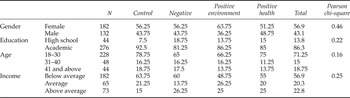
Overall, the sample included 320 Israeli respondents. A detailed description of the survey's characteristics and a between-information treatment comparison is presented in table 1. Subjects were recruited from Greater Tel Aviv, Haifa and Beer Sheva. The survey was conducted mostly in universities. Student interviewers administered the questionnaire, explaining to the respondents the purpose of the study (studying consumers' perceptions of biotechnology), and then asking them to answer 43 questions.
Our sample – being based on a student population – is younger, poorer and better educated than the average Israeli, while with respect to gender, the sample's distribution is quite similar to that of the Israeli census (56.9 per cent female in our sample vs. 51.2 per cent female in the Israeli census).Footnote 3 Sampling that is based mostly on a student population is a widely used procedure (Peterson, Reference Peterson2001) and is effective in isolating the net effect of information. This is done by recruiting homogenous groups and analyzing between-group differences that can then be attributed solely to information treatments and not to differences in demographic and cultural identities. Table 1, which presents the sample's demographics, suggests that the allocation to the treatment groups was indeed random.
Between-groups comparison of the sample's sociodemographic characteristics

In the next section, we analyze the data beginning with testing hypotheses (1) and (2). Analyzing consumers' perceptions of the taste of the GM tomato, the healthfulness of the canola oil and the contribution to the environment of GM cotton in the control group enables us to test hypothesis (1). Analyzing consumers' perceptions of the taste of the GM tomato and the health perception of GM canola oil in the control group is used to test hypothesis (2). In subsection 4.2, we analyze the effect of exposure to information on multiple benefits of genetic modification of the three products.
4. Results
4.1. Description of the survey and between-group comparison
Table 1 presents the sample's sociodemographic distribution, as well as a comparison between groups. Table 1 suggests that the between-group differences in demographic characteristics are not significant, increasing our confidence in the randomization of the allocation between groups.
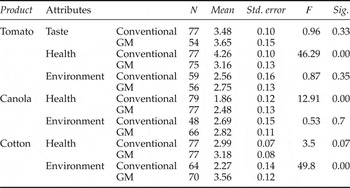
Next we present the perceptions of products' attributes in the control group. Comparison of the perceptions of the attribute that was hypothetically engineered between the GM and the conventional product enables us to analyze the effect of information on a single attribute and test hypothesis (1). Table 2 presents consumers' perceptions by attribute level.
Comparing perceptions of regular and GM product in the control group

In the control group, consumers perceived the difference in the GM and the conventional tomato's taste to be insignificant (3.65 and 3.48, respectively). The perception of the GM tomato's contribution to health relative to that of the conventional tomato is lower (3.16 and 4.26, respectively), and there is no difference between perceptions of the GM and the conventional tomato's contribution (damage) to the environment. Consumers perceive GM canola oil to be less hazardous to health than conventional canola oil (2.48 and 1.86, respectively), and the difference in the GM and the conventional canola oil seeds' production on the environment to be insignificant. These perceptions suggest that consumers perceive oil, whether conventional or GM, to be unhealthy. Nonetheless, consumers were convinced that it is possible to produce GM canola oil that has the capacity to reduce health risks. Consumers perceive the contribution to the environment of water-saving GM cotton to be higher than that of conventional cotton (3.56 and 2.27, respectively). The capacity to save water did not affect consumers' perception of growing and wearing cotton fabric on their health (the difference is marginally significant).
While consumers were not convinced that biotechnology can produce a tastier tomato, they were accepting of the idea that GM canola oil can be better for their health and that GM cotton can save water. The tomato is an exception in its cross-attribute effect in that the claim of its superior taste reduced perceptions of its healthfulness. These results support hypotheses (1) and (2).
4.2. The effect of multi-attribute information on perceptions
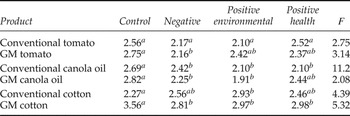
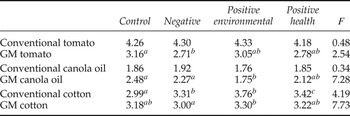
Tables 3a–3c present the effects of exposure to additional information on perceptions. Information on biotechnology's negative impact on the environment (hereinafter: ‘negative information’) significantly decreased perceptions that eating GM tomatoes contributes to health relative to the control (2.71 vs. 3.16) while increasing the perception that using conventional cotton contributes to health (3.31 vs 2.99).
The effect of exposure to additional information on perceptions of taste

Notes: Means without a common letter differ significantly (p<0.05) as per the Tukey method.
The effect of exposure to additional information on perceptions of contribution (damage) to the environment

Notes: Means without a common letter differ significantly (p<0.05) as per the Tukey method. For example, the perceptions of GM tomatoes' contribution to the environment is significantly lower in the negative information (notated by b ) treatment than in the control condition, indicated by a , whereas under the positive health condition this perception does not significantly differ from that of either the control or the negative conditions.
The effect of exposure to additional information on perceptions of health

Notes: Means without a common letter differ significantly (p<0.05) as per the Tukey method.
Information on biotechnology's positive contribution to water conservation (hereinafter: ‘positive environmental information’) increased the perception that production of both conventional and GM canola oil and that of GM cotton are hazardous to the environment relative to the control group. The contribution of production using GM variety to the environment declined to 2.97 relative to 3.56 in GM cotton and to 1.91 relative to 2.82 in production of GM canola oil. Positive environmental information decreased the perception that the production of conventional cotton is harmful to the environment. Negative information increased the perceptions that agricultural production that uses GM varieties is more harmful to the environment in four out of the six products: GM tomatoes (2.42, 2.69), GM canola oil (2.25, 2.82) and GM cotton (2.8.1, 3.56), as well as for the conventional canola oil relative to the control. Furthermore, the decline in perceptions of contribution to the environment is not significantly different from that caused by negative information, suggesting that additional information – regardless of whether it is positive or negative – reduces perceptions about contribution to the environment. These findings are consistent with the models of averaging and subtracting, and provide an additional explanation for the opposite effect of framing GM products: the capacity to reduce usage of pesticides on buyers' willingness to purchase them (Krishna and Qaim, Reference Krishna and Qaim2008; Huffman, Reference Huffman2010).
Additional information on GM food products' capacity to add vital nutrients to GM apples (hereinafter: ‘positive health’) – which is not directly related to one of our three products, yet sheds light on GM food products' capacity to improve health – decreased perceptions of contribution to the environment relative to the control in conventional canola oil (2.1 vs. 2.69) and GM cotton (2.98 vs. 3.56). Positive health information increased perceptions of contribution to health in conventional cotton (3.42 vs. 2.99), while not affecting perceptions of other products' healthfulness.
While the effect of negative information on these perceptions is intuitive and is consistent with the Bayesian information updating framework, the cross-product and cross-attribute changes in perceptions relative to the control can be explained using the subtraction model, supporting hypothesis (3). The case of cotton exemplifies the cross-product information's effect. The two positive information treatments should have strengthened consumers' confidence in biotechnology, as they increase awareness of GM food products' contribution to health and the environment. The environment-positive information is identical in its valence and magnitude (e.g., 20 per cent water savings) to the claim made on the advantages of GM cotton, and the difference therefore is in the product affected. Additional information on biotechnology's capacity to produce another product that can save water should have increased consumers' confidence in the argument, reduced their uncertainty, and increased therefore the posterior perceptions of contribution to the environment. Our results indicate, however, that the additional evidence reduced consumers' perceptions of GM cotton's contribution to the environment while increasing their evaluation of conventional cotton.
Positive health information that is expected to signal biotechnology's capacity to add value to horticultural products and change consumer perceptions of their healthfulness reduced consumers' perceptions of the contribution of the GM water-saving cotton to the environment.
These results suggest, therefore, that additional information, whether on the primed attribute yet a different product, or on a second attribute, weakens perceptions compared to information on a single attribute, thereby supporting the averaging and subtraction models, as well as hypothesis (3).
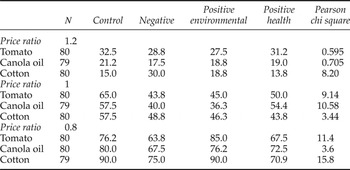
Hypothesis (4) suggests that provision of additional information may reduce demand above and beyond the adjustment made thereto due to unfavorable changes in perceptions. We tested this hypothesis by comparing the proportion of consumers who chose the GM product as a function of information treatments. If hypothesis (4) holds, then we expect to observe a significant decline in demand. We compared the effect of additional information on choices under three different price ratios, wherein the GM product's price is higher (lower) by 20 per cent than the conventional product's, and under equal prices, i.e.,
 ${P_{G} \over P_C} = 1.2$
,
 ${P_{G} \over P_C} = 1$
, and
 ${P_{G} \over P_C} = 0.8$
, where P
G
and P
C
are, respectively, the prices of the GM and conventional products. The conventional price, P
C
, is the market price of a product (e.g., canola oil). Given the set of prices of the conventional and the GM products, consumers were asked to choose between the GM and the conventional products. Aggregation of the number of the consumers who chose the GM product is presented in Table 4.
Comparing the proportion of consumers who chose the GM product between the three information treatments across three different price ratios

The results in table 4 suggest that in 11 out of 14 cells wherein the differences between treatments are significant, additional information reduced demand; in two cells demand inclined; and in one it did not change. In an additional 10 cells the changes were not significant. Thus additional information mostly reduced or did not affect demand, providing partial support to hypothesis (4). Since hypothesis (1) was not rejected, incongruity cannot serve as an alternative explanation strengthening our last finding.
5. Conclusions
Previous literature suggested that exposure to information on multi-attributes may lower consumers' evaluation of a product relative to a situation wherein the information is focused on a single attribute, even when the information on the second attribute is favorable. Averaging heuristics have been employed to explain this phenomenon. Recent studies suggest that under certain conditions, a subtraction mechanism is employed, causing consumers to deflate their evaluations even more.
In this paper we apply the notions of subtraction and averaging testing how information on multiple attributes of GM products affects evaluations and choices relative to a situation wherein information is provided on a single attribute of the GM product.
GM products differ in this context from non-GM in two aspects: inherent information complexity, and risk. Merely by virtue of marketing GM products as having the potential to add nutrients, to be safer as the product contains less pesticide, or to help lower food prices, consumers are exposed to information on at least two attributes: health and environment, yield, price, etc. In many cases, associations of GM products are unfavorable and increase consumers' accessibility to environmental hazards and health risks.
Using experimental surveys, we show that adding information – even if positively framed and about other products – deflates consumers' perceptions of GM products and in turn their willingness to purchase them. Consumers' responses to information on an additional attribute (e.g., healthfulness when the only other information was on environmental benefit and vice versa) indicate that they employ a subtractive rather than an additive rule in their information updating. This result is consistent with advertisers' long tradition of avoiding the positioning of the advertised brand on more than one attribute, as doing so increases the likelihood of ambiguous positioning, although it results from the differing and more fundamental reasoning of employing subtracting updating rules.
In addition to repeating previous results showing that multi-attribute information may reduce product evaluation relative to a situation wherein information on a single attribute is provided, this study extends the theory by suggesting that multi-attribute information reduces attributes' perceptions and total evaluation. Future studies may focus on analyzing whether or not multi-attribute information changes the importance weights of these attributes in addition to the observed changes in perceptions. If indeed both perceptions and importance weights change, then consumers' heterogeneity with regard to the importance weights assigned to GM products' attributes may accelerate the decline of demand post exposure to multi-attribute information.
Our respondents believe that agriculture is harming the environment regardless of the technology used and the information treatments. This result may be limited to Israel, and may be the outcome of unfavorable media coverage that associates agriculture with scarce water usage, subsidies, and pressure of the agriculture lobby to make importing vegetables unprofitable. This unsupportive attitude on the part of consumers constitutes an opportunity for GM products that save water, use residual water, or produce food products in arid areas where land has no alternative use. Indeed, consumers' choices indicate that they are more open to acceptance of GM cotton, which is designed to save water compared to its conventional counterpart that demands substantial quantities of water.
This study's findings indicate that to build demand, marketers should act according to the proverb ‘Too many cooks spoil the broth’, and focus on one attribute only, even if biotechnology provides multiple benefits.