- CLCM
Corpus Christianorum Continuatio Mediaevalis
- LP i
Liber pontificalis: ancient biographies of the first Roman bishops to AD 715, ed. R. Davis, Liverpool 1989
- LP ii
Liber pontificalis: the lives of the eighth-century popes, ed. R. Davis, Liverpool 1992
Rome, the Eternal City, caput mundi, is also home to certain un-worldly creatures – ones even more exotic than the Swiss Guards. The archangel Michael, perched on the dome of what was once the Emperor Hadrian's mausoleum, presides over a pageant of his confrères below on Ponte Sant'Angelo; Michael is thus preeminent in Roman architecture as he is among the angelic hosts.Footnote 1 This article explores the problematic historical origins of Rome's celestial guardian and his presence atop Castel Sant'Angelo.
Ado of Vienne (d. 875) was the first to mention a Roman chapel dedicated to the archangel, attributing the initial renovation of the pagan moles Hadriani to Pope Boniface (probably meaning Boniface iv, pope from 608 to 615). The entry in Ado's Martyrologium for 29 September, the feast of St Michael, after a lengthy account of the archangel's appearances above Monte Gargano, concludes:
But not much later, in Rome, the venerable Pope Boniface dedicated to Holy Michael a church built atop a circular monument, a crypt of marvellous craft and great height. The church is housed within the very summit of this building, thus it is said to reside among the clouds.Footnote 2
Liutprand of Cremona confirmed the chapel's existence in the late tenth century, for he described the angelic shrine when it hosted the nuptial mass of Hugo, king of Rome, and his bride Marozia (a rather demonic woman in Liutprand's opinion):
There is a certain fortress at the entrance of the city of Rome, an impressive work, raised in marvellous strength. Before its gates a most valuable bridge spans the Tiber, and all entering or leaving Rome must cross this bridge, for there is no other way in or out. No one, moreover, is allowed to cross without the consent of those guarding the fortress. The fortress itself, however, is of such a great height that the church which can be seen at its apex is called ‘the Church of the Holy Angel up to the Heavens’ (‘usque ad caelos’), one built in honour of the archangel Michael, eminent prince of the celestial armies.Footnote 3
Liutprand, however, did not name Boniface as its founder. If Boniface iv truly oversaw the dedication of this angelic shrine, there remains a span of about 250 years between its supposed construction in the early 600s and the first historical record of its existence in the 850s. Surprisingly, the contemporary Liber pontificalis makes no mention of such a significant papal renovation of this massive pagan monument.Footnote 4 Even more surprising, no scholar has questioned the attribution to Boniface iv, despite Ado's evident and manifold forgeries. Any revision of the traditionally accepted origins of this angelic chapel must, therefore, start with a critique of Ado's value as a historical source.
Ado, a Frankish monk who eventually became bishop of Vienne, composed a Martyrologium during his stay in Lyon, a work completed before his promotion to the episcopate in 860.Footnote 5 He was a contemporary of Florus and Usuard, other prominent ninth-century Frankish compilers of historical martyrologies, but more than any other writer of his day he embellished, expanded and even created new daily readings on the saints.Footnote 6 He borrowed freely figures from the New Testament, from the writings of Eusebius, Jerome, Gregory of Tours, Bede and the Liber pontificalis, updating the sparse entries of earlier martyrologies and often inventing new ones for days which were previously blank. His innovations were more a product of his own resourceful imagination than of historical reality.Footnote 7 The most notorious example, however, of Ado's fabrication is his use of a ‘revered and ancient source’ which he calls the Venerabile perantiquum martyrologium.
Ado's contemporaries and fellow hagiographers, responding sceptically to the popularity garnered by the first recension of his new, expanded martyrology, challenged Ado on all these historical novelties. Ado, fearful of their suspicions and anxious to safeguard the future of his writings, justified his additions in the preface to the second recension of his Martyrologium:
Lest you think me to have laboured in vain and to have created a superfluous work, I will briefly explain my actions … A well–respected and ancient martyrology has greatly aided me in properly ordering the often confusing sanctoral cycle; it was sent originally from the pope to a certain bishop in Aquileia, and then it was passed along to me by a certain monk. I copied it with great care during my stay in Ravenna, and thought it only fitting to adjoin it to this current work. You should not be surprised, therefore, by all the salutary, slightly extended accounts of the martyrs' stories which I have added to my martyrology, especially towards the end.Footnote 8
Ado's contemporaries could do nothing more than trust his word in this matter, although they often pared down his additions in their own subsequent revisions. Dubois, however, elaborating the work of his mentor Henri Quentin, has proved that in order to silence his adversaries Ado himself secretly authored the Venerabile perantiquum martyrologium sometime between the first and second recension of his own martyrology.Footnote 9 His ruse worked so well that scholars in the early twentieth century still considered the Venerabile perantiquum martyrologium a valid, authentic source, and one that must have provided him with the details concerning the foundation of a chapel atop Hadrian's tomb.
La civiltà cattolica, the long-standing, widely diffused Jesuit periodical based in Naples, published a short article in 1900 entitled ‘The transformation of Hadrian's Mausoleum into Castel Sant'Angelo’, which claimed to explain the historical origins of the angelic chapel. The anonymous author noted that Ado was the first to document this transformation, and assumed that Ado's immediate source was none other than the Venerabile perantiquum martyrologium.Footnote 10 The article added that Ado's reference to ‘Boniface’ should be interpreted as Boniface iv because this same pope had converted another great pagan monument in Rome, the Pantheon, into a site of Christian worship.Footnote 11 This problematic assumption has survived unchallenged to the present day. T. Squadrilli, in a recent 800-page tome dedicated solely to the history of Castel Sant'Angelo, briefly mentions Boniface iv as the chapel's founder and moves on.Footnote 12 There remains, however, another key historic variable which has further obscured the origins of the chapel, one for which Ado cannot be blamed. Here Gregory the Great's legendary vision of an angel atop the mausoleum enters the question.
Pope St Gregory i assumed the See of Peter amidst a great crisis. His predecessor, Pelagius i, died unexpectedly, victim to the plague then spreading throughout the Italian peninsula. Gregory, then only a deacon, sought to assuage God's anger by leading the people of Rome on an expiatory procession, a practice later called the ‘major litany’.Footnote 13 His prayers were effective, so effective that afterwards the people of Rome unanimously elected Gregory pope.Footnote 14 Near the end of the procession, as Gregory approached the city's northern fortifications, he is supposed to have seen the archangel Michael sheathing his sword atop Hadrian's tomb, the sign that God's anger (manifested by the ravaging plague) had been appeased.Footnote 15
Modern historians have argued that this angelic apparition was an important reason for the construction of the chapel, a shrine built to commemorate God's mercy and Gregory's holiness.Footnote 16 This miracle, then, conveniently corroborates Ado's assertion of the chapel's early seventh-century origins. Unfortunately, this legendary apparition is no more reliable than Ado's notorious use of the Venerabile perantiquum martyrologium. Gregory himself never mentioned it in any of his many writings. None of his early biographers did either, even though they described the plague and the procession in detail.Footnote 17 The earliest known written accounts of Gregory's angelic encounter date to the mid-thirteenth century when Dominican hagiographers introduced the idea of Gregory's vision of the angel as being the stimulus for the construction of the chapel.Footnote 18 In response to the rapid diffusion of the legend, Pope Nicholas iii (1277–80) renovated the chapel in 1280 and had its walls repainted with frescoes depicting St Gregory's miraculous procession, the first artistic record of the event.Footnote 19 This story, like the Venerabile perantiquum martyrologium, is almost certainly a later fabrication.Footnote 20 Historians, therefore, who have tried to validate Ado's vague and problematic claim that Boniface (iv) dedicated the chapel sometime between 608 and 615 have in fact only further obfuscated the chapel's origins by relying upon Gregory i's (590–604) supposedly contemporary but probably apocryphal vision of the archangel. Only by clearing away these two spurious sources can a surer knowledge of the chapel's true provenance be achieved.
Even without the aid of Ado, or a miracle, a relatively firm timeframe for the consecration of the chapel can be established. Procopius provides a reasonable terminus post quem; as an eyewitness trapped in Rome he discussed at length in his Gothic wars the strategic importance of Hadrian's tomb:
The tomb of the Roman Emperor Hadrian stands outside the Aurelian Gate, removed about a stone's throw from the fortifications, a very noteworthy sight. For it is made of Parian marble, and the stones fit closely one upon the other … [and the height of its battlements] exceeds that of the city wall, and above there are statues of the same marble, representing men and horses, of wonderful workmanship … Meanwhile the Goths began an assault upon the Aurelian Gate and the Tower of Hadrian … [and] they suddenly appeared and began the attack … and for a short time consternation fell upon the Romans, who knew not what means of defence they should employ to save themselves, but afterwards by common agreement they broke in pieces most of the statues … [and] threw them with both hands down upon the heads of the enemy, who gave way before this shower of missiles … [and] they reduced their opponents to great fear, and their assault was quickly ended.Footnote 21
These few passages represent only a fraction of the attention that Procopius allotted to this one battle. His description of Hadrian's tomb is detailed and intimate; if there had been a chapel housed in its dome, he almost certainly would have mentioned it, at least in passing, in this lengthy account. His silence on the matter is a good indication that the oratory dedicated to Michael did not yet exist when he observed this assault in 537.
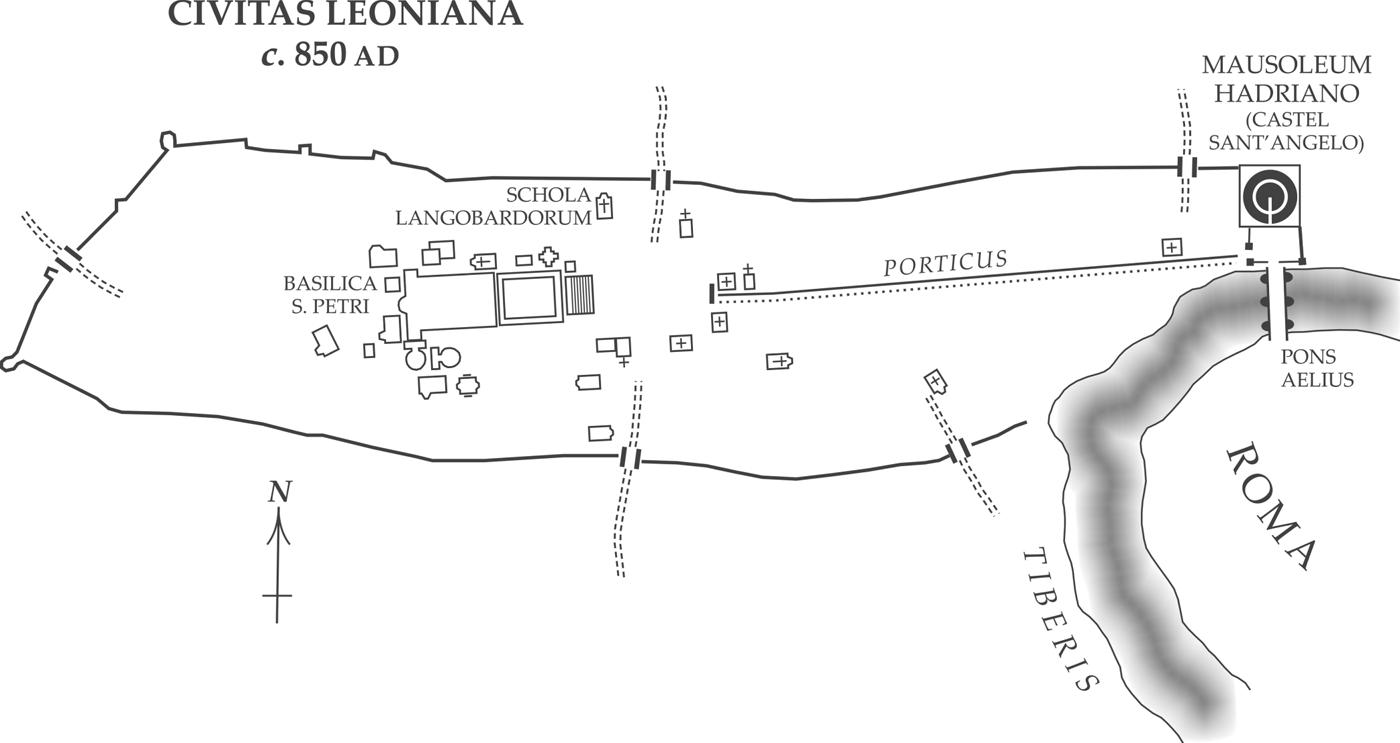
This is still very early. It can be assumed (with less certainty) that Gregory the Great's distaste for pagan sanctuaries and reluctance to convert them into sites of Christian worship pushes back the probable date of the renovation of the mausoleum to at least the early seventh century.Footnote 22 Concerning a terminus ante quem, it can be inferred that Ado, powerful as his imagination might have been, could not conjure an entire chapel out of thin air. St Peter's basilica had become the most renowned and popular pilgrimage centre in the west by the ninth century.Footnote 23 Ado, even if he had never visited Rome personally, certainly spoke with many acquaintances who had. The Franks, by the late eighth century, had established sizeable lodgings for their pilgrims just south of St Peter's basilica.Footnote 24 Any Frank entering the city proper would have to cross the Pons Aelius (now Ponte Sant'Angelo), the only northern bridge over the Tiber, a bridge guarded by Hadrian's tomb (see Figure 1 above).Footnote 25 If Ado had lied about the chapel's very existence, he would have been found out quickly. Strictly speaking, the chapel dedicated to Michael must have been established before 855 when Ado composed his Martyrologium.
Figure 1.

We can, however, reduce the gap between these dates (537–855) considerably. Ado, like other contemporary hagiographers, did not know when or by whom this chapel had been founded, but they all knew of its existence, either by viewing it in person or by first-hand report. Why, then, did Ado confidently ascribe its construction to a certain Pope Boniface? The answer rests in Ado's bold interpretation of the sources available to him. Ado repeatedly embellished and enlivened previously marginal characters of the New Testament and of certain patristic writings, persons mentioned only briefly or by name alone, enlarging these vague personae into great martyrs whose detailed lives and miracles filled entire pages in his martyrology. He also gathered historical information from the Liber pontificalis – it was his most popular source after Eusebius and the Bible.Footnote 26 He likely took particular notice of this entry under Boniface iv: ‘At that time he [Boniface] asked the emperor Phocas for the temple called the Pantheon, and in it he made the church of the ever-virgin St Mary and all the martyrs.’Footnote 27 The similarities between the Pantheon and Hadrian's tomb are striking. Their square foundations, great heights and impressive domes make them structurally akin. Both would have been recognised in the early Middle Ages as among the chief religious monuments of pagan Rome, one a temple dedicated to all the gods, the other a repository for the earthly remains of the ‘divine’ emperors and their families.Footnote 28 Ado, perhaps with these congruencies in mind, decided that Boniface iv was the most likely patron of the chapel. He had Christianised the Pantheon, why not Hadrian's tomb as well? The attribution to Boniface iv, because it makes the most sense historically, would likely have dissuaded Ado's contemporaries from challenging this claim. These logical incentives, combined with Ado's resourceful creativity, gave birth to the first mention of the chapel's origins.
This argument assumes that neither Ado nor his contemporaries knew the true origins of the chapel; the fact that no one in the next five centuries challenged Ado's assertion argues strongly in favour of this claim. A century passed before anyone even mentioned the chapel's existence again. No one commented on its origins because they simply had nothing to add to the discussion. If this assumption is correct, the chapel must at the very least predate the ninth century, otherwise contemporary knowledge would have silenced Ado's early seventh-century attribution. The most likely timeframe within which the chapel must have been built, therefore, can safely be trimmed down from the three-hundred-year span of 537 to 855 to a more manageable one: 600 to 800.
This means, of course, that Ado and all subsequent historians could be right. Boniface iv is a valid candidate, reigning from 608 to 615. Nevertheless, considering Ado's inclination to fabrication, accepting his claim at face value is hardly a safe decision. There are other possibilities. Devotion to St Michael certainly spread from east to west via the Greeks, and there were at least two sizeable churches in Rome bearing his name, one a basilica on the Via Salaria dating from the fifth century, the other a sixth-century church located within the city walls.Footnote 29 The chapel atop the moles Hadriani could, therefore, be seen simply as a further expansion of an originally eastern devotion.Footnote 30
Another potential solution to the question of the chapel's opaque origins is suggested by the very architecture of this great pagan mausoleum. Hadrian's tomb figured prominently as a military stronghold, securing the city's northern entrance. Procopius testified amply to this point. Many later shrines were similarly built in elevated spaces and portrayed Michael as a celestial guardian whose protective gaze watched over all below. One scholar adds:
It is fitting, in the first place, that the archangel's sanctuary be established in an elevated location, a prominent geographic site or a chapel in one of the higher levels of a church. But the archangel serves equally as the warden at the gate, the defender of the City of God.Footnote 31
This theory provides a sound ideological basis for the chapel's construction on top of Hadrian's tomb, but we are still left without any immediate or effective reason for its creation. The question still remains: why and how was this specific site transformed from a pagan monument into an angelic shrine?
Another scholar proposes that the chapel may have been constructed for the benefit of the soldiers garrisoned within the mausoleum.Footnote 32 The suggestion, however, of a military chapel must remain mere speculation until more than just academic intuition backs it. All the theories mentioned so far – ones focusing on Boniface iv, potential Greek origins, the shrine's symbolic location, and its potential role as a military chapel – though certainly viable, lack specific and convincing proof.
Another possibility comes to mind, one which modern scholars have not yet suggested, one which will likely never be proved beyond a doubt, but one which, nevertheless, makes a great deal of sense and accounts for all the historical discrepancies. The Lombards and their devotion to St Michael, emanating from Monte Gargano, may be the overlooked solution to this historical conundrum; indeed, the many striking parallels between the Roman shrine and its counterpart on Gargano cannot be ignored. These parallels confirm a close link between these two religious sites and argue strongly that the archangel's cult, first established at Gargano, then came to Rome (probably via Lombard pilgrims) and situated itself atop Hadrian's tomb.
A shrine of Greek origin dedicated to St Michael had existed on Monte Gargano since at least the sixth century when it was converted from a pagan sanctuary to Christian use.Footnote 33 The Lombards, following their sudden entry onto the Italian scene in 568, quickly conquered the lands of Benevento and by 571 had commandeered Monte Gargano.Footnote 34 The widespread adoption of Michael as the Lombard national saint and protector, however, did not occur until the mid-seventh century, and diffusion of his cult probably began during the reign of King Grimoald, formerly duke of Benevento.Footnote 35
Paul the Deacon's History of the Lombards, composed about 790, is the primary historical source for this period. It introduces Grimoald:
And since he was a very warlike man and distinguished everywhere, when the Greeks at that time came to plunder the sanctuary of the holy archangel situated upon Mount Gargano, Grimoald, coming upon them with his army, overthrew them with the utmost slaughter.Footnote 36
This battle occurred in 650. A few years later, in 663, the Byzantine emperor Constans ii invaded the Italian peninsula; landing in Taranto, the Greeks again assaulted the duchy of Benevento. Grimoald, by now king of the Lombards, had left his son Romuald to look after their homeland. When Romuald discovered that Constans's armies were approaching, he quickly sent to Pavia for his father, and Grimoald rushed south to defend his son. The Greeks were again quickly dispersed.Footnote 37
These two victories probably accelerated the growth of Michael's cult in the Lombard capital of Pavia.Footnote 38 They also provide the historical context for the most famous account of the archangel's involvement in Italian affairs, the Liber de apparitione S. Michaelis in monte Gargano. This text, probably written in the late seventh century, tells of an army of pagans who set out from Naples seeking to pillage the countryside around Michael's shrine at Gargano. The archangel intercedes on the locals' behalf, violently shaking the mountain, covering its summit with ominous clouds and raining down fiery bolts upon the heads of the dismayed invaders who quickly flee back to their Neapolitan stronghold.Footnote 39 Historically, however, Naples was not a pagan city in the seventh century, but a Greek one, and Constans ii (according to Paul the Deacon) fled immediately to this imperial port after his failed attack against the Lombards of Benevento in 663.Footnote 40 The analogous historical context underlying the Liber de apparitione's hagiography seems to be this: the pagans in the tale represent the Greek invaders while the Sipontan and Beneventan defenders represent the Lombards. Such a reading of the Liber is appealing to leading scholars and also argues for a late seventh- or early eighth-century composition of the text.Footnote 41
The spread of this popular hagiographic account coincided with another important expression of Lombard devotion to Michael, the minting of golden coins adorned with the archangel's image. Grimoald's successor Cunincpert (688–700) issued coins bearing his own profile on the front and Michael's on the back. Here the archangel is arrayed for battle, holding a large spear and round shield, an image perhaps recalling his previous powerful intercession, one certainly invoking his aid in future conflicts.Footnote 42 Michael, in return, seems to have especially favoured Cunincpert. When one of the king's sworn followers rebelled and tried to usurp the throne, Cunincpert challenged him to single combat. The traitor responded, ‘I cannot do this because among his spears I see the image of the holy archangel Michael by whom I swore allegiance to him.’Footnote 43 Apparently by the late seventh century Lombard warriors were invoking Michael as a solemn witness to their oaths of fealty.
The Lombards' devotion to Michael also changed the very landscape of the Italian peninsula. Fortifications named after the archangel sprang up throughout central Italy concomitant with the Liber de apparitione's composition and diffusion; at least 250 toponyms bearing Michael's name have been identified in Lombard–controlled Calabria, dating mostly from between the seventh and the ninth century.Footnote 44 Numerous churches dedicated to Michael were erected in Milan, Monza, Pisa, Lucca, Siena and Arezzo between the ninth and the eleventh century.Footnote 45 The grand Romanesque church of S. Michele Maggiore in Pavia (the Lombard capital) may have been constructed as late as the end of the seventh century.Footnote 46 Grimoald's son Romuald, in a display of piety and devotion to the archangel, inscribed his name on the walls of the grotto at Gargano and prayed that God protect him and guide his father the king.Footnote 47 The Lombard dukes of Benevento also financed renovations of the Gargano shrine in the 670s as attested by another of the grotto's inscriptions.Footnote 48 By the ninth century the influence of Gargano had even spread as far north as Normandy where the locals tried to replicate the Italian shrine.Footnote 49 The Carolingians, in imitation of the shrine atop Gargano (and perhaps also recalling the Roman chapel dedicated to the archangel in the summit of Hadrian's tomb), dedicated numerous elevated oratories to Michael, a custom preserved especially in Benedictine houses well into the eleventh century.Footnote 50 Considering the great vitality and broad diffusion of Michael's cult from Gargano, would it not have spread to nearby Rome as well?
Before considering the specific historical and political circumstances which would have brought Gargano to Rome, a survey of Castel Sant'Angelo's main religious and architectural features is appropriate, in order to establish the Roman chapel's distinctly Lombard rather than Greek origins. First, the grotto at Gargano and the chapel atop Hadrian's tomb resemble one another structurally.Footnote 51 Both are small, enclosed cavities fitted into a high pinnacle. Both, because of their great height, evoke images of clouds: the Lombard Liber de apparitione notes that, at the moment of Michael's appearance, ‘dark clouds enveloped the mountain's pinnacle’, and the very title of the Roman chapel proclaims it to be inter nubes, among the clouds.Footnote 52
Both sites can also be viewed as military strongholds, one effective for the repulsion of ‘Neapolitans’, the other for securing Rome's northern entrance; Lombard spirituality certainly embraced and invoked the archangel's devastating martial prowess. This is perhaps the most characteristic difference between Lombard and Greek devotions to Michael.Footnote 53 The archangel's major eastern shrine at Chonae (near modern-day Honaz in Turkey) honours him primarily as a healer; this Greek devotion spread to Constantinople.Footnote 54 The Liber de apparitione, on the other hand, extols Michael's deadly strength. This western account glorifies the archangel as the military commander of the Christian forces:
Behold, the very night before the battle Michael came to the bishop and informed him that his prayers had been heard. The archangel promised that he would aid him, and foretold that tomorrow they must go to battle at the fourth hour. The Christians, therefore, were overjoyed, certain of an angelic victory, and went out early in the morning to meet the pagans. In the first moments of the battle, moreover, Gargano was violently shaken and quaked continuously. Thunderbolts sprang forth repeatedly and dark clouds enveloped the entire summit of the mountain … The pagans fled, some struck by warriors' swords, others overwhelmed by the flaming bolts … and hid wounded behind the walls of their fortified city [Naples], soon to die.Footnote 55
Michael set the exact hour of the conflict, ordered the marshalling of the Christian army and struck first against the pagans, killing nearly 600 of them with lightning bolts from the peak of Gargano.Footnote 56 The Liber de apparitione does note at the end of its account that Michael did equip Gargano with curative waters, an important parallel to the archangel's cult at Chonae whose spring Michael had also endowed with healing powers, and one which testifies to the eastern origins of the shrine on Gargano.Footnote 57 Unlike at Chonae, however, where the reservoir was created by a roaring cataract, the miraculous waters of Gargano – still called today the stilla, or ‘drip’ – trickle weakly but steadily from a crack in the rocks. The earliest account of the Chonae miracle focuses on Michael's manipulation of the massive waterfall, whereas the Liber de apparitione emphasises the archangel's military triumph.Footnote 58 The Liber also notes how clerics servicing Gargano long remembered Michael's terrible feats of strength and thus feared to enter his holy shrine after dark.Footnote 59 Castel Sant'Angelo, moreover, is the first known military stronghold dedicated to the archangel, thus it seems to favour the western, Lombard vision of Michael as a fearsome warrior over the eastern, Greek devotion to Michael as a healer.
These observations certainly reveal similarities between Michael's cults atop Monte Gargano and Castel Sant'Angelo, but how, when and by whom could this Lombard devotion have been installed so prominently in Rome? First, Hadrian's tomb (like all other ancient Roman monuments by the end of the seventh century) belonged to the pope.Footnote 60 Any major renovation, especially Christianisation, of such a prominent building would require his express approval.
The Lombards, since their violent arrival on to the Italian scene in 568, had been feared by the Roman pontiffs.Footnote 61 Their orthodoxy, moreover, remained questionable. Attraction to both paganism and Arianism perpetuated the Lombards' separation from Rome, and only in the eighth century, after the Three Chapters schism had been finally resolved in Pavia, can they be considered firmly and uniformly Catholic.Footnote 62
King Liutprand (712–44) testified powerfully to the religious shift towards Rome in his additions to the Lombard laws.Footnote 63 Speaking as a ‘Catholic Christian prince’ and supreme legislator of his people, he conceded the spiritual supremacy of the pope:
We have added this measure [concerning marriage] because, as God is our witness, the pope at Rome, who is the head of the Church of God and of priests throughout all the world, has exhorted us through a letter that we not permit such unions to be contracted in any way.Footnote 64
Liutprand also decreed that scribes could prepare charters either ‘according to the law of the Lombards … or according to that of the Romans’ and he also ruled that, after a Lombard woman had married a Roman man, ‘she became a Roman and the children born of such a marriage shall be Roman and shall live according to the law of their Roman father’.Footnote 65 This accommodation of Roman law and custom signalled a profound development in papal/Lombard relations, one which was not limited to the legal sphere alone but was also manifested in politics.
One of Liutprand's first acts upon becoming king was to confirm his predecessor's donation of the ‘patrimony of the Cottian [i.e. French] Alps’ to the papacy.Footnote 66 He also refused, despite attempted imperial bribes, to support the assassination of Pope Gregory ii; instead, the Liber pontificalis recounts that the ‘Romans and Lombards bound themselves together like brothers in the tie of faith, all of them willing to undergo a glorious death in the pontiff's defence.’Footnote 67 When Liutprand later ran afoul of papal ambition by seizing the fortress of Sutri (only thirty miles north-east of Rome), he bowed to papal pressure and gave the city as a gift to Gregory ii, even though it had initially belonged to the empire.Footnote 68
Granted that Liutprand on several occasions quarrelled with the Romans and the pope, he nevertheless always managed, through diplomacy, to restore peaceful, friendly relations. For example, at the promptings of Exarch Eutychius he threatened to besiege Rome, but when Gregory ii himself came forth seeking peace, Liutprand immediately backed down. He then followed the pope into St Peter's basilica and, as a sign of friendship and submission, laid down his crown, sword and armour before the Apostle's tomb. Liutprand also successfully negotiated peace between Gregory and Eutychius.Footnote 69 Likewise, although Liutprand fought briefly but bitterly against Gregory iii, he soon restored all the lands that he had seized to Gregory's successor, Zachary. Liutprand and Zachary were on such friendly terms that they feasted together and then together toured the towns that had just been transferred to the pope.Footnote 70 Never before had pope and Lombard king been so close.
Liutprand's successor, Ratchis (744–9), continued and enhanced his father's generous and peaceful dealings with Rome. He was a devout Catholic, readily granted land to Pope Zachary, and even married a Roman wife.Footnote 71 His judges also served as the pope's northern gatekeepers, granting or withholding foreign pilgrims passage to Rome.Footnote 72 He was soon deposed, perhaps for his overly conciliatory pro-Roman attitude, and retired, supposedly at the pope's invitation, as a monk at Monte Cassino.Footnote 73 After Ratchis, Lombard kings took a much more aggressive, expansionist political stance which often clashed with Roman interests, provoking the arrival of papal protectors, Pepin iii and most famously his son Charlemagne. Pavia fell, for good, into Carolingian hands in 774; thus the Lombard kingdom came to its end.
The reigns of Liutprand and his son Ratchis therefore mark the highpoint of Lombard/papal relations. Many treatises were ratified, peaceful diplomacy generally triumphed, and land, cities and fortresses were exchanged. This period, roughly the first half of the eighth century, was undoubtedly the most favourable time for the establishment of the Lombard angelic cult in papal Rome. The construction of a chapel dedicated to the Lombards' national patron saint atop the fortress guarding St Peter's basilica would have symbolised architecturally an important, new (but ultimately short-lived) political reality: the official acknowledgement of friendship between Rome and Pavia.
Coincidentally, massive papally-funded construction and restoration occurred around Castel Sant'Angelo during the eighth century.Footnote 74 Since the late fourth century a monumental stone portico had connected St Peter's basilica to Hadrian's tomb, and maintenance of this huge structure – not to mention the upkeep of the Pons Aelius – was constantly required. For example, during the reign of Pope Hadrian i (772–95) 12,000 blocks of tufa were laid around the base of Castel Sant'Angelo and its adjoining bridge in order to accommodate the crowds of pilgrims travelling between St Peter's basilica and the city proper.Footnote 75 Multiple deaconries, i.e. food distribution hubs targeting the city's poor, were established in and around Castel Sant'Angelo by Popes Stephen ii (c. 755) and Hadrian i (c. 780).Footnote 76 Finally, the Lombard schola – an area dedicated solely to lodging Lombard pilgrims, located immediately north-east of St Peter's – was well established by the year 799, nestled between Castel Sant'Angelo and the basilica. This national residence, however, had been founded many years earlier, probably in the late seventh or early eighth century.Footnote 77 Construction, therefore, of a small chapel dedicated to St Michael atop the fortress guarding the Pons Aelius and entrance to the city fits well within the building activities of this period.
Such a chapel would also mirror the predominant building style of the period. Bryan Ward-Perkins, in his important study of Italian urban construction, notes that ‘The most common early medieval foundation was not a cemetery-church nor a large intramural hall of worship, but a small foundation within the built-up area, with a church (or chapel) associated generally with a small private monastery or with a charitable institution.’Footnote 78 This claim is substantially based on documentary and archaeological evidence surviving from Rome, so his comment is particularly applicable in the case of St Michael's chapel. His other main source of information comes from a remarkably well-preserved collection of private charters which survive in Lucca, formerly a Lombard town. Among the twenty building projects undertaken by the elites of that city during the eighth century, three were dedicated specifically to the archangel Michael.Footnote 79 They were all carried out between the years 720 and 764, a perfect match for the proposed time frame for the construction of the Roman chapel.
Liutprand and Ratchis also had angels on their minds. The former, treacherously assaulted by some of his key retainers, punished them all with long imprisonment, except for the one who fled immediately to a nearby church dedicated to St Michael; this man alone was pardoned.Footnote 80 Before he became king, Ratchis financed an intricately carved stone altar in honour of his father; angels were the dominant decorative motif.Footnote 81
The numerous Lombard pilgrims travelling to Rome would have noticed Hadrian's tomb – by this time a military fortress guarding St Peter's basilica – as they approached the city from the north. Its dome, along with that of the basilica, dominated the urban skyline and would have impressed any newcomer. Liutprand and Ratchis, moreover, both visited Rome many times during their reigns and were well aware of the fortress's important defensive role.Footnote 82 In addition, any Lombard entering Rome would pass directly beneath the massive shadow of the mausoleum. No visitor could fail to marvel at this daunting monument.
The cumulative weight of such factors combine to argue very persuasively for the construction of a chapel dedicated to Michael atop Hadrian's tomb during the first half of the eighth century, as a project almost certainly inspired by Lombard devotion to the archangel. The Lombards at this time were finally firmly Catholic; relations with Rome and the papacy were at an all-time high, and popes and Lombard kings often met to discuss peace and exchange lands. Lombard pilgrims were numerous around St Peter's basilica; they even had their own schola. Moreover, national devotion to Michael was well established and widely diffused. Lombard leaders in other cities funded similar projects in Michael's honour. Significant construction and restoration was then common in Rome around Hadrian's tomb. Lombard rulers of this period were well aware of the fortress's existence and importance. Constructing a chapel atop Castel Sant'Angelo would also have been perfectly in line with contemporary, smaller-scale building projects. Finally, such a chapel, set within the pinnacle of a tall, important fortress, would have been structurally and thematically very similar to the important shrine at Gargano; it would perfectly express the uniquely Lombard cult of Michael as a warrior patron and guardian. Such compelling coincidences cannot be ignored or lightly dismissed.
Michael's presence atop this fortress – clearly in line with Lombard spirituality – would, therefore, have been profoundly symbolic. It would have expressed physically the close spiritual and political ties, short-lived though they were, between Rome and the Lombards.
It seems very likely, therefore, that at some time in the early eighth century Lombard pilgrims, kings or otherwise, mindful of their national devotion to Michael and Gargano, petitioned that a similar angelic shrine be built in Rome and perhaps even financed the project themselves.Footnote 83 The numerous similarities between Gargano and the proposed oratory in the dome of Hadrian's mausoleum would have rendered the project especially appealing to the Lombards, and it would likely have gained support among other pilgrims familiar with the Gargano shrine. The popes of this period, mindful of the many benefits and concessions that they had received from Liutprand and/or Ratchis, would probably have complied readily to such a request. Just as the Roman devotion to St Peter had profoundly impressed itself upon the Lombards, so too would the Lombard devotion to Michael make its mark in Rome.
This solution also resolves many historical dissonances. The chapel would still predate Ado's martyrology by roughly 100 years, far enough in the past that neither he nor his contemporaries would know its true origins. The Lombard presence in Rome (especially the pilgrims clustered at the schola near St Peter's within sight of the Hadrianum) combined with their national devotion to Michael and a warming of papal/Lombard relations in the early eighth century provide solid motives and favourable conditions for the building of the chapel, ones with a better historical base than St Gregory's apocryphal angelic vision. Paul the Deacon might not have mentioned the Roman shrine either because he was not aware of its existence when writing in the 790s, or because his History of the Lombards focused almost exclusively on the broader political narrative. Paul, after all, only mentioned the hugely important Gargano shrine once, and that in passing. Most important, this solution may explain why the Liber pontificalis remained completely silent on the conversion of Hadrian's tomb, one of Rome's most prominent pagan monuments, into a Christian shrine. The Lombards, after all, soon proved a serious obstacle to papal ambitions – so much so that Pepin iii and Charlemagne had to invade Italy on Rome's behalf – and this ‘diabolical, greedy, mendacious, treacherous, and foul-smelling race’ would never be praised by later Roman chroniclers. One leading scholar states:
To put it as succinctly as possible, the papal historians recorded a continuing tale of oppression and they left out virtually everything that did not fit with this theme … Once again, we know well the ultimate verdict that fell upon the Lombards, but it is interesting to see how early the brief against them began to be drafted and how obviously consistent were its basic outlines over a long period of time.Footnote 84
In short, the authors of the Liber pontificalis would probably never have admitted such a pro-Lombard papal concession or have credited the Lombards with such a pious and generous initiative, even if this meant not recording the Christianisation of a grand Roman edifice. Moreover, the Liber pontificalis rarely mentioned privately-funded projects, another reason for its silence on the angelic chapel assuming that the Lombards (or any other non-papal source) financed it.Footnote 85 Given the available historical evidence, this ‘Lombard solution’ is therefore the most convincing explanation for Castel Sant'Angelo's early medieval origins.
Thus Gargano came to Rome and inspired the transformation of a prominent pagan monument (Hadrian's tomb) into a Christian shrine and fortress dedicated to the archangel Michael (Castel Sant'Angelo). The Roman Church wove the uniquely Lombard characteristics of Michael's cult at Gargano into its own rich spiritual fabric, endorsing this specific devotion and encouraging its diffusion throughout the Christian west. Ado himself associated Michael's elevated Roman chapel with the shrine on Gargano in his martyrology, listing them together under the same date, 29 September, even though the Gargano miracle should be celebrated, according to Beneventan liturgical manuscripts, on 8 May.Footnote 86 He thus unwittingly hinted at the chapel's true origins.