‘Let me not pray to be sheltered from dangers, but to be fearless in facing them. Let me not beg for the stilling of my pain, but for the heart to conquer it.’
~ Rabindranath Tagore1. Introduction
How can international courts and tribunals, designed to deal with narrow legal questions of guilt and specific fact-finding, contribute to overall reconciliation in communities devastated by war, ethnic violence and civil unrest?Footnote 1
It is important to note upfront that this article does not discuss all the merits and problematic aspects of including the goal of reconciliation in the scope of objectives sought by international criminal justice.Footnote 2 It rather adopts the view, shared by the UN executive organs, such as the Security Council and the Secretary-General, that international criminal law can strive to contribute to this worthy goal.Footnote 3 The courts also endorse this objective, albeit in a more careful manner, sometimes treating it as auxiliary to retribution and deterrence.Footnote 4 The website of the International Criminal Tribunal for the Former Yugoslavia (ICTY) nonetheless lists strengthening the rule of law as one of its achievements, thereby contributing to reconciliation in the region.Footnote 5 To that effect, Judge Gabrielle Kirk McDonald who served as the second president of the ICTY, recently reflected on the Tribunal’s contribution to peace and reconciliation, noting that it is a long process.Footnote 6
In answering the question as to whether international criminal justice can contribute to reconciliation, it is first important to recognize that law, by its nature, is analytical and formulaic. It is oriented towards achieving a certain definite outcome, conviction or acquittal. The principle of legal certainty requires such an outcome-driven approach. In contrast, reconciliation is best seen as a process.Footnote 7 In psychological terms, reconciliation is understood as a restoration process of a union following conflict. This process is one that intends a harmonious and sustainable future between the parties involved.Footnote 8
The idea of reconciliation in the field of psychology can be broken down into three main components. First, structural and political changes must be made in order to redistribute power, equity, or resources between the advantaged and disadvantaged parties. Secondly, relational exchanges and contact between the adversaries, which enhances trust and alters the perceptions of the self and other, must take place. Thirdly, reconciliation must include a socio-emotional healing component.Footnote 9 Simultaneous and reciprocal satisfaction of the emotional needs of the perpetrator and victim are essential to the reconciliation process. Specifically, following conflict, the psychological and emotional need of the victim or victim group is to recover a sense of power, whereas the needs of the perpetrator or perpetrator group is social acceptance. Shnabel and Nadler expand on this point to say that these emotional needs create barriers to reconciliation and must therefore be fulfilled.
Thus, a process-based view of reconciliation grounded in the psychological understanding of the term calls for an open-ended discussion or a discursive space within which competing concepts are mediated.Footnote 10 The aim is to have a dialogue with the view of forging a program of action rather than seeking to convince one another.Footnote 11 This vision stresses the importance of a step-by-step process of social repair in the aftermath of the atrocity.Footnote 12 Reconciliation viewed as a process is therefore important for the prevention of renewed violence, which is influenced by the way survivors remember and understand what happened.Footnote 13
How then to solve this outcome versus process dilemma in attaining the goal of reconciliation through international criminal justice? What is needed, for the sake of reconciliation, is a ‘bridge’ between the black letter of law and the values it tries to impart. In this article, we argue that art can be used as a tool to communicate the values of international criminal justice to a wider audience, beyond the legal community, and in a more digestible format. This process of ‘translating’ law can, in turn, contribute to reconciliation. Our claim is not merely related to strengthening ‘outreach’ efforts by judiciary. It goes further to explore how international criminal justice and art can complement each other in bringing positive change at the societal level. Channeling the message of international criminal justice through art is particularly helpful in facilitating relational exchanges between the adversaries and socio-emotional healing (second and third aspect of reconciliation discussed above).
Prior to further developing our argument, we wish to explain the choice of terminology, as well as our specific focus in this article. There is a nascent field of study exploring the connection between art and transitional justice.Footnote 14 As the discipline starts to evolve, there is a tendency to compartmentalize the discussion by focusing on the specific form of art, its concrete location or a unique paradigm of assessing the role of art and aesthetics in facilitating the transition in the aftermath of atrocities.Footnote 15 In light of this trend, Eliza Garnsey observes the need for a thicker conception of art and transitional justice, which acknowledges the limitations brought about by such segmentation.Footnote 16 There are three ways in which this article seeks both to contribute to the emerging field and also to distinguish itself from the existing works.
Firstly, we are conscious about the choice of language in this article. We refer to the connection between art and ‘international criminal law’ and ‘international criminal justice’ as opposed to ‘transitional justice’. All three concepts embody a plethora of definitions, to the extent that they become a ‘moving target’. For instance, the UN report defines transitional justice as ‘the full range of [juridical and non-juridical] processes and mechanisms associated with a society’s attempts to come to terms with a legacy of large-scale past abuses, in order to ensure accountability, serve justice and achieve reconciliation’.Footnote 17 International criminal law is traditionally understood more narrowly as one of the ‘tools’ in the toolbox of transitional justiceFootnote 18 – a legal discipline that has at its core the fight against impunity for war crimes, crimes against humanity, and genocide. International criminal justice, in turn, refers to a set of practices and institutions engaged in the administration of international criminal law, which is also inclusive of the law itself. In comparative terms, transitional justice as a field is procedural in nature.Footnote 19 It looks forward to the transformation and backwards to the repairFootnote 20 and it exhibits a heavy bias towards institutional responses to mass atrocities.Footnote 21 In contrast, international criminal justice is more normative and outcome oriented.Footnote 22 It aspires to set standards through law. These categories are not set in stone, however. Christine Schwöbel-Patel even submits that the field of international criminal law has appropriated the vocabulary, mechanisms, and understandings of transitional justice, arguably ‘swallowing the field’.Footnote 23
In this article, we choose to deploy the terms ‘international criminal law’ and ‘international criminal justice’ due to their normative focus and clearly expressed international dimension. This also allows more emphasis to be placed on the direct connection between law and art and less focus on specific institutions. We do, however, adopt the widest possible reading of these terms and acknowledge their ongoing link to the field of transitional justice. We are also aware that some, if not most, of the examples we use in this article to illustrate our points could be placed under the umbrella of transitional justice. It is nonetheless possible to conceptualize these practices as a form of justice linked directly to the legal standards set out by international criminal law.
Secondly, we focus on the role of art in promoting the goal of reconciliation. This framing allows us to introduce generalized arguments pertaining to the role of art in international criminal justice, while keeping the discussion sufficiently focused. We therefore go beyond the discourse on art as a medium of outreach for international criminal law.Footnote 24 We also go beyond the discussion on the possibilities of art as a form of reparations.Footnote 25 Our goal is to show different modalities in which art can transmit the message of international criminal justice in ways that contribute to reconciliation. However, we do not provide a comprehensive empirical analysis of such engagement of art as our purpose is rather to explain its relevance and elicit theoretical evidence from the field of psychology, while supporting it by the targeted examples.
Finally, and most importantly, we augment our analysis by including a psychological frame to our claim that art possesses reconciliatory and healing properties. This theoretical perspective will be interjected throughout the article. We argue that the reconciliation process is parallel to psychological healing. A point is to be made of the therapeutic nature of reconciliation, and vice versa. In this way, the therapeutic nature of art (both in theory and application) is considered throughout this article. This article will expand on the reconciliatory properties elicited by the three fundamental qualities of art discussed below.
To continue with terminological clarifications, we use the terms ‘art’ and ‘creative expression’ interchangeably. These terms are understood broadly to encompass different forms of expression (visual, auditory, sensual) employed with the purpose of transmitting a certain message coloured by emotions. The challenge of defining art for the purposes of this article is that in its broadest possible sense, it lies beyond concept and therefore beyond description and categorization. There is an existential quality of art that subordinates its different manifestations in the physical form as well as its functions. Theodor Adorno, in the famous Aesthetic Theory, acknowledges this difficulty and chooses to define art through dialectical exercises by resorting to contradictions, while simultaneously upholding the limit to these contradictions. Art has two elements: ‘import’ – art’s form and content, and ‘function’ – the work’s purpose.Footnote 26 He then dwells extensively on the contradiction between the components of import – the form and content – emphasizing the essential nature of the ‘truth content’ of art, or the way in which artwork simultaneously challenges the way things are and suggests how they could be.Footnote 27 Importantly, Adorno underlines the fluidity of art, which exists in relation to what it is not – historical origins of the production.Footnote 28
These sets of identified contradictions give us a sense of the effects of art without necessarily providing a comprehensive definition. The inquiry into the nature of art would require a separate study going far beyond the scope of the present article. Our purpose here is to select the qualities of art best described in analytical categories and suitable for supporting the argument that art can contribute to achieving some of the goals set out by international criminal law, and in particular that of reconciliation.
The key argument is therefore that art has the clear ability to mediate and amplify the law’s reconciliatory potential through three key features, crucial in supporting this proposition: its process-orientated platform, relational quality, and inherent intelligence.Footnote 29 Firstly, art reflects the complexity of the human condition and reserves a place for emotional processing. Secondly, it is a useful relational tool in opening a space for dialogue, the latter being essential for reconciliation. Lastly, art has the capacity to translate legalistic findings into a language accessible to a wider audience.
Section 2 of the article dwells in detail on these qualities of art and their psychological benefits in the context of international criminal law. Section 3 then proceeds to the agency question: stakeholders’ engagement with art in relation to international criminal justice can be envisaged in a variety of forms, some of which we discuss in this section. Section 4 raises a few countervailing considerations and maps out potential pitfalls in employing art to achieve the goal of reconciliation in international criminal justice. Finally, Section 5 concludes this article.
2. Three qualities of art that can contribute to reconciliation
2.1 Art as a process
The first essential quality of art that is relevant for the present discussion is its procedural nature. We view art primarily as a process for allowing artistic expression. The work of Simon O’Sullivan is helpful in explaining this specific vision. O’Sullivan in his article, ‘The Aesthetic of Affect: Thinking Art beyond Representation’, observes that art is not merely an object of knowledge to be studied from the perspective of representation but something that produces affects.Footnote 30 Affects are moments of intensity, a reaction in/on the body at the level of matter.Footnote 31 This vision of art exposes art’s dual function: to represent and interpret reality and to create direct human experience connecting us to ourselves through aesthetics. Art goes beyond language and even beyond representation of meaning by creating direct experience. It facilitates the channel of communication between the observer and the observed, dispensing with the dimensions of time and space. This experiential aspect of art opens up the emotional channels for receiving the interpretative or representational message, while at the same time avoiding dogmatism. In this way, the message is internalized by an individual, taking into account their subjective reality and experience of life.
It is through this quality that art allows for processing of trauma.Footnote 32 Psychoanalyst Anna Ornstein elaborates on this concept to explain that victims, both on an individual and societal level, through self-object functions and symbolism, are able to emotionally process and recover from extremely inhumane experiences with a relatively intact mind.Footnote 33 Emotional processing is a key component of reconciliation.Footnote 34 Nurit Shnabel and Arie Nadler further observe how victims, perpetrators, and the greater community experience a wide range of emotions such as powerlessness, guilt, and repentance in the aftermath of mass atrocities.Footnote 35 Art-making fosters emotions such as self-efficacy, connectedness through group cohesion, authenticity, and a sense of control and purpose. These are critical ingredients to the reconciliation process because when victims are able to recover a sense of empowerment and perpetrators are able to regain a positive image, both groups are more likely to have reconciliatory goals and views.Footnote 36
Those who survive heinous crimes such as genocide or war crimes do so with physical, emotional, and cognitive wounds throughout their day-to-day experience, many of which persist long after the noted event.Footnote 37 Studies show that symbolization, a process whereby an unexpressed emotion or experience is externalized and given form, has significant healing properties in the aftermath of mass atrocities.Footnote 38 The viewing of art is a correspondingly moving process.Footnote 39 As individuals view or make art, they are able to discover their emotions and experiences articulated outside of themselves.Footnote 40 This can provide those affected by mass violence with a sense of relief, consolation and can assuage isolation by enabling traumatic experiences to be shared with and experienced by others.Footnote 41 The art serves as a relational mirror that allows the affected parties to resonate with emotions that they themselves are not able to adequately articulate.Footnote 42 This process fosters reconciliation.Footnote 43
When externalized through the means of art, individuals are able to process taboos and traumatic events. Furthermore, individuals who engage in the artwork utilize emotive and cognitive functioning in order to digest such symbolism, resulting in their own interpretation and creating individual meaning around the artistic piece. Take, for instance, theatre. On a superficial level, one may view it as a mere form of recreation and storytelling. It has, however, traditionally held a deeper purpose for it conveys collective memories, identities, and reiterated behaviours.Footnote 44 As an outlet of such expression, theatre performances were laced with political critique during the existence of the concentration camps in ChileFootnote 45 and Germany.Footnote 46 Openly discussing these atrocities was unsafe and unwelcome in these countries but made possible through the means of art and symbolization. More recently, local and international human rights activists in Afghanistan used this country’s strong tradition of oral storytelling and theatre to start a conversation about more than three decades of war and victimization in the country.Footnote 47
Art-making and viewing processes offer a safe space to those who engage with such activities, and this is imperative for the reconciliation process. Agency and the sense of control are made available through artistic expression, which is especially therapeutic during times of transition, loss or grief.Footnote 48 The recovery of the sense of control is understood to be a key ingredient in the process of reconciliation for victims. Furthermore, perpetrators’ psychological needs in the course of reconciliation are that of moral recovery, which also requires a safe space for processing. Rituals, rhythms and structure afforded by the art-making process are known to provide a sense of safety and strengthen individuals’ capabilities to heal. Thus, art’s ‘safe space’ affords such an experience for all the stakeholders involved. Artistic spaces are places for mourning, regret or atonement, similar to that of a gravesite or memorial.
2.2 Art’s relational quality
Our conceptualization of art as a process is directly linked to another essential quality of art that we wish to explore – its relational quality. This quality allows for emotions to be mediated, leading to their subsequent release. Art creates an opportunity for the creator to be seen and understood by the self and others on a nonverbal level.Footnote 49 With art as the tool, individuals are able to transcend restrictions of linguistics and formulate aspects of their inner being to the self and other in a way which bridges potential separation that tends to be a result of differing perspectives, communication barriers or lived experiences. Indeed, art links the viewer to the artwork, self, and other.Footnote 50 The work of Argentinian artist León Ferrari provides a powerful illustration of this point. His creations confronted the dictatorship in his country, expressly highlighting the limitations of language. The series ‘Carta a un General’ is a spider web of illegible lines of ink, suggesting that no verbal and rational communication is possible with the tyrant.Footnote 51
Through the lens of psychology, aesthetic experience is a relational process whereby a reciprocal interchange between the art-viewer and artwork exists.Footnote 52 Such theories support the deployment of aesthetic elements in eliciting feelings and disclosing unfamiliar or novel perspectives within the viewer. Works of art have the ability to change the viewer’s outlook on the world through bodily and emotional engagement.Footnote 53 Through viewing of an artwork, individuals actively participate in relating to and making meaning to the object. This enacted bodily and emotive engagement of ‘coupling to an artwork’ provides context for exploration and relating with the art. Such relational quality of art explains art’s capacity for prompting emotional release and shifts in perspective, both of which are key components of the reconciliation process. The foundation of aesthetic experience is in the recognition of the other’s (the art-maker or subject of the art) experiences as distinct from that of the viewer. In this way, feelings of insight or awe transpire as the viewer relates to the artwork. By emotionally and physically engaging with the artwork, the viewer temporarily adopts new or unfamiliar perspectives. This results in a re-orientation process that has the capacity to touch viewers emotionally and on conscious and unconscious levels.Footnote 54
Art’s relational quality extends beyond the individual relationship between the artist, the viewer and the artwork, however. Theodor Adorno stresses the propensity of the psychoanalytical theory to focus on art as a form of a ‘daydream’, the projection of the unconscious. This undue focus on the artist’s relation to the artwork, he argues, overlooks the importance of the object itself.Footnote 55 It is the broader relational quality of art that assists in tackling serious traumas stored at the level of community as a whole.Footnote 56 Adorno offers a way to understand art’s connection to society. For him, art is a social antithesis to society, from which it is both autonomous in a sense of being a reflection of an inward space of men, and in which it simultaneously is embedded.Footnote 57 Art becomes ‘social’ by its opposition to society, and occupies this position only as autonomous art. By crystallizing itself as something unique, rather than complying with some existing social norms, it criticizes society by merely existing.Footnote 58
Complex narratives, conflicting truths, and various voices can be communicated through works of art, through the art object itself and the art-making process.Footnote 59 In this way, engagement with art complements the production of criminal law judgments adjudicating on issues of individual criminal responsibility, which tend to simplify events to fit the facts of the case and specific legal definitions. It becomes no longer necessary for the recipients of international criminal justice to abandon their previous sets of beliefs to accept certain judicial outcomes, rather art creates room for a ‘work of memory’, or space to process and relate to historical truths and attach meaning without insistence on homogeneity. Engagement with the arts as a viewer similarly fosters such aesthetic experiences because upon engaging with artworks, individuals relate to the work. This process, in turn, results in an authentic seeing of other, which requires an initial seeing of one’s self. This quality of art achieves a cognitive truth and a state of ‘body-mind unity’.Footnote 60
An example of this can be seen in Maya Lin’s Vietnam Veteran’s Memorial. This piece allows participants to engage directly with the artwork through the use of abstraction and aesthetic approaches. A massive accumulation of nearly 58,000 names of American servicemen who lost their lives is inscribed in black, mirror-like granite walls. As viewers look to the wall’s surface, they see their reflection amongst the names of the fallen and are abstractly ‘placed’ inside of the event. Additionally, the walls’ architecture is designed in a way to demonstrate the inconceivable quantity of the loss of the soldiers.Footnote 61 It does this by guiding viewers alongside the wall, which begins at a height of eight inches and gradually reaches its peak at ten feet. Viewers’ perceptions are altered because they become displaced as they relate to this interactive monument. They see themselves embedded in the fixture while simultaneously being swallowed by its heights.Footnote 62
2.3 Art’s inherent intelligence
The third quality of art that we wish to stress is its inherent intelligence, independent from the meaning intended by the creator or the commissioner of an artistic piece. This quality is linked to the previous point on the broader relational quality of art, but it focuses more on time-and-space-dependency of artistic pieces. This last quality can also be referred to as the ‘split agency’ of art. Artistic process implies that the agency of the creator or commissioner of art is shared with the agency of the one receiving it in a given moment in time and space and an inherent intelligence of the artistic piece itself. Mieke Bal, a cultural theorist, dwells on this topic by exploring, more specifically, pictorial intelligence of images. Images are not subordinated to language or discourse; they exist in parallel. Images articulate thoughts visually. The question is then: ‘How can the images think?’Footnote 63 There exists, she argues, a gap between the process of creation and the object itself. There is certain muteness to the object and the need to (re-)activate it.Footnote 64 The process of re-activation is, however, not a mere process of reconstructing the author’s intention.Footnote 65 Filling in the gaps requires the agency of the receiver. The key to understanding art is to conceptualize it only partially through the involvement of the artist. The main definitional quality of art is thus its capacity to bring the receiver to the present moment, and this process requires time and change of situation to reach the receivers and ‘do’ things to them.Footnote 66
Art, with its inherent intelligence, can support the mission of international criminal law. Art can be used as a powerful and accessible tool to communicate its values to a wider audience, beyond the legal community. The placement of artworks in the public sphere conveys a message to the public that has a healing effect.Footnote 67 Following atrocities, a lack of a belief in humanity is a key hindrance to achieving reconciliation.Footnote 68 An installation is a symbol, which tangibly acknowledges the experience of a disparate group of people.Footnote 69 Art located in public spaces is what Quentin Stevens and Karen Franck define as ‘spaces of engagement’.Footnote 70 Through such placement, installations merge with mundane daily life, therefore avoiding the ‘closing down of meaning’ by intervening in the public sphere.Footnote 71 Messages such as accountability and de-stigmatization can be conveyed through art in a way that legal proceedings alone cannot.
International criminal law is currently at the initial stages of integrating this understanding of the role of art as a ‘symbol’. It is instructive to elaborate here on the process of reparations in Lubanga – the first International Criminal Court (ICC) case resulting in conviction. This case is also the first instance where the ICC ordered symbolic reparations that include artistic endeavours. It dealt with the crime of recruiting children. The Lubanga order on reparations explicitly acknowledged the reconciliatory value of reparations in the affected communities.Footnote 72 When it came to practical implementation, the Trust Fund for Victims (TVF), which is the body specifically tasked with implementing reparations, faced a real challenge in explaining how reconciliation and reintegration should be understood for the purposes of symbolic reparations initiatives in the specific context of this case.
The draft implementation plan proposed by TVF included memorialization projects that would be community-driven and ‘take a range of forms, including written, audio, artistic, events or other mediums’.Footnote 73 This is, in part, to fight the social stigma attached to the former child soldiers as individuals and also their general profile in the community.Footnote 74 Consequently, the TVF suggested that activities and events may include a community dialogue, artistic, cultural, and theatrical activities to promote awareness-raising about the crimes subject to international prosecution and the harms suffered by child soldiers.Footnote 75 When it comes to a more permanent physical space, the TVF proposed that the future building should serve as a ‘living’ space that offers a venue for symbolic activities. The interior of the building could be utilized to exhibit pictures and artwork created by former child soldiers that depict the past, present, and their hopes for the future. The structures may also host music, dance, drama, and cultural events.Footnote 76
The Trial Chamber approved the TVF’s plan for the construction of three such community centres and the launch of a mobile program featuring activities to reduce stigma and discrimination that former child soldiers continue to face in the communities where they reside.Footnote 77 These buildings are now in the process of being constructed with the assistance of local villages.Footnote 78 It appears that the Lubanga Trial Chamber and the TVF, through their decision to create permanent spaces for artistic expression in the local communities, implicitly acknowledged that an important element of art as a method of reconciliation is its inclusivity and ability to overcome limitations of time and space. This quality of art, discussed in the previous section, offers solid possibilities of memorialization.
3. Who makes and engages with art?
When discussing the role of art in international criminal justice, it is essential to identify modalities of stakeholders’ engagement with it. In this section, we will look at the ‘agency question’ and assess how various parties could participate with creative expression as a means to achieve reconciliation.Footnote 79 Exploring the question of agency provides illustrations for the paradigm that includes international criminal justice, art, and reconciliation. Arguably, international criminal justice can no longer be viewed solely from the vantage point of international courts. Rather it is a ‘project’ with many aspirations and engaging multiple stakeholders. At the core of this project is the idea of justice in the aftermath of war crimes, crimes against humanity and genocide. This idea of justice increasingly encompasses concerns about victims’ and community needs. Attention to these questions is necessary for maintaining overall legitimacy of the field. For instance, Frédéric Mégret suggests expanding our vision of international criminal justice to include the idea of the ‘sites of conscience’ – sites built with a specific commemorative purpose that would bridge legal concepts of victim reparation, humanitarian ideas of victim assistance, and the larger needs of transitional societies.Footnote 80 Thus, as the discussion opens up to a more expansive vision of post-conflict justice to be delivered by international criminal law, the number of actors engaged in it grows.
3.1 International courts
International courts are the main sources of jurisprudence and the main ‘interpreters’ of the normative standards in the field of international criminal law. They are also the starting point in the discussion of the role of art in promoting the goal of reconciliation. How can international courts through their practice contribute to the development of artistic endeavours? The ICC, the Extraordinary Chambers in the Courts of Cambodia (ECCC) and the Inter-American Court of Human Rights (IACtHR) are already embracing the value of artistic efforts through the practice of reparations. These three courts are particularly strong in their practice of reparations with symbolic effect.
Pursuant to Article 75(1) of the Rome Statute of the ICC, the Court may order reparations to victims, in the form of restitution, compensation, and rehabilitation.Footnote 81 This list is not exhaustive as the Court may select reparations with symbolic, preventative, and transformative value.Footnote 82 The nature of reparations is thus to be defined on a case by case basis and depending on the circumstances of the case. What is important is that the Court is not limited to ordering a specific type of reparations, for example, financial compensation. Where appropriate, the ICC may order that the award for reparations be made through the TVF.Footnote 83 Article 79 of the Rome Statute refers to the Trust Fund as a body established by the Assembly of State Parties with the mandate to serve as an intermediary between victims and the ICC, in particular when it comes to accumulating fines or forfeiture ordered by the Court to be later used for reparations.Footnote 84 While the Court orders symbolic reparations in abstract terms, it is up to the implementing body – TVF – to come up with the practical execution of the order. The first case where symbolic reparations have been ordered and are currently implemented is Lubanga discussed in the previous section.
Symbolic reparations have clear advantages for long-term healing and can complement other forms of reparations listed in the Rome Statute, namely restitution, compensation, and rehabilitation. Each of these three expressly mentioned forms of reparations have their downsides when it comes to achieving the goal of reconciliation. The principle of restitution derives its origins from the domestic idea of restitutio ad integrum but it does not fully reflect the reality of mass atrocitiesFootnote 85 – it is hardly possible to undo the harm inflicted on the victims. Monetary compensation is limited in scope and oriented towards the past and without more efforts is unlikely to leave a solid legacy.Footnote 86 Finally, rehabilitation appears to be welfarist in nature, referring to physical, psychological, and material support for the benefit of victims and their families.Footnote 87 Yet, it lacks broader context.
Thus, there is a clear scope for initiatives that are commemorative in nature and that allow communities to heal and process the past, while looking at how to rebuild the broken ties in the community affected by violence. Art’s inherent intelligence, relational, and procedural qualities, discussed in Section 2, speak directly to the success in designing symbolic reparations. More specifically, the psychological benefits of symbolization reside in externalizing unexpressed emotion or experience, giving it a form and therefore opening avenues for subsequent processing of trauma.Footnote 88
The ECCC framework also provides for the possibility of civil party participation before the Court and it includes both the right for victims to participate as parties in the criminal trial of an accused, and to pursue a related civil action for collective and moral reparations, including symbolic reparations.Footnote 89 The ECCC rendered its judgment in Case 002 on 16 November 2018 in which it ruled positively on the request by civil parties to accept as a form of reparations a classical dance production and a related exhibition addressing the crime of forced marriage committed during the Khmer Rouge regime.Footnote 90
The performance and exhibition communicate emotional and historical complexities of this historical moment in time. The Sophiline Arts Ensemble developed the dance performance, ‘Phka Sla’, with the aim of helping survivors heal.Footnote 91 Informative in nature, this performance begins by contrasting a traditional marriage to one under the forced marriage Khmer Rouge regime, expanding on the policy’s outlined objects to increase population.Footnote 92 Narration and dialogue allows for poignant questions to be explicitly raised through the form of script, all while recorded testimonies of civil parties in the court are translated and expressed through the form of live choreography.Footnote 93
Symbolism is laced throughout this work, for example the ‘Phka Sla’, the name of the show, is a kind of flower that is given to the bride by the groom in traditional Cambodian wedding ceremonies. The music guides viewers through an intricate journey, featuring variants of traditional melodies in juxtaposition to patriotic songs from the Khmer Rouge, offering a rich and experiential historical backdrop. Through this multi-dimensional portrayal, nuanced stories and fates emerged, shedding light on the complexity of the issue and the lasting historical imprint as a result of this gender-based violence.Footnote 94
The IACtHR is an international human rights court, hence, in contrast with the previous two courts dealing with individual criminal responsibility, it rules on state responsibility for violations of the Inter-American Convention on Human Rights (IACHR). Since its creation, the Court was confronted with mass human rights violations, often sanctioned by the state.Footnote 95 As a result, it developed an extensive system of reparations. As Alexandra Hunneus notes, it quickly became apparent that monetary compensation would not satisfy the families of victims of disappearances, while the state continues to perpetrate atrocities and cover them up.Footnote 96 The Court therefore had to innovate. Reparations ordered by the IACtHR include compensation, satisfaction, and assurances that the violations will not be repeated.Footnote 97 This list is not exhaustive and the Court frequently orders symbolic reparations that take various forms.
For instance, the IACtHR frequently orders measures aimed at public commemoration to honour both individual victims and groups of victims, especially in the cases of violations against a large number of persons, such as massacres. Reparation orders in these cases may result in both tangible and intangible objects. Examples of tangible objects include orders for the state to name a street or to erect public monuments.Footnote 98 Tangible objects solidify the event in the memory, signalling to future generations the devastating effects of abuse suffered by the victims. The IACtHR may also order reparations in an intangible form, such as a commemoration ceremony or a public apology.Footnote 99 Intangible objects, such as commemoration ceremonies or artistic performances, work more with the present moment by invoking art’s healing potential to bring to the surface, relive, and let go of trauma.
3.2 International courts: Outreach section
Outreach efforts by international courts are gaining importance. When the ICTY and ICTR were established it was expected that no outreach would be necessary and that the judgments would speak for themselves.Footnote 100 The distance between the tribunals and their intended audience led to the mounting number of misconceptions about the tribunals. The outreach sections were thus created, but it happened only a few years into the tribunals’ operation.Footnote 101 In contrast with its predecessors, the ICC had an outreach section in place at the time of its creation. The emphasis is on providing accurate information to communities affected by the crimes adjudicated at the Court.Footnote 102 There is clear scope for the ICC to use creative and artistic tools to reach out to relevant communities.
An early attempt to that effect was an exhibition entitled ‘Healing, Trauma and Hope’, conducted in partnership with the National Geographic photographer Marcus Bleasdale. It took place in 2018 on the ICC premises in The Hague and at the UN Headquarters in New York, and is currently available online.Footnote 103 Fiana Gantheret observes that one of the underlying rationales for this exhibition was precisely the desire of the Outreach Section to communicate some of the issues related to justice through art.Footnote 104 Yet, the impact of such efforts remains unclear. Gantheret notes that the ICC prefers a statistical or quantitative (for instance, number of attendees) approach to measure the effect of its various activities, while some leading universities offer additional qualitative assessments. Yet, there is no study specifically and comprehensively addressing the impact of creative outreach activities.Footnote 105
The hybrid courts – the Special Court for Sierra Leone (SCSL) and the ECCC – invested significant attention to outreach efforts. The SCSL was the first internationalized court to have an extensive outreach programme that included audio and video tools and placed a strong emphasis on public engagement.Footnote 106 It has been observed, however, that its success was limited: it managed to spread the knowledge about the SCSL but not the deeper understanding of the Court’s operation.Footnote 107
The ECCC has most experience with regard to creative outreach. In terms of organizational structure, responsibility for outreach is shared by the Public Affairs Section (PAS) and the Victims Support Section (VSS) of the ECCC.Footnote 108 In the course of its existence, PAS engaged in a number of creative activities aimed at outreach. For instance, it published stickers, booklets, and brochures in Khmer and English. Brochures for the public explain the operation of the court and include images. To elaborate, one poster reads ‘Everyone can be involved in the process’. It portrays ordinary Cambodians listening to the ECCC trials on the radio, reading about them in the newspaper, watching them on television or visiting the trial in person. Maria Elander points out that such a message implies peaceful engagement with the Court as opposed to, for example, protesting or arguing.Footnote 109
The ‘flagship’ of ECCC’s outreach efforts is its study tour, engaging the public in the discussion of the ECCC and Khmer Rouge more generally.Footnote 110 The tour includes visits to the Tuol Sleng Genocide Museum, the Choeung Ek Killing Fields, and the ECCC itself. The building currently housing the Tuol Sleng Genocide Museum was originally a high school and later turned into an interrogation and torture facility named ‘S-21’ by the Khmer Rouge regime between 1975 and 1978. The museum opened to the public in 1980 with a clear educational objective and was visited by hundreds of thousands of people in the first few months of its opening.Footnote 111 The museum displays on its walls 6,000 photographs of victims who were photographed by Khmer Rouge cadres upon admission to S-21. These photographs are now part of the exhibits of the museum. They create a powerful momentum for the viewer, making it possible for them to connect with the message of international criminal law through personal relationship with art. Viewing the photographs at Tuol Sleng Genocide Museum activates art’s inherent intelligence by directly bringing the viewer into the space experienced by the victims at the time of admission to the prison. It creates empathy and, arguably, opens the intellectual channels for receiving more information about the work of the ECCC and the overall mission of international criminal justice.
3.3 Policy makers
International criminal justice becomes an instrument of reconciliation and accountability efforts in a variety of ways: it can be applied directly by international courts or tribunals or it may merely constitute the body of substantive law utilized in the course of transition to peace. Colombia is a good example of the involvement of international and national policy makers in the transition process towards peace and of using the ‘tool box’ of international criminal law. It is clear that these policy makers may become the source of artistic initiatives. The peace deal, concluded between guerrillas of the Revolutionary Armed Forces of Colombia (FARC) and the government, that ends protracted civil war in the country is closely monitored by the ICC as part of its assessment of Colombia’s ability and willingness to conduct its own prosecutions of international crimes.Footnote 112
Implementation of the peace deal provides ample scope for activities promoting national reflection and healing. For instance, these include commemoration efforts in local communities. One of the peace agreement’s central features is its heavy reliance on restoration and reparation when discussing the idea of justice as such.Footnote 113 Furthermore, the law implementing the deal provides that the state guarantees the right to reparations to victims of gross violations of humanitarian law, either collectively or individually.Footnote 114 It remains to be seen how such a ‘dual’ restorative-retributive focus of the system created by the peace deal will be executed, but it is safe to assume that art and creative expression has potential to facilitate the restorative side of the deal. The first steps of incorporating art in the healing process in Colombia were laid when the agreement was reached to melt the weapons, turned over by the guerrillas in the process of demobilization following the signing of the peace deal, into three monuments to be installed in Bogotá, Havana, and New York – essential places for the negotiation of the final agreement.Footnote 115
3.4 Non-governmental organizations and individual initiatives
Non-governmental organizations, civil society, and individual actors are starting to explore the role of art in promoting the goal of reconciliation. Some of the initiatives are directly linked with international justice, while others are broader in scope and explore the methodology of art in promoting activist agenda. Most examples given in this subsection go beyond the scope of the paradigm of art, reconciliation, and international criminal justice, yet they provide a direction for future creative endeavours that will support the mission of international criminal law in a more direct way – either through research or through creative outreach.
An example of a related project is the one pursued by the faculty of law of the University of Windsor in Canada that is dealing with indigenous laws and art. Researchers put into context the idea of reconciliation by reflecting ‘the diversity, strength, and hope embodied in indigenous traditions’.Footnote 116 Rachel Kerr leads a project at King’s College London entitled ‘Art and Reconciliation: an innovative approach to conflict resolution’.Footnote 117 The project focuses on the Western Balkans and aims to guide the use of arts in generating conversations around reconciliation. The recently launched ‘Art and International Justice Initiative’ (ARTIJ) aims to serve as a hub for artists, academics, and practitioners aiming to explore the ways in which art can support and enhance international justice.Footnote 118 The recent symposium on ‘Art and International Courts’ held on ARTIJ’s website is an attempt to map out the main avenues for further discussion, as well as to find a common vocabulary to talk about creativity in the context of international (criminal) justice.Footnote 119
Other activist projects that can serve as an inspiration include, for example, ‘legislative art’ by artist Laurie Jo Reynolds. Art in her projects engages governmental structures with the goal to accomplish concrete political change. Her creative practice of getting imagery from prisoners subjected to severe sensory deprivation in one of the US supermax prisons led to its eventual closure.Footnote 120 These types of projects show the relevance of art in facilitating broader social change.
3.5 Victims
A more formalized way in which the victims and wider community can benefit from artistic expression in the field of international criminal justice is through consultations during the phase of reparations. This is what the ICC is striving to achieve in Lubanga. The TVF’s submission to the Trial Chamber clearly indicated extensive consultations with different community representatives in the region where the commemoration centres will be erected.Footnote 121
There are also less formalized possibilities to involve victims of mass atrocities in the dialogue relating to accountability, not necessarily using the route of reparations. For example, South Africa’s African National Congress addressed the past through the National Reconciliation Act of 1995 by offering a platform for individuals to discuss the systemic and individual wrongs committed under the apartheid regime.Footnote 122 The Truth and Reconciliation Commission (TRC), set up pursuant to the National Reconciliation Act of 1995, created space for truth to come out.Footnote 123 During this testimony, which was television broadcast countrywide, victims engaged in truth telling, whereas perpetrators asked for amnesty and showed contrition.Footnote 124 The full disclosure of violent crimes by perpetrators in conjunction with political changes, such as granting each individual the power to vote, allowed for a transition of democracy.Footnote 125
Admittedly, the link between international criminal justice and art is less pronounced if institutions, other than courts, are engaged in accountability and reconciliation efforts. Nonetheless, it appears possible to see the connection if one focuses on the core value of the project – fight against impunity – and adopts a broader vision of justice. The example of the TRC exemplifies this point.
Victims’ testimonies in the TRC were not always neatly fitting with the goal of reconciliation. The decision to grant amnesties to perpetrators of apartheid in exchange for truth was a way to avoid political impasse but did not fully address the grievances of those affected by crimes.Footnote 126 Art created around the work of the TRC allowed additional space for people to deal with the consequences of apartheid but also the remnants of the TRC.Footnote 127 Catherine Cole notes the rich tradition of journalism and community-based art in South Africa. She observes that as soon as the TRC began its work in 1996, many journalists, but also artists working in different genres, rose up to respond to its work in the form of images, stories, themes, and insights. Artists and journalists became interlocutors between the TRC and society, moderating the discussion.Footnote 128
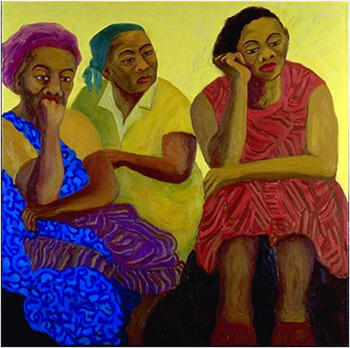
The benefits of involving victims in the dialogue relating to accountability are manifold. Art, not limited to verbal structures, serves as a refuge from the intense emotions associated with the aftermath of atrocities and allows the makers of art to express how they experience such emotions.Footnote 129 As one gives form to their experiences, psychological and social repair is made possible.Footnote 130 Through the means of art, individuals are able to represent an experience or emotion that has been previously unformulated.Footnote 131 One example of a multifaceted experience depicted through art is through the series of paintings by Georgette. Her work portrays scenes of the TRC and the ending of apartheid. One piece is an oil painting titled ‘Should I Testify’ (Figure 1), which showcases three women sitting side-by-side. Emotionally gripping, this piece is thought to represent the special women’s hearings held by the TRC.Footnote 132 The troubled and discontented faces of the women convey the difficult position of deciding whether or not to testify in the hearings held in Cape Town.Footnote 133
Painting: ‘Should I Testify?’, Oil on Canvas (2000).

3.6 Perpetrators and wider community
The study of perpetrators of international crimes is gaining momentum.Footnote 134 It is no longer satisfactory to push aside uncomfortable questions as to their motivation in the commission of crimes, possible trauma caused by the extreme violence as well as other environmental and psychological factors that may have led individuals to commit war crimes, crimes against humanity, and genocide.Footnote 135
We argue that it is possible to use creative expression in the work with perpetrators of mass atrocities to process trauma and achieve greater accountability. By ‘perpetrators’ we mean persons convicted of international crimes in international and domestic courts and currently serving their sentence. We also include those who confess in the course of the TRC proceedings as well as those who stood trial in localized justice institutions. Art has potential in creating discursive space within which both accountability and conflicting social narratives can coexist.Footnote 136 One prominent example of a national transitional justice mechanism holding space for emotions and expression, while at the same time facilitating accountability, is the gacaca grassroots courts system in Rwanda. In Phil Clark’s study, truth, peace, justice, healing, forgiveness, and reconciliation are the ‘profound objectives’ of gacaca. To this extent, it is a prime example of restorative justice intended to initiate the process of the reconstruction of the social fabric.Footnote 137
In the shift away from viewing victims and perpetrators as extreme binaries, Erin Baines addresses complex victimhood by exploring the political agency of women abducted as children by the Lord’s Resistance Army in northern Uganda.Footnote 138 By exposing their narratives, she points out that although these women were often forced to marry their commanders and bear their children, they were not passive victims. Instead, they navigated complex social and political domains. In the quest to survive, these women were forced to make troubling decisions: to kill or to be killed. Baines argues that through sharing one’s narrative, it is possible to reclaim the sense of self and learn to live with past choices instrumental to survival.Footnote 139 In moving beyond static categories of ‘victim’ and ‘perpetrator’, one sees the complexity of individual agency during and after mass atrocities.
3.7 Academics
Another important route via which art is processed in the field of international criminal law is through the engagement of academics with artistic pieces. This exercise can lead to rethinking of the dominant assumptions in the field. One example of such work is Wouter Werner’s exploration of documentaries on international criminal justice produced in the last ten years.Footnote 140 Wouter Werner argues that there are ample reasons for legal scholars to engage more intensely with documentary films. The latter hold immense didactic potential and combine storytelling with emotion.Footnote 141 Another example is Immi Tallgren’s critical assessment of the central narratives perpetuated by international criminal lawyers and compared them to those highlighted by the historical series ‘Tokyo Trial’.Footnote 142 For instance, she points out how much scholarly attention is dedicated to the ‘fight against impunity’ as a rather all-encompassing project, whereas ‘Tokyo Trial’ does not hide away from complexity and highlights the doubts of individual judges.Footnote 143
From a methodological perspective, art therefore may serve as a method of scientific inquiry. The use of art in scientific exploration is nothing new. For instance, visual methods are used in discourse analysis, which can be studied through documentary or historical images with other forms of data.Footnote 144 More generally, sociology has started taking the ‘visual’ more seriously with ongoing research on the promise of visual methodology as alternative ways of scientific inquiry.Footnote 145
There is also an urgent demand for exploring visual methodology in legal science. The overproduction of imagery in our modern life is what Richard Sherwin refers to as the age of ‘digital baroque’.Footnote 146 The term ‘baroque’ emphasizes the shifts in the dominant forms of communication, whereby images collected, for instance, through social media, create mediated reality.Footnote 147 The original concept depicted by an image fades away with the unfolding of the infinite representational forms amply supplied by the internet. The digital baroque calls for new mindfulness, one that integrates the affects of the body’s senses with the mind’s natural capacity to analyse and categorize.Footnote 148 Sherwin eloquently argues for the exploration of the path of visual jurisprudence as a way to navigate the new forms of mediated reality. In this new state of affairs, where the visual shapes our perception of reality, law in its purely analytical form retains its validity, but loses the significance.Footnote 149
Such a turn to visuality has not yet occurred in the study and practice of international (criminal) law, a discipline which remains focused entirely on texts and the written word. One can imagine, however, how undertaking art projects aimed at promoting international criminal law values can contribute to the study of the discipline as such. Creative expression can illuminate the aspects of this field long ignored by traditional approaches. For instance, an exhibition dedicated to the work of the ICC, such as ‘Healing, Trauma and Hope’, hosted by the ICC Outreach Section,Footnote 150 may evoke responses in the general public indicative of the new solutions to practical problems faced by the Court.
4. Critique of utilizing art in international criminal justice
So far, we painted the picture of the benefits of using art in promoting the goal of reconciliation in international criminal justice. We would like to offer our reflections on a number of critiques of this position. It is important to make a disclaimer at this point that given the already broad scope of this article, we are only able to provide cursory treatment of the ethical and legal challenges stemming from the deployment of art in international criminal justice. This is one of the key areas for further specialized research.
4.1 Ethical issues of consumerism
There are clear issues involved in aestheticizing suffering for consumerist purposes.Footnote 151 The challenge is that aesthetic representation removes some of the horrors the depiction or production represents.Footnote 152 A good example of this challenge are ethical concerns surrounding turning photographs of prisoners, taken upon their entry into the torture facility S-21 in Phnom Penh, into exhibits currently on display in Tuol Sleng Genocide Museum.Footnote 153 For Thierry de Duve, encounter with these photographs placed him in an impossible position where ‘aesthetic feelings became involuntary’.Footnote 154 He attended the S-21 exhibition of photographs in MoMA in New York at the time when some of the images from Tuol Sleng were showcased there. De Duve fought with the initial reaction that he terms ‘cheap empathy’. The environment in which he viewed the photographs could have also played a role in such a strong reaction because context and prevalent cultural values are essential in interpreting and giving meaning to photographs, which are by no means neutral representations of reality.Footnote 155 De Duve resolved the tension by coming back to the exhibition the following day and addressing the photos one by one, acknowledging the individuality of each person depicted on them.Footnote 156
Another aspect of the same problem is the danger of replicating unhelpful biases through art. Certain international criminal justice notions, such as ‘victim’, are powerful tools in the political and economic struggle for global justice resources. Christine Schwöbel-Patel emphasizes that although victims are complex and multi-faceted, they are often depicted as feminized, infantilized, and racialized in the hands of international criminal law for political and economic reasons. By marketing simple messages of good and evil, victimization is stereotyped so as to appear worthy of humanitarian support and resources.Footnote 157
4.2 The subjective nature of art
Criminal law is based on the principle of legality, which honours precision and clarity, while art thrives on ambiguity, which embraces different meanings attributed by different actors and in different contexts. Criminal law often operates in black and white categories. It is a ‘yes’ or ‘no’ discipline with little room to manoeuvre when it comes to factual questions as to whether or not a certain act occurred and legal evaluative questions as to whether or not the accused is to be held responsible for it. Art, in contrast, has the enigma that captivates the observer by inviting interpretation and deep reflection from different angles.
Such a drastic gap between the two domains may invite scepticism that erasing the clear boundaries of the law may lead to the de-objectification of the discipline to the extent that it loses its persuasive power. Can art actually harm the discipline of international criminal law? In response, we would argue that, through art, the boundaries are upheld in a different way – the law retains its content, while the complexity of life is captured by the direct experience of affect.
There is a division of labour between art and law. Legal documents, such as the statutes of international criminal courts and tribunals or the judgments issued by these institutions are forceful statements, but they speak primarily to the legal community. It is not obvious that a member of the general public will go directly to the legal judgment for information. Moreover, there may be cognitive biases in place preventing direct transmission of the information from the tribunal to individuals, even if it is simplified and broken down into small analytical pieces (for example, case information sheets). These biases have to do with the nature of human decision-making: people are not fully rational when arriving at certain conclusions as emotions and cognitive biases often overtake the whole process of forming an opinion.Footnote 158 When confronted with information that goes against their deep-seated convictions or a sense of self in the society, people are likely to rigidly favour information they had obtained previously and disregard disturbing new facts.
A clear example of the challenge of mediating the values of international criminal law (broadly conceived) through art is the destruction in 2017 of the Mapiripán monument in Colombia. In 2005, the IACtHR ordered the construction of the monument to commemorate the torture and murder of civilians in Mapiripán, Colombia.Footnote 159 This monument – a symbol of justice – was constructed, but subsequently demolished by an unknown group.Footnote 160 Critics of employing art may observe that the implication of this destruction is traumatic as it can produce revictimization, stir discontent or cause polarization instead of healing. This is a valid concern.Footnote 161
Polarization of society often accompanies post-conflict settings. Moreover, research has shown that mass violence is cyclical in nature.Footnote 162 If the underlying causes are not addressed, there is a risk of resuming violence.Footnote 163 It is therefore understandable that artistic pieces, aiming at memorialization, provoke to the extent that they may even become objects of an attack. If reconciliation is viewed as a process, however, it is the discursive space that matters rather than the specific outcome. Artistic pieces act as relatively ‘safe triggers’ in that they bring to the surface issues still to be discussed at societal level. Art’s broader relational quality is in its ability to encompass different points of view and, if necessary, provide space for further discussion.
4.3 Emphasizing victimhood
It is unclear to what extent expressions from victims can surpass the point of healing and extend into increasing victimization or the ‘creation of a spectacle’, as coined by Michael Humphrey. Humphrey’s critique in reference to truth commissions is that focusing on victims after atrocities has the capacity to inadvertently reproduce them.Footnote 164 He argues that reparation that is only symbolic leaves victims feeling short-changed if not paired with adequate trials. Our argument is somewhat different: we do not suggest art in place of justice but rather as complementing one another. Nonetheless, one can still pose the question: can art jeopardize the intended goal of liberation and healing by emphasizing victimhood or exploiting victim status?Footnote 165
4.4 Passage of time
The other possible challenge arises out of experiencing art over time. While art-making is beneficial for the author, is it equally beneficial for the audience when time lapses? If one accounts for ‘focalization’ – that is subjective perception of art – the process of experiencing art is filled with the unknowns. This quality of art stands in sharp contrast with the outcomes of international trials, resulting in the judgments signalling finality. Law, by definition, has certain determinacy to it, while the meaning that a piece of art carries may change with the passage of time and from person to person.Footnote 166 This specific concern exposes a wider dilemma as to the incompatibility of the process-oriented vision of reconciliation with the goal of analysing the cause of responsibility prominent in criminal law.Footnote 167 The solution would be to view two processes as complementary: judgments emanating from international tribunals set out one specific narrative related to the conflict and limited by the facts of the case. They have high authoritative value due to the checks and balances of the legal process. Art-making and art-viewing, connected to the issues adjudicated upon by the tribunals, can allow space for diverse narratives, which are also needed as part of reconciliation.
5. Conclusion
This article opened the discussion about the reconciliatory potential of art in the field of international criminal justice. The focus of this work is twofold: first, to explore the overall psychological benefits of engaging with art in attaining the goal of reconciliation sought by international criminal law. Secondly, the article mapped out specific issues to be considered in researching this bigger question.
We argued that it is essential to reflect on three features of art instrumental to reconciliation, namely its process-oriented nature, its broader relational quality, and its inherent intelligence. While providing a comprehensive definition of art lies beyond the scope of this article, we studied each of these three qualities independently, using the tools offered by psychology and international criminal justice. In addition to the relevant features of art, we also explored possible agents of art-making and art-viewing in the field of international criminal justice. Finally, we briefly dwelled on the possible critique of the engagement with art to promote the goal of reconciliation.
In sum, we view our work primarily as a ‘mapping exercise’, aimed at starting the discussion and pointing towards the new frames of reference in an important quest to find the right instruments for reconciliation in the communities devastated by conflict and subject to the attention of international criminal law(yers).